Original Research Article
Determinants of utilization of health services
Manisha Arora
1, George Koshy
1*, Vandana Gangadharan
2INTRODUCTION
Healthcare in India is a complex mix of providers, facilities and payment systems with low budgetary support from the government. After decades of neglect there is realisation that health is a priority and spending should be increased. Also there is a shortage of evidence and subsequently a need to suggest direction based on this evidence.1 Universal health coverage is defined as ensuring that all people have access to needed health services (including prevention, promotion, treatment, rehabilitation and palliation) of sufficient quality to be effective while also ensuring that the use of these services does not expose the user the financial hardship. Access is one of the most major determinants of health seeking behaviour.2 The health related indices in our country are far from satisfactory and the country still bears an enormous share of the global disease burden. The lack of accessibility, scarce availability and the poor quality of
health services and personnel in the remote rural and underdeveloped urban areas have been the major obstacles to the delivery of quality health care services in a vast and culturally diverse country with inter- and intra-regional variations and inequalities.3 The health seeking behaviour of a community determines how they use health services. Utilisation of health facilities can be influenced by the cost of services, distance to health facilities, cultural beliefs, level of education and health facility inadequacies such as stock-out of drugs.4 In order to gain knowledge on the health care seeking practices, the study was planned with the objectives of preference of type of health facility among the residents, determining factors in utilization of health services as well as try and identify barriers perceived in utilization of health services. Scheppers and colleagues classified potential barriers into three levels including patient, provider and system levels. Demographic and structural variables, health beliefs and attitudes, personal enabling resources,
ABSTRACT
Background: Health care in India is a complex amalgam involving various stakeholders. For decades it has been a
neglected area with reluctance in increasing the inputs such as finance or infrastructure required to drive this system. Utilization and access to this health system is a key indicator and major determinant of health seeking behaviour.
Methods: This community based cross sectional study was conducted from January-February 2016 in, the urban slum
located in a metro city using a pretested, semi-structured questionnaire. The data was analyzed using SPSS 22.
Results: More than half of the participants preferred to seek treatment from a public health care facility compared to a private. One of the most predominant determining factors on choosing a particular health facility was affordability. Main barriers perceived in utilization of health services were long waiting time at the health facility and expenditure on treatment.
Conclusions: The key for ensuring adequate and appropriate utilization of health care services is in having an efficient government health care delivery system which can offer quality and affordable medical care to one and all.
Keywords: Utilization, Health services, Determinants, Barriers
1Department ofCommunity Medicine, 2Department of Pathology, Army College of Medical Sciences, Delhi, India
Received: 26 September 2019
Revised: 14 November 2019
Accepted: 16 November 2019
*Correspondence:
Dr. George Koshy,
E-mail: [email protected]
Copyright: © the author(s), publisher and licensee Medip Academy. This is an open-access article distributed under the terms of the Creative Commons Attribution Non-Commercial License, which permits unrestricted non-commercial use, distribution, and reproduction in any medium, provided the original work is properly cited.
community enabling resources, perceived illness and personal health practices could be classified as patient level items while provider level may consist of provider characteristics such as provider's skills and attitudes. System characteristics like the organization of the health care system could also be classified as barriers of system level.5
Objective
To study the various determinants involved in the utilization of health services in the backdrop of the barriers encountered so as to ensure a robust health care delivery system.
METHODS
This community based, descriptive, cross sectional study was conducted in, the urban slum located in Delhi. The study period was from January to Febraury 2016. A pretested, semi-structured questionnaire was used to collect information on preference of health facility for treatment, determining factors and barriers perceived in utilization of health services. Adults aged 18 year and above were included in the study. All those who refused to participate were excluded from the study. Informed consent was obtained from those who agreed to participate in the survey. Descriptive analysis was used for computing frequencies and Chi square tests were carried out for the association of socio-demographic variables with preference for health facility. A p value less than 0.05 was considered statistically significant. The data was analysed using SPSS 22. Ethical approval obtained from Ethical Committee.
RESULTS
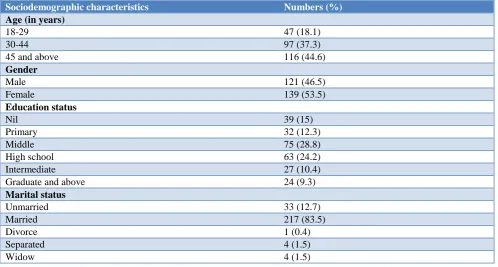
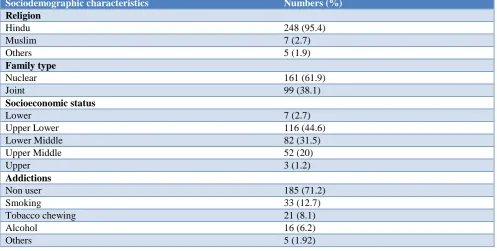
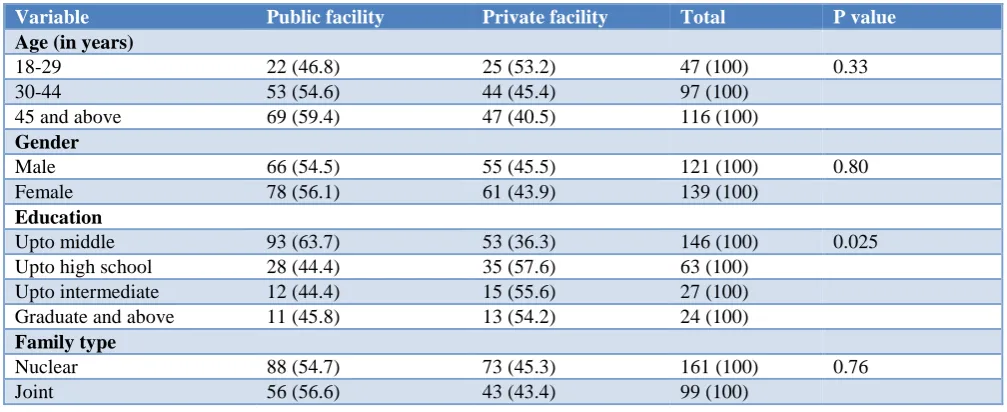
Of the total of 260 participants, one hundred thirty nine (53.5%) were males and 121 (46.5%) were females.15% of the participants were illiterate, and only 9.3% were graduates. Participants were predominantly Hindu by religion and belonged to lower socioeconomic status (76.1%). Majority belonged to a joint family (61.9%). 12.7% of the participants were regular smokers, 8.1% were tobacco chewers (Table 1). About half of the participants took decisions on health care on their own while 18.8% took advice of the elders of family as shown. More than half of the participants (56.9%) preferred to seek treatment from a public health care facility compared to a private. 44.6% liked to go directly to a government hospital. Nearly 90% preferred allopathic system of medicine and 6.9% Ayurvedic treatment .Only three participants said they would prefer to go to a traditional healer to seek treatment (Table 2). Predominant determining factors on choosing a particular health facility was affordability (50.8%), nearness of the health facility (46.9%), quality of care (35%), and free consultation and drug availability (32.3%). Seventy six (29.2%) of the participants would decide from previous experience of a health facility (Table 3). Long waiting time at the health facility (49.6%) and expenditure on treatment (44.6%) were the main barriers perceived in utilization of health services. Twelve participants reported fear of side effects of treatment (Table 4).On chi-square analysis, the education status of the participant was found to have a significant association with preference of health facility, those with higher education preferring to seek treatment from private health facility (Table 5).
Table 1: Socio-demographic characteristic of the participants.
Sociodemographic characteristics Numbers (%)
Age (in years)
18-29 47 (18.1)
30-44 97 (37.3)
45 and above 116 (44.6)
Gender
Male 121 (46.5)
Female 139 (53.5)
Education status
Nil 39 (15)
Primary 32 (12.3)
Middle 75 (28.8)
High school 63 (24.2)
Intermediate 27 (10.4)
Graduate and above 24 (9.3)
Marital status
Unmarried 33 (12.7)
Married 217 (83.5)
Divorce 1 (0.4)
Separated 4 (1.5)
Widow 4 (1.5)
Sociodemographic characteristics Numbers (%) Religion
Hindu 248 (95.4)
Muslim 7 (2.7)
Others 5 (1.9)
Family type
Nuclear 161 (61.9)
Joint 99 (38.1)
Socioeconomic status
Lower 7 (2.7)
Upper Lower 116 (44.6)
Lower Middle 82 (31.5)
Upper Middle 52 (20)
Upper 3 (1.2)
Addictions
Non user 185 (71.2)
Smoking 33 (12.7)
Tobacco chewing 21 (8.1)
Alcohol 16 (6.2)
Others 5 (1.92)
Table 2: Health care seeking behaviour.
Category Numbers (%)
Decision about health care
Elders 49 (18.8)
Self 133 (51.2)
Spouse 34 (13.1)
Shared decision with other family members 44 (16.9)
Type of health facility preferred
Public 148 (56.9)
Private 112 (43.1)
System of medicine preferred
Allopathy 233 (89.6)
Ayurveda 18 (6.9)
Homeopathy 6 (2.3)
Traditional healer 3 (1.2)
Health insurance
None 206 (79.2)
CGHS 17 (16.5)
ESI 12 (4.6)
ECHS 3 (1.2)
Table 3: Determining factors to choose a particular health facility.
Determining factors Numbers (%)
Nearness of health facility 122 (46.9)
Affordability 132 (50.8)
Behaviour of doctor 47 (18.1)
Paramedical staff behaviour 17 (6.5)
Advise by family members/friends 18 (6.5)
Faith in the system of medicine 49 (18.9)
Previous experience 76 (29.2)
Quality of care 91 (35.0)
Less waiting time 82 (31.5)
Table 4: Barriers perceive in utilization of health services.
Barriers Numbers (%)
Ill-treatment of staff 28 (10.8)
Poor quality of care 48 (18.5)
Expenditure on treatment 116 (44.6)
Long waiting time 129 (49.6)
Distance of health facility 27 (10.4)
Fear of side effects 12 (4.6)
Belief in self-medication 5 (1.9)
Belief in traditional healers 5 (1.9)
Table 5: Preference for type of health facility vs. sociodemographic factors.
Variable Public facility Private facility Total P value
Age (in years)
18-29 22 (46.8) 25 (53.2) 47 (100) 0.33
30-44 53 (54.6) 44 (45.4) 97 (100)
45 and above 69 (59.4) 47 (40.5) 116 (100)
Gender
Male 66 (54.5) 55 (45.5) 121 (100) 0.80
Female 78 (56.1) 61 (43.9) 139 (100)
Education
Upto middle 93 (63.7) 53 (36.3) 146 (100) 0.025
Upto high school 28 (44.4) 35 (57.6) 63 (100)
Upto intermediate 12 (44.4) 15 (55.6) 27 (100)
Graduate and above 11 (45.8) 13 (54.2) 24 (100)
Family type
Nuclear 88 (54.7) 73 (45.3) 161 (100) 0.76
Joint 56 (56.6) 43 (43.4) 99 (100)
DISCUSSION
Utilization of health services is the cornerstone of universal health coverage. About half of the participants took decision for seeking treatment on their own while 18.8% relied on the advice of elders. In a study from Kenya on health seeking behaviour for child illnesses, found fathers to be the ultimate decision makers. This was due to their position as head of family and also they provided funds for seeking treatment.6 More than half of participants preferred to seek treatment from a public health facility than a private health facility. A study conducted in an urban field practice area of a medical college of Aligarh, found significantly higher numbers of people in urban areas were going to government health facilities (48.7%) as compared to rural areas where the majority was going to private health centres (42.0%).1 Another study carried out in Dharavi, Mumbai found 83 % of the attendees preferred government hospitals in case of major illness while 34% preferred home remedies and 32% desired government hospitals for minor illnesses.7 In contrast, a study conducted in an urban slum of Delhi, found 90% of the participants exclusively depended on the local unlicensed, unregistered practitioners for their basic primary health care.2
issues of fraud and misuse of funds meant for the underprivileged.12,13 Delhi—which has a large slum population—has also been in news for massive corruption and fraud in its municipal body (Municipal Corporation of Delhi), which is responsible for basic amenities as well as a significant number of health facilities.14 The felt need of the hour is to ensure a robust and efficient government health care delivery system which can offer quality and affordable medical care to one and all. At the same time ignoring the ever growing private health care industry would perhaps be a grave mistake and perhaps this is the right time to review concept of public private partnership afresh.
CONCLUSION
Planning of different categories of health care facilities in different locations should be based on utilization rates while proper management of established facilities should aim to improve health seeking behaviour of people.15 It is evident from the study that there is a tendency to seek health care in Government setups and faith on allopathic system of medicine which emphasises the fact that there is an urgent need to set up a robust government health care system which provides accessible quality health care.
Funding: No funding sources Conflict of interest: None declared
Ethical approval: The study was approved by the Institutional Ethics Committee
REFERENCES
1. Azhar G, Amir A, Khalique N, Khan Z. A Study of Determinants of Use of Healthcare Services in India. Int J Med Public Health. 2011;1(3):62–6.
2. Barua N, Pandav CS. The allure of the private practitioner: Is this the only alternative for the urban
poor in India? Indian J Public Health.
2011;55(2):107.
3. Dhingra B, Dutta AK. National Rural Health Mission. Indian J Pediatr. 2011;78(12):1520–6. 4. Musoke D, Boynton P, Butler C, Musoke MB.
Health seeking behaviour and challenges in utilising
health facilities in Wakiso district, Uganda. Afr Health Sci. 2014;14(4):1046–55.
5. Ghafari M, Shamsuddin K, Amiri M. Barriers to Utilization of Health Services: Perception of Postsecondary School Malaysian Urban Youth. Int J Prev Med. 2014;5(7):805–6.
6. Abubakar A, Van Baar A, Fischer R, Bomu G, Gona JK, Newton CR. Socio-Cultural Determinants of Health-Seeking Behaviour on the Kenyan Coast: A Qualitative Study. Jenkins N, ed. PLoS ONE. 2013;8(11):e71998.
7. Patil SP, Parbhankar SS, Study of health seeking behaviour and its determinants among its attendees of urban health centre, Dharavi, Mumbai. Int J Community Med Public Health. 2016;3(7):1856-61. 8. Gupta I, Guin P. Health status and access to health
services in Indian slums. Health. 2015;7:245-55. 9. Gupta, I. and Mitra, A. Basic Amenities and Health
in Urban India. National Med J India, 2002;15:26-31.
10. Gupta I, Mitra A, Jha M. Slum Dwellers in Delhi: An Unhealthy Population. IEG Working Paper No. E/ 194/98, Institute of Economic Growth, Delhi; 1998.
11. Kumar S. Health Care Is among the Most Corrupt Services in India. British Medical Journal. 2003;326:10.
12. World Bank. World Bank and Government of India Agree Action to Stamp out Health Project Fraud and Corruption. Press Release No:2008/234/SAR. World Bank, Washington DC; 2009.
13. Sinha K. CAG to Audit NRHM Scheme in 18 States. The Times of India, New Delhi; 2008. 14. Dash DK, Lalchandani N, Pandit A. Mayor May
Seek CBI Probe into Fake MCD Staff Scam. The Times of India, New Delhi; 2009.
15. Oladipo JA. Utilization of health care services in rural and urban areas: a determinant factor in planning and managing health care delivery systems. Afri Health Sci. 2014;14(2):322–33.
Cite this article as: Arora M, Koshy G, Gangadharan