Original Research Article
An epidemiological cross sectional study to assess the prevalence of
reproductive tract infections and sexually transmitted infections among
married women in the reproductive age group in urban slum of
Mumbai, Maharashtra, India
Neeta D. Rathod, Charuhas V. Akre*
INTRODUCTION
Sexually transmitted infections and reproductive tract infections (STIs/RTIs) are an important public health problem in India. Studies suggest that 6% of the adult population in India is infected with one or more STIs/RTIs. Individuals with STIs/RTIs have a significantly higher chance of acquiring and transmitting HIV. Moreover, STIs/RTIs are also known to cause infertility and reproductive morbidity. Controlling STIs/RTIs helps decrease HIV infection rates and
provides a window of opportunity for counselling about HIV prevention and reproductive health.1
A broad based study conducted in different part of the country revealed a prevalence of reproductive tract infections varying from 19 to 71%. Marked variation has been found across all these studies in terms of pattern and level of morbidity which means that no single set of estimates for RTIs, could apply in such a large and diverse country as India. Hence, the prevalence rates of RTIs for a particular geographical area need to be
ABSTRACT
Background: In developing countries reproductive tract infections (RTI) and sexually transmitted infections (STI) continue to present a major public health problem. Women in India had very low knowledge in sexually transmitted infections and HIV/AIDS. It is found that many of the RTI/STI is preventable and curable. The occurrence of STI/RTI among married women is quite high. Hence, this study will be carried out to assess prevalence of STI/RTI in the married women of reproductive age group in an urban slum.
Methods: A cross-sectional study was carried out in the general OPD of Urban Health Centre, Mumbai during the period of 1st July 2015 to 31st July 2015. The data of 180 women in the reproductive age group of 15 to 49 years was collected by Pretested, semi structure interview schedule and statistically analyzed.
Results: In the present study, the prevalence of STIs/RTIs symptoms was found to be 35.6%. Maximum prevalence
of the symptoms among the study subjects found to be higher in the age group of 35 years and above (40.4%), in illiterate women (53.7%), women having one or two children (52.7%), women using IUD (50%) and women having per capita income <Rs. 5000/- (45.2%).
Conclusions: There is a need for preventing new STI/RTI cases by educating people about the common symptoms,
common methods of transmission, complications and preventive measures.
Keywords: STI/RTI, Prevalence, Urban slum, OPD
Department of Community Medicine, Government Medical College, Chandrapur, Maharashtra, India
Received: 09 July 2018
Revised: 20 September 2018
Accepted: 21 September 2018
*Correspondence: Dr. Charuhas V. Akre,
E-mail: [email protected]
Copyright: © the author(s), publisher and licensee Medip Academy. This is an open-access article distributed under
the terms of the Creative Commons Attribution Non-Commercial License, which permits unrestricted non-commercial use, distribution, and reproduction in any medium, provided the original work is properly cited.
assessed so as to help the health administrator in providing better services for their treatment and control.2
Aim
To assess the prevalence of STI/RTI among women in the reproductive age group of 15-49 years old attending general OPD of Urban Health Centre in an urban area.
Objectives
To study their socio-demographic profile and the factors affecting STI/RTI.
To make suitable recommendations based on the study results.
METHODS
Place of study
General OPD of urban health centre at Shahajinagar in an urban area, Mumbai.
Study population
The married women in the reproductive age group of 15 – 49 years, who attended general OPD of an Urban Health Centre in the month of July 2015
Inclusion criteria
The beneficiaries meeting the following inclusion criteria were selected: women of reproductive age group; residing in community more than 6 months; study population volunteering to give information.
Exclusion criteria
Exclusion criteria were mentally challenged women; people not willing to participate in the study; people seriously ill due to any other disease at the time of interview.
Data collection
Sample size was 180.
Data was collected by a pretested, preformed, semi structured interview schedule (four to five women per day were selected randomly)
Informed consent was obtained verbally from all the participants after explaining the purpose of the study and promise was made about anonymity, and that social and economic information collected about them was to be kept confidential.
Statistical analysis
Template was generated in MS Excel. The statistical analysis was performed using SPSS software (version 16.0). All values are expressed in the form of percentages, mean and standard deviation and the chi-square test was applied wherever necessary.
RESULTS
The overall 180 married women from the reproductive age group of 15-49 years old were cross-examined in the Month of July 2015 at an urban health center of Mumbai and out of which 64 of them were found to be suffering from RTIs giving the occurrence of 35.6%.
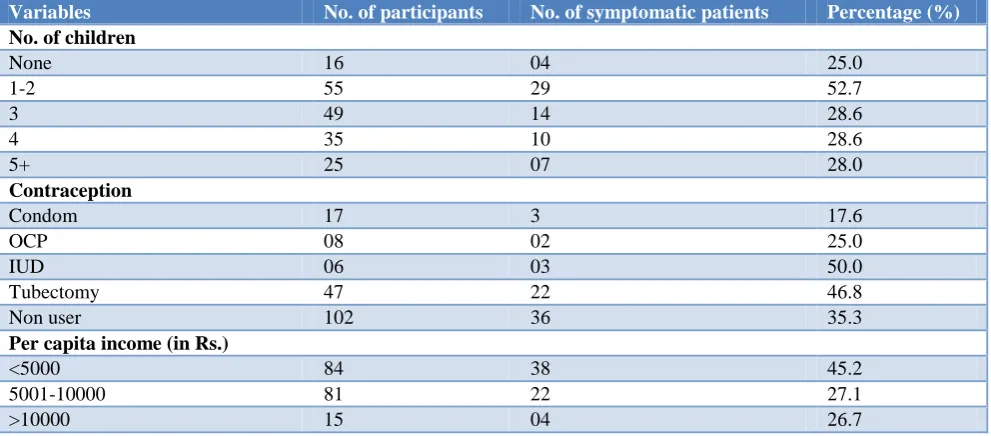
Table 1: Socio-demographic characteristics of the sexually active women in the age group of 15-49 years.
Variables No. of participants No. of symptomatic patients Percentage (%)
Age (in years)
<25 28 06 21.4
25-34 100 37 37.0
≥35 52 21 40.4
Marital status
Married 169 60 35.5
Divorced/widowed 11 04 36.4
Education
Illiterate 54 29 53.7
Primary 32 12 37.5
Middle 34 11 32.4
High and secondary 47 09 19.2
Graduate and above 13 03 23.1
Occupation
Housewife 158 57 36.1
Agriculture 04 02 50.0
Service 07 02 28.6
Others 11 03 27.3
Variables No. of participants No. of symptomatic patients Percentage (%) No. of children
None 16 04 25.0
1-2 55 29 52.7
3 49 14 28.6
4 35 10 28.6
5+ 25 07 28.0
Contraception
Condom 17 3 17.6
OCP 08 02 25.0
IUD 06 03 50.0
Tubectomy 47 22 46.8
Non user 102 36 35.3
Per capita income (in Rs.)
<5000 84 38 45.2
5001-10000 81 22 27.1
>10000 15 04 26.7
From Table 1 it is observed that as the age increases the occurrence of RTIs increases.
The prevalence of RTIs was (21.4%) in <25 years, (37%) in 25-34 years and (40.4%) in ≥35 years. Means thoroughgoing maximum prevalence was seen in the age group of 35 years and above i.e. 40.4%
It is observed that variable of marital status not shown much significant result while considering this study. Similarly while considering the variable as education it is seen that the occurrence of STIs/RTIs having decreasing trend with increasing level of education & in cross examination it was found to be maximum in illiterate women (53.7%).
On considering the factor of number of children of married women, it is observed that the occurrence is very less in women who had no children (25%) and maximum in women who had one or two children while the no of children having not much significant result with subsequent increasing in deliveries (28.6%, 28.6% and 28.0%).
With the increasing awareness of contraceptive use, the variable of contraceptive use is considered in this study & it was found that the occurrence of RTIs were less in women who were using the contraceptives as compared to those who were not using it.
Thorough going it is seen that total 50% of the women using intrauterine devices and 46.8% of women who had tubectomies facing RTIs. Similarly the prevalence of RTIs among women using oral contraceptive pills and condoms was less (25.0% and 17.6% respectively). While considering the factor of socioeconomic class in this study on the basis of average income earned by per
person in given area it is seen that the occurrence of STIs/RTIs was more in women having per capita income <Rs. 5000 (45.2%), as compared with women having per capita income Rs. 5001-10000 (27.1%) and women having per capita income >Rs. 10000 (26.7%). The prevalence of RTIs was inversely proportionate to the per capita income.
Table 2: The prevalence of symptoms among the study population.
Symptoms
Symptomatic patients N=64 (%)
Study population N=180 (%)
Vaginal discharge 31 (48.4) 31 (17.2)
Pain in lower
abdominal 16 (25.0) 16 (15.5)
Itching 09 (14.0) 09 (05.0)
Dyspareunia 03 (4.0) 03 (1.67)
Genital ulcer disease 02 (3.1) 02 (1.1)
Inguinal
lymphadenopathy 01 (1.5) 01 (0.5)
Burning micturition 02 (3.1) 02 (1.1)
From Table 2 it was observe that while assessing the occurrence of STIs/RTIs, the most common symptom was vaginal discharge (48.4%) followed by lower abdominal pain (16%), itching (14%), dyspareunia (4%), genital ulcer and burning micturition conditions (3.1%) and inguinal lymphadenopathy(1.5%).
DISCUSSION
social hesitation and due to busy schedule in there day to day life. In coincidence similar prevalence of RTIs/STDs was also found in the study done by Devi et al in an urban slum area of Tirupati.3 Another study done in Karnataka by Mutharayappa also showed the prevalence of STIs/RTIs 41.6% which is approximately comparable to results of our study.4
While assessing the occurrence of symptoms among the study population in our study, the most common symptom found was vaginal discharge i.e. 48.4% and followed by lower abdominal pain, itching, dyspareunia, genital ulcer and burning micturition. Similarly the research conducted by Chavan et al also found that the vaginal discharge as most common symptom of STIs/RTIs i.e. 57% followed by burning micturition 43%, genital itching 45%, genital ulceration 17%, and lower abdominal pain in 42% women.6
In this study, prevalence of STIs/RTIs was found to be increasing with the increase in age group in which maximum prevalence was found in the age group of 25-34 and 35 years above. A similar observation regarding age group was found in a study conducted by Sharma et al in Himachal Pradesh.5
Considering the effect of socio economic background in present study, the maximum prevalence of RTIs was found in women having low per capita income, having three or more children and those who were using intra uterine devices and tubectomy as method of contraception. Analogous results were observed in study accompanied by Sharma et al and Bhilawar et al.5,8 similarly it was seen that 50% of women among IUD users had RTIs. This confirmed that IUD users are at more risk of acquiring RTI as they are exposed to iatrogenic and exogenous infections.9
CONCLUSION
The occurrence of STIs/RTIs was quite high in this study. It was significantly associated with socio demographical characteristics such as age, education level, socio economic status, knowledge of contraceptive use and higher parity. The most common symptom reported among all STIs/RTIs was vaginal discharge. Awareness about consistency of condom use for prevention of STI/RTI is also found less in this study. Knowledge about STI/RTI is less than that of HIV/AIDS. The health promotional activities and awareness regarding STIs/ RTIs services should be focused on low income group people. The services for prevention and control of STIs/RTIs should be widely distributed through proper health education. Medical officers, Counselors, Health care workers and Para medical staffs should be well trained to identify RTI/STIs among women by syndromic approach and targeted interventions. In order to sensitize women about reporting their reproductive problems they should be well-informed with proper communication strategies.
ACKNOWLEDGEMENTS
Authors would like to thank Dr. S. R. Suryawanshi, Professor and Head, Department of Community Medicine, Dr. Rajan Kulkarni, Professor for their moral support and suggestions. Authors would also gratefully acknowledge the necessary help provided by the staff of Urban Health Center, Shahaji Nagar, for their unconditional support.
Funding: No funding sources Conflict of interest: None declared
Ethical approval: The study was approved by the Institutional Ethics Committee
REFERENCES
1. National guidelines on prevention, management and control of reproductive tract infections including sexually transmitted infections ministry of health and family welfare government of India. Available at http://www.nacoonline.org/upload/policies %20&20 Guidelines/14%20National Guidelines on PMC of_RTI_Including_STI.pdf. Accessed on 2 June 2018.
2. Bote MM, Shenoy AG. An epidemiological study to find out the prevalence of RTI/STI and various factors associated with it among ever married women of reproductive age group in an urban slum community of Mumbai. IOSR J Dent Med Sci. 2014;13(3):9-15.
3. Devi BS, Swarnalatha N. Prevalence Of Rti/Sti Among Reproductive Age Women (15-49 Years) In Urban Slums Of Tirupati Town, Andhra pradesh. Health Population Perspect Issues. 2007;30(1):56-70.
4. Mutharayappa R. Reproductive morbidity of women in Karnataka J Health Management. 2006;8:1. 5. Sharma S, Gupta BP. The prevalence of
reproductive tract infection and sexually transmitted diseases among married women in the reproductive age group in rural area. Indian J Community Med. 2009;34:62-4.
6. Chavan SS, Giri PA, Singh VS, Sankaranarayan S. Study of Pap smear and other feasible tests among self-reported symptomatic married women in reproductive age group (15-49 yrs) regarding reproductive tract infections in a rural community of Maharashtra. Int J Res Med Sci. 2013;1:545-51. 7. Roy S, Nandan D. Development towards achieving
Health/ reproductive Health for All and Millennium Development Goals: A Critical Appraisal for strengthening action program (part-II). Health population- perspect Issues. 2007;30(3):150-76. 8. Bhilwar M, Lal P, Sharma N, Bhalla P, Kumar A.
9. Thakur JS, Swami HM, Bhatia PS. Efficiency of syndromic approach in management of reproductive tract infection and associated difficulties in a rural area of Chandigarh. Indian J Community Med. 2002;27:110-3.
Cite this article as: Rathod ND, Akre CV.An