IJSRSET184224 | Accepted : 15 Jan 2018 | Published 22 Jan 2018 | January-February-2018 [ (4)2 : 133-137 ]
© 2018 IJSRSET | Volume 4 | Issue 2 | Print ISSN: 2395-1990 | Online ISSN : 2394-4099 National Conference on Advanced Research Trends in Information and Computing Technologies (NCARTICT-2018), Department of IT, L. D. College of Engineering,
Ahmedabad, Gujarat, India In association with International Journal of Scientific Research in Science, Engineering and Technology
Improving Energy Efficiency Through VM Placement and
Consolidation Techniques in Cloud Computing
Bhumi K. Joshi
1, Prof. Dr. Chirag S. Thaker
21M. E. Student (Information Technology Department), L. D. College of Engineering, Gujarat Technological University, Ahmedabad, Gujarat, India
2Assistant Professor (Information Technology Department), L. D. College of Engineering, Gujarat Technological University, Ahmedabad, Gujarat, India
ABSTRACT
Cloud computing offers utility-oriented IT services to users worldwide based on a pay-as-you-go model. Data centers hosting Cloud applications consume huge amounts of electrical energy that causes high operational costs and carbon footprints to the environment. Therefore we need green cloud computing solution that can reduce the environmental impact as well as minimize operational costs. A virtualization technology is used to consolidating multiple Virtual machines (VM) onto a minimum number of servers to improve energy efficiency of server. Dynamic VM placement, VM consolidation, and switching servers on and off as required, through all these techniques data centers can benefit higher server utilization and energy efficiency. In this paper I conducted a survey of research in energy-efficient computing as well as proposed a solution that will help to improve higher server utilization and energy efficiency for cloud computing.
Keywords: energy efficient computing, VM placement, VM consolidation, Cloud Computing
I. INTRODUCTION
The term Cloud indicates to a Network or Internet. We can say that Cloud is something, which is present at remote location. Cloud computing offers an infrastructure, platform, and software as services that are made available to end user in a pay-as-you-go model. These services are referred to as Infrastructure as a Service (IaaS), Platform as a Service (PaaS), and Software as a Service (SaaS) respectively in enterprise. To deliver Cloud computing services many computing service providers including Google, Microsoft, Yahoo, and IBM are rapidly deploying data centers in various locations around the world. Rapid growth of the interest for computational power by scientific, business and web-applications has led to the creation of large-scale data centers that consumes huge amounts of electrical power. Continued development of servers shows our need for more power, space, network, human resources, air conditioning and other infrastructure. As number of request over the data center raise that raises the load and
power consumption of the data center. So the requests need to be balanced in such manner which having more effective strategy for utilization of resources that can leads toward improving the energy efficiency of cloud computing.
A. VM placement and consolidation
VM consolidation provides important benefits to cloud computing by providing improved use of the available datacenter resources. The hypervisor provides resources to VMs based on peak load demand in static VM consolidation. But this is not more useful because workload demands keeps on changing. The VMs can be dynamically reallocated through live virtual machine migration according to current resource demand in dynamic consolidation.
The main characteristics of VM placement problem are: I. The number of VMs needed for particular kind of
workload is dynamic in nature which results in allocation and removal of VMs.
II. The resource requirements of VM keep on changing as per workload demand.
III. Migrating VM from one PM to another takes long time and energy consumption because it increases the load on source side.
IV. The cloud provider rent the VMs from external cloud providers or can use the VMs of its own.
VM migration and consolidation follows four steps: I. Initially place the VMs on host.
II. Identify the host which get over or under loaded using some statistical methods and select the VM for migration from that host.
III. Perform the live migration by selecting appropriate migration technique.
IV. The last step is to identify the destination host where to place the migrated VMs; the selection of wrong host can lead to excessive energy and power consumption and inefficient resource utilization.
The main objective of VM placement and consolidation technique is power saving. In power saving goal the target is to consolidate the VMs in order to make the datacenter energy efficient.
II. RELATED WORK
A. VM placement techniques
First fit: In this the VM scheduler starts searching the hosts step by step to place the VM. The host which has sufficient resources will get selected. If there is no such
host exists then the server starts the new physical machine and place the VM on that host [2].
Dot product based fit:
It uses the concept of dot product of two vectors. One vector is the resource requirements of VM and the other vector consists the resource utilization by the host. After calculating the product the PMs are ordered in decreasing order [3].
Stochastic integer programming:
It uses the technique of future prediction of host in terms of resource based on some historical data. To predict historical data it uses some probability distributions [2].
Genetic algorithms:
In Genetic algorithms based solution initial population is defined to show the various solutions for the problem. Then the fitness function selects the best solution for the problem. Then on the solution crossover and mutation operations are applied to generate the new population
[4].
B. VM consolidation techniques KNN- regression:
K- Nearest neighbor based regression algorithm first checks the resource usage of nearest hosts. It predicts based on regression that which nearest host is getting overloaded. Major target is server consolidation. The host on which the VM is going to be placed is decided by Power Aware Best Fit Decreasing algorithm [5].
pMapper:
Enhanced Weighted Round Robin Algorithm:
It keeps on checking the running VMs states to identify the over utilized processing elements and if any found then hibernate that element by sending some signal. It uses dynamic voltage frequency signal to set the minimum VM frequencies for each task. To meet the task deadlines the DVFS selects the best CPUfrequency out of available frequencies. The energy consumption is minimized using VM reuses [7].
Power Aware Resource Virtual Machine Allocation Policy:
This paper proposed an algorithm that use linear power model to get power efficiency of data center, on that efficiency we have proposed and VM allocation policy to maximize the utilization of resources available in data center. If there is such data center which having high efficiency and underutilize also having enough capability to fulfill request requirement then allow that data center to serve requests. Here efficiency of data center is calculate by applying liner power model which use utilization of each data center to calculate to get power efficiency of data centers. After allocation of VM again updates data center list and start it with step until task queue is empty [8].
C. Comparison of VM placement technique
No Approach
used
Resource considered
Problem with approach
1 First fit CPU, memory, bandwidth
unbalances the load
2 Dot product based fit
CPU, memory Does not considered the length of VM and remaining capacity of PM
3 Stochastic integer programm ing
CPU, memory, Bandwidth
Probability distribution of resource
requirement should be known 4 Genetic
algorithms
CPU, memory, BW
Due to local optimization can’t achieve global optimal solution
D. Comparison of VM placement technique
No Technique Power
saving method Parameters analyzed Future work required
1 KNN regression
Uses KNN to predict under/ove r utilized host SLA violation, power consumption -
2 pMapper mPP, mPPH and pMap Number of migrations, energy consumption Improve performa nce for higher utilizatio ns 3 Enhanced
Weighted Round Robin Algorithm DVFS and VM reuse Resource utilization, power consumption Improve resource utilizatio n rate with combine d DVFS and EWRR 4 Power
Aware Resource Virtual Machine Allocation Policy PARAP (Power Aware Resource Allocation Policy) algorithm maximize utilization of resource, improves energy efficiency Paramete rs for quality of services and throughp ut can be included.
III. PROPOSED WORK FLOW
After studying all these previous work I have concluded that there is still a need for developing such a method that considers all these parameters that are previously being omitted such as: quality of service, throughput, effective resource utilization, workload consolidation, minimizing number of migrations, active physical hosts and Load balancing.
machine consolidation and live migration, server consolidation can be applied to improve energy efficiency and better result can be obtained as compared to previous proposed methods.
Consolidation of virtual machines is one of the key strategies used to reduce the power consumption of Cloud data centers. Consolidation has the goal of allocating virtual machines on a few physical servers as possible, while satisfying the Service Level Agreement established with users. The effectiveness of a consolidation strategy strongly depends on the forecast of virtual machine resource needs. To this aim, data-driven models can be exploited to develop intelligent consolidation policies. In particular, migrations are driven by the forecast of the future computational needs (CPU, RAM) of each virtual machine, in order to efficiently allocate those on the available servers.
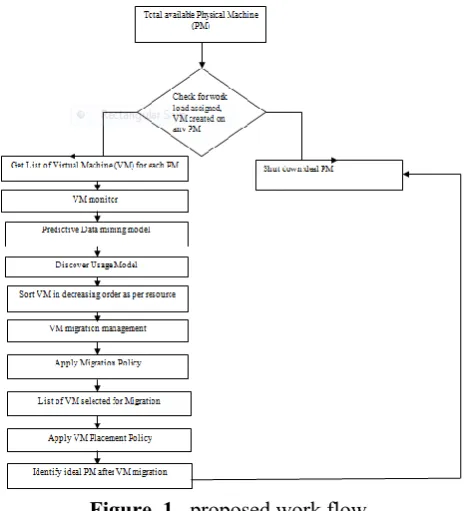
Proposed work flow is shown in fig 3.1. All steps can be described as bellow:
Step-1: Obtains the list of available physical machine running for providing cloud computing services.
Step-2: Checks for any workload is assigned or VM is created over PM or not.
Step-3: If no workload is assigned or no VM running over PM then it is in ideal state so shut down it.
Step-4: If workload is assigned then gets the list of number of VM running over each PM.
Step-5: At run time CPU and RAM needs of each VM are monitored by VM monitor module and logged as VM resource usage data.
Step-6: such data are analyzed by data mining models. Step-7: This data mining model will discover usage models for CPU and RAM resources.
Step-8: Sort VM as per current as well as future resource demand.
Step-9: VM migration management will apply VM migration policy.
Step-10: VM Migration list can be obtained Step-11: Apply VM placement Policy Step-12: Identify any PM has become ideal Step-13: shutdown PMs obtained from step-12
Figure 1. proposed work flow
IV. CONCLUSION
After studding and analysing various VM placement and VM consolidation techniques we can’t say that a single technique is best. The major issues that are needed to be resolved in these techniques are: Quality of service, Throughput, Effective resource utilization, Workload consolidation, Minimizing number of migrations and active physical hosts, Load balancing.
V. FUTURE WORK
In future I will work to minimize the number of migration in order to balance the load and minimizing SLA violations.
VI. REFERENCES
[1] https://www.javatpoint.com/virtualization-in-cloud-computing*
[2] R. K. Gupta, R. K. Pateriya, “Survey on Virtual Machine Placement Technique in Cloud Computing Enviornment”, International Journel on Cloud Computing: Services and Architecture, vol. 4, No. 4, August 2014.
[4] M. Kalra, S. Singh, “ A review of metaheuristic scheduling techniques in cloud computing “, Egyptian Informatics Journal(2015) 16, 275-295. [5] H. I. G, R. C, “A Survey on VM Consolidation For
Energy Efficient Green Cloud Computing”, International Journal of Emerging Technology in Computer Science and Electronics ISSN: 0976-1353, Vol. 19.
[6] Z. A. Mann, “Allocaton of Virtual Machines in Cloud Data Centers- A Survey of Problem Models and Optimization Algorithms”, Published in ACM Computing Surveys, Vol. 48, issue 1, 2015.
[7] A. Alnowiser, E. Aldhahri and A. Alahmadi, “ Enhanced Weighted Round Robin Scheduling with DVFS technology in Cloud”, 2014 International Conference on Computational Science and Computational Intelligence.