Original Research Article
Parental perception of girl-child early marriage amongst
the Urhobos in Nigeria
Emmanuel A. Agege
1, Ezekiel U. Nwose
2*, Stella Odjimogho
1INTRODUCTION
We had publish two review articles on Legalities of child marriage as well as parental perceptions both of which summarily indicates as follow:
“Studies have shown that girls with three or fewer years of schooling are five times more likely than girls with eight or more years of schooling to marry before the age of 18 years old. There has been global struggle that
highlighted the plight of uneducated girls in poor countries as being most vulnerable. The objective of this narrative is to highlight some of the legalities of child or early marriage in Nigeria. Three Case scenarios are presented together with their associated salient impacts that go beside and often worse than sexual health. In this endeavour, the case stories expatiate how cultural differences, religious practices, social orientation and conflicting laws constitute the legalities surrounding child or early marriages. In particular, attempt is made to
ABSTRACT
Background: This study was on the parental perception of early marriage amongst the Urhobos in the Central District of Delta State. World Health Organization (2013) defined early marriage, or child marriage, as the marriage or union between two people in which one or both parties are younger than 18 years of age. The aims of this research were to assess the parents on four themes including concept of early marriage as well as perceptions on causes, consequences and strategies to mitigate the problems.
Methods: A descriptive cross-sectional survey adopted questionnaire that comprised 4-themes and a critical review. A total 360 out of 384 samples were drawn from 8-communities within the local governments in the Central senatorial district of Delta State. The percentages of responses from the respondents categorized on the Likert scale groups were determined.
Results: The analysis shows disagreements among respondents‟ perception. 60% are yet to acknowledge gender discrimination in the underlying practice of early marriage. 77% admitted that ignorance is a factor. There is also some strong agreement that early marriage was due to unexpected pregnancy. A total of 62.5% of respondents admitted that their daughter married the boys who impregnated them, and all the girls were forced into it by their parents.
Conclusions: The observation lays credence to the fact that unexpected pregnancy is the highest cause of early marriage. It is hereby inferred that there appear to be ignorance leading parents to force their girls into early marriage because of premarital pregnancy.
Keywords: Early marriage, Gender discrimination, Health literacy, Parental ignorance, Unexpected pregnancy
1
Department of Public and Community Health, Novena University Ogume, Nigeria
2
School of Community Health, Charles Sturt University, New South Wales, Australia
Received: 27 May 2018 Revised: 06 July 2018 Accepted: 09 July 2018
*Correspondence: Dr. Ezekiel U. Nwose, E-mail: [email protected]
Copyright: © the author(s), publisher and licensee Medip Academy. This is an open-access article distributed under the terms of the Creative Commons Attribution Non-Commercial License, which permits unrestricted non-commercial use, distribution, and reproduction in any medium, provided the original work is properly cited.
elucidate the role of peer-pressure and social tension as well as the fact that culture, parents or religions are not only the culprits, but also the girls such as in analogy to teenage pregnancies. Recommendations of strategies for prevention articulated”.1
“Early marriage forces girls into adulthood before they are emotionally and physically matured, and it has harmful effects on their health, educational, economic and social development. In many countries, 18 years is the legal age of marriage and Nigeria has made a constitutional effort to establish same as a minimum age for marriage. This narrative review examined the causes and consequences of early marriage with a view to establish framework to assess the perception on factors among Urhobos in Nigeria. Unpublished stories are appraised alongside news media and published literature to illustrate scenarios that exemplify discussed causes. Several causes of early marriage were noted and gender discrimination, ignorance, and unexpected pregnancy appear salient or are under-discussed. There is evidence that men and women prefer husbands to earn higher wages than wives and females are less ambitious. Although there are public health concerns in the literature, data on perception of parents, especially those in low socioeconomic status, regarding public health is lacking. Critical appraisal posits that early marriage is not only shrouded in legalities, but is also caused by multiple factors. The factors that cause or lead to early marriages need to be identified for each society to appropriately address the associated ramifications. The lack of data on perception of parents suggests that educational intervention needs to start with community needs assessment”.2
The objective of this study is to investigate the perceptions of parents on concepts as well as causes and consequences of early marriage as a public health problem. It is hoped that this may provide data that could help to change parents‟ attitude towards practices, customs and traditions against early marriage. It is also intended to provide government and non-government agencies the needed impetus to control early marriage.
METHODS
Research design and ethical consideration
The research was designed be a descriptive cross-sectional survey. Ethical approval was obtained from the Novena University‟s authority. Participation as respondents was voluntary. Informed consents of all the participants were obtained prior to the commencement of the study. All data were treated with high level of confidentiality and participants were anonymous.
Population study
The Urhobos constitute one of the tribes in Delta State of Nigeria. They occupy Delta Central exclusively,
geographically located within the Niger Delta area with an estimated population of over 2.1 million. (1999 Population Census).
The questionnaire and data analysis
This was made up of two sections (A and B). Section A was designed to obtain background information of respondents; while section B consisted of 36 Likert scaled (SA= Strongly Agree, A= Agree, U= Undecided, D= Disagree and SD= Strongly Disagree) questions covering the four themes. Level of practice of early marriage constituted „other analyses‟ done as critical review. The coded data were analyzed descriptively using the Microsoft Excel Tool Pak and SPSS version 20.0.
Data collection and selection criteria
Data collection was within the period of July to October 2017, as part of Master of Public Health research project. Participants were limited to parents, and who lives within the Delta Central geographical location.
RESULTS
A total of 384 research questionnaires size distributed in the eight communities within the local government areas of the Central senatorial district of Delta State. 360 questionnaires were received with answers, which meant 93.7% response rate. First, the results show discrepancies in agreement/disagreement on the various themes as indicated by the percentage distribution of the responses across the thematic Likert scaled questions (Table 1). The respondents‟ demographics are presented (Table 2).
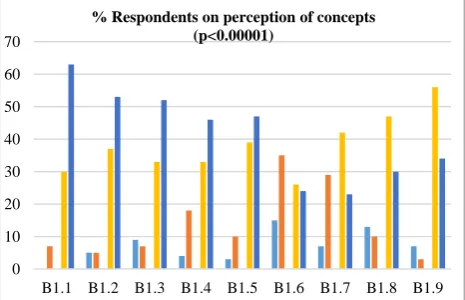
Figure 1: Perceptions on the concepts of early marriage by girls.
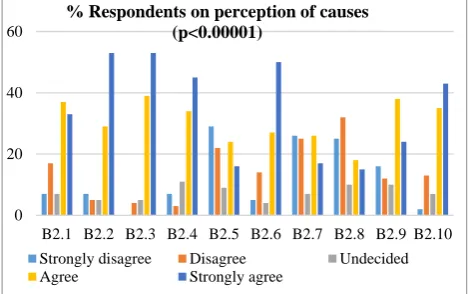
Up to 93% of respondents are aware of that age below 18 being defined as early, and not less than 77% agrees that early marriage constitutes violation of human right as well as good health (Figure 1). More than 72% either agree or strongly agree that customs, ignorance and poverty are causes of early marriage. While 60% of the
0 10 20 30 40 50 60 70
B1.1 B1.2 B1.3 B1.4 B1.5 B1.6 B1.7 B1.8 B1.9
% Respondents on perception of concepts (p<0.00001)
respondents are yet to acknowledge gender discrimination in the underlying practice of early marriage, 92% affirm that „unexpected pregnancy‟ is a
cause of early marriage (Figure 2). Hence this factor will be further analyzed.
Table 1: Percentage distribution of responses across the thematic Likert scaled questions.
Themes* S’ disagree Disagree Undecided Agree S’ agree Total
Concept 7 14 0 38 41 100
Causes 14 15 8 30 33 100
Consequence 2 8 14 38 38 100
Prevention 1 1 4 33 61 100
S‟– strongly; *perceptions on themes.
Table 2: Demographics of respondents.
Questions Response options N %
Gender
Male 234 65
Female 120 33
No answer 6 2
Marital Status
Married 213 59
Divorced 20 6
Separated 0 0
Never married 102 28
No answer 25 7
If married at what age did you marry?
15 - 19 6 2
20 - 25 47 13
26 - 30 155 43
≥ 31 152 42
What is your highest level of education?
None 0 0
FSLC 12 3
WASC or equivalent 6 2
NCE or diploma 30 8
Bachelor degree 210 59
Master's degree 90 25
Doctorate degree 6 2
Occupation
Civil servant: teacher 6 2
Civil servant: govt. Office worker 118 34
Medical prof.: doctor 0 0
Medical prof.: nurse 12 3
Medical prof.: pharmacist 6 2
Petty trader 12 3
Business man 48 14
Farmer 12 3
Non-govt. worker 136 39
Estimated monthly income of respondents of parents
N7,000 18 6
N7,000-15,000 24 8
N16,000–24,000 36 12
N25,000–50,000 36 12
N51,000–70,000 72 24
N71,000–100,000 24 8
> N100,000 90 30
On perceptions about consequences of early marriage, most of the respondents either agree or strongly agree to all the health conditions itemized. For instance, vesico-vagina fistulae disease as a potential consequence as well as death are both affirmed by 78% (Figure 3). On the
disagreement whether parents should meet the needs of their children, but few strongly disagrees that cultural and traditional practices negating the welfare of the girl child should be abolished (Figure 4).
Figure 2: Perceptions on causes of early.
Figure 3: Perception on the health consequences of early marriage by girls.
Figure 4: Perception on prevention of early marriage by girls.
Further analysis of responses on that „unexpected pregnancy‟ is a cause of early marriage, was particularly to determine readiness of the prospective husbands as well as volition of the girls. Results indicate over 70% of the men is adults, but more than 40% are unemployed
(Figure 5). Critical review shows that all of the girls who went into early marriage due to unexpected pregnancy were forced into it by their parents (Figure 6). Yet, there is significant difference in the level of disagreements across the themes–with more disagreements by respondents on perception regarding the causes of early marriage, relative to other themes (Figure 7).
Figure 5: The level of practices relating to the employment status of the boy.
Figure 6: Proportion of forced early marriages due to unexpected pregnancy.
Figure 7: Further evaluation by disagreement levels across themes of questions.
0 20 40 60
B2.1 B2.2 B2.3 B2.4 B2.5 B2.6 B2.7 B2.8 B2.9 B2.10
% Respondents on perception of causes (p<0.00001)
Strongly disagree Disagree Undecided Agree Strongly agree
0 20 40 60 80
B3.1 B3.2 B3.3 B3.4 B3.5 B3.6 B3.7 B3.8 B3.9 B3.10
% Respondents on perception of consequences (p<0.00001)
Strongly disagree Disagree Undecided Agree Strongly agree
0 20 40 60 80
B4.1 B4.2 B4.3 B4.4 B4.5 B4.6 B4.7
% Respondents on perception of prevention (p<0.00001)
Strongly disagree Disagree Undecided Agree Strongly agree
0% 10% 20% 30% 40% 50% 60% 70% 80%
Adulthood Employment Ideal Unideal
0% 2% 4% 6% 8% 10% 12% 14% 16%
B1 B2 B3 B4
DISCUSSION
The breakdown of the respondents in line with ages of marriage, age of parenthood and levels of education were part of the section A of the questionnaire. Relating the responses from the questionnaire on section B, which comprised 4-themes and which were critically reviewed from the data collated, were in tandem with the to the research objectives and questions. In the narrative review preceding this report, the potential causes and consequences of early child marriage have been highlighted.2-8 The responses affirm that there is significant disagreement on causes of early marriage that boils down to perceptions.
There is a strong regard or understanding among parents on the concepts of early marriage by the girl child as collated data revealed that on the marriage below 18 years, strongly agree= 63% and 30%, early marriage being referred to teenage marriage 53% Strongly agree and 37%, as a violation on the girl child Strongly agree was 46% and Agree was 33% (Figure 1). It is evident that there were more disagreements by respondents on perception regarding the causes of early marriage, relative to other themes. In particular, simple majority of 60% are yet to acknowledge gender discrimination in the underlying practice of early marriage; however, 77% admitted that ignorance is a factor, so it could also be deduced from this that ignorance has inadvertently led to the female children not been given the proper care they ought to get thereby leading into the uncultured lifestyle resulting in early pregnancy thereby early marriage.
The study also shows strongest agreement that early marriage was due to unexpected pregnancy, more than ignorance; and a strongest disagreement on gender discrimination as a cause. A total of 62.5% as against 37.5% agreeing that though the girls married the boys who impregnated them, they were forced into it by their parents, thereby laying credence to one of the objectives of this study that unexpected pregnancy is the highest cause of early marriage. It is hereby inferred that there appear to be ignorance leading parents to force their girls when pregnant into marriage not on the girl‟s own volition.
Most of the husbands in the early marriage were unprepared either by age or joblessness. Unemployment by the would-be husband has been seen as a major oversight on the part of the parents forcing their unexpectedly pregnant daughter into early marriage. Unemployment by the would-be husband will translate to the inability to properly take care of the wife and the offspring to be raised in that marriage constituting health problems such as malnutrition, poor antenatal and postnatal care, malaria etc., the unemployment can also to lead to emotional and financial stress that drives child abuse and violence in the marriage.9-12
Gender discrimination and ignorance are also paramount when parents of the girls fail to see how they may have contributed to their daughter‟s unwanted pregnancy or demand the man to take responsibility. With emphasis on the observation that 100% of daughters who went into early marriage because of unwanted pregnancy were forced into it; there is still some disagreement that cultural and traditional practices negating the welfare should be abolished, but a contrary agreement that parents should meet the needs of their children. Therefore, as previously depicted, it is arguably an act of ignorance by the parents to blame of the girl or gender discrimination for making the man responsible.2
CONCLUSION
Based on the findings from this research that parents agreed on the definitions of early marriage; and the facts about the negative health consequences. However, parents ignorantly force their girl-child into early marriage when they become pregnant – whether it is for reason of culture, family name or poverty. Mitigating measures need to be put in place and be enforced by both the government and other related authorities in order to eradicate the issues of early marriage to the nearest minimum. On the premise of ignorance, Public Health campaign also need to articulate a program to enlighten parents against forcing daughters into early marriage with fact sheets on both how to prevent unwanted pregnancy and the health consequences early marriage.
ACKNOWLEDGEMENTS
Prof. Igumbor, Provost of the College of Health Sciences as well as Dr. (Mrs) Helen Chime and Mr. Agofure Otovwe are both appreciated for their support during this project work.
Funding: No funding sources Conflict of interest: None declared
Ethical approval: The study was approved by the Institutional Ethics Committee
REFERENCES
1. Agege EA, Nwose EU, Odjimogho S, Igumbor EO. Legalities of child marriage in Nigeria: Implications on health and strategies of prevention. Sex Health Issues. 2017;1(1):1-4.
2. Agege EA, Nwose EU, Odjimogho S. Parents‟ perception on factors of early marriage among the Urhobos in Delta State of Nigeria. Int J Community Med Public Health. 2018;5(2):411-5.
3. Nour NM. Health consequences of child marriage in Africa. Emerging Infectious Diseases. 2006;12(11):1644-9.
5. Malhotra A. The causes, consequences and solutions to forced child marriage in the developing world. 2010 Available at: https://www.icrw.org/files/ images/Causes-Consequences-and%20Solutions-to- Forced-Child-Marriage-Anju-Malhotra-7-15-2010.pdf. Accessed on 03 March 2017.
6. World Health Organization. Child marriages: 39000 every day. 2013 Available at: http://www.who. int/mediacentre/news/releases/2013/child_marriage_ 20130307/en/. Accessed on 05 May 2017.
7. Bell Bajao. What causes early marriage? 2012. Available at: http://www.bellbajao.org/what-causes-early-marriage/. Accessed on 05 March 2016. 8. Pouwer F, Kupper N, Adriaanse MC. Does
emotional stress cause type 2 diabetes mellitus? A review from the European Depression in Diabetes (EDID) Research Consortium. Discov Med. 2010;9(45):112-8.
9. Braveman P, Marchi K, Egerter S, Kim S, Metzler M, Stancil T, et al. Poverty, near-poverty, and hardship around the time of pregnancy. Matern Child Health J. 2010;14(1):20-35.
10. Frasquilho D, de Matos MG, Santos T, Gaspar T, Caldas de Almeida JM. Unemployment as a source of mental distress to individuals and their family: Unemployed parents' perceptions during the economic recession. Int J Soc Psychiatry. 2016;62(5):477-86.
11. Backhans MC, Hemmingsson T. Unemployment and mental health--who is (not) affected? Eur J Public Health. 2012;22(3):429-33.
12. Burazeri G, Qirjako G, Roshi E, Brand H. Determinants of witnessed parental physical violence among university students in transitional Albania. J Public Health (Oxf). 2011;33(1):22-30.