Original Research Article
Study of knowledge, attitude and practice of needle stick injury
among nurses in a tertiary care hospital
Dharmendra Gupta
1, Shashi Saxena
1*, Vijender Kumar Agrawal
2,
Meenakshi Singh
1, Saurabh Mishra
1INTRODUCTION
Needle Stick Injuries (NSIs) are one of the major risk factors for blood-borne infections. NSIs present the single greatest occupational hazard to medical personnel.1 After stress, NSIs are the top health and safety concern of nurses worldwide.2 Nurses have the highest rate of NSIs among healthcare workers due to their maximum exposure to the needles and other sharp instruments while as many as twenty blood borne pathogens can be transmitted through accidental needle sticks.3,4 Among 35 million health care workers worldwide, three million
experience NSSIs every year.5 There are more than 20 blood borne diseases, but those of primary significance to health care workers are hepatitis due to either the hepatitis B virus or hepatitis C virus and acquired immune deficiency syndrome (AIDS) due to human immunodeficiency virus (HIV).6 The transmission rate of infection per injury is between 6-30% for hepatitis B, 3% for hepatitis C and 0.3% for HIV.7 According to the center for disease control and prevention, only 10% of these injuries are reported. In developing countries, which have the highest global prevalence of HIV, the prevalence of NSIs is also at the highest level.8 The
ABSTRACT
Background: Needle stick injuries (NSIs) are a hazard for people who work with hypodermic syringes and other needle equipment. These injuries can occur at any time when people use, disassemble, or dispose of needles. Needle Stick and Sharps Injuries (NSSIs) are one of the major risk factors for blood-borne infections. The aim and objectives of the study were to assess the knowledge, attitude, practice and prevalence of NSIs among nurses in a private tertiary care hospital of district Bareilly; to recommended the preventive measure to control the injuries.
Methods: A survey has been conducted in August 2013 to February 2014 among the nurses. This is a cross-sectional study. A purposive sampling was done aimed at covering at least 50 trained nurses and 50 nursing students working in a private tertiary care hospital Bareilly.
Results: The prevalence of needle stick injuries per year equals 69.0%. Self inflicted were most common among nurses working in the wards. Instruments contaminated with infectious material accounted for the injuries in the study group of nurses.
Conclusions: NSSIs are highly prevalent among nurses, and prevention is the most effective way to protect nurses from infectious diseases. The most common cause of injuries from needles was an improper handling of syringes and needles after injections.
Keywords: Prevalence, Cross sectional study, Needle stick injury, Nurses
Department of Community Medicine, 1Shri Ram Murti Smarak Institute of Medical Sciences, 2Rajshree Medical and Research Institute, Bareilly, Uttar Pradesh, India
Received: 15 December 2018 Accepted: 16 January 2019
*Correspondence: Dr. Shashi Saxena,
E-mail: [email protected]
Copyright: © the author(s), publisher and licensee Medip Academy. This is an open-access article distributed under the terms of the Creative Commons Attribution Non-Commercial License, which permits unrestricted non-commercial use, distribution, and reproduction in any medium, provided the original work is properly cited.
establishment of an effective infection control program requires information on occupational exposure, prevalence of the disease and the factors related to it. Such surveillance data is essential for developing and revising infection control policies and procedures.9
Aims and objectives
To assess the knowledge, attitude, and practice of NSSIs.
To assess the prevalence of NSIs among nurses in a private tertiary care.
To recommended the preventive measure to control the injuries.
METHODS
A survey has been conducted in August 2013 to February 2014 among the nursing staff and nursing students of Rohilkhand Medical College and Hospital (RMCH). This is a hospital based cross-sectional study. A purposive sampling was done aimed at covering 50 nursing staff and 50 nursing students working in RMCH, Bareilly.
Sample size was calculated by assuming the prevalence of NSI as 61.4% in a previous study with 10% absolute error.10 By using the formula N= PQ/L2. Assuming 10% non response rate the sample size comes to be 100.
Inclusion criteria
Both male and female including those professionals who normally deal with needles among nursing health care workers (HCWs).
Exclusion criteria
HCWs who did not give their consent to participate in the study.
Data collection
involved the simple interviewing technique using a semi-structured questionnaire that was filled by the interviewer. HCWs received the questionnaire directly from the researcher. The questionnaire consisted of a brief introduction covering the potential risk of NSIs and the questions related to the occurrence of NSIs in the previous one year and respondents' knowledge, attitudes and practice concerning the prevention and management of NSIs. Before filling up the questionnaire the investigators told the study participants about the purpose of study. Informed consent was taken from each respondent before conducting the interview. The research protocol and questionnaire was approved by the Institutional Ethical committees. The statistical tests were applied included proportions and Chi-square tests for significance of associations.
RESULTS
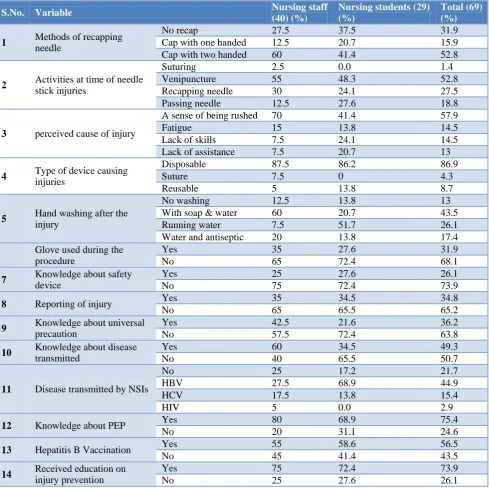
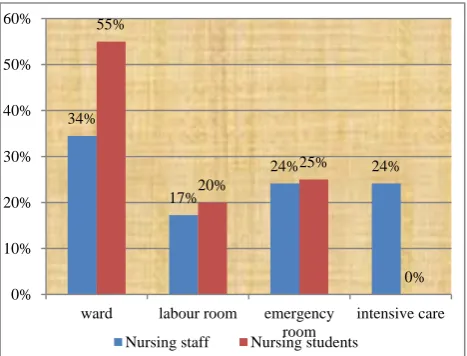
Table 1 illustrates the demographic characteristics of the health care workers. According to which 26% males and 74% females suffered from NSIs. With respect to age distribution, the highest rate of injuries (71%) was revealed in the age group 20-29 years, while in more than 40 years of age, the nurses were affected least (3%). Table 2 shows that prevalence of NSIs among nurses was 69%. Among these, nursing students had suffered more NSIs (58%) compared to the nursing staff (42%). According to Figure 1, the injuries occurred maximally in those nurses who had a job experience of less than one year. Most of these injuries happened during an attempt to venipuncture of the needle (52.8%), and much less while recapping (27.5%), and suturing (1.4%). As per Table 3 those nurses who suffered from NSIs (69%), the maximum source of injury was self inflicted (76.8%) followed by due to someone else (23.2%) as shown in Figure 2. Table 4 shows that majority of NSIs was occurred in the ward (46.3%) followed by Emergency department (24.6%) and labor room (18.8%) as in Figure 3. In Table 5, KAP (Knowledge, Aptitude and Practices) study shows the poor practices and less knowledge of procedures, recapping, safety device, reporting and PEP (post exposure prophylaxis) among the nurses attributed to the NSIs.
Table 1: Demographic characteristic of health care workers.
S. No. Variables No
1
Age (years)
<19 14
20–29 71
30–39 12
>40 3
2
Sex
Male 26
Female 74
3
Job category
Nursing staff 50
Nursing students 50
4
Work experience (in years)
<1 69
1-4 22
5-9 8
>10 1
Total 100
Table 2: Distribution of needle sticks injuries among nurses since previous 12 month.
Health care workers
NSI (Present) No. (%)
NSI (Absent) No. (%)
Statistical values Nursing staff 29 (42) 21(67.7)
X2 =5.66 P=0.017 Nursing student 40 (58) 10(32.3)
Table 3: Association of healthcare workers with type of injuries.
Healthcare workers Self inflicted (accidents)
N (%)
Someone else N (%)
Total
N (%) Statistical values
Nursing staff 26 (49.1) 3 (18.8) 29 (42)
X2 =4.633 P=0.031
Nursing students 27 (50.9) 13 (81.2) 40 (58)
Total 53 (100) 16 (100) 69 (100)
Table 4: Distribution of health care workers according to work place at the time of injuries.
Health care workers
Ward N (%)
Labor room N (%)
Emergency dept. N (%)
Intensive care unit N (%)
Total N (%)
Statistical values
Nursing staff 10 (34.5) 5 (17.2) 7 (24.1) 7 (24.1) 29 (100)
X2 =11.25 P=0.0104
Nursing student 22 (55) 8 (20) 10 (25) 0 (0.0) 40 (100)
Total 32 (46.3) 13 (18.8) 17 (24.6) 7 (10.1) 69 (100)
Table 5: Knowledge, attitude and practice after needle stick injuries among nursing staff and nursing students.
S.No. Variable Nursing staff
(40) (%)
Nursing students (29) (%)
Total (69) (%)
1 Methods of recapping needle
No recap 27.5 37.5 31.9
Cap with one handed 12.5 20.7 15.9
Cap with two handed 60 41.4 52.8
2 Activities at time of needle stick injuries
Suturing 2.5 0.0 1.4
Venipuncture 55 48.3 52.8
Recapping needle 30 24.1 27.5
Passing needle 12.5 27.6 18.8
3 perceived cause of injury
A sense of being rushed 70 41.4 57.9
Fatigue 15 13.8 14.5
Lack of skills 7.5 24.1 14.5
Lack of assistance 7.5 20.7 13
4 Type of device causing injuries
Disposable 87.5 86.2 86.9
Suture 7.5 0 4.3
Reusable 5 13.8 8.7
5 Hand washing after the injury
No washing 12.5 13.8 13
With soap & water 60 20.7 43.5
Running water 7.5 51.7 26.1
Water and antiseptic 20 13.8 17.4
Glove used during the procedure
Yes 35 27.6 31.9
No 65 72.4 68.1
7 Knowledge about safety device
Yes 25 27.6 26.1
No 75 72.4 73.9
8 Reporting of injury Yes 35 34.5 34.8
No 65 65.5 65.2
9 Knowledge about universal precaution
Yes 42.5 21.6 36.2
No 57.5 72.4 63.8
10 Knowledge about disease transmitted
Yes 60 34.5 49.3
No 40 65.5 50.7
11 Disease transmitted by NSIs
No 25 17.2 21.7
HBV 27.5 68.9 44.9
HCV 17.5 13.8 15.4
HIV 5 0.0 2.9
12 Knowledge about PEP Yes 80 68.9 75.4
No 20 31.1 24.6
13 Hepatitis B Vaccination Yes 55 58.6 56.5
No 45 41.4 43.5
14 Received education on injury prevention
Yes 75 72.4 73.9
Figure 1: Needle sticks injuries according to their work experience (in years).
Figure 2: Type of injuries among health staffs.
Figure 3: Place of duty where NSI happened.
DISCUSSION
This study assesses the prevalence as well as knowledge, attitude and practices of NSIs. Among this study, the prevalence of NSIs (69%) was considerably lower than a study where it was found that 80% of nurses were exposed to NSIs.11 Among the persons suffering from
NSIs, majority (74%) were females. Similar findings were also seen in other studies.12 In present study, the higher percentage of NSIs was seen in wards (46.2%), while less percentage were seen in a study by Jayanth et al in medicine ward (42.24%).13 Most of the injuries reported were due to disposable syringes (86.9%). In another study 30.5% incidents of injury were caused by solid-bore needle.14 In the present study, a sense of being rushed (57.9%) was the leading cause of their injury while lack of experience, insufficient training and fatigue leads to occupational sharp injuries and this was also seen in many other procedures.15 Venipuncture (52.8%) for blood collection and suturing (1.4%) was the most common procedure of the NSI in this study. This is in contrast to other studies where suturing was the most common procedure (29-46%) responsible for NSI.16 Among the injured nurses, majority (68.1%) were not using gloves, however, in another study only 28% of the health care workers in Iran did not use any personal protective equipment.17 In this study, majority of site of injury is washed with soap & water (43.5%). The World Health Organization recommended that the site of injury should be allowed to bleed briefly and then should immediately be washed thoroughly with running water and antiseptic solution.18 In this study majority of the nurses had poor knowledge about the hospital policies and about disease transmitted (50.7%). The poor knowledge about safety device (73.9%), universal precaution (63.8%) and bad practice about recapping (52.8%) attributed to the NSIs. A study conducted in Pakistan at Holy Family Hospital revealed that of the nurses had good knowledge (73.3%) about NSIs and the diseases caused by them.19 In this study about one third (34.8%) of nurses reported NSIs while in Prasuna et al study nursing students (54.5%) did not report NSI.20 In our study hepatitis B vaccination was 56.5% among the nurses. However a similar study conducted in Pakistan at a tertiary care hospital indicated that 82% of nurses had vaccinated.19
CONCLUSION
The prevalence of NSIs in the study group was 69.0% per year. Accidents of this kind were most common in nurses working in wards. The injuries were self-inflicted in the vast majority of cases. The most important factor that causes NSI was venipuncture. Health care providers should get training to fill the skill gap, apply universal precaution and never recap needles after use. It is recommended that every hospital should develop a multi-pronged strategy to deal with NSI. Besides health promotion, an adequate surveillance mechanism should be set up in every large hospital and also, facilities for prompt response and treatment of NSI should be provided.
Funding: No funding sources Conflict of interest: None declared
Ethical approval: The study was approved by the Institutional Ethics Committee
0% 10% 20% 30% 40% 50% 60% 70%
< 1 1-4 5-9 ≥10 62%
25%
6% 7% 13%
19%
26%
42% NSI Present
NSI Absent
49.10% 50.90%
18.80%
81.20%
0.00% 20.00% 40.00% 60.00% 80.00% 100.00%
Nursing staff Nursing students Type of injuries
self someone else
34%
17%
24% 24%
55%
20%
25%
0% 0%
10% 20% 30% 40% 50% 60%
ward labour room emergency room
intensive care
REFERENCES
1. Kelen GD, Fritz SF, Qaqish B. Unrecognized HIV infection in emergency Department patients. N Engl J Med. 1998;38:1645-50.
2. Clark PF, Clark DA. World Survey of Nurses Unions and Associations: preliminary report. Hershey, PA: Penn State University, 2000.
3. Medicalkenya. Nursing matters – WHO fact sheets. Nairobi: Medicalkenya; 2011.
4. Jagger J, Hunt EH, Brand-Elnaggar J, Pearson RD.Rates of needlestick injury caused by various devices in a university hospital. N Engl J Med. 1988;319:284-8.
5. World Health Organization: The world health report: 2002: Reducing risks, promoting healthy life. Geneva: World Health Organization; 2002.
6. Calver J. Occupational Health Services. Am J Infect Control. 1997;25:363-5.
7. Elmiyeh B, Whitaker I, James M, Chahal C, Galea A, Alshafi K. Needle-stick injuries in the National Health Service: a culture of silence. J Royal Society Med. 2004;97(7):326–27.
8. Shoghli A, Mousavi Nasab N, Ghorchian F, Masoumi H, Momtazi S. Study of the Needle Sticks Injury (NSI) among the Zanjan Educational Hospitals Staff. ZUMS J. 2013;21(85):131–41. 9. Sahasrabuddhe AG, Suryawanshi SR, Khare R.
Determinants of occupational exposure to blood borne pathogens among resident doctors in a tertiary care hospital in the city of Mumbai. Int J Med Sci Public Health. 2014;3:1014–7.
10. Joardar GK, Chatterjee C, Sadhukhan SK, Chakraborty M, Dass P, Mandal A. Needle sticks injury among nurses involved in patient care: a study in two medical college hospitals of West Bengal. Indian J Public Health. 2008;52(3):150-2. 11. Muralidhar S, Singh PK, Jain RK, Malhotra M, Bala
M. Needle stick injuries among health care workers in a tertiary care hospital of India. Indian J Med Res. 2010;131:405-10.
12. Li Z, Sengane ML, Setswe KG. Knowledge and experiences of needle prick injuries among nursing
at a university in Gauteng, South Africa. SA Fam Pract. 2008;50(5):48-50.
13. Jayanth ST, Kirupakaran H, Brahmadathan KN, Gnanaraj L, Kang G. Needle stick injuries in a tertiary care hospital. Indian J Med Microbiol. 2009;27(1):44-8.
14. Sharma R, Rasania, SK, Verma A, Singh S. Study of prevalence and response to needle stick injuries among health care workers in a tertiary care hospital in Delhi, India. Indian J Community Med. 2010;35(1):74–7.
15. Rogers B, Goodno L. Evaluation of interventions to prevent needle stick injuries in health care occupations. Am J Prev Med. 2000;18:90-8. 16. Mbaisi EM, Ng’ang’a Z, Wanzala P, Omolo J.
Prevalence and factors associated with percutaneous injuries and splash exposures among health-care workers in a provincial hospital, Kenya, 2010. Pan Afr Med J. 2013;14:10.
17. Askarian M, Malekmakan L. The prevalence of needle stick injuries in medical, dental, nursing and midwifery students at the university teaching hospitals of Shiraz, Iran. Indian J Med Sci 2006;60:227-32.
18. World Health Organization. Practical Guidelines for Infection Control in Health Care Facilities. Geneva: World Health Organization; 2004.
19. Siddique K, Mirza S, Tauqir SF, Anwar I, Malik AZ. Knowledge, attitude and practices regarding needle stick injuries amongst healthcare providers. Pak J Surg. 2008;24:243-8.
20. Prasuna J, Sharma R, Bhatt A, Arazoo A, Painuly D, Butola H, et al. Occurrence and knowledge about needle stick injury in nursing students. J Ayub Med Coll Abbottabad. 2015;27(2):430-3.