NEXT GENERATION 5G SATELLITE WIRELESS
COMMUNICATION SYSTEMS: CHALLENGES AND
EVOLUTION
Hridaya Nand Sah
Department of Mathematics, Raja Singh College, Siwan, Bihar, India, Pin-841226.
ABSTRACT: The main objective of this paper is a detailed and comprehensive study about the evolution
of the different mobile generation technologies in the wireless communication. This paper also gives an overview of mobile communication technologies developed so far and also throws some light on what can we expect from the future of mobile world. Mobile communication has become a major source for information exchange throughout the world. An year by year, we see lot of development in the world of mobile
technology. The 5G-technology stands for the 5th Generation Mobile technology. 5G is a next major phase
of mobile telecommunications standards beyond the 4G standards.5G is expected to provide speed upto 10Gbit/s, wider frequency band, high increased peak bit rate, high system spectral efficiency, ubiquitous connectivity and significant increase in QoS as compared to current 4G technology. Evolution of mobile communication technology to 5G is discussed in this review, followed by protocol stack and 5G architecture. A wide comparison is given between the various generations so as to compare why 5G technology is better and needed.
Keywords: Mobile Phone, Wireless Communication Technology.5G Architecture, Evolution from 1G to
5G, etc.
I. INTRODUCTION
We are exists in a 21ST Century science world where no one can even imagine a one second without
phones in which different technologies were used like push to talk, mobile telephone system, improved mobile telephone system etc. Martin Cooper, an employee of Motorola Company is considered as key player as he developed the first mobile phone. Before him, handsets were used in vehicles, but he came with the development of first truly portable mobile phone. History was created in April 1972 with first call made on a mobile phone. A “G” refers to generation, related to next generation wireless technologies. We have gone through a very big change in the generation of mobile communication. Each of the generation is making us faster, secure as well as more reliable as compared to previous ones. It is hard to overcome this reliability factor. We see smart phones as our companions today and we are dependent on these devices in large number of ways. Below we start with the generation 1G of mobile world, moving towards all the latest development that has been done up to 7.5 G connectivity.
II. 5G SATELLITE WIRELESS COMMUNICATION SYSTEM
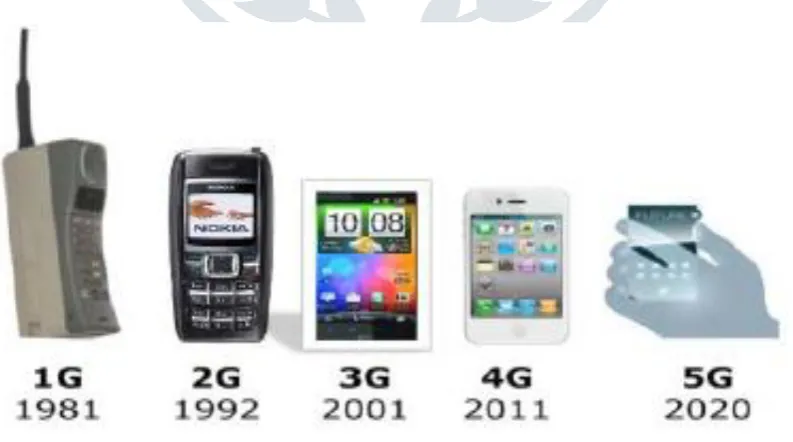
5G technology is definitely the next most crucial mobile technology stage after 4G networks [6]. It can be called as the real wireless world because it is a complete wireless communication with no boundaries.5G is expected to be an intelligent innovation technology which will interconnect the whole world with no limits. Now 5G is not a formally utilized term but new versions will give rise to system performance and in addition to this it will add latest features with new application domain. Figure 1 shows evolution of 1G to 5G. 5G is futuristic mobile technology which will be a successor of 4G network technology. 5G is a Fifth Generation wireless communication technology. 5G is an unused network system that has undoubted high data rate, trustworthy and low latency than the preceding generations. 5th generation technology framed on the footing created by 4G, the technologies to be used in 5G, are still being outlined. The 5th generation networks works on encoding type known as OFDM. The air interface outlined for considerable lower latency and better adaptability. 5G networks can work as low frequencies and high as “millimeter wave” and that frequency can communicate huge quantity of information/data, but few blocks at a moment of time. 5G networks are further probably to be networks of mini cells such as size of a house router than to be big tower; it is to extend network scope. The objective is to have great speed accessible and large scope at low latency than 4G. The latency rate of 4G is close to 50 milliseconds, but 5G cut down to almost one millisecond. This is specifically valuable for driverless vehicles and automated applications. The purpose of 5G is to achieve transmission speed to 20-30Gbps, which is 50 times speedy than 4G networks. And its speed has been being tested uninterrupted up to 1.5Gbps while traveling 100km/h and max up to 7.5 Gbps. 5th generation network is determine to provide up to a million of connections per square kilometer. It also implies the whole wireless world interconnection together with very high data rates.
III. IMPORTANCE 5G MOBILE GENERATION 1. Very High speed, high capacity, and low cost per bit.
2. It supports interactive multimedia, voice, video, Internet, and other broadband services, more effective and more attractive, and have Bi- directional, accurate traffic statistics.
3. 5G technology offers Global access and service portability. 4. It offers the high quality services due to high error tolerance.
5. It is providing large broadcasting capacity up to Gigabit which supporting almost 65,000 connections at a time. More applications combined with artificial intelligent (AI) as human life will be surrounded by artificial sensors which could be communicating with mobile phones.
6. 5G technology use remote management that user can get better and fast solution. 7. The uploading and downloading speed of 5Gtechnology is very high.
8. 5G technology offer high resolution for crazy cell phone user and bi-directional large bandwidth shaping.
9. 5G technology offer transporter class gateway with unparalleled consistency.
IV. ADVANTAGES OF 5G WIRELESS COMMUNICATION SYSTEMS
5G (Fifth generation) objective is at providing countless of utility to the consumer at high speed. The applications developed to use these utilities are highly customer companionable; curtail the intercommunication among the application and the customer. For example, unification of speech recognition technology in the user interfaces would ease the use of the applications for each user.
1. 5G targets at providing a unified global standard which will facilitate global mobility and service portability.
2. 5G stations and networks will provide common services independent of their capabilities. This is also called as service personalization.
3. It is expected to provide wireless download speeds of above 1Gbps in Local Area Network (LAN) and 500 Mbps in Wide Area Network (WAN), about 40 times greater than the 4G wireless
networks.
4. Its focus at lower power consumption.
5. It would provide users access to large repository of data and services where he would have flexibility to filter these data and services as per his preferences by configuring the operational mode of their devices.
6. Better network convergence 7. Provide higher bandwidth 8. More effective and efficient
9. Most likely, will provide a huge broadcasting data (in Gigabit), which will support more than 60,000 connections.
10. 5G offers high resolution to the users.
11. It provides high speed, capacity and low cost per bit. 12. It offers global access.
13. It offers transporter class gateway with unparalleled consistency. 14. It has high error tolerance thus offers high quality services. 15. It supports interactive media, video, internet.
16. It provides high uploading and downloading speed to the users. 17. It provides large broadcasting of data in Gigabits.
18. It also supports virtual private network.
THE FEATURES OF 5G: 1. Multimedia Newspapers.
2. TV programs with clarity as good as HD TV. 3. Fast data transmission.
6. One unified global standard.
7. Cognitive radio technology, also known as smart radio.
8. 5G technology is providing large broadcasting of data inGigabit which supporting almost 65,000 connections
V. COMPARISION OF MOBILE GENERATIONS 1G TO 5G
Wireless communication has started in early 1970s. In next four decades, a mobile wireless technology has evolved from 1G to 5G generations. Fifth generation technology offer very high bandwidth that user never experienced before. The Fifth generation technologies offer various new advanced features which makes it most powerful and in huge demand in the future. The table 2 shows the comparison between different mobile technologies that evolved through years. The table gives a detailed description about features, start/deployment time, data bandwidth, services and the type of core network. The table indicate significance rise of data bandwidth from 1G to 5G along with inclusion of FDMA, TDMA, CDMA technologies. The services were also given more priority compared to its previous generations.
Table: 2 COMPARISION OF MOBILE GENERATIONS 1G TO 5G
VI. CONCLUSIONS
may face hand off /roaming issue which in fact drives us to 7G mobile wireless networks whose ultimate aim is to acquire space roaming. And 7.5G on the other hand will bring some more changes to 7G, thereby giving benefits to mobile users. By looking at the growth of all these technologies with time, we are sure that wireless world of these technologies will bring tremendous change in our lives. The development of the mobile and wireless networks is going towards higher data rates and all-IP principle. Mobile terminals are obtaining each year more processing power, more memory on board, and longer battery life for the same applications. 5G include latest technologies such as cognitive radio, SDR, nanotechnology, cloud computing and based on All IP Platform. It is expected that the initial Internet philosophy of keeping the network simple as possible, and giving more functionalities to the end nodes, will become reality in the future generation of mobile networks, here referred to as 5G.
ACKNOWLEDGMENTS
One of the authors DR. HRIDAYA NAND SAH takes this opportunity to thank Prof. (Dr.) B.K. Azad
(M.Sc., PhD), Retired Principal, R.D.S. College, Muzafferpur Former HOD, Department of Mathematics R.D.S. College, Muzafferpur, Bihar (INDIA), for numerous discussions, valuable suggestion and help in preparing the present research paper for publication. I also feel indebted to some scientific spiritualists who provided us the enthusiasm to undertake scientific studies with a wholesome attitude.
LIST OF REFERENCES:
[1] J. M. Pereira, Fourth Generation: Now, It Is Personal.
[2] B. G. Evans and K. Baughan, Visions of 4G, Electronics and Communication Engineering Journal, Dec. 2002.
[3] M. Nekovee, A survey of cognitive radio access to TV white spaces, Int. J. Digi. Multimed. Broadcast.
[4] R. N. Mitra and D. P. Agarwal, 5G Mobile Technology: A Survey, ICT Express, Vol.1, Issue.3, pp. 132-137, Dec 2015.
[5] J. G. Andrewa et.al, What Will be 5G? IEEE Journal on Selected Areas in Communications, Vol.32, Issue.6, pp. 1065-1082, June 2014.
[6] DMC R&D Center, 5G Vision White Paper, 2015.
[7] Payal, B. Dhruv and P. Kumar, A Research Based Study on Evolution of Cellular Generations, International Journal of Advanced Research in Computer and Communication Engineering, Vol.3, Issue.7, pp 7522-7525, 2014.
[8] S. Hossain, 5G Wireless Communication Systems, American Journal of Engineering Research, Vol.2, Issue.10, pp. 344-353, 2013.
[9] R. Henderson and M. Langridge, What is 5G, When is it Coming and Why do we Need it?, Jan. 2017.
[10] M. H. Khan and P.C. Barman, 5G- Future Generation Technologies of Wireless Communication Revolution -2020, American Journal of Engineering Research, Vol. 4, Issue. 5, pp 206-215, 2015. [11] 5G Wireless Architecture: By Vadan Mehta.
[12] T.V. N. Rao, 5G technologies-An anecdote of network service for the future‖, Journal of
Global Research in Computer Science Volume 2 No (7), July 2011 164-170.
[13] V. K. Singh& Dr. H. N. Sah, Satellites System in Neighborhood of Parametric Resonances, International Journal of Creative Research Thoughts, Vol. 6, issue 1, Fab., 2018, pp 1658-1661.
[14] H. Asmat, and S. Ullah, The Impact of Existing and Future Mobile Technologies on Pakistan: A Survey, International Journal of Future Computer and Communication, Vol. 4, No. 4, August 2015.
[15] F. Boccardi et al., "Vodafone," Communications Magazine, Vol. 52, No. 2, 2014.
[16] M. R. Bhalla, A. V. Bhalla, Generations of mobile wireless technology: A Survey, International Journal of Computer Applications, Volume 5– No.4, August 2010.