EFFECT OF EARTHQUAKE ON HIGH RISE
BUILDING IN DIFFERENT POSITION OF
SHEAR WALL USING STAAD PRO
1Amit A. Paul, 2Prof. G. D. Dhawale, 3Prof. V. A. Kalmegh
1M-Tech Research Scholar (Structural Engineering),
Department of Civil Engineering, BDCE, Sevagram, Wardha, MH. 2 3
Asst. Professor, Department of Civil Engineering, BDCE, Sevagram, Wardha, MH.
Abstract:
The present study reports the effect of earthquake on high rise building in different position of shear wall using Staad Pro to work out effective, economical and ideal location of shear walls. G+7 high rise building in zone IV for Delhi is considered for the present study. Analysis of the building is conferred with some preliminary investigations, analyzed by varied position of shear wall by considering five models as without shear wall building, shear wall along periphery, shear wall at corner, shear wall in middle and shear wall at corner in different position. Maximum shear wall moments and maximum deflections are calculated and analyzed for all considered cases. M30 grade of concrete is used with Fe415 steel is used for the present study. The design and analysis are complete using the software package STAAD Pro.
Keywords— Shear Walls, Staad Pro, Lateral forces, Stiffness.
I. INTRODUCTION
Earthquake is one of the most destructive natural hazards in more damages in manmade structures. The stability and stiffness of any structure is the major issue of concern in any high rise buildings. Shear walls are structural members which resist lateral forces predominant on moment resisting frame. Shear walls are most preferred structural walls for earthquake resistance. This research is related to comparison of shear wall type structure with moment resisting type of building. The present study includes five types of models with G+7 storey building, moment resisting frame i.e. model 1, shear wall along periphery i.e. model 2, shear wall at corner i.e. model 3,shear wall in middle i.e. model 4, shear wall at corner in different position i.e. model 5. Models of the four structures with same loading be create on STADD Pro and be present analyzed and further they will be compared for their suitability and loads be applied as per the IS specifications. The analysis will be conducted as per the specifications of IS standards IS 1893, IS 875, IS 456.
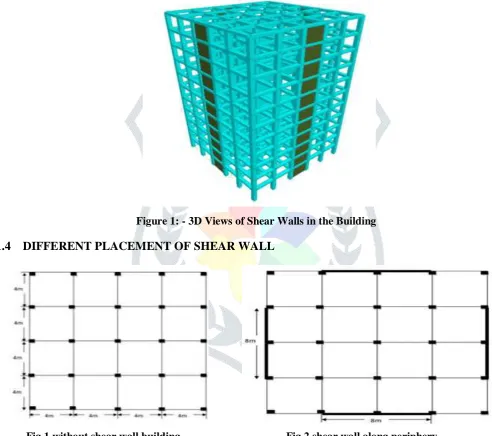
Shear wall is a structural member positioned at different places in a building from foundation level to top parapet level, used to resist lateral forces i.e. parallel to the plane of the wall. When lateral displacement is large in a building with moment frames only, structural walls, often commonly called shear walls, can be introduced to help reduce overall displacement of buildings, because these vertical plate-like structural elements have large in-plane stiffness and strength. There are different materials by which shear wall can be constructed but reinforced concrete (RC) buildings often have vertical plate-like Reinforced concrete walls (Figure 1) in addition to slabs, beams and columns. Their thickness can be as low as 150mm, or as high as 400mm in high rise buildings. Shear walls are usually provided along both length and width of buildings.
1.1 BASIS FOR SELECTION OF PROJECT TOPIC
The earthquake in general has had a long history of deadly devastation in the past. Every year all over the world number of earthquakes strikes the earth with low and high intensities.
Delhi is vulnerable to earthquakes, for this present study assigning zone IV for moderate seismic intensity as stated in table 2 of IS 1893 – 2002 (Part 1).
Because at least three to four earthquakes occur in 1year in Delhi. Richter scale recorded 2.7 magnitude.
Currently earthquake in Delhi NCR for date 02/02/2019 recorded on Richter Scale is 5.34 magnitude.
1.2 NEED OF EARTHQUAKE ON SHEAR WALL IN HIGH RISE BUILDING
2. Generally, shear walls are either plane in section, while core walls consist of channel sections. 3. They also provide adequate strength and stiffness to control lateral displacements.
1.3 REQUIREMENT OF EARTHQUAKE ON SHEAR WALL IN HIGH RISE BUILDING
1. Shear wall is a Structural member used to resist lateral force i.e. parallel to plane of the wall.
2. Shear walls provide large strength and stiffness to buildings in the direction of their orientation, which significantly reduces lateral sway of the building and thereby reduces damage to structure and its contents. 3. Since shear walls carry large horizontal earthquake forces, the overturning effects on them are large. 4. These walls generally start at foundation level and are continuous throughout the building height. 5. Their thickness can be as low as 150mm, or as high as 400mm in high rise buildings.
Figure 1: - 3D Views of Shear Walls in the Building
1.4 DIFFERENT PLACEMENT OF SHEAR WALL
Fig.3shear wall at corner Fig.4shear wall in middle
Fig.5shear wall at corner
II. LITERATURE REVIEW
1
Prasad Ramesh Vaidya Building was modelled by using finite element software SAP 2000. Beams and columns were modelled as two nodded beam elements with six degree of freedom at each node. Slab and shear wall were modeled by using shell element. Walls were modelled by equivalent strut approach. The thickness of strut was same as thickness of brick infill wall and only width of the strut was derived. Four models for the building were prepared. Model one was of frame type structural system and other three models were of shear wall frame interaction system. Total four shear walls were provided two on sloping side and other two on other side of the building. In model II all the four walls were provided towards the shorter columns of the building on corner, i.e. two on sloping side and two on other side. In model III all the four walls were provided towards the longer columns of the building. In model IV shear walls were arranged symmetrically in plan. Response spectrum analysis was carried out on the models as per IS 1893 (Part 1): 2002.
2
Tarun shrivastava, Prof. Anubhav Rai They have conducted the study on effectiveness of shear wall frame structure subjected to wind loading in multi-storey building. Different cases were prepared with different configuration of shear wall. Frames of 8 storey R.C.C. structure in medium soil with a ground plan of 20m x 18m and height of the structure is 25.6m. Assuming wind pressure of 1.5 kN/m2 and special moment resisting frame, analysis was carried out with shear wall at different location for regular shape building. Various parameters such as lateral deformation, storey drift index, maximum bending moment and shear force were calculated. Result showed that model 3 with core shear wall case is most suitable as moment percentage of moment and shear force resisted by shear wall in this case is 93.2% and 98% which was much greater than other cases. Also model 3 is stiffer against lateral loads. Study concluded that effectiveness of shear wall was not helping too much in reducing the base shear but providing more lateral stiffness and taking maximum share of the moment.
3M. Pavani, G. Nagesh Kumar, Dr. Sandeep Pingale This paper mainly focuses on analysis and design
Ehsan Salimi Firoozabad, Dr. K. Rama Mohan Rao Determined the shear wall configuration on seismic act of building. The top storey displacements for different configurations were obtained using SAP 2000. From the study it was observed that the top storey drift can be reduced by changing the location of shear wall and it was suggested that the quantity of shear wall could not affect the seismic behavior of buildings. Different place of shear walls can reduce the top story drift at least twice, which means the drift of building is reduced 100 percent from highest value to lowest one. The quantity of shear walls cannot guarantee the seismic behavior of buildings, which means, if you provide more shear walls.
5
Shaik Kamal Mohammed Azam, Vinod Hosur They have conducted the study on seismic performance evaluation of multistoried RC framed building with shear wall. The elastic as well as in-elastic analysis were carried out for the evaluation of seismic performance on 6, 12, 24 and 36 storied moment resisting RC framed building using ETAB software. Eight models were prepared for each type of storey with plan area of 30m x 20m and height of 3m. Approximate method was used for lateral static and dynamic analysis of wall frame based on the continuum approach and one-dimensional finite element method. Structure was analyzed for various load combination as per IS 1893 (Part 1): 2002 for seismic zone. Capacity curve was drawn based on load deformation responses. Result showed that the storey displacement for 6 and 12 storey building behave like shear building due to less height, while 24 and 36 storey building exhibit flexural behavior as grater height than lateral dimension. Non-linear static pushover analysis showed that lateral stiffness has the least value for the model without shear wall and also influence of shear wall was quite large for shorter building.
6
Seyed M. Khatami, Alireza Mortezaei, Rui C. Barros This paper presented the results of time history analysis which addressed the effect of openings in shear walls near- fault ground motions. A model of ten storey building with three different types of lateral load resisting system: Complete shear walls, shear walls with square opening in the center and shear wall with opening at right end side were considered. From the results it was practical that shear walls with openings experienced a decrease in terms of strength. The maximum lateral displacement of complete shear wall is 17% less than that of shear walls with openings at center whose displacement is found to be 8% less than that of shear walls with beginnings at right end.
7
Romy Mohan, C Prabha This paper presented dynamic analysis of RCC buildings with shear Wall. For study consider the two multi storey structures, one of six and other of eleven storey have been modeled using software package SAP 2000 for earthquake zone V in India. Six different types of shear walls with its variation in shape are considered for learning their effectiveness in resisting lateral forces. This paper also contracts with the effect of the variation of the building height on the structural response of the shear wall.
III. OBJECTIVES
The primary objectives of this project can be summarized as follows: 1. To analyze an earthquake resistant structure using STAAD Pro.
2. Analyze the same structure with rectangular shear wall for earthquake resistance. But only the difference provides a different position of the shear wall.
3. Comparing the effect earthquake forces for without shear wall building, shear wall along periphery, shear
wall at corner,shear wall in middle, shear wall at corner in different position of structure in shear wall
building.
4. Establishing a comparison between the five types of structure and analyzing the result and establishing a needful resemblance with effectiveness.
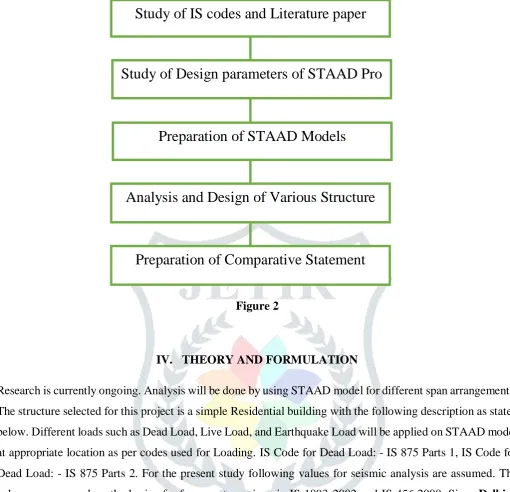
IV. RESEARCH METHODOLOGY
Figure 2
IV. THEORY AND FORMULATION
Research is currently ongoing. Analysis will be done by using STAAD model for different span arrangements.
The structure selected for this project is a simple Residential building with the following description as stated
below. Different loads such as Dead Load, Live Load, and Earthquake Load will be applied on STAAD model
at appropriate location as per codes used for Loading. IS Code for Dead Load: - IS 875 Parts 1, IS Code for
Dead Load: - IS 875 Parts 2. For the present study following values for seismic analysis are assumed. The
values are assumed on the basis of reference steps given in IS 1893-2002 and IS 456:2000. Since Delhi is
vulnerable to earthquakes, for this present study assigning zone IV for moderate seismic intensity as stated in
table 2 of IS 1893 – 2002. All the results obtain from STADD Pro structural software and these results are
compared in tabular form.
V. REFERENCE
[1] Prasad Ramesh Vaidya, “Seismic Analysis of Building with Shear Wall on Sloping Ground”,
International Journal of Civil and Structural Engineering Research (IJCSER), ISSN No: 2348-7607,
Volume 2, Issue 2, October 2014 - March 2015, pp.53-60.
[2] Tarun shrivastava and Prof. Anubhav Rai, “Effectiveness of Shear Wall-Frame Structure Subjected to
Wind Loading in Multi-Storey Building”, International Journal of Computational Engineering
Research (IJCER), ISSN No: 2250 – 3005, Volume 5, Issue 2, February 2015, pp.20-28.
[3] M. Pavani, G. Nagesh Kumar and Dr. Sandeep Pingale, “Shear Wall Analysis and Design
Optimization in Case of High-Rise Buildings Using ETABS (Software)”, International Journal of
Study of IS codes and Literature paper
Study of Design parameters of STAAD Pro
Preparation of STAAD Models
Analysis and Design of Various Structure
Scientific & Engineering Research (IJSER), ISSN No: 2229-5518, Volume 6, Issue 1, January 2015,
pp.546-559.
[4] Ehsan Salimi Firoozabad and Dr. K. Rama Mohan Rao, “Effect of Shear Wall Configuration on
Seismic Performance of Building”, Proc. Of Int. Conf. On Advances in Civil Engineering (PICACE),
2012, pp.121-125.
[5] Shaik Kamal Mohammed Azam1 and Vinod Hosur2, “Seismic Performance Evaluation of
Multistoried RC Framed Buildings with Shear Wall”, Journal of Scientific & Engineering Research
(JSER), ISSN No: 2229-5518, Volume 4, Issue 1, January 2013, pp.1-6.
[6] Seyed M. Khatami, Alireza Mortezaei and Rui C. Barros, “Comparing Effects of Openings in Concrete
Shear Walls Under Near-Fault Ground Motions”, The 15th World Conference on Earthquake
Engineering (WCEE), 2012, pp.1-10.
[7] Romy Mohan and C Prabha, “Dynamic Analysis of RCC Buildings with Shear Wall”, International
Journal of Earth Science and Engineering (IJESC), ISSN No: 974-5904, Volume 04, October 2011,
pp.659-662.
[8] B. Ramamohana Reddy and M. Visweswara Rao, “Earthquake Resistant Design of a Building Using
Shear Wall”, International Journal & Magazine of Engineering, Technology, Management and
Research (IJMETMR),ISSN No: 2348-4845, Vol. 2, Issue 10, October 2015, pp.415-421.
[9] P. P. Chandurkar and Dr. P. S. Pajgade, “Seismic Analysis of RCC Building with and Without Shear
Wall”, International Journal of Modern Engineering Research (IJMER), ISSN No: 2249-6645, Vol. 3,
Issue. 3, May - June 2013, pp.1805-1810.
[10] Alokkumar A. Mondal, Miss. Deepa Telang and Mrs. Gitadevi. B. Bhaskar, “Comparing the Effect of
Earthquake on High-Rise Building with Shear Wall and Flange Concrete Column”, International
Journal for Research in Applied Science & Engineering Technology (IJRASET), ISSN No:
2321-9653, Vol. 5, Issue. 7, July 2017, pp.697-711.
[11] Shyam Bhat M, N. A. Premanand Shenoy and Asha U Rao, “Earthquake Behaviour Of Buildings with
And Without Shear Walls”, IOSR Journal of Mechanical and Civil Engineering (IOSR-JMCE),
e-ISSN No: 2278-1684, p-e-ISSN No: 2320-334X, 2015, pp.20-25.
[12] Ali Fathalizadeh, “Introducing Two Most Common Types of Shear Walls and Their Construction
Methods”, Journal of Civil Engineering Researchers (JCER), February 2017, pp.7-12.
[13] Bhruguli H. Gandhi, “Effect of Opening on Behaviour Of Shear Wall”, International Journal for
Technological Research in Engineering (IJTRE), ISSN No: 2347 – 4718, Vol. 3, Issue. 4, December
2015, pp.875-878.
[14] Vishal A. Itware and Dr. Uttam B. Kalwane, “Effects of Openings in Shear Wall on Seismic Response
of Structure”, International Journal of Engineering Research and Applications (IJERA), ISSN No:
2248-9622, Vol. 5, Issue. 7, July 2015, pp.41-45.
[15] Venkata Sairam Kumar, Surendra Babu and Usha Kranti, “Shear Walls- A Review”, International
Journal of Innovative Research in Science, Engineering and Technology (IJIRSET), ISSN No:
[16] Sanjeebanee Behera and P.K Parhi, “Studies on Location of Shear Wall in Buildings for Structural
Stability”, International Journal of Research in Engineering and Technology (IJRET), e-ISSN No:
2319-1163, p-ISSN No: 2321-7308, Vol. 6, Issue. 6, Jun 2017, pp.116-122.
[17] Pradnya Nagrale and Dr. M. M. Mahajan, “Critical Study of The Buildings with Shear Walls for The
Best Suitable Placement”, Journal of Civil Engineering and Environmental Technology (JCEET),
e-ISSN No: 2349-879X, p-e-ISSN No: 2349-8404, Vol. 2, June 2015, pp. 54 -57.
[18] Swathi P and Haritha P. S, “Effective Distribution of RC Shear Wall in Buildings”, International
Journal of Engineering Trends and Technology (IJETT), ISSN No: 2231-5381, Vol. 37, July 2016,
pp.363-367.
[19] S.K. Duggal, “Earthquake Resistant Design of Structures”, Second Edition, 2013, Oxford University
Press, ISBN- 0-19-808352-1.
[20] IS 875 (part-1), “Code of Practice for Design Loads (Other Than Earthquake) For Building and Structures”, Dead loads, New Delhi, 1987.
[21] IS 875 (part-2), “Code of Practice for Design Loads (Other Than Earthquake) For Building and
Structures”, Imposed loads, New Delhi, 1987.
[22] IS 1893:2002 (Part 1), “Criteria for Earthquake Resistant Design of Structures”, Fifth revision, Bureau
of Indian Standards, New Delhi.
[23] IS 456:2000, “Plain and Reinforced Concrete Code of Practice”, Fourth revision, Bureau of Indian