Original Research Article.
Sex Determination of Human Mandible in Population of Bihar by
Using Metrical Parameters
Aman Kumar
1, Md. Jawed Akhtar
2*, Binod Kumar
3, Rajiv Ranjan Sinha
3,
Avanish Kumar
4, Sanjeev Kumar
51Additional Professor, 5Associate Professor,
Department of Forensic Medicine & Toxicology, Indira Gandhi Institute of Medical Sciences, Patna, Bihar, India. 2*Assistant Professor, 3Additional Professor, 4Professor and Head,
Department of Anatomy, Indira Gandhi Institute of Medical Sciences, Patna, Bihar, India.
ABSTRACT
Background: The sex determination from bones are important part of study in forensic medicine as many interpretations and analysis depends upon it. In case of mass disasters like earthquake, explosions, warfare, floods, aircraft crashes, when only the fragmented bones and it’s part are found, sex determination becomes difficult and it depends largely on the available parts of skeleton. Mandible may play a significant role in sex determination, because it is most durable facial bone that retains its shape better than others bones. But, still no data are available on different metric parameters of human mandible for determination of sex in Bihar region hence the necessity of the present study arose.
Materials and Methods: The present study is a cross sectional study which has been carried out on 156 dried fully ossified dentulous adult human mandibles (male: 90 and female:66). The age of the bones used in the study was not predetermined. The bigonial breadth, bicondylar breath, mandibular length and mandibular index was measured with the help of digital vernier caliper and mandibulometer. The software Graph Pad Prism version 4.03 was used for statistical analysis of data. The results were analysed by unpaired t-test.
Results: In our study we found that mean value of the bigonial breadth, bicondylar breadth, mandibular length and mandibular index in male were 90.63 ± 8.16, 108 ± 9.06, 104.43 ± 12.78 and 96.59 ± 12.68 respectively and in female 90.12 ± 8.77, 108.35 ± 8.44, 101.78 ± 11.05 and 94.24 ± 10.19 respectively.
Conclusion: Identification of gender from the available skeletal remains is of great anthropological and medico legal significance. The application of the metrical parameters like bigonial breadth, bicondylar breadth and mandibular length along with morphological features may be an useful tool for mandible. More studies involving different group of population with larger sample size may be helpful in gender determination using metric parameters or morphology among population of Bihar.
Key Words: Mandible, Sex Determination, Bigonial Breadth, Bicondylar Breadth, Mandibular Length.
*Correspondence to:
Md. Jawed Akhtar,
Assistant Professor, Department of Anatomy, IGIMS, Patna, Bihar, India.
Article History:
Received: 24-09-2018, Revised: 21-10-2018, Accepted: 18-11-2018
Access this article online Website:
www.ijmrp.com
Quick Response code
DOI:
10.21276/ijmrp.2018.4.6.036
INTRODUCTION
The sex determination from bones are important part of study in forensic medicine as many interpretations and analysis depends upon it. Normally morphological as well as different metric methods are used to determine the sex of a bone. The advantage of various metric analysis is that the data obtained can be easily comparable with different studies. In case of mass disasters like earthquake, explosions, warfare, floods, aircraft crashes, when only the fragmented bones and it’s part are found, sex determination becomes difficult and it depends largely on the available parts of skeleton. The sex determination of an unknown individual can be determined by different data from the
morphology and various metric features of skull as well as mandible, soft tissues, forensic odontology, and DNA analysis of teeth.1 For the sex determination, the pelvic and skull bones are
the most reliable source among the human bones. But sometimes where intact skull is not found, mandible may play a significant role in sex determination, because it is most durable facial bone that retains its shape better than others bones.2 It is the strongest
and movable part of the skull3 and forms the principal articulating
segment of the skull. Its morphological features show different changes with reference to age, sex and race.4 Male and female
angle as well as gonial flare.5 Loth and Henneberg6 reported a
distinct angulation at the posterior border of ramus of male mandible at the level of occlusal plane. In most of the females, the ramus have straight juvenile shape.7 The use of mandibular ramus
flexure as a method to distinguish between male and female was observed by Loth and Henneberg.6 But, still no data are available
on different metric parameters of human mandible for determination of sex in Bihar region hence the necessity of the present study arose. Objectives of the present study were to obtain data of different metric parameters specifically bigonial breadth, bicondylar breadth, mandibular length and mandibular index of different human mandibles belongs to population of Bihar for identification of sex and compare it to findings from other part of the country and different races of the world.
MATERIALS AND METHODS
Present study is a cross sectional study which has been carried out on 156 dried fully ossified dentulous adult human mandibles, which were examined in the Department of Anatomy and Forensic Medicine of different medical colleges of Bihar state of India. The mandibles were divided into male and female on the basis of morphological features.8,9 The age of the bones used in the study
was not predetermined. Only fully ossified dried, macerated and thoroughly cleaned mandibles which were complete in all respects, in order to give the correct observations, were included in the study while the mandibles having any deformity or
pathology were excluded. Before measurement, the mandibles were placed on a horizontal plane surface to which the lower border of the mandible is in direct contact. All measurements were taken in millimeters by using a digital vernier caliper, measuring scale and mandibulometer.
The following metric parameters were studied:
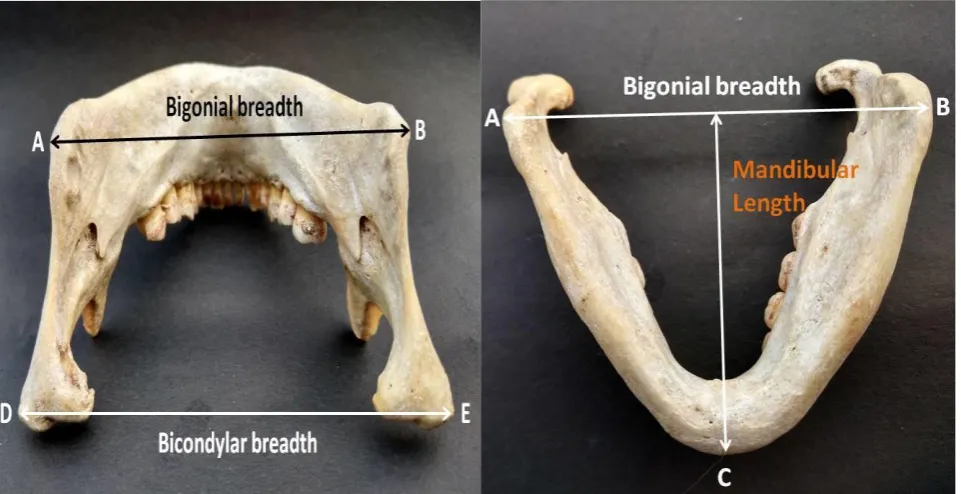
1. Bigonial Breadth: This is the straight distance between two gonia (from point A to point B). (Figure 1 and 2)
2. Bicondylar Breadth: This is the straight distance between the two most lateral point present on both condyles (from point D to point E). (Figure 1)
3. Mandibular Length: This is the distance of anterior margin of the chin from the centre point on a projected straight line placed along the posterior border of both mandibular angles (from centre of point A and point B to point C). (Figure 2)
4. Mandibular Index:
Mandibular length X 100 Mandibular Index =
Bicondylar breadth
The data were collected, tabulated and statistically analyzed. The software Graph Pad Prism version 4.03 was used for statistical analysis of data. The results were analysed by unpaired t-test. p value ≤ 0.05 was considered statistically significant. Continuous variables were expressed in term of mean and standard deviation. (Table 1)
Figure 1: Bigonial breadth and bicondylar breadth Figure 2: Bigonial breadth and mandibular length
RESULTS
Out of 156 mandibles, 90 belongs to male and 66 belongs to females. The different parametric data were recorded and the mean and standard deviation were derived.
Bigonial Breadth
Bigonial breadth of male mandible varies from 74.14 –107.40 mm with an average of 90.63 ± 8.16 and that of female mandible varies from 71.20 – 104.48 mm with an average of 90.12 ± 8.77. The gender differences in mean values of bigonial breadth of male
and female is statistically not significant (p=0.712) for mandible. [Table 1]
Bicondylar Breadth
Mandibular Length
Mandibular length of male mandible varies from 83.20 – 125.90 mm with an average of 104.43 ± 12.78 and that of female mandible varies from 78.40 – 120.80 mm with an average of 101.78 ± 11.05. The gender differences in mean values of mandibular length of male and female is statistically not significant (p=0.179) for mandible. [Table 1]
Mandibular Index
Mandibular index of male mandible varies from 71.42 – 133.33 mm with an average of 96.59 ± 12.68 and that of female mandible varies from 67.59 – 116.56 mm with an average of 94.24 ± 10.19. The gender differences in mean values of mandibular index of male and female is statistically not significant (p=0.216) for mandible. [Table 1]
Table 1: Showing different parameters measured in the mandible.
Sr. No. Parameter Sex Range Mean ± SD p value t value
1. Bigonial Breadth Male 74.14 – 107.40 90.63 ± 8.16 0.712 0.369
Female 71.20 – 104.48 90.12 ± 8.77
2. Bicondylar Breadth Male 86.60 – 120.80 108.61 ± 9.06 0.859 0.177
Female 83.14 – 117.16 108.35 ± 8.44
3. Mandibular Length Male 83.20 – 125.90 104.43 ± 12.78 0.179 1.349
Female 78.40 – 120.80 101.78 ± 11.05
4. Mandibular Index Male 71.42 – 133.33 96.59 ± 12.68 0.216 1.241
Female 67.59 – 116.56 94.24 ± 10.19
DISCUSSION
Generally, in male mandibles are large in size, prominent muscular attachment sites and slightly more robust than the female mandibles. There are many non-metric traits of the mandible which are associated with the sex. Male features of mandible include a broad ascending ramus, gonial flaring, high symphysis and small mental eminence.8,9 There are several
studies on sexual dimorphism in the human mandible including morphologic and morphometric parameters. In our study, we used the discriminant function analysis to establish different mandibular measurement that gives the most reliable information regarding differentiation of males and females mandible in the population of Bihar. Bigonial breadth, bicondylar breadth and mandibular length were selected by us as the most discriminatory parameter and we don’t found any statistically significant difference between both sexes.
Bigonial Breadth
In the present study, we observed that the mean value of the bigonial breadth of mandible was 90.63 mm in males and 90.12 mm in females. The standard deviation for bigonial breadth in male was 8.16 and in female were 8.77. The values in the female mandible were lesser as compared to that obtained in male mandible.
Vinay G et al10 studied 250 mandibles and reported that the mean
value of the bigonial breadth of mandible was 9.45 cm in males and 8.74 cm in females. The standard deviation for bigonial breadth in their study for male was 0.53 and for female was 0.54. They observed that the values in the female mandible were lesser as compared to in males. Kujur B et al.11 reported that the mean of
bigonial breadth in males was 94.69 mm and of females was 88.27 mm, after measurements of 225 mandibles. They found standard deviation was 2.46 for males and 7.84 for females in their study. Franklin et al.12 reported that the mean of bigonial
breadth in males was 9.35 cm and of females was 8.70 cm, after measurements of 225 mandibles. They found standard deviation was 0.57 for males and 0.56 for females in their study. Ongkana N et al13 found in their study on 102 mandibles that the mean value
of bigonial breadth for male mandible was 9.68 cm and for female
was 8.97 cm. They found standard deviation was 0.77 for males and 0.59 for females in their study. Ranganath et al.14 in their
study on 111 mandibles (65 males and 46 females) showed that the mean for bigonial breadth for male was 8.68 cm and for females was 8.62 cm. They reported standard deviation was 1.37 for males and 0.72 for females in their study. Jayakaran et al.15
studied 207 mandibles and found that the mean of bigonial breadth for male mandible was 9.38 cm and of females was 8.71 cm. They found standard deviation was 0.54 for males and 0.48 for females in their study. Our study showed no statistically significant difference between male and female mandible values. The mean values of females were found to be lesser than males.
Bicondylar Breadth
In the present study, we observed that the mean value of the bicondylar breadth of mandible was 108.61 mm in males and 108.35 mm in females. The standard deviation for bicondylar breadth in male was 9.06 and in female were 8.44. The values in the female mandible were lesser as compared to that obtained in male mandible.
Vinay G et al.10 studied 250 mandibles and reported that the mean
value of the bicondylar breadth of mandible was 11.34 cm in males and 10.82 cm in females. The standard deviation for bicondylar breadth in their study for male was 0.55 and for female was 0.70. They also observed that the values of bicondylar breadth in the female mandible were lesser as compared to in males. Kujur B et al.11 reported that the mean of bicondylar
breadth in males was 111.20 mm and of females was 107.89 mm, after measurements of 225 mandibles. They found standard deviation was 5.73 for males and 4.03 for females in their study. Franklin et al.12 observed that the mean of bicondylar breadth in
males was 11.36 cm and of females was 10.86 cm, after measurements of 225 mandibles. They found standard deviation was 0.60 for males and 0.58 for females in their study. Ongkana N et al.13 found in their study on 102 mandibles that the mean value
of bicondylar breadth for male mandible was 12.38 cm and for female was 11.61 cm. They reported standard deviation for male mandible was 0.63 and for females was 0.59. Ranganath et al.14
cm and for females was 11.51 cm. Standard deviation was 1.48 in males and 0.93 in females. Jayakaran et al.15 observed that the
mean of bicondylar breadth for male mandible was 11.26 cm and of females was 10.77 cm after study on 207 mandibles. They found standard deviation was 0.53 both for males and females in their study. We don’t found any statistically significant difference between male and female mandible values. The mean values of females were found to be lesser than males.
Mandibular Length
In the present study, we observed that the mean value of the mandibular length of mandible was 104.43 mm in males and 101.78 mm in females. The standard deviation for mandibular length in male was 12.78 and in female were 11.05. The values in the female mandible were lesser as compared to that obtained in male mandible. Vinay G et al.10 studied 250 mandibles and
reported that the mean value of the mandibular length of mandible was 7.54 cm in males and 7.25 cm in females. The standard deviation for mandibular length in their study for male was 0.43 and for female was 0.51. They observed that the values in the female mandible were lesser as compared to in males. Kujur B et al.11 reported that the mean of mandibular length in males was
72.91 mm and of females was 71.53 mm, after measurements of 225 mandibles. They found standard deviation was 5.39 for males and 5.24 for females in their study. Ongkana N et al.13 found in
their study on 102 mandibles that the mean value of mandibular length for male mandible was 8.94 cm and for female was 8.53 cm. They found standard deviation was 0.60 for males and 0.55 for females in their study. Jayakaran et al.15 studied 207
mandibles and found that the mean of mandibular length for male mandible was 74.4 mm and of females was 70.6 mm. They found standard deviation was 4.1 for males and 4.7 for females in their study. We not found any statistically significant difference between male and female mandible values. The mean values of females were found to be lesser than males.
Mandibular Index
In the present study, we observed that the mean value of the mandibular index was 96.59 in males and 94.24 in females. The standard deviation for mandibular index in male was 12.68 and in female were 10.19. The values in the female mandible were lesser as compared to that obtained in male mandible. Vinay G et al.10
reported that the mean value of the mandibular index was 66.52 in males and 66.41 in females. The standard deviation for mandibular index in their study for male was 4.42 and for female were 5.69. They also observed that the values in the female mandible were lesser as compared to in males.
Kujur B et al.11 reported that the mean of mandibular index in
males was 65.49 and of females was 64.44, after measurements of 225 mandibles. They found standard deviation was 4.81 for males and 5.20 for females in their study. Ongkana N et al.13
found in their study on 102 mandibles that the mean value of mandibular index for male mandible was 89.4 mm and for female was 85.3 mm. They found standard deviation was 6.0 for males and 5.5 for females in their study. We also not found any statistically significant difference between male and female mandible for mandibular index. The mean values of females were also found to be lesser than males.
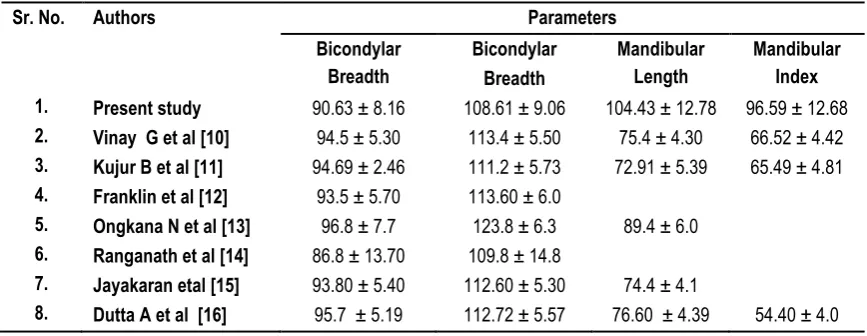
Table 2: Comparisons of various parameters (in mm) of the male mandibles
Sr. No. Authors Parameters
Bicondylar Breadth
Bicondylar Breadth
Mandibular Length
Mandibular Index
1. Present study 90.63 ± 8.16 108.61 ± 9.06 104.43 ± 12.78 96.59 ± 12.68
2. Vinay G et al [10] 94.5 ± 5.30 113.4 ± 5.50 75.4 ± 4.30 66.52 ± 4.42
3. Kujur B et al [11] 94.69 ± 2.46 111.2 ± 5.73 72.91 ± 5.39 65.49 ± 4.81
4. Franklin et al [12] 93.5 ± 5.70 113.60 ± 6.0
5. Ongkana N et al [13] 96.8 ± 7.7 123.8 ± 6.3 89.4 ± 6.0
6. Ranganath et al [14] 86.8 ± 13.70 109.8 ± 14.8
7. Jayakaran etal [15] 93.80 ± 5.40 112.60 ± 5.30 74.4 ± 4.1
8. Dutta A et al [16] 95.7 ± 5.19 112.72 ± 5.57 76.60 ± 4.39 54.40 ± 4.0
Table 3: Comparisons of various parameters (in mm) of the female mandibles
Sr. No. Authors Parameters
Bicondylar Breadth
Bicondylar Breadth
Mandibular Length
Mandibular Index
1. Present study 90.12 ± 8.77 108.35 ± 8.44 101.78 ± 11.05 94.24 ± 10.19
2. Vinay G et al [10] 87.40 ± 5.4 108.2 ± 7.0 72.5 ± 5.10 66.4 ± 5.69
3. Kujur B et al [11] 88.27 ± 7.84 107.89 ± 4.03 71.53 ± 5.24 64.44 ± 5.20
4. Franklin et al [12] 87.0 ± 0.56 108.6 ± 0.58
5. Ongkana N et al [13] 89.70 ± 0.59 116.1 ± 0.59 85.3 ± 5.5
6. Ranganath et al [14] 86.20 ± 0.72 115.1 ± 0.93
7. Jayakaran etal [15] 87.10 ± 0.48 107.7 ± 0.53 70.6 ± 4.7
CONCLUSION
Identification of gender from the available skeletal remains is of great anthropological and medico legal significance. The traditional non-metrical method for the determination of sex of different parts of the skeleton depends on ability as well as experience of the expert. The application of the metrical parameters like bigonial breadth, bicondylar breadth and mandibular length along with morphological features may be a useful tool for mandible. This can be also helpful for the treatment of dentofacial conditions. The levels of sexual dimorphism of skeleton are population specific due to various combinations of genetic as well as environmental factors. More studies involving different group of population could be an additional value to assist in identification of racial and ethnic differences by using the mandible. Studies with larger sample size may helpful in gender determination using metric parameters or morphology among population of Bihar.
REFERENCES
1. B. Rai, J. Kaur. Sex determination methods in forensic odontology. Evidence Based Forensic Dentistry 2013; 73-79. 2. Reddy KSN, Murthy OP. The Essentials of Forensic Medicine and Toxicology. 33rd edition. New Delhi: Jaypee Brothers Medical Publishers; 2014. p.65.
3. Tanveer Ahamed Khan H.S. J.H. Sharieff. Observation on Morphological Features of Human Mandibles in 200 South Indian Subjects. Anatomica Karnataka 2011;5(1):44-49.
4. Warwick R. The relation of direction of mental foramen to growth of human mandible. J Anat 1950;30(2):116-20.
5. M Vodanovic, et al. Odontometrics: a useful method for sex determination in an archaeological skeletal population. Journal of Archaeological Science 2006; 1-9.
6. Loth SR, Henneberg M. Mandibular ramus flexure: a new morphologic indicator of sexual dimorphism in the human skeleton. Am J Phys Anthropol 1996; 99(3): 473-85.
7. AC Oettle, E Pretorius and M Steyn. Geometric Morphometric Analysis of Mandibular Ramus Flexure. Am J Phys Anthropol 2005;128:623–29.
8. Krogman WM, Iscan MY. The Human Skeleton in Forensic Medicine. 2nd ed. Springfield: Charles C. Thomas. 1986.
9. Schwartz JH. Skeleton Keyes: An Introduction to Human Skeletal Morphology Development and Analysis. Oxford University Press: New York. 1995.
10. Vinay G, Mangala Gowri SR, Anbalagan J. Sex determination of human mandible using metrical parameters. Journal of Clinical and Diagnostic Research 2013;7(12): 2671-73.
11. Kujur B, Wakode N S, Gaikwad M R, Wakode S L. Most reliable Parameter of the mandible used for sex determination. Int J Anat Res 2017;5(4.2):4611-15.
12. D. Franklin, O.P. Higgins, C.E. Oxnard Sexual dimorphism in the mandible of indigenous South Africans: a geometric morphometric approach S Afr J Sci 2008;104(3):101-109. 13. Ongkana N, Sudwan P. Gender difference in Thai mandibles using metric analysis. Chiang Mai Med J 2009; 48(2):43-8. 14. Ranganath Vallabhajosyula, Yogitha Ravindranath, Roopa Ravindranath. Sexual dimorphism in mandibular morphology: a study on South Indian sample. South Asian Anthropologist 2008;8(1):9-11.
15. Flossie Jayakaran, Sayee Rajangam, Janakiram S, Thomas IM. Sexing of the mandible. Anatomica Karnataka2000;1(1):11-16. 16. Datta A, Siddappa S C, Gowda V K et al. A study of sex determination from human mandible using various morphometrical parameters. Indian Journal of Forensic and Community Medicine 2015;2(3):158-166.
[
Source of Support: Nil. Conflict of Interest: None Declared.
Copyright: © the author(s) and publisher. IJMRP is an official publication of Ibn Sina Academy of Medieval Medicine & Sciences, registered in 2001 under Indian Trusts Act, 1882. This is an open access article distributed under the terms of the Creative Commons Attribution Non-commercial License, which permits unrestricted non-commercial use, distribution, and reproduction in any medium, provided the original work is properly cited.
Cite this article as: Aman Kumar, Md. Jawed Akhtar, Binod Kumar, Rajiv Ranjan Sinha, Avanish Kumar, Sanjeev Kumar. Sex Determination of Human Mandible in Population of Bihar by Using Metrical Parameters. Int J Med Res Prof. 2018 Nov; 4(6):173-77.