R E S E A R C H
Open Access
Determining the best population-level alcohol
consumption model and its impact on estimates
of alcohol-attributable harms
Tara Kehoe
1,2*, Gerrit Gmel
1, Kevin D Shield
1,9, Gerhard Gmel
1,4,5,6and Jürgen Rehm
1,3,7,8,9Abstract
Background:
The goals of our study are to determine the most appropriate model for alcohol consumption as an
exposure for burden of disease, to analyze the effect of the chosen alcohol consumption distribution on the
estimation of the alcohol Population- Attributable Fractions (PAFs), and to characterize the chosen alcohol
consumption distribution by exploring if there is a global relationship within the distribution.
Methods:
To identify the best model, the Log-Normal, Gamma, and Weibull prevalence distributions were
examined using data from 41 surveys from Gender, Alcohol and Culture: An International Study (GENACIS) and
from the European Comparative Alcohol Study. To assess the effect of these distributions on the estimated alcohol
PAFs, we calculated the alcohol PAF for diabetes, breast cancer, and pancreatitis using the three above-named
distributions and using the more traditional approach based on categories. The relationship between the mean
and the standard deviation from the Gamma distribution was estimated using data from 851 datasets for 66
countries from GENACIS and from the STEPwise approach to Surveillance from the World Health Organization.
Results:
The Log-Normal distribution provided a poor fit for the survey data, with Gamma and Weibull
distributions providing better fits. Additionally, our analyses showed that there were no marked differences for the
alcohol PAF estimates based on the Gamma or Weibull distributions compared to PAFs based on categorical
alcohol consumption estimates. The standard deviation of the alcohol distribution was highly dependent on the
mean, with a unit increase in alcohol consumption associated with a unit increase in the mean of 1.258 (95% CI:
1.223 to 1.293) (R
2= 0.9207) for women and 1.171 (95% CI: 1.144 to 1.197) (R
2= 0. 9474) for men.
Conclusions:
Although the Gamma distribution and the Weibull distribution provided similar results, the Gamma
distribution is recommended to model alcohol consumption from population surveys due to its fit, flexibility, and
the ease with which it can be modified. The results showed that a large degree of variance of the standard
deviation of the alcohol consumption Gamma distribution was explained by the mean alcohol consumption,
allowing for alcohol consumption to be modeled through a Gamma distribution using only average consumption.
Keywords:
Alcohol consumption, Empirical distribution, Gamma distribution, Log-Normal distribution, Weibull
dis-tribution, Population-Attributable Fraction, Exposure disdis-tribution, Up-estimation, Per capita consumption, Mean,
Standard deviation
Introduction
Alcohol consumption is a component cause [1] for over
200 International Classification of Diseases (ICD-10)
three-digit codes [2,3]. In other words, a fraction, usually
called the Population-Attributable Fraction (PAF) of the
incidence of these diseases, would disappear if exposure
to one of the causal components was eliminated [4-7]
(in the case of alcohol, under the counterfactual
sce-nario of every person being a lifetime abstainer). The
proportion of the diseases caused by alcohol
consump-tion in a component cause model for a populaconsump-tion is
determined by both the patterns and volume of alcohol
consumption and by the relative risks associated with
* Correspondence: [email protected]
1Centre for Addiction and Mental Health (CAMH), Toronto, Canada
Full list of author information is available at the end of the article
each exposure level [3,8]. For most major diseases where
alcohol plays a role (for example, alcohol-attributable
cancers, pancreatitis, and cirrhosis of the liver), the
aver-age volume of alcohol consumption alone was found to
be an adequate predictor of the risk [3,8-10]; however,
some diseases and injuries (for example, ischemic heart
disease, unintentional injuries, and intentional injuries)
were found to be also dependent on drinking patterns
[11-14].
The calculation of an alcohol PAF involves a
three-stage process: 1) estimation of an exposure distribution
of alcohol, 2) establishment of the relative risk function,
and 3) the solving of the equation for the PAF [15].
Since the distribution of alcohol consumption on an
international level has not been agreed upon, the
com-mon approach is to estimate the PAF using categorical
measurements rather than modeling it in a more
mathe-matically appropriate continuous manner [16,17]. The
mathematical expression is as follows:(Formula 1)
PAF
=
k
i=1P
i(
RR
i−
1)
k
i=1P
i(
RR
i−
1) + 1
where
i
is the exposure category with baseline
expo-sure or no expoexpo-sure,
i = 0, RR
iis the relative risk at
exposure level
i
compared to no consumption, and
P
iis
the prevalence of the
j
thcategory of exposure.
When a continuous distribution for the volume of
alcohol consumption is used, this calculation can be
represented by the following formula:(Formula 2)
PAF
(
x
) =
P
aRR
a+
P
exRR
ex+
150
0
P
(
x
)
RR
(
x
)
dx
- 1
P
aRR
a+
P
exRR
ex+
150
0
P
(
x
)
RR
(
x
)
dx
where
P
ais the prevalence of lifetime abstainers,
RR
ais the relative risk of lifetime abstainers,
P
exis the
preva-lence of former drinkers,
RR
exis the relative risk of
for-mer drinkers,
x
is the average volume of alcohol
consumption per day,
P(x)
is the prevalence of alcohol
consumption, and
RR(x)
is the relative risk of drinkers
[15]. Although this is the most accurate way to calculate
a PAF, it requires that the distribution of alcohol
con-sumption be known. Previous attempts at modeling
alcohol consumption using a Log-Normal distribution
have been criticized for various reasons [18,19];
how-ever, the Log-Normal distribution has provided adequate
approximations for most applications [20,21]. Recently,
more adaptable distributions such as the Gamma
distri-bution have been favored over the Log-Normal
distribu-tion [15,22], and it has been suggested that a mixing of
distributions is needed to separately model the
fre-quency of drinking and the quantity of alcohol
con-sumed [23].
There are two main instruments to monitor alcohol
exposure currently used by countries and international
organizations: 1) general population surveys and 2)
esti-mates of per capita consumption, where per capita
con-sumption is an aggregate measure of recorded,
unrecorded, and tourist per capita consumption of
alco-hol (derived from sales, production, and other economic
statistics) [9,24,25]. These instruments, however, have
limitations [26].
There are no available surveys for many countries, and
in some cases where they do exist they do not allow for
the accurate estimation of the volume of consumption,
as these surveys only ask about the absence or presence
of drinking [27]. Existing surveys often considerably
underestimate real consumption levels [28-30] by
typi-cally covering only 30% to 60% of alcohol sales [26]. As
a result, per capita consumption figures are considered
to be a best estimate of overall volume of consumption
in a country [31]; however, per capita consumption does
not provide any disaggregated statistic and, thus, does
not provide age- and gender-specific consumption
esti-mates. Since in some instances the risk relationship
between alcohol consumption and disease-specific
mor-tality is dependent on gender as well as on age, alcohol
exposure by gender and age is required to estimate the
PAF and to calculate the alcohol-attributable burden of
disease in a population [3].
The problems noted above with respect to surveys
lead to an underestimated burden of disease attributable
to alcohol consumption when PAFs are calculated from
population data without adjustment. As a consequence,
methods have been developed to triangulate both
aver-age alcohol consumption derived from population
sur-veys and from per capita consumption information
[15,26]. However, current PAF calculation methods are
based on categorical estimates of consumption with
alcohol consumption being corrected by multiplying the
two top alcohol consumption categories by the inverse
of the estimated undercoverage (per capita
consump-tion/the estimated per capita consumption from the
sur-vey) [17]. For most categories of disease where there is
an association with volume of alcohol consumption, the
dose-response relationship is nonlinear and, thus,
distri-bution estimates of alcohol consumption by age and
gender are required for accurate estimates of alcohol
PAFs [3].
distribution of alcohol consumption that can easily be
modeled to make the fit more compatible with per
capita consumption data and that also has properties
that make it possible to estimate the exposure
distribu-tion for countries that lack survey data except for
esti-mates of prevalence of abstention. Thus, the first aim of
this study is to assess internationally if alcohol
consis-tently follows one of the three well-known right-skewed
distributions, Log-Normal, Gamma, or Weibull, and to
determine if the chosen exposure distribution has a
sig-nificant effect on the estimation of a PAF, using the
PAFs for pancreatitis, diabetes, and breast cancer as
examples. The second aim of this study is to investigate
if a global relationship between parameters exists so that
a distribution of alcohol consumption can be estimated
based on mean alcohol consumption.
Methods
Description of underlying surveys
This study used data from Gender, Alcohol and Culture:
An International Study (GENACIS), from the European
Comparative Alcohol Study (ECAS), and from the
STEPwise approach to Surveillance (STEPS). Survey
data were collected for the average volume of
consump-tion for Argentina, Australia (two surveys from Australia
were used: Australia and Australia1), Austria, Belize,
Brazil, Canada, Costa Rica, Czech Republic, Denmark,
Finland, France, Germany, Hungary, Iceland, India,
Ire-land, Isle of Man, Israel, Italy, Japan, Kazakhstan,
Mex-ico, Netherlands, Nicaragua, Nigeria, Norway, Peru,
Spain, Sri Lanka, Sweden, Switzerland, Uganda, United
Kingdom, Uruguay, and the United States of America
from GENACIS (three surveys from the United States of
America were used: USA1, USA2, and USA3; USA1 was
a 2001 longitudinal study that surveyed women only,
and USA2 and USA3 were 1995-1996 and 2000
National Alcohol Surveys, respectively); for Finland,
France, Germany, Italy, Sweden, and the United
King-dom from ECAS; and for Cameroon, Côte D
’
Ivoire,
Dominica, Democratic Republic of the Congo, Eritrea,
Kuwait, Mali, Mozambique, American Samoa, Barbados,
Benin, Botswana, Cape Verde, Republic of the Congo,
Cook Islands, Indonesia, Madagascar, St. Kitts and
Nevis, Swaziland, Zambia, Fiji, Kiribati, Marshall Islands,
Mongolia, Nauru, Solomon Islands, Tokelau, Tonga,
Vanuatu, Micronesia, and Samoa from STEPS. (For
information on sampling methodology and the questions
used in GENACIS surveys see [33-35], ECAS see [30],
and STEPS see [36]). For most of the GENACIS surveys
and for the ECAS surveys alcohol consumption was
measured by a beverage-specific usual
quantity-fre-quency technique (i.e., asking separate questions on
usual frequency of drinking, and then eliciting the usual
quantity per drinking occasion), and in the remaining
GENACIS surveys alcohol consumption was measured
by a global quantity-frequency measure. In the STEPS
surveys alcohol consumption was measured in standard
drinks consumed in the seven days preceding the survey.
All data from surveys were divided by sex and age into
eight age groups; 15-24, 25-34, 35-44, 45-54, 55-64,
65-74, 75-84, and 85 +.
Methods for fitting the distributions
As alcohol consumption distributions have been shown
to have a unimodal shape, [19,37,38] we evaluated the
fit of the Log-Normal, Gamma, and Weibull
distribu-tions (unimodal distribudistribu-tions commonly used to fit
right-skewed empirical data) to determine the most
appropriate distribution to model alcohol consumption
from national survey data. The Log-Normal, Gamma,
and Weibull probability densities are similar in shape,
but have significantly different tail behaviors. In the
past, alcohol consumption has been more commonly
modeled by the Log-Normal distribution as it is used to
model continuous random quantities that are
right-skewed and is based on the normal distribution, making
it easy to fit, test, and modify [20,21]. Although alcohol
consumption is frequently modeled using the
Log-Nor-mal distribution, empirical distributions often deviate
considerably from the Log-Normal model. In
compari-son, the Gamma and Weibull distributions have a scale
parameter and a shape parameter, making them more
adaptable since the scale parameter can stretch or
com-press the distribution.
The Log-Normal distribution is a function of the
mean (
μ
) and standard deviation (
s
) parameters, and
describes a random variable x where log (x) is normally
distributed. The probability density function of the
Log-Normal distribution can be expressed as follows:
f
(
x
;
μ
,
σ
) =
1
x
σ
√
2
π
exp
−
(log
x
−
μ
)
22
σ
2where x > 0 and -
∞
<
μ
<
∞
,
s
> 0 The Gamma
dis-tribution is characterized by a shape (
) and a scale
parameter (
θ
), has a mean of
θ
and a standard
devia-tion of
√
κθ
2.
The probability density function of the
Gamma distribution can be expressed as follows:
f
(
x
;
κ
,
θ
) =
x
κ−1
θ
κ(
κ
)
exp
−
x
θ
where
x
>
0,
>
0,
θ
>
0
and
(
κ
) =
∞
0
t
κ−1exp
{−t}
dt
Similar to the Gamma
distri-bution, the Weibull distribution is commonly
Weibull distribution has a mean of
θ
1
γ
+ 1
and a
standard deviation of
θ
2
γ
+ 1
−
1
γ
+ 1
2,
where
(
x
)
=
∞
0
t
x−1exp
{−
t
}
dt
is the Gamma function
evaluated at
x
. The probability density function of the
Weibull distribution is expressed as follows:
f
(
x
;
θ
,
γ
) =
γ
θ
x
θ
γ−1exp
−
x
θ
γwhere x
≥
0,
g
> 0,
θ
> 0 Maximum likelihood
estima-tion was used to fit all three distribuestima-tion models to the
drinking population data obtained from GENACIS and
ECAS. All missing values were excluded from the fitted
models. The Newton-Raphson algorithm was used to
optimize the likelihood equations solving for the
maxi-mum likelihood estimates of the unknown parameters
[39]. Data values of alcohol consumption over 300 g/day
were truncated to 300 g/day. Numerical integration
uti-lizing the trapezoidal rule was used to characterize each
distribution.
Method for deriving the alcohol PAF
We performed a sensitivity analysis where the alcohol
PAFs for pancreatitis, diabetes, and breast cancer were
calculated using a continuous model (Log-Normal,
Gamma, and Weibull) and using a categorical model in
order to see if the chosen exposure distribution had an
effect on the estimation of the alcohol PAF. All PAFs
were calculated with zero alcohol consumption as the
counterfactual scenario, similarly to the Comparative
Risk Analysis for alcohol. This counterfactual scenario
under certain circumstances of a light drinking average
alcohol consumption without heavy drinking occasions
may not reflect the theoretical minimum risk depending
on the distribution of diseases and cause of death in a
society. However, for this paper these considerations are
not relevant. The relative risks of lifetime abstainers and
former drinkers for pancreatitis, diabetes, and breast
cancer were obtained from the meta-analysis [40-42].
In order to illustrate that the alcohol PAF estimates
based on the Gamma distribution model deviated only
slightly from the PAF derived from the categorical
model, we calculated the difference between the PAFs
calculated for both models.
Methods for characterizing the gamma distributions
The Gamma distribution can be characterized by a
shape () and a scale parameter (θ), where the mean
and the standard deviation of the Gamma distribution
can be obtained directly from the parameter estimates
as follows:
μ
=
κθ
and
σ
=
√
κθ
2Since the mean of the Gamma distribution is equal to
the mean of the empirical distribution, the mean of the
Gamma distribution does not need to be estimated from
the shape and scale parameters.
A maximum likelihood algorithm (see description
above) was used to obtain the shape and scale
para-meters using the maximum likelihood function for the
shape and scale parameters of the Gamma distribution:
l(κ,θ) = (κ−1)
N
i=1 ln(xi)−
N
i=1
xi
θ −N·κ·ln(θ)−N·ln((κ))
Regression analysis
The maximum likelihood method was used to fit a
Gamma model in order to summarize the alcohol
con-sumption of 66 countries by gender and age (in total 851
datasets [422 for women; 429 for men]). After the data
was fit by a Gamma model, the relationship between the
Gamma mean and the Gamma standard deviation was
examined using various general linear models. The
per-formance of the general linear models was then assessed
by how well the assumption of homoscedasticity was
upheld and based on the distribution of the residuals.
All data analyses were performed in R version 2.13.0
[43].
Results
Modeling alcohol consumption as a distribution
The three distributions, Log-Normal, Gamma, and
Wei-bull, were fit to 41 datasets; parameter estimates are
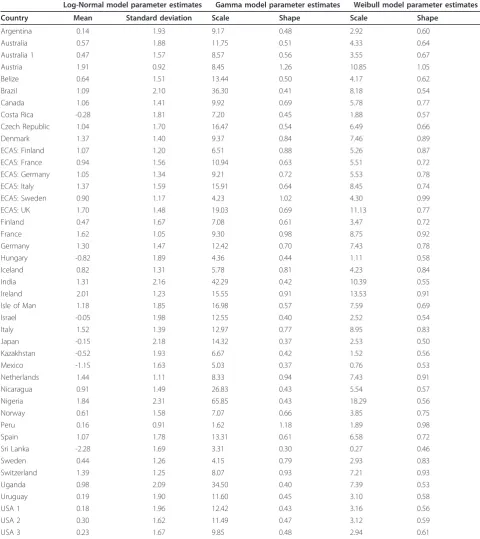
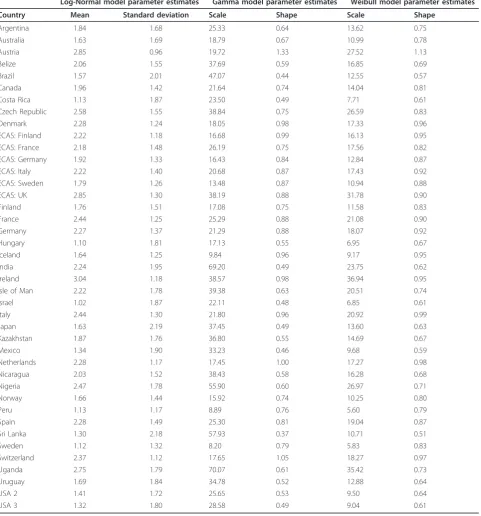
outlined in Table 1 for women and in Table 2 for men.
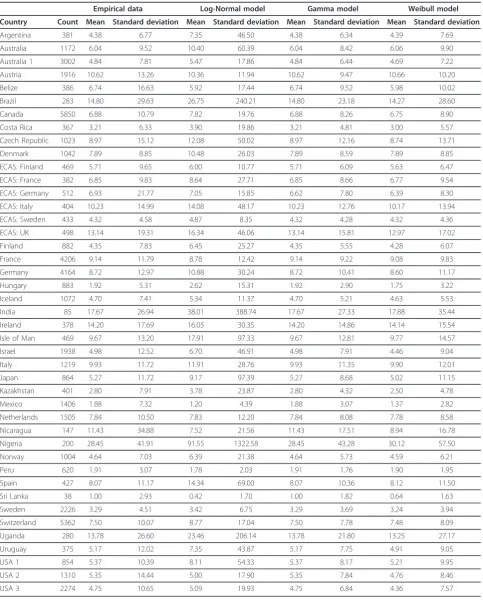
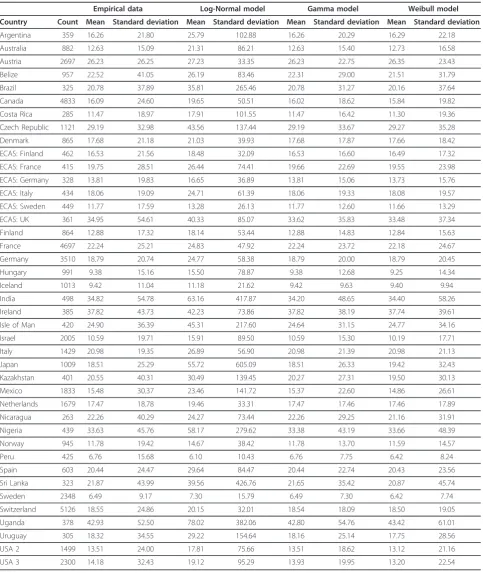
The mean and standard deviation estimates from the
empirical data and the estimates from each fitted model
are summarized in Table 3 for women and in Table 4
for men. When comparing the empirical mean to each
distribution
’
s mean, we observed that the mean
esti-mates from the Weibull distribution were much closer
to the empirical mean than were the Log-Normal
distri-bution mean estimates, while the mean estimates from
the Gamma distribution were equal to the empirical
mean. When comparing the standard deviation
esti-mates, the estimates from the Log-Normal distribution
deviated furthest from the empirical data, while there
was no statistically significant difference between the
empirical standard deviation estimate and the standard
deviation estimates from either of the Weibull or the
Gamma distributions.
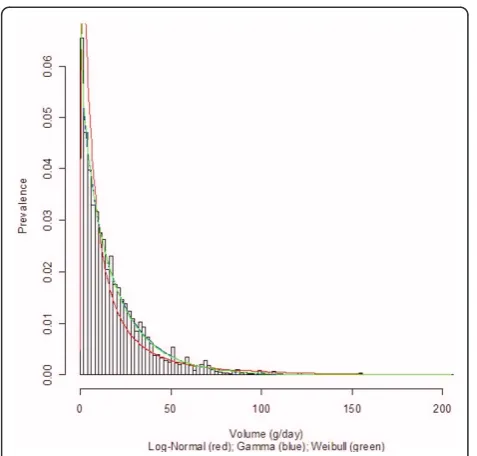
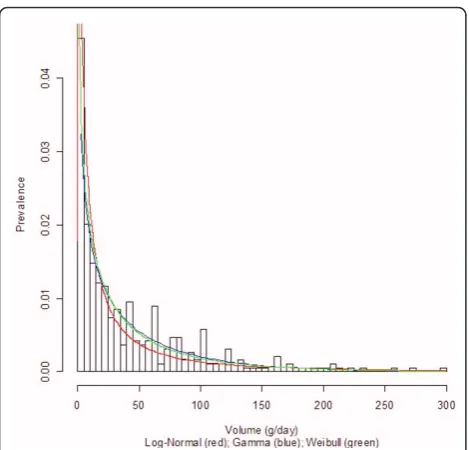
Uganda, were selected to display their density curves
(Log-Normal, Gamma, and Weibull) superimposed on
the population-based data histograms; see Figures 1, 2,
3, 4, 5, and 6 for both women and men. We observed a
common trend among men in Figures 2, 4, and 6: the
Log-Normal distribution tended to underestimate the
number of men who drank 25 g/day to 50 g/day,
whereas the Gamma and Weibull distributions
accu-rately estimated alcohol consumption for these
popula-tions. A similar trend was observed with respect to
Table 1 Parameter estimates from Log-Normal, Gamma, and Weibull models for women from 43 datasets
Log-Normal model parameter estimates Gamma model parameter estimates Weibull model parameter estimates
Country Mean Standard deviation Scale Shape Scale Shape
Argentina 0.14 1.93 9.17 0.48 2.92 0.60
Australia 0.57 1.88 11.75 0.51 4.33 0.64
Australia 1 0.47 1.57 8.57 0.56 3.55 0.67
Austria 1.91 0.92 8.45 1.26 10.85 1.05
Belize 0.64 1.51 13.44 0.50 4.17 0.62
Brazil 1.09 2.10 36.30 0.41 8.18 0.54
Canada 1.06 1.41 9.92 0.69 5.78 0.77
Costa Rica -0.28 1.81 7.20 0.45 1.88 0.57
Czech Republic 1.04 1.70 16.47 0.54 6.49 0.66
Denmark 1.37 1.40 9.37 0.84 7.46 0.89
ECAS: Finland 1.07 1.20 6.51 0.88 5.26 0.87
ECAS: France 0.94 1.56 10.94 0.63 5.51 0.72
ECAS: Germany 1.05 1.34 9.21 0.72 5.53 0.78
ECAS: Italy 1.37 1.59 15.91 0.64 8.45 0.74
ECAS: Sweden 0.90 1.17 4.23 1.02 4.30 0.99
ECAS: UK 1.70 1.48 19.03 0.69 11.13 0.77
Finland 0.47 1.67 7.08 0.61 3.47 0.72
France 1.62 1.05 9.30 0.98 8.75 0.92
Germany 1.30 1.47 12.42 0.70 7.43 0.78
Hungary -0.82 1.89 4.36 0.44 1.11 0.58
Iceland 0.82 1.31 5.78 0.81 4.23 0.84
India 1.31 2.16 42.29 0.42 10.39 0.55
Ireland 2.01 1.23 15.55 0.91 13.53 0.91
Isle of Man 1.18 1.85 16.98 0.57 7.59 0.69
Israel -0.05 1.98 12.55 0.40 2.52 0.54
Italy 1.52 1.39 12.97 0.77 8.95 0.83
Japan -0.15 2.18 14.32 0.37 2.53 0.50
Kazakhstan -0.52 1.93 6.67 0.42 1.52 0.56
Mexico -1.15 1.63 5.03 0.37 0.76 0.53
Netherlands 1.44 1.11 8.33 0.94 7.43 0.91
Nicaragua 0.91 1.49 26.83 0.43 5.54 0.57
Nigeria 1.84 2.31 65.85 0.43 18.29 0.56
Norway 0.61 1.58 7.07 0.66 3.85 0.75
Peru 0.16 0.91 1.62 1.18 1.89 0.98
Spain 1.07 1.78 13.31 0.61 6.58 0.72
Sri Lanka -2.28 1.69 3.31 0.30 0.27 0.46
Sweden 0.44 1.26 4.15 0.79 2.93 0.83
Switzerland 1.39 1.25 8.07 0.93 7.21 0.93
Uganda 0.98 2.09 34.50 0.40 7.39 0.53
Uruguay 0.19 1.90 11.60 0.45 3.10 0.58
USA 1 0.18 1.96 12.42 0.43 3.16 0.56
USA 2 0.30 1.62 11.49 0.47 3.12 0.59
women from Germany and Uganda who drank between
10 g/day to 30 g/day and for Sri Lankan women who
drank between 0.5 g/day to 2.0 g/day.
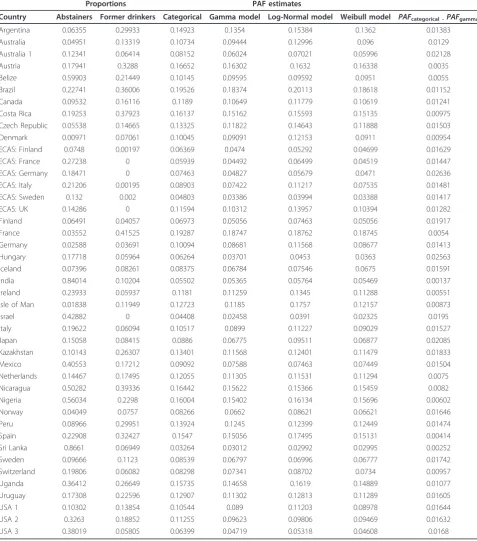
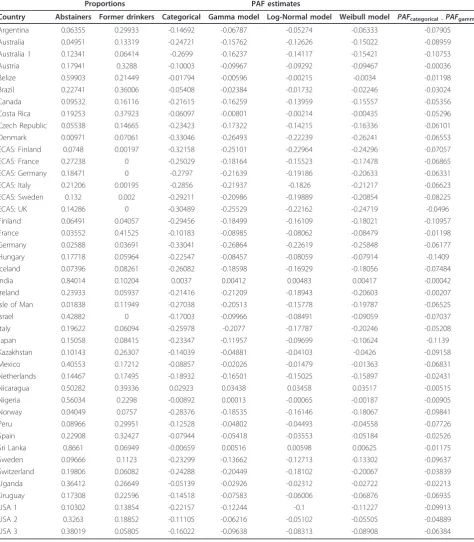
Alcohol PAF estimates modeled using the
Log-Nor-mal, Gamma, and Weibull distributions, together with
the proportion estimates for lifetime abstainers and
for-mer drinkers, are listed in Table 5 for breast cancer
(women), Tables 6 and 7 for diabetes (women and men,
respectively), and Tables 8 and 9 for pancreatitis
(women and men, respectively).
The alcohol PAF estimates that incorporated the
Gamma and Weibull distributions are very similar and,
for the most part, are within 1% of one another. Since
the Log-Normal distribution is known to have a heavy
tail, and this study includes data values for alcohol
con-sumption up to 300 g/day, the alcohol PAF estimates
Table 2 Parameter estimates from Log-Normal, Gamma, and Weibull models for men from 41 datasets
Log-Normal model parameter estimates Gamma model parameter estimates Weibull model parameter estimates
Country Mean Standard deviation Scale Shape Scale Shape
Argentina 1.84 1.68 25.33 0.64 13.62 0.75
Australia 1.63 1.69 18.79 0.67 10.99 0.78
Austria 2.85 0.96 19.72 1.33 27.52 1.13
Belize 2.06 1.55 37.69 0.59 16.85 0.69
Brazil 1.57 2.01 47.07 0.44 12.55 0.57
Canada 1.96 1.42 21.64 0.74 14.04 0.81
Costa Rica 1.13 1.87 23.50 0.49 7.71 0.61
Czech Republic 2.58 1.55 38.84 0.75 26.59 0.83
Denmark 2.28 1.24 18.05 0.98 17.33 0.96
ECAS: Finland 2.22 1.18 16.68 0.99 16.13 0.95
ECAS: France 2.18 1.48 26.19 0.75 17.56 0.82
ECAS: Germany 1.92 1.33 16.43 0.84 12.84 0.87
ECAS: Italy 2.22 1.40 20.68 0.87 17.43 0.92
ECAS: Sweden 1.79 1.26 13.48 0.87 10.94 0.88
ECAS: UK 2.85 1.30 38.19 0.88 31.78 0.90
Finland 1.76 1.51 17.08 0.75 11.58 0.83
France 2.44 1.25 25.29 0.88 21.08 0.90
Germany 2.27 1.37 21.29 0.88 18.07 0.92
Hungary 1.10 1.81 17.13 0.55 6.95 0.67
Iceland 1.64 1.25 9.84 0.96 9.17 0.95
India 2.24 1.95 69.20 0.49 23.75 0.62
Ireland 3.04 1.18 38.57 0.98 36.94 0.95
Isle of Man 2.22 1.78 39.38 0.63 20.51 0.74
Israel 1.02 1.87 22.11 0.48 6.85 0.61
Italy 2.44 1.30 21.80 0.96 20.92 0.99
Japan 1.63 2.19 37.45 0.49 13.60 0.63
Kazakhstan 1.87 1.76 36.80 0.55 14.69 0.67
Mexico 1.34 1.90 33.23 0.46 9.68 0.59
Netherlands 2.28 1.17 17.45 1.00 17.27 0.98
Nicaragua 2.03 1.52 38.43 0.58 16.28 0.68
Nigeria 2.47 1.78 55.90 0.60 26.97 0.71
Norway 1.66 1.44 15.92 0.74 10.25 0.80
Peru 1.13 1.17 8.89 0.76 5.60 0.79
Spain 2.28 1.49 25.30 0.81 19.04 0.87
Sri Lanka 1.30 2.18 57.93 0.37 10.71 0.51
Sweden 1.12 1.32 8.20 0.79 5.83 0.83
Switzerland 2.37 1.12 17.65 1.05 18.27 0.97
Uganda 2.75 1.79 70.07 0.61 35.42 0.73
Uruguay 1.69 1.84 34.78 0.52 12.88 0.64
USA 2 1.41 1.72 25.65 0.53 9.50 0.64
Table 3 Mean and standard deviation estimates from the empirical data, Log-Normal model, Gamma model, and the
Weibull model for alcohol consumption of women from 43 datasets
Empirical data Log-Normal model Gamma model Weibull model
Country Count Mean Standard deviation Mean Standard deviation Mean Standard deviation Mean Standard deviation
Argentina 381 4.38 6.77 7.35 46.50 4.38 6.34 4.39 7.69
Australia 1172 6.04 9.52 10.40 60.39 6.04 8.42 6.06 9.90
Australia 1 3002 4.84 7.81 5.47 17.86 4.84 6.44 4.69 7.22
Austria 1916 10.62 13.26 10.36 11.94 10.62 9.47 10.66 10.20
Belize 386 6.74 16.63 5.92 17.44 6.74 9.52 5.98 10.02
Brazil 283 14.80 29.63 26.75 240.21 14.80 23.18 14.27 28.60
Canada 5850 6.88 10.79 7.82 19.76 6.88 8.26 6.75 8.90
Costa Rica 367 3.21 6.33 3.90 19.86 3.21 4.81 3.00 5.57
Czech Republic 1023 8.97 15.12 12.08 50.02 8.97 12.16 8.74 13.71
Denmark 1042 7.89 8.85 10.48 26.03 7.89 8.59 7.89 8.85
ECAS: Finland 469 5.71 9.65 6.00 10.77 5.71 6.09 5.63 6.47
ECAS: France 382 6.85 9.83 8.64 27.71 6.85 8.66 6.77 9.54
ECAS: Germany 512 6.93 21.77 7.05 15.85 6.62 7.80 6.39 8.30
ECAS: Italy 404 10.23 14.99 14.08 48.17 10.23 12.76 10.17 13.94
ECAS: Sweden 433 4.32 4.58 4.87 8.35 4.32 4.28 4.32 4.36
ECAS: UK 498 13.14 19.31 16.34 46.06 13.14 15.81 12.97 17.02
Finland 882 4.35 7.83 6.45 25.27 4.35 5.55 4.28 6.07
France 4206 9.14 11.79 8.78 12.42 9.14 9.22 9.08 9.83
Germany 4164 8.72 12.97 10.88 30.24 8.72 10.41 8.60 11.17
Hungary 883 1.92 5.31 2.62 15.31 1.92 2.90 1.75 3.22
Iceland 1072 4.70 7.41 5.34 11.37 4.70 5.21 4.63 5.53
India 85 17.67 26.94 38.01 388.74 17.67 27.33 17.88 35.44
Ireland 378 14.20 17.69 16.05 30.35 14.20 14.86 14.14 15.54
Isle of Man 469 9.67 13.20 17.91 97.33 9.67 12.81 9.77 14.57
Israel 1938 4.98 12.52 6.70 46.91 4.98 7.91 4.46 9.04
Italy 1219 9.93 11.72 11.91 28.76 9.93 11.35 9.90 12.01
Japan 864 5.27 11.72 9.17 97.39 5.27 8.68 5.02 11.15
Kazakhstan 401 2.80 7.91 3.78 23.87 2.80 4.32 2.50 4.78
Mexico 1406 1.88 7.32 1.20 4.39 1.88 3.07 1.37 2.82
Netherlands 1505 7.84 10.50 7.83 12.20 7.84 8.08 7.78 8.58
Nicaragua 147 11.43 34.88 7.52 21.56 11.43 17.51 8.94 16.78
Nigeria 200 28.45 41.91 91.55 1322.58 28.45 43.28 30.12 57.50
Norway 1004 4.64 7.03 6.39 21.38 4.64 5.73 4.59 6.21
Peru 620 1.91 3.07 1.78 2.03 1.91 1.76 1.90 1.95
Spain 427 8.07 11.17 14.34 69.00 8.07 10.36 8.12 11.50
Sri Lanka 38 1.00 2.93 0.42 1.70 1.00 1.82 0.64 1.63
Sweden 2226 3.29 4.51 3.42 6.75 3.29 3.69 3.24 3.94
Switzerland 5362 7.50 10.07 8.77 17.04 7.50 7.78 7.48 8.09
Uganda 280 13.78 26.60 23.46 206.14 13.78 21.80 13.25 27.17
Uruguay 375 5.17 12.02 7.35 43.87 5.17 7.75 4.91 9.05
USA 1 854 5.37 10.39 8.11 54.33 5.37 8.17 5.21 9.95
USA 2 1310 5.35 14.44 5.00 17.90 5.35 7.84 4.76 8.46
from the Log-Normal distribution tend to be much
lar-ger and unrealistic when compared to the estimates
from the Gamma and Weibull distributions.
Overall, the PAF estimates from the categorical model,
Gamma model, and Weibull model are relatively similar
when the survey data are more compact, but for those
Table 4 Mean and standard deviation estimates from the empirical data, Log-Normal model, Gamma model, and the
Weibull model for alcohol consumption of men from 41 datasets
Empirical data Log-Normal model Gamma model Weibull model
Country Count Mean Standard deviation Mean Standard deviation Mean Standard deviation Mean Standard deviation
Argentina 359 16.26 21.80 25.79 102.88 16.26 20.29 16.29 22.18
Australia 882 12.63 15.09 21.31 86.21 12.63 15.40 12.73 16.58
Austria 2697 26.23 26.25 27.23 33.35 26.23 22.75 26.35 23.43
Belize 957 22.52 41.05 26.19 83.46 22.31 29.00 21.51 31.79
Brazil 325 20.78 37.89 35.81 265.46 20.78 31.27 20.16 37.64
Canada 4833 16.09 24.60 19.65 50.51 16.02 18.62 15.84 19.82
Costa Rica 285 11.47 18.97 17.91 101.55 11.47 16.42 11.30 19.36
Czech Republic 1121 29.19 32.98 43.56 137.44 29.19 33.67 29.27 35.28
Denmark 865 17.68 21.18 21.03 39.93 17.68 17.87 17.66 18.42
ECAS: Finland 462 16.53 21.56 18.48 32.09 16.53 16.60 16.49 17.32
ECAS: France 415 19.75 28.51 26.44 74.41 19.66 22.69 19.55 23.98
ECAS: Germany 328 13.81 19.83 16.65 36.89 13.81 15.06 13.73 15.76
ECAS: Italy 434 18.06 19.09 24.71 61.39 18.06 19.33 18.08 19.57
ECAS: Sweden 449 11.77 17.59 13.28 26.13 11.77 12.60 11.66 13.29
ECAS: UK 361 34.95 54.61 40.33 85.07 33.62 35.83 33.48 37.34
Finland 864 12.88 17.32 18.14 53.44 12.88 14.83 12.84 15.63
France 4697 22.24 25.21 24.83 47.92 22.24 23.72 22.18 24.67
Germany 3510 18.79 20.74 24.77 58.38 18.79 20.00 18.79 20.45
Hungary 991 9.38 15.16 15.50 78.87 9.38 12.68 9.25 14.34
Iceland 1013 9.42 11.04 11.18 21.62 9.42 9.63 9.40 9.94
India 498 34.82 54.78 63.16 417.87 34.20 48.65 34.40 58.26
Ireland 385 37.82 43.73 42.23 73.86 37.82 38.19 37.74 39.61
Isle of Man 420 24.90 36.39 45.31 217.60 24.64 31.15 24.77 34.16
Israel 2005 10.59 19.71 15.91 89.50 10.59 15.30 10.19 17.71
Italy 1429 20.98 19.35 26.89 56.90 20.98 21.39 20.98 21.13
Japan 1009 18.51 25.29 55.72 605.09 18.51 26.33 19.42 32.43
Kazakhstan 401 20.55 40.31 30.49 139.45 20.27 27.31 19.50 30.13
Mexico 1833 15.48 30.37 23.46 141.72 15.37 22.60 14.86 26.61
Netherlands 1679 17.47 18.78 19.46 33.31 17.47 17.46 17.46 17.89
Nicaragua 263 22.26 40.29 24.27 73.44 22.26 29.25 21.16 31.91
Nigeria 439 33.63 45.76 58.17 279.62 33.38 43.19 33.66 48.39
Norway 945 11.78 19.42 14.67 38.42 11.78 13.70 11.59 14.57
Peru 425 6.76 15.68 6.10 10.43 6.76 7.75 6.42 8.24
Spain 603 20.44 24.47 29.64 84.47 20.44 22.74 20.43 23.56
Sri Lanka 323 21.87 43.99 39.56 426.76 21.65 35.42 20.87 45.74
Sweden 2348 6.49 9.17 7.30 15.79 6.49 7.30 6.42 7.74
Switzerland 5126 18.55 24.86 20.15 32.01 18.54 18.09 18.50 19.05
Uganda 378 42.93 52.50 78.02 382.06 42.80 54.76 43.42 61.01
Uruguay 305 18.32 34.55 29.22 154.64 18.16 25.14 17.75 28.56
USA 2 1499 13.51 24.00 17.81 75.66 13.51 18.62 13.12 21.16
countries where data are more spread out, PAF
esti-mates are more susceptible to sampling bias for diseases
with a relatively linear or exponential risk relationship
with alcohol, such as pancreatitis and breast cancer. For
example, for Brazilian men the alcohol consumption
prevalence data tend to be very spread out when
com-pared to men from France, leading to a small difference
in the PAFs for pancreatitis. However, this trend does
not apply when we look at a disease, such as diabetes,
that has a J-shaped relative risk function. If we look at
the same example, we find that the alcohol PAFs for
dia-betes provide similar estimates from the categorical
model, Gamma model, Log-Normal model, and Weibull
model for men from both Brazil and France. This is due
to the fact that the relative risk functions are exponential
Figure 1Alcohol consumption distribution in grams per day ofpure alcohol for women in Germany. Alcohol consumption distribution in grams per day of pure alcohol for women in Germany.
Figure 2Alcohol consumption distribution in grams per day of pure alcohol for men in Germany.
Figure 3Alcohol consumption distribution in grams per day of pure alcohol for women in Sri Lanka.
for pancreatitis and are J-shaped for diabetes and thus
have different properties. The J-shaped curve in some
cases leads to a negative PAF (which represents the
frac-tion of deaths prevented) as the risk of diabetes at the
population level is less under current levels of alcohol
consumption than under the counterfactual scenario of
no alcohol consumption.
Characterizing the alcohol consumption gamma
distribution
Based on data from GENACIS and STEPS, the mean
daily average per capita alcohol consumption among
drinkers was estimated to be 7.549 grams for women
(the Gamma standard deviation was 9.862) and 18.292
grams for men (the Gamma standard deviation was
22.015) (see Table 10).
After analyzing the association between the Gamma
mean and the Gamma standard deviation, a strong
lin-ear relationship was established. Analysis of the
resi-duals of various general linear models led to the
conclusion that a general linear model with a normal
distribution and an identity link (i.e., a linear regression
model) is the best possible model to characterize the
relationship between the standard deviation of the
Gamma distribution and the mean of the Gamma
dis-tribution. As a statistical interaction was determined to
be present by gender for the relationship between the
Gamma mean and the Gamma standard deviation, this
linear relationship was modeled separately for men and
for women.
Figures 7 and 8 illustrate the linear fit for women
and men, respectively. The linear regressions indicate
that a unit increase in mean alcohol consumption is
associated with an increase of 1.258 (95% CI: 1.223 to
1.293) in the standard deviation of the Gamma alcohol
consumption distribution for women and 1.171 (95%
CI: 1.144 to 1.197) in the standard deviation of the
Gamma alcohol consumption distribution for men.
Additionally, for women the linear regression indicated
that 92.07% of the variation of the standard deviation
of the Gamma distribution was explained by the mean,
while for men 94.74% of the variation of the standard
deviation of the Gamma distribution was explained by
the mean.
Regression diagnostics indicated that there were some
outliers. For women, two data points from Nigeria and
one from Uganda were identified as influential
observa-tions, while for men, two observations in Germany and
one in Nigeria were identified as influential observations.
There was no indication of a lack of homoscedasticity
for any of the regression models (Additional file 1).
Discussion
Both the Gamma and the Weibull distributions
sum-marized the population distribution of average volume
of alcohol consumption more accurately than did the
Log-Normal distribution. Moreover, for the Gamma and
Weibull distributions the ratio of mean to standard
deviation was comparable across all countries,
irrespec-tive of drinking patterns and the survey measure used to
measure alcohol consumption. Overall, both the Gamma
and Weibull distributions yield similar PAFs and could
Figure 5Alcohol consumption distribution in grams per day ofpure alcohol for women in Uganda.
be used in descriptive alcohol epidemiology. Although
not examined specifically, these outcomes would also
apply to PAFs that are calculated when using a
counter-factual scenario where alcohol consumption is decreased
due to a policy or intervention such as taxation. Since
the Weibull distribution is a more complicated
distribu-tion and less flexible than the Gamma distribudistribu-tion, and
since it is possible to shift the Gamma distribution
Table 5 Proportion estimates for lifetime abstainers and former drinkers, as well as Population-Attributable Fraction
(PAF) estimates for breast cancer using a categorical model and continuous models (Gamma, Log-Normal, and
Weibull) for women
Proportions PAF estimates
Country Abstainers Former drinkers Categorical Gamma model Log-Normal model Weibull model PAFcategorical -PAFgamma
Argentina 0.06355 0.29933 0.14923 0.1354 0.15384 0.1362 0.01383
Australia 0.04951 0.13319 0.10734 0.09444 0.12996 0.096 0.0129
Australia 1 0.12341 0.06414 0.08152 0.06024 0.07021 0.05996 0.02128
Austria 0.17941 0.3288 0.16652 0.16302 0.1632 0.16338 0.0035
Belize 0.59903 0.21449 0.10145 0.09595 0.09592 0.0951 0.0055
Brazil 0.22741 0.36006 0.19526 0.18374 0.20113 0.18618 0.01152
Canada 0.09532 0.16116 0.1189 0.10649 0.11779 0.10619 0.01241
Costa Rica 0.19253 0.37923 0.16137 0.15162 0.15593 0.15135 0.00975
Czech Republic 0.05538 0.14665 0.13325 0.11822 0.14643 0.11888 0.01503
Denmark 0.00971 0.07061 0.10045 0.09091 0.12153 0.0911 0.00954
ECAS: Finland 0.0748 0.00197 0.06369 0.0474 0.05292 0.04699 0.01629
ECAS: France 0.27238 0 0.05939 0.04492 0.06499 0.04519 0.01447
ECAS: Germany 0.18471 0 0.07463 0.04827 0.05679 0.0471 0.02636
ECAS: Italy 0.21206 0.00195 0.08903 0.07422 0.11217 0.07535 0.01481
ECAS: Sweden 0.132 0.002 0.04803 0.03386 0.03994 0.03388 0.01417
ECAS: UK 0.14286 0 0.11594 0.10312 0.13957 0.10394 0.01282
Finland 0.06491 0.04057 0.06973 0.05056 0.07463 0.05056 0.01917
France 0.03552 0.41525 0.19287 0.18747 0.18762 0.18745 0.0054
Germany 0.02588 0.03691 0.10094 0.08681 0.11568 0.08677 0.01413
Hungary 0.17718 0.05964 0.06264 0.03701 0.0453 0.0363 0.02563
Iceland 0.07396 0.08261 0.08375 0.06784 0.07546 0.0675 0.01591
India 0.84014 0.10204 0.05502 0.05365 0.05764 0.05469 0.00137
Ireland 0.23933 0.05937 0.1181 0.11259 0.1345 0.11288 0.00551
Isle of Man 0.01838 0.11949 0.12723 0.1185 0.1757 0.12157 0.00873
Israel 0.42882 0 0.04408 0.02458 0.0391 0.02325 0.0195
Italy 0.19622 0.06094 0.10517 0.0899 0.11227 0.09029 0.01527
Japan 0.15058 0.08415 0.0886 0.06775 0.09511 0.06877 0.02085
Kazakhstan 0.10143 0.26307 0.13401 0.11568 0.12401 0.11479 0.01833
Mexico 0.40553 0.17212 0.09092 0.07588 0.07463 0.07449 0.01504
Netherlands 0.14467 0.17495 0.12055 0.11305 0.11531 0.11294 0.0075
Nicaragua 0.50282 0.39336 0.16442 0.15622 0.15366 0.15459 0.0082
Nigeria 0.56034 0.2298 0.16004 0.15402 0.16134 0.15696 0.00602
Norway 0.04049 0.0757 0.08266 0.0662 0.08621 0.06621 0.01646
Peru 0.08966 0.29951 0.13924 0.1245 0.12399 0.12449 0.01474
Spain 0.22908 0.32427 0.1547 0.15056 0.17495 0.15131 0.00414
Sri Lanka 0.8661 0.06949 0.03264 0.03012 0.02992 0.02995 0.00252
Sweden 0.09666 0.1123 0.08539 0.06797 0.06996 0.06777 0.01742
Switzerland 0.19806 0.06082 0.08298 0.07341 0.08702 0.0734 0.00957
Uganda 0.36412 0.26649 0.15735 0.14658 0.1619 0.14889 0.01077
Uruguay 0.17308 0.22596 0.12907 0.11302 0.12813 0.11289 0.01605
USA 1 0.10302 0.13854 0.10544 0.089 0.11203 0.08978 0.01644
USA 2 0.3263 0.18852 0.11255 0.09623 0.09806 0.09469 0.01632
upwards (necessary in modeling the burden of disease
attributable to alcohol consumption), the Gamma
distri-bution is the best distridistri-bution for modeling alcohol
consumption.
Modeling survey alcohol consumption data alone
with-out correcting the distribution for undercoverage will
lead to inaccurate alcohol PAFs as self-reported survey
data typically underestimate alcohol consumption based
Table 6 Proportion estimates for lifetime abstainers and former drinkers, as well as Population-Attributable Fraction
(PAF) estimates for diabetes using a categorical model and continuous models (Gamma, Log-Normal, and Weibull) for
women
Proportions PAF estimates
Country Abstainers Former drinkers Categorical Gamma model Log-Normal model Weibull model PAFcategorical -PAFgamma
Argentina 0.06355 0.29933 -0.14692 -0.06787 -0.05274 -0.06333 -0.07905
Australia 0.04951 0.13319 -0.24721 -0.15762 -0.12626 -0.15022 -0.08959
Australia 1 0.12341 0.06414 -0.2699 -0.16237 -0.14117 -0.15421 -0.10753
Austria 0.17941 0.3288 -0.10003 -0.09967 -0.09292 -0.09467 -0.00036
Belize 0.59903 0.21449 -0.01794 -0.00596 -0.00215 -0.0034 -0.01198
Brazil 0.22741 0.36006 -0.05408 -0.02384 -0.01732 -0.02246 -0.03024
Canada 0.09532 0.16116 -0.21615 -0.16259 -0.13959 -0.15557 -0.05356
Costa Rica 0.19253 0.37923 -0.06097 -0.00801 -0.00214 -0.00435 -0.05296 Czech Republic 0.05538 0.14665 -0.23423 -0.17322 -0.14215 -0.16336 -0.06101
Denmark 0.00971 0.07061 -0.33046 -0.26493 -0.22239 -0.26241 -0.06553
ECAS: Finland 0.0748 0.00197 -0.32158 -0.25101 -0.22964 -0.24296 -0.07057
ECAS: France 0.27238 0 -0.25029 -0.18164 -0.15523 -0.17478 -0.06865
ECAS: Germany 0.18471 0 -0.2797 -0.21639 -0.19186 -0.20633 -0.06331
ECAS: Italy 0.21206 0.00195 -0.2856 -0.21937 -0.1826 -0.21217 -0.06623
ECAS: Sweden 0.132 0.002 -0.29211 -0.20986 -0.19889 -0.20854 -0.08225
ECAS: UK 0.14286 0 -0.30489 -0.25529 -0.22162 -0.24719 -0.0496
Finland 0.06491 0.04057 -0.29456 -0.18499 -0.16109 -0.18021 -0.10957
France 0.03552 0.41525 -0.10183 -0.08985 -0.08062 -0.08479 -0.01198
Germany 0.02588 0.03691 -0.33041 -0.26864 -0.22619 -0.25848 -0.06177
Hungary 0.17718 0.05964 -0.22547 -0.08457 -0.08059 -0.07914 -0.1409
Iceland 0.07396 0.08261 -0.26082 -0.18598 -0.16929 -0.18056 -0.07484
India 0.84014 0.10204 0.0037 0.00412 0.00483 0.00417 -0.00042
Ireland 0.23933 0.05937 -0.21416 -0.21209 -0.18943 -0.20603 -0.00207
Isle of Man 0.01838 0.11949 -0.27038 -0.20513 -0.15778 -0.19787 -0.06525
Israel 0.42882 0 -0.17003 -0.09966 -0.08491 -0.09059 -0.07037
Italy 0.19622 0.06094 -0.25978 -0.2077 -0.17787 -0.20246 -0.05208
Japan 0.15058 0.08415 -0.23347 -0.11957 -0.09699 -0.10624 -0.1139
Kazakhstan 0.10143 0.26307 -0.14039 -0.04881 -0.04103 -0.0426 -0.09158
Mexico 0.40553 0.17212 -0.08857 -0.02026 -0.01479 -0.01363 -0.06831
Netherlands 0.14467 0.17495 -0.18932 -0.16501 -0.15025 -0.15897 -0.02431
Nicaragua 0.50282 0.39336 0.02923 0.03438 0.03458 0.03517 -0.00515
Nigeria 0.56034 0.2298 -0.00892 0.00013 -0.00065 -0.00187 -0.00905
Norway 0.04049 0.0757 -0.28376 -0.18535 -0.16146 -0.18067 -0.09841
Peru 0.08966 0.29951 -0.12528 -0.04802 -0.04493 -0.04558 -0.07726
Spain 0.22908 0.32427 -0.07944 -0.05418 -0.03553 -0.05184 -0.02526
Sri Lanka 0.8661 0.06949 -0.00659 0.00516 0.00598 0.00625 -0.01175
Sweden 0.09666 0.1123 -0.23299 -0.13662 -0.12713 -0.13302 -0.09637
Switzerland 0.19806 0.06082 -0.24288 -0.20449 -0.18102 -0.20067 -0.03839
Uganda 0.36412 0.26649 -0.05139 -0.02926 -0.02312 -0.02722 -0.02213
Uruguay 0.17308 0.22596 -0.14518 -0.07583 -0.06006 -0.06876 -0.06935
USA 1 0.10302 0.13854 -0.22157 -0.12244 -0.1 -0.11227 -0.09913
USA 2 0.3263 0.18852 -0.11105 -0.06216 -0.05102 -0.05505 -0.04889
on sales or taxation (e.g., [26]). In other words, alcohol
surveys often do not accurately represent the population
due to undercoverage where some members of the
popu-lation are inadequately represented (or excluded) or due
to response bias [30]. Accordingly, a method must be
developed that will shift the exposure distribution so that
it is consistent with per capita consumption data in order
to correct for survey bias and allow for a more accurate
Table 7 Proportion estimates for lifetime abstainers and former drinkers, as well as Population-Attributable Fraction
(PAF) estimates for diabetes using a categorical model and continuous models (Gamma, Log-Normal, and Weibull) for
men
Proportions PAF estimates
Country Abstainers Former drinkers Categorical Gamma model Log-Normal model Weibull model PAFcategorical -PAFgamma
Argentina 0.02488 0.08209 -0.06204 -0.04912 -0.03488 -0.04748 -0.01292
Australia 0.04 0.078 -0.06679 -0.05195 -0.03473 -0.05064 -0.01484
Austria 0.07014 0.15774 -0.03393 -0.0344 -0.03358 -0.03185 0.00047
Belize 0.20958 0.28647 0.01671 0.02142 0.02176 0.02153 -0.00471
Brazil 0.14516 0.2724 0.01291 0.01974 0.0221 0.01964 -0.00683
Canada 0.05019 0.1359 -0.04406 -0.03732 -0.02801 -0.03536 -0.00674
Costa Rica 0.07212 0.24279 -0.00984 0.00218 0.01119 0.00484 -0.01202
Czech Republic 0.02653 0.07235 -0.04347 -0.03926 -0.03536 -0.04003 -0.00421
Denmark 0.00669 0.02899 -0.08567 -0.08015 -0.06768 -0.0783 -0.00552
ECAS: Finland 0.06855 0 -0.08737 -0.0843 -0.07434 -0.08173 -0.00307
ECAS: France 0.12632 0 -0.07771 -0.06634 -0.05575 -0.06515 -0.01137
ECAS: Germany 0.11828 0 -0.08546 -0.07494 -0.06289 -0.073 -0.01052
ECAS: Italy 0.107 0 -0.08652 -0.07515 -0.06007 -0.07519 -0.01137
ECAS: Sweden 0.07803 0 -0.08431 -0.07873 -0.06794 -0.07597 -0.00558
ECAS: UK 0.10422 0 -0.06259 -0.04982 -0.05368 -0.04976 -0.01277
Finland 0.03181 0.05196 -0.07492 -0.06375 -0.04797 -0.06205 -0.01117
France 0.01975 0.2008 -0.02168 -0.0214 -0.01805 -0.02032 -0.00028
Germany 0.01415 0.03101 -0.08136 -0.07386 -0.05941 -0.07326 -0.0075
Hungary 0.04696 0.04052 -0.07032 -0.0531 -0.03804 -0.04984 -0.01722
Iceland 0.04117 0.09005 -0.06259 -0.05392 -0.04428 -0.05279 -0.00867
India 0.56138 0.10816 0.00549 0.00725 0.00506 0.0058 -0.00176
Ireland 0.16501 0.06958 -0.03008 -0.02443 -0.03142 -0.02394 -0.00565
Isle of Man 0.00885 0.06195 -0.05799 -0.0442 -0.03528 -0.04466 -0.01379
Israel 0.23209 0 -0.06315 -0.048 -0.03712 -0.04455 -0.01515
Italy 0.05808 0.03977 -0.07456 -0.06762 -0.05524 -0.06853 -0.00694
Japan 0.04869 0.04148 -0.06659 -0.04611 -0.03092 -0.04448 -0.02048
Kazakhstan 0.04267 0.21336 -0.01315 -0.0054 -0.0001 -0.00513 -0.00775
Mexico 0.09404 0.13644 -0.03411 -0.01966 -0.01217 -0.01758 -0.01445
Netherlands 0.06032 0.10269 -0.05643 -0.0539 -0.04592 -0.05264 -0.00253
Nicaragua 0.12052 0.45114 0.05098 0.0533 0.05278 0.05332 -0.00232
Nigeria 0.41863 0.18445 0.0144 0.0159 0.01485 0.01489 -0.0015
Norway 0.02321 0.06286 -0.06847 -0.06023 -0.04747 -0.05749 -0.00824
Peru 0.03488 0.14147 -0.04085 -0.02909 -0.02334 -0.02555 -0.01176
Spain 0.09172 0.23378 -0.0116 -0.0071 0.00214 -0.00672 -0.0045
Sri Lanka 0.19403 0.27032 0.01625 0.02531 0.02578 0.02476 -0.00906
Sweden 0.05049 0.06481 -0.06583 -0.04793 -0.04038 -0.0462 -0.0179
Switzerland 0.06763 0.0412 -0.07542 -0.07214 -0.06481 -0.06895 -0.00328
Uganda 0.28611 0.18889 0.01732 0.01764 0.01246 0.01555 -0.00032
Uruguay 0.04787 0.14096 -0.03916 -0.02318 -0.01523 -0.02209 -0.01598
USA 2 0.16125 0.1617 -0.02577 -0.01383 -0.0064 -0.01152 -0.01194
USA 3 0.26011 0.0707 -0.04069 -0.02818 -0.02105 -0.0261 -0.01251
USA 2 0.3263 0.18852 -0.11105 -0.06216 -0.05102 -0.05505 -0.04889
estimation of the true alcohol consumption distribution
and for an accurate comparison of the
alcohol-attributa-ble burden of disease across countries.
Given the relationship between the mean and the
stan-dard deviation of alcohol consumption [15], modeling
alcohol consumption using the Gamma distribution,
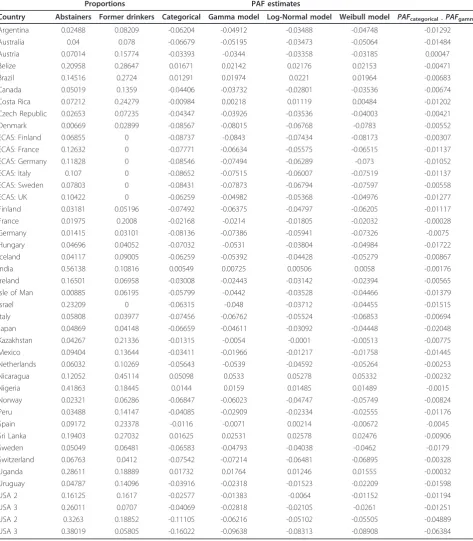
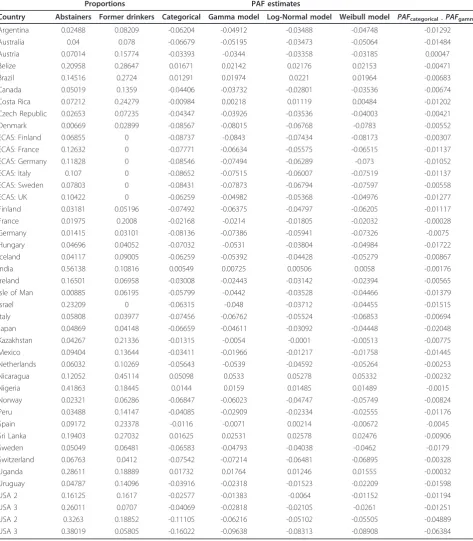
up-Table 8 Proportion estimates for lifetime abstainers and former drinkers, as well as Population-Attributable Fraction
(PAF) estimates for pancreatitis using a categorical model and continuous models (Gamma, Log-Normal, and Weibull)
for women
Proportions PAF estimates
Country Abstainers Former drinkers Categorical Gamma model Log-Normal model Weibull model PAFcategorical -PAFgamma
Argentina 0.02488 0.08209 -0.06204 -0.04912 -0.03488 -0.04748 -0.01292
Australia 0.04 0.078 -0.06679 -0.05195 -0.03473 -0.05064 -0.01484
Austria 0.07014 0.15774 -0.03393 -0.0344 -0.03358 -0.03185 0.00047
Belize 0.20958 0.28647 0.01671 0.02142 0.02176 0.02153 -0.00471
Brazil 0.14516 0.2724 0.01291 0.01974 0.0221 0.01964 -0.00683
Canada 0.05019 0.1359 -0.04406 -0.03732 -0.02801 -0.03536 -0.00674
Costa Rica 0.07212 0.24279 -0.00984 0.00218 0.01119 0.00484 -0.01202
Czech Republic 0.02653 0.07235 -0.04347 -0.03926 -0.03536 -0.04003 -0.00421
Denmark 0.00669 0.02899 -0.08567 -0.08015 -0.06768 -0.0783 -0.00552
ECAS: Finland 0.06855 0 -0.08737 -0.0843 -0.07434 -0.08173 -0.00307
ECAS: France 0.12632 0 -0.07771 -0.06634 -0.05575 -0.06515 -0.01137
ECAS: Germany 0.11828 0 -0.08546 -0.07494 -0.06289 -0.073 -0.01052
ECAS: Italy 0.107 0 -0.08652 -0.07515 -0.06007 -0.07519 -0.01137
ECAS: Sweden 0.07803 0 -0.08431 -0.07873 -0.06794 -0.07597 -0.00558
ECAS: UK 0.10422 0 -0.06259 -0.04982 -0.05368 -0.04976 -0.01277
Finland 0.03181 0.05196 -0.07492 -0.06375 -0.04797 -0.06205 -0.01117
France 0.01975 0.2008 -0.02168 -0.0214 -0.01805 -0.02032 -0.00028
Germany 0.01415 0.03101 -0.08136 -0.07386 -0.05941 -0.07326 -0.0075
Hungary 0.04696 0.04052 -0.07032 -0.0531 -0.03804 -0.04984 -0.01722
Iceland 0.04117 0.09005 -0.06259 -0.05392 -0.04428 -0.05279 -0.00867
India 0.56138 0.10816 0.00549 0.00725 0.00506 0.0058 -0.00176
Ireland 0.16501 0.06958 -0.03008 -0.02443 -0.03142 -0.02394 -0.00565
Isle of Man 0.00885 0.06195 -0.05799 -0.0442 -0.03528 -0.04466 -0.01379
Israel 0.23209 0 -0.06315 -0.048 -0.03712 -0.04455 -0.01515
Italy 0.05808 0.03977 -0.07456 -0.06762 -0.05524 -0.06853 -0.00694
Japan 0.04869 0.04148 -0.06659 -0.04611 -0.03092 -0.04448 -0.02048
Kazakhstan 0.04267 0.21336 -0.01315 -0.0054 -0.0001 -0.00513 -0.00775
Mexico 0.09404 0.13644 -0.03411 -0.01966 -0.01217 -0.01758 -0.01445
Netherlands 0.06032 0.10269 -0.05643 -0.0539 -0.04592 -0.05264 -0.00253
Nicaragua 0.12052 0.45114 0.05098 0.0533 0.05278 0.05332 -0.00232
Nigeria 0.41863 0.18445 0.0144 0.0159 0.01485 0.01489 -0.0015
Norway 0.02321 0.06286 -0.06847 -0.06023 -0.04747 -0.05749 -0.00824
Peru 0.03488 0.14147 -0.04085 -0.02909 -0.02334 -0.02555 -0.01176
Spain 0.09172 0.23378 -0.0116 -0.0071 0.00214 -0.00672 -0.0045
Sri Lanka 0.19403 0.27032 0.01625 0.02531 0.02578 0.02476 -0.00906
Sweden 0.05049 0.06481 -0.06583 -0.04793 -0.04038 -0.0462 -0.0179
Switzerland 0.06763 0.0412 -0.07542 -0.07214 -0.06481 -0.06895 -0.00328
Uganda 0.28611 0.18889 0.01732 0.01764 0.01246 0.01555 -0.00032
Uruguay 0.04787 0.14096 -0.03916 -0.02318 -0.01523 -0.02209 -0.01598
USA 2 0.16125 0.1617 -0.02577 -0.01383 -0.0064 -0.01152 -0.01194
USA 3 0.26011 0.0707 -0.04069 -0.02818 -0.02105 -0.0261 -0.01251
USA 2 0.3263 0.18852 -0.11105 -0.06216 -0.05102 -0.05505 -0.04889
Table 9 Proportion estimates for lifetime abstainers and former drinkers, as well as Population-Attributable Fraction
(PAF) estimates for pancreatitis using a categorical model and continuous models (Gamma, Log-Normal, and Weibull)
for men
Proportions PAF estimates
Country Abstainers Former drinkers Categorical Gamma model Log-Normal model Weibull model PAFcategorical -PAFgamma
Argentina 0.02488 0.08209 0.22296 0.15927 0.43723 0.20014 0.06369
Australia 0.04 0.078 0.08654 0.08482 0.38073 0.10451 0.00172
Austria 0.07014 0.15774 0.28936 0.22295 0.35679 0.2301 0.06641
Belize 0.20958 0.28647 0.33325 0.24985 0.33703 0.27395 0.0834
Brazil 0.14516 0.2724 0.36261 0.29194 0.39178 0.32264 0.07067
Canada 0.05019 0.1359 0.21733 0.13226 0.33792 0.15511 0.08507
Costa Rica 0.07212 0.24279 0.12691 0.10615 0.29474 0.14666 0.02076
Czech Republic 0.02653 0.07235 0.45021 0.44383 0.59431 0.46265 0.00638
Denmark 0.00669 0.02899 0.21317 0.1266 0.36293 0.13557 0.08657
ECAS: Finland 0.06855 0 0.15448 0.09867 0.28828 0.1085 0.05581
ECAS: France 0.12632 0 0.27896 0.19496 0.44157 0.22458 0.084
ECAS: Germany 0.11828 0 0.11683 0.07036 0.27456 0.07978 0.04647
ECAS: Italy 0.107 0 0.14476 0.13578 0.42278 0.1422 0.00898
ECAS: Sweden 0.07803 0 0.14909 0.04825 0.19429 0.05417 0.10084
ECAS: UK 0.10422 0 0.52217 0.49318 0.58899 0.50824 0.02899
Finland 0.03181 0.05196 0.12555 0.07766 0.33705 0.0898 0.04789
France 0.01975 0.2008 0.24059 0.22953 0.39322 0.24816 0.01106
Germany 0.01415 0.03101 0.18565 0.16192 0.44023 0.17239 0.02373
Hungary 0.04696 0.04052 0.08571 0.0504 0.29853 0.07345 0.03531
Iceland 0.04117 0.09005 0.0527 0.04367 0.15151 0.04482 0.00903
India 0.56138 0.10816 0.40834 0.36381 0.36933 0.36204 0.04453
Ireland 0.16501 0.06958 0.58943 0.51065 0.5712 0.52348 0.07878
Isle of Man 0.00885 0.06195 0.41981 0.3877 0.57684 0.42486 0.03211
Israel 0.23209 0 0.15418 0.05803 0.26452 0.09695 0.09615
Italy 0.05808 0.03977 0.13931 0.18626 0.45169 0.18221 -0.04695
Japan 0.04869 0.04148 0.25401 0.2705 0.53622 0.35619 -0.01649
Kazakhstan 0.04267 0.21336 0.42465 0.27561 0.43974 0.30884 0.14904
Mexico 0.09404 0.13644 0.29837 0.18325 0.36482 0.23945 0.11512
Netherlands 0.06032 0.10269 0.13115 0.11909 0.29457 0.12463 0.01206
Nicaragua 0.12052 0.45114 0.35959 0.24862 0.30616 0.26612 0.11097
Nigeria 0.41863 0.18445 0.35308 0.37914 0.43234 0.39043 -0.02606
Norway 0.02321 0.06286 0.13943 0.06723 0.2652 0.07835 0.0722
Peru 0.03488 0.14147 0.17245 0.04226 0.05929 0.04328 0.13019
Spain 0.09172 0.23378 0.22602 0.19353 0.43043 0.20917 0.03249
Sri Lanka 0.19403 0.27032 0.36577 0.31928 0.36454 0.33162 0.04649
Sweden 0.05049 0.06481 0.03966 0.02675 0.08574 0.02787 0.01291
Switzerland 0.06763 0.0412 0.25281 0.12628 0.30113 0.14007 0.12653
Uganda 0.28611 0.18889 0.56306 0.5551 0.55585 0.55323 0.00796
Uruguay 0.04787 0.14096 0.39759 0.24 0.43627 0.2895 0.15759
USA 2 0.16125 0.1617 0.18083 0.11673 0.28693 0.15662 0.0641
estimating this distribution using the relationship
between the mean and the standard deviation, and using
per capita consumption data, allows us to correct for the
biases that lead to undercoverage (for specifics on the
upshifting methods see [15]) and allows for the
estima-tion of the distribuestima-tion of alcohol consumpestima-tion in a
country as if it were measured by a survey with a much
higher coverage rate. Additionally, based on the
relation-ship between the mean and the standard deviation of the
alcohol consumption Gamma distribution, we can use
the mean alcohol consumption from sales and taxation
data to obtain the
and
θ
parameters for the alcohol
exposure distribution for those countries where no
sur-vey data exist. Due to great variations in the populations
surveyed, and in the sampling frame, response rate, and
coverage rate for each of the individual surveys within
the main survey groups of GENACIS, ECAS, and STEPS,
our observations that alcohol consumption can best be
modeled through a Gamma distribution and that the
mean is highly correlated with the standard deviation of
the alcohol consumption Gamma distribution indicate
that these results are applicable to a wide range of
countries and are valid for population surveys that use
different methodologies.
An interesting finding from our study was the
identifi-cation as outliers of some of the observations from
Nigeria. This could be due to multiple factors. The
number of observations from Nigeria upon which the
mean and the standard deviation of the alcohol
con-sumption Gamma distribution are based are fewer than
the number of observations from other countries. A
further factor is that the relationship between the mean
and standard deviation of the alcohol consumption
Gamma distribution for Nigeria may be different when
compared to other countries. Given that only some age
groups in Nigeria were identified by the regression
diag-nostics as outliers, it is very likely that these outliers
were due to the low number of individuals surveyed in
Nigeria. Future research will focus on modeling alcohol
consumption by global region (such as by using the
2005 Comparative Risk Assessment regions [44]) to see
if there are regional differences in the relationship
between the mean and the standard deviation of the
alcohol consumption Gamma distribution.
Table 10 Descriptive statistics of the alcohol surveys from 66 countries
Number of estimates
Empirical mean
Empirical standard deviation
Gamma distribution mean
Gamma distribution standard deviation
Women 422 7.55 12.63 7.55 9.86
Men 429 18.29 25.60 18.29 22.01
Total 851 12.96 19.17 12.96 15.99
Figure 7Regression analysis and scatter plot for the mean and standard deviation of the alcohol consumption Gamma distribution for women.
Conclusion
When comparing the Log-Normal, Weibull, and Gamma
distributions to calculate average consumption of
alco-hol, the Gamma distribution and the Weibull
distribu-tion outperform the Log-Normal distribudistribu-tion in fitting
the empirical consumption distribution. Of these two
distributions, the Gamma distribution appears to be the
best choice for modeling as it has two parameters that
can easily be shifted to make the fit more compatible
with the per capita consumption data, thus making it
possible to estimate the exposure distribution of
coun-tries with only aggregate per capita consumption
reported, as long as prevalence of abstention is known
(see [15]). Thus, shifting the mean upwards is possible,
as the Gamma distribution can be described by two
parameters (mean and standard deviation), which
empirically can be reduced to one, as a large degree of
variance of the standard deviation of the alcohol
con-sumption Gamma distribution is explained by the mean
alcohol consumption. Accurate modeling of alcohol
con-sumption as an upshifted distribution will provide public
health decision-makers with accurate data to assess the
impact of alcohol consumption within and across
coun-tries and will aid in determining public health priorities
and where to allocate resources.
Additional material
Additional file 1: Web Appendix. This web appendix includes parameter estimates using non-truncated data for women and men from Log-Normal, Gamma, and Weibull models, proportion estimates for lifetime abstainers and former drinkers, as well as Population Attributable Fraction (PAF) estimates for breast cancer, diabetes, pancreatitis using a categorical model and a continuous model. Count, proportion and weighted global proportion estimates for women and men drinkers that drink≤96 g/day, > 96 g/day,≤120 g/day, and > 120 g/day were also included. Proportion estimates for the decomposition of alcohol Population Attributable Fraction (PAF) are listed for breast cancer and pancreatitis consisting of drinkers that drink≤96 g/day and > 96 g/day, ≤120 g/day and > 120 g/day,≤150 g/day and > 150 g/day, and≤200 g/day and > 200 g/day using a continuous model (Gamma, Log-Normal, and Weibull) for women and men.
Acknowledgements
This paper uses data from Gender, Alcohol and Culture: An International Study (GENACIS). GENACIS is a collaborative international project affiliated with the Kettil Bruun Society for Social and Epidemiological Research on Alcohol and coordinated by GENACIS partners from the University of North Dakota, the University of Southern Denmark, the Charité University Medicine Berlin, the Pan American Health Organization (PAHO), and the Swiss Institute for the Prevention of Alcohol and Drug Problems. Support for aspects of the project comes from the World Health Organization (WHO), the Quality of Life and Management of Living Resources Programme of the European Commission (Concerted Action QLG4-CT-2001-0196), the United States National Institute on Alcohol Abuse and Alcoholism/National Institutes of Health (Grant Numbers R21 AA012941 and R01 AA015775), the German Federal Ministry of Health, PAHO, and Swiss national funds. Support for individual country surveys was provided by government agencies and other
national sources. The study leaders and funding sources for datasets used in this study are:
Argentina (Myriam Munné, WHO); Australia (Jillian Fleming, National Campaign Against Drug Abuse, National Centre for Epidemiology and Population Health, Australian National University; Paul Dietze, National Health and Medical Research Council (Grant 398500)); Austria (Irmgard Eisenbach-Stangl, Boltzmann Institute); Belize (Claudina Cayetano, PAHO); Brazil (Florence Kerr-Correa; Foundation for the Support of Sao Paulo State Research (Fundação de Amparo a Pesquisa do Estado de São Paulo, FAPESP) (Grant 01/03150-6)); Canada (Kate Graham; Canadian Institutes of Health Research (CIHR)); Costa Rica (Julio Bejarano, WHO); Czech Republic (Ladislav Csémy, Ministry of Health (Grant MZ 23752)); Denmark (Kim Bloomfield, Sygekassernes Helsefond; Danish Medical Research Council); Finland (Pia Mäkelä, National Research and Development Centre for Welfare and Health (STAKES)); France (Francois Beck, National Institute of Prevention and Heath Education (INPES)); Germany (Ludwig Kraus, German Federal Ministry of Health (BMGS) and in cooperation with the Institute for Therapy Research, Munich, Germany); Hungary (Zsuzsanna Elekes, Ministry of Youth and Sport); Iceland (Hildigunnur Ólafsdóttir, Alcohol and Drug Abuse Prevention Council, Public Health Institute of Iceland, Reykjavík, Iceland); India (Vivek Benegal, WHO); Ireland (Ann Hope, Department of Health and Children (HPU)); Isle of Man (Martin Plant, Moira Plant, Isle of Man Medical Research Council; University of the West of England, Bristol); Israel (Giora Rahav, Meir Teichman, Anti Drugs Authority of Israel); Italy (Allaman Allamani, Centro Alcologico, Florence Health Agency, Regional Health Agency of Tuscany); Japan (Shinji Shimizu, Japan Society for the Promotion of Science (Grant 13410072)); Kazakhstan (Bedel Sarbayev, WHO); Mexico (Maria-Elena Medina-Mora, Ministry of Health, Mexico, Office of Antinarcotics Issues; US Embassy in Mexico; National Institute of Psychiatry; National Council Against Addictions; General; Directorate of Epidemiology and Sub-secretary of Prevention and Control of Diseases, Ministry of Health, Mexico); Netherlands (Ronald Knibbe, Ministry of Health and Welfare of the Netherlands); Nicaragua (Jose Trinidad Caldera, PAHO); Nigeria (AkanidomoIbanga, WHO); Norway (Sturla Nordlund, Norwegian Institute for Alcohol and Drug Research); Peru (Marina Piazza, PAHO); Spain (Juan C. Valderrama, Dirección General de Atención a la Dependencia, Conselleria de Sanidad, Generalitat Valenciana; Comisionado do Plan de Galicia sobre Drogas, Conselleria de Sanidade, Xunta de Galicia; Dirección General de Drogodependencias y Servicios Sociales, Gobierno de Cantabria); Sri Lanka (Siri Hettige, WHO); Sweden (Karin Bergmark, Ministry for Social Affairs and Health, Sweden); Switzerland (Gerhard Gmel, Swiss Federal Office for Education and Science (Contract 01.0366); Swiss Federal Statistical Office; Uganda (Nazarius Mbona Tumwesigye, WHO); Uruguay (Raquel Magri, WHO); UK (Martin Plant, Moira Plant, Alcohol Education and Research Council; European Forum for Responsible Drinking; University of the West of England, Bristol); US (Sharon C. Wilsnack, Richard W. Wilsnack, Thomas Greenfield, National Institute on Alcohol Abuse and Alcoholism/National Institutes of Health (Grants; R01 AA015775 and R21 AA012941; P50 AA05595; P50 AA05595); University of North Dakota (Subcontract No. 254, Amendment No.2 UND Fund 4153-0425)).
This paper also uses data from STEPwise approach to Surveillance (STEPS). We would like to thank the following individuals who have supported the concept of STEPS:
Hermann, John Jabbour, Samer Jabbour, Rally Jim, S.K. Jindal, Abraham Joseph, Prashant Joshi, Umesh Kapil, S.K. Kapoor, Oussama Khatib, Robert Kim-Farley, Hilary King, Makeleta Koloi, Lingzhi Kong, Andrea Kriska, Etienne Krug, Thomas Kurian, Kerry Kutch, Kari Kuulasmaa, Louise Hayes, Gael Kernen, Stevenson Kuartei, Justina Langidrik, H. Latiri, Jerzy Leowski, Dominique LeFévre, Xinhua Li, L. Lili’o, Kipier Lippwe, Alan Lopez, Heather MacDonald, Nancy Macdonald, Sarah MacFarlane, Judith Mackay, Nejma Macklai, U.A. Maga, Blerta Maliqi, Jean-Claude Mbanya, Tony Mbewu, Laura McDougall, David McQueen, Shanthi Mendis, George Mensah, Airambiata Metai, Dan Miller, Anoop Misra, V. Mohan, Maristela Monteiro, Alfredo Morabia, D. McDonald Mtotha, David McQueen, Ferdinand Mugusi, Gano Mwarewo, Shakila Naidu, Richard Nesbit, Angela Newill, Nawi Ng, Chizuru Nishida, Robyn Norton, Ayoade Olatunbosun-Alakija, Pedro Ordunez, Stipe Orešković, Fred Paccaud, Arvind Pandey, Lili Pasat, Margie Peden, Rachel Pedersen, Janina Petkeviciene, Pirjo Pietinen, Barry Popkin, Rimina Potemkinov, Viliami Puloka, Pekka Puska, Jan Pryor, Mahmudur Rahman, Sawat Ramaboot, Lars Ramstrom, K Srinath Reddy, Peter Redert, Nina Rehn, Claude Renaud, Sylvia Robles, Paz Rodriquez, Gojka Roglic, Salanieta Taka Saketa, Susana Sans, Shekhar Saxena, Cristina Schneider, Jimaima Schultz, Cecilia Sepulveda, Bella Shah, Aushra Shatchkute, Prakash Shetty, N. Short, Padam Singh, S.K. Sinha, Michael Sjöström, Seilini Soakai, Lakshmi Somatunga, C. Sookram, Soeharsono Soemantri, Harley John Stanton, Krisela Steyn, Kathleen Strong, T.N. Sugathan, Hirotu Suzuki, Karen Tairea, Julita Tellei, K.R. Thankappan, Benete Tokanang, Hanna Tolonen, Steve Tollman, O. Tommaso, Thomas Truelsen, Nigel Unwin, Ulla Uusitalo, Cherian, Barbora Vozarova, Godfrey Waidubu, Stig Wall, Lepani Waqatakirewa, Franklin White, Derek Yach, Zaida Yadon, Mabel Yap, Helena Zabina, Paul Zimmet. Support from the Governments of Australia, the Netherlands, Sweden, and the United Kingdom toward the development and implementation of the WHO STEPwise approach to Surveillance (STEPS) is also gratefully acknowledged.
Author details
1Centre for Addiction and Mental Health (CAMH), Toronto, Canada. 2
Department of Statistics, University of Toronto, Toronto, Canada.3Dalla Lana School of Public Health (DLSPH), University of Toronto, Toronto, Canada.
4
Addiction Info Suisse, Lausanne, Switzerland.5Alcohol Treatment Centre, Lausanne University Hospital CHUV, Lausanne, Switzerland.6University of the
West of England, Bristol, UK.7Institute for Clinical Psychology and Psychotherapy, Dresden University of Technology, Dresden, Germany.
8Department of Psychiatry, University of Toronto, Toronto, Canada.9Institute
of Medical Science, University of Toronto, Toronto, Canada.
Authors’contributions
TK, GG, and JR conceptualized the overall article. TK, GG, KDS, GG, and JR contributed to the methodology, identified sources for risk relations and exposure, and contributed to the writing. TK performed all statistical analyses. All authors have approved the final version.
Competing interests
The authors declare that they have no competing interests.
Received: 14 June 2011 Accepted: 10 April 2012 Published: 10 April 2012
References
1. Murray CJL, Lopez A:Global mortality, disability, and the contribution of risk factors: global burden of disease study.Lancet1997,349:1436-1442. 2. World Health Organization:International classification of diseases and related
health problems, 10th revision (version for 2007)Geneva, Switzerland: World Health Organization; 2007.
3. Rehm J, Baliunas D, Borges GLG, Graham K, Irving HM, Kehoe T,et al:The relation between different dimensions of alcohol consumption and burden of disease - An overview.Addiction2010,105:817-843. 4. Eide G, Heuch I:Attributable fractions: fundamental concepts and their
visualization.Stat Methods Med Res2001,10:159-193.
5. Rothman KJ, Greenland S, Lash TL:Modern Epidemiology.3 edition. PA, USA: Lippincott Williams & Wilkins; 2008.
6. Walter SD:The estimation and interpretation of attributable risk in health research.Biometrics1976,32:829-849.
7. Walter SD:Prevention of multifactorial disease.Am J Epidemiol1980,
112:409-416.
8. Rehm J, Room R, Graham K, Monteiro M, Gmel G, Sempos C:The relationship of average volume of alcohol consumption and patterns of drinking to burden of disease - An overview.Addiction2003,
98:1209-1228.
9. Rehm J, Room R, Monteiro M, Gmel G, Graham K, Rehn N,et al:Alcohol as a risk factor for global burden of disease.Eur Addict Res2003,9:157-164. 10. Gutjahr E, Gmel G, Rehm J:The relation between average alcohol
consumption and disease: an overview.Eur Addict Res2001,7:117-127. 11. Roerecke M, Rehm J:Irregular heavy drinking occasions and risk of
ischemic heart disease: a systematic review and meta-analysis.Am J Epidemiol2010,171:633-644.
12. Puddey IB, Rakic V, Dimmitt SB, Beilin LJ:Influence of pattern of drinking on cardiovascular disease and cardiovascular risk factors - a review.
Addiction1999,94:649-663.
13. Taylor B, Irving HM, Kanteres F, Room R, Borges G, Cherpitel C,et al:The more you drink, the harder you fall: a systematic review and meta-analysis of how acute alcohol consumption and injury or collision risk increase together.Drug Alcohol Depend2010,110:108-116.
14. Gmel G, Kuntsche E, Rehm J:Risky single occasion drinking: bingeing is not bingeing.Addiction2011,106:1037-1045.
15. Rehm J, Kehoe T, Gmel G, Stinson F, Grant B, Gmel G:Statistical modeling of volume of alcohol exposure for epidemiological studies of population health: the example of the US.Popul Health Metr2010,8:3.
16. Rehm J, Mathers C, Popova S, Thavorncharoensap M, Teerawattananon Y, Patra J:Global burden of disease and injury and economic cost attributable to alcohol use and alcohol use disorders.Lancet2009,
373:2223-2233.
17. Patra J, Taylor B, Rehm J, Baliunas D, Popova S:Substance-attributable morbidity and mortality changes to Canada’s epidemiological profile: measurable differences over a ten-year period.Can J Public Health2007,
98:228-234.
18. Duffy JC:The distribution of alcohol consumption - 30 years on.Br J Addict1986,81:735-741.
19. Skog OJ:The distribution of alcohol consumption.Part I. A critical discussion of the Ledermann ModelOslo, Norway: National Institute for Alcohol Research; 1982.
20. Guttorp P, Hiang H:A note on the distribution of alcohol consumption.
Drinking and Drug Practices Surveyor1977,13:7-8.
21. Skog OJ:A note on the distribution of alcohol consumption; Gamma vs Lognormal distributions.A reply to Guttorp and Song. Drinking and Drug Practices Surveyor1979,14:3-6.
22. Skog OJ:The tail of the alcohol consumption distribution.Addiction1993,
88:601-610.
23. Gruenewald P, Nephew T:Drinking in California: Theoretical and empirical analyses of alcohol consumption patterns.Addiction1994,