e-ISSN: 2278-067X, p-ISSN: 2278-800X, www.ijerd.com
Volume 9, Issue 5 (December 2013), PP. 18-22
Linear Operator Based Motion Detection
J.Mahesh
1, Dr. N. Vasudevan
2, Dr. S. Ravi
3, Dr. G. Saravana Kumar
41Research Scholar, Dr MGR Educational and Research Institute University, Chennai, India
2
Dean (Academic), SRM University, Chennai, India.
3Professor&Head, ECE Dept., Dr MGR Educational and Research Institute University, Chennai, India
4Dean & Professor, Dept. of ECE, Vel Tech High Tech Dr. Rangarajan Dr. Sakunthala Engineering College,
Chennai, India.
Abstract:- This paper proposes a novel method to detect moving objects in a continuous video sequence. A simple linear operator based classifier, is implemented to separate target objects from their background. It also estimates stochastic parameters for each pixel of the image. The output data exhibits a frame categorization sanctioning a simple and efficient pixel-level transition identification framework. The degree of similarity between adjacent pixels and their relationship, neighbourhood can be utilized for precise detection. This paper explores the aforesaid inference to establish a spatiotemporal systematic alignment of the leaf level solution. This method accomplishes sturdiness and exactitude, with memory utilization and a highly efficient computational structure.
I.
INTRODUCTION
Motion detection is a key element in gamut of computer vision and video processing tasks such as image registration, object recognition, standards conversion, frame-rate-up conversion, noise reduction, image stabilization, mosaicking and artefact concealment in archived film sequences [1]. The existence of repetitive pixel information consumes large chunk of memory space. Downsizing repetitiveness in spatial domain is a precarious component in scheming video compressions systems. The manoeuvre aims at estimating two dimensional motions by localizing origination of velocity vector in three dimensional spaces. The vulnerability of this method is aggravated by intensity conservation and spatial coherence. The amount of influence exerted by the two factors makes the scheme as docile. Preserving Intensity information in spatial domain actualizes intensity conservation. The intensity conservation fails at boundary regions, presence of shadows or specular reflections, areas of occlusion, presence of noise and transparency effects. Spatial coherence describes the amount of similarity exists between adjacent pixels that enhances the presence of same object and motion models. For multiple, concurrently moving objects and random, complex video sequences the spatial coherence is distorted. In acquiring video sequences by stationary camera a method referred as background subtraction can be employed for motion detection [2-6]. Motion detection comprises of two steps, the First step is eliminating moving objects and constructing static frames yields image background and the second step is, in each frame the video sequence is compared with the background to segregate uncommon regions of motion referred as foreground [7].
In general tracking algorithms can be categorized into two based on their representation schemes, Generative and Discriminative models [8]. Searching specific image regions with minimal reconstruction errors is the objective of Generative algorithms. Their functionality is based on learning an appearance model. To deal with appearance variation, adaptive models such as the WSL tracker [9] and IVT method [10] have been proposed. To manage form changes and partial occlusion, fragmentation based appearance model can be used for motion detection [11]. Sparse representation methods can also be used to symbolize the object by a set of target and trivial templates to handle partial occlusion, illumination change and pose variation [12]. The inability to account surrounding visual context, thrust aside expedient information reduces the capacity of generative models to separate target object from the background [8].
The recursive computational methods yields statistical measures such as first order value and second order value for Gaussian distribution [17]. Predictive filter based estimation schemes computes progressive derivative values to identify background values at different instances. The limitations of recursive schemes are,
i. Sluggish adaptability to cope with instantaneous changes in background states ii. Ineffectiveness to set background state weights
The constraining factors for opting linear computational schemes are complex numerical operations and memory. An effective trade-off between constraining factors and robust estimation can be realized by explicit adoption of multi modal distribution framework. The disadvantages associated with linear schemes were addressed by non-linear schemes. These schemes calculate background values and fine tunes it towards optimal value by iterative approximations. They also exhibit cost effective computational methods over linear schemes.
The paper proposes following techniques to exterminate the imminent limitations identified in the aforementioned methods.
i. Mathematical description of the problem ii. Background estimations model
iii. Motion estimation model
II.
METHODOLOGY
This paper proposes background estimation to identify motion detection in a frame. The description of the scheme contents are as follows.
A. Problem description
The objective is to track down areas of projection P1, P2, P3… PM for M moving inelastic objects in a frame. The quadratic transformation is used to model optic flow at spatial coordinates x = (x, y) for planar surface moving objects [18] as
vx = b1 + b2 x + b3 y + b7 xy + b8 x2 --- (1)
and
vy = b4 + b5 x + b6 y + b7 x2 + b8 xy --- (2)
Where θ = (α1, α2--- αs) are the movement parameters of the objects. A parameter based model adopts two forms direct form and amalgamated form. The amalgamated form results from intensity equation combination with quadratic form. The generalized form can be described as
y(x) = f (x: θM) + εx for all x € PM --- (3)
In (3) „y‟ corresponds to the vector (vx, vy), „f „is known function, θM is the vector of motion parameters of apriori object PM.
B. Background Estimation scheme module No. 1
This paper proposes a scheme to measure background state estimate as follows. The input sequence is denoted as It and the estimated background value is denoted as Mt.
1. For every pixel x, the back ground estimate value is assumed to be the original pixel value. 2. For the entire frame t, the following steps are iterated for every pixel x.
i. If the previous background estimate value of a pixel x is greater than input pixel value of a frame t, than present background estimate value is incremented by one.
ii. Upon not complying the conditional criterion stated in (i) the present background estimate value is decremented by one.
The magnitude of discontinuity in the input sequence restricts the precision of the proposed scheme. The rate of change incurred by the input sequence determines the effective estimate calculation.
C. Background Estimation scheme module No. 2
1. The absolute difference between input sequence value and background value is calculated.
2. The transition from static position to dynamic position is tracked by computing average squared deviation value.
3. The amount of movement magnitude is assumed as the non-zero numerical value computed from step (i).
i. If the previous transition value is less than total absolute value for the frame than previous transition value is incremented by one and assigned to present transition value.
ii. If the previous transition value is greater than total absolute value for the frame than previous transition value is incremented by one and assigned to present transition value.
5. If the numerical value computed from step (iv) is less than step (ii) than the movement is branded as null otherwise it is branded as valid.
D. Motion Estimation Model
The proposed motion estimation model is narrated as follows.
1. The details of the image are obtained by using a low pass filter. The low pass filter retains details of the image and discards the edges.
2. The scheme assumes that a future state of the process depends only upon the state. The state of the process is partially observable.
3. The motion estimation of a binary background motion is calculated for given observation field. 4. The framework is maximized by assuming that the presence or absence of a particular feature is
unrelated to the presence of or absence of any other feature.
5. For a given observation field the motion label is assigned and the conditional probability is maximized.
6. This initial estimate does not need to be precise. The robustness of the implementation procedure is essential for localizing the starting point gradient descent algorithm.
III.
IMPLEMENTATION
The proposed is used to distinguish objects in a frame obtained from video sequence. The foreground detection is developed using Gaussian Mixture Model (GMMs). The detection acts as the primary step to erudite tasks such as classification of objects.
A. CONVERTING VIDEO SEQUENCE INTO FRAMES
The following method is employed to convert the given video sequence into frames. 1. A temporary working folder is created to store image sequences.
2. A VideoReader object is created to read frames from the frame sequence. 3. The video sequence is subjected to looping.
4. Each frame is encapsulated into a width-by-height-by-3 array named img.
5. Each image is indexed as a JPEG file with a name in the form imgN.jpg, where N is the frame number.
6. The JPEG file names are found in the images folder.
7. The frame numbers are extracted from the file names. They are used to sort the images. 8. The frame numbers are sorted from lowest to highest.
B. FOREGROUND DETECTION
The following steps are executed to segregate foreground from the frame.
1. Foreground Detector Initialization
The entire video sequence is segregated into a specific number of frames. From each frame the moving objects are segmented from the background. The foreground detector requires a certain number of video frames in order to initialize the Gaussian mixture model. This scheme uses the first 50 frames to initialize three Gaussian modes in the mixture model. The Pseudo code for foreground detector initialization is,
Assign foregrounddetector = vision_foreground_detector [No_of_Gaussian_modes, No_of_training_frames];
Create videoReader object; Read Videofile;
For i= 1 to 50
Assign frame=Video_Reader_Step; Compute Foreground;
end
2. Displaying frames
3. Motion Detection
During foreground segmentation process, a detrimental noise component is developed. The method employs morphological opening to eradicate the noise and to fill gaps in the detected objects. It aspires three important objectives
i. Prediction of object's location prediction
ii. Enabling the procedure of association of multiple objects to their tracks iii. Decreasing noise incorporated by false detections
IV.
RESULTS
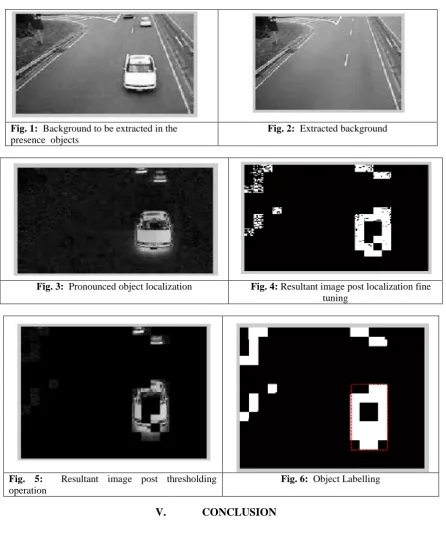
The proposed background method is applied on a frame obtained from a video sequence is shown in Fig. 1. It extracts background for a specific frame and discards identified objects as shown in Fig. 2. Object localization technique identifies objects with blurred details as shown in Fig. 3.The resultants images resulting from threshold operation and labelling operation are shown in Fig. 5 and Fig. 6.
Fig. 1: Background to be extracted in the presence objects
Fig. 2: Extracted background
Fig. 3: Pronounced object localization Fig. 4: Resultant image post localization fine tuning
Fig. 5: Resultant image post thresholding operation
Fig. 6: Object Labelling
The proposed algorithm extracts the background from any specified frame of video sequence and detects the foreground meritoriously. This algorithm dynamically updates the background frame by frame .This algorithm also identifies the quality degrading intrusive components from moving object to detect the focused object accurately. This scheme exhibits adaptiveness in detecting various sizes of the object present in a frame by adjusting the threshold values. It also follows up with swift changing edge values. The proposed algorithm shall be gauged by a measure referred as Log-likelihood statistic ratio. The numerical interpretations of the results can be utilized as the basis for futuristic motion detection algorithm development.
ACKNOWLEDGMENT
The authors like to extend their genuine appreciation to Micro Logic Systems, Chennai for marshalling their resources towards this manuscript preparation.
REFERENCES
[1] Vasileios Argyriou, “Sub Hexagonal Phase Correlation for Motion Estimation”, IEEE transactions on Image Processing, Vol. 20, No. 1, January 2011.
[2] B. Horn, Robot Vision, Cambridge, MA. MIT Press, 1986.
[3] V.A. and T. Poggio, “Against quantitative optical flow”, Proceeding of First International Conference on Computer Vision, pp. 171-180, 1987.
[4] Y.H., B.M.J., F.R., “The dense estimation of motion and appearance in layers”, Proceedings of Computer Vision and Pattern Recognition Workshop, p.165, June 2004.
[5] P.I., W.M., and R. Van den Boomgaard, “Dense motion estimation using regularization constraints on local parametric models”, IEEE transactions on Image Processing, Vo. 13, No. 11, Nov. 2004.
[6] G.D., and S.M., “Robust optical flow estimation based on a sparse motion trajectory set”, IEEE transactions on Image Processing, Vol. 12, No.4, April 2003.
[7] A. Manzanera, J. C. Richefeu, “A robust and computationally efficient motion detection algorithm based on ∑- Δ background estimation”, ENSTA / LEI, 32 Bd Victor, F 75739 PARIS CEDEX 15. [8] Kaihua Zhang, Lei Zhang, Ming-Hsuan Yang, “Real-time object tracking via Online Discriminative
Feature Selection”, IEEE transactions on Image Processing, Vol. 22, No. 12, December 2013.
[9] A. Jepson, D. Fleet, T. El-Maraghi, “Robust on-line appearance models for visual tracking”, IEEE transactions on Pattern Analysis and Machine Intelligence, Vol. 25, No. 10, October 2003.
[10] Ross, J. Lim, R.-S. Lin, and M.-H. Yang, “Incremental learning for robust visual tracking,” International Journal for. Computer Vision, vol. 77, no. 1, , May 2008.
[11] Adam, E. Rivlin, and I. Shimshoni, “Robust fragments-based tracking using the integral histogram,” Proceedings of IEEE Conference on Computer Vision Pattern Recognition, Jun. 2006.
[12] S. Avidan, “Ensemble tracking,” IEEE Transactions on Pattern Analysis and Machine Intelligence, Vol. 29, No. 2, Feb. 2007.
[13] H. Grabner, M. Grabner, and H. Bischof, “Real-time tracking via online boosting,” in Proceedings of British Machine Vision Conference, 2006.
[14] S. Avidan, “Ensemble tracking,” IEEE Transactions on Pattern Analysis and Machine Intelligence, Vol. 29, No. 2, Feb. 2007.
[15] H. Grabner, M. Grabner, and H. Bischof, “Real-time tracking via online boosting,” in Proceedings of British Machine Vision Conference, 2006.
[16] C. Wren, A. Azarbayejani, T. Darrell, and A. Pentland. Pfinder, “Real-time tracking of the human body”, IEEE Transactions on Pattern Analysis and Machine Intelligence, 1997.
[17] G. Adiv, “Determining 3-D motion and structure from optical flows generated by several moving objects”, IEEE transactions for Pattern Analysis and Machine Intelligence, Vol. 7, 1985.
[18] G. Srinivas Babu, “Motion detection using MATLAB”, International Journal of Engineering Research