R E S E A R C H
Open Access
An online-updating algorithm on
probabilistic matrix factorization with active
learning for task recommendation in
crowdsourcing systems
Man-Ching Yuen
*, Irwin King and Kwong-Sak Leung
*Correspondence: [email protected] Department of Computer Science and Engineering, The Chinese University of Hong Kong, Shatin, NT, Hong Kong, China
Abstract
Background: To ensure the output quality, current crowdsourcing systems highly rely on redundancy of answers provided by multiple workers with varying expertise, however massive redundancy is very expensive and time-consuming. Task
recommendation can help requesters to receive good quality output quicker as well as help workers to find their right tasks faster. To reduce the cost, a number of previous works adopted active learning in crowdsourcing systems for quality assurance. Active learning is a learning approach to achieve certain accuracy with a very low cost. However, previous works do not consider the varying expertise of workers for various task categories in real crowdsourcing scenarios; and they do not consider new workers who are not willing to work on a large amount of tasks before having a list of preferred tasks recommended. In this paper, we propose ActivePMFv2, Probabilistic Matrix Factorization with Active Learning (version 2), on a task recommendation framework called TaskRec to recommend tasks to workers in crowdsourcing systems for quality assurance. By assigning the most uncertain task for new workers to work on, this paper identifies a flaw in our previous ActivePMFv1, Probabilistic Matrix Factorization with Active Learning (version 1). Therefore, ActivePMFv2 can give new workers a list of preferred tasks recommended faster than that of ActivePMFv1. Our factor analysis model considers not only worker task selection preference, but also worker performance history. It actively selects the most uncertain task for the most reliable workers to work on to retrain the classification model. Moreover, we propose a generic online-updating method for learning the model, ActivePMFv2. The larger the profile of a worker (or task) is, the less important is retraining its profile on each new work done. In case of the worker (or task) having large profile, our online-updating algorithm retrains the whole feature vector of the worker (or task) and keeps all other entries in the matrix fixed. Our online-updating algorithm runs batch update to reduce the running time of model update.
Results: Complexity analysis shows that our model is efficient and is scalable to large datasets. Based on experiments on real-world datasets, the result shows that the MAE results and RMSE results of our proposed ActivePMFv2 are improved up to 29 % and 35 % respectively comparing with ActivePMFv1, where ActivePMFv1 outperforms the PMF (Continued on next page)
(Continued from previous page)
with other active learning approaches significantly as shown in previous work. Experiment results show that our online-updating algorithm is accurate in approximating to a full retrain of the learning model while the average runtime of model update for each work done is reduced by more than 80 % (decreases from a few minutes to several seconds).
Conclusions: To the best of our knowledge, we are the first one to use PMF, active learning and dynamic model update to recommend tasks for quality assurance in crowdsourcing systems for real scenarios.
Keywords: Crowdsourcing, Task recommendation, Matrix factorization, Probabilistic matrix factorization
Background
Crowdsourcing is an idea of outsourcing a task to a large group of networked people in the form of an open call to reduce the production cost [1, 2]. In recent years, crowdsourc-ing systems attract much attentions at present [3, 4]. Some examples of crowdsourccrowdsourc-ing systems are Amazon Mechanical Turk (or MTurk) [5], CrowdFlower [6], Taskcn [7] and TopCoder [8]. In a crowdsourcing system, the output quality of a completed task in a crowdsourcing system is “the extent to which the provided outcome fulfills the require-ments of the requester” [9]. For quality assurance, a requester has to verify the quality of every answer submitted by workers, and it is very time-consuming. Alternatively, requesters highly rely on redundancy of answers provided by multiple workers with vary-ing expertise, but massive redundancy is very expensive and time-consumvary-ing. “If we ask 10 workers to complete the same task, then the cost of crowdsourcing solutions tends to be comparable to the cost of in-house solutions” [10]. Therefore, it is important to investigate on how to support task requesters to verify correct answers on crowdsourc-ing platforms easily and effectively. On the other hand, it is not efficient that the amount of time for a worker spent on selecting a task is comparable with that spent on work-ing on a task, but the monetary reward of a task is just a small amount. To address this problem, task recommendation can help to provide a list of preferred tasks to work-ers in crowdsourcing systems. However, new workwork-ers do not want to work on a large number of tasks or wait for a long time before having a list of preferred tasks recom-mended. Therefore, it is important to help workers to find their right tasks as quick as possible and minimize the number of task assignments to achieve a target output qual-ity [11]. The worker performance history makes it possible to mine workers’ preference on tasks and to provide an indication of worker quality on tasks. Based on worker per-formance history, an active learning approach on task recommendation can be used to help requesters to receive good quality output quicker with lower cost, thus achieve quality assurance in crowdsourcing systems. Moreover, by assigning the most uncertain task for new workers to work on, it not only helps new workers having a list of pre-ferred tasks recommended faster, but also improves the output quality of crowdsourcing systems.
has to be trained and learned before the model can be applied for prediction. In real-world applications, the performance of a factorization model is highly affected by how the model is updated, and thus dynamic updating a model is very important [13]. When updating a worker’s profile, the profile will not change much if the worker having large profile; while the profile will have great change if the worker having small profile.
Active learning is a learning approach to improve the prediction accuracy with a low cost. By performing active learning in a task recommendation model, it can guarantee the accuracy of recommendations with a very low cost, but it still needs to consider the minimizaton of the user waiting time. The tasks recommended to the new workers have to carefully selected, because new workers are not willing to work on a lot of tasks before having their preferred tasks recommended. Therefore, systems that provide rec-ommendations in large user waiting times are not suitable for real-world applications [14]. Moreover, it does not make sense to retrain the model from scratch whenever a worker of large profile completes a task, because the performance improvement by retraining the model in the case is tiny but the cost of retraing model is high. Furthermore, when a large number of workers are working in the crowdsourcing system at the same period of time, the computational complexity is very high if the model is retrained after each worker completes a task. Batch update provides a method of reducing both user waiting time and computational complexity.
Our contributions are as follows:
• First, we propose a way for quality assurance by performing ActivePMFv2, Probabilistic Matrix Factorization with Active Learning (version 2), for task recommendation in crowdsourcing systems, where ActivePMF is an active learning approach on factor analysis based on probabilistic matrix factorization, such that the worker latent feature space, task latent feature space and task category latent feature space are learned. ActivePMF considers the varying expertise of workers for different tasks in real crowdsourcing scenarios. The most informative task and the most skillful worker are selected to learn the factor analysis model.
• Second, we first assign all new tasks to the most reliable workers based on the task categories in our proposed ActivePMFv2, so new workers can receive a list of preferred tasks recommended faster than that of ActivePMFv1 [15]. Our proposed ActivePMFv2 also has better output prediction quality than that of ActivePMFv1. • Third, we propose a generic online-updating method for learning a factor analysis
model, ActivePMFv2. In our proposed updating approach, our online-updating algorithm applies on a learned PMF model without having retrain the whole model. The proposed update methods are generic and appliable for all PMF models. • Fourth, we demonstrate the performance of our proposed ActivePMFv2 by using the
real word dataset. The experimental results show that ActivePMFv2 outperforms ActivePMFv1 by 29 % in the MAE results and 35 % in RMSE results, where
ActivePMFv1 outperforms PMF with various active learning approaches significantly (PMF is the state-of-the-art approach for recommendation systems).
• Fifth, we demonstrate the performance of our online-updating algorithm by using the real world dataset. The experiment results show that the prediction of
algorithm is significantly lower than that of a full retrain of the model. By using online-updating algorithm, the average runtime of model update for each work done is reduced by more than 80 % (decreases from a few minutes to several seconds). • Finally, complexity analysis shows that our model is efficient and is scalable to large
datasets.
Related work
Crowdsourcing systems
Crowdsourcing is outsourcing a task to a large group of networked people in the form of an open call to reduce the production cost. A crowdsourcing process involves operations of both requesters and workers. A requester submits a task request; a worker selects and completes a task; and the requester only pays the worker for the successful completion of the task. Task recommendation in crowdsourcing is important because of the following reasons:
• Motivate workers of diverse background to work on crowdsourcing tasks in long run.Currently, on crowdsourcing sites, most workers only provide moderate contributions [16] and there is a significant population of young and well-educated Indian workers [17]. It can attract more workers to contribute their efforts in long run if a worker find a suitable task on a crowdsourcing site easily.
• Improve the quality of work.Workers perform better if they are familiar with the tasks. Chilton et al. [18] showed that task workers only browsed the first few pages on crowdsourcing sites when searching for tasks. The task list for a worker of Amazon MTurk site is usually displayed on hundreds of pages. A worker selects a task from the list of available tasks sorted by a specified feature of tasks such as task creation date and reward amount. When the tasks posted on the first few pages are not suitable for a worker, the worker might choose a task that he does not familiar with and try to complete it to earn the rewards; otherwise, the worker does not select any task. Working with a unfamiliar task might decrease the quality of work.
Recommendation systems
Broadly speaking, recommendation systems are based on either content filtering approach or collaborative filtering approach. The content filtering approach creates a profile for each user or product, for example, a movie, to characterize its nature. The pro-files of users and products allow programs to associate users with matching products. The advantage is that it can address the system’s new products and users. However, the profile information might not be available or easy to collect. On the other hand, the col-laborative filtering approach relies only on past user behavior. This approach analyzes relationships between users and interdependencies among products to identify new user-item associations. It is generally more accurate than content filtering approach. However, collaborative filtering cannot address the system’s new products and users [19], which is the cold-start problem.
not scalable. Probabilistic matrix factorization (PMF) model [22] can scale linearly with the number of observations, and performs very well on large, sparse, and imbalanced datasets.
Recently, several probabilistic matrix factorization methods [23] have been proposed for collaborative filtering approach in recommendation systems. These methods focus on using low-rank approximations to model the user-item rating matrix for making further predictions. The premise behind a low-dimensional factor model is that there is only a small number of factors influencing preferences, and that a user’s preference vector is determined by how each factor applies to that user. The above approaches are used for user recommendation in social tagging systems.
Task recommendation in crowdsourcing systems
A recommendation system can improve the performance of crowdsourcing systems by providing task requesters some output quality controls based on a number of param-eters, such as task requirements, task properties, worker interests, worker incentives, and costs [24]. Based on collaborative filtering, Organisciak et al. [25] proposed two approaches for capturing personal preferences in personalized item recommendation in crowdsourcing systems; and they are taste-matching and taste-grokking. Taste-matching uses workers’ taste to infer the requester’s taste where workers and the requester have similar tastes, while taste-grokking uses workers’ explicit prediction on the requester’s taste. Both taste-matching and taste-grokking have better performance than the use of generic workers. Later, Organisciak et al. [26] demonstrated the performance of per-sonalized crowdsourcing in a complexer environment by carrying out case studies on personalized text highlighting in film reviews. The results show that both approaches have better performance than a non-personalized baseline. Besides, the taste-grokking approach performs well in simpler tasks and the taste-matching approach performs well with larger crowds and tasks with latent decision-making variables. Ambati et al. [27] proposed classification based task recommendation approach to recommend tasks to users based on implicit modeling of skills and interests. However, these approaches can not solve cold-start problem. Besides, task recommendation is much difficult than product recommendation, and workers do not have to give ratings to tasks to indi-cate the extent of their favor of each task. A crowdsourcing system needs some sig-nals indicating types of available tasks, and the number of tasks workers select and complete [28].
Active learning
unlabeled instance in the pool. The advantage is that large amount of unlabeled data are available in many domains at present, this approach is very important. However, it is dif-ficult to find a good way to choose good queries from the pool. In both stream-based approach and pool-based approach, a query selection strategy is required to achieve high accuracy with as low labeling cost as possible.
Several query selection strategies are commonly used in active learning systems. For example, uncertainty sampling selects instances, which the current model is the most uncertain about, to query. There are many ways to measure the uncertainty, such as small-est margin [31], least confidence [32] and maximum entropy [33]. Another example of query selection strategies is query by committee [34]. This approach maintains a commit-tee of independently trained classification models, and queries the instance for which the committee models disagree the most. Among all query selection strategies, uncertainty sampling is one of the simplest and widely used strategies in active learning systems [35].
Active learning for task recommendation in crowdsourcing systems to achieve quality assurance
Our motivation is the observation of the increase of difficulty for requesters to obtain good output with low cost. Currently, active learning approach has been applied on a number of quality assurance methods in crowdsourcing systems [35–37] because active learning can achieve certain accuracy by using fewer annotations even in noisy annota-tion scenarios. Laws et al. [36] demonstrated that actively selecting instances for label query can achieve performance gains in natural language processing tasks. However, they did not consider actively selecting annotators. To further improve the output quality, Yan et al. [35] proposed to use uncertainty sampling to select the most uncertain instance to query, and also uses an optimization formulation to choose multiple confident workers to query from. However, it is costly to pay for multiple labelers. To characterize the strength of each worker and improve the compentency of weak workers, Fang et al. [37] proposed a Self-Taught Active Learning paradigm, where a weak worker can learn complementary knowledge from a strong worker. Each labeler has a knowledge set (a set of confidence scores), which is used for worker selection. By using the knowledge set of the most reliable labeler to replace that of the most unreliable labeler, the most reliable labeler can teach the unreliable labeler. However, the learning curves of different labelers vary in real scenarios. Later, Fang and Zhu [38] proposed to use diversity density to character-ize the oracle’s uncertain knowledge. However, an oracle does not exist in real-world applications.
They proved that considering task categories in PMF can improve the performance. How-ever, it does not consider to reduce the labeling cost by applying active learning approach. Later, Yuen et al. [15] proposed Probabilistic Matrix Factorization with Active Learning (version 1) for task recommendation systems. The model outperforms the PMF model with other active learning approaches, but new workers have to wait for a long time before having a list of perferred tasks recommended due to lack of worker performance history for all new workers.
Task recommendation for new workers in crowdsourcing systems
In crowdsourcing systems, workers prefer to have a list of recommended tasks, but they are not willing to work on a large number of tasks before having a list of preferred tasks recommended. Since new workers have not worked on a lot of tasks yet, it is difficult for a recommendation system to make a better recommendation for new workers due to the small working profiles of new workers. When performing active learning in recommen-dation systems, besides accuracy of recommenrecommen-dations and minimization of cost, it is also important for new workers to have a list of preferred tasks recommended as soon as they start working in a crowdsourcing system.
Dynamic-updating crowdsourcing systems for real-world scenarios
Some previous works proposed various ways to improve the performance of recom-mendation systems for real-world scenarios [13, 14]. Rendle et al. [13] proposed an online-updating algorithm for three kernal matrix factorization models, they are lin-ear, logistic and linear non-negative matrix factorization model. They demonstrated that the output quality of their proposed online-updating algorithm approximates to that of fully retraining the models. However, the three kernal matrix factorization models are designed for user-item matrices. Besides, the user preference on item category, which is necessary for real-world applications, is not considered in the models. Karimi et al. [14] proposed an active learning method for aspect model in recommendation systems. They observed that “users are not willing to provide information for a large amount of items, thus the quality of recommendations is affected specially for new users” [14], and a full retrain of an aspect model needs a long time especially for a system of large number of existing users. In their online-updating method, the aspect model is updated to learn user latent factors for new users only and not the other users. Experimental results show that the user waiting time of their method is significantly less than that of bayesian method, but the prediction accuracy of their method is not always better than that of bayesian method.
Our motivation
user waiting time on the learning model update, we propose a generic online-updating method for learning the model, ActivePMFv2.
Task recommendation framework
Our task recommendation framework (TaskRec) is based on matrix factorization method, to perform factor analysis to learn the worker latent feature, the task latent feature and the task category latent feature. To reduce the labeling cost and guarantee the output quality, Probabilistic Matrix Factorization with Active Learning (version 2) selects the most informative task to be learned and selects the best worker to query from.
The problem we study in this paper is how to effectively predict the missing values in the worker-task performance matrix so as to select the most informative task for the best worker to query from to achieve high accuracy with as few instances as possible. We define the problem of quality assurance in crowdsourcing systems as follows:
Definition 1Quality assurance problem:Given a set of workers WS ={wi}mi=1, a set of
tasks VS={vj}nj=1, a set of ratings R ={rij}associated between worker wiand task vjwhere
rij∈RM×N and only certain elements of R are initially known. The binary matrix I ={Iij}
of the same shape as R represents the known points, so that Iij is 1 if rij is observed and
0 otherwise. The set of (i, j) indexes where Iij = 0 is denoted by PS. Predict the set of the
unknown elements of R ={rij}where(i,j)∈PS. The aim of ActivePMF is to query the most
informative tasks selected from the set of the unknown elements of R ={rij}where(i,j)∈PS,
and to query from the most reliable workers.
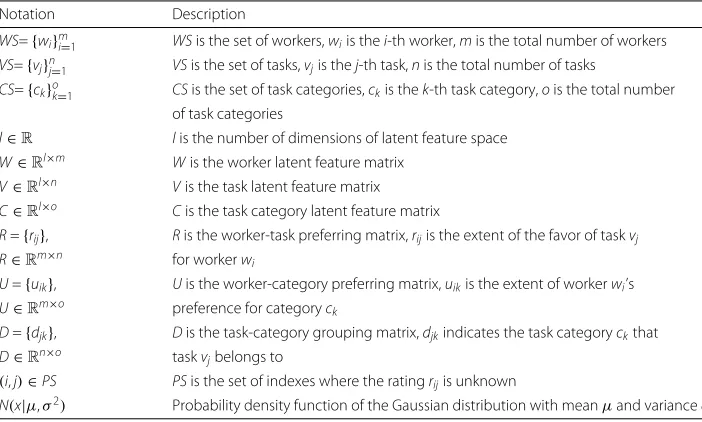
To facilitate our discussions, Table 1 defines basic terms and notations used throughout this paper.
Probabilistic Matrix Factorization on Task Recommendation Framework
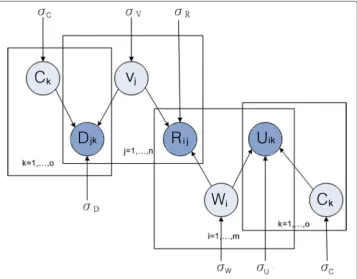
Our model consists of three parts. First, we connect workers’ task preferring information with workers’ category preferring information through the shared worker latent feature
Table 1Basic notations throughout this paper
Notation Description
WS={wi}mi=1 WSis the set of workers,wiis thei-th worker,mis the total number of workers VS={vj}nj=1 VSis the set of tasks,vjis thej-th task,nis the total number of tasks
CS={ck}ok=1 CSis the set of task categories,ckis thek-th task category,ois the total number of task categories
l∈R lis the number of dimensions of latent feature space W∈Rl×m Wis the worker latent feature matrix
V∈Rl×n Vis the task latent feature matrix C∈Rl×o Cis the task category latent feature matrix
R={rij}, Ris the worker-task preferring matrix,rijis the extent of the favor of taskvj R∈Rm×n for workerw
i
U={uik}, Uis the worker-category preferring matrix,uikis the extent of workerwi’s U∈Rm×o preference for categoryck
D={djk}, Dis the task-category grouping matrix,djkindicates the task categoryckthat
D∈Rn×o taskv
jbelongs to
(i,j)∈PS PSis the set of indexes where the ratingrijis unknown
space. Second, we connect workers’ task preferring information with tasks’ category grouping information through the shared task latent feature space. Third, we con-nect workers’ category preferring information with tasks’ category grouping information through the shared category latent feature space. The graphical model of the TaskRec framework is represented in Fig. 1.
By using a worker-task preferring matrix, we can measure the extend the worker prefer to work the task and provide output that accepted by requesters. Unlike traditional rec-ommendation systems, workers do not have to give ratings to tasks to indicate the extent of their favor of each task. To have ratings on tasks, we transform workers’ behaviors into values as follows:
Worker Behavior Value
Worker’s work done is accepted by requester. −→ 5
Worker’s work done is rejected by requester. −→ 4
Worker completes a task and submits the work done. −→ 3 Worker selects a task to work on but not complete it. −→ 2 Worker browses the detailed information of a task. −→ 1 Worker does not browse the detailed information of a task. −→ 0
In some cases, the ratings based on value transformation of worker behavior would be inaccurate on reflecting workers’ task preference. For example, a worker’s work done is being accepted, but he might not like the task very much.
Worker-task preferring matrix factorization
We havemworkers,ntasks. The worker-task preferring matrix is denoted asR, the ele-mentrijinRmeans the extent of the favor of taskvjfor workerwi, where values ofrijare
within the range [0, 1]. Without loss of generality, we first map the ratings that inferred from worker behavior 1, ..., 5 to the interval [0, 1] using the functionf(x) =x/5. Hence, we are given a partially observed worker-task preferring matrix,R, withmworkers andn tasks.
To learn the workers’ preference on the tasks, we employ matrix factorization, more specifically, Probabilistic Matrix Factorization (PMF) [12], to recover the worker-task pre-ferring matrix. Given the partial observed matrixR, we aim at decomposing the matrixR into twol-dimensional low-rank feature matrices,WandV, whereW ∈Rl×mis the latent feature matrix for workers with column vectorWi, andV ∈ Rl×n is the latent feature
matrix for tasks with column vectorVj.
To learn the matrices, a Gaussian distribution on the residual of the observed ratings is assumed as [12], and it is defined in Eq. (1):
p(R|W,V,σR2)=
m
i=1 n
j=1
N(rij|g(WiTVj),σR2)
IijR
, (1)
where N(x|μ,σ2) is the probability density function of the Gaussian distribution with meanμand varianceσ2, andIijRis the indicator function that is equal to 1 if the entry rijis observed and equal to 0 otherwise. The Gaussian distribution model can make
pre-dictions outside of the range of valid values. The function g(x) is the logistic function g(x)=1/(1+exp(−x)), which makes it possible to bound the range ofWiTVjwithin the
range [ 0, 1]. Similar to [48], to avoid overfitting, zero-mean spherical Gaussian priors are also placed on the worker and task feature matrices, which are defined in Eq. (2):
pW|σW2=
m
i=1
NWi|0,σW2
,pV|σV2= n
j=1
NVj|0,σV2
. (2)
Hence, through a Bayesian inference, the posterior distributions ofWandVbased only on the observed ratings are derived in Eq. (3):
pW,V|R,σR2,σW2,σV2∝pR|W,V,σR2pW|σW2pV|σV2
= m
i=1 n
j=1
N
rij|g(WiTVj),σR2
IijR ×
m
i=1
N(Wi|0,σW2)×
n
j=1
NVj|0,σV2
. (3)
Worker-category preferring matrix factorization
We have m workers and o task categories. The worker-category preferring matrix is denoted asU, where the elementuikinUrepresents the extent of workerwi’s preference
for task categoryck. Workers’ performance histories indicate workers’ preference for task
categories, so the meaning ofuik can be interpreted as whether the workerwihas
We representuikas shown in Eq. (4):
uik =g(f(wi,ck)), (4)
whereg(.)is the logistic function, andf(wi,ck)represents the number of times workerwi
completes a task of the categoryckwhere the task is accepted.
The idea of worker-category preferring matrix factorization is to derive two low-rank l-dimensional matricesW andC, whereW ∈ Rl×mandC ∈Rl×oare the latent feature
matrices for workers and task categories, respectively. The column vectorsWiandCk
rep-resenting thel-dimensional worker-specific and category-specific latent feature vectors of workerwi and categoryck, respectively. We can define the conditional distributions
over the observed worker-category preferring matrix in Eq. (5):
p(U|W,C,σU2)=
m
i=1 o
k=1
N(uik|g(WiTCk),σU2)
IU ik
, (5)
whereN(x|μ,σ2) is the probability density function of the Gaussian distribution with meanμand varianceσ2, andIikUis the indicator function that is equal to 1 if workerwihas
at least one completed task of the categoryckbeing accepted and equal to 0 otherwise.
To avoid overfitting, zero-mean spherical Gaussian priors are placed on the worker and the category latent feature matrices, which are defined in Eq. (6):
p(W|σW2)=
m
i=1
N(Wi|0,σW2),p(C|σC2)=
o
k=1
N(Ck|0,σC2). (6)
Hence, through a Bayesian inference, the posterior distributions ofWandCbased only on the observed ratings are derived in Eq. (7):
p(W,C|U,σC2,σW2,σU2)∝p(U|W,C,σU2)p(W|σW2)p(C|σC2)
= m
i=1 o
k=1
N(uik|g(WiTCk),σU2)I
U ik
× m
i=1
N(Wi|0,σW2)×
o
k=1
N(Ck|0,σC2). (7)
Task-category grouping matrix factorization
We haventasks andotask categories. The task-category grouping matrix is denoted as D, where the elementdjkinDshows the categoryckthat taskvjbelongs to. The
mean-ing ofdjk can be interpreted as whether the taskvjbelongs to the categoryck (a binary
representation) . We representdjkas shown in Eq. (8):
djk=f(vj,ck), (8)
wheref(vj,ck) is an indicator variable with the value of 1 if the taskvj belongs to the
categoryck, and 0 otherwise.
The idea of task-category grouping matrix factorization is to derive two low-rankl -dimensional matricesV andC, whereV ∈ Rl×n andC ∈ Rl×o are the latent feature matrices for tasks and task categories, respectively. The column vectorsVjandCk
observed task-category grouping matrix in Eq. (9):
p(D|V,C,σD2)=
n
j=1 o
k=1
N(djk|g(VjTCk),σD2)
ID jk
, (9)
where N(x|μ,σ2) is the probability density function of the Gaussian distribution with meanμand varianceσ2, andIjkDis the indicator function that is equal to 1 if the entrydjk
is observed and equal to 0 otherwise.
To avoid overfitting, zero-mean spherical Gaussian priors are placed on the task and the category latent feature matrices, which are defined in Eq. (10):
p(V|σV2)=
n
j=1
N(Vj|0,σV2),p(C|σC2)=
o
k=1
N(Ck|0,σC2). (10)
Hence, through a Bayesian inference, the posterior distributions ofVandCbased only on the observed ratings are derived in Eq. (11):
p(V,C|D,σC2,σV2,σD2)∝p(D|V,C,σD2)p(V|σV2)p(C|σC2)
= n
j=1 o
k=1
N(djk|g(VjTCk),σD2)
IjkD ×
n
j=1
N(Vj|0,σV2)×
o
k=1
N(Ck|0,σC2). (11)
A unified matrix factorization for TaskRec
According to the graphical model of the TaskRec framework described in Fig. 1, we derive the log function of the posterior distributions of TaskRec in Eq. (12):
lnp(W,V,C|R,U,D,σW2,σV2,σC2,σR2,σU2,σD2)
= − 1
2σ2 R
m
i=1 n
j=1
IijRrij−g
WiTVj
2
− 1
2σ2 U
m
i=1 o
k=1
IikUuik−g
WiTCk
2
− 1
2σD2
n
j=1 o
k=1
IjkDdjk−g
VjTCk
2
− 1
2σW2
m
i=1
WiTWi−
1 2σV2
n
j=1
VjTVj
− 1
2σC2
o
k=1
CkTCk−
m
i=1 n
j=1
IijRlnσR−
m
i=1 o
k=1
IikUlnσU−
n
j=1 o
k=1
IjkDlnσD
−l m
i=1
lnσW−l n
j=1
lnσV −l o
k=1
lnσC+C, (12)
E(W,V,C,R,U,D)
=1 2
m
i=1 n
j=1
IijR
rij−g
WiTVj
2 +θU
2
m
i=1 o
k=1
IikU
uik−g
WiTCk
2
+ θD 2
n
j=1 o
k=1
IDjk
djk−g
VjTCk
2
+ θW 2
m
i=1
WiTWi+ θV
2
n
j=1
VjTVj+ θC
2
o
k=1
CkTCk, (13)
whereθU = σR2/σU2,θD = σR2/σD2,θW = σR2/σW2,θV = σR2/σV2, andθC = σR2/σC2. The
local minimum can be found by performing the gradient descent onWi,VjandCk, and
the derived gradient descent equations are described in Eq. (14), Eq. (15) and Eq. (16) respectively:
∂E
∂Wi =
n
j=1
IijR
g
WiTVj
−rij
g
WiTVj
Vj+θWWi
+θU o
k=1
IikUgWiTCk
−uik
gWiTCk
Ck, (14)
∂E
∂Vj =
m
i=1
IijRgWiTVj
−rij
gWiTVj
Wi+θVVj
+θD o
k=1
IjkD
g
VjTCk
−djk
g
VjTCk
Ck, (15)
∂E
∂Ck =θU
m
i=1
IikU
g
WiTCk
−uik
g
WiTCk
Wi+θCCk
+θD n
j=1
IDjkgVjTCk−djkgVjTCkVj, (16)
whereg(.)is the first-order derivative of the logistic function. To reduce the model com-plexity, we setθW =θV =θCin our experiments. The training time for our model scales
linearly with the number of observations.
ActivePMFv2 - active learning for concurrent selection of task and worker
We first query all new tasks, which have not been tried by anyone, from the most reliable worker. Then, we query the most uncertain task from all new workers. Next, we query the most uncertain task, and select the most reliable worker for the task to query from. Our proposed ActivePMFv2 is presented in Algorithm 1.
Random new task selection for reliable worker
Algorithm 1Probabilistic Matrix Factorization with Active Learning (version 2), ActivePMFv2
Input:
Partially observed worker-task matrix,R; Maximum num of queries,MaxQueries;
Active-sampling heuristic, h (use uncertainty-sampling using the Maximum Difference between predicted rate and observed rate: arg maxvj∈VS
m
i=1 1
m i=1Iij
IijRgWiTVj
−rij);
Output:
Full worker-task matrixRfullvalued within the interval [0, 1] predicting unobserved
entries ofR; Initialize:
Rtmp=R; /* currently observed data */
NumQueries= 0; /*num of queries done by workers*/
1: R¯full= PMF(Rtmp); /* compute full matrixR¯full*/
2: Un= set of unobserved entries ofRtmp;
3: NewT= Select all new tasks;
4: NewW= Select all new workers;
5: Set = ActiveSelect(h, R¯full, Un); /* select the most uncertain unobserved instances
(Maximum Difference between predicted rate and observed rate) fromUn-Newusing hand current predictionsR¯full*/
6: if|NewT|>0then
Select a new taskv∗fromNewusing Eq. (17);
Select the most reliable workerw∗for taskv∗using Eq. (18); Request workerw∗to work on taskv∗;
Add the rate toRtmp;
NumQueries=NumQueries+ 1;
7: else
8: if|NewW|>0then
Select the most uncertain taskv∗∗fromSetusing Eq. (19); Select a new workerw∗∗for taskv∗∗using Eq. (20); Request workerw∗∗to work on taskv∗∗;
Add the rate toRtmp;
NumQueries=NumQueries+ 1;
9: else
Select the most uncertain taskv∗∗∗fromSetusing Eq. (21); Select the most reliable workerw∗∗∗for taskv∗∗∗using Eq. (22); Request workerw∗∗∗to work on taskv∗∗∗;
Add the rate toRtmp;
NumQueries=NumQueries+ 1;
10: end if 11: end if
12: if(NumQueries<MaxQueries)then
Go to Step 1
13: else
14: returnR¯full;
v∗= {vj|∃vj∈VS;Iij=0,∀wi∈WS}, (17)
w∗=arg max
wi∈WSuik where djk =1,vj=v
∗, (18)
In Algorithm 1, Step 6 represents the process of new task selection for most reliable worker in the category.
Uncertainty sampling for task selection for randomly selected new worker
The algorithm assumes a particular active learning heuristic specified as an input, and we adopt uncertainty-sampling [30] using the Maximum Difference between predicted rate and observed rate as in Eq. (19) to choose the most uncertain task, that requires mini-mization of uncertainty. To let new workers having a list of preferred tasks recommended but not having to work on a large amount of tasks beforehand, we randomly select a new worker (if any) to query from, as given in Eq. (20).
v∗∗=arg max
vj∈VS m
i=1
1 m
i=1Iij
IRij
g
WiTVj
−rij, (19)
w∗∗= {wi|∃wi∈WS;Iij=0,∀vj∈VS}. (20)
In Algorithm 1, Step 8 represents the process of most uncertain task selection for new worker.
Uncertainty sampling for task selection for reliable worker
The algorithm assumes a particular active learning heuristic specified as an input, and we adopt uncertainty-sampling [30] using the Maximum Difference between predicted rate and observed rate as in Eq. (21) to choose the most uncertain task, that requires minimization of uncertainty. To select the most reliable worker for the most uncertain task, we select the worker with the maximum worker-category perferring score where the category that the task belongs to as in Eq. (22).
v∗∗∗ =arg max
vj∈VS m
i=1
1 m
i=1Iij
IijR
g
WiTVj
−rij, (21)
w∗∗∗=arg max
wi∈WSuik where djk=1,vj=v
∗∗∗. (22)
In Algorithm 1, Step 9 represents the most uncertain task selection for the most reliable worker.
After annotation, the selected task is removed from the unlabeled data set. Next, the selected task and its rate are added to the set of labeled dataset. The model is then retrained on the labeled tasks and the informativeness of the remaining tasks in the unlabeled data set is re-evaluated.
Online-updating on ActivePMFv2 - online-update on active learning for concurrent selection of task and worker
presented in Algorithm 2, while the full retrain approach of ActivePMFv2 is presented in Algorithm 1. The online-updating approach uses the same sampling heuristics and the same active learning approach in query method as that of the full retrain approach. The main difference between the online-updating approach and the full retrain approach is the model update methods they used. In the full retrain approach, it retrains the whole learning model after each work done. In the online-updating approach, it has two main parts: (1) It retrains the learning model in batch mode where model update occurs after a number of work done; (2) For each work done related to a worker (or task) having pro-file larger than the threshold, it updates the whole feature vector of the worker (or task) and keeps all other entries in the feature matrix fixed. On the other hand, for work done related to a worker (or task) having profile smaller than the threshold, it updates the whole feature matrix.
Partial update
The impact on retraining the whole learning model decreases as the profile size of the worker (or task) increases. Especially when work done by new workers or work done on task having small profile, updating the feature matrix is crucial. For a new worker, each work done by him will result in much change in his task perference in his worker profile; while for a worker that has already completed a lot of tasks, each work done by him will not change much in his worker profile. Updating feature vectors for a worker (or task) having smaller profile results in a much better model. As a result, for a worker (or task) having large profile, we observe that the model learned from retraining the feature vector of the worker (or task) only is approximate to that learned from a full retrain.
As mentioned before, through a Bayesian inference, the posterior distributions ofW andVbased only on the observed ratings are derived in Eq. (3), while the posterior distri-butions ofW andCbased only on the observed ratings are derived in Eq. (7). For partial update on a large worker profile, we only retrain the feature vector of the selected worker wm in worker-task preferring matrix and worker-category preferring matrix as shown in
Eq. (23) and Eq. (24) respectively.
FVWV(wm)
= m
i=m n
j=1
N(rij|g(WiTVj),σR2)
IR ij
× m
i=m
N(Wi|0,σW2I)×
n
j=1
N(Vj|0,σV2I), (23)
FVWC(wm)
= m
i=m o
k=1
N(uik|g(WiTCk),σU2)
IikU ×
m
i=m
N(Wi|0,σW2I)×
o
k=1
N(Ck|0,σC2I). (24)
As stated previously, through a Bayesian inference, the posterior distributions ofWand Vbased only on the observed ratings are derived in Eq. (3), while the posterior distribu-tions ofV andCbased only on the observed ratings are derived in Eq. (11). For partial update on a large task profile, we only retrain the feature vector of the selected taskvn
Algorithm 2Online-Updating on ActivePMFv2 Input:
Partially observed worker-task matrix,R; Threshold,Threshold;
Batch size,BatchSize;
Active-sampling heuristic, h (use uncertainty-sampling using the Maximum Difference between predicted rate and observed rate: arg maxvj∈VS
m i=1 1
m i=1Iij
IijR
gWiTVj
−rij);
Output:
Full worker-task matrix Rfull valued within the interval [0, 1] predicting unobserved
entries ofR; Initialize:
Rtmp=R; /* currently observed data */
NumQueries= 0; /*num of queries done by workers*/
1: R¯full= PMF(Rtmp); /* compute full matrixR¯full*/
2: Un= set of unobserved entries ofRtmp;
3: NewT= Select all new tasks; 4: NewW= Select all new workers;
5: Set= ActiveSelect(h,R¯full,Un); /* select the most uncertain unobserved instances
(Max-imum Difference between predicted rate and observed rate) fromUn-Newusinghand current predictionsR¯full*/
6: if|NewT|>0then
Select a new taskv∗fromNewusing Eq. (17);
Select the most reliable workerw∗for taskv∗using Eq. (18); Request workerw∗to work on taskv∗;
Add the rate toRtmp;
NumQueries=NumQueries+ 1;
7: else
8: if|NewW|>0then
Select the most uncertain taskv∗∗fromSetusing Eq. (19); Select a new workerw∗∗for taskv∗∗using Eq. (20); Request workerw∗∗to work on taskv∗∗;
Add the rate toRtmp;
NumQueries=NumQueries+ 1;
9: else
Select the most uncertain taskv∗∗∗fromSetusing Eq. (21); Select the most reliable workerw∗∗∗for taskv∗∗∗using Eq. (22); Request workerw∗∗∗to work on taskv∗∗∗;
Add the rate toRtmp;
NumQueries=NumQueries+ 1;
10: end if 11: end if
12: if(Worker Profile>=Threshold) and (Task Profile>=Threshold)then Update the feature vectors of the selected workerwmusing Eq. (23), Eq. (24);
Update the feature vectors of the selected taskvnusing Eq. (25), Eq. (26);
13: else
14: if(Worker Profile>=Threshold) then
Update the feature vectors of the selected workerwmusing Eq. (23), Eq. (24);
15: else
16: if(Task Profile>=Threshold)then
Update the feature vectors of the selected taskvnusing Eq. (25), Eq. (26);
17: else
Update the feature vectors of all workers; Update the feature vectors of all tasks; 18: end if
19: end if 20: end if
21: if(No new incoming work done)then 22: returnR¯full;
23: end if
24: if(NumQueriesmodBatchSize=0)then
NumQueries= 0;
Go to Step 1; 25: else
FVWV(vn)
= m
i=1 n
j=n
N(rij|g(WiTVj),σR2)
IijR ×
m
i=1
N(Wi|0,σW2I)×
n
j=n
N(Vj|0,σV2I), (25)
FVVC(vn)
= n
j=n o
k=1
N(djk|g(VjTCk),σD2)I
D jk
× n
j=n
N(Vj|0,σV2I)×
o
k=1
N(Ck|0,σC2I). (26)
In Algorithm 2, Step 12, 14 and 16 represents the process of partial update. For a worker (or task) having profile size larger than the threshold, the algorithm retrains the fea-ture vector of the worker (or task) and keep all other entries in the matrix unchanged; otherwise, the algorithm retrains the feature vectors of all workers and all tasks.
Batch update
The time for retraining a learning model is proportional to the computational complexity of the model and the amount of information stored in the model; while the amount of information depends on the number of workers, the number of tasks and the number of work done. Retraining a large learning model takes a long time. For a large real-world crowdsourcing system, it is inefficient if the whole model is retrained from scratch once a worker completes a task.
In Algorithm 2, Step 24 and 25 represents the process of batch update. When the num-ber of work done is smaller than the batch size, the learning model is not retrained. On the other hand, when the number of work done is larger than the batch size, the algorithm retrains the learning model.
General update problem
Our proposed online-updating approach can also be applied in a general update problem. In a general recommendation system, a new ratingru,imight affect the features of both
useruand itemi. The partial update method works based on the following conditions: (1) If the profiles of both user and item are large, it could update the feature vectors of both the selected user and the selected item; (2) If the user profile is large (but the item profile is small), it could update the user feature vector only; (3) If the item profile is large (but the user profile is small), it could update the item feature vector only; (4) If the profiles of both user and item are small, it could update the feature vectors of all users and all items. Besides, based on the number of new incoming ratings, the batch update method retrains the whole learning model. A general update algorithm is shown in Algorithm 3.
Complexity analysis
Algorithm 3General Online-Updating Algorithm Input:
Partially observed user-item matrix,R; Threshold,Threshold;
Batch size,BatchSize; Active-sampling heuristic,h; Output:
Full user-item matrixRfullvalued within the interval [0, 1] predicting unobserved entries
ofR; Initialize:
Rtmp=R; /* currently observed data */
NumQueries= 0; /*num of queries done by workers*/
1: R¯full= compute full matrixR¯fullby usingRtmp
2: Un= set of unobserved entries ofRtmp;
Request the rating from useruon itemi; Add the rate toRtmp;
NumQueries=NumQueries+ 1;
3: if(User Profile>=Threshold) and (Item Profile>=Threshold)then Update the feature vector of the user in the matrixRtmp;
Update the feature vector of the item in the matrixRtmp;
4: else
5: if(User Profile>=Threshold) then
Update the feature vector of the user in the matrixRtmp;
6: else
7: if(Item Profile>=Threshold)then
Update the feature vector of the item in the matrixRtmp;
8: else
Update the feature vectors of all users; Update the feature vectors of all items; 9: end if
10: end if 11: end if
12: if(No new incoming rating)then 13: returnR¯full;
14: end if
15: if(NumQueriesmodBatchSize=0)then
NumQueries= 0;
Go to Step 1; 16: else
Go to Step 2; 17: end if
in matricesR,U, and Drespectively, andlis the number of dimensions of latent fea-ture space. By using the similar approach, we can derive the complexities of Eq. (14), Eq. (15) and Eq. (16). For the computation of selecting the most uncertain task for the most reliable worker, the complexity of selecting the most uncertain task in Eq. (21) is
O(nRl), the complexity of selecting the most reliable worker in Eq. (22) isO(m), and thus
the total complexity of assigning a task to a worker isO(m+nRl). As a result, the total
complexity for one iteration isO(m+nRl+nUl+nDl). It means that the complexity is
linear with respect to the number of workers and the number of observations in the three sparse matrices. The complexity analysis shows that ActivePMFv2 can scale to very large datasets.
To apply online-updating approach when learning ActivePMFv2 model, we consider both the partial update method and the batch update method. Since only some non-zero entries in matrices is updated in the partial update method, the complexity of evaluat-ing the objective function in Eq. (13) isO(zRl+zUl+zDl), wherezR,zU andzDare the
iteration isO(m+zRl+zUl+zDl), wherezR<<nR,zU <<nU,zD<<nD. Based on
our observation, the complexity of learning ActivePMFv2 model can be highly reduced by using the partial update method. Besides, the batch method can greatly reduce the number of iterations, thus further reduce the computational complexity.
Experimental analysis
In this section, our experiments are intended to address the following five research questions:
1. How is ActivePMFv1 approach compared with PMF with various active learning approaches?
2. How is ActivePMFv1 approach compared with PMF with various active sampling heuristics?
3. How is our ActivePMFv2 approach compared with ActivePMFv1?
4. How is the partial update part of online-updating approach compared with the full retrain when learning ActivePMFv2 model?
5. How is the batch update part of online-updating approach compared with the full retrain when learning ActivePMFv2 model?
Description of dataset
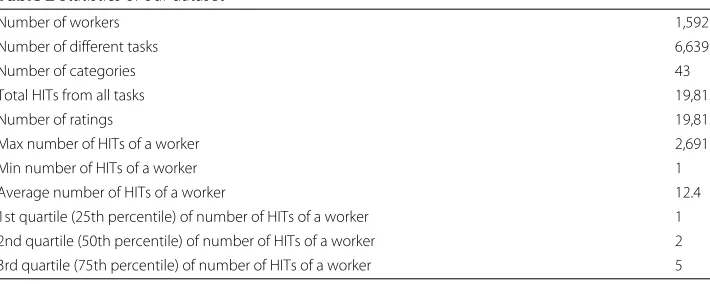
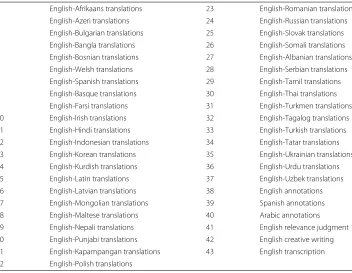
We use the same dataset as shown in [41]. Our dataset is retrieved from the recent NAACL 2010 workshop on crowdsourcing, which has made publicly available all the data collected as part of the workshop [49]. The data was collected within a month from multi-ple requesters seeking data for a diverse variety of tasks on MTurk. Table 2 provides some statistics about our dataset. Our dataset is mainly related to tasks for creating speech and language data. The task categorization is shown in Table 3.
Evaluation metrics
For performance comparison with our proposed ActivePMFv2, we implement PMF (Probabilistic Matrix Factorization) with the following Active Learning baselines:
• T[Rand]W[Rand]:It assigns a randomly selected task to a randomly selected worker. • T[MaxDiff]W[Rand]:It assigns the task of maximum difference between its
observed values and its predicted values to a randomly selected worker.
• T[Rand]W[Reli]:It assigns a randomly selected task to the most reliable worker in the task category.
Table 2Statistics of our dataset
Number of workers 1,592
Number of different tasks 6,639
Number of categories 43
Total HITs from all tasks 19,815
Number of ratings 19,815
Max number of HITs of a worker 2,691
Min number of HITs of a worker 1
Average number of HITs of a worker 12.4
Table 3Task categorization by both language and keywords given by MTurk in our dataset
1 English-Afrikaans translations 23 English-Romanian translations 2 English-Azeri translations 24 English-Russian translations 3 English-Bulgarian translations 25 English-Slovak translations 4 English-Bangla translations 26 English-Somali translations 5 English-Bosnian translations 27 English-Albanian translations 6 English-Welsh translations 28 English-Serbian translations 7 English-Spanish translations 29 English-Tamil translations 8 English-Basque translations 30 English-Thai translations 9 English-Farsi translations 31 English-Turkmen translations 10 English-Irish translations 32 English-Tagalog translations 11 English-Hindi translations 33 English-Turkish translations 12 English-Indonesian translations 34 English-Tatar translations 13 English-Korean translations 35 English-Ukrainian translations 14 English-Kurdish translations 36 English-Urdu translations 15 English-Latin translations 37 English-Uzbek translations 16 English-Latvian translations 38 English annotations 17 English-Mongolian translations 39 Spanish annotations 18 English-Maltese translations 40 Arabic annotations 19 English-Nepali translations 41 English relevance judgment 20 English-Punjabi translations 42 English creative writing 21 English-Kapampangan translations 43 English transcription 22 English-Polish translations
• T[MaxDiff]W[Reli]:It assigns the task of maximum difference between its observed values and its predicted values to the most reliable worker in the task category. • T[N]W[Reli]+T[MaxPredictErr]W[Reli]:It has two parts. First, it assigns all new
tasks to the most reliable worker in the task categories. Second, it assigns the task of maximum average prediction error of all its predicted values to the most reliable worker in the task category.
• T[N]W[Reli]+T[MaxEntropy]W[Reli]:It has two parts. First, it assigns all new tasks to the most reliable worker in the task categories. Second, it assigns the task of maximum Entropy on the posterior variance to the most reliable worker in the task category.
• T[N]W[Reli]+T[MaxDiff]W[Reli] (ActivePMFv1):It has two parts. First, it assigns all new tasks to the most reliable worker in the task categories. Second, it assigns the task of maximum difference between its observed values and its predicted values to the most reliable worker in the task category.
• T[N]W[Reli]+T[MaxDiff]W[N]+T[MaxDiff]W[Reli] (ActivePMFv2):It has three parts. First, it assigns all new tasks to the most reliable worker in the task categories. Second, for all new workers, it assigns the task of maximum difference between its observed values and its predicted values to a randomly selected new worker. Third, it assigns the task of maximum difference between its observed values and its predicted values to the most reliable worker in the task category.
MAE=
i,j|ri,j− ˆri,j|
N ,RMSE=
i,j
ri,j− ˆri,j2
N , (27)
whereri,jdenotes the rating that indicates the extent of the favor of taskjfor workeri, ˆ
ri,jdenotes the predicted rating, andNis the total number of testing ratings.
Performance comparison
To show the prediction performance improvements of ActivePMFv2, we first com-pare ActivePMFv1 [15] with PMF with various active learning approaches and different active sampling heuristics, where Probabilistic Matrix Factorization (PMF) [12] is the state-of-the-art approach for recommendation systems. Next, we compare our proposed ActivePMFv2 with ActivePMFv1.
From our dataset, we randomly select 80 % of ratings as training data (20 % as initial training set + 60 % as active set), and leave the remaining 20 % as prediction perfor-mance testing. The procedure is carried out 10 times independently, and we report the average values in this paper. For the value transformation, we have 10,411 approved tasks (value transformed to 5), 9,399 submitted tasks (value transformed to 3) and only 5 rejected tasks (value transformed to 4). Most rejected tasks are already removed in our dataset. In the comparison, we setθW=θV =θC= 0.00004, setθU= 0.0001 andθD= 0.01.
The MAE results and the RMSE results are reported from Tables 4, 5, 6, 7, 8 and 9. MAE measures the average magnitude of the errors in predicted values; while RMSE gives a relative high weight to large errors.
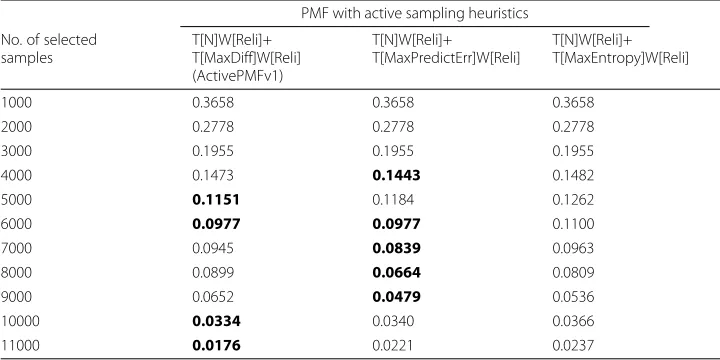
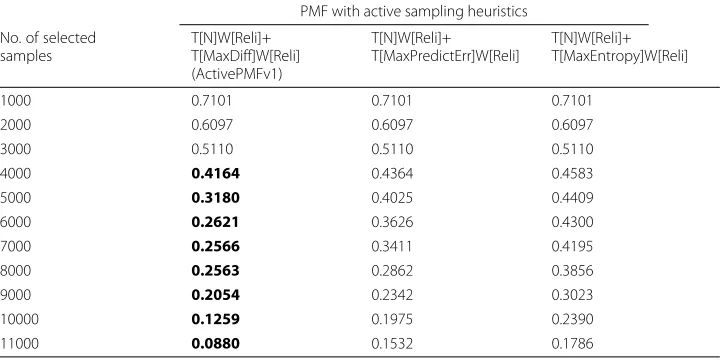
In Tables 4 and 5, we compare among PMF with three sampling heuristics on select-ing tasks, which are Maximum Difference (ActivePMFv1), Maximum Prediction Error and Maximum Entropy. The performance results of the three approaches are similar when the number of selected samples is small. However, as the number of selected sam-ples increases, Maximum Difference approach (ActivePMFv1) outperforms the other two approaches.
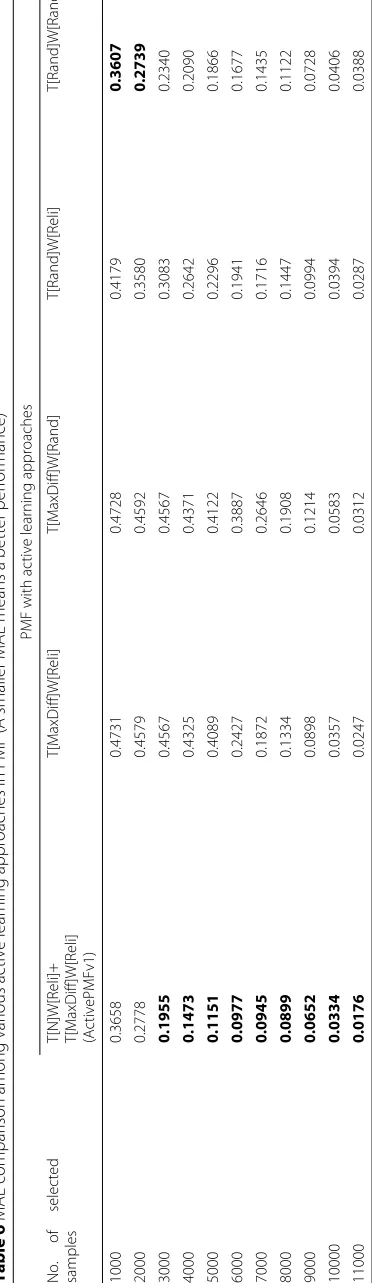
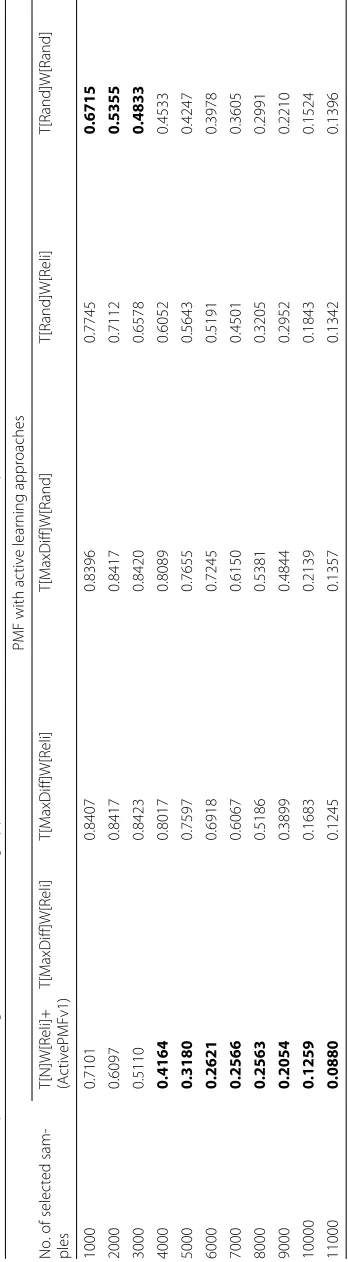
In Tables 6 and 7, we compare among PMF with different active learning approaches on task selection and worker selection. When the number of selected samples is very small,
Table 4MAE comparison among various active sampling heuristics in PMF (A smaller MAE means a better performance)
PMF with active sampling heuristics No. of selected
samples
T[N]W[Reli]+ T[MaxDiff]W[Reli] (ActivePMFv1)
T[N]W[Reli]+
T[MaxPredictErr]W[Reli]
T[N]W[Reli]+ T[MaxEntropy]W[Reli]
1000 0.3658 0.3658 0.3658
2000 0.2778 0.2778 0.2778
3000 0.1955 0.1955 0.1955
4000 0.1473 0.1443 0.1482
5000 0.1151 0.1184 0.1262
6000 0.0977 0.0977 0.1100
7000 0.0945 0.0839 0.0963
8000 0.0899 0.0664 0.0809
9000 0.0652 0.0479 0.0536
10000 0.0334 0.0340 0.0366
Table 5RMSE comparison among various active sampling heuristics in PMF (A smaller MAE means a better performance)
PMF with active sampling heuristics No. of selected
samples
T[N]W[Reli]+ T[MaxDiff]W[Reli] (ActivePMFv1)
T[N]W[Reli]+
T[MaxPredictErr]W[Reli]
T[N]W[Reli]+ T[MaxEntropy]W[Reli]
1000 0.7101 0.7101 0.7101
2000 0.6097 0.6097 0.6097
3000 0.5110 0.5110 0.5110
4000 0.4164 0.4364 0.4583
5000 0.3180 0.4025 0.4409
6000 0.2621 0.3626 0.4300
7000 0.2566 0.3411 0.4195
8000 0.2563 0.2862 0.3856
9000 0.2054 0.2342 0.3023
10000 0.1259 0.1975 0.2390
11000 0.0880 0.1532 0.1786
assigning tasks to workers randomly gives the best performance in both the MAE results and the RMSE results. However, as the number of selected samples increases, assigning new tasks in the first stage can greatly improve the performance in both the MAE results and the RMSE results. Compared with random selection on task and worker to the PMF learning model (i.e.T[Rand]W[Rand]), ActivePMFv1 can greatly improve both MAE and RMSE performance.
In Tables 8 and 9, we compare our proposed ActivePMFv2 with ActivePMFv1. The per-formance results of the three approaches are similar when the number of selected samples is small. However, as the number of selected samples increases, ActivePMFv2 outper-forms ActivePMFv1 in both MAE and RMSE results. Compared with ActivePMFv1, the MAE results and the RMSE results of ActivePMFv2 are improved up to 29 % and 35 % respectively.
In Table 10, we compare the partial update part of our online-updating approach with the full retrain on ActivePMFv2 model learning. The prediction quality of ActivePMFv2 with partial update (thresholdt= 0.001) approximates to that of ActivePMFv2 with full retrain, but the average runtime on model update per work done of ActivePMFv2 with partial update (thresholdt = 0.001) is greatly reduced by 12 % compared with that of ActivePMFv2 with full retrain.
Table 6 MAE comparison among various active learning approaches in PMF (A smaller MAE means a better performance) PMF with active learning approaches No. o f selected samples
T[N]W[Reli]+ T[MaxDiff]W[Reli] (ActivePMFv1)
Table 8MAE comparison between ActivePMFv2 and ActivePMFv1 (A smaller MAE means a better performance)
No. of selected samples
T[N]W[Reli]+T[MaxDiff]W[N]+ T[MaxDiff]W[Reli] (ActivePMFv2)
T[N]W[Reli] + T[MaxDiff]W[Reli] (ActivePMFv1)
1000 0.3658 0.3658
2000 0.2778 0.2778
3000 0.1955 0.1955
4000 0.1052 0.1473
5000 0.1001 0.1151
6000 0.0948 0.0977
7000 0.0897 0.0945
8000 0.0879 0.0899
9000 0.0652 0.0652
10000 0.0283 0.0334
11000 0.0156 0.0176
Table 9RMSE comparison between ActivePMFv2 and ActivePMFv1 (A smaller RMSE means a better performance)
No. of selected samples
T[N]W[Reli]+T[MaxDiff]W[N] + T[MaxDiff]W[Reli] (ActivePMFv2)
T[N]W[Reli] + T[MaxDiff]W[Reli] (ActivePMFv1)
1000 0.7101 0.7101
2000 0.6097 0.6097
3000 0.5110 0.5110
4000 0.2710 0.4164
5000 0.2594 0.3180
6000 0.2513 0.2621
7000 0.2479 0.2566
8000 0.2494 0.2563
9000 0.2030 0.2054
10000 0.1116 0.1259
11000 0.0845 0.0880
Table 10Comparison on a Full-Retrain with Partial Update on Online-Updating Approach on ActivePMFv2 model learning (Feature k = 20; No of Work Done = 11,000; Batch = 1)
ActivePMFv2 model MAE RMSE Avg Runtime per Work
Done (min)
Full Retrain 0.0156 0.0845 3.839
Online-Updating (Partial = 0.001) 0.0156 0.0845 3.374
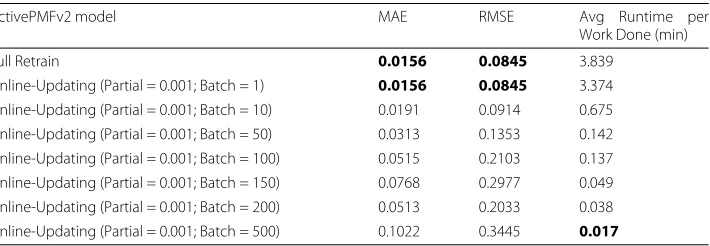
Table 11Comparison on a Full-Retrain with Batch Update on Online-Updating Approach on ActivePMFv2 model learning (Feature k = 20; No of Work Done = 11,000)
ActivePMFv2 model MAE RMSE Avg Runtime per
Work Done (min)
Full Retrain 0.0156 0.0845 3.839
increased by 8.2 % (increases from 0.0845 to 0.0914). Therefore, by adjusting the batch size, the average runtime on model update per work done can be reduced significantly, but only very small performance degradation is resulted. In the cases shown in Table 11, batch size 10 is the best choice among all the listed choices.
Conclusion
In this paper, we have proposed Probabilistic Matrix Factorization with Active Learn-ing (version 2), ActivePMFv2, on Task Recommendation framework, TaskRec, for quality assurance in crowdsourcing systems. It first randomly assigns new tasks to the most reli-able worker in the task categories. Second, it actively selects the most uncertain task, and then request new workers to complete the task. Third, it actively selects the most uncertain task, and then request the most reliable workers to complete the task for retraining the classification model. Experimental results show that our ActivePMFv2 out-performs ActivePMFv1, where the MAE results and the RMSE results of ActivePMFv2 are improved up to 29 % and 35 % respectively. Previous work shows that ActivePMFv1 outperforms the PMF with other active learning approaches significantly.
Moreover, we have proposed online-updating on the task recommendation model to reduce the runtime of retraining the model. In a large-scale crowdsourcing system, it does not make sense to retrain the model from scratch whenever a worker of large profile com-pletes a task, because the performance improvement by retraining the model in the case is tiny but the cost of retraing model is high. Moreover, when a large number of workers are working in the crowdsourcing system at the same period of time, the computational com-plexity is very high if the model is retrained after each worker completes a task. The larger the profile of a worker (or task) is, the less important is retraining its profile on each new work done. In case of the worker (or task) having large profile, our online-updating algo-rithm retrains the whole feature vector of the worker (or task) and keeps all other entries in the matrix fixed. Our online-updating algorithm runs batch update to reduce the run-ning time of model update. Experiment results show that our online-updating algorithm is accurate in approximating to a full retrain of the learning model while the average run-time of model update for each work done is reduced by more than 80 % (decreases from a few minutes to several seconds).
Acknowledgements
This research was in part supported by grants from the National Grand Fundamental Research 973 Program of China (No. 2014CB340405), the Research Grants Council of the Hong Kong Special Administrative Region, China (Project No. CUHK 413212), and Microsoft Research Asia Regional Seed Fund in Big Data Research (Grant No. FY13-RES-SPONSOR-036).
Authors’ contributions
All authors made substantial contributions to conception and design of the work. MC carried out experiments, data analysis and data interpretation. Besides, MC participated in drafting and revising the manuscript. All authors read and approved the final manuscript.
Competing interests
The authors declare that they have no competing interests.
Received: 24 November 2015 Accepted: 14 September 2016
References
1. Howe J. The rise of crowdsourcing. Wired. 2006;14(6).
2. Howe J. Crowdsourcing: Why the Power of the Crowd Is Driving the Future of Business. New York: Crown Business; 2008.