ORIGINAL ARTICLE
Comparative evaluations of lignocellulose
reactivity and usability in transgenic rice plants
with altered lignin composition
Yuri Takeda
1, Yuki Tobimatsu
1*, Masaomi Yamamura
1, Toshiyuki Takano
2, Masahiro Sakamoto
2and Toshiaki Umezawa
1,3*Abstract
The aromatic composition of lignins is considered an important trait that affects the physico-chemical properties of lignocellulosic biomass. However, our knowledge of the relationship between lignin structure and biomass utiliza-tion properties remains limited, especially in monocotyledonous grass species, despite their potential as biomass feedstocks. In this study, we used recently produced rice transgenic lines with distinct lignin monomer compositions, i.e., guaiacyl (G)/syringyl (S)/p-hydroxyphenyl (H) aromatic unit ratios, to study the impact of lignin composition on the chemical reactivity, enzymatic saccharification efficiency and calorific value of rice lignocellulose. The H-lignin-enriched rice transgenic line showed significantly enhanced biomass saccharification efficiency after alkali and acid pretreatments and even without any pretreatment, whereas the S-lignin-enriched rice transgenic line displayed enhanced saccharification efficiency after liquid hot water pretreatment. While we detected no significant differences in biomass heating values between the transgenic rice materials tested, analysis of synthetic lignins comprising only G, S or H units suggested that increased ratios of G or H units could increase the heating value of lignin-based solid biofuels.
Keywords: p-Coumaroyl ester 3-hydroxylase, Coniferaldehyde 5-hydroxylase, Enzymatic saccharification, Heating value, Grass biomass
© The Author(s) 2019. This article is distributed under the terms of the Creative Commons Attribution 4.0 International License
(http://creat iveco mmons .org/licen ses/by/4.0/), which permits unrestricted use, distribution, and reproduction in any medium,
provided you give appropriate credit to the original author(s) and the source, provide a link to the Creative Commons license, and indicate if changes were made.
Introduction
The production and utilization of sustainable resources and energy are becoming increasingly important to fol-low a sustainable development path by achieving so-called SDGs (sustainable development goals) [1]. Biomass is a particularly important sustainable feedstock, because it can provide not only energy but also organic sub-stances, including liquid fuels, that are not available from most other sustainable energy sources currently under consideration (e.g., solar, hydraulic and wind power). In particular, lignocellulosic biomass, a plant-derived bio-composite composed of cellulose, hemicelluloses and
lignins, accounts for the highest proportion of global terrestrial biomass; the estimated annual production of lignocellulosic biomass is approximately 5600 M tons, of which approximately 2000 M tons are derived from trees and the rest (approximately 3600 M tons) from non-tree species, mostly grasses [2, 3].
While tree biomass is necessary for the production of wood materials and pulp and paper commodities, grasses are a prominent plant group that show great potential as biomass feedstocks. Huge amounts of lignocellulose are produced annually as agricultural residues from grass grain crops, such as maize, wheat, rice, barley, Sorghum and millet. In addition, large-sized perennial grass spe-cies, such as Erianthus, Miscanthus, switchgrass and bamboo, have attracted considerable attention as potent biomass sources because of their higher lignocellulose productivity and better biomass processability than
Open Access
*Correspondence: [email protected]; [email protected]
1 Research Institute for Sustainable Humanosphere, Kyoto University, Uji,
Kyoto 611-0011, Japan
typical tree species [2–4]. Furthermore, grass biomass may provide more output than tree biomass. For exam-ple, major grass crops, such as sugarcane, maize and Sor-ghum, produce grains that can be used for food, cattle feed and/or fermentation feedstocks, while the residual straw, which is mainly composed of lignocellulose, can be utilized for combustion fuels, fiber materials and/or other various polysaccharide- and lignin-derived biofuels and biochemicals. In fact, sugarcane-based sugar facto-ries use sugarcane bagasse residue as a combustion fuel that can easily cover all the energy demands within the factories [5, 6].
Lignins, which are complex phenylpropanoid polymers typically accounting for 15–30% of lignocellulosic bio-mass, display considerable structural heterogeneity. In general, lignins in gymnosperms (softwoods) are com-posed mainly of guaiacyl (G) aromatic units derived via polymerization of coniferyl alcohol, whereas lignins in angiosperms, i.e., in both eudicots (e.g., hardwoods) and monocots including grasses, incorporate G and syrin-gyl (S) aromatic units from sinapyl alcohol; both gym-nosperm and angiosperm lignins also contain a small amount of p-hydroxyphenyl (H) units from p-coumaryl alcohol [7]. Unlike eudicot lignins, grass lignins also contain γ-p-coumaroylated G and S units incorporated via polymerization of γ-p-coumaroylated coniferyl and sinapyl alcohol conjugates [8], as well as flavone tricin units derived via co-polymerization of tricin with mon-olignols [9]. In addition, abundant ferulates cross-link lignins and hemicelluloses (arabinoxylans) in grass cell walls [8], further making grass cell walls unique and more complicated than gymnosperm and eudicot cell walls.
Traditionally, lignin has been considered the major recalcitrant factor in biomass utilization, particularly because it impedes the utilization of cell wall polysaccha-rides. Accordingly, metabolic engineering approaches to reduce lignin content and/or to alter lignin structures to mitigate such lignin recalcitrance in polysaccharide utili-zation have been extensively pursued [3, 4, 10–13]. More recently, bioengineering approaches to manipulate lignin deposition and structures to enhance the recovery and conversion of lignins into useful aromatic chemicals are becoming an important research subject in the light of the biorefinery concept [3, 14, 15]. In addition, as lignin content positively affects the energetic yields of lignocel-lulose, the manipulation of lignin biosynthetic enzymes or transcriptional factors to enrich lignins against poly-saccharides is a potent strategy to improve biomass heat-ing values for better solid fuel applications [3, 16, 17].
Currently, however, the relationships between lignin chemical structures and various lignocellulose utiliza-tion properties are not fully understood, mainly due to the intricate lignin structures that show great variability
among different biomass sources. In this respect, trans-genic plants containing engineered lignins represent a powerful model system to investigate the effects of altered lignin structures on various lignocellulose prop-erties. Indeed, eudicot model plants, such as Arabidop-sis, poplar and alfalfa, have been used to study these effects in eudicot biomass [18–23]. However, few efforts have been made to systematically investigate the effects of lignin structures on lignocellulose utilization proper-ties in grasses despite their importance as biomass feed-stocks, possibly due to the limited transgenic materials with altered lignin structures available in grasses. In fact, as aforementioned, the structural organization of lignins in grasses substantially differs from those in eudicots and gymnosperm species, and therefore studies using appropriate grass model plants, such as rice, maize and Brachypodium, are essential to characterize the unique biosynthesis, structures and properties of grass lignins [3, 4, 24–26].
We recently succeeded in generating transgenic rice lines that produce lignins with distinct aromatic com-positions: down- and up-regulation of a gene encoding coniferaldehyde 5-hydroxylase (OsCAld5H1), an enzyme catalyzing the key reaction step in the lignin biosynthetic pathway for S-lignin units, produced altered lignins enriched in G and S units, respectively [27, 28], while the down-regulation of a gene encoding p-coumaroyl ester 3-hydroxylase (OsC3′H1), an entry enzyme in the main lignin biosynthetic pathway leading to the formation of G and S units but not H units, produced lignins largely enriched in H units [29]. Given that the H-/G-/S-lignin composition is considered an important trait that greatly affects the physico-chemical properties of lignin as well as the usability of lignocellulosic biomass as a whole [3], these transgenic rice lines represent a useful system to study the relationship between the engineered lignin composition and lignocellulose properties in grasses. In this study, we comparatively characterized cell wall mate-rials prepared from these lignin-modified transgenic rice lines in terms of their structures, chemical reactivities in typical biomass processing reactions, i.e., dilute alkali, dilute acid and liquid hot water treatments, enzymatic saccharification with or without chemical pretreatments for fermentable sugar production and calorific values for combustion fuel applications.
Methods/experimental Materials
29]. The T3 progenies of the rice transgenic lines and wild-type control lines were grown side by side under greenhouse conditions [27]. Mature aerial parts were harvested and dried at 27 °C for 30 days, and dried culm straws were then collected by removing the pani-cle, leaf blade and leaf sheath. Culm samples from three plants for each genotype were pooled and homogene-ously pulverized with a TissueLyser (Qiagen, Hilden, Germany), and then extracted with methanol, hexane and distilled water to produce extractive free cell wall residues (CWRs) [30]. To prepare lignin-enriched cell wall samples, the CWRs were further ball-milled and digested with crude cellulases according to a previ-ously described method [31]. Dehydrogenation poly-mers (DHPs) were prepared via peroxidase-catalyzed polymerization of p-coumaryl, coniferyl and sinapyl alcohols for H-DHP, G-DHP and S-DHP, respectively, as described previously [32, 33].
Alkali, acid and liquid hot water treatments
Dilute alkali and dilute acid treatments were carried out by heating CWRs in a polypropylene tube contain-ing 31.25 mM (0.125%) NaOH [34] or 1.3% (150 mM) H2SO4 solution at 90 °C for 3 h [18]. The reaction mix-tures were then neutralized with 1 N HCl or 6 N NaOH solution and the precipitates were collected by centrif-ugation, washed with distilled water, and then freeze-dried for cell wall analyses. Liquid hot water treatment was carried out by autoclaving CWRs in a Teflon tube containing distilled water at 200 °C (35 min heat-up time followed by 10 min hold) using a Metal Reac-tor TEM-D1000 M (Taiatsu Techno Co., Ltd., Saitama, Japan) [19]. After the reaction, the precipitates were col-lected by centrifugation, washed with distilled water, and then freeze-dried for cell wall analyses. Mass recov-ery rate was calculated as follows:
where CWR U and CWR P are dry weights (mg) of CWRs
before and after each treatment, respectively.
Cell wall analyses
Microscale thioacidolysis, Klason lignin assay, deter-mination of cellulosic (crystalline) and hemicellulosic (amorphous) glycan contents, and ash analysis of CWRs were performed as previously described [29]. Total lignin content was expressed as the sum of the Klason acid-insoluble (corrected by ash content) and acid-soluble lignin contents. NMR analysis of lignin-enriched CWRs was performed on a Bruker Biospin Avance III 800US system (Bruker Biospin, Billerica, MA, USA) equipped with a cryogenically cooled 5 mm TCI gradient probe using dimethylsulfoxide (DMSO)-d6/pyridine-d5 (4:1,
Mass recovery rate(%) = CWRP
CWRU ×100,
v/v) as a solvent. Adiabatic heteronuclear single-quantum coherence (HSQC) NMR experiments were carried out using standard implementation (“hsqcetgpsp.3”) [31, 35]. Data processing and analysis were performed with the Bruker TopSpin 3.5 software (Bruker Biospin, Billerica, MA, USA) and the central DMSO solvent peaks (δC/δH: 39.5/2.49 ppm) were used as an internal reference. HSQC plots were obtained with typical matched Gaussian apo-dization in F2 and squared cosine-bell apoapo-dization and one level of linear prediction (16 coefficients) in F1. For volume integration, linear prediction was turned off and no correction factors were used. The normalized HSQC NMR contour intensities shown in Fig. 1 are expressed on a G + ½S + ½H = 100% and a I + I´ + II + II´ + ½III + ½ III´ = 100% basis.
Enzymatic saccharification assays
Unpretreated CWRs (~ 15 mg) were transferred to poly-propylene tubes, destarched and subjected to enzymatic hydrolysis with an enzyme cocktail composed of Cellu-clast 1.5 L (Novozymes, Bagsvaerd, Denmark) (1.1 FPU), Novozyme 188 (Novozymes) (2.5 CbU) and Ultraflo L (Novozymes) (65 μg) in a sodium citrate buffer (pH 4.8) [36]. The reaction was carried out in a rotary reactor (Heatblock Rotator SN-48BN, Nissin, Saitama, Japan) at 12.5 rpm at 50 °C for 24 h. The glucose concentra-tion was determined with a Glucose CII test kit (Wako Pure Chemicals Industries, Osaka, Japan) according to the manufacturer’s instructions. Cell wall pretreatments and the subsequent enzymatic saccharification assay were performed as follows. Dried CWRs (~ 15 mg) were added to 1 mL of 31.25 mM NaOH or 500 μL of 1.3% H2SO4 for dilute alkali and acid pretreatments, respec-tively, and incubated at 90 °C for 3 h [18, 34]. The reac-tion mixtures were adjusted to pH 4–5 by adding 35 μL of 1 N HCl or 500 μL of 0.52 N NaOH for dilute alkali and acid pretreatments, respectively, and then subjected to enzymatic saccharification as described above. For liquid hot water pretreatment, dried CWRs (~ 15 mg) were autoclaved with 500 μL of distilled water at 200 °C (35 min heat-up time followed by 10 min hold) using a Metal Reactor TEM-D1000 M (Taiatsu Techno Co., Ltd., Saitama, Japan) [19]. After the reaction, the reac-tion mixtures were diluted with 500 μL of distilled water and then subjected to enzymatic saccharification as described above.
Determination of heating values
Co., Ltd., Kyoto, Japan). The HHV was calculated based on the equation HHV = (0.2949 C + 0.8250 H) × 1000 (J/g), where C and H are mass percentages of carbon and hydrogen, respectively [37]. For bomb calorimetry, each CWR and lignin-enriched CWR sample (~ 200 mg) was oven-dried, encapsulated in a gelatin capsule with a known calorific value (IKA-Werke GmbH&Co, Staufen, Germany), and then subjected to combustion in a bomb calorimeter (IKA C5003 Calorimeter System; IKA-Werke GmbH&Co, Staufen, Germany). The calorimeter was cal-ibrated by the combustion of a known calorific value fuel (benzoic acid).
Results and discussion
Cell wall structures in rice transgenic lines
The previously generated OsCAld5H1-KD,
OsCAld5H1-OX and OsC3′H1-KD transgenic rice lines [27, 29] were grown together with the wild-type con-trol and the cell wall composition of their mature culm cell walls was analyzed. The lignin content estimated by Klason assay [38] was in the range of 15% to 22% among the tested genotypes; the highest was in OsCAld5H1 -KD plants, followed by OsC3′H1-KD, OsCAld5H1-OX and wild-type control plants (Table 1). The analysis of cellulosic and hemicellulosic glycans by a trifluoro-acetic acid (TFA)/H2SO4-catalyzed hydrolysis method IIα, II′α
III′α
Iβ, I′β
I′γ
Iγ X1′γ
X1γ
Iα, I′α
IIα, II′α III′α
Iβ, I′β
I′γ
Iγ X1′γ
X1γ
Iα, I′α
IIα, II′α III′α
Iβ, I′β
I′γ
Iγ X1′γ
X1γ
Iα, I′α
IIα, II′α III′α
Iβ, I′β
I′γ
Iγ X1′γ
X1γ
Iα, I′α
III + III′ I + I′ II + II′ O OMe O OMe HO OH O O HO 5 β α γ O O α β γ β γ O O O α β β O R O R α βO HO HO OMe γ
4 HOαβO O OMe γ 4 O R O O 5 β α γ O
R OH O
guaiacyl units syringyl units p-hydroxyphenyl units p-coumarate residues tricin residues
OMe O 5 2 6 G α β RO γ OMe O 2 6 MeO S α β RO γ 2′ 6′ 6 8 O 5 2 6 pCA O HO 7 8 9
3 T3
O 5 3 2 6 H α β RO γ 100 110 120 x4 x2
WT OsCAld5H1-KD OsCAld5H1-OX OsC3ʹH1-KD
7.0
7.5 6.5
II
β-5 (γ-OH) β-β (γ-O-α)III β-β (γ-acylated)III′
I
β-O-4 (γ-OH) β-O-4 (γ-acylated)I′ β-5 (γ-acylated)II′
α β γ X1 cinnamyl alcohol end-units (γ-OH) α β γ X1′ cinnamyl alcohol end-units (γ-acylated) O R
WT OsCAld5H1-KD OsCAld5H1-OX OsC3ʹH1-KD
0 20 40 60 80 100 Norm alize d contour in te nsity (% ) 7.0
7.5 6.5 7.5 7.0 6.5 7.5 7.0 6.5
a
80 70 60 ppm 13C 1H5.5 4.5 3.5 5.5 4.5 3.5 5.5 4.5 3.5 5.5 4.5 3.5
d
0 20 40 50 150 100 WT OsC Ald5 H1-K D OsC Ald5 H1-O X OsC 3ʹH1 -KD WT OsC Ald5 H1-K D OsC Ald5 H1-O X OsC 3ʹH1 -KD ppm 13 C 1H H G S 0 20 40 60 80 100 No rmalize d co nt ou r int ens ity (% ) WT OsC Ald5 H1-K D OsC Ald5 H1-O X OsC 3ʹH1 -KD 250 200 30 50 0 60 pCA Tricine
c
b
Normalized contour intensity (%
) G2 S2/6 T8 T6 T3 T2′/6′
pCA3/5
pCA2/6
G5/6
H2/6 +...
pCA8 G2
S2/6 T8
T6
T3 T2′/6′
pCA3/5
pCA2/6
G5/6
H2/6 +...
pCA8
G2 S2/6 T8 T6 T3 T2′/6′
pCA3/5
pCA2/6
G5/6
H2/6 +...
pCA8
G2 S2/6 T8 T6 T3 T2′/6′
pCA3/5
pCA2/6
G5/6
H2/6 +...
pCA8
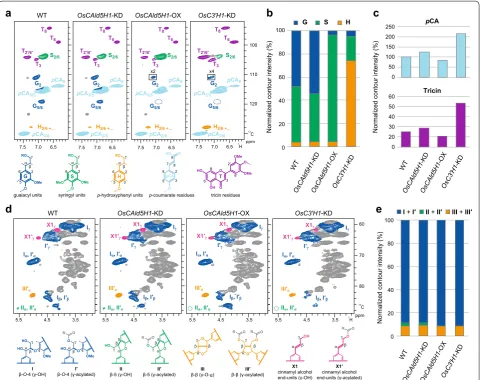
Fig. 1 NMR characterization of transgenic rice cell walls. a–c Aromatic sub-regions of short-range 1H–13C correlation (HSQC) NMR spectra of
[39, 40] estimated that the cellulose and hemicellulose contents varied from 38 to 44% and from 32 to 42% among the tested genotypes, respectively; OsC3′H1-KD plants showed relatively higher cellulose (44%) and lower hemicellulose (32%) contents than the other gen-otypes (Table 1).
Next, the lignin structures were evaluated by 2D HSQC NMR and thioacidolysis. As expected, both analytical methods determined that OsCAld5H1-KD, OsCAld5H1-OX and OsC3′H1-KD transgenic culm lignins had significantly augmented G-, S- and H-type aromatic units, respectively, compared with the wild-type controls (Figs. 1a, b, 2 and Additional file 1: Table S1). HSQC NMR estimated 54% G units in OsCAld5H1 -KD, 92% S units in OsCAld5H1-OX and 75% H units in OsC3′H1-KD lignins compared with 48% G, 48% S and 4% H in wild-type lignins, based on the volume integra-tion of the well-resolved C2/6–H2/6 signal contours [35] (Fig. 1b), whereas thioacidolysis determined 55% G units in OsCAld5H1-KD, 83% S units in OsCAld5H1-OX and 33% H units in OsC3′H1-KD lignins compared with 47% G, 49% S and 4% H in wild-type lignins (Fig. 2 and Addi-tional file 1: Table S1); the differences between the G/S/H
compositions estimated by HSQC NMR and thioacido-lysis could be at least partially attributed to the fact that the latter measures only the distribution of monomers released by cleaving β–O–4 bonds [41]. The aromatic sub-regions of the HSQC NMR spectra also resolved sets of the signals from p-coumarate (pCA) and tricin resi-dues incorporated into the rice lignin polymers (Fig. 1a) [27–29]. Integral ratios of pCA contour signals relative to the total of G/S/H aromatic signals were 102%, 125%, 86% and 216%, whereas those of tricin contour signals were 18%, 22%, 13% and 52%, in the wild-type, OsCAld5H1 -KD, OsCAld5H1-OX and OsC3′H1-KD lignin spectra, respectively (Fig. 1c), suggesting that both pCA and tricin residues were relatively augmented in the OsCAld5H1 -KD and OsC3′H1-KD lignins and conversely depleted in the OsCAld5H1-OX lignins compared to in the wild-type lignins; it is notable that both pCA and tricin signals could be over-represented in our HSQC NMR spectra because correlation signals from such mobile appendant or end group units in lignin polymers typically relax more slowly than those from less mobile internal units [31, 35]. The aliphatic sub-regions of the HSQC NMR spectra fur-ther provided useful information on the distribution of Table 1 Chemical composition of transgenic rice cell walls
WT, wild-type; OsCAld5H1-KD, OsCAld5H1-knockdown; OsCAld5H1-OX, OsCAld5H1-overexpression; OsC3´H1-KD, OsC3´H1-knockdown a Sum of the Klason acid-insoluble (corrected by ash content) and acid-soluble lignin contents
b Trifluoroacetic acid (TFA)-insoluble glucan content
c Sum of TFA-soluble arabinan, xylan, mannan, galactan and glucan contents. Values are mean ± SD (n= 3) Lignin, % (fold change
vs untreated sample)a Cellulose, % (fold change vs untreated sample)b Hemicelluloses, % (fold change vs untreated
sample)c
Untreated
WT 15.4 ± 1.4 (–) 41.3 ± 0.7 (–) 42.4 ± 1.7 (–)
OsCAld5H1-KD 22.1 ± 1.1 (–) 40.2 ± 0.7 (–) 37.0 ± 4.5 (–)
OsCAld5H1-OX 16.5 ± 0.9 (–) 37.9 ± 0.5 (–) 38.9 ± 1.3 (–)
OsC3´H1-KD 18.7 ± 1.7 (–) 44.0 ± 1.7 (–) 31.7 ± 0.6 (–)
Dilute alkali (31.25 mM NaOH, 90 °C, 3 h)
WT 14.8 ± 0.3 (0.96) 46.6 ± 1.8 (1.13) 33.1 ± 1.7 (0.78)
OsCAld5H1-KD 17.4 ± 1.7 (0.79) 47.4 ± 0.2 (1.18) 33.4 ± 1.6 (0.90)
OsCAld5H1-OX 12.0 ± 0.8 (0.73) 46.6 ± 0.5 (1.23) 35.0 ± 6.6 (0.90)
OsC3´H1-KD 14.5 ± 2.7 (0.78) 48.8 ± 1.7 (1.11) 25.3 ± 0.7 (0.80)
Dilute acid (1.3% H2SO4, 90 °C, 3 h)
WT 49.0 ± 0.6 (3.17) 54.9 ± 1.0 (1.33) 12.7 ± 0.1 (0.30)
OsCAld5H1-KD 51.1 ± 1.3 (2.31) 56.1 ± 1.2 (1.40) 9.9 ± 1.1 (0.27)
OsCAld5H1-OX 44.1 ± 0.9 (2.68) 55.3 ± 1.2 (1.46) 9.6 ± 0.6 (0.25)
OsC3´H1-KD 27.9 ± 0.5 (1.50) 53.8 ± 1.9 (1.22) 9.8 ± 0.1 (0.31)
Liquid hot water (200 °C, 10 min)
WT 51.6 ± 3.9 (3.34) 61.9 ± 2.1 (1.50) 4.8 ± 0.4 (0.11)
OsCAld5H1-KD 56.7 ± 0.9 (2.56) 61.4 ± 4.0 (1.53) 3.9 ± 0.2 (0.11)
OsCAld5H1-OX 59.4 ± 3.9 (3.61) 64.1 ± 3.8 (1.69) 4.1 ± 0.2 (0.11)
lignin inter-monomeric linkage types between the trans-genic and wild-type lignin polymers (Fig. 1d). Quantita-tive analysis of the HSQC contour signals suggested that all the transgenic and wild-type lignins had similar lignin linkage distributions, being comprised mainly of β–O–4 linkages (I and I´; > 80% of the total detectable linkage types) with lesser amounts of β–5 (II and II´) and β–β (III and III´) linkages; the OsCAld5H1-OX and OsC3′H1-KD lines showed slightly increased β–O–4 and decreased β–5 units compared with the wild-type control and OsCAld5H1-KD line (Fig. 1e), which overall was consis-tent with our previously published data [27, 29].
Chemical treatments of transgenic rice cell walls
To investigate the effects of the altered lignin composi-tion on the reactivity of rice lignocellulose in typical bio-mass processing reactions, the lignin-modified transgenic rice cell walls were subjected to dilute alkali, dilute acid and liquid hot water treatments; these thermochemical treatments have been frequently used as pretreatments to improve the enzymatic saccharification efficiency of lignocellulosic biomass [42–46]. The mass recovery rate (see “Methods/experimental”) and lignocellulose struc-tural changes were determined and compared between the lignin-altered transgenic and wild-type rice cell walls.
In the dilute alkali treatment (in 31.25 mM NaOH at 90 °C for 3 h), the mass recovery rates were simi-lar overall (76–81%) among all the genotypes examined (Fig. 3). Lignocellulose compositional analyses by the Klason lignin and neutral sugar assays indicated that lignin and hemicellulose contents were decreased, while cellulose contents were increased after the alkaline treatment (Table 1). The data suggested that the alkali treatment preferentially extracted and removed lignins
and hemicelluloses from the rice cell walls [46]. Interest-ingly, the decrease of lignin content was more prominent in the three transgenic lines (0.73–0.79-fold changes vs untreated samples) compared with the wild-type con-trol (0.96-fold change vs untreated samples), although we found no significant differences in the degree of lignin removal among the three transgenic lines (Table 1). This result suggested that, regardless of the differences in aromatic composition, the transgenic rice lignins were somehow more susceptible to the alkaline treatment than the wild-type lignins. No drastic changes in the total yield or H/G/S composition of thioacidolysis-derived lignin monomers were detected after the alkaline treat-ment (Fig. 2 and Additional file 1: Table S1). Therefore, the current alkaline treatment had a minor effect on rice lignin structures, although previous studies have shown that more severe alkaline treatments may cleave the lignin polymer linkages and typically S-lignins are more easily degraded than G- or H-lignins under harsh alkali conditions [47–49].
By contrast, both the dilute acid (in 1.3% H2SO4 at 90 °C for 3 h) and liquid hot water (in compressed water at 200 °C for 10 min) treatments largely reduced the hemicellulosic glycans, probably via acid-cata-lyzed hydrolysis, and eventually enriched lignins and cellulosic glucans (Table 1); in the typical liquid hot water process, cell wall-derived organic acids such as p-hydroxycinnamates, acetates, formates and glucu-ronic acids liberated in compressed hot water provoke acid-induced cell wall hydrolysis and condensation reactions [46]. It is, however, notable that lignin con-tent of the acid and liquid hot water-treated cell walls evaluated by the Klason assay may be somehow
H
G S G S H
b
a
WT OsC Ald5 H1-K D OsC Ald5 H1-O X OsC 3ʹH1 -KD lat oT yi dle of oiht ic a lo d no m sis y sr e mo lo mμ( /g ) R W C oT ta ei yl tf o dl h oi dic a is ylo s m on o sr e m o mμ( il g/l in g )n 0 100 200 300 400 500 20 60 100 120 0 WT OsC Ald5 H1-K D OsC Ald5 H1-O X OsC 3ʹH1-KD WT
OsC Ald5 H1-K D OsC Ald5 H1-O X OsC 3ʹH1
-KD WT
OsC Ald5 H1-K D OsC Ald5 H1-O X OsC 3ʹH1 -KD WT OsC Ald5 H1-K D OsC Ald5 H1-O X OsC 3ʹH1
-KD WT
OsC Ald5 H1-K D OsC Ald5 H1-O X OsC 3ʹH1
-KD WT
OsC Ald5 H1-K D OsC Ald5 H1-O X OsC 3ʹH1
-KD W T OsC Ald5 H1-K D OsC Ald5 H1-O X OsC 3ʹH1 -KD 140 600 40 80 Dilute alkali (31.25 mM NaOH,
90 °C, 3 h) Untreated
Dilute acid (1.3% H2SO4,
90 °C, 3 h)
Liquid hot water (200 °C, 10 min) Dilute alkali
(31.25 mM NaOH, 90 °C, 3 h) Untreated
Dilute acid (1.3% H2SO4,
90 °C, 3 h)
Liquid hot water (200 °C, 10 min)
overestimated by repolymerized polysaccharide deg-radation products (pseudo-lignins) (Table 1) [44, 50]. The mass recovery rate (Fig. 3) and the hemicellulose content data (Table 1) suggested that the liquid hot water treatment was likely harsher and more effective in hemicellulose removal than the dilute acid treatment employed in this study. Notably, the OsC3′H1-KD line showed significantly higher mass recovery rates than the other genotypes in both the dilute acid and liquid hot water treatments (Fig. 3), which might have been due to the relatively low hemicellulose levels in the original cell walls from the OsC3′H1-KD line compared with those from the other genotypes (Table 1). Despite the large increases in lignin content (Table 1), the total yields of thioacidolysis monomers expressed per total lignin content were largely depleted after the acid and liquid hot water treatments for all the tested rice cell walls (Fig. 2b and Additional file 1: Table S1), suggest-ing that lignins underwent acid-induced condensation reactions in both the dilute acid and liquid hot water treatments. We again observed more pronounced mono-mer yield reductions after liquid hot water treatment than after dilute acid treatment (Fig. 2b and Additional file 1: Table S1). Particularly after the liquid hot water treatment, both H- and G-type thioacidolysis mers were more drastically depleted than S-type mono-mers (Fig. 2b and Additional file 1: Table S1). The result suggests that H- and G-lignins are more susceptible to acid-induced condensation reactions than S-lignins, possibly due to the higher reactivities of non- or less methoxylated H- and G-type aromatic rings than
S-type aromatic rings in typical acid-catalyzed conden-sation reactions of lignins [51–53].
Enzymatic saccharification efficiency of transgenic rice cell walls
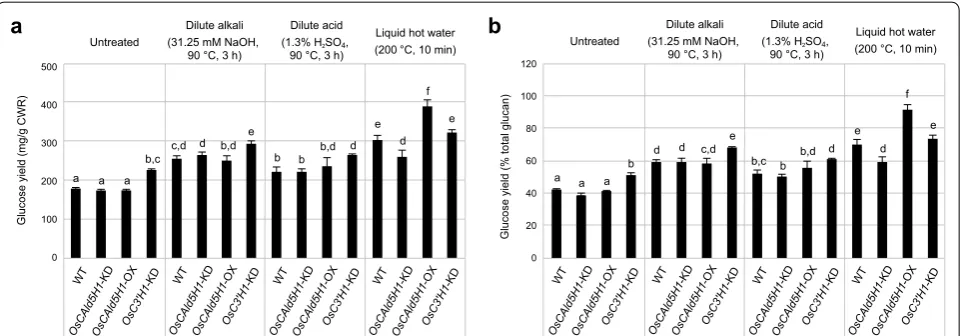
To assess the effects of altered lignin composition on cell wall degradability, we evaluated the enzymatic sac-charification efficiency of the rice cell wall samples with and without chemical pretreatments. In line with our previous data [29], raw untreated cell walls from the H-lignin-augmented OsC3′H1-KD line displayed a sig-nificantly higher saccharification efficiency (51% per total glucan) than the wild-type control cell walls (42% per total glucan) (Fig. 4). A similar improvement in cell wall saccharification efficiency was also reported for H-lignin-enriched Arabidopsis mutants [54]. Thus, H-lignin may show a lower inhibitory effect than G- and S-lignins on cell wall hydrolysis by cellulolytic enzymes [54, 55]. In addition, we previously determined that cell wall cross-linking ferulates specific to grass cell walls were substan-tially reduced in OsC3′H1-KD rice cell walls, which may also contribute to the enhancement of cell wall digestibil-ity [29]. In contrast, G-lignin-augmented OsCAld5H1 -KD (39% per total glucan) and S-lignin-augmented OsCAld5H1-OX (41% per total glucan) cell walls showed similar saccharification efficiencies to the wild-type con-trol (42% per total glucan) (Fig. 4), suggesting that the S/G ratio does not much affect the biomass saccharifi-cation efficiency without any pretreatment. Similarly, analogous studies with transgenic alfalfa [18], Arabidop-sis [19, 21–23] and poplar [20] also noted that changes in S/G ratio had a minor impact on the digestibility of eud-icot cell walls without thermochemical pretreatment.
Next, we investigated the enzymatic saccharifica-tion in combinasaccharifica-tion with the dilute alkali, dilute acid and liquid hot water treatments. All the pretreatments greatly enhanced the glucose yields, by 40–213 mg/g cell walls or 9–50% per total glucan after 24 h of enzymatic hydrolysis (Fig. 4). Like we observed with untreated cell wall samples, the H-lignin-augmented OsC3′H1-KD line showed significantly higher glucose yields than the wild-type control, whereas the OsCAld5H1-KD and OsCAld5H1-OX lines displayed overall similar glucose yields to the wild-type control with dilute alkali and acid pretreatments (Fig. 4). However, the S-lignin-enriched OsCAld5H1-OX line displayed a dramatically increased glucose yield (91% per total glucan) compared to other genotypes (60–73% per total glucan) after liquid hot water pretreatment (Fig. 4). A similar result was reported in earlier studies with transgenic Arabidopsis and natu-ral poplar variants; increasing the proportions of S units in lignins likewise improved the enzymatic hydrolysis of cellulose when combined with hot water pretreatments WT
OsC Ald5
H1-K D
OsC Ald5
H1-O X
OsC 3ʹH1
-KD
0 60 80
WT
OsC Ald5
H1-K D
OsC Ald5
H1-O X
OsC 3ʹH1
-KD WT
OsC Ald5
H1-K D
OsC Ald5
H1-O X
OsC 3ʹH1
-KD
100
20 40
b a a a,b
a b b c
a b c a
et
ar
yr
ev
oc
er
ss
a
M
)
%(
Dilute alkali (31.25 mM NaOH,
90 °C, 3 h)
Dilute acid (1.3% H2SO4,
90 °C, 3 h)
Liquid hot water (200 °C, 10 min)
[19, 56]. The actual reason why liquid hot water process-ing enhances the enzymatic saccharification of S-lignin-enriched plants remain unknown; Li et al. speculated that S-rich lignins might have lower melting points than G-rich lignins and thus might be more easily melted and relocated under high-temperature conditions [19]. In contrast, with the liquid hot water pretreatment, the G-lignin-enriched OsCAld5H1-KD line (60% per total glucan), and even the H-lignin-enriched OsC3′H1-KD line (73% per total glucan), which displayed improved saccharification efficiency with no pretreatment condi-tions, displayed similar or lower glucose yields compared with the wild-type control (70% per total glucan). Taken together with the structural analysis data discussed ear-lier (Table 1, Fig. 2 and Additional file 1: Table S1), the highly condensed lignins derived via liquid hot water treatment of G- and H-lignins may be more recalcitrant than the lignins derived via the treatment of S-lignins, by impeding the accessibility and/or the catalytic activity of hydrolytic enzymes. Overall, our data demonstrate that modulations of the H-/G-/S-lignin composition can be a promising strategy to enhance enzymatic saccharification of grass biomass to boost the production of fermentable sugars.
Calorific values of transgenic rice cell walls
The calorific value is an important trait that directly correlates to the performance of biomass in solid fuel applications, so we lastly evaluated the HHVs of the rice transgenic cell walls. For comparison, we determined the HHVs of CWRs, lignin-enriched CWRs prepared via cel-lulolytic hydrolysis of CWRs (Additional file 1: Table S2) and synthetic lignins (dehydrogenation polymers, DHPs)
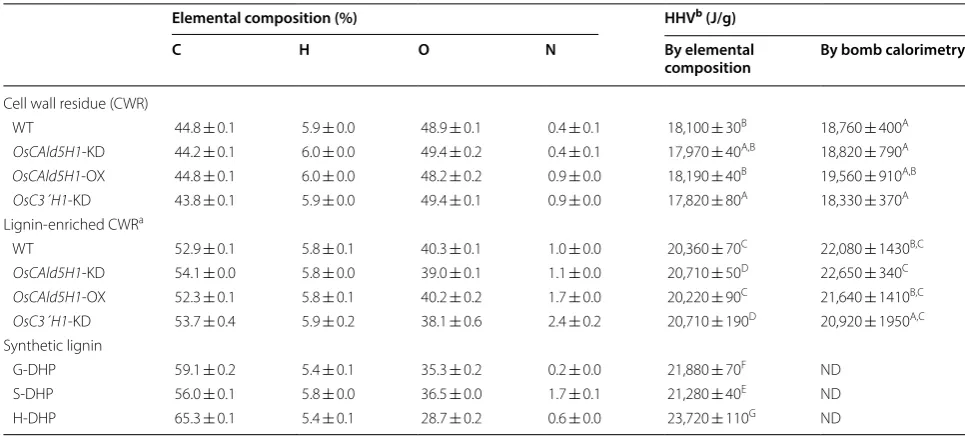
comprising only G (G-DHP), S (S-DHP) or H (H-DHP) aromatic units [32, 33]. For all rice cell wall and DHP samples, the HHVs were estimated based on the elemen-tal composition using the equation proposed by Yin [37]. In parallel, the actual HHVs of rice cell wall samples were measured by bomb calorimetry.
In line with the notion that HHV of biomass is posi-tively correlated with the lignin content [3, 16, 17, 57– 59], the HHVs of lignin-enriched CWRs were generally higher than those of untreated CWRs, as determined by both elemental analysis and bomb calorimetry (Table 2). Because the degree of lignin methoxylation negatively correlates with the carbon contents of lignin polymers, an increase of less methoxylated H- or G-lignins over S-lignins may increase lignin HHVs [3]. In fact, the cal-culated HHVs determined for the DHPs were the highest for H-DHP (23,720 J/g), followed by G-DHP (21,880 J/g) and S-DHP (21,280 J/g) (Table 2). We also found that the calculated HHVs of lignin-enriched CWRs determined for the G-lignin-augmented OsCAld5H1-KD (20,710 J/g) and the H-lignin-augmented OsC3′H1-KD (20,710 J/g) lines were statistically higher than those determined for the S-lignin-augmented OsCAld5H1-OX line (20,220 J/g) and the wild-type control (20,360 J/g); we did not detect such a tendency in the untreated CWR samples, possibly because of their low lignin levels (Table 2). These data are in line with the notion that enrichment of less methox-ylated H- or G-lignins could be beneficial to improving the heating value of lignin-based solid biofuels. Conse-quently, however, we did not detect any statistically sig-nificant differences in the actual HHVs determined by bomb calorimetry between the rice cell walls from the three transgenic lines and the wild-type control, either
b
a
WT OsC Ald5 H1-K D OsC Ald5 H1-O X OsC 3ʹH1 -KD ul G eiy es oc dl g m(/g ) R W C cul G eiy es o dl %( at ot ulg l )n ac 0 20 40 60 80 100 100 200 300 400 0 WT OsC Ald5 H1-K D OsC Ald5 H1-O X OsC 3ʹH1-KD WT
OsC Ald5 H1-K D OsC Ald5 H1-O X OsC 3ʹH1
-KD WT
OsC Ald5 H1-K D OsC Ald5 H1-O X OsC 3ʹH1 -KD Dilute alkali (31.25 mM NaOH,
90 °C, 3 h) Untreated WT OsC Ald5 H1-K D OsC Ald5 H1-O X OsC 3ʹH1
-KD WT
OsC Ald5 H1-K D OsC Ald5 H1-O X OsC 3ʹH1
-KD WT
OsC Ald5 H1-K D OsC Ald5 H1-O X OsC 3ʹH1
-KD WT
OsC Ald5 H1-K D OsC Ald5 H1-O X OsC 3ʹH1 -KD
a a a
b,c c,d d b,d e
b b b,d d e
d f
e
500
a a a b
d d c,d e
b,c b b,d d e d e f 120 Dilute acid (1.3% H2SO4,
90 °C, 3 h)
Liquid hot water (200 °C, 10 min)
Dilute alkali (31.25 mM NaOH,
90 °C, 3 h) Untreated
Dilute acid (1.3% H2SO4,
90 °C, 3 h)
Liquid hot water (200 °C, 10 min)
among the untreated CWR or among the lignin-enriched CWR samples (Table 2). This might have been because of the variations in the inter-mixed polysaccharides and/or lignin components other than the G/S/H aromatic units (Table 1 and Additional file 1: Table S2). For example, the elevations of lignin HHVs by the augmentation of G and H units in the OsCAld5H1-KD and OsC3′H1-KD lignins could be somehow offset by the increase in the relatively oxygen-rich pCA and tricin residues as suggested by our NMR analysis (Fig. 1c).
Conclusions
To gain insight into the effects of lignin composition on biomass properties in grasses, we comparatively evaluate the biomass reactivity, enzymatic saccharification with or without pretreatments and calorific values of our recently produced rice transgenic lines with distinct lignin mono-mer compositions. Our data demonstrated that the enrich-ment of H-lignins can be effective in enhancing biomass saccharification efficiency with alkali and acid pretreat-ments or even without any pretreatment. Additionally, the enrichment of S-lignins greatly enhanced cell wall sacchari-fication with liquid hot water pretreatment. While the total lignin content showed a clear positive effect on the heating value of rice cell walls, modulating lignin aromatic compo-sition had no effect on the heating values at least for the rice cell wall materials used in this study. However, because the analysis of synthetic lignin models demonstrated a negative
correlation between the methoxyl content and lignin heat-ing value, further genetic enrichment of less methoxylated H- or G-lignins, in combination with an increase of total lignin content, may help to increase the biomass heating value. We believe that further cell wall analysis of lignin-modified transgenic rice plants will greatly help us identify a potent strategy for developing biorefinery-suited grass biomass feedstocks.
Additional file
Additional file 1: Table S1. Thioacidolysis-derived lignin composition of transgenic rice cell walls. Table S2. Isolation yields and cell wall sugar composition of lignin-enriched cell walls from transgenic rice.
Abbreviations
CWR : cell wall residue; DHP: dehydrogenation polymer; DMSO: dimethylsulfox-ide; G: guaiacyl; H: p-hydroxyphenyl; HHV: higher heating value; HSQC: hetero-nuclear single-quantum coherence; KD: knockdown; NMR: hetero-nuclear magnetic resonance; OX: overexpression; S: syringyl; TFA: trifluoroacetic acid.
Authors’ contributions
YurT, YukT, MS and TU designed the research. YurT, YukT, MY and TT per-formed the experiments. YurT, YukT and TU analyzed the data and wrote the manuscript with contributions of all the other authors. All authors read and approved the final manuscript.
Author details
1 Research Institute for Sustainable Humanosphere, Kyoto University, Uji, Kyoto
611-0011, Japan. 2 Graduate School of Agriculture, Kyoto University, Sakyo-ku, Table 2 Elemental composition and higher heating values (HHVs) of transgenic rice cell walls and synthetic lignins
ND, not determined; WT, wild-type; OsCAld5H1-KD, OsCAld5H1-knockdown; OsCAld5H1-OX, OsCAld5H1-overexpression; OsC3´H1-KD, OsC3´H1-knockdown a Cell wall residues after enzymatic hydrolysis of the polysaccharide fraction with crude cellulases. Isolation yields and cell wall sugar composition are shown in Additional file 1: Table S2
b Different letters indicate a significant difference between datasets (ANOVA with post hoc Tukey–Kramer method, p < 0.05). Elemental composition and HHV results are reported on an ash-free basis. Values are mean ± SD (n= 3)
Elemental composition (%) HHVb (J/g)
C H O N By elemental
composition By bomb calorimetry
Cell wall residue (CWR)
WT 44.8 ± 0.1 5.9 ± 0.0 48.9 ± 0.1 0.4 ± 0.1 18,100 ± 30B 18,760 ± 400A
OsCAld5H1-KD 44.2 ± 0.1 6.0 ± 0.0 49.4 ± 0.2 0.4 ± 0.1 17,970 ± 40A,B 18,820 ± 790A
OsCAld5H1-OX 44.8 ± 0.1 6.0 ± 0.0 48.2 ± 0.2 0.9 ± 0.0 18,190 ± 40B 19,560 ± 910A,B
OsC3´H1-KD 43.8 ± 0.1 5.9 ± 0.0 49.4 ± 0.1 0.9 ± 0.0 17,820 ± 80A 18,330 ± 370A
Lignin-enriched CWR a
WT 52.9 ± 0.1 5.8 ± 0.1 40.3 ± 0.1 1.0 ± 0.0 20,360 ± 70C 22,080 ± 1430B,C
OsCAld5H1-KD 54.1 ± 0.0 5.8 ± 0.0 39.0 ± 0.1 1.1 ± 0.0 20,710 ± 50D 22,650 ± 340C
OsCAld5H1-OX 52.3 ± 0.1 5.8 ± 0.1 40.2 ± 0.2 1.7 ± 0.0 20,220 ± 90C 21,640 ± 1410B,C
OsC3´H1-KD 53.7 ± 0.4 5.9 ± 0.2 38.1 ± 0.6 2.4 ± 0.2 20,710 ± 190D 20,920 ± 1950A,C
Synthetic lignin
G-DHP 59.1 ± 0.2 5.4 ± 0.1 35.3 ± 0.2 0.2 ± 0.0 21,880 ± 70F ND
S-DHP 56.0 ± 0.1 5.8 ± 0.0 36.5 ± 0.0 1.7 ± 0.1 21,280 ± 40E ND
Kyoto 606-8502, Japan. 3 Research Unit for Development of Global
Sustainabil-ity, Kyoto UniversSustainabil-ity, Uji, Kyoto 611-0011, Japan.
Acknowledgements
We thank Dr. Hironori Kaji and Ayaka Maeno (ICR, Kyoto University) for their assistance in NMR analysis, and Dr. Kazuaki Katagiri, Shimpei Yamaguchi and Takuya Ehiro (Osaka Research Institute of Industrial Science and Technology) for bomb calorimetry.
Competing interests
The authors declare that they have no competing interests.
Availability of data and materials
All data generated or analyzed during this study are included in this published article and its additional files.
Funding
This work was supported in part by grants from the Japan Science and Technology Agency/Japan International Cooperation Agency (Science and Technology Research Partnership for Sustainable Development, SATREPS), the Japan Society for the Promotion of Science (KAKENHI, #16H06198 and #16K14958), and RISH, Kyoto University (Mission-linked Research Funding, #2016-5-2-1). YurT acknowledges the JSPS fellowship program (#17J09654). Part of this study was conducted using the facilities in the DASH/FBAS at RISH, Kyoto University, and the NMR spectrometer in the JURC at ICR, Kyoto University.
Publisher’s Note
Springer Nature remains neutral with regard to jurisdictional claims in pub-lished maps and institutional affiliations.
Received: 20 September 2018 Accepted: 4 December 2018
References
1. Griggs D, Stafford-Smith M, Graffney O, Rockström J, Öhman MC, Shyam-sunder P, Steffen W, Glaser G, Kanie N, Noble I (2013) Policy: sustainable development goals for people and planet. Nature 495:305–307 2. Tye YY, Lee KT, Wan Abdullah WN, Leh CP (2016) The world availability
of non-wood lignocellulosic biomass for the production of cellulosic ethanol and potential pretreatments for the enhancement of enzymatic saccharification. Renew Sustain Ener Rev 60:155–172
3. Umezawa T (2018) Lignin modification for valorization. Phytochem Rev 17:1305–1327
4. Bhatia R, Gallagher JA, Gomez LD, Bosch M (2017) Genetic engineer-ing of grass cell wall polysaccharides for biorefinengineer-ing. Plant Biotechnol J 15:1071–1092
5. de Moraes Rocha GJ, Martin C, Soares IB, Maior AMS, Baudel HM, de Abreu CAM (2011) Dilute mixed-acid pretreatment of sugarcane bagasse for ethanol production. Biomass Bioenerg 35:663–670
6. Bezerra TL, Ragauskas AJ (2016) A review of sugarcane bagasse for second-generation bioethanol and biopower production. Biofuels Bioprod Bioref 10:634–647
7. Boerjan W, Ralph J, Baucher M (2003) Lignin biosynthesis. Annu Rev Plant Biol 54:519–546
8. Ralph J (2010) Hydroxycinnamates in lignification. Phytochem Rev 9:65–83
9. Lan W, Lu F, Regner M, Zhu Y, Rencoret J, Ralph SA, Zakai UI, Morreel K, Boerjan W, Ralph J (2015) Tricin, a flavonoid monomer in monocot lignifi-cation. Plant Physiol 167:1284–1295
10. Chiang VL (2006) Monolignol biosynthesis and genetic engineering of lignin in trees, a review. Environ Chem Lett 4:143–146
11. Vanholme R, Morreel K, Ralph J, Boerjan W (2008) Lignin engineering. Curr Opin Plant Biol 11:278–285
12. Wang P, Dudareva N, Morgan JA, Chapple C (2015) Genetic manipulation of lignocellulosic biomass for bioenergy. Curr Opin Chem Biol 29:32–39
13. Mottiar Y, Vanholme R, Boerjan W, Ralph J, Mansfield SD (2016) Designer lignins: harnessing the plasticity of lignification. Curr Opin Biotechnol 37:190–200
14. Ragauskas AJ, Beckham GT, Biddy MJ, Chandra R, Chen F, Davis MF, Davison BH, Dixon RA, Gilna P, Keller M, Langan P, Naskar AK, Saddler JN, Tschaplinski TJ, Tuskan GA, Wyman CE (2014) Lignin valorization: improv-ing lignin processimprov-ing in the biorefinery. Science 344:1246843
15. Rinaldi R, Jastrzebski R, Clough MT, Ralph J, Kennema M, Bruijnincx PC, Weckhuysen BM (2016) Paving the way for lignin valorization: recent advances in bioengineering, biorefining and catalysis. Angew Chem Int Ed Engl 55:8164–8215
16. Scully ED, Gries T, Sarath G, Palmer NA, Baird L, Serapiglia MJ, Dien BS, Boateng AA, Ge Z, Funnell-Harris DL, Twigg P, Clemente TE, Sattler SE (2016) Overexpression of SbMyb60 impacts phenylpropanoid biosynthe-sis and alters secondary cell wall composition in Sorghum bicolor. Plant J 85:378–395
17. Koshiba T, Yamamoto N, Tobimatsu Y, Yamamura M, Suzuki S, Hattori T, Mukai M, Noda S, Shibata D, Sakamoto M, Umezawa T (2017) MYB-medi-ated upregulation of lignin biosynthesis in Oryza sativa towards biomass refinery. Plant Biotechnol 34:7–15
18. Chen F, Dixon RA (2007) Lignin modification improves fermentable sugar yields for biofuel production. Nat Biotechnol 25:759–761
19. Li X, Ximenes E, Kim Y, Slininger M, Meilan R, Ladisch M, Chapple C (2010) Lignin monomer composition affects Arabidopsis cell-wall degradability after liquid hot water pretreatment. Biotechnol Biofuels 3:27–33 20. Mansfield SD, Kang K-Y, Chapple C (2012) Designed for
deconstruc-tion—poplar trees altered in cell wall lignification improve the efficacy of bioethanol production. New Phytol 194:91–101
21. Van Acker R, Vanholme R, Storme V, Mortimer JC, Dupree P, Boerjan W (2013) Lignin biosynthesis perturbations affect secondary cell wall composition and saccharification yield in Arabidopsis thaliana. Biotechnol Biofuels 6:46–62
22. Anderson NA, Tobimatsu Y, Ciesielski PN, Ximenes E, Ralph J, Donohoe BS, Ladisch M, Chapple C (2015) Manipulation of guaiacyl and syringyl monomer biosynthesis in an arabidopsis cinnamyl alcohol dehydroge-nase mutant results in atypical lignin biosynthesis and modified cell wall structure. Plant Cell 27:2195–2209
23. Shi J, Pattathil S, Parthasarathi R, Anderson NA, Kim JI, Venketachalam S, Hahn MG, Chapple C, Simmons BA, Singh S (2016) Impact of engineered lignin composition on biomass recalcitrance and ionic liquid pretreat-ment efficiency. Green Chem 18:4884–4895
24. Fu C, Mielenz JR, Xiao X, Ge Y, Hamilton CY, Rodriguez M Jr, Chen F, Foston M, Ragauskas A, Bouton J, Dixon RA, Wang ZY (2011) Genetic manipula-tion of lignin reduces recalcitrance and improves ethanol producmanipula-tion from switchgrass. Proc Natl Acad Sci USA 108:3803–3808
25. Cesarino I, Simões MS, dos Santos Brito M, Fanelli A, da Franca Silva T, Romanel E (2016) Building the wall: recent advances in understanding lignin metabolism in grasses. Acta Physiol Plant 38:269
26. Hatfield RD, Rancour DM, Marita JM (2017) Grass cell walls: A story of cross-linking. Front Plant Sci 7:2056
27. Takeda Y, Koshiba T, Tobimatsu Y, Suzuki S, Murakami S, Yamamura M, Rah-man MM, Takano T, Hattori T, Sakamoto M, Umezawa T (2017) Regulation of CONIFERALDEHYDE 5-HYDROXYLASE expression to modulate cell wall lignin structure in rice. Planta 246:337–349
28. Takeda Y, Suzuki S, Tobimatsu Y, Osakabe K, Osakabe Y, Ragamustari SK, Sakamoto M, Umezawa T (2018) Lignin characterization of rice CONIF-ERALDEHYDE 5-HYDROXYLASE loss-of-function mutants generated with the CRISPR/Cas9 system. Plant J. https ://doi.org/10.1111/tpj.14141 29. Takeda Y, Tobimatsu Y, Karlen SD, Koshiba T, Suzuki S, Yamamura M,
Murakami S, Mukai M, Hattori T, Osakabe K, Ralph J, Sakamoto M, Umezawa T (2018) Downregulation of p-COUMAROYL ESTER 3- HYDROXY-LASE in rice leads to altered cell wall structures and improves biomass saccharification. Plant J 95:796–811
31. Tobimatsu Y, Chen F, Nakashima J, Escamilla-Trevino LL, Jackson L, Dixon RA, Ralph J (2013) Coexistence but independent biosynthesis of catechyl and guaiacyl/syringyl lignin polymers in seed coats. Plant Cell 25:2587–2600
32. Tobimatsu Y, Takano T, Kamitakahara H, Nakatsubo F (2008) Studies on the dehydrogenative polymerizations of monolignol β-glycosides. Part 3: horseradish peroxidase-catalyzed polymerizations of triandrin and isosyringin. J Wood Chem Technol 28:69–83
33. Sawamura K, Tobimatsu Y, Kamitakahara H, Takano T (2017) Lignin functionalization through chemical demethylation: preparation and tannin-like properties of demethylated guaiacyl-type synthetic lignins. ACS Sustain Chem Eng 5:5424–5431
34. Santoro N, Cantu SL, Tornqvist C-E, Falbel TG, Bolivar JL, Patterson SE, Pauly M, Walton JD (2010) A high-throughput platform for screening milligram quantities of plant biomass for lignocellulose digestibility. Bioenerg Res 3:93–102
35. Mansfield SD, Kim H, Lu F, Ralph J (2012) Whole plant cell wall characteri-zation using solution-state 2D NMR. Nat Protoc 7:1579–1589
36. Hattori T, Murakami S, Mukai M, Yamada T, Hirochika H, Ike M, Tokuyasu K, Suzuki S, Sakamoto M, Umezawa T (2012) Rapid analysis of transgenic rice straw using near-infrared spectroscopy. Plant Biotechnol 29:359–366 37. Yin C-Y (2011) Prediction of higher heating values of biomass from
proxi-mate and ultiproxi-mate analyses. Fuel 90:1128–1132
38. Hatfield RD, Jung H-JG, Ralph J, Buxton DR, Weimer PJ (1994) A compari-son of the insoluble residues produced by the Klacompari-son lignin and acid detergent lignin procedures. J Sci Food Agric 65:51–58
39. Foster CE, Martin TM, Pauly M (2010) Comprehensive compositional analysis of plant cell walls (lignocellulosic biomass) part II: carbohydrates. J Vis Exp 37:1837
40. Lam PY, Tobimatsu Y, Takeda Y, Suzuki S, Yamamura M, Umezawa T, Lo C (2017) Disrupting flavone synthase II alters lignin and improves biomass digestibility. Plant Physiol 174:972–985
41. Lapierre C, Monties B, Rolando C (1986) Preparative thioacidolysis of spruce lignin: isolation and identification of main monomeric products. Holzforschung 40:47–50
42. Yu Q, Zhuang X, Lv S, He M, Zhang Y, Yuan Z, Qi W, Wang Q, Wang W, Tan X (2013) Liquid hot water pretreatment of sugarcane bagasse and its comparison with chemical pretreatment methods for the sugar recovery and structural changes. Bioresour Technol 129:592–598
43. Alvira P, Tomás-Pejó E, Ballesteros M, Negro MJ (2010) Pretreatment technologies for an efficient bioethanol production process based on enzymatic hydrolysis: a review. Bioresour Technol 101:4851–4861 44. Hu F, Ragauskas A (2012) Pretreatment and lignocellulosic chemistry.
Bioenerg Res 5:1043–1066
45. Mood SH, Golfeshan AH, Tabatabaei M, Jouzani GS, Najafi GH, Gholami M, Ardjmand M (2013) Lignocellulosic biomass to bioethanol, a compre-hensive review with a focus on pretreatment. Renew Sustain Ener Rev 27:77–93
46. Kim TH (2013) Pretreatment of lignocellulosic biomass. In: Yang S, El-Enshasy HA, Thongchul N (eds) Bioprocessing technologies in biorefinery for sustainable production of fuels, chemicals, and polymers. Wiley, New Jersey, pp 91–105
47. Huntley SK, Ellis D, Gilbert M, Chapple C, Mansfield SD (2003) Signifi-cant increases in pulping efficiency in C4H-F5H-transformed poplars: improved chemical savings and reduced environmental toxins. J Agric Food Chem 51:6178–6183
48. Shimizu S, Yokoyama T, Akiyama T, Matsumoto Y (2012) Reactivity of lignin with different composition of aromatic syringyl/guaiacyl structures and erythro/threo side chain structures in β-O-4 type during alkaline delignification: as a basis for the different degradability of hardwood and softwood lignin. J Agric Food Chem 60:6471–6476
49. Wagner A, Tobimatsu Y, Phillips L, Flint H, Geddes B, Lu F, Ralph J (2015) Syringyl lignin production in conifers: proof of concept in a pine tra-cheary element system. Proc Natl Acad Sci USA 112:6218–6223 50. Sannigrahi P, Kim DH, Jung S, Ragauskas A (2011) Pseudo-lignin and
pretreatment chemistry. Energy Environ Sci 4:1306–1310
51. Miyamoto T, Mihashi A, Yamamura M, Tobimatsu Y, Suzuki S, Takada R, Kobayashi Y, Toshiaki U (2018) Comparative analysis of lignin chemical structures of sugarcane bagasse pretreated by alkaline, hydrothermal, and dilute sulfuric acid methods. Ind Crops Prod 121:124–131 52. Shioya T, Akiyama T, Yokoyama T, Matsumoto Y (2016) Formation rate of
benzyl cation intermediate from p-hydroxyphenyl, guaiacyl, or syringyl nucleus in acidolysis of lignin. J Wood Chem Technol 37:75–86 53. Wayman M, Chua MGS (1979) Characterization of autohydrolysis aspen
(P. tremuloides) lignins. Part 2. Alkaline nitrobenzene oxidation studies of extracted autohydrolysis lignin. Can J Chem 57:2599–2602
54. Bonawitz ND, Kim JI, Tobimatsu Y, Ciesielski PN, Anderson NA, Ximenes E, Maeda J, Ralph J, Donohoe BS, Ladisch M, Chapple C (2014) Disruption of mediator rescues the stunted growth of a lignin-deficient Arabidopsis
mutant. Nature 509:376–380
55. Sangha AK, Davison BH, Standaert RF, Davis MF, Smith JC, Parks JM (2014) Chemical factors that control lignin polymerization. J Phys Chem B 118:164–170
56. Studer MH, DeMartini JD, Davis MF, Sykes RW, Davison B, Keller M, Tuskan GA, Wyman CE (2011) Lignin content in natural Populus variants affects sugar release. Proc Natl Acad Sci USA 108:6300–6305
57. Demirbaş A (2001) Relationships between lignin contents and heating values of biomass. Energy Convers Manag 42:183–188
58. Vargas-Moreno JM, Callejón-Ferre AJ, Pérez-Alonso J, Velázquez-Martí B (2012) A review of the mathematical models for predicting the heating value of biomass materials. Renew Sustain Ener Rev 16:3065–3083 59. Kačík F, Ďurkovič J, Kačíková D (2012) Chemical profiles of wood