Overview on conductometric solid-state gas dosimeters
I. Marr, A. Groß, and R. Moos
Department of Functional Materials, University of Bayreuth, Bayreuth, Germany
Correspondence to: R. Moos ([email protected])
Received: 1 August 2013 – Revised: 20 December 2013 – Accepted: 6 January 2014 – Published: 22 January 2014
Abstract. The aim of this article is to introduce the operation principles of conductometric solid-state dosimeter-type gas sensors, which have found increased attention in the past few years, and to give a literature overview on promising materials for this purpose. Contrary to common gas sensors, gas dosimeters are suitable for directly detecting the dose (also called amount or cumulated or integrated exposure of analyte gases) rather than the actual analyte concentration. Therefore, gas dosimeters are especially suited for low level applications with the main interest on mean values. The applied materials are able to change their electrical properties by selective accumulation of analyte molecules in the sensitive layer. The accumulating or dosimeter-type sensing principle is a promising method for reliable, fast, and long-term detection of low analyte levels. In contrast to common gas sensors, few devices relying on the accumulation principle are described in the lit-erature. Most of the dosimeter-type devices are optical, mass sensitive (quartz microbalance/QMB, surface acoustic wave/SAW), or field-effect transistors. The prevalent focus of this article is, however, on solid-state gas dosimeters that allow a direct readout by measuring the conductance or the impedance, which are both based on materials that change (selectively in ideal materials) their conductivity or dielectric properties with gas loading. This overview also includes different operation modes for the accumulative sensing principle and its unique features.
1 Introduction
In times of strict environmental requirements and an increas-ing demand for mobility and energy, a growincreas-ing need for reliable, low concentration level gas-sensing devices comes along. Especially the detection of toxic, harmful gases, like SO2, NO and/or NO2(=NOx), H2S, CO, or NH3, which can
affect human health, particularly in workplaces and urban en-vironments, are important target gases for gas sensors. Inex-pensive sensor devices based on semiconducting metal ox-ides manufactured in ceramic technology or in thin- or thick-film technology are installed in annual quantities of mil-lions (Yamazoe, 2005). The measurand is the conductance of metal oxides, as it depends on the analyte concentration. For information on the physical background of such sen-sors, the reader is referred to reviews in the literature (Göpel, 1994; Williams, 1999; Kohl, 2001; Yamazoe et al., 2003; Barsan et al., 2007). Semiconducting solid-state gas sensors can be miniaturized and operated with low power consump-tion (Simon et al., 2001; Semancik et al., 2001). However,
most sensors show poor selectivity, nonlinear characteristics (Williams, 1999; Yamazoe et al., 2003), and according to Padilla et al. (2010), the main drawback is their lack of sta-bility over time, leading to recalibration costs. Another issue is that increased sensitivity is often accompanied by a slow sensor kinetic. Even if the response time is fast enough for special applications, in many cases the recovery time is not. This does not really jeopardize low-cost applications for de-tecting dangerous conditions or alarm concentration levels. If, however, maximum allowable concentrations in emission or immission regulations are given in time-weighted aver-age concentrations or cumulated amounts, like the immission standards for air quality monitoring as annual or hourly mean values, a mathematical integration of the linearized sensor signal is error-prone due to both slow sensor recovery times and baseline drifts.
For instance, NO2 thresholds are given by the EU
should not be exceeded more than 18 times per calendar year, and an alert limit of 400µg m−3 measured over three
con-secutive periods of one hour each. For comparison, the one hour limit of 200µg m−3NO
2corresponds to a concentration
of 0.1 ppm. In order to detect such small integrated concen-tration values by conventional semiconducting gas sensors with the required accuracy, complex procedures like contin-uous switching between clean air and analyte are required (Schütze et al., 1995).
Solid-state dosimeter-type gas sensing principles comprise a promising method for overcoming the above-mentioned drawbacks. Like passive samplers, solid-state gas sensors working in the accumulating mode are adequate devices for the reliable detection of lowest pollution levels (Seethapathy et al., 2008) because the dosimeter principle eludes several problems of a conventional gas sensor (Yamazoe and Shima-noe, 2007).
There are various publications on sensing devices men-tioning an “irreversible reaction” or a very slow recovery time, not recognizing the benefits of this sensor behavior that differs from conventional gas sensors. The intention of this overview is to show exemplarily research papers that ob-served accumulating, integrating or irreversible gas-sensing properties. Sensor responses that do not recover in the ab-sence of analyte under sorption conditions are denoted as “irreversible” in the following, even if the samples can be regenerated under modified operation conditions. It is a fur-ther aim of this study to elucidate the sensing principle and some special operation modes that allow a direct readout of the concentration as well as an accumulated concentration value at the same time and a plausibility check during regen-eration.
This overview lists the different dosimeter-type gas sens-ing principles ussens-ing the change of the electrical properties of the gas-sensitive material as the measurand. The focus of this overview is on conductometric integrating gas sen-sors but there are also optical (mostly organic dye-based coloration reactions) (Dasgupta et al., 1998; Tanaka et al., 1998, 1999; Sasaki et al., 2001; Maruo, 2007; Maruo et al., 2009; Small et al., 2009; Bhalla et al., 2010), SAW (Martin et al., 1996; Nieuwenhuizen and Harteveld, 1997), field-effect transistors (FET) (Andringa et al., 2012; Klug et al., 2013), quartz microbalance (QMB) (Matsuguchi et al., 2005; Jung et al., 2009), and passive sampling (Roadman et al., 2003; Varshney and Singh, 2003; Seethapathy et al., 2008) devices that are able to detect very low gas concentrations in the ppb range.
This article reviews the basic working principles of con-ductometric solid-state gas dosimeters (Sect. 2). It consid-ers the direct amount determination and the indirect concen-tration determination, influencing factors, and compares gas dosimeters with classical gas sensors. Certain basic examples for sensing devices using the dosimeter-type sensing princi-ple are shown in Sect. 3. Section 4 describes modifications regarding the dosimeter setup and the operation modes.
Fur-thermore, suitable or already applied materials are listed in Sect. 5.
2 Basic working principle of a solid-state gas dosimeter
The basic working principle of gas dosimeters relies on the accumulation of analyte gas molecules in the sensitive layer of the detecting device and the concomitant accumulation level dependent change of the electrical properties. The ir-reversible, selective, and progressive analyte sorption result-ing in analyte accumulation can be caused by strong analyte sorption or a chemical reaction between the analyte and the receptor. Hence, gas dosimeters working in the accumula-tion mode (Yamazoe and Shimanoe, 2007) are often also de-noted as “integrating” or “accumulating” sensors (Tanaka et al., 1999; Maruo 2007; Shu et al., 2010; Geupel et al., 2010; Groß et al., 2012b). For the explanation of the accumulating sensing principle, a planar setup consisting of an insulating support with electrodes, e.g., interdigitated electrodes, cov-ered with a sensitive layer, was chosen. This setup makes it possible to measure the conductance of the sensor layer.
2.1 Direct amount and indirect concentration detection The benefit of the dosimeter-type sensing behavior is the di-rect determination of the dose of the analyte gas species or the mean concentration in a defined period of time without the need for a mathematical integration of the sensor signal. In the case of a constant gas flow rate, the analyte dose as the measurand can be given in a simplified manner as the ana-lyte amount or cumulated exposure Ac, calculated according
to Eq. (1) as the time integral of the analyte concentration c(t) with the starting point of the sorption interval t0:
Ac=
t
Z
t0
c(t)dt. (1)
Acis often given in the unit ppm s, which can be converted to
µL orµmol if accounting for the applied gas flow rate. The determination of the amount Acas the measurand of
the gas dosimeter is in accordance with national or inter-national environmental immission or emission regulations, given, for instance, as mean time values, like the annual or 1 h limit.
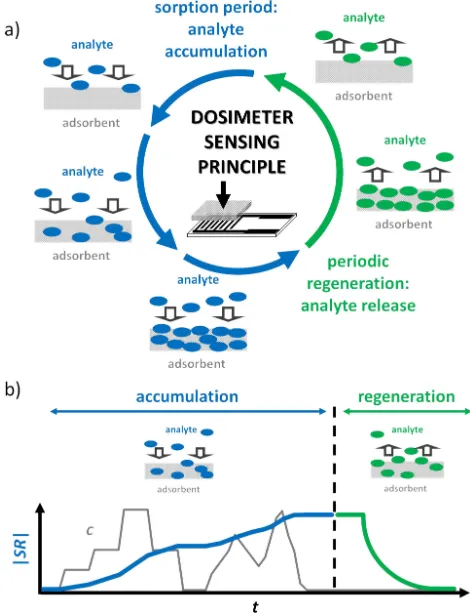
Figure 1.Scheme of the operation principle of a dosimeter-type gas sensing device with a sensitive layer as an adsorbent: (a) alternation of analyte accumulation in the sorption period (blue) and analyte re-lease upon regeneration (green), (b) sensor response|SR|during the analyte accumulation (blue) and during the short-term regeneration period (green).
change of at least one material property due to analyte ac-cumulation. In a short regeneration step under defined con-ditions, the formerly sorbed analyte molecules are released from the sorbent and the sorption capacity is recovered. De-pendent on the interaction between the sorbent and the an-alyte, different regeneration procedures are effective to re-cover the sorption capacity as well as the sensor signal. They include thermal decomposition at elevated tempera-tures (Katayama et al., 2004; Helwig et al., 2008; Kubinski and Visser, 2008; Brunet et al., 2008; Shu et al., 2010; Bran-denburg et al., 2013; Groß et al., 2013a), chemical reactions, e.g., by a changed gas atmosphere (Helwig et al., 2007, 2008; Groß et al., 2012a) or optical-induced desorption, e.g., by UV light (Li et al., 2003; Helwig et al., 2008).
As sketched in Fig. 1b, the absolute value of the accumulation-level dependent physical property that is mon-itored and evaluated as sensor response,|SR|, increases dur-ing the sorption period and recovers durdur-ing regeneration. “... the sensor is designed to provide an output that intrinsically depends on the history of the input quantities” (Angelini et
(Varghese et al., 2001; Mattoli et al., 2007; Helwig et al., 2008; Geupel et al., 2010; Shu et al., 2010; Hennemann et al., 2012a; Groß et al., 2012c). Regeneration has to be initi-ated if saturation effects limit the sorption rate of the sensitive layer or if the sensing characteristic is deteriorated.
The dosimeter-type sensing properties are often demon-strated in two different ways, but always at a constant gas flow: first, by looking at the signal change as a function of the exposure duration at a constant analyte concentration; or secondly, by plotting the concentration-related characteris-tic line of the measured data after specific exposure dura-tion. However, more information on the accumulating sens-ing properties is obtained by a repeated exposure to pulses of analyte gas with a defined concentration and duration.
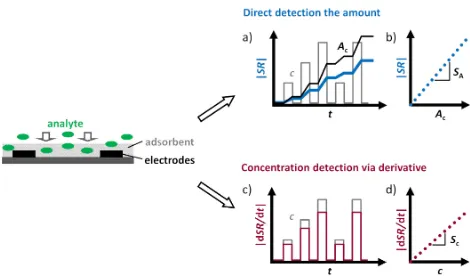
A more detailed analysis of the ideal sensor response of a gas dosimeter with a linear sensing characteristic during the analyte sorption at a constant gas velocity is shown in Fig. 2. Like the cumulated amount, Ac, being the time integral of
the concentration according to Eq. (1), the absolute value of the sensor response,|SR|, in Fig. 2a increases in the presence of the analyte gas. Thereby, the slope of the time-dependent sensor response reflects the sorption rate and correlates with the actual analyte concentration c(t) (Dasgupta et al., 1998; Sasaki et al., 2001; Reyes et al., 2006; Shu et al., 2010; Groß et al., 2012a; Mukherjee et al., 2012). In the absence of the analyte, i.e., if c=0 ppm, no signal recovery occurs, the sen-sor response remains constant and the response change due to the analyte is irreversible (Nieuwenhuizen and Harteveld, 1997). The course of |SR| in Fig. 2a indicates progressive analyte accumulation in the sensitive layer. Ideally, the sen-sor response|SR|depends linearly on the analyte amount, Ac
(Fig. 2b). When the characteristic line becomes nonlinear, the sensitive layer needs to be regenerated. The amount sen-sitivity SAis defined as the slope of the characteristic line in
the linear measurement range.
In consequence of the concentration-dependent slope of the sensor response, the course of the current analyte concen-tration over time can be determined by the time derivative of the sensor response|dSR/dt|, as shown on the timescale in Fig. 2c. The corresponding concentration-related character-istic line with the concentration sensitivity Scis depicted in
Fig. 2d. Instead of the equilibrated state, in the case of gas dosimeters, the sensor response change is evaluated.
Figure 2.Dual-mode functionality of gas dosimeters: (a) correla-tion between the analyte amount Ac and the sensor response|SR|
and (b) associated amount-related characteristic line, (c) correlation between the time-dependent analyte concentration c(t) and the time derivative of the signal|dSR/dt|and (d) associated concentration-related characteristic line.
and the current course of the analyte concentration can be determined indirectly from the signal derivative. For an ideal dosimeter, the material acts as an integrator and the deriva-tive reflects the actual concentration. This is in contrast to an ideal classical gas sensor, which determines the actual con-centration but the dose has to be obtained by integration.
The accumulating sensing principle is well suited for the long-term detection of very low analyte concentrations. By the chemical accumulation of the analyte molecules in the sensitive sorbent, the dosimeter “counts” every gas molecule that reaches the sensitive layer and causes a change of the physical properties of the material. This chemical integra-tion increases the accuracy of the amount determinaintegra-tion com-pared to conventional concentration detecting gas sensors. There, the determination of the average concentration val-ues or the cumulated exposure by mathematical integration of the concentration-related sensor response is error-prone in the case of very low gas concentrations due to slow sensor kinetics, zero-point drifts and nonlinearities in the measure-ment range (Corcoran and Shurmer, 1994).
As described above, periodic regeneration recovers the sorption capacity of the sensitive layer as well as the sensor response. Concerning the observed saturation of gas dosime-ters, e.g., in Geupel et al. (2010), it needs to be distinguished whether those effects originate from the limited number of sorption sites in the analyte sensitive material or from a non-linear correlation between the sensor response and the ana-lyte loading level.
2.2 Influencing factors
Similar to passive samplers, different sensor setup parame-ters and measurement conditions influencing the dosimeter-type gas sensing properties are reported in the literature and will be summarized and discussed.
Like conventional sensors, gas dosimeters may show cross sensitivities to other gases if those interact with the sensi-tive layer. They might restrict or promote the analyte sorp-tion process, which would affect the analyte sensitivity. Addi-tionally, the sensor response might change reversibly (Vargh-ese et al., 2001) or irreversibly due to other gas components dependent on the strength of interaction with the receptor. For instance, the dosimeter-type NOxsensing properties of a
carbonate-based sensitive layer were found to be affected by SO2in two ways: the competition between SO2and NOxfor
the sorption sites lowers the NOx sensitivity as well as the
measurement range. Furthermore, the conductivity is irre-versibly affected by sulfate formation, enabling SO2
dosime-try (Groß et al., 2012d).
The analyte sorption properties of the sensitive material are also influenced by the operation temperature. Due to ki-netic limitations, the sorption rate diminishes at lower tem-peratures; however, the strength of the analyte receptor inter-action increases, resulting in accumulating properties due to a reduced desorption rate. With increasing temperature, an-alyte sorption occurs faster and the sensitivity is enlarged. However, since the sorption capacity is reduced and the strength of interaction is weakened, the sensitive layer tends to release formerly sorbed analyte molecules. Hence, higher temperatures increase the sensitivity of gas dosimeters but reduce the linear measurement range (Groß et al., 2012a).
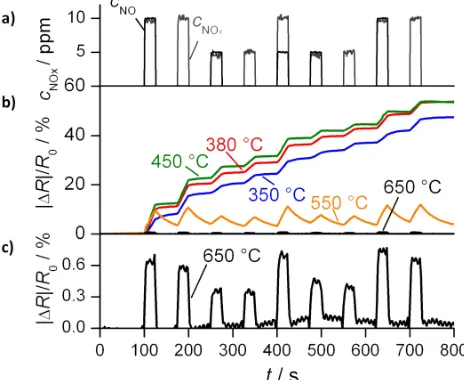
While the equilibrated sensor response is monitored with conventional sensors as a measure of the analyte concen-tration, the progressive change of the material properties of gas dosimeters during analyte sorption serves as the mea-sure of the cumulated amount. Hence, for the accumulating properties of the gas dosimeter it is very important that the chemical equilibrium is strongly shifted to the product side. Since the chemical equilibrium is strongly affected by tem-perature, it is possible that the same sensitive device can act like a gas dosimeter at low temperatures, while at higher temperatures it shows the typical concentration-related gas sensor behavior (Reyes et al., 2006; Shu et al., 2010; An-dringa et al., 2012). Brandenburg et al., 2013 demonstrate this temperature-dependent behavior for a sensitive layer of a carbonate-based NOxstorage material. The sensor shown in
Fig. 3 acts as an accumulating-type gas sensor up to 450◦C,
whereas the enhanced NOxdesorption rate in the absence of
analyte deteriorates the sensor response at 550◦C. At 650◦C,
response and recovery of the sensor signal to pulses of NOx
are very fast and the sensor behaves like a concentration de-tecting device (Fig. 3c) (Brandenburg et al., 2013).
Another influencing factor is the thickness of the sensitive layer being related to the sorption capacity (Nieuwenhuizen and Harteveld, 1997; Shu et al., 2011). Groß et al. demon-strated the dependency of the dosimeter-type NOx sensing
properties on the thickness of the carbonate-based sorbent. Since nitrates form mainly at the surface of the sorbent, the sensitivity of the NOx accumulating sensor decreases with
Figure 3.Temperature-dependence of the gas sensing behavior of a carbonate-based NOxstorage material for NOxsensing purposes:
(a) dosed NOx (NO or NO2) concentration, (b) sensor response
|∆R| /R0= |SR|for different temperatures and (c) sensor response
at 650◦
C. Please note the different scale of the y axes in (b) and (c). Reprinted from Brandenburg et al. (2013), with permission of Elsevier.
increases (Groß et al., 2012b). Additionally, the sensor re-sponse time concerning the concentration detecting proper-ties was found to increase with the layer thickness.
Similarly, it is expected that the analyte uptake can be in-fluenced by the sensitive surface area and hence the porosity of the sorbent.
As will be discussed in detail in Sect. 4, the setup-dependent gas velocity across the sensitive material was found to affect the analyte sorption (Beulertz et al., 2011, 2012).
The main characteristics of the classical and the dosimeter-type sensing principle – particularly for low level detection – are briefly compared in Fig. 4.
Some further advantages of the dosimeter-type sensor principle should be mentioned here. The long-term zero drift, being a drawback of conventional gas sensors, is avoided by redefining the zero level at the end of each regeneration pe-riod.
While the sensors’ response and recovery times, defined as the time span to reach the equilibrated states, are critical pa-rameters for classical gas sensors, in the case of gas dosime-ters the sensor signal change due to analyte accumulation is analyzed. Since the actual concentration value is given by the derivative, the sensor response is very fast.
It should also be mentioned that the measurement range and the sensitivity of the gas dosimeter can be adjusted dur-ing operation by varydur-ing the workdur-ing temperature.
Figure 4.Comparison of the main features of a gas dosimeter for the long-term low-level analyte detection with the properties of a conventional gas sensor.
3 Examples for conductometric gas dosimeters
In the following, some work on conductometric or impedancemetric sensors working in the accumulation mode for different analytes and with various sensitive materials are discussed exemplarily.
Shu and colleagues presented a resistive NO2sensor based
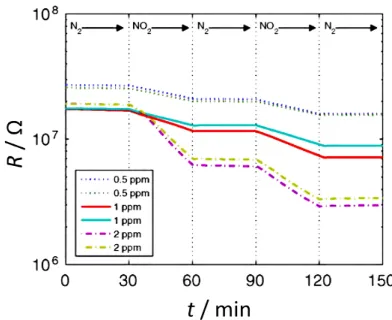
on iron (II) phthalocyanine that is operated at room tempera-ture (Shu, 2010; Shu et al., 2010, 2011). Figure 5 depicts the course of the measured resistance R during cyclic exposure to NO2 for 30 min in concentrations of 0.5, 1, and 2 ppm. The
total flow rates were 0.95, 0.43, and 0.25 L min−1,
respec-tively. For all applied concentrations, the typical curve shape of a dosimeter-type gas sensor signal is observed. While dos-ing NO2 in N2with a constant concentration, the resistance
decreases with a steady slope and remains at its level dur-ing the intermediate N2 phases, resulting in plateaus in the
response course. Unfortunately, the effect of NO2 is
rela-tively low (R/R0≈1 to 0.88) and the characteristic line is
not linear. The regeneration of this NO2chemo-dosimeter is
achieved thermally. The influence of the temperature was in-vestigated in the range from−46◦C to 71◦C. For the diff er-ence of∼50◦C the resistance decreases approximately one order of magnitude. With increased temperature the desorp-tion effects increase. Regarding the long-term stability, an in-crease of the conductivity during storage in air due to the ad-sorption of H2O and O2, an effect which is known for metal
containing phthalocyanines, can be observed (Shu, 2010). Helwig et al. realized a dosimeter-like p-type conducto-metric gas sensor with a hydrogenated diamond (HD) as pH sensitive material for NO2 and NH3as analytes (Beer et al.,
2013; Helwig et al., 2013). Figure 6 compares the resistance changes of the HD-sample to those of a conventional metal oxide (MOX)-based device in dry synthetic air. Due to the electrolytic dissociation of the gases in the sensitive layer, the resistance at room temperature decreases stepwise in the presence of NO2 pulses (Fig. 6a, red line) and increases in
the NH3-containing atmosphere (Fig. 6b, red line). For both
Figure 5.Course of the resistance R of iron(II)phthalocyanine in the presence of different NO2 concentrations at room temperature.
Adapted from Shu et al. (2010); reprinted with permission from El-sevier.
like an integrator-like gas sensor, whereas the signal of the metal oxide-based gas sensor (black line) shows the expected behavior of a conventional concentration related gas sensor. The recovery times of the dosimeter can be enhanced by a temperature increase, or by ozone or UV light. Figure 6c shows the reset of the sensor response after exposure to NH3
in different concentrations by a short O3pulse after each
am-monia phase, causing the oxidation of NH3at the sensor
sur-face at room temperature (Helwig et al., 2008).
In another example, a lean NOx-trap material known from
automotive NOx storage catalysts was applied as the NOx
sensitive layer (Geupel et al., 2010, 2011). At 380◦C, the
carbonate-based material accumulates NO and NO2
chemi-cally by forming nitrates. Due to nitrate formation, the re-sistance decreases, enabling total NOx dosimetry. Figure 7
demonstrates the suitability of the carbonate-based dosime-ter for the long-dosime-term detection of NO2even in the sub-ppm
range. The sensor response |SR| = |∆R| /R0 in Fig. 7a
fol-lows the characteristic behavior of an accumulating gas sen-sor during cyclic exposure to 0.2 to 2 ppm NO2 in steps
of 75 s over 50 min. |∆R| /R0 completely overlaps with the
normalized time integral of the concentration, ∫cNO2(t)dt (with cNO2(t) calculated from mass flow controller output data), which is shown in green as a reference for the course of the cumulated amount. The corresponding characteristic line gives a linear correlation between the sensor response |∆R| /R0 and the analyte amount ANO2 (Fig. 7b). Due to this linearity, the time derivative of the resistance|dR/dt|reflects the course of the NO2 concentration, as shown in Fig. 7c.
In accordance with the European air quality standards limit of 200µg m−3 NO2 (≈0.1 ppm) and the applied flow rate of
2 L min−1, this hourly threshold of about 360 ppm s could be monitored for at least 3.7 h with the sensitivity of the NOx
dosimeter shown in Fig. 7b, whereas it is even 18.5 h for the annual value of 40µg m−3. Besides the sensitivity, the
lin-ear measurement range of the presented sensor was found to be affected by temperature (Geupel et al., 2011) as well as by the thickness (Groß et al., 2012b) of the sensitive layer. The linear range always ends at a sensor response change of about 30 to 40 %. Regeneration is achieved by increasing the temperature to 650◦C (Groß et al., 2013a) or switching to
reducing gas atmospheres (Geupel et al., 2010).
Further examples for resistive-type gas dosimeters will be given in the next sections with the focus on modifications of the gas dosimeter setup and with special respect to the operation mode as well as to suitable sorbent materials.
4 Modifications of the dosimeter principle
Several conductometric sensors relying on the accumulating detection principle are reported. In this section, examples for modifications of the above-described dosimeter-type sens-ing principle are summarized. First of all, different config-urations of the sensor setup and the associated influencing factors are described before discussing alternative operation modes.
4.1 Dosimeter setup configurations
The access of the analyte molecules to the sensitive layer, impacting the sensing properties particularly in the case of gas velocity fluctuations, can be varied by the gas dosimeter setup. Equation (1) defines the concentration-related amount of analyte Acin the gas phase as the time integral of the
con-centration. However, for fluctuating flow rates, the analyte dose is better reflected by the volume-related amount AVas
the time integral of the concentration and the gas flow rate ˙
V(t) according to Eq. (2):
AV=
t
Z
t0
c(t)·V(t)dt˙ . (2)
If ˙V(t) denotes a volume flow ([ ˙V(t)]=m3s−1), the unit of AV
is m3(or hereµL). If, however, ˙V(t) is a molar flow ([ ˙V(t)]= mol s−1), then the unit of AVis mol, i.e., [AV]=mol. Hence,
the sensor signal of real amount-integrating gas dosimeters is expected to depend on the gas velocity. Otherwise the sensi-tive device works as a concentration integrator, allowing for concentration information by analyzing the signal derivative (Sect. 2.1).
Beulertz et al. (2011) investigated the influence of the flow rate on the sensor response of a carbonate-based NOx
dosimeter. Figure 8a depicts the time course of the sen-sor response|SR| = |∆R| /R0 of the NOx dosimeter in the
Figure 6.Dosimeter-like response of a hydrogenated diamond (HD) sensor at room temperature acting as pH sensor towards a sequence of (a) NO2and (b) NH3pulses in dry synthetic air and the effect of humidity. Adapted from Helwig et al. (2013); reprinted with permission from
Elsevier. (c) Response of a hydrogenated diamond sample in synthetic air (80 % N2/20 % O2) towards pulses of NH3and the O3-induced
reset of the sensor surface by NH3oxidation. Modified after Helwig et al. (2008); reprinted with permission from Elsevier.
Figure 7.Suitability for the long-term low-level NO2detection of
a planar sensor with a carbonate-based LNT-material in lean atmo-sphere at 350◦C: (a) sensor response|SR| = |∆R| /R
0in 0.2 to 2 ppm
NO2for 75 s each, (b) linear correlation of|SR| = |∆R| /R0and the
total NO2 amount ANO2, and (c) time derivative of the resistance |dR/dt|follows the course of the NO2concentration. Adapted from
Groß et al. (2012a), with permission of the authors.
to 400 mL min−1. The corresponding characteristic lines in
Fig. 8b, correlating the sensor response with the volume-related amount AV(here denoted as ANO), reveal that for the
same total amount of NO in the gas stream, the sensor re-sponse|SR| = |∆R| /R0differs for the applied gas flow rates.
This implies that a planar gas dosimeter measures the integral of the concentration Ac independently of the gas flow rate,
according to Eq. (1), and not the real, gas velocity-dependent amount of the analyte gas, AV, according to Eq. (2). This
be-havior can be explained by the fact that the gas velocity is very high and that only a small fraction of the gas stream passing the setup reaches the sensitive layer to be accumu-lated. In the investigated flow rate range, the analyte
con-centration near the sensitive layer is always constant and un-affected by the sorption capability of the sensitive material, resulting in same sensor responses independent of the gas velocity.
For further investigations on the NOx dosimeter, a
flow-through channel-type sensor, as sketched in Fig. 9a, was de-veloped in order to obtain full analyte storage (Beulertz et al., 2012; Moos et al., 2012). Due to the use of two sen-sitive layers with bigger sensen-sitive areas of 126 mm2 (three-fold longer compared to planar setup) with a small spacing in between, the diffusion of the passing analyte molecules to the sorption sites should be enhanced. The applied gas flow rate was adapted to the new geometry in such a way that the gas velocities across the sensitive layers were the same as in the planar setup. Hence, the measurements were carried out at flow rates of 30 to 60 mL min−1. All these
modifica-tions yielded a residence time of 151 ms, a value which is in the same order of magnitude as in the small channels of an automotive lean NOx catalyst, in which one can observe a
full storage without NOxslip. A second channel-type sensor
was located downstream of the first dosimeter to detect the NOxslip. The sensor responses|SR|of the two channel-type
sensors upon various NO concentrations and for the diff er-ent flow rates are summarized in Fig. 8c. The response of the downstream sensor (“second sensor”) remains zero for all runs. This indicates that for all applied flow rates, NO is completely sorbed by the sensitive layer of the first channel-type dosimeter. Comparing the sensor responses of the first sensor, a clear dependence of the sensor response on the gas flow rate for this channel-type setup appears. The higher the gas flow rate and, consequently, the higher the total exposed NO dose is, the higher is the sensor response. The character-istic lines demonstrate that in fact the same volume-related amount of analyte gas in the gas stream causes the same sen-sor response change. The sensitivity is independent of the gas velocity (in Fig. 8d, AVdenoted as ANO). Hence, the
Figure 8.(a) and (b) Sensor response|SR| = |∆R| /R0 of a planar NOx accumulating sensor at various gas flow rates: (a)|SR|does not
depend on the flow rates upon exposure towards 0 to 10 ppm NO, (b) corresponding characteristic lines related to the flow rate-dependent total amount AV, here denoted as ANO. (c) and (d) Sensor response|SR| = |∆R| /R0 of a channel-type NOxaccumulating senor at various
gas flow rates: (c) course of|SR|in 0 to 20 ppm NO for the different flow rates, (d) corresponding characteristic lines related to the flow rate-dependent total amount AV, here denoted as ANO. Slightly modified after Beulertz et al. (2012); reprinted with permission from Elsevier.
fired (LTCC)-based NOx sensor setup with a buried heater
structure was established (Fig. 9b) (Kita et al., 2012). Due to this rotational symmetric setup, the analyte can be sorbed uniformly by a sensitive layer deposited onto the inner sur-face of the tube. The enhanced intersur-face between the gas phase and the sorbent also enables integrating sensing prop-erties with linear characteristics concerning the volume-related amount. The buried heater structure allows a uniform and adjustable temperature distribution in the sensitive layer as well as periodic switching between the sorption and the regeneration temperature (Brandenburg et al., 2013).
Another design of a gas dosimeter, similar to the setup of passive sampling devices, was introduced by Mattoli et al. (2007) for a mercury sensor with a gold layer as sorbent. As shown in Fig. 10a, the sensitive layer is located inside a sampling chamber closed by a filter material functioning as diffusion barrier. To reach the sensitive sorbent layer, the gas needs to diffuse through the filter, resulting in a gradi-ent of the analyte concgradi-entration (here Hg) between zero at the sorbent (acting as analyte sink) and the surrounding gas concentration (Fig. 10b). Hence, the uptake of the analyte in the sorbent is diffusion controlled, leading to an analyte current that depends linearly on the analyte concentration in the ambience. The independency of the analyte uptake on the velocity of the passing gas stream results in concentration in-tegrating properties of the sensing device. Upon exposure to gaseous elemental Hg, the dosimeter changes its sensor sig-nal irreversibly. With growing number of mercury injections, the total amount of adsorbed Hg is concomitantly increased, which is reflected by the sensor signal. With this sensor de-sign, real-time monitoring of low levels of gaseous analyte is possible with a small size, low weight and low cost device applicable for personal safety.
Different options for the arrangement of gas dosimeters in gas pipes are possible to decrease the gas velocity across the sensitive layer, for instance to place the sensing device in a bypass with or without a gas pump to ensure a constant gas stream (Moos et al., 2010).
4.2 Operation modes of gas dosimeters
As discussed, the proportionality between sensor signal and cumulated analyte amount of linear gas dosimeters allows for time-continuous direct dose detection during the sorp-tion period and, depending on the setup, for concentrasorp-tion information by analyzing the signal derivative. However, gas dosimeters might also be operated in different modes. Some
Figure 10.Gas dosimeter setup for a diffusion-controlled analyte sorption: (a) cross-section of the dosimeter sampling chamber with a filter acting as diffusion layer, (b) profile of the resulting Hg con-centration, and (c) top view of the sampling chamber. Reprinted from Mattoli et al. (2007), with permission from Elsevier.
examples are described in the following. A summary con-cludes this section.
As described above and depicted in Fig. 1b, the analyte accumulation level of the sorbent is reflected by the elec-trical properties during the sorption period as well as dur-ing the subsequent analyte release in the regeneration in-terval. Hence, the analysis of the sensor signal change dur-ing the regeneration interval is another method for operat-ing gas dosimeters. It was demonstrated on a potassium and manganese containing NOx sensor that, after the sorption
period under sorption conditions, the change of the electri-cal conductance during thermal decomposition of the for-merly formed nitrates correlates with the preceding sorbed analyte amount (Groß et al., 2013a). A schematic drawing of this novel method is given in Fig. 11. Since it combines electrical characterization of the sorbent with temperature programmed desorption of the analyte, it is also denoted as eTPD. Due to the heating from the sorption to the desorp-tion temperature, the thermal activated conductance G of the sensitive layer increases as well (Fig. 11b). Thereby, the con-ductance of the material in the NOxloaded state, G, exceeds
those of the unloaded sample, G0. The thermal release of the
formerly sorbed analyte is indicated by a desorption peak with the concentration creleased (measurable by an NOx
Figure 11.Scheme of the electrical evaluation during thermal re-generation (denoted as eTPD): (a) time dependence of the conduc-tance G and the outlet analyte concentration creleased upon heating
from the sorption to the regeneration temperature, (b) determina-tion of the released amount Areleasedfrom the desorption peak and
the electrical response FG as deviation of G from the course of
the unloaded state, and (c) analysis of FGas a function of Areleased.
Reprinted from Groß et al. (2013a), with permission of the authors.
course of the conductance can be analyzed, as sketched in Fig. 11b. The desorption peak gives information on the for-merly sorbed analyte amount, being equal to the released amount Areleased=∫creleaseddt if the regeneration is complete.
The deviation of the thermally activated conductance after NOx loading, G, from the course in the unloaded state, G0
(Fig. 11b), was evaluated as sensor signal during the regen-eration interval (Fig. 11c) and is defined as FGaccording to
Eq. (3). Figure 11c depicts the dependency of the resulting sensor signal, FG, and the released analyte amount, Areleased.
FG=
tend
Z
tstart
[logG(t)−logG0(t)]dt. (3)
Figure 12 summarizes the results of an eTPD analysis of the potassium and manganese containing NOx dosimeter
operated at a sorption temperature of 380◦C and heated to
650◦C for thermal regeneration. During both intervals, the sensor was applied to a lean gas mixture of 2 L min−1. To achieve different NOxloading levels, the sensor sample was
exposed to 8 ppm NO or 8 ppm NO2for a duration tNOx,in be-tween 0 s and 1000 s. The NOxloading level, evaluated as the
Figure 12.eTPD results of the potassium and manganese contain-ing NOxdosimeter after exposure to 8 ppm NO or NO2for different
NO2exposure durations tNO2up to 1000 s: (a) linear increase of the
desorbed amount Areleasedwith tNO2; (b) course of the conductance,
G, in different loading states upon heating; and (c) linear correla-tion between Areleasedand the electrical response, FG(deviation of
G from G0), during desorption. Reprinted from Groß et al. (2013a),
with permission of the authors.
released amount, Areleased(measured by a chemiluminescence
detector), increases proportionally to the NOxexposure time,
tNO2,in, at the fixed NOxconcentration of 8 ppm, indicating a time-constant sorption rate (Fig. 12a). In Fig. 12b, the curves of log G during heating after different NO2exposure intervals
from 250 to 1000 s are compared to those without NO2
dos-ing (log G0, after 0 s NO2). The temperature at which all the
curves meet, here about 620◦C, represents the end of the
ni-trate decomposition. Figure 12c clarifies that for NO or NO2
dosage, the electrical response, FG(Eq. 3), during thermal
re-generation serves as an electrical measure for the former NOx
loading level, since FGcorrelates with Areleased. Figure 12
re-veals that, besides of the real-time and time-continuous de-tection of the analyte dose during the sorption period, the NOxloading state as well as the cumulated NOxexposure can
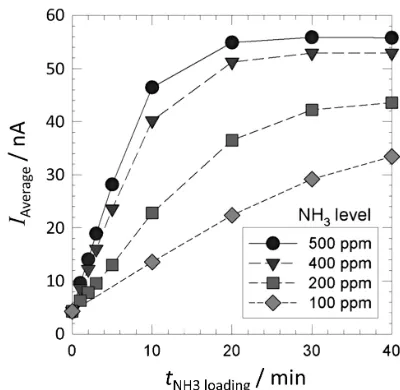
al., 2008; Rodríguez-González and Simon, 2010; Simons and Simon, 2011, 2012). Kubinski et al. (2008) described a linear correlation between the average alternating current IAverageat
a constant applied AC voltage (5 VP−P) at a frequency of 4 Hz during the thermal NH3release and the duration of the
pre-vious NH3exposure of an SCR catalyst-based conductivity
sensor (Fig. 13). For reaching a lowly loaded state, the sensor was exposed to a constant NH3concentration, as indicated in
a base gas atmosphere of 5 % O2and∼1 % H2O in N2 for
time durations from 0 to 40 min. Measuring IAverageduring
thermal NH3 release enables the in situ monitoring of the
former NH3loading level with a higher sensitivity compared
to those in the sorption mode.
A similar example for the investigation of the electrical properties during release of a chemisorbed gas species was the work of Rossé et al, 1984. They found that a CdSe thin film irreversibly sorbs oxygen and can be thermally regener-ated, causing a measurable change in the resistance.
The different operation modes of gas dosimeters are sum-marized in Fig. 14. As discussed in detail, the cumulated an-alyte exposure as well as the anan-alyte loading level of the sen-sitive material can be electrically detected either during sorp-tion (including concentrasorp-tion informasorp-tion from the deriva-tive) (Fig. 14a) or regeneration (Fig. 14b). Due to the corre-lation between the analyte amount and the sensor signal, it is possible to determine the mean analyte concentration also by the time∆tspecthat is needed to reach a defined loading state
of the sensor, indicated by a specific signal change|SR|spec
(Fig. 14c). For instance, the frequency of regeneration might serve as a measure for the analyte concentration. Due to a limited linear measurement range, the regeneration needs to be initiated at a predefined sensor signal before the signal saturates. Further, the time to reach a percolation threshold, tperc, indicated by a steep increase or decrease in the
conduc-tivity of the percolation dominated dosimeter, may serve as the measure for the mean concentration (Fig. 14d). For both time-measuring modes, no instantaneous information on the cumulated exposure or the actual concentration is obtained.
4.3 Gas dosimeters based on percolation effects Percolation effects (Ulrich et al., 2004) may modify the sens-ing characteristics of gas dosimeters, as investigated and de-scribed in detail for soot sensors being similar to gas sensors. Several soot sensors for diesel particulate filters consisting of an insulating substrate with electrodes on top have been reported (Ochs et al., 2010; Weigl et al., 2010; Hagen et al.,
Figure 13.Average current IAverageduring heating up to 520◦C for
thermal regeneration of a zeolite-based NH3sensor depending on
the NH3 loading time, tNH3loading. The SCR catalyst material was
loaded at a temperature of∼267◦
C in a gas stream composed of 5 % O2and∼1 % H2O in N2containing NH3, as indicated for 0 to
40 min. Adapted from Kubinski and Visser (2008); reprinted with permission from Elsevier.
2010; Kondo et al., 2011; Husted et al., 2012; Bartscherer and Moos, 2013). The resistance between these electrodes is analyzed. It serves as a measure for accumulated soot parti-cles on an insulating support. Figure 15 schematically depicts the formation of conductive pathways for the soot sensing device in its different states of soot loading. The soot depo-sition is driven by electrophoresis due to the applied voltage, U. Soot paths start to grow at the electrodes. From Fig. 15a to d, the amount of deposited conductive soot particles on the substrate surface between the electrodes increases. For the unloaded and lowly soot loaded state, almost no current, I, flows and the resistance between the electrodes, R, is almost infinite (R→ ∞). The sensor remains blind until the percola-tion threshold is reached after an exposure time of tperc. Then,
the formed conducting paths cause a fast decrease of the re-sistance (R<∞). Further soot accumulation leads to an addi-tional current increase or resistance decrease (R↓). An addi-tional low-conducting layer on top of the electrodes made of a resistive paste may reduce the sensor blind time. Owing to the low conductivity of the added layer, the soot amount can be detected in the accumulation mode without percolation effects (Bartscherer and Moos, 2013). The actual soot con-centration can be determined from the percolation time tperc
Figure 14.Scheme of the different operation modes of gas dosimeters: consideration of the loading level-dependent sensor signal during (a) analyte sorption and (b) analyte desorption and of the period of time to reach a defined loading state indicated by (c) a specific sensor signal like the end of the linear measurement range, or, e.g., (d) the percolation threshold.
Figure 15.Scheme of percolation-dominated resistive soot detec-tion with planar electrodes on an insulating substrate: (a) regener-ated soot sensor with an infinite resistance R, (b) sensor covered by a few soot particles below the percolation threshold, (c) sensor at point in time when the percolation threshold tpercis reached due
to a sufficient number of deposited particles forming a conductive pathway with a specific resistance, and (d) more soot particles at the surface, causing a further decrease of R.
Another example for dosimeter type gas sensors using per-colation effects is given by Hennemann et al. (2012b, c) and Sauerwald et al. (2013). Applying CuO nanofibers as H2S
sensitive materials, the change of conductance of the fibers upon pulsed H2S dosing is measured. When adsorbing H2S,
the conductance of the fibers increases due to their transition from CuO to CuS. However, as shown in Fig. 16a, the con-ductance G does not change during the first H2S pulses, but
after reaching the percolation threshold, a conductive path-way of CuS in the CuO layer is formed and the conduc-tance increases promptly. Beyond the percolation threshold, the sensor behaves like a H2S integrating gas sensor.
Never-theless, saturation effects deteriorate the sensor signal soon after reaching the percolation threshold. If one plots the
re-ciprocal value of the percolation time tperc (defined as the
time when the percolation threshold is reached, denoted as “switching time” in the work of Hennemann et al., 2012a) as a function of the H2S concentration, Fig. 16b implies a linear
dependency, demonstrating clearly that tperc decreases with
increased H2S concentration. Hence, a direct measurement
of the actual concentration and dose of H2S is not possible;
however, by the evaluation of the switching time the average concentration and the total amount of H2S in a certain
pe-riod of time can be determined indirectly (Hennemann et al., 2012a).
Similarly, the electrical properties of a Ni-based catalyst pellets were examined by impedance spectroscopy during the exposure to H2S. Before sulfur poisoning, the conductance is
very low due to the high dispersion of the Ni particles in the catalyst, i.e., the impedance is dominated by the permittiv-ity of the pellet material. With the addition of H2S, nickel
sulfide forms. Due to the enhanced volume of the nickel sulfides compared to the Ni particles, the distance between the conductive particles diminishes. Reaching the percola-tion threshold, the conductance increases immediately due to the formation of conductive pathways of nickel sulfides, al-lowing also dosimeter-type H2S detection (Fremerey et al.,
2012).
It should be clear, however, that accumulating percolation-type gas sensors cannot display the instant value directly. Since they act like switches if a certain accumulation level has been reached, however, the time span between two per-colation events can be seen as an indicator for the average concentration between the two events.
5 Suitable materials for accumulating gas sensors
Figure 16.Percolation-dominated H2S detection with CuO nanofibers at 160◦C: (a) conductance during consecutive 1 ppm H2S pulses for
1 min each with a sudden increase of the conductance as the percolation threshold is reached, denoted as switching time, (b) correlation between the reciprocal switching time and the H2S concentration. Modified after Hennemann et al. (2012a); reprinted with permission from
John Wiley and Sons.
components of gas dosimeters with a linear sensing charac-teristic (Groß et al., 2012a).
1. Selective sorption of the analyte: only one distinct gas species should accumulate in the sensitive layer, e.g., by chemisorption, including the chemical transformation of the material. To obtain linear sensing characteristics, the sorption rate should be proportional to the current analyte concentration in the gas phase.
2. Strength of sorption: the analyte sorption rate has to ex-ceed largely the desorption rate to ensure accumulation of analyte molecules in the sensitive material without releasing formerly sorbed molecules in the absence of the analyte in the gas atmosphere (i.e., holding capabil-ity).
3. At least one measurable electrical property must change with analyte accumulation, e.g., the impedance or the conductivity. The relation between the analyte loading level and the change of the electrical measurand has to be linear.
4. The sorption rate must be independent of the present analyte loading level of the sensitive layer so that no deterioration of the sorption efficiency with time occurs.
5. Ability to actively initiate a regeneration: the sensitive material must be able to release the formerly sorbed analyte molecules from the storage sites under defined conditions that are different from the sorption condi-tions (e.g., different temperature or gas composition). If there is no possibility to regenerate the storage material, the sensor is a single-use device.
Conductometric gas sensors using the accumulating sensing principle have been reported by several working groups for various analytes and sensitive materials (Sect. 3). The ap-plied materials range from organic semiconductors to metal
oxides, zeolites and carbon nanotubes. In the following an overview on the materials is given.
Suitable materials for the accumulation sensing mode are materials that have been successfully applied as storage com-ponents, for instance in filters or catalysts, e.g., lean NOx
traps or selective catalytic reduction (SCR) materials stor-ing NH3. Geupel et al. (2011) applied NOxstorage catalysts
based on alkaline (earth) carbonates as coatings for NOx
dosimeter operated at temperatures in the range of 300 to 400◦C. However, BaCO
3 serves also as a sulfur oxide
ad-sorbing layer on a gas sensor to protect it from sulfur poi-soning (Rettig et al., 2003). The irreversible interaction of SO2 with the NOx storage catalyst material causes a
cross-sensitivity of the NOx dosimeter but enables SO2 dosimetry
(Groß et al., 2012d). Zeolites, being a common class of ma-terials in SCR catalysis due to their NH3 storage capability,
are also viable materials as sensitive layers working in the accumulation mode. The gas sorption capacity of zeolites is very high and, due to their special framework structure, they hold a certain shape-selectivity. Upon gas sorption, zeo-lite materials are able to change their conductivity (Stamires, 1962; Eigenmann et al., 2000; Sahner et al., 2008), making them potential candidates for dosimeter-type sensors. An ex-ample for the dosimeter-type conductivity change is proton conducting H-ZSM-5 adsorbing NH3 (Simon et al., 1998;
Franke et al., 2003; Kubinski and Visser, 2008). Similar to those microporous zeolites, mesoporous materials might also be of interest, as they have been successfully applied as pre-concentrators in gas sensors to enhance the sensitivity by an-alyte accumulation in the porous material via sorption (Wag-ner et al., 2013).
Metal oxides also show potential as sensitive layers of gas dosimeters. Hennemann et al. (2012a) showed that CuO is an appropriate material for the accumulative detection of H2S being dominated by percolation effects. The
conductiv-ity of NiO shows a similar behavior in H2S containing gas
oxides, yet to be applied as sensitive material in conven-tional gas sensors, should be investigated concerning their suitability as gas dosimeter under modified sensing condi-tions that allow for irreversible analyte sorption, e.g., WO3
and Al-activated WO3as H2S dosimeter at room temperature
(Reyes et al., 2006) and SnO2 as O2, H2O, and H2
dosime-ter (Yamazoe et al., 1979). Mathieu et al., 2013, for exam-ple, give a broad overview on the sorption of SO2 by
vari-ous oxides, e.g., CaO, TiO2, CeO2, MnO2and mixed oxides,
meaning metal oxides in association with, e.g., Al2O3. They
also describe the regeneration of the metal oxides by thermal decomposition of the metal sulfates (Mathieu et al., 2013). With regard to the accumulating sensor principle, these ma-terials hold a certain storage capacity, but it has to be clarified whether the SO2accumulation causes measurably changing
electrical properties.
Another class of materials, providing a gas storage capac-ity that can be monitored by the resistance, are metal oxide-coated carbon nanotubes (Mangu et al., 2010). Varghese et al. (2001) reported impedimetric gas sensors based on SiO2
coated multi-wall carbon nanotubes as sensitive layer, show-ing the behavior of a conventional gas sensor towards H2O
(Varghese et al., 2001), O2 and CO2 (Ong et al., 2002), but
acting as a dosimeter in presence of NH3 (Varghese et al.,
2001; Ong et al., 2002). Single-walled carbon nanotubes with SnO2 coatings were applied by Mubeen et al. (2013) as
re-sistive gas sensors. Their tests with several gases reveal the classical gas sensor response; however the behavior towards NO2is dosimeter-like.
As already shown, hydrogenated diamond is a well-suited material for the accumulating sensing method to detect NO2
and NH3due to a pH change upon electrolytic analyte
dis-sociation in the surface electrolyte layer (Beer et al., 2013; Helwig et al., 2013). The hydrogenated diamond-based sen-sor can be regenerated thermally by O3or UV light (Helwig
et al., 2007, 2008).
Conductive polymers have already been applied for gas sensing applications. Bai and Shi show an overview on diff er-ent polymers for gas detection. They described that some of the conductive polymers show an irreversible reaction to cer-tain gases, making them a notable class of materials for gas dosimeters. However, it has to be kept in mind that polymers often show a poor long-term stability (Bai and Shi, 2007; Liu et al., 2012). The conductive polymeric system PEDOT:PSS was applied as a gas sensitive layer by Liu et al. (2012), act-ing as a classical gas sensor in the presence of NOx.
How-ever, initial tests of Marr et al. (2013) have shown that the conductive copolymer PEDOT:PSS is also a promising ma-terial for an accumulating gas sensing device. Their first mea-surements at room temperature with NOxas test gas show a
dosimeter-type change of the resistance in presence of NOx.
Organic compounds also might be suitable materials for the integrating sensing principle. A resistive low-level NO2
dosimeter based on iron (II) phthalocyanine was presented by Shu et al. (2010). Padma et al. (2009) and Brunet et al.
(2001, 2008) reported a NO2 sensitivity of copper
phthalo-cyanine. The Saltzmann reagent was applied in optical sen-sors for the detection of O3 and NO2 (Tanaka et al., 1998,
1999; Maruo, 2007; Maruo et al., 2009), morpholines for NO2sensing (Matsuguchi et al., 2005), eosin Y for NH3
de-tection via the slope of the drain current of a based OFET (Klug et al., 2013), and naphthyl polyenes to detect organic vapors electrically (Sircar et al., 1983). Their suitability for resistive gas dosimeters should be investigated.
Even metals can be applied as sensitive materials for gas dosimeters: Mattoli et al. (2007) realized a sensing device based on a Au layer for the resistive, cumulative detection of gaseous Hg. Ag was found to be a suitable material for the detection of H2S in the accumulation mode by Angelini et
al. (2009) and Chen et al. (2013).
Additionally, Mukherjee et al. (2012) summarizes gas sen-sor materials interacting reversibly or partly irreversibly with various gases.
As already mentioned in Sect. 2, the temperature strongly influences the gas sensing behavior (Reyes et al., 2006; An-dringa et al., 2012; Shu et al., 2012; Brandenburg et al., 2013; Groß et al., 2013a). Since conventional gas sensors are mostly based on metal oxides as sensitive layer and these materials are known to be able to adsorb gases, e.g., SO2
(Mathieu et al., 2013), they might be suitable for applications in a gas dosimeter under modified operation conditions. The desorption of the analyte gas predominates at elevated tem-peratures if the analyte concentration in the gas phase de-creases. The sensor signal changes reversibly, according to the established chemical equilibrium. Hence, the operation of the sensitive materials of conventional gas sensors at lower temperatures might reveal dosimeter-type sensing properties with analyte accumulation due to a reduced desorption rate. Similarly, BaCO3acts as NOxdosimeter at low temperatures
(Groß et al., 2013b) but the recovery time after NOxsorption
can be reduced by increasing the temperature, resulting in a reversible sensing characteristic (Tamaki et al., 1995).
6 Conclusion and outlook
scribing accumulating sensing behavior, but further inves-tigations regarding the long-term stability of gas dosimeter have to be conducted, especially when the regeneration step is a thermal one. A comparison between classical gas sensors and gas dosimeters lists the advantages and disadvantages of both sensing principle. Nevertheless, different principles have to be tested under same conditions to compare them di-rectly.
Acknowledgements. Ralf Moos thanks the German Research Foundation (DFG) for supporting this work under grant number MO 1060/15-1.
Edited by: M. Penza
Reviewed by: two anonymous referees
References
Andringa, A.-M., Vlietstra, N., Smits, E. C. P., Spijkman, M.-J., Gomes, H. L., Klootwijk, J. H., Blom, P. W. M., and de Leeuw, D. M.: Dynamics of charge carrier trapping in NO2sensors based
on ZnO field-effect transistors, Sensor. Actuator. B: Chemical, 171–172, 1172–1179, doi:10.1016/j.snb.2012.06.062, 2012. Angelini, E., Grassini, S., Neri, A., Parvis, M., and Perrone, G.:
Plastic Optic Fiber Sensor for Cumulative Measurements, in: Proceedings of the International Instrumentation and Measure-ment Technology Conference – I2MTC 2009, Singapore, 5–7 May 2009, 1666–1670, doi:10.1109/IMTC.2009.5168723, 2009. Bai, H. and Shi, G.: Gas Sensors Based on Conducting Polymers,
Sensors, 7, 267–307, doi:10.3390/s7030267, 2007.
Barsan, N., Koziej, D., and Weimar, U.: Metal oxide-based gas sen-sor research: How to?, Sensen-sor. Actuator. B: Chemical, 121, 18– 35, doi:10.1016/j.snb.2006.09.047, 2007.
Bartscherer, P. and Moos, R.: Improvement of the sensitivity of a conductometric soot sensor by adding a conductive cover layer, Journal of Sensors and Sensor Systems, 2, 95–102, doi:10.5194/jsss-2-95-2013, 2013.
Beer, S., Helwig, A., Müller, G., Garrido, J., and Stutzmann, M.: Water adsorbate mediated accumulation gas sensing at hydro-genated diamond surfaces, Sensor. Actuator. B: Chemical, 181, 894–903, doi:10.1016/j.snb.2013.02.072, 2013.
Beulertz, G., Geupel, A., Moos, R., Kubinski, D. J., and Visser, J. H.: Accumulating gas sensor principle – how to come from concentration integration to real amount measurements, Procedia Engineering, 25, 1109–1112, doi:10.1016/j.proeng.2011.12.273, 2011.
Beulertz, G., Groß, A., Moos, R., Kubinski, D. J., and Visser, J. H.: Determining the total amount of NOxin a gas stream – Advances
Bonn am 5 August 2010, Nr. 40, 1065, 2010.
Brandenburg, A., Kita, J., Groß, A., and Moos, R.: Novel tube-type LTCC transducers with buried heaters and inner inter-digitated electrodes as a platform for gas sensing at various high temperatures, Sensor. Actuator. B: Chemical, 189, 80–88, doi:10.1016/j.snb.2012.12.119, 2013.
Brunet, J., Talazac, L., Battut, V., Pauly, A., Blanc, J. P., Germain, J. P., Pellier, S., and Soulier, C.: Evaluation of atmospheric pol-lution by two semiconductor gas sensors, Thin Solid Films, 391, 308–313, doi:10.1016/S0040-6090(01)01001-X, 2001.
Brunet, J., Garcia Parra, V., Pauly, A., Varenne, C., and Lauron, B.: An optimized gas sensor microsystem for accurate and real-time measurement of nitrogen dioxide at ppb level, Sensor. Actu-ator. B: Chemical, 134, 632–639, doi:10.1016/j.snb.2008.06.010, 2008.
Chen, R., Morris, H. R., and Whitmore, P. M.: Fast Detection of Hydrogen Sulfide Gas in the ppmv Range with Silver Nanopar-ticles Films at Ambient Conditions, Sensor. Actuator. B: Chemi-cal, 186, 431–438, doi:10.1016/j.snb.2013.05.075, 2013. Corcoran, P. and Shurmer, H. V.: An intelligent gas sensor,
Sen-sor. Actuator. A: Physical, 41–42, 192–197, doi:10.1016/ 0924-4247(94)80110-X, 1994.
Dasgupta, P. K., Genfa, Z., Poruthoor, S. K., Caldwell, S., Dong, S., and Liu, S.-Y.: High-Sensitive Gas Sensors Based on Gas-Permeable Liquid Core Waveguides and Long-Path Absorbance Detection, Anal. Chem., 70, 4661–4669, doi:10.1021/ac980803t, 1998.
Directive 2008/50/EC of the European Parliament and of the Coun-cil of 21 May 2008 on Ambient Air Quality and Cleaner Air for Europe, Off. J. EU 2008, L152/1, 2008.
Eigenmann, F., Maciejewski, and Baiker, A.: Gas adsorption studied by pulse thermal analysis, Thermochimica Acta, 359, 131–141, doi:10.1016/S0040-6031(00)00516-5, 2000.
Franke, M. E., Simon, U., Moos, R., Knezevic, A., Müller, R., and Plog, C.: Development and working principle of an ammonia gas sensor based on a refined model for solvate supported proton transport in zeolites, Phys. Chem. Chem. Phy., 5, 5195–5198, doi:10.1039/B307502H, 2003.
Fremerey, P., Jess, A., and Moos, R.: Direct in-situ detec-tion of sulfur loading on fixed bed catalysts, in: Proceed-ings of the 14th International Meeting on Chemical Sensors – IMCS 2012, Nuremberg, Germany, 20–23 May 2012, 76–79, doi:10.5162/IMCS2012/1.1.5, 2012.
Geupel, A., Schönauer, D., Röder-Roith, U., Kubinski, D. J., Mulla, S., Ballinger, T. H., Chen, H.-Y., Visser, J. H., and Moos, R.: Integrating nitrogen oxide sensor: A novel concept for measur-ing low concentrations in the exhaust gas, Sensor. Actuator. B: Chemical, 145, 756–761, doi:10.1016/j.snb.2010.01.036, 2010. Geupel, A., Kubinski, D. J., Mulla, S., Ballinger, T. H., Chen, H.-Y.,
Automo-tive Exhausts – A Novel Concept, Sensor Letters, 9, 311–315, doi:10.1166/sl.2011.1471, 2011.
Göpel, W.: New materials and transducers for chemical sensors, Sensor. Actuator. B: Chemical, 18–19, 1–21, doi:10.1016/ 0925-4005(94)87049-7, 1994.
Groß, A., Beulertz, G., Marr, I., Kubinski, D. J., Visser, J. H., and Moos, R.: Dual Mode NOxSensor: Measuring Both the
Accumu-lated Amount and Instantaneous Level at Low Concentrations, Sensors, 12, 2831–2850, doi:10.3390/s120302831, 2012a. Groß, A., Richter, M., Kubinski, D. J., Visser, J. H., and Moos, R.:
The Effect of the Thickness of the Sensitive Layer on the Per-formance of the Accumulating NOxSensor, Sensors, 12, 12329–
12346, doi:10.3390/s120912329, 2012b.
Groß, A., Bishop, S. R., Yang, D. J., Tuller, H. L., and Moos, R.: The electrical properties of NOx-storing
carbon-ates during NOx exposure, Solid State Ionics, 225, 317–323,
doi:10.1016/j.ssi.2012.05.009, 2012c.
Groß, A., Hanft, D., Beulertz, G., Marr, I., Kubinski, D. J., Visser, J. H., and Moos, R.: The effect of SO2on the sensitive layer of
a NOxdosimeter, Sensor. Actuator. B: Chemical, 187, 153–161,
doi:10.1016/j.snb.2012.10.039, 2012d.
Groß, A., Kremling, M., Marr, I., Kubinski, D. J., Visser, J. H., Tuller, H. L., and Moos, R.: Dosimeter-Type NOx Sensing
Properties of KMnO4 and Its Electrical Conductivity during
Temperature Programmed Desorption, Sensors, 13, 4428–4449, doi:10.3390/s130404428, 2013a.
Groß, A., Weller, T., Tuller, H. L., and Moos, R.: Electrical conduc-tivity study on NOxtrap materials BaCO3and K2CO3/La-Al2O3
during NOxexposure, Sensor. Actuator. B: Chemical, 187, 461–
470, doi:10.1016/j.snb.2013.01.083, 2013b.
Hagen, G., Feistkorn, C., Wiegärtner, S., Heinrich, A., Brügge-mann, D., and Moos, R.: Conductometric Soot Sensor for Au-tomotive Exhausts: Initial Studies, Sensors, 10, 1589–1598, doi:10.3390/s100301589, 2010.
Helwig, A., Müller, G., Weidemann, O., Härtl, A., Garrido, J. A., and Eickhoff, M.: Gas Sensing Interactions at Hydro-genated Diamond Surfaces, IEEE Sensors Journal, 7, 1349– 1353, doi:10.1109/JSEN.2007.905019, 2007.
Helwig, A., Müller, G., Garrido, J. A., and Eickhoff, M.: Gas sens-ing properties of hydrogen-terminated diamond, Sensor. Actua-tor. B: Chemical, 133, 156–165, doi:10.1016/j.snb.2008.02.007, 2008.
Helwig, A., Beer, S., and Müller, G.: Breathing mode gas detection, Sensor. Actuator. B: Chemical, 179, 131–139, doi:10.1016/j.snb.2012.07.088, 2013.
Hennemann, J., Sauerwald, T., Kohl, C.-D., Wagner, T., Bog-nitzki, M., and Greiner, A.: Electrospun copper oxide nanofibers for H2S dosimetry, Phys. Status Solidi A, 209, 911–916,
doi:10.1002/pssa.201100588, 2012a.
Hennemann, J., Sauerwald, T., Wagner, T., Kohl, C.-D., Dräger, J., and Russ, S.: Electrospun Copper(II)oxide Fibers as Highly Sen-sitive and Selective Sensor for Hydrogen Sulfide Utilizing Perco-lation Effects, in: Proceedings of the 14th International Meeting on Chemical Sensors – IMCS 2012, Nuremberg, Germany, 20– 23 May 2012, 197–200, doi:10.5162/IMCS2012/2.3.4, 2012b. Hennemann, J., Sauerwald, T., Wagner, T., Kohl, C.-D., Dräger,
J., and Russ, S.: Gassensoren für Schwefelwasserstoffmit in-tegrierender Funktion, in: Proceedings of the XXVI. Messtech-nisches Symposium des Arbeitskreises der Hochschullehrer für
Messtechnik, Aachen, Germany, 20–22 September 2012, 5–16, 2012c.
Husted, H., Roth, G., Nelson, S., Hocken, L., Fulks, G., and Racine, D.: Sensing of Particulate Matter for On-Board Diagnosis of Par-ticulate Filters, SAE paper 2012-01-0372, doi:10.4271/ 2012-01-0372, 2012.
Jung, W., Sahner, K., Leung, A., and Tuller, H. L.: Acoustic wave-based NO2 sensor: Ink-jet printed active layer, Sensor.
Actua-tor. B: Chemical, 141, 485–490, doi:10.1016/j.snb.2009.07.010, 2009.
Katayama, S., Yamada, N., and Awano, M.: Preparation of alkaline-earth metal silicates from gels and their NOx-adsorption
be-havior, Journal of the European Ceramic Society, 24, 421–425, doi:10.1016/S0955-2219(03)00211-5, 2004.
Kita, J., Brandenburg, A., Groß, A., and Moos, R.: Novel tube-type LTTC transducers with buried heaters and inner interdigitated electrodes for high-temperatures gas sensors, Proc. Eng., 47, 60– 63, doi:10.1016/j.proeng.2012.09.084, 2012.
Klug, A., Denk, M., Bauer, T., Sandholzer, M., Scherf, U., Slu-govc, C., and List, E. J. W.: Organic field-effect transistor based sensors with sensitive gate dielectrics used for low-concentration ammonia detection, Organic Electronics, 14, 500– 504, doi:10.1016/j.orgel.2012.11.030, 2013.
Kohl, D.: Function and applications of gas sensors, J. Phys. D: Applied Physics, 34, R125–R149, doi:10.1088/ 0022-3727/34/19/201, 2001.
Kondo, A., Yokoi, S., Sakurai, T., Nishikawa, S., Egami, T., Tokuda, M., and Sakuma, T.: New Particulate Matter Sensor for On Board Diagnosis, SAE paper 2011-01-0302, doi:10.4271/ 2011-01-0302, 2011.
Kubinski, D. J. and Visser J. H.: Sensor and method for determining the ammonia loading of a zeolite SCR catalyst, Sensor. Actua-tor. B: Chemical, 130, 425–429, doi:10.1016/j.snb.2007.09.007, 2008.
Li, J., Lu, Y., Ye, Q., Cinke, M., Han, J., and Meyyappan, M.: Car-bon Nanotube Sensors for Gas and Organic Vapor Detection, Nano Letters, 3, 929–933, doi:10.1021/nl034220x, 2003. Liu, X., Cheng, S., Liu, H., Hu, S., Zhang, D., and Ning, H.: A
Survey on Gas Sensing Technology, Sensors, 12, 9635–9665, doi:10.3390/s120709635, 2012.
Mangu, R., Rajaputra, S., Clore, P., Qian, D., Andrews, R., and Singh, V. P.: Ammonia sensing properties of multi-walled carbon nanotubes embedded in porous alumina tem-plates, Materials Science and Engineering B, 174, 2–8, doi:10.1016/j.mseb.2010.03.003, 2010.
Marr, I., Stöcker, T., and Moos, R.: Resistives Gasdosime-ter auf Basis von PEDOT:PSS zur Detektion von NO und NO2, in: Proceedings of the 11th Dresdner
Sensor-Symposium, Dresden, Germany, 9–11 December 2013, 317–320, doi:10.5162/11dss2013/F3, 2013.
Martin, S. J., Frye, G. C., Spates, J. J., and Butler, M. A.: Gas Sens-ing with Acoustic Devices, in: ProceedSens-ings of the IEEE Ultrason-ics Symposium 1996, 1, San Antonio, Texas/USA, 3–6 Novem-ber 1996, 423–434, doi:10.1109/ULTSYM.1996.584005, 1996. Maruo, Y. Y.: Measurement of ambient ozone using newly
devel-oped porous glass sensor, Sensor. Actuator. B: Chemical, 126, 485–491, doi:10.1016/j.snb.2007.03.041, 2007.