Galal. World Journal of Engineering Research and Technology
DISTURBANCE REJECTION WITH HIGHLY OSCILLATING
SECOND-ORDER-LIKE PROCESS, PART VII: PIP CONTROLLER
Prof. Dr. Galal Ali Hassaan*
Emeritus Professor, Department of Mechanical Design and Production, Faculty of
Engineering, Cairo University, Egypt.
Article Received on 20/07/2015 Article Revised on 15/08/2015 Article Accepted on 08/09/2015
ABSTRACT
The purpose of this paper is to investigate the possibility of using a PIP
controller for disturbance rejection associated with highly oscillating
second-order-like processes. The MATLAB control and optimization
toolboxes are used to tune the PIP controller using five error-based
objective functions. The best objective function for this control
application is assigned. The effect of the controller parameters during
the process of disturbance rejection is investigated. The PIP controller
can reduce the maximum time response due to a unit step disturbance
input to 0.0016. The effectiveness of using the PIP controller is quantitatively evaluated
through comparing with PD-PI, PI-PD, IPD, PPI and 2DOF controllers.
KEYWORDS: Disturbance rejection, PIP controller, controller tuning, control system performance.
INTRODUCTION
This is the seventh paper in a series of research papers aiming at investigating the used of a
specific controllers and compensators for disturbance rejection associated with highly
oscillating second-order-like processes.
Dixon, Young and Shau, 1996 discussed the design and implementation of an optimal PIP
controller for a large inverted pendulum system. They used a linear quadratic optimal design
Technology
and
Engineering Research
Journal of
World
WJERT
www.wjert.org
*Correspondence for AuthorProf. Dr. Galal Ali Hassaan
Emeritus Professor,
Department of Mechanical
Design and Production,
Faculty of Engineering,
Cairo University, Egypt.
of the PIP controller. Taylor, Chotai and Young, 1998 discussed the robustness and
disturbance response characteristics of two PIP control structures. They demonstrated the
efficiency of the design method through simulation examples. Liu, Dixon and Daley, 2001
introduced a design step to stabilize the PIP controller and ensure that the equivalent
closed-loop transfer function of the system remains identical in the absence of model mismatch to
that of the original PIP closed-loop system. Quanten, Janssens, McKenna, Young and
Berkmans, 2002 developed a PIP climate controller for a SISO system. The PIP controller
was able to follow a temperature level of 18-23-21 oC at any point. Gue, Taylor and Seward,
2004 used a PIP controller to control the Lancaster University computerised intelligent
excavator. They compared the PIP controller with a conventionally tuned PID controller
demonstrating the feasibility of their approach.
Al-Hammouri, Liberatore, Branicky and Phillips, 2006 described a method for finding the
stability regions of PI and PIP controllers for TCP AQM with delays. They showed that
previously proposed PIP controllers can be unstable in the presence of time delays. Taylor,
Shaban, Stables and Ako, 2007 considered PIP control of nonlinear systems. Their approach
yielded a state-dependent parameter – PIP control algorithm with improved performance and
robustness in comparison with conventional linear PIP control. Hu, Zhang, Wang, He and
Xu, 2009 proposed a current control scheme force grid- connected PWM voltage source
converter under unbalanced and distorted supply voltage conditions. Their control scheme
was composed of a single PI regulator and multi-frequency resonant controllers. Nada and
Shaban, 2014 investigated the use of parallel processing facilities for which a fixed point PIP
control design algorithm was developed and implemented upon fast mechatronic system with
high speed control. Their experimental results showed valuable enhancement of the
implemented PIP controller.
Provallike, Sekhar and Reddy, 2015 used a fuzzy plus PI and self tuning of PIP fuzzy hybrid
controllers. They obtained improved response when compared with conventional PI
controller. Hassaan, 2015 investigated using a PIP controller to control a highly oscillating
second-order-like process for set-point tracking. He tuned the controller using MATLAB
optimization toolbox and four objective functions. He compared the performance of the
control system with six other controllers used with the same process. Hassaan, 2015
investigated using a PIP controller for disturbance rejection associated with delayed double
environment to tune the PIP controller. His tuning approach could generate an effective
performance and robustness of the control system for time delay up to 20 seconds. The PIP
could compare with the IPD controller.
Process
The process is a highly oscillating second-order-like process having the transfer function,
Gp(s):
Gp(s) = ωn2 / (s2 + 2ζωns + ωn2) (1)
Where ωn = process natural frequency = 10 rad/s.
ζ = process damping ratio = 0.05.
The 10 rad/s natural frequency and 0.05 damping ratio produce an oscillating step time
response of 85.4 % maximum overshoot which represents an challenge in selecting a specific
controller to damp down the time response due to a disturbance input (disturbance rejection).
PIP Controller
The structure of the PIP controller is shown in Fig.1 for a linear control system with two
inputs: a reference input R(s) and a disturbance input D(s) [Hassaan 2015]. The controller
consists of two parts:
- A feedforward PI sub-controller part of GPI(s) transfer function.
- A feedback P- sub-controller part of GP(s) transfer function in an internal loop with the
process transfer function Gp(s).
The PI sub-controller has the transfer function:
GPI(s) = Kpc + Ki/s (2)
Where:
Kpc = the proportional gain of the PI sub-controller.
Ki = the integral gain of the PI sub-controller.
The P sub-controller is a proportional controller having the transfer function:
GP(s) = Kf (3)
Where:
Kf = the proportional gain of the feedback sub-controller.
Closed-loop Transfer Function
For sake of disturbance rejection study, only the disturbance input in the block diagram of
Fig.1 will be considered and the reference input will be discarded. Doing this, the transfer
function of the resulting control system , C(s)/D(s) using the block diagram of Fig.1 and
Eqs.1, 2 and 3 will be:
C(s)/D(s) = b0s / (s3 + a0s2 + a1s + a2) (4)
Where:
b0 = ωn2
a0 = 2ζωn
a1 = ωn2(1 + K‟)
a2 = ωn2Ki
K‟ = Kpc + Kf
PIP Controller Tuning
- The PIP-controller is tuned, first, by the definition of an error based objective functions as
follows [Martins 2005, Soni and Bhatt 2013, Karnavas 2006]:
ITAE: ∫ t|e(t)| dt (5)
ISE: ∫ [e(t)]2 dt (6)
IAE: ∫ |e(t)| dt (7)
ITSE: ∫ t[e(t)]2 dt (8)
ISTSE: ∫ t2[e(t)]2 dt (9)
- The objective function will be a nonlinear function in the controller parameters Ki and
- The MATLAB control toolbox is used to assign the step response of the control system to
a unit disturbance input for any assigned controller parameters using its command „step‟
[Houpis and Sheldon 2014].
- The error function e(t) is defined as the difference between the time response of the
control system c(t) to unit disturbance input and the desired response (which is zero in
this case)
- The MATLAB toolbox is used to define one of the objective functions in Eqs.5 to 9 using
its command „fminunc‟ [Venkataraman 2009].
- The tuning results for a guessed controller parameter K‟ of 200 and some of the
performance characteristics of the control system disturbance response are give in Table1.
Table 1: PIP controller tuning parameters and system characteristics.
ITAE ISE IAE ITSE ISTSE
K’ 200.000 201.728 200.140 200.125 200.000
Ki 2.3223 0.4540 0.9916 9.9837 2.1435
cmax 0.0052 0.0048 0.0049 0.00448 0.0045
Tcmax(s) 4.585 11.8284 5.3734 3.7358 7.4525
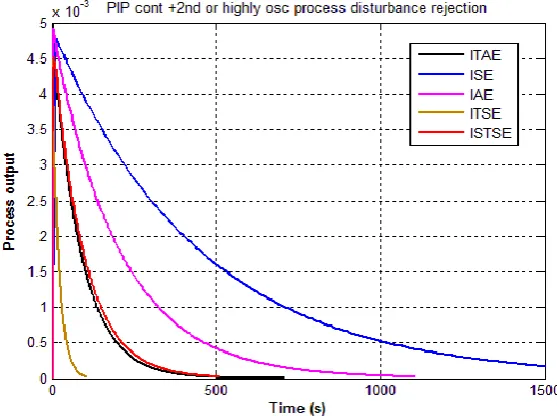
- The effect of using five different objective functions on the compensator tuning
process and the performance of the control system in response to a unit disturbance
input is shown in Fig.2.
Fig 2. Effect of objective function on system time response.
Fig.2 shows that the type of the objective function used in the PIP controller tuning has a
with the highly oscillating second-order-like process. The ITSE objective function provides
the best control system performance. Therefore, it is used in the rest of the work.
- Because of the nonlinearity of the optimization problem, local minima are expected
depending on the initial guess of the PIP controller parameters. The effect of the
controller parameter K‟ on the time response of the control system for a unit disturbance
input is shown in Fig.3.
Fig 3. Effect of controller parameter K’ on disturbance time response.
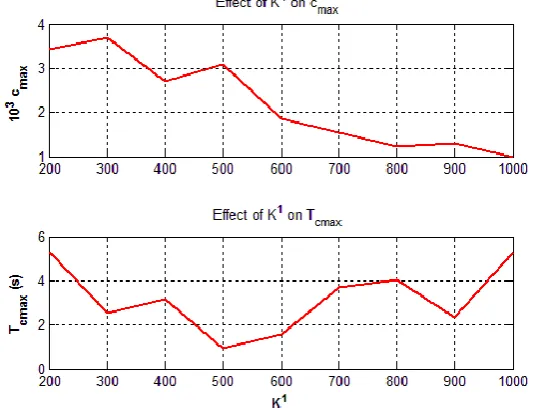
- The controller parameter affects both the maximum time response and its corresponding
time for the unit step disturbance time response. This effect is illustrated in Fig.4 for K‟ in
the range 200 ≤ K‟ ≤ 1000.
- The effect of the PIP controller parameter Ki on the control system dynamics during
disturbance rejection is shown in Fig.5 for Ki in the range 1.1 ≤ Ki ≤ 12.43.
Fig 5. Effect of controller parameter Ki on disturbance time response.
Comparison with other Controllers
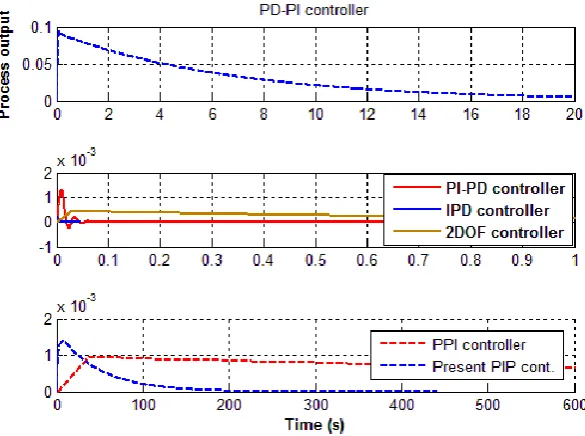
To investigate the effectiveness of using the PIP controller in disturbance rejection associated
with the highly oscillating second-order-like process, the control system performance using
the PIP controller is compared with that using PD-PI controller (Hassaan, 2015), PI-PD
controller (Hassaan 2015), IPD controller (Hassaan 2015), 2DOF controller (Hassaan 2015)
and PPI controller (Hassaan 2015). This comparison is shown in Fig.6.
CONCLUSION
- The objective of this research work was to investigate using a PIP controller for
disturbance rejection associated with highly oscillating second-order-like processes.
- The PIP controller had two parameters to be tuned.
- It was tuned using the MATLAB control and optimization toolboxes.
- Five objective functions based on the error between the disturbance time response of the
closed-loop control system and the desired steady-state value were used to tune the PIP
controller.
- The ITSE objective function has given the best results during the controller tuning
process.
- The effect of changing the controller parameters K‟ and Ki was investigated in details.
- Using a PIP controller for disturbance rejection associated with a highly oscillating
second-order process was relatively successful.
- It was possible to reduce the maximum time response due to a unit disturbance input to ≤
0.0016.
- It was possible to generate a step disturbance response with zero settling time and a very
small value.
- The PIP controller could compete with other controllers used with the same process as the
PD-PI, PI-PD and PPI controllers.
REFERENCES
1. Al-Hammouri, A., Liberatore, V., Branicky, M. and Phillips, S. “Complete stability
regions characterization for PI-AQM”, ACM SIGBED Review, 2006; 3(2): 1-6.
2. Dixon, R., Young, P. and Shau, J. “Proportional-integral-plus (PIP) control of an inverted
pendulum”, Proceedings of the IEE Conference, 1996; 427(2): 650-55.
3. Gu, J., Taylor, C. and Seward, D. “Proportional-integral-plus control of an intelligent
excavator”, Computer Aided Civil and Infrastructure Engineering, 2004; 19(1): 16-27.
4. Hassaan, G. A. “Tuning of a PIP controller for use with a highly oscillating
second-order-like process”, International Journal of Research in Information Technology, 2015; 3(7):
206-213.
5. Hassaan, G. A. “Controller tuning for disturbance rejection associated with delayed
double integrating process, Part VI: PIP controller”, International Journal of Advanced
6. Hassaan, G. A. (2015). “Disturbance rejection with highly oscillating second-order
process, Part II: PD-PI controller”, Scientific Review (under publication).
7. Hassaan, G. A. (2015). “Disturbance rejection with highly oscillating second-order
process, Part III: PI-PD controller”, Journal of Research in Science, Technology,
Engineering and Management (accepted for publication).
8. Hassaan, G. A. (2015). “Disturbance rejection with highly oscillating second-order process, Part IV: IPD controller”, International Journal of Advanced Research in
Management, Architecture, Technology and Engineering (under publication).
9. Hassaan, G. A. (2015). “Disturbance rejection with highly oscillating second-order process, Part V: 2DOF controller”, International Journal of Engineering and Advanced
Research Technology (under publication).
10. Hassaan, G. A. (2015). “Disturbance rejection with highly oscillating second-order process, Part VI: PPI controller”, International Journal of Science and Engineering (under
publication).
11. Houpis, S. and Sheldon, S. (2014). “Linear control system analysis and design with MATLAB”, CRC Press.
12. Hu, I., Zhang, W, Wang, H., He, Y.. and Xu, L. “Proportional-integral-plus
multi-frequency resonant current controller for grid-connected voltage converter under
unbalanced and distorted supply voltage conditions”, Journal of Zhejiang University
Science, 2009; 10(10): 1532-1540.
13. Liu, G., Dixon, R. and Daley, S. “Design of stable proportional-integral-plus controllers”,
International Journal of Control, 2001; 74(16): 1581-1587.
14. Nada, A. and Shaban, E. (2014). “The development of proportional-integral-plus control
using programmable gate array technology applied to Mechatronics system”, American
Journal of Research Communication, 2014; 2(4): 14-27.
15. Pravallika, S., Sekhar, J. and Reddy, D. “Optimization of speed control of induction
motor using self tuned PI plus fuzzy hybrid controller”, International Journal of Emerging
Technology and Advanced Engineering, 2015; 5(1): 258-262.
16. Quanten, S., Janssens, K., McKenna, P., Young, P. and Berckmans, D. “Measurement
and analysis of the thermal micro-climate in cars”, 9th International Conference on Indoor
Air Quality and Climate, Rotterdam, Netherlands, 2002; pp. 701-706.
Engineers, Part I, Journal of Systems and Control Engineering, November, 2007;
pp.1019-1031.
18. Venkataraman, P. (2009), “Applied optimization with MATLAB programming”, Wiley
Publishing.
BIOGRAPHY
Prof. Galal Ali Hassaan
Emeritus Professor of System Dynamics and Automatic
Control.
Has got his B.Sc. and M.Sc. from Cairo University in 1970 and 1974.
Has got his Ph.D. in 1979 from Bradford University, UK
under the supervision of Late Prof. John Parnaby.
Now with the Faculty of Engineering, Cairo University, EGYPT.
Research on Automatic Control, Mechanical Vibrations , Mechanism Synthesis and History of Mechanical Engineering.
Published more than 100 research papers in international journals and conferences.
Author of books on Experimental Systems Control, Experimental Vibrations and
Evolution of Mechanical Engineering.
Chief Justice of International Journal of Computer Techniques.
Member of the Editorial Board of a number of International Journals including the
WJERT journal.
Reviewer in some international journals.
Scholars interested in the authors publications can visit:
![Fig 1. Control system block diagram with PIP controller [Hassaan, 2015].](https://thumb-us.123doks.com/thumbv2/123dok_us/8357853.1669777/3.595.162.443.531.700/fig-control-block-diagram-pip-controller-hassaan.webp)