University of Constantine Department of Computer Science
MISC Lab, Algeria 1[email protected]
Abstract. The Binary Decision Diagram (BDD) is used to represent in symbolic manner a set of states. It is largely used in the field of formal checking. The variable ordering is a very important step in the BDD optimization process. A good order of variables will reduce considerably the size of a BDD. Unfortunately, the search for the best variables ordering has been showed NP-difficult. In this article, we propose a new iterative approach based on a hybrid Genetic Algorithm and Variable Neighborhood Search Algorithm. The obtained results are very encouraging and show the feasibility and effectiveness of the proposed hybrid approach.
Keywords: Binary decision diagram, Genetic algorithm,Variable neighborhood search,Hybrid methods
(Received December 11, 2010 / Accepted May 02, 2011)
1 Introduction
The objective of the checking application and electric circuits is to detect the errors which they contain or to show that they function well. One of the methods used in system checking is the model-checking [17]
One of the difficulties encountered in the domain of formal verification is the combinatorial explosion prob-lem. For example in the model checking, the number of states in the transition graphs can reach prohibitive level, which makes their manipulation difficult or im-possible. Consequently, compression methods are used in order to reduce the size of the state graph. The com-pression is done by using data structures in order to rep-resent in a concise manner the set of states. In this case, the operations are done so on set of states rather than on explicit states.
The representation by the Binary Decision Dia-grams BDD [6] is among the most known symbolic
no-tations. The BDD is a data structure used to represent Boolean functions. The BDD is largely used in several fields since they offer a canonical representation and an easy manipulation. However, the BDD size depends on the selected variable order. Therefore it is important to find variable order which minimizes the number of nodes in a BDD. Unfortunately, this task is not easy considering the fact that there is an exponential num-ber of possible variable ordering. Indeed, the problem of variable ordering was shown NP-hard [2]. For that, several methods were proposed to find the best BDD variable order and which can be classified in two cate-gories. The first class tries to extract the good order by inspecting the logical circuits [10], whereas, the second class is based on the dynamic optimization of a given order[11] .
It presents many interesting features such as adaptation, emergence and learning. Artificial neural networks, ge-netic algorithms and artificial immune systems are ex-amples of bio-inspired systems used to this end. One of the iterative methods that have been developed recently to solve this type of problem is Genetic Algorithms GA [16, 8]. It is a stochastic iterative algorithm which main-tains a population of individuals. GA adapts nature op-timizing principles like mechanics of natural selection and natural genetics. Each individual represents a fea-sible solution in the problem search space. Basically, a genetic algorithm consists of three essential selection, crossover, and mutation. The selection evaluates the fit-ness of each individual and keeps the best ones among them. The others are removed from the current pop-ulation. The crossover merges two individuals to pro-vide new ones. The operator of mutation allows moving each solution to one of its neighbours in order to main-tain a good diversity during the process of optimization. GA allows guided search that samples the search space. Although GAs have been showed to be appropriate for solving BDD ordering problem [9], their computational cost seems to be a dissuasive factor for their use on large instances. To overcome this drawback and in order to get better speed and quality convergence, their implicit parallelism is exploited.
Metaheuristics are a family of optimization tech-niques inspired by nature used to solve difficult opti-mization problems for which we do not know the most effective method. The heuristic search procedures are recognized as the neighboring structures (NS), which transform a solution to one of its neighbourhood by applying some perturbations. Variable neighbourhood search (VNS) [14] is a recent metaheuristic for solving combinatorial optimization problems. The main idea of VNS is to change systematically the neighbourhood by simply passing one NS to another while they exe-cute a search Local. The VNS changes the neighbour-hood structure where the search is trapped in a local minimum. VNS offers a multiple neighbourhood struc-ture with which one recovers the solutions trapped via the others. The main idea here is to choose heuris-tics (neighbourhood structures) complementary to each other [3].
In this context, we propose in this article, a new iterative approach called GAVNSBDD based on a hy-brid GA and variable neighbourhood search. For that, a problem formulation in terms of genetic representa-tion and evolurepresenta-tionary dynamic borrowing evolurepresenta-tionary operators were defined. To foster the convergence to optimality, the VNS has been embedded within the op-timization process. VNS helps the search process to
avoid local optima and explores the solution space eco-nomically and effectively without getting trapped into cycles. The experiences carried out on GAVNSBDD showed the feasibility and the effectiveness of our ap-proach.
Consequently, the remainder of the paper is orga-nized as follows: section 2 presents some basis concepts of BDD. A brief introduction to variable neighbourhood search is presented in section 3. The proposed approach is described in section 4. Section 5 illustrates some ex-perimental results. Then, we finish by giving conclu-sion and some perspective.
2 Binary Decision Diagram
A Binary Decision Diagram or BDD is data structure used for representation of Boolean functions in the form of rooted directed acyclic graph. A BDD is a rooted directed acyclic graph G = (V, E) with node set V containing two kinds of nodes, non-terminal and termi-nal nodes (Figure1). A non-termitermi-nal nodevhas as tag a variableindex(v) ∈ {x1, x2, . . . , xn}and two chil-drenlow(v),high(v)∈ V . The final nodes are called 0-final and 1-final. A BDD can be used to compute a Boolean functionf (x1, x2, . . . , xn)in the following way. Each inputa = (a1, a2, . . . , an) ∈ {0, 1}n de-fines a computation path through the BDD that starts at the root. If the path reaches a non-terminal nodevthat is labelled byxi, it follows the pathlow(v)ifai = 0, and it follows the path high(v)if ai = 1. The label of the terminal node determines the return value of the BDD on inputa. the BDD is called "ordered" if the dif-ferent variables appear in the same order on all the ways from the root (figure 1). It is important to note that for a given order of variables, the minimal binary decision graph is single. A BDD can be reduced while using the two following rules [7, 6, 4]:
• Recognize and share identical sub-trees.
• Erase nodes whose left and right child nodes are identical.
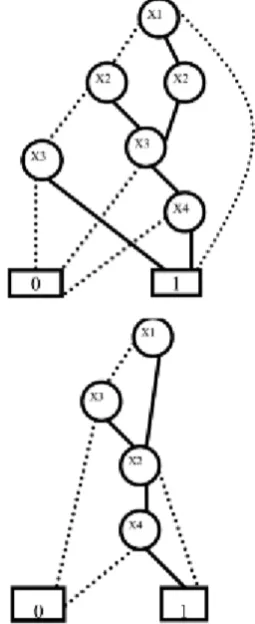
It is very important to take into account the order of variables to be used when using the BDD in practice. The size of a BDD is largely affected by the choice of the variable ordering (Figure 2).
Figure 1: Binary Decision Diagram for the Boolean functionf = x1x3 + x2x3
Figure 2: Two BDDs representation of the function(x1∨ x3) ∧ (x2⇒ x4), in the top the order of variable is:x1, x2, x3, x4; and in the bottom the order is:x1, x3, x2, x4
3 Variable neighbourhood search
A Variable Neighbourhood Search (VNS) is a recent metaheuristic based on the idea of a systematic change in the search space. Basically, a local search algo-rithm performs exploration in a limited region of in the candidate solutions space. The effectiveness of VNS compared to simple local search method is based on the systematic change of neighbourhood. A simple al-gorithm VNS starts from an initial solution from the search space, than enhances it through a two nested loop in which the core one alters and explores via two main functions so called shake and local search. Shaking step is performed by randomly selecting a solution from the first neighbourhood. This is followed by applying a lo-cal search algorithm. This procedure is repeated as long as a new incumbent solution is found [14, 3].
In order to develop a competent VNS algorithm, the structure of neighbourhood and heuristic functions used must be selected with great accuracy in order to con-struct a powerful VNS algorithm. We can use more than one neighbourhood structure for shake and local search procedures. The VNS comprises the following steps:
1. Initialization: Find an initial solution x.
2. Repeat: the following steps until the stopping condition is met:
(a) Shake Procedure: Generate at random a starting solutionx�.
(b) Local Search: Apply a local search from the starting solutionx�using the base neighbour-hood structure until a local minimum x" is found.
(c) Improve or not: Ifx�� is better thanx, do x← x�.
The integration of the VNS in the genetic algorithm can be done in two ways. This integration can replace completely the mutation operation in a simple genetic algorithm, as we can combine the two operations into a single operation of mutation. Although this method has proved effective in solving several difficult prob-lems, it remains, nonetheless difficult to adapt to the problem of BDD ordering. This is mainly due to the large number of parameters to define: initial solution, local search method, neighbourhood function, number of neighbours to explore.
3.1 Initial solution
the quality of the initial solution. In our approach, the initial solution is obtained from the genetic algorithm and passed as a parameter to the operator of VNS. So, the solutions passed to the VNS procedure are mainly dependent on the quality of the current individual pop-ulation in the genetic algorithm.
3.2 Neighbourhood function
The choice of the neighbourhood is very important in this type of local search method; it must be a compro-mise between efficiency and quality. The complexity of solving approach based on VNS depends mainly on the size of the current solution neighbourhood and the val-uation method of each of these neighbours to determine which minimizes the cost function. It has been demon-strated that almost 90% of the execution time is spent in neighbourhood’s evaluation. Therefore, it is interest-ing to use if possible neighbourhoods with constraints to reduce the runtime complexity. The best neighbour generated belonging to the first neighbourhood is se-lected and the total number of neighbourhoods to gen-erate for each iteration is well defined. The mechanism for the generating of neighbouring solutions is based on choosing a first point to move, then a second point which will be the target of movement. We selected a number of neighbourhoods equal to two, the point of movement is selected from the first neighbourhood de-fined by the VNS or we undertake a systematic change in the neighbourhood.
4 The Proposed Approach
The development of the suggested approach called GAVNSBDD is based basically on a genetic represen-tation of the research space associated with the problem and an evolutionary dynamic used to explore this space by operating on the genetic representation by using evo-lutionary operations.
4.1 The fitness function
To select the best individuals of the current population, we must first evaluate these individuals to compute their efficiency or adaptation. The fitness in our case is the number of nodes in the resulting BDD. The best indi-vidual is one who gives a minimum number of nodes; the greater the size of the BDD is minimal, the resulting solution is optimal. In order to compute the fitness of variable order, we must first construct the correspond-ing BDD and then we compute the number of nodes in the resulting BDD. The implementation of the fit-ness function must be especially optimized because it will be executed many times during the execution of
the genetic algorithm. Consequently, the algorithm con-vergence depends largely on the runtime of the fitness function.
4.2 Genetic representation of variable order The problem of variable ordering can be mathemati-cally formulated as follow
Given a set of variablesV ={x1, x2. . . , xn}, the prob-lem of BDD variables ordering can be defined by spec-ifying implicitly a pair(Ω, SC)where is the set of all possible solutions that is potentials variables order and SCis a mappingΩ−→ �called score of the variable ordering. This score is the BDD size. Each solution is viewed as permutation of the V variables. Conse-quently, the problem consists to define the best permu-tation ofV that gives the minimal BDD size. In our approach, the variable order is represented as integer vector (figure 3) satisfying the following criteria:
• ForN variable, the size of the vector isN.
• There is no repetitive variable in this vector
Figure 3: Genetic representation of the variable ordering
4.3 Initial Population
4.4 Genetic operators
Seclection: The selection is to select individuals that have the best fitness to construct the intermediate popu-lation in order to apply the evolutionary operators. Each individual is selected with a probability related to its fitness. Thus, individuals with high affinity value have more chance of being selected for the next generation. Selection strategies that we can use in genetic algo-rithms such as [8]:
• The roulette wheel selection.
• The opposite roulette wheel selection.
• The tournament selection.
• Selection by rank.
In our approach, we have used the roulette wheel se-lection. The basic motivation for adopting this fitness proportional rule is to preserve diversity of good and bad individuals in the pool, so that it can contain a large space search of potential solutions and to avoid being trapped in local minimum.
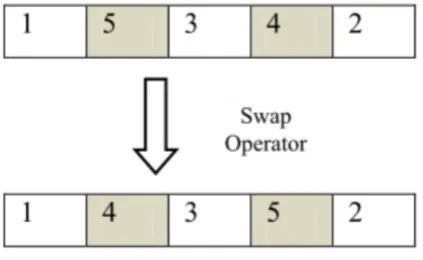
Mutation operator: this operator performs permuta-tion between two variables (figure4). It allows moving from the current solution to one of its neighbors. It con-sists first in selecting pairs of two variables are chosen randomly according to a defined probability, and then swap these two variables as in figure 4 . This operator allows exploring new solutions and thus enhances the diversification capabilities of the search process.
Figure 4: Mutation Operator
Crossover operators: Crossovers are important for promoting the exchange of high quality blocks within the population (figure 5). They exchange subparts
of two chromosomes. We have used Partial Mapped Crossover (PMC). The PMC was recommended by Goldberg and Linge[13] . It passes ordering and value information from the parent orders to the offspring or-ders. A portion of one parent’s string is mapped onto a portion of the other parent’s string and the remaining information is exchanged.
Figure 5: Cross-over Operator
4.5 Local search procedure
To improve the efficiency of the exploration process, we incorporated a local search method in evolutionary dy-namics. This form of hybridization has proved advan-tageous in the context of BDD problems. Indeed, the performances of the local search method allow deeper exploration of certain solution space identified as par-ticularly promising. On the other hand, the diversify ability of the genetic algorithm allows the periodic shift of the solution search to regions rarely visited so far. The proposed hybrid approach is based on genetic algo-rithm enhanced by the local search method called vari-able neighbourhood search.
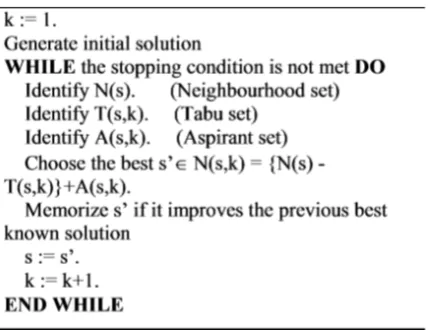
The local search method used in the VNS procedure is the Tabu Search (TS) [1, 12]. TS is among the most popular and robust local search methods. TS is found to be practical in many hard combinatorial optimization problems. The general procedure of TS is given in the figure6 . The main idea underlying is to diversify the search and avoid becoming trapped in local by forbid-ding or penalizing moves which take the solution, in the next iteration, to point in the solution space previously visited. For this, the algorithm creates a memory list of undesirable moves called "tabu list".
Our approach is flexible, so we can used other stochas-tic local search algorithms.
Figure 6: Tabu Search procedure
4.6 Outline of the proposed framework
Now, we describe how the representation scheme in-cluding genetic representation and evolutionary opera-tors has been embedded within a variable neighbour-hood search algorithm and resulted in a hybrid stochas-tic algorithm performing BDD variable ordering.
Our approach is an evolutionary algorithm based on a genetic core. The approach consists of a population of individuals where each individual represents a specific variable orders. To find the best solution, the optimiza-tion process of our algorithm consists of a set of steps. The first step is to create the initial population generated randomly. At each iteration of the algorithm, we apply the classical operators: selection, crossover, mutation, fitness evaluation, etc. To increase the performance op-timization of our approach, we have incorporated vari-able neighbourhood search (VNS) in the genetic core. In more details, the proposed approach can be described as follow:
Input:A set of variable ord
1. Construct the initial Population of Chromosomes POP
2. Evaluate the population 3. save the best solution
4. Repeat
5. Apply a crossover operation on POP according to crossover probability.
6. Apply a mutation operation on POP according to the probability pm.
7. Apply the variable neighbourhood search.
8. Evaluate the new population.
9. Update the best solution
10. Apply selection and reduce and merge operators
11. Until a termination-criterion is reached
Output:the best variable order.
5 Implementation and Evaluation
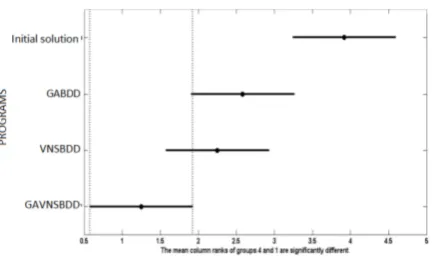
algorithm to perform the binary decision diagram or-dering problem. The Freidman test (figure7) confirms that our approach ranks high in this experiment. How-ever the performance of the pure genetic algorithm GABDD is a poor compared to GAVNSBDD or VNS-BDD. Moreover, Friedman’s test shows that the re-sults obtained by the pure VNS approach are near to those of the hybrid method GAVNSBDD, this reflects the good method that uses VNS to change systemati-cally the neighbourhood to find the optimal solution. The effectiveness of our approach is explained by the good combination between diversification and intensi-fication which leads the algorithm to effectively explore the search space and locate a good solution.
The search for the optimal solution is not performed randomly but it runs iteratively by gradually improving the solution until the stop criterion is satisfied. Figures 8 and 9 show how the algorithm converges to the op-timal solution. In the first figure (obtained by a test of two functions each of 20 variables), our method starts with an initial solution equal to 766 then it is gradually improved, sure there are mediocre solutions but it’s part of the evolution process which leads to better solutions. The algorithm then converges gradually to reach a solu-tion equal to 200 which is the optimal solusolu-tion found.
Table 1: Results: BDD functions with 20 variables
Initialsolution GA V N S GAV N S F xorG 766 491 483 190
F andG 882 360 299 206
F orG 828 282 242 219
Table 2: Results: BDD functions with 30 variables
Initialsolution GA V N S GAV N S F xorG 1846 1443 811 617 F andG 1175 750 448 244
F orG 1918 1565 695 444
Table 3: Results: BDD functions with 40 variables
Initialsolution GA V N S GAV N S F xorG 8437 3183 2713 1208
F andG 2629 2097 2000 1704
F orG 1394 883 2557 889
Table 4: Results: BDD functions with 60 variables
Initialsolution GA V N S GAV N S F xorG 34555 24787 15010 21041 F andG 21342 13898 21038 18727
F orG 22838 17394 21300 15198
Figure 7: Freidman test The nearest to zero is the best program
Figure 8: The behaviour of the best fitness ( two functions of 20 varibales)
6 Conclusion
In this work, we have proposed a new approach called GAVNSBDD to deal with the BDD variable problem. GAVNSBDD is based on a hybridizing of genetic algo-rithm and variable neighbourhood search method. The experimental studies prove the feasibility and the effec-tiveness of our approach. We have shown that the uses of variable neighbourhood search can help the genetic algorithm to find better solutions. In the future, we try to use other search local strategies more adapted to the BDD problem like sifting technique. In order to accel-erate our approach, we may apply parallelization tech-niques. Finally, the performance of the algorithm may be improved by using a clever startup solution.
References
[1] Blum, C., Roli, A., and Sampels, M. Hybrid metaheuristics (editorial). Journal of Mathemat-ical Modelling and Algorithms,Special issue on Hybrid Metaheuristics, 5(1), April 2006.
[2] Bollig, B. and Wegener, I. Improving the variable ordering of OBDDs is NPcomplete. IEEE Trans. on Comp, 45(9):993–1002, 1996.
[3] Brimberg, J., Mladenovi´c, N., Uroševi´c, D., and Ngai, E. Variable neighborhood search for the heaviest k-subgraph. Computers and Operations Research, 36(11):2885–2891, 2009.
[4] Bryant, R. E. Symbolic boolean manipulation with ordered binary decision diagrams. ACM com-puting surveys, 24(3):293–318, September 1992.
[5] Cahon, S., Melab, N., and Talbi, E.-G. Paradiseo: A framework for the reusable design of parallel and distributed metaheuristics. Journal of Heuris-tics, 10(3):357–380, May 2004.
[6] Drechsler, R. and Becker, B. Binary Decision Dia-grams: Theory and Implementation. Kluwer Aca-demic Publisher, 1998.
[7] Ebendt, R., Fey, G., and Drechlser, R. Advanced BDD optimization. Springer, 2005.
[8] Eiben, A. E. and Smith, J. E. Introduction to Evo-lutionary Computing. Springer, 2003.
[9] Forrest, S. Genetic algorithms: Principles of natural selection applied to computation science. 261:872–878, 1993.
[10] Fujii, H., Ootomo, G., and Hori, C. Interleaving based variable ordering methodes for ordered bi-nary decision diagrams. In Int’l Conf on CAD, pages 38–41, 1993.
[11] Fujita, M., Fujisawa, H., and Kawato, N. Eval-uation and improvements of boolean comparison method based on binary decision diagrams. In Intl’s conf on CAD, pages 2–5, 1988.
[12] Glover, F. Tabu search part I. ORSA Journal on Computing, 1(3):190–206, 1989.
[13] Goldberg, D. E. and Lingle, R. Alleles, loci, and the tsp. In Proceedings of the first International Conference on Genetic Algorithms, pages 154—-159, 1985.
[14] Hansen, P., Mladenovi´c, N., and Moreno-Pérez, J. A. Variable neighbourhood search: methods and applications. Annals of Operations Research, 175(1):367–407, 2010.
[15] Jørn, L.-N. http://sourceforge.net/ projects/buddy/.
[16] Layeb, A. and Saidouni, D. E. A new quantum evolutionary algorithm with sifting strategy for bi-nary decision diagram ordering problem. Interna-tional Journal of Cognitive Informatics and Natu-ral Intelligence, 4(4):47–61, December 2010.