Abstract— Medical images generally have a problem of presence of noise during its acquisition and transmission. In order to achieve appropriate diagnosis, medical image should be clear, sharp, and free of noises and artifacts. Image denoising plays an important role in image and signal processing. It is used to suppress noise level and improve the quality of an image therefore retaining its significant features. In this paper, Discrete Wavelet transform is used for image denoising as it allows multiresolution decomposition. The wavelet coefficients are threshold using hard and soft thresholding techniques. This paper proposed a novel method of medical images denoising through thresholding and optimization using Genetic Algorithm (GA). In this proposed algorithm, wavelet parameters such as threshold value and decomposition level are optimized in Bayesian method. Results obtained using this method based on genetic algorithm outperforms in comparison to other methods such as Visu shrink, Sure shrink and Bayes shrink. It gives better results in terms of visual quality and peak signal to noise ratio (PSNR)
.
Index Terms—Image denoising, Discrete wavelet transform, Bayesian shrinkage, Genetic algorithm, Peak signal to noise ratio.
I. INTRODUCTION
Image processing is an important part of signal processing in which input and output are taken as image or image parameters. An image is two dimensional function i.e. f(x, y) where x, y are spatial coordinates called as pixels and amplitude of f(x, y) at any pair of coordinates (x, y) is called the intensity or gray level of image at that point. Image is basically processed in spatial and frequency domain. Spatial domain refers to the image plane itself, it is based on the direct manipulations of the pixels in the image [2]. Frequency domain refers to an image which is processed in the form of sub bands and it is applicable to all transformations such as DWT , DFT [2]. Image denoising based on wavelet transform can analyze the image with different resolution at different frequencies. Donoho and Johnstone [3] have done a lot of research in the field of image denoising.
Medical images are corrupted by additive white Gaussian noise due to the presence of ambient noise from environment, acquisition and transmission noise from equipment and noise due to presence of some tissue , fat, other organs and breathing motion. Therefore, noise suppression is very important as noise may prevent effectiveness of medical image diagnoisis. Let g(t) be the
Manuscript received May, 2015.
Sonali Singh, Electrical Engineering department, MITS, Gwalior Gwalior, India, 9893224275.
Sulochana Wadhwani, Electrical Engineering department, MITS, Gwalior, India.
original image and f(t) be the noisy image corrupted with zero mean, white Gaussian noise h(t) is given in (1); 𝑓 𝑡 = 𝑔 𝑡 + 𝜎𝑛 (𝑡) (1) where
𝜎
𝑛 is the noise variance and h (t) is independent and identically distributed (i.i.d.) has a normal distribution N(0,1).This paper proposed a new method of removing Gaussian noise from noisy image using the wavelet transform. The wavelet coefficients are threshold in the transformed domain using the Visu shrink, Sure shrink and Bayes shrink. In this paper, Bayes shrink obtained better results as compared to Visu shrink and Sure shrink in terms of mean square error. It is required to find a optimized value of threshold in order to obtain maximum PSNR so proposed algorithm is applied on bayes shrink as an extension method. The proposed algorithm finds the corrected threshold value and the level of decomposition for the Bayesian thresholding by the use of stochastic and randomized search algorithm [] i.e., Genetic Algorithm. Experimental results show that this novel technique outperforms the known noise removal operators in terms of visual quality and peak signal to noise ratio (PSNR).
II. IMAGEDENOISING
Image denoising is a process in image processing which eliminate noise from the image, enhance the image quality and recover fine details that may be hidden in the image. The traditional way of image denoising is filtering. Image filtering is done by linear and nonlinear methods. Linear methods include weiner filter to denoise the image while non linear methods include median filter, wavelet thresholding etc. A lot of research has been done about non linear methods of image denoising [5]. These methods are based on threshold the wavelet coefficients that are affected by white Gaussian noise.
Wavelet thresholding operation is performed in following steps:
1. Apply forward 2D discrete wavelet transform. 2. Find the value of threshold.
3. Apply the calculated threshold value to the noisy wavelet coefficients.
4. Apply Hard and soft thresholding shrinkage rule. 5. Perform the inverse discrete wavelet transform to restore the image.
Consider an input image as ‗f‘ which is corrupted with Gaussian noise ‗z‘ and the expression for noisy image‘n‘ is given in (2) as:
Genetic Algorithm Based Medical Image Denoising
Through Sub Band Adaptive Thresholding.
n = f + z (2)
where z is Gaussian noise having independent and identical distribution and n is the noisy image.
The discrete wavelet transformation W is applied on the noisy image which decomposes the noisy image into different coefficients, it is given in (3) as:
N = W (n) (3)
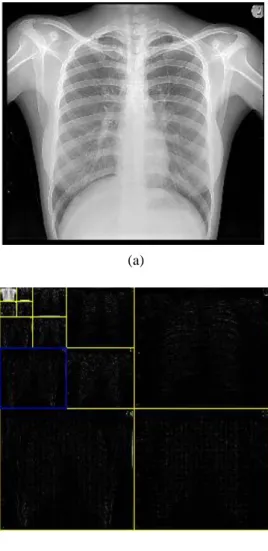
Wavelet decomposition divides the noisy image into different sub bands, labeled as 𝐿𝐿𝑘 , 𝐿𝐻𝑘, 𝐻𝐿𝑘, 𝑎𝑛𝑑 𝐻𝐻𝑘 , where k is the decomposition level as k= 1, 2… m and m is the largest level in the decomposition. 𝐿𝐿𝑘 is lowest frequency band 𝑎𝑛𝑑 𝐻𝐻𝑘 is the highest frequency band . 𝐿𝐻𝑘, 𝐻𝐿𝑘, 𝑎𝑛𝑑 𝐻𝐻𝑘 sub bands gives information about the horizontal, vertical and diagonal coefficients. The 𝐿𝐿𝑘 is further decomposed recursively into following sub bands 𝐿𝐻𝑘 _+1, 𝐻𝐿𝑘 +1, 𝐻𝐻𝑘 +1. (a) (b)
Figure 1. (a) Original X-ray image (b) Four level decomposition of the X-ray image.
On determining the value of threshold, the wavelet coefficients are applied to a shrinkage function S, it is shown in (4) as:
F = S (N) (4)
After performing the shrinkage rule denoised wavelet coefficients are inverse transformed to the original image given in (5) as:
𝑓′= 𝑊−1 (𝐹) (5)
III. THRESHOLD ESTIMATION
Donoho and Johnstone has pioneered the concept of filtering additive (i.i.d.) Gaussian noise by using wavelet coefficients thresholding. A wavelet coefficient is compared to a given threshold and coefficients value is set to zero if its magnitude is less than the threshold value otherwise it is kept or modified according to the thresholding rule. The goal is to find the exact value of threshold which minimizes the noise in the image without losing its important features. The different methods of estimating the thresholds are Visu Shrink [15], Sure Shrink [10] and Bayes Shrink [14, 16]. These methods are explained as follows :
A.VISU SHRINK
Visu Shrink is the universal threshold method proposed by Donoho and Johnstone. The threshold for Visu shrink is given in (6) :
𝑇 = 𝜎 ∗ (2 ∗ 𝑙𝑜𝑔𝑀) (6) where M is the number of pixels in the image and
𝜎
isstandard deviation of noise in image. It is known to yield an overly smoothed images due its dependence on number of pixels M.
B.SURE SHRINK
Sure shrink is the hybrid of universal threshold and the SURE threshold which is derived as minimizing Stein‘s unbiased risk estimator [10] and it performs better than visu shrink. The threshold is estimated in (7) as:
𝑇 = 𝑎𝑟𝑔𝑚 ≥0min 𝑆𝑈𝑅𝐸(𝑚, 𝑋) (7) Where SURE i.e Stein‘s unbiased risk estimator is minimized in (8) as: 𝑆𝑈𝑅𝐸 𝑚, 𝑋 = 𝑑 − 2 𝑖: 𝑎𝑏𝑠 𝑋𝑖 ≤ 𝑚 + 𝑚𝑖𝑛 𝑑 𝑖=1 (𝑎𝑏𝑠 𝑋𝑖 , 𝑚)2 (8) Where X is the coefficients of the sub band and d is the number of coefficients in the sub band.
C. BAYES SHRINK
Since the works of donoho and Johnstone , there has been research on finding the threshold for non parametric estimation in statistics. In Bayes Shrink, sub band adaptive data driven threshold is selected in which the wavelet coefficients are distributed as a Generalized Gaussian Distribution (GGD) in each sub band [6]. The threshold is given in (9) and (10) as:
𝜎𝑠𝑖𝑔𝑛𝑎𝑙 = (max(𝜎𝑌2− 𝜎𝑛𝑜𝑖𝑠𝑒2 , 0)) (10) Where 𝜎𝑌2= 1 𝑑 𝑋𝑖 2 𝑑
𝑖=1 and d is the number of wavelet coefficients of sub band 𝑌𝑖,𝑗. This methods choose signal to noise ratio in each sub band and it uses a robust estimator of noise variance as median absolute value of the wavelet coefficients [14]. The noise variance is expressed in (11) as: 𝜎𝑛𝑜𝑖𝑠𝑒 = (𝑚𝑒𝑑𝑖𝑎𝑛 (𝑎𝑏𝑠(𝑌𝑖,𝑗)))/0.6745 (11) Where 𝑌𝑖,𝑗 belongs to sub band HH and 𝑌𝑖,𝑗 carries the coefficients in sub band HH which is the refined decomposition level. This method yields better results as it minimizes the mean square error to great extent.
IV. WAVELETSHRINKAGEMETHODS The wavelet coefficients are shrinked by using Hard and Soft thresholding techniques.The threshold value is compared to all wavelet coefficients and if the value of coefficients is less than the threshold value they are assigned zero values ,otherwise they are kept unchanged or modified according to shrinkage rule.
The hard thresolding is expressed as:
𝐻𝑎𝑟𝑑 𝑤, 𝑇 = 𝑤 ∶ 𝑤 > 𝑇
0 ∶ 𝑤 ≤ 𝑇 (12)
The soft thresholding is expressed as:
𝑆𝑜𝑓𝑡 𝑤, 𝑇 = 𝑠𝑔𝑛 𝑤 ( 𝑤 − 𝑇)+ ∶ 𝑤 ≥ 𝑇 0 ∶ 𝑤 < 𝑇 (13) Soft thresholding results in over smoothing in the reconstructed image and hard thresholding causes artifacts in the reconstructed image.
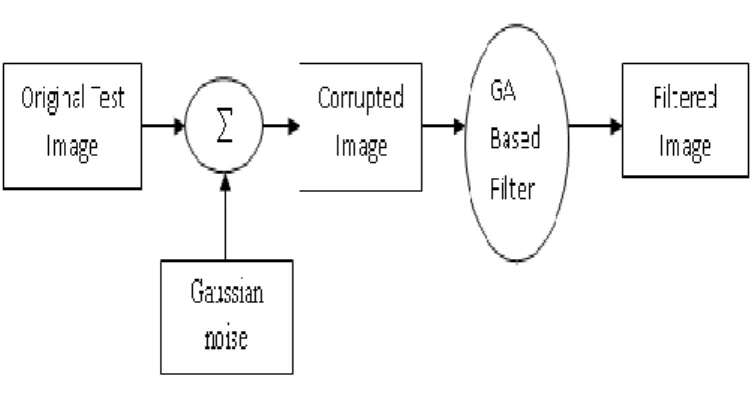
V. PROPOSEDDENOISINGALGORITHM Wavelet based denoising can be successfully implemented if its parameters such as wavelet function, decomposition level and threshold value are estimated well. These parameters can be optimized in order to get better restoration results. This problem is solved by adding a randomized search algorithm to this paper. Bayes shrink obtained excellent restoration results but a good tuning of the new optimized threshold and decomposition level outperforms the sub band adaptive thresholding technique. Genetic Algorithm, a stochastic and randomized search algorithm has been proposed in this paper to search the corrected threshold value and decomposition level which is a small correction to Bayes shrink. The block diagram of proposed algorithm is given in fig.2
Figure 2. Block diagram of proposed technique VI. GABASEDOPTIMIZATION
Genetic Algorithm is a randomized search and optimization technique which is inspired by natural genetic systems and guided by the biological evolution process. Initial population of individuals is encoded randomly and fitness of all individuals is calculated. The fittest individuals are selected for reproduction, crossover and mutation process until an appropriate solution is obtained. Here, Genetic algorithm searches for the correct value of Bayesian threshold and decomposition level by encoding the population randomly. The objective of GA based optimization is to minimize the mean square error and maximize the peak signal to noise ratio. The fitness function is given in (14).
𝑓 = 𝑃𝑆𝑁𝑅 𝑑𝑏 = 10 ∗ 𝑙𝑜𝑔10(2552/𝑀𝑆𝐸) (14) The mean square error is given in (15) .
𝑀𝑆𝐸 = 1
𝑀∗𝑁 [𝐼1 𝑚 ,𝑛− 𝐼2 𝑚 ,𝑛] 2
𝑚 ,𝑛 (15) Where m and n are the dimensions of the input images respectively. I1 and I2 are the original and filtered images respectively. The flowchart for Genetic Algorithm is shown in fig. 3. Binary tournament selection (BTS) [19] is being used for selecting the fittest individual chromosomes to make the mating pool with the same size as the population. Two chromosomes are selected randomly from the population and the best one is copied to the mating pool of the next generation until the pool is empty [12]. Tie is resolved randomly.
Crossover is a high probabilistic operation takes place between two randomly selected chromosomes each time [11].
Uniform crossover method is followed in the proposed scheme. It is iterated for n/2 size for a pool size of n. Firstly two chromosomes are selected randomly from the pool as given in [19].
After crossover every offspring undergoes mutation. It is also a probabilistic operation. Mutating a bit means just swapping 0 to 1 or 1 to 0. It is occurring for very low probability.
Figure 3. Flowchart of genetic algorithm
The GA based filtering procedure eliminates the additive white Gaussian noise effectively and reduces the mean square error .
VII. RESULTS
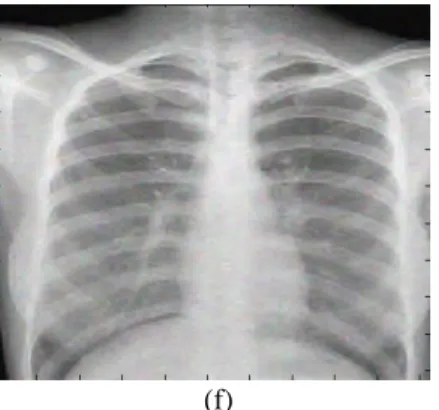
The performance of the GA based filter has been calculated quantitatively and qualitatively through MATLAB analysis. Different denoising methods like Visu shrink, Sure shrink, Bayes shrink along with GA based Bayes shrink methods are implemented. X-ray image is used for denoising purpose and compare with other methods also. A result obtained using proposed GA based optimization is compared with other filtering methods is shown in table 1. The X-ray image has been corrupted with additive white Gaussian noise with 𝜎 = 30 and proposed GA algorithm is performed on it. On comparing with different methods it is observed that proposed method performs better than the other existing denoising operators. The effect of restoration results are shown in fig.4
(a)
(b)
(c)
(d)
(f)
Figure 4. (a) Original X-ray image. (b) Noisy image. (c) Denoised image using Visu shrink. (d) Sure shrink. (e) Bayes shrink. (f) Proposed GA based denoised image.
Table 1. Comparision of PSNR value of different denoising methods with proposed algorithm .
Filter 𝜎 = 10 𝜎 = 30 𝜎 = 60 𝜎 = 90 Visu shrink 29.82 27.33 25.53 23.08 Sure shrink 31.32 27.95 25.70 23.19 Bayes shrink 33.25 28.71 26.43 23.45 Proposed Algorithm 34.51 29.80 26.52 24.01 VIII. CONCLUSION
This paper proposed a novel method to denoise medical images corrupted with Gaussian noise. In Wavelet based denoising thresholding technique is applied either to whole image or on each sub band of the image. This paper searches for a marginal correction to Bayesian threshold using Genetic Algorithm in sub band independently. Image denoising methods like Visu shrink, Sure shrink, Bayes shrink and the proposed GA based thresholding techniques have also been implemented. MATLAB results obtained using proposed denoising algorithm produces better results in terms of PSNR value and visual effect.
ACKNOWLEDGEMENT
Author expresses their gratitude towards the Electrical Engineering Department at MITS, Gwalior for their support and providing the equipment required for experimental results.
REFERENCES
[1]. I. Daubechies, ―Ten Lectures on Wavelets.
[2]. R.C.Gonzalez, R.E.Woods, S.L.Eddins, ―Digital Image Processing using MATLAB.
[3]. D.L Donoho, Johnstone I. M, ―Ideal spatial adaptation via wavelet shrinkage‖, Biometrika, 81, pp.425-455, 1994. [4]. T. Downie, B.W.Silverman, ―The discrete multiple wavelet
transform and thresholding methods‖, IEEE transactions on signal processing 46, pp.2558–2561,1998.
[5]. R. Coifman, D. Donoho, Wavelet invariant denoising in wavelets and statistics, Springer lecture notes in statics, springer, New York 103, 1998.
[6]. T.D.Bui, G.Y.Chen, ―Translation invariant denoising using multiwavelets‖, IEEE transactions on signal processing 46, pp.3414–3420,1998.
[7]. C.S.Burrus, R.A.Gopinath, H.Guo, ―Introduction to Wavelets and Wavelet Transforms‖, Prentice Hall, pp. 2-18, 1998. [8]. S. Grace chang, Bin Yu, Martin Vetterli, ‖Adaptive wavelet
thresholding for image denoising and compression‖, IEEE transactions on image processing, pp.1532- 1546, 2000 [9]. G. Chen, T. Bui, ―Multiwavelet denoising using neighbouring
coefficients‖, IEEE signal processing letters 10, pp.211–214,2003.
[10]. F. Luisier, T. Blu, and M. Unser, ―A new SURE approach to image denoising: Inter-scale orthonormal wavelet thresholding‖, IEEE Trans. Image Process., vol. 16, no. 3, pp. 593–606, Mar.1998
[11]. G. D.E., ―Genetic algorithm in search, optimization and machine learning‖, Addison-Wesley.
[12]. J. K. Mandal, S. Mukhopadhyay, ― GA based denoising of impulses (gadi) ‖, Proceedings of the International Conference on Communications in Computer and Information Science (CCIS), Springer 245 , pp.212–220, 2011.
[13]. G. Chen, T. Bui, ―Multiwavelet denoising using neighbouring coefficients‖, IEEE signal processing letters 10,pp. 211–214,2003.
[14]. H.Chipman, E. Kolaczyk, R. McCulloch, ―Adaptive bayesian wavelet shrinkage‖, J Am Stat Assoc 440 (92), 1413–1421,1997. [15]. M.Malfati, D.Roose, ―Wavelet-based image denoising using a markov random field a priori mode‖l, IEEE Transactions on image processing6 (4) , 549–565,1997
[16]. S. Chang, B. Yu, M. Vetterli,‖ Spatially adaptive wavelet thresholding based on context modeling for image denoising‖, IEEE Transactions on image processing 9 (9), 1522–1531,2000. [17]. D. Donoho, I. Johnstone,‖ Adapting to unknown smoothness via
wavelet shrinkage‖, J Am Stat Assoc, 90, 1200–1224,1995. [18]. Claudio F.M Toledo, Lucas de Oliveira, Ricardo Dutra da Silva
and Helio Pedrini,‖ Image denoising based on genetic algorithm‖,IEEE Congress on Evolutionary Computation, pp.1294-1301,2013.
[19]. S. Mukhopadhyay, J. K. Mandal, ‖Wavelet based medical image denoising using sub band adaptive thresholding techniques through genetic algorithm‖,Procedia technology 10, pp.680-689,2013.
Sonali Singh, M.tech Research Scholar in Electrical Engineering
department at MITS, Gwalior.
Sulochana Wadhwani, Associate Professor in Electrical Engineering Department at MITS, Gwalior.