Dynamic Source Routing Protocol Using Ant Colony
Optimization Mobile Ad Hoc Networks
Deepshikha Dhiman1, Praveen Sharma 2
M-Tech Student1, Assit. Prof. 2 & Department of CSE & NGF College of Engineering &Technology Palwal, Haryana, India
Abstract
Quality of Service (QoS) in Mobile Ad hoc Networks (MANETs) is a challenging task because of restricted resource and dynamic configuration. To support QoS, the link state information i.e. bandwidth, delay, cost, jitter, node energy and error rate in the network should be existed and manageable. The concentration of this paper is exploring the scope to QoS routing mechanism, to report the source about QoS existed to any destination node in the wireless network. Since, available QoS routing solutions were managed with only one or two parameters of the QoS. It is significant that MANETs should offer QoS support routing, i.e. acceptable jitter, delay and energy in the situation of real time and multimedia applications. This paper introduces a QoS Dynamic Source Routing (DSR) protocol utilizing Ant Colony Optimization (ACO) known as Ant DSR (ADSR).The DSR and ADSR performance are examined utilizing network simulator-2. ADSR generates better results as compared to the available DSR in terms of energy, delay, throughput and jitter.
Keywords: Ad Hoc Networks, Dynamic Source Routing,
Quality of Service, ACO and ADSR
I. INTRODUCTION
Mobile ad hoc network (MANET) is a set of mobile devices, which build a communication network with no pre-available infrastructure or wiring. Routing in MANETs is challenging however there is no central management, i.e. base station, or static routers as in other wireless networks that maintain routing decisions. All nodes in mobile ad-hoc network cooperate in a distributed way to form routing decisions. Several routing protocols have been formulated for MANETs. In proactive protocols, each node manages the network configuration information in the form of routing tables by periodically interchanging routing information. Routing information is normally broadcasted in the entire network. Whenever a node needs a path to a destination node, it operates a suitable path-finding algorithm on the configuration information it manages.
The Wireless Routing Protocol (WRP), Destination Sequenced Distance Vector (DSDV) routing protocol and Cluster-head Gateway Switch Routing (CGSR) protocol are some instances for the protocols that are related to this category. Protocols that come under reactive protocols category do not manage the network configuration information. They get the essential path when it is needed, by utilizing a link establishment procedure. Thus, these protocols do not interchange routing information in a periodic way. The Ad hoc On-demand Distance Vector (AODV) routing protocol, Dynamic Source Routing (DSR) protocol, Associativity Based Routing (ABR) and Temporally Ordered Routing Algorithm (TORA) are some instances for the protocols that are related to this category [1]. Quality of Service (QoS) is often described as a set of service needs that require to be satisfy by the network while propagating a packet stream from source node to destination node. With the increasing requirements of QoS provisioning for developing applications i.e. real-time audio/video, it is required to support these facilities in ad hoc networking surrounding. The network is required to confirm a set of measurable mentioned service attributes to the subscribers in terms of bandwidth, end-to-end delay, energy, possibility of packet loss, energy and delay variance (jitter). The QoS metrics can be categorized as concave metrics, additive metrics and multiplicative metrics. Energy and Bandwidth are concave metrics, while delay, cost and jitter are additive metrics. Energy and Bandwidth are concave in the manner that energy and end-to-end bandwidth are the least among all the connections along the path. The end-to-end delay is an additive restraint because it is the collection of all delays of the connections along the route. The availability or reliability of a connection depending on some criteria i.e. link break possibility is a multiplicative metric. Discovering the best path subject to two or more concave/additive metrics is a complicated issue. A possible solution to route dealing with non-additive and additive metrics is to utilize an optimization mechanism.
Ant Colony Optimization (ACO) is a collection of Swarm Intelligence. The basic concept of the ant colony optimization is considered from the food searching nature of real ants [2]. When ants are on the path to search for food, they initiate from their nest and walk toward the food. When an ant arrive an intersection, it has to choose which branch to consider next. While walking, ants deposit a pheromone, which ants are capable to smell, which marks the route considered. The focus of pheromone on a specific path is an indication of its use. With time, the focus of pheromone reduces because of diffusion impacts. This property is significant because it is combining dynamic into the path searching procedure.
The remaining paper is presented as follows. In section two, the prior work related to QoS routing protocols is briefly surveyed. In section three, improved version of DSR depending on Ant Colony Optimization (ACO) known as Ant Dynamic Source Routing (ADSR) is explained. In section four, the major simulation results are presented. In section five, the result of the work done is described.
II. RELATED WORK
QoS support in MANETs involves QoS resource reservation signaling, QoS models, QoS routing and QoS Medium Access Control (MAC) [3]. This paper talks about some key design considerations in offering QoS routing support, and shows a survey of prior work addressing the problem of route selection subject to QoS restraints.
Anuj K. Gupta et.al [1] introduces two new energy-aware routing algorithms for wireless ad hoc networks, known as Reliable Minimum Energy Routing (RMER) and Reliable Minimum Energy Cost Routing (RMECR). RMECR addresses three significant needs of ad hoc networks: reliability, energy-efficiency and increasing network lifetime. It takes the energy consumption and the left battery energy of nodes as well as quality of connections to discover energy-efficient and reliable routes that improve the network operational lifetime. RMER, on the other side, is an energy-effective routing algorithm which discovers routes reducing the total energy needed for end-to-end packet traversal. RMECR and RMER are introduced for networks in which either end-to-end or hop-by-hop retransmissions assure reliability. Simulation studies represent that RMECR is capable to detect reliable and energy-efficient routes same as RMER, while also increasing the network operational lifetime. This builds RMECR a graceful solution to increase reliability, energy-efficiency and wireless ad hoc networks lifetime. In the RMECR design, they consider minute details i.e. restricted no. of
retransmissions permitted per packet, energy consumed by processing elements of transceivers, packet sizes and the effect of acknowledgment packets. This adds to the newness of this work in comparison of the available studies.
Parma Nand1 et.al. [2] proposes a power-aware route maintenance protocol for Mobile Ad Hoc Networks (MANETs). Termed Dynamic Path Switching (DPS), the novel protocol puts an overloaded node to sleep before a route connection breaks because that node runs out of energy, and takes other proper nodes into play. When the battery charge of a node arrive a stated level, the node can send a request to change to a sleep state for sometime. The request is honored unless survival of some path rests on the propagating activity of that very node. All nodes are considered to be collaborative. The DPS protocol is completely backward compatible, as it can be enforced within available routing protocols i.e. Dynamic Source Routing (DSR). The novel protocol has been widely modeled with the demonstrated network simulator NS2. The findings show a much enhanced power awareness of the managed routing protocol with respect to the unadorned one. Power saving is specifically efficient at the time of long-lived sessions.
Shariq Haseeb et.al [3] introduced that in mobile ad hoc networks, the on demand multi-path routing protocols addresses specific issues i.e. link failures, more message overheads and node's high mobility. More message overheads are caused because of increased broadcasting. Packets are discarded by intermediary nodes because of frequent connection failures. Furthermore, the total packet delivery ratio and throughput are decreased in high mobility scenarios. For overcoming the efficient multi-path routing protocol ABMRLBCC (Ant Based Multi-path Routing for Load Balancing and CongestionControl) issues depending on Ant Colony Optimization is introduced. The best path for every ant is chosen depending upon the travel time and no. of hops. Bibhash Roy et.al [4] proposes that the complexity increases because of several features i.e. time varying QoS needs, dynamic configuration, restricted resources and energy etc. QoS routing plays a significant role for offering QoS in wireless ad hoc networks. The major challenge in this type of networks is to discover a path between the communication end points fulfilling subscriber's QoS need. Nature-inspired algorithms (swarm intelligence) i.e. ant colony optimization (ACO) algorithms have indicated to be a good mechanism for developing routing algorithms for MANETs. In this paper, a novel QoS algorithm for mobile ad hoc network has been introduced.
N. Umapathi et.al [5] explains, AntHocNet an algorithm for routing in mobile ad-hoc networks. It is a hybrid algorithm which integrates reactive and proactive behaviour to measure end to end delay, packet delivery ratio and overhead by changing the mobile nodes speed. The algorithm depends on introduced nature inspired, self organized algorithm of ANT colony optimization (ACO). The bit error rate of ANT algorithm with respect to with other algorithms (DSDV, AODV, DSR) is computed involving time delay, power consumption and packet loss.
Young-Min Kim et.al [6] introduces an ant colony optimization (ACO) based energy saving routing, called as A-ESR, for energy effective networks. The introduced A-ESR algorithm firstly re-develops the energy-consumption minimized network (EMN) problem, which is NP-complete, into a simpler one by utilizing the traffic centrality concept. After that, it solves the re-development problem by 1) letting the flow to autonomously be combined on some particular heavy-loaded connections and 2) switching off the other light-loaded connections. Simulation results present that the A-ESR algorithm can achieve better performance as compared to prior works with respect to energy efficiency. Javad Vazifehdan et.al [7] introduces some energy-aware routing algorithms for these ad hoc networks. The introduced algorithms characteristics directing the traffic load dynamically to mains-powered devices holding the hop count of chosen routes minimal. They combine these algorithms into a framework in which the path selection is developed as a bi-criteria decision making problem. Reducing the cost of energy for end-to-end packet transfer and reducing the hop count are the two criteria in this framework. Several algorithms that is introduced differ in the manner they define the energy cost for end-to-end packet traversal or the manner they solve the bi-criteria decision making issue. Some of them take the energy consumed to transmit and obtain packets, while others also assume the residual battery energy of battery enabled nodes. The introduced algorithms utilize either the weighted sum method or the lexicographic mechanism to solve the bi-criteria decision making issue. They measure the algorithms performance in fix andd mobile ad hoc networks, and in networks with and without transmission power control. Sarala.P et.al [8] utilizes the Multipath dynamic source routing protocol (MPDSR) to find multipath route under MANET nodes. The MPDSR protocol utilizes the local connection information for the route discovery mechanism. The MPDSR protocol is improved with ant colony optimization mechanism to offer multipath route information utilizing global connection information. EMPDSR
offers QoS parameters i.e. end to end reliability. Bandwidth, Network traffic and battery power parameters make an effect over the route discovery method. Cost enabled route discovery is one of the considerable routing mechanisms that enable the cost estimation with several metrics. The multipath routing protocols focus on the route discovery with end to end reliability elements. The EMPDSR protocol is combined with fuzzy cost estimations mechanisms. Network traffic, Distance, battery power metrics and bandwidth are utilized in the fuzzy cost enabled multipath dynamic source routing protocol.
III. CATEGORIES OF AD-HOC
ROUTING PROTOCOLS
Recently, the wireless networks that permit communication among mobile devices can be categorized into the following two classes:
1. Networks having a static infrastructure: an example of this type of network is a cellular phone network.
2. Networks that do not have a static infrastructure: this is a developing but highly supporting and promising kind of network communication mechanism. There are various situations where this type of network would be essential; mostly, in unplanned events i.e. wars and natural disasters, but also in a planned event. This kind of network can be explained as a network of mobile devices that is generated or destroyed as required and thus it is known as mobile ad hoc network or MANET. In wireless networks, physical connections do not available and a single packet transmission will transfer a packet to several nodes within the communication range of a transmitting node simultaneously. We cal this inherent broadcast of MANETS „local broadcast‟ to differentiate it from global broadcast
Fig 2: Categorization of ad hoc routing
Some routing protocols have been introduced for MANET. These can be classified as proactive (also called table driven) protocols, reactive (called source initiated or demand-driven) protocols or the hybrid of the proactive and reactive protocols. A classification of the high ad hoc routing protocols is depicted in Figure 2 Routing protocols in traditional wired networks normally utilize either link state or distance vector routing algorithms, both of which need periodic routing advertisements to be forwarded by every router. In distance vector routing, every router forwards to each of its neighboring routers its view of the distance to all hosts, and every router evaluates the shortest route to every host depending on the information advertised by every neighbors. In link state routing, every router instead forwards to all other routers in the network its status view of each of its adjacent network connections, and every router then evaluates the shortest distance to every host depending on the whole picture of the network built from the most recent connection information from all routers. In addition to its usage in wired networks, the fundamental distance vector algorithm has also been followed for routing in wireless ad hoc networks, necessarily treating every mobile host as a router.
IV. ANT DYNAMIC SOURCE
ROUTING (ADSR)
This paper introduces an improved version of DSR based on Ant Colony Optimization (ACO) Known as Ant Dynamic Source Routing (ADSR) an it takes into account of three QoS parameters jitter, delay and energy.
4.1 Ant Colony Optimization (ACO):
Two of the most successful swarm intelligence mechanisms are Particle Swarm Optimization (PSO) and Ant Colony Optimization (ACO). ACO is a meta-heuristic optimization algorithm that can be utilized to detect approximate solutions to complex combinatorial optimization issues. In ACO artificial ants make solutions by moving on the problem graph and they, mimicking real ants, gather artificial pheromone on the graph in such a manner that future artificial ants can make better solutions. ACO has been used successfully to an impressive no. of optimization issues. PSO is a global minimization mechanism for handling problems in which a best solution can be shown as a surface or point in an n-dimensional space. ACO is application of ant’s nature to complicated computational optimization issues. ACO is motivated by the foraging nature of ant colonies, wherein they are capable to discover shortest path between two points by collective learning. Learning is obtained by deposition of a chemical known as pheromone. ACO depends on real ant’s nature in finding a route to food nest. It has
been noted that of existed routes, ants discover shortest route to food nest. To obtain this, ant interacts through deposition of chemical substance known as pheromone along the route. Shortest path has highest focus leading to more and more ants utilizing this route.
Basic Ant Algorithm: The basic concept of the ant
colony optimization Meta heuristic is considered from the food searching nature of real ants. Fig 3 represents a scenario with two routes from the nest to the food place. At the intersection, the first ants choose the next branch randomly. However the route below is shorter in comparison of the upper one, the ants that use this path will arrive the food place first.
Figure 3: Ants take the shortest path after an initial searching time
On their path back to the nest, the ants again have to choose a path. After a short time the pheromone focus on the shorter path will be higher in comparison of on the longer path, because the ants utilizing the shorter path will increase the pheromone concentration faster. The shortest path will therefore be identified and finally all ants will only utilize this one. This nature of the ants can be utilized to discover the shortest path in networks. Particularly, the dynamic component of this technique permits a high adaptation to changes in MANET configuration, however in these networks the availability of connections are not confirmed and connection changes happen usually.
4.2 Ant Dynamic Source Routing (ADSR)
Dynamic Source Routing (DSR) protocol is an on-demand routing protocol that depend on the concept of source routing [12]. Mobile nodes are needed to manage route caches that consists the source routes of which the mobile is informed. Route cache entries are continually managed as new routes are learnt. The protocol contains two major steps: route discovery and route maintenance.
Route Request: When a mobile node wants a packet
to forward to the destination node, it first looks its route cache to find whether it previously has a route to the destination node. If it has an unexpired route to the destination node, it will utilize this route to forward the packet. On the other side, if the node does not have any previous route, it starts route discovery by flooding a route request packet. This route request consist the address of the destination node, along with the source node's address and a unique identification no. Every node obtaining the
packet examines whether it is aware of a route to the destination node. If it does not, it appends its own address to the route record of the packet and then sends the packet along its outgoing connections. To limit the no. of route requests transported on the outgoing connections of a node, a mobile node only sends the route request if the request has not yet been viewed by the mobile and if the mobile's address does not already look in the route record.
Route Reply: A route reply is produced when the
route request either arrive the destination node itself, or arrives an intermediary node which consists in its route cache an unexpired route to the destination node. By the time the packet arrives either the destination node or such an intermediary node, it consists a route record leading the sequence of hops considered. If the node producing the route response is the destination, it places the route record consisted in the route request into the route response. If the replying node is an intermediary node, it will add its cached route to the route record and then produce the route response. To return the route response, the replying node must have a route to the beginner. If it has a route to the beginner in its route cache, it may utilize that route. Else, if symmetric connections are supported, the node may reverse the route in the route record. If symmetric connections are not supported, the node may start its own route discovery process and piggyback the route response on the new route request.
Route maintenance: Route maintenance is achieved
by the usage of route error packets and acknowledgments. Route error packets are produced at a node when the data link layer finds a transmission issue. When a route error packet is obtained, the hop in error is eliminated from the node's route cache and all routes consisting the hop are truncated at that time. In summation to route error messages, acknowledgments are utilized to verify the right operation of the route connections. These acknowledgments involve passive acknowledgments, where a mobile is capable to listen the adjacent hop sending the packet along the route. In Ant DSR (ADSR), backward ant (BANT) and the Forward ant (FANT) packets are appended in the route request and route response of DSR respectively and FANT packets are utilized in this route discovery mechanism. Forward ants are utilized to explore new paths in the network. Ants evaluate the current state of network for instance by hop count, trip times or Euclidean distance traveled. Backward ants support the objective of reporting the originating node about the information gathered by the forward ant. The ant routing has two kinds of feedback: positive feedback increases the levels of pheromone on routes actively carrying ant packets and negative feedback reduces
values of pheromone periodically to restrict the impacts of stale information. Routing decisions support the paths with larger pheromone levels and, when permitted to converge, shortest end-to-end paths are empirically realized to be favored. Modified ant mechanism algorithm that utilizes delay, energy and jitter metrics to make updates of pheromone levels is introduced. Considering a control packet containing delay, energy and jitter metrics, a separate pheromone level will be managed for every metric [11]. In the algorithm, ant packet headers have fields that:
1. track the least residual energy of the nodes that relay them and
2. track the cumulative jitter and delay depending on backlog information of queued packets targeted to the packet’s source.
Hence, delay, energy and jitter pheromone levels will be managed at every node.
V. PERFORMANCE EVALUATION
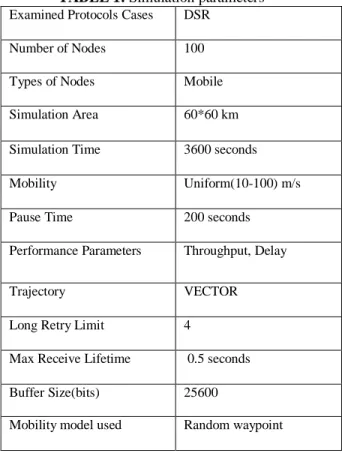
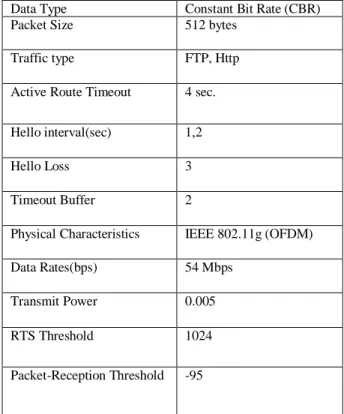
The DSR and ADSR protocol performance is measured utilizing the ns-2 simulator [13]. End-to-end delay, throughput, jitter, routing overhead and residual node energy are utilized as metrics for comparison of the performance of DSR with ADSR. Table 1 represents the simulation parameters and environments utilized.
TABLE 1: Simulation parameters
Examined Protocols Cases DSR Number of Nodes 100 Types of Nodes Mobile Simulation Area 60*60 km Simulation Time 3600 seconds
Mobility Uniform(10-100) m/s
Pause Time 200 seconds
Performance Parameters Throughput, Delay
Trajectory VECTOR
Long Retry Limit 4 Max Receive Lifetime 0.5 seconds Buffer Size(bits) 25600 Mobility model used Random waypoint
Data Type Constant Bit Rate (CBR)
Packet Size 512 bytes
Traffic type FTP, Http
Active Route Timeout 4 sec. Hello interval(sec) 1,2
Hello Loss 3
Timeout Buffer 2
Physical Characteristics IEEE 802.11g (OFDM) Data Rates(bps) 54 Mbps
Transmit Power 0.005 RTS Threshold 1024 Packet-Reception Threshold -95
5.1 End-to-end Delay
Fig 4 represents impact of pause time on end-to-end delay of the two protocols. End-to-end delay leads to increase with increasing pause time in both protocols. The end-to-end delay is decreased by employing ADSR. This is primarily because of adding of delay pheromone in the RREP and RREQ packets. The decrement in delay is highest (15 %) when the pause time arrives 300 seconds. Both protocols have similar delay for maximum pause time.
FIGURE 4: Effect of pause time on end-to-end delay 5.2 Energy
Fig 5 represents the impact of pause time on energy. The left energy of ADSR is 11% higher as compared to DSR, however the energy pheromone is appended in the route request and route response of DSR packets.
FIGURE 5: Effect Of Pause Time On Energy
5.3 Jitter
FIGURE 6: Effect of pause time on jitter
Fig 6 represents impact of pause time on jitter. The jitter is decreased in ADSR by 14 to 25%. This is because of addition of jitter pheromone in the route request and route response. ADSR provides better performance as compared to DSR in all the mobility situations.
5.4 Throughput
Fig 7 represents the impact of pause time on throughput. No. of packets obtained in the destination is computed and considered as throughput. The enhancement over DSR is high for low pause time.
FIGURE 7: Effect of pause time on throughput
0 10 20 30 40 50 60 100 200 300 400 500 DSR ADSR 4.4 4.5 4.6 4.7 4.8 4.95 5.1 5.2 5.3 100 nodes 200 nodes 300 nodes 400 nodes 500 nodes DSR ADSR 4.4 4.6 4.8 5 5.2 5.4 100 nodes 200 nodes 300 nodes 400 nodes 500 nodes DSR ADSR 4.4 4.6 4.8 5 5.2 5.4 100 nodes 200 nodes 300 nodes 400 nodes 500 nodes DSR ADSR
CONCLUSION AND FUTURE WORK
In this paper, DSR based on-demand routing algorithm ADSR is introduced to optimize three parameters of QoS jitter, delay and energy utilizing Ant Colony Optimization (ACO). This neglects the overhead of having three independent routing algorithms, one for every QoS metric. The technique was based on the backward ant (BANT) and Forward ant (FANT) packets appended in the route request and route reply. The introduced protocol chooses a least delay path with the maximum residual energy at nodes. Moreover, the choice of QoS routes should also take into account the jitter metric for keeping the maximum and minimum delay values around to the average delay. ADSR generated better results as compared to the available DSR with respect to end-to-end delay, packet delivery ratio and residual energy at node. Even though ADSR leads a slightly high routing overhead as compared to DSR, it performs well in route discovery process with dynamic modification in the network configuration and generates much better throughput with very low delay variance. Further, this can be enforced on the other hybrid and reactive routing protocols
REFERENCES
[1] Anuj K. Gupta, Harsh Sadawarti, and Anil K. Verma, “MANET Routing Protocols Based on Ant Colony Optimization”, International Journal of Modeling and Optimization, Vol. 2, No. 1, February 2012, P.P 42-49 [2] Parma Nand1, Dr. S.C. Sharma, “Performance study of Broadcast based Mobile Adhoc Routing Protocols AODV, DSR and DYMO”, International Journal of Security and Its Applications, Vol. 5 No. 1, January, 2011,P.P 53-64. [3] SHARIQ HASEEB, KHAIRUL AZAMI SIDEK, AHMAD FARIS ISMAIL, LAI W.K. &AW YIT MEI, “IIUM Engineering Journal, Vol. 5, No. 1, 2004, P.P 1-12. [4] Network Simulator, http://www.isi.edu/nsnam/ns [5] B.SOUJANYA, T.SITAMAHALAKSHMI, CH.DIVAKAR,” International Journal of Engineering Science and Technology (IJEST), Vol. 3 No. 4 April 201, ISSN: 0975-5462, P.P 2622-2631.
[6] Anuj K. Gupta, Member, IACSIT, “Performance analysis of AODV, DSR & TORA Routing Protocols”, IACSIT International Journal of Engineering and Technology, Vol.2, No.2, ISSN: 1793-8236, April 2010. [7] Shivanajay Marwaha Jadwiga Indulska Marius Portmann, “Biologically Inspired Ant-Based Routing In Mobile Ad hoc Networks (MANET): A Survey,“STUDY OF ROUTING PROTOCOLS IN MOBILE AD-HOC
NETWORKS”,The Sixth International Conference on Ubiquitous Intelligence and Computing.
[8] Md.Masud Parvez, Shohana Chowdhury, S.M.Bulbul Ahammed, A.K.M Fazlul Haque, Mohammed Nadir Bin Ali, “ Improved Comparative Analysis of Mobile Ad-hoc Network “International Journal of Emerging Technology and Advanced Engineering, ISSN 2250-2459, Volume 2, Issue 8, August 2012,P.P 205-211.
[9] Sunil Taneja and Ashwani Kush, “A Survey of Routing Protocols in Mobile Ad Hoc Networks”, International Journal of Innovation, Management and Technology, Vol. 1, No. 3, August 2010, ISSN: 2010-0248, P.P 279-285. [10] Anuj K. Gupta, Harsh Sadawarti, and Anil K. Verma, “MANET Routing Protocols Based on Ant Colony Optimization”, International Journal of Modeling and Optimization, Vol. 2, No. 1, February 2012. P.P 42-49. [11] Sharmin Sultana,”Enhanced-DSR: A New Approach to Improve Performance of DSR Algorithm”, International Journal of Computer Science and Information Technology, Volume 2, Number 2, April 2010. P.P 113-123.
[12] G. di Caro and M. Dorigo, AntNet: distributed stigmergetic control for communications network, Journal of Artificial Intelligence Research (JAIR), Vol. 9, 1998, Pag. 317-365.
[13] Md. Golam Kaosar, Ashraf S. Hasan Mahmoud, Tarek R. Sheltami, ” Performance Improvement of Dynamic Source Routing Protocol Considering the Mobility Effect of Nodes in Cache Management”, IEEE, May 2006. [14] Anil Rawat, Prakash Dattatraya Vyavahare, and Ashwani Kumar Ramani , “Enhanced DSR for MANET with Improved Secured Route Discovery and QoS”, International Journal of Network Security, Vol.5, No.2, PP.158–166, Sept. 20007.
[15] Sangeeta Biswal, Suneeta Mohanty and Dambarudhar Seth, ” Study of DSR Routing Protocol in Mobile Adhoc Network”, International Conference on Information and Network Technology, Volume 4, 2011. P.P 131-135. [16] Tarek H. Ahmed,” Simulation of Mobility and Routing in Ad Hoc Networks using Ant Colony Algorithms”, International Conference on Information Technology: Coding and Computing, March 2005.