Open Access
Research article
Evaluating the evidence for models of life course socioeconomic
factors and cardiovascular outcomes: a systematic review
Ricardo A Pollitt*, Kathryn M Rose and Jay S Kaufman
Address: Department of Epidemiology, School of Public Health, University of North Carolina at Chapel Hill, Chapel Hill, North Carolina, USA Email: Ricardo A Pollitt* - [email protected]; Kathryn M Rose - [email protected]; Jay S Kaufman - [email protected] * Corresponding author
Abstract
Background: A relatively consistent body of research supports an inverse graded relationship
between socioeconomic status (SES) and cardiovascular disease (CVD). More recently, researchers have proposed various life course SES hypotheses, which posit that the combination, accumulation, and/or interactions of different environments and experiences throughout life can affect adult risk of CVD. Different life course designs have been utilized to examine the impact of SES throughout the life course. This systematic review describes the four most common life course hypotheses, categorizes the studies that have examined the associations between life course SES and CVD according to their life course design, discusses the strengths and weaknesses of the different designs, and summarizes the studies' findings.
Methods: This research reviewed 49 observational studies in the biomedical literature that
included socioeconomic measures at a time other than adulthood as independent variables, and assessed subclinical CHD, incident CVD morbidity and/or mortality, and/or the prevalence of traditional CVD risk factors as their outcomes. Studies were categorized into four groups based upon life course design and analytic approach. The study authors' conclusions and statistical tests were considered in summarizing study results.
Results: Study results suggest that low SES throughout the life course modestly impacts CVD risk
factors and CVD risk. Specifically, studies reviewed provided moderate support for the role of low early-life SES and elevated levels of CVD risk factors and CVD morbidity and mortality, little support for a unique influence of social mobility on CVD, and consistent support for the detrimental impact of the accumulation of negative SES experiences/conditions across the life course on CVD risk.
Conclusions: While the basic life course SES study designs have various methodologic and
conceptual limitations, they provide an important approach from which to examine the influence of social factors on CVD development. Some limitations may be addressed through the analysis of study cohorts followed from childhood, the evaluation of CVD risk factors in early and middle adulthood, and the use of multiple SES measures and multiple life course analysis approaches in each life course study.
Published: 20 January 2005
BMC Public Health 2005, 5:7 doi:10.1186/1471-2458-5-7
Received: 08 July 2004 Accepted: 20 January 2005 This article is available from: http://www.biomedcentral.com/1471-2458/5/7
© 2005 Pollitt et al; licensee BioMed Central Ltd.
This is an Open Access article distributed under the terms of the Creative Commons Attribution License (http://creativecommons.org/licenses/by/2.0), which permits unrestricted use, distribution, and reproduction in any medium, provided the original work is properly cited.
Background
The adult behavioral lifestyle theory of cardiovascular dis-ease (CVD) describes an adult's lifestyle choices and levels of physiologic risk factors as the primary predictors of CVD risk [1-3]. This approach is supported by a relatively consistent literature demonstrating an inverse, graded relationship between SES and CVD [4-12]. There is also a growing literature that focuses upon the influence of SES at different points in life on adult CVD risk.
A force behind the interest in the impact of early-life con-ditions on adult health is the fetal origins (Barker) hypothesis. This hypothesis, which has been met with considerable support and criticism, posits that poor nutri-tion during fetal and early infant development ("critical periods") can increase risks for adult disease. While the dominance of the adult lifestyle model of chronic disease development may not be threatened by evidence for the fetal origins hypothesis, a reconsideration of the primary importance of adult behaviors and risk factors is underway.
A life course approach to chronic disease proposes that the combination, accumulation, and/or interaction of the social environments and biological insults experienced throughout the life course impact current and future events, environments, and health conditions and thus ultimately impact adult health [13,14]. Various interre-lated theories have been put forward, [14-23] and many study designs have been utilized to examine the impact of life course SES [13,17,19,23-30].
This review describes the major groups of conceptual life course SES models, and then categorizes and summarizes studies that examine the associations between life course SES and CVD risk. Studies are grouped by the basic life course design utilized; summaries include methodologic critiques and descriptions of certain key studies. Evidence supporting each conceptual life course model is consid-ered and future research directions are discussed.
Life course SES conceptual models
The different extant hypotheses on the influence of life course SES on CVD can be grouped into four broad con-ceptual models: the latent effects, pathway, social mobil-ity, and cumulative life course models. Most studies reviewed tested the influence of life course SES on CVD outcomes via the operation of one or more of these models.
The latent effects model
The "latent effects" life course conceptual model hypoth-esizes that adverse early life experiences increase the risk of CVD in later life, independent of intervening SES, life-style, or traditional CVD risk factors. Power & Hertzman
(1997) describe a latent effects model wherein certain early life events may have strong independent effects on adult health [14]. Kuh and Ben-Schlomo (1997) propose the related concept of biological chains of risk, wherein prenatal and early life socioeconomic factors affect bio-logic resources and directly influence adult health [13]. A recent formulation suggests the operation of biological or developmental influences during early "sensitive periods" which permanently impact the organism [28].
The pathway model
In this life course model, early life events and environ-ments influence later life experiences, opportunities, and health risk factors. Hertzman et al. (2001) propose a developmental process linking early-life psychosocial environments with adult health risk via pathway effects, wherein early experiences place an individual onto a cer-tain "life trajectory," eventually impacting adult health [28]. Similarly, Kuh et al. (1997) use the concept of "social chains of risk," whereby early events influence later life experiences, thus impacting adult disease risk [20]. Blane (1999) describes an "ongoing social process" wherein a continuity of social circumstances are linked and may create a "chain of disadvantage [31]."
While a pathway life course model is intuitively appeal-ing, its operation is difficult to test empirically. Life course studies typically collect information on participants at two or three time points, which does not permit the con-tinuous, lifelong operation of pathway effects to be observed.
The social mobility model
Social mobility theories all hypothesize that SES mobility across the life course impacts adult health, although the different proposed theories posit different health effects. Forsdahl (1978) hypothesized that deprivation in early life followed by later affluence combine to produce ele-vated CHD mortality risk, partly via elevation of adult cholesterol levels [32]. Others proposed that natural "health selection" occurs, wherein less healthy individuals tend to have downward social mobility and healthier individuals tend to be upwardly mobile [30,33]. In con-trast, the "health constraint" hypothesis contends that socially mobile individuals possess health characteristics of both the SES group they leave and the one they join, so that social mobility minimizes the health differences between SES groups [15,34].
The cumulative model
A cumulative SES life course model hypothesizes that psy-chosocial and physiological experiences and environ-ments during early and later life accumulate to influence adult disease risk. Davey-Smith et al. (2002) suggest that if factors operating at different life stages are combined,
large differences in CVD risk will be observed [35]. Kuh et al. (1997) describe an individual's biological resources accumulated over the life course as their 'health capital' [20], which describes and influences current and future health. The "accumulation of risk" model described by Ben-Schlomo and Kuh (2002) proposes that the impacts of different life course events accumulate but do not inter-act [26].
Methods
We conducted a MEDLINE search using keywords and MeSH terms related to SES, life course, early life, longitu-dinal studies, CVD and CVD risk factors. References iden-tified and books on life course research were also examined for study citations. Inclusion criteria were: (1) publication date between January 1966 and July 2003; (2) SES or related measures as independent variables; (3) out-comes of subclinical CHD, CVD morbidity and/or mortal-ity, or traditional CVD risk factors. Behavioral risk factors were limited to: adult diet, physical activity, alcohol con-sumption, and smoking. Physiological outcomes were: measures of obesity, blood pressure, intima-media thick-ness, fibrinogen, insulin resistance, dyslipidemia, and lung function. Ecologic studies, studies primarily evaluat-ing the fetal origins hypothesis, and studies only examin-ing the impact of birth weight, height, upper leg length, patterns of growth, household crowding, geographic mobility or numbers of siblings were excluded. Forty-nine studies met the inclusion criteria.
Quantitative summarization of the study findings is prob-lematic due to varied study populations, SES measures and CVD outcomes evaluated, time points evaluated, and designs utilized. Moreover, a tally approach to summariz-ing across studies based on statistical significance can be misleading due to the different strengths, weaknesses, power and biases of each study (p. 671) [36]. Summaries
therefore consist primarily of qualitative information on the types and directions of associations observed and the findings reported by authors. Although we avoid focusing on statistical significance, in most studies the authors' decision to declare a positive finding was tied to a null-hypothesis significance test using a p-value of < 0.05.
Categorization of life course studies by life course study design
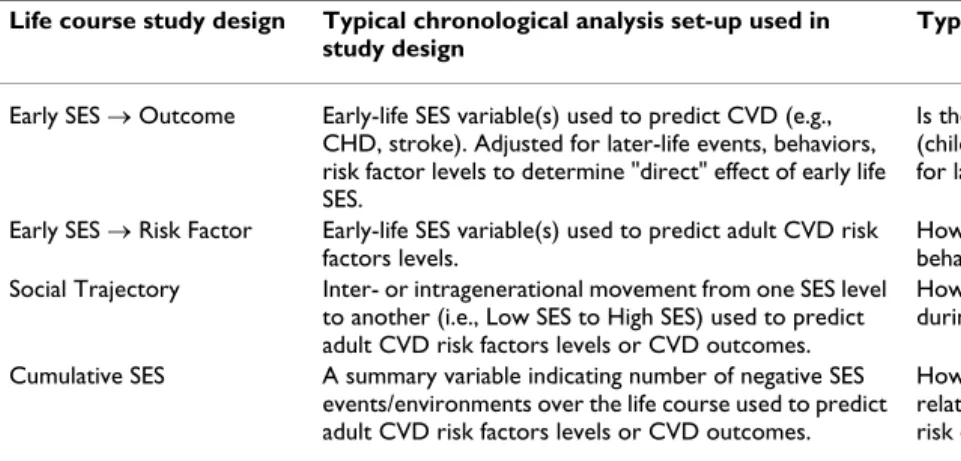
Studies were categorized by their life course study design(s) and study question(s) into four groups: early SES → outcome, early SES → risk factor, social trajectory, and cumulative SES studies. Several studies appear in mul-tiple categories, as they employed more than one of these designs. Table 1 describes the research questions and hypotheses typically considered by each design.
Results
Early SES → outcome life course studies: overview
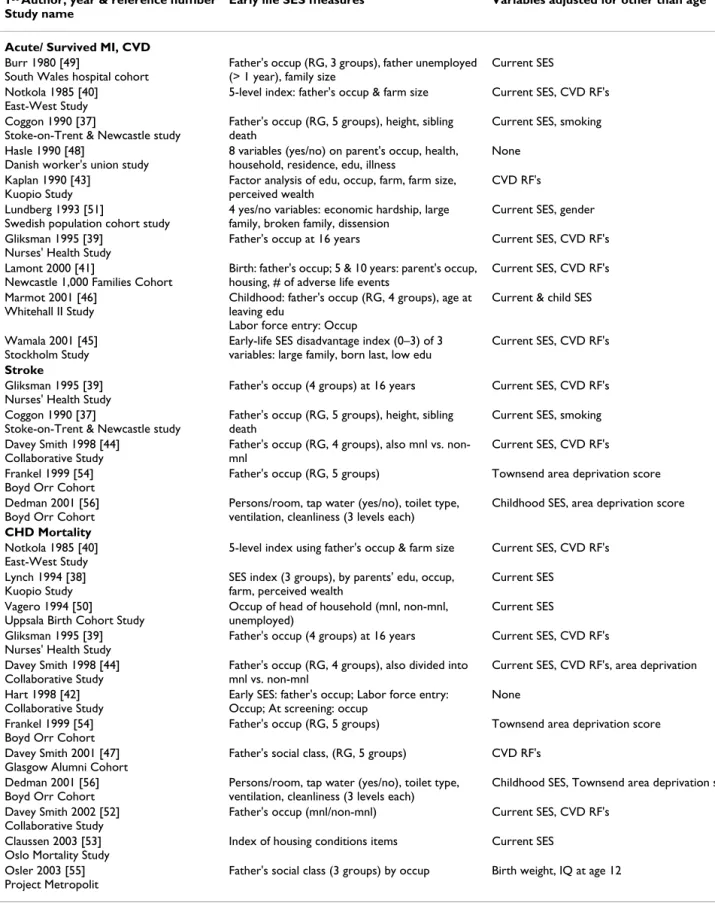
These studies examined the effect of childhood and/or adolescent SES on risk of adult CVD (e.g., incident myo-cardial infarction (MI), CVD death, incident/fatal stroke) [37-56] and typically tested the latent effects hypothesis (i.e., examining the "direct" effect of early-life SES on adult CVD risk). They commonly measured the independ-ent effect of childhood SES by statistically adjusting for later-life SES and CVD risk factors in regression models.
Early SES → outcome studies: summary of results
Table 2 lists these 20 studies according to CVD outcome utilized (see Additional file 1 for greater detail on these studies). All 19 studies conducting unadjusted or age-adjusted analyses reported a point estimate consistent with an inverse association between early-life SES and risk of one or more of the adult cardiovascular outcomes. Authors of 14 studies concluded that their findings sup-ported some or all of their study hypotheses [39,41-45], Table 1: Life course study designs: hypotheses tested and typical study questions posed
Life course study design Typical chronological analysis set-up used in
study design
Typical study question
Early SES → Outcome Early-life SES variable(s) used to predict CVD (e.g., CHD, stroke). Adjusted for later-life events, behaviors, risk factor levels to determine "direct" effect of early life SES.
Is there a significant independent effect of early-life (childhood) SES on the adult risk of CVD after adjusting for later-life SES and risk factors?
Early SES → Risk Factor Early-life SES variable(s) used to predict adult CVD risk factors levels.
How does early-life SES affect later-life levels of behavioral and physiological CVD risk factors? Social Trajectory Inter- or intragenerational movement from one SES level
to another (i.e., Low SES to High SES) used to predict adult CVD risk factors levels or CVD outcomes.
How does social mobility from one point to another during the life course affect the risk of CVD? Cumulative SES A summary variable indicating number of negative SES
events/environments over the life course used to predict adult CVD risk factors levels or CVD outcomes.
How does the accumulated number of negative SES-related exposures across the life course influence the risk of CVD?
Table 2: Summary of SES – CVD life course studies using an early SES → outcome design 1st Author, year & reference number
Study name
Early life SES measures Variables adjusted for other than age
Acute/ Survived MI, CVD
Burr 1980 [49]
South Wales hospital cohort
Father's occup (RG, 3 groups), father unemployed (> 1 year), family size
Current SES Notkola 1985 [40]
East-West Study
5-level index: father's occup & farm size Current SES, CVD RF's Coggon 1990 [37]
Stoke-on-Trent & Newcastle study
Father's occup (RG, 5 groups), height, sibling death
Current SES, smoking Hasle 1990 [48]
Danish worker's union study
8 variables (yes/no) on parent's occup, health, household, residence, edu, illness
None Kaplan 1990 [43]
Kuopio Study
Factor analysis of edu, occup, farm, farm size, perceived wealth
CVD RF's Lundberg 1993 [51]
Swedish population cohort study
4 yes/no variables: economic hardship, large family, broken family, dissension
Current SES, gender Gliksman 1995 [39]
Nurses' Health Study
Father's occup at 16 years Current SES, CVD RF's Lamont 2000 [41]
Newcastle 1,000 Families Cohort
Birth: father's occup; 5 & 10 years: parent's occup, housing, # of adverse life events
Current SES, CVD RF's Marmot 2001 [46]
Whitehall II Study
Childhood: father's occup (RG, 4 groups), age at leaving edu
Labor force entry: Occup
Current & child SES
Wamala 2001 [45] Stockholm Study
Early-life SES disadvantage index (0–3) of 3 variables: large family, born last, low edu
Current SES, CVD RF's
Stroke
Gliksman 1995 [39] Nurses' Health Study
Father's occup (4 groups) at 16 years Current SES, CVD RF's Coggon 1990 [37]
Stoke-on-Trent & Newcastle study
Father's occup (RG, 5 groups), height, sibling death
Current SES, smoking Davey Smith 1998 [44]
Collaborative Study
Father's occup (RG, 4 groups), also mnl vs. non-mnl
Current SES, CVD RF's Frankel 1999 [54]
Boyd Orr Cohort
Father's occup (RG, 5 groups) Townsend area deprivation score Dedman 2001 [56]
Boyd Orr Cohort
Persons/room, tap water (yes/no), toilet type, ventilation, cleanliness (3 levels each)
Childhood SES, area deprivation score
CHD Mortality
Notkola 1985 [40] East-West Study
5-level index using father's occup & farm size Current SES, CVD RF's Lynch 1994 [38]
Kuopio Study
SES index (3 groups), by parents' edu, occup, farm, perceived wealth
Current SES Vagero 1994 [50]
Uppsala Birth Cohort Study
Occup of head of household (mnl, non-mnl, unemployed)
Current SES Gliksman 1995 [39]
Nurses' Health Study
Father's occup (4 groups) at 16 years Current SES, CVD RF's Davey Smith 1998 [44]
Collaborative Study
Father's occup (RG, 4 groups), also divided into mnl vs. non-mnl
Current SES, CVD RF's, area deprivation Hart 1998 [42]
Collaborative Study
Early SES: father's occup; Labor force entry: Occup; At screening: occup
None Frankel 1999 [54]
Boyd Orr Cohort
Father's occup (RG, 5 groups) Townsend area deprivation score Davey Smith 2001 [47]
Glasgow Alumni Cohort
Father's social class, (RG, 5 groups) CVD RF's Dedman 2001 [56]
Boyd Orr Cohort
Persons/room, tap water (yes/no), toilet type, ventilation, cleanliness (3 levels each)
Childhood SES, Townsend area deprivation score Davey Smith 2002 [52]
Collaborative Study
Father's occup (mnl/non-mnl) Current SES, CVD RF's Claussen 2003 [53]
Oslo Mortality Study
Index of housing conditions items Current SES Osler 2003 [55]
Project Metropolit
Father's social class (3 groups) by occup Birth weight, IQ at age 12
CHD = Coronary heart disease; Edu = Education; IHD = Ischemic heart disease; MI = Myocardial infarction; Mnl = Manual occupational class; Non-mnl = Non-manual occupational class; Occup = Occupation; RF = Risk factor; RG = Registrar General's social class categories.
[49-55]. Fourteen of 16 studies adjusting for adult SES and/or CVD risk factors reported some indication of an inverse association; however, in only five did the authors suggest that their results support the hypothesis of an inverse association between early life SES and CVD. For studies with CHD and stroke outcomes limited to early-life SES (i.e., not controlling for adult SES or other risk factors) almost all included a point estimate consist-ent with an inverse association. However, in adjusted analyses, authors of only one study with a CHD-related outcome and fewer than half the studies of CVD mortality reported inverse adjusted associations. Thus, the existence of a "direct effect" of early-life SES after adjusting for adult risk factors was not strongly supported.
Early SES → outcome studies: methodologic issues
To prevent statistical confounding by adult conditions, most studies employed statistical models that adjusted the association between childhood SES and adult CVD risk for adult SES and behavioral/ physiological CVD risk tors. This may be an over-adjustment, as certain risk fac-tors (e.g., BMI, smoking) are part of the pathways through which low childhood SES may influence CVD risk. Little information is usually available on how participants' early-life SES may have influenced levels of adult CVD risk factors. Additionally, if unknown variables influence both the distribution of a CVD risk factor adjusted for and the distribution of the outcome measure, then adjustment will result in an incorrect partitioning of the total effect of early-life SES into "direct" and "indirect" components [57-59]. Thus, early SES → outcome studies which seek to determine the "direct," adjusted effect of early-life SES on CVD risk may incorrectly estimate this effect [60], leading to questions about the accuracy of such estimates. Some studies examined and qualitatively compared the effects of adjustment for different classes of CVD risk fac-tors. Gliksman et al. (1995), for example, analyzed the association between father's occupational class and adult CVD in a series of models adjusting for different classes of potential mediators or confounders. This allowed for a more complete description of the impact of adult environ-ment, behavior, and physiologic risk factors versus the latent impact of early life socioeconomic factors [39]. Studies utilizing more than one life course study design ("mixed-design studies") take a related approach and are considered in the Discussion section.
Early SES → risk factor studies: overview
Life course studies in the early SES → risk factor group evaluated the influence of early- and/or mid-life SES or living conditions on later-life behavioral or physiologic CVD risk factors [14,40,44,52,61-73]. These designs are often similar to those used in the early SES → outcome
studies group except that CVD risk factors are the out-comes. The life course hypotheses typically examined, however, include both the latent effects and pathway con-ceptual models. The typical study design involves a statis-tical model where early-life SES measures predict the levels of CVD risk factors in adulthood.
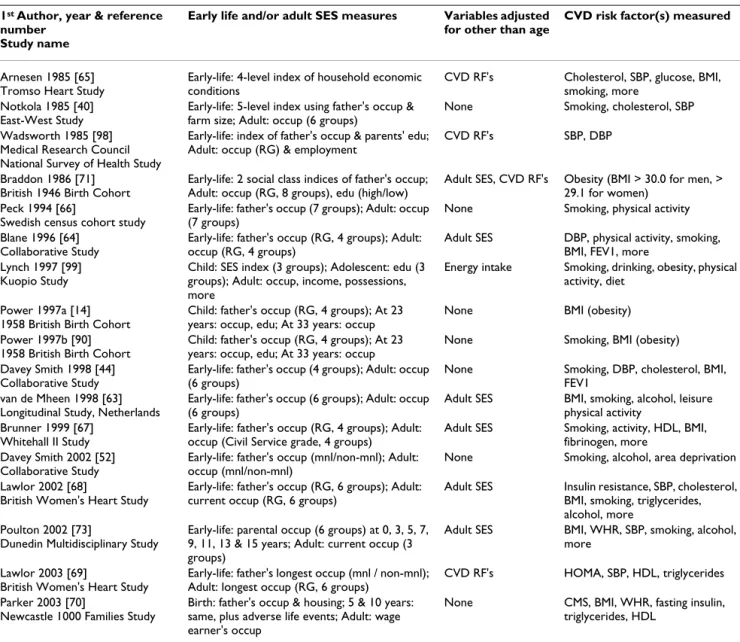
Early SES → risk factor studies: summary of results
Table 3 outlines the 17 studies reviewed (see Additional file 2 for detailed summaries). Five of six studies reported associations between low early-life SES and little or no adult leisure-time physical activity [14,61,63,64,66], five of five found associations with high adult alcohol intake [52,61,63,68,73], and eight of twelve studies reported associations with higher smoking rates as study findings [14,44,52,63,65-68]. Nine of 11 studies reported (unad-justed) associations between lower early-life SES and ele-vated BMI or WHR [14,44,63,64,67,68,70,71,73]. The impact of a statistical adjustment for other CVD risk fac-tors varied, including no impact [59], attenuation with a persistence of the significant effect [46,55], and strong attenuation with associations no longer apparent [54,78].
Early SES → risk factor studies: methodologic issues
As with the early SES → outcome studies, concerns that lack of adequate adjustment or over-adjustment may lead to biased estimates are germane to this group of studies. The issue of covariate adjustment is complex in these stud-ies, given that many CVD risk factors are considered. Cer-tain physiologic risk factors (e.g., insulin resistance, dyslipidemia) may be linked to early-life SES through latent physiologic effects of negative childhood expo-sures, continuous exposure to negative physiologic stim-uli, or other physiologic or life course pathway mechanisms [14,63,70,74]. In contrast, the links between early-life SES and levels of behavioral risk factors (e.g., smoking, diet), and certain physiologic risk factors (e.g., BMI, hypertension), may operate principally through learned behaviors, behavioral responses to negative psy-chosocial stimuli, or other psypsy-chosocial life course path-way effects. The associations may develop through the operation of multiple physiologic and psychosocial path-ways, making "correct" covariate adjustment challenging within a single model. Thus, statistical adjustment should take into account the specific life course pathways hypoth-esized to be operating [39]. Previous findings should be used to generate a priori hypotheses; nonetheless, there is considerable opportunity for inappropriate adjustments to be made.
Social trajectory studies: overview
Studies evaluating the social mobility life course model typically considered the impact of inter-generational or intra-generational social mobility on CVD and CVD risk factors [38,44,49,64,72,73,75-79]. Inter-generational
mobility was usually determined by contrasting the par-ticipant's father's occupational SES to the participants'. Intra-generational SES was typically defined as a change in occupational SES from early adulthood to later adult-hood. Six of 11 studies evaluated adult CVD risk factors as outcomes [49,64,72,73,75,77]; seven evaluated CVD mortality or CHD [38,44,75-79]. Four adjusted only for age [38,49,76,80].
Social trajectory studies: summary of results
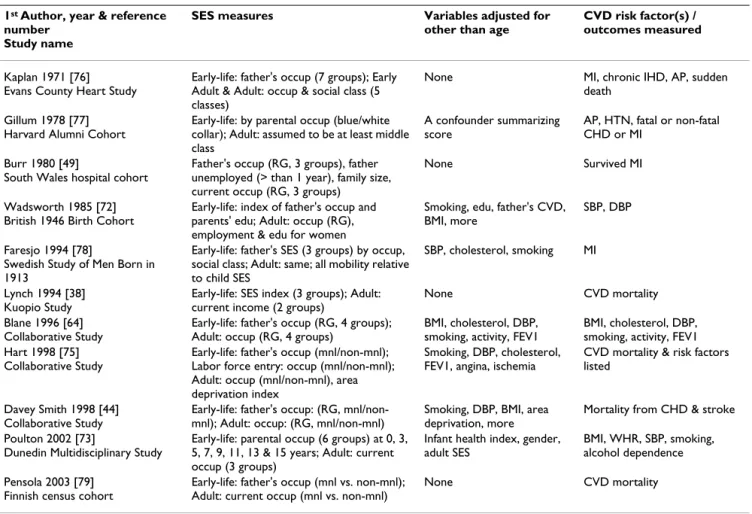
Table 4 outlines these studies (see Additional file 3 for greater detail). Of 10 studies carrying out statistical
analy-ses [38,44,49,72,73,75-79], six did not report associations between upward or downward mobility and either ele-vated levels of CVD risk factors or increased CVD morbid-ity or mortalmorbid-ity when compared to stable low-SES or high-SES trajectories [38,44,49,75,78,79]. Nine studies, how-ever, reported the suggestion of inverse, although not always statistically significant, relationships between social mobility and a CVD-related outcome [38,44,72,73,75-79]. Two studies found marked differ-ences in CVD mortality risk between upwardly mobile individuals and individuals maintaining the same SES across time. However, one study reported increased CVD Table 3: Summary of SES – CVD life course studies using an early SES → risk factor design
1st Author, year & reference
number Study name
Early life and/or adult SES measures Variables adjusted
for other than age
CVD risk factor(s) measured
Arnesen 1985 [65] Tromso Heart Study
Early-life: 4-level index of household economic conditions
CVD RF's Cholesterol, SBP, glucose, BMI, smoking, more
Notkola 1985 [40] East-West Study
Early-life: 5-level index using father's occup & farm size; Adult: occup (6 groups)
None Smoking, cholesterol, SBP Wadsworth 1985 [98]
Medical Research Council National Survey of Health Study
Early-life: index of father's occup & parents' edu; Adult: occup (RG) & employment
CVD RF's SBP, DBP
Braddon 1986 [71] British 1946 Birth Cohort
Early-life: 2 social class indices of father's occup; Adult: occup (RG, 8 groups), edu (high/low)
Adult SES, CVD RF's Obesity (BMI > 30.0 for men, > 29.1 for women)
Peck 1994 [66]
Swedish census cohort study
Early-life: father's occup (7 groups); Adult: occup (7 groups)
None Smoking, physical activity Blane 1996 [64]
Collaborative Study
Early-life: father's occup (RG, 4 groups); Adult: occup (RG, 4 groups)
Adult SES DBP, physical activity, smoking, BMI, FEV1, more
Lynch 1997 [99] Kuopio Study
Child: SES index (3 groups); Adolescent: edu (3 groups); Adult: occup, income, possessions, more
Energy intake Smoking, drinking, obesity, physical activity, diet
Power 1997a [14] 1958 British Birth Cohort
Child: father's occup (RG, 4 groups); At 23 years: occup, edu; At 33 years: occup
None BMI (obesity) Power 1997b [90]
1958 British Birth Cohort
Child: father's occup (RG, 4 groups); At 23 years: occup, edu; At 33 years: occup
None Smoking, BMI (obesity) Davey Smith 1998 [44]
Collaborative Study
Early-life: father's occup (4 groups); Adult: occup (6 groups)
None Smoking, DBP, cholesterol, BMI, FEV1
van de Mheen 1998 [63] Longitudinal Study, Netherlands
Early-life: father's occup (6 groups); Adult: occup (6 groups)
Adult SES BMI, smoking, alcohol, leisure physical activity
Brunner 1999 [67] Whitehall II Study
Early-life: father's occup (RG, 4 groups); Adult: occup (Civil Service grade, 4 groups)
Adult SES Smoking, activity, HDL, BMI, fibrinogen, more
Davey Smith 2002 [52] Collaborative Study
Early-life: father's occup (mnl/non-mnl); Adult: occup (mnl/non-mnl)
None Smoking, alcohol, area deprivation Lawlor 2002 [68]
British Women's Heart Study
Early-life: father's occup (RG, 6 groups); Adult: current occup (RG, 6 groups)
Adult SES Insulin resistance, SBP, cholesterol, BMI, smoking, triglycerides, alcohol, more
Poulton 2002 [73]
Dunedin Multidisciplinary Study
Early-life: parental occup (6 groups) at 0, 3, 5, 7, 9, 11, 13 & 15 years; Adult: current occup (3 groups)
Adult SES BMI, WHR, SBP, smoking, alcohol, more
Lawlor 2003 [69]
British Women's Heart Study
Early-life: father's longest occup (mnl / non-mnl); Adult: longest occup (RG, 6 groups)
CVD RF's HOMA, SBP, HDL, triglycerides Parker 2003 [70]
Newcastle 1000 Families Study
Birth: father's occup & housing; 5 & 10 years: same, plus adverse life events; Adult: wage earner's occup
None CMS, BMI, WHR, fasting insulin, triglycerides, HDL
BMI = Body mass index; CMS = Central metabolic syndrome; DBP = Diastolic blood pressure; Edu = Education; FEV1 = Forced expiratory volume in 1 second; HOMA = Homeostasis model assessment score; Mnl = Manual occupational class; Non-mnl = Non-manual occupational class; Occup = Occupation; RF = Risk factor; RG = Registrar General's social class categories; SBP = Systolic blood pressure; WHR = Waist-to-hip ratio.
risk among the upwardly mobile [77] and one reported decreased mortality risk [79].
Four studies examined differences in CVD risk between stable low-SES trajectory and stable high-SES trajectory individuals [38,44,75,79]. Three reported that individuals with stable low-SES trajectories had a greater CVD risk than stable high-SES trajectory individuals [44,75,79]; the fourth reported a marginally significantly greater risk [38]. These results are similar to those of most cumulative SES studies (described below) in that greater exposure to low SES was associated with increased CVD risk.
Social trajectory studies: methodologic issues
In these studies the unit of analysis is a trajectory, permit-ting the impact of change over time to be examined. How-ever, the socioeconomic trajectories in most reviewed studies were limited to two time points, and groups compared tended to share the same SES at one of these
time points. These similarities may partly explain why seven of ten studies did not report an association between social mobility and risk of CVD risk factors or events. Social trajectory studies incorporating SES at three or more time points allow for the analysis of more informa-tive trajectories than studies evaluating SES at only two points [75]. Yet, even with large studies, analysis becomes cumbersome if more than two or three SES levels at three time points are measured. Additionally, the impact of uncommon (e.g. downward) trajectories are difficult to study due to the small numbers of individuals who typi-cally comprise them.
Cumulative SES studies: overview
These studies tested the operation of the cumulative life course conceptual model, typically by summing the number of times participants experienced unfavorable SES situations during early, middle or later life, and creat-ing SES indices representcreat-ing the accumulation of these Table 4: Summary of SES – CVD life course studies using a social trajectory design
1st Author, year & reference
number Study name
SES measures Variables adjusted for
other than age
CVD risk factor(s) / outcomes measured
Kaplan 1971 [76] Evans County Heart Study
Early-life: father's occup (7 groups); Early Adult & Adult: occup & social class (5 classes)
None MI, chronic IHD, AP, sudden death
Gillum 1978 [77] Harvard Alumni Cohort
Early-life: by parental occup (blue/white collar); Adult: assumed to be at least middle class
A confounder summarizing score
AP, HTN, fatal or non-fatal CHD or MI
Burr 1980 [49]
South Wales hospital cohort
Father's occup (RG, 3 groups), father unemployed (> than 1 year), family size, current occup (RG, 3 groups)
None Survived MI
Wadsworth 1985 [72] British 1946 Birth Cohort
Early-life: index of father's occup and parents' edu; Adult: occup (RG), employment & edu for women
Smoking, edu, father's CVD, BMI, more
SBP, DBP
Faresjo 1994 [78]
Swedish Study of Men Born in 1913
Early-life: father's SES (3 groups) by occup, social class; Adult: same; all mobility relative to child SES
SBP, cholesterol, smoking MI
Lynch 1994 [38] Kuopio Study
Early-life: SES index (3 groups); Adult: current income (2 groups)
None CVD mortality Blane 1996 [64]
Collaborative Study
Early-life: father's occup (RG, 4 groups); Adult: occup (RG, 4 groups)
BMI, cholesterol, DBP, smoking, activity, FEV1
BMI, cholesterol, DBP, smoking, activity, FEV1 Hart 1998 [75]
Collaborative Study
Early-life: father's occup (mnl/non-mnl); Labor force entry: occup (mnl/non-mnl); Adult: occup (mnl/non-mnl), area deprivation index
Smoking, DBP, cholesterol, FEV1, angina, ischemia
CVD mortality & risk factors listed
Davey Smith 1998 [44] Collaborative Study
Early-life: father's occup: (RG, mnl/non-mnl); Adult: occup: (RG, mnl/non-mnl)
Smoking, DBP, BMI, area deprivation, more
Mortality from CHD & stroke Poulton 2002 [73]
Dunedin Multidisciplinary Study
Early-life: parental occup (6 groups) at 0, 3, 5, 7, 9, 11, 13 & 15 years; Adult: current occup (3 groups)
Infant health index, gender, adult SES
BMI, WHR, SBP, smoking, alcohol dependence Pensola 2003 [79]
Finnish census cohort
Early-life: father's occup (mnl vs. non-mnl); Adult: current occup (mnl vs. non-mnl)
None CVD mortality
AP = Angina pectoris; BMI = Body mass index; CHD = Coronary heart disease; DBP = Diastolic blood pressure; Edu = Education; FEV1 = Forced expiratory volume in 1 second; HTN = Hypertension; IHD = Ischemic heart disease; MI = Myocardial infarction; Mnl = Manual occupational class; Non-mnl = Non-manual occupational class; Occup = Occupation; RG = Registrar General's social class categories; SBP = Systolic blood pressure; WHR = Waist-to-hip ratio.
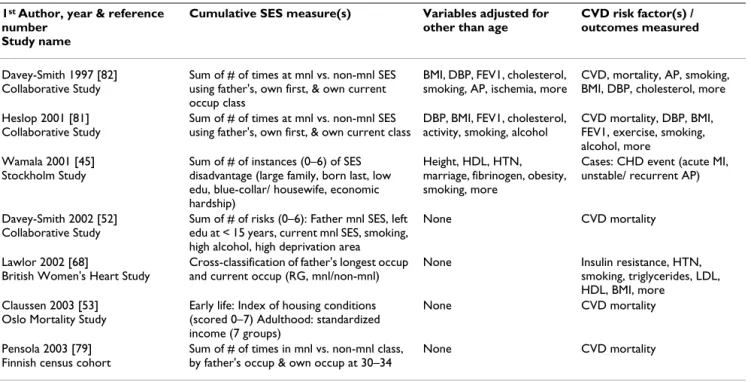
experiences [45,52,53,68,79,81,82]. For example, three of these studies summed the number of times a participant (or their parents during the participant's childhood) had been in a manual occupation to create an index of accu-mulated low-SES exposure [68,81,82]. Cumulative SES was also measured using indices of occupational class, socioeconomic categories, exposures to negative socioeco-nomic experiences/conditions, income, and housing con-ditions. [45,52,53,68,81,82].
Cumulative SES studies: summary of results
Table 5 summarizes the seven cumulative SES studies (see Additional file 4 for greater detail). All authors reported that participants' cumulative life course exposure to low SES conditions was associated with increases in CVD out-come, supporting the cumulative life course SES hypothe-sis. Several studies indicated that cumulative SES was a more powerful predictor of CVD morbidity and/or mor-tality than adult or early-life SES alone [45,53,79,81]. In studies that adjusted for CVD risk factors, graded associa-tions were attenuated but remained strong in two studies [81,82] and were greatly attenuated in another [45]. Davey-Smith et al. (2002) employed a unique cumulative SES measure, combining early and later-life occupational class experience with the CVD risk factors of smoking and heavy alcohol consumption [52]. They reported a marked,
graded relationship between the number of negative SES exposures and risk of CVD mortality.
Only a large cohort study of Norwegians reported a statis-tically significant supra-multiplicative interaction between early- and later-life SES on risk of CVD [53]. Another study reported marginally statistically significant supra-multiplicative interaction effects between early and later life [45].
Cumulative SES studies: methodologic issues
The reported associations between cumulative SES and CVD risk are more consistent than those reported in the other life course study designs. However, three of the seven studies evaluated were based on the same cohort [52,81,82]. Cumulative life course SES variables include current SES, and therefore may be conflating the effect of current SES with that of SES over the life course. For example, in Pensola et al. (2003), social mobility analyses suggested that the observed gradient in CVD mortality associated with cumulative manual occupational class was driven primarily by the impact of current occupa-tional status. Addioccupa-tionally, cumulative indices implicitly assume that a specific negative life experience or situation has the same impact regardless of when it occurs in an individual's lifetime, with no distinction made between the impact of childhood versus adult events on risk of dis-Table 5: Summary of SES – CVD life course studies using a cumulative SES design
1st Author, year & reference
number Study name
Cumulative SES measure(s) Variables adjusted for
other than age
CVD risk factor(s) / outcomes measured
Davey-Smith 1997 [82] Collaborative Study
Sum of # of times at mnl vs. non-mnl SES using father's, own first, & own current occup class
BMI, DBP, FEV1, cholesterol, smoking, AP, ischemia, more
CVD, mortality, AP, smoking, BMI, DBP, cholesterol, more Heslop 2001 [81]
Collaborative Study
Sum of # of times at mnl vs. non-mnl SES using father's, own first, & own current class
DBP, BMI, FEV1, cholesterol, activity, smoking, alcohol
CVD mortality, DBP, BMI, FEV1, exercise, smoking, alcohol, more
Wamala 2001 [45] Stockholm Study
Sum of # of instances (0–6) of SES disadvantage (large family, born last, low edu, blue-collar/ housewife, economic hardship)
Height, HDL, HTN, marriage, fibrinogen, obesity, smoking, more
Cases: CHD event (acute MI, unstable/ recurrent AP)
Davey-Smith 2002 [52] Collaborative Study
Sum of # of risks (0–6): Father mnl SES, left edu at < 15 years, current mnl SES, smoking, high alcohol, high deprivation area
None CVD mortality
Lawlor 2002 [68]
British Women's Heart Study
Cross-classification of father's longest occup and current occup (RG, mnl/non-mnl)
None Insulin resistance, HTN, smoking, triglycerides, LDL, HDL, BMI, more
Claussen 2003 [53] Oslo Mortality Study
Early life: Index of housing conditions (scored 0–7) Adulthood: standardized income (7 groups)
None CVD mortality
Pensola 2003 [79] Finnish census cohort
Sum of # of times in mnl vs. non-mnl class, by father's occup & own occup at 30–34
None CVD mortality
AP = Angina pectoris; BMI = Body mass index; CHD = Coronary heart disease; DBP = Diastolic blood pressure; Edu = Education; FEV1 = Forced expiratory volume in 1 second; HTN = Hypertension; MI = Myocardial infarction; Mnl = Manual occupational class; Non-mnl = Non-manual occupational class; Occup = Occupation; RG = Registrar General's social class categories.
ease [45]. Furthermore, some cumulative SES studies combined disparate measures into a single, lifetime index variable, or summed the number of times different nega-tive events or exposures occur [45,52]. This approach assumes that different types of exposures have an equiva-lent impact on the risk of CVD. Evidence supporting these assumptions is not provided in these studies.
Discussion
General life course SES study issues
Certain general limitations and assumptions of life course SES studies should be considered. First of all, SES is a the-oretical construct operationalized using various measures (e.g., income, occupation, education) that tap into differ-ent compondiffer-ents of this construct. Despite several pro-posed SES evaluation schemes [83-85], there is no overarching theory in the biomedical literature providing a rationale for the use of specific SES measures. Occupa-tional status, the SES measure most commonly used in the studies reviewed, is assumed to be an adequate proxy of SES, but in fact represents only one component of SES. As associations of a given SES measure with CVD risk factors are not always consistent with those of other SES measures [47,60], it is important to consider that results may depend upon the proxy SES measure employed [64,81].
Most life course studies used retrospective cohorts or a case-control design, relying on participants' recall of early life SES. There has been little systematic evaluation of the validity of recalled early life circumstances or of the poten-tial for such recall errors to bias associations. In studies directly comparing the impact of childhood and adult SES on adult CVD risk, greater error in childhood (vs. adult) SES measures may underestimate the true impact of child SES [86,87]. Additionally, selection bias due to either loss to follow-up or selective survival may distort findings. Studies using cohorts followed from birth or early life probably do not have these limitations [14,28,47,62,71,72,77,88-93] and may avoid the prob-lem of changing occupational status and workplace func-tions across time if they establish SES scales at the time of measurement and update them as appropriate. As more studies analyze data from prospective cohorts starting in early life, concerns about unequal measurement error and the changing status of specific occupations should decrease [14,54,73,89,93,94].
Most studies were limited to white males. While the number of studies including women has increased in recent years, minority groups remain underrepresented in most life course studies. These groups may interact differ-ently with the economic and/or social systems of the majority group; there are also established associations between minority status, low SES, and increased CVD risk
[5,84,85]. The lack of information on the manner in which life course SES relates to adult CVD risk in minori-ties should be addressed.
Support for life course effects on CVD risk
The majority of the early SES → outcome group studies' results describe an inverse association between early life SES and risk of adult CHD, non-fatal MI, and CVD mor-tality. Similarly most early SES → risk factor studies sug-gest that low early-life SES negatively impacts levels of adult CVD risk factors. Most studies reported relation-ships between lower early-life SES and elevated alcohol intake, BMI/WHR, and insulin resistance, as well as decreased leisure physical activity. Together, the early SES → outcome and early SES → risk factor studies support the hypothesis that low early-life SES is inversely associ-ated with adult risk of CVD. However, support for the hypothesis of a "direct effect" of early-life SES on risk of CVD mortality is equivocal as findings were less consist-ent after risk factor adjustmconsist-ent. Additionally, reported associations between early-life SES and adult health behaviors detract from the evidence supporting a latent effects life course model, as they suggest that CVD risk may be driven by learned behaviors.
The operation of social chains of risk or life trajectories described by a pathway life course model are difficult to observe or test, since almost all early SES → risk factor studies consider only two points during the life course. However, significant associations between early-life SES and the adult risk factors suggest behavioral, psychosocial or environmental links that may be best explained as a pathway effect. As described below, the pathway model will need further examination through the use of series of linked studies.
While nine of 10 social trajectory studies reported some relationship between inter- or intra-generational social mobility and CVD-related outcomes, only four were iden-tified as providing evidence in favor of a social mobility hypothesis. Conversely, most studies comparing stable low- and high-SES trajectory groups reported markedly increased CVD mortality among the low-SES group, with many socially mobile groups having a CVD risk between the stable high and low groups. Determining whether these associations are a function of social mobility, or whether they are due to exposure to low SES at some point in the life course and not to mobility, is problematic. Future studies should focus on differentiating between the influences of cumulative SES and social mobility. Of the conceptual models discussed, the cumulative life course model was the most consistently supported. How-ever, the weight of these findings is limited as much of the data came from one cohort [57,60,61]. Also, specific
methodological concerns (e.g., equal weighting of life course periods, conflation of current and life-course SES) need to be considered when interpreting these findings. Future studies conducted in other cohorts that address these concerns will help clarify the viability of cumulative life course SES hypotheses.
Directions for future research
Researchers have noted the limitations of life course SES study designs examining only one potential pathway link-ing SES and CVD. Accordlink-ingly, recent studies tend to use a combination of SES measures, CVD risk factor and/or outcomes and life course study designs [40,44,45,52,53,68]. These mixed-design studies allow for a comparison of how well different life course SES con-ceptual models fit the patterns observed in the same data. Such studies are also less likely to overlook patterns of association in the data than studies which only evaluate one possible relationship between SES and CVD.
As modern life course cohorts are followed from child-hood, longer prospective studies or series of cross-sec-tional studies that evaluate associations between early-life experiences and risk factor levels at several time points may provide the opportunity to observe the operation of pathway life course effects. For example, two studies in the early SES → risk factor group [14,90] compared levels of CVD risk factors at two points in young adulthood (22 and 33 years of age). The authors observed an association between childhood SES and adult obesity, which was smaller for participants at 33 than at 23 years of age [14], suggesting a decreasing impact of early life SES on adult health with increasing age. Such information is only obtained through longer ongoing studies or series of interrelated studies.
Individuals' socioeconomic environments may impact their CVD risk factor levels and CVD risk. Community socioeconomic conditions may influence individuals' ability to engage in leisure physical activity or eat a healthy diet [95-97]. Some life course studies have evalu-ated the community socioeconomic environment, prima-rily through the use of indicators of neighborhood deprivation [44,48,54,81,82]. Future studies should like-wise consider the effect of physical and psychosocial envi-ronmental factors.
Life course SES studies have generally failed to consider the length of exposure to the various socioeconomic con-ditions measured. As this may influence the impact of negative SES experiences on adult health, future cumula-tive life course studies may benefit from evaluating the effect of length of exposure into their indices.
Conclusions
The wide range of populations, analysis designs, expo-sures, and outcomes used in the life course studies reviewed precludes a simple, quantitative analysis of the impact of life course SES on CVD risk. Nevertheless, the results thus far modestly support the existence of life course SES effects on risk of adult CVD. The cumulative life course model is more consistently supported by extant studies than other models. However, the different meth-odologic issues of each study design make direct compar-isons of the relative support for each conceptual model difficult. Analyses utilizing multiple life course designs within the same study offer the best approach to testing which theories best describe the links between life course SES and CVD risk. The inclusion of minority participants, different SES measures, and data from early and middle adulthood in large, prospective, mixed-design studies will allow more informed and generalizable statements to be made about the impact of life course SES on adult disease risk. While this area of research needs methodologic refinement, it offers a promising and informative perspec-tive from which to understand the development of chronic disease.
Competing interests
The author(s) declare that they have no competing interests.
Authors' contributions
R. A. Pollitt conducted the literature search, reviewed and categorized the articles and had primary responsibility for writing the manuscript. K. M. Rose assisted in the catego-rization and summacatego-rization of the papers reviewed, and helped to revise the manuscript in response to the reviewer's comments. All authors participated in inter-preting the studies' results and preparing the methodo-logic criticism, provided input on the various drafts, and read and approved the final manuscript.
Additional material
Additional File 1
SES – CVD life course studies using an early SES → outcome design Click here for file
[http://www.biomedcentral.com/content/supplementary/1471-2458-5-7-S1.doc]
Additional File 2
SES – CVD life course studies using an early SES → risk factor design Click here for file
[http://www.biomedcentral.com/content/supplementary/1471-2458-5-7-S2.doc]
Acknowledgements
R. A. Pollitt was funded by National Heart, Lung, and Blood Institute (NHLBI) Training Grant 5T32-HL007055-27, and by the Life Course SES, Social Context and Cardiovascular Disease (LC-SES) study (NHLBI grant 5-RO1-HL064142-01-04).
References
1. Aronowitz RA: Making Sense of Illness: Science, Society, and
Disease. In Cambridge history of medicine Cambridge, U.K.,
Cam-bridge University Press; 1998.
2. Labarthe D: Causation and prevention of cardiovascular
dis-eases: An overview of the contributions of 20th-century epi-demiology. In Epidemiology and prevention of cardiovascular diseases :
a global challenge Gaithersburg, Md., Aspen Publishers; 1998:17-25. 3. Kuh D, Smith GD: The life course and adult chronic disease: an
historical perspective with particular reference to coronary heart disease. In A life course approach to chronic disease epidemiology
Edited by: Kuh D and Ben-Shlomo Y. Oxford, Oxford University Press; 1997:15-41.
4. Kaplan GA, Keil JE: Socioeconomic factors and cardiovascular
disease: a review of the literature. Circulation 1993, 88:1973-1998.
5. Labarthe D, Heiss G: Epidemiology and prevention of
cardio-vascular diseases : a global challenge. Gaithersburg, Md., Aspen
Publishers; 1998:xix, 681.
6. Lenfant C: Conference on Socioeconomic Status and
Cardio-vascular Health and disease. Circulation 1996, 94:2041-2044.
7. Hinkle LEJ, Whitney LH, Lehman EW, Dunn J, Benjamin B, King R, Plakun A, Flehinger B: Occupation, education, and coronary
heart disease. Risk is influenced more by education and back-ground than by occupational experiences, in the Bell System. Science 1968, 161:238-246.
8. Stamler J: Established major coronary risk factors. In Coronary Heart Disease Epidemiology: From Aetiology to Public Health Edited by: Marmot M and Elliott P. Oxford, England, Oxford University Press; 1992:35-66.
9. Marmot M, Kogevinas M, Elston MA: Social/economic status and
disease. Ann Rev Public Health 1987, 8:111-135.
10. Sorlie PD, Backlund E, Keller JB: US mortality by economic,
demographic, and social characteristics: the National Longi-tudinal Mortality Study. Am J Public Health 1995, 85:949-956.
11. Marmot MG, Smith GD, Stansfeld S, Patel C, North F, Head J, White I, Brunner E, Feeney A: Health inequalities among British civil
servants: the Whitehall II study. Lancet 1991, 337:1387-1393.
12. Martikainen P, Makela P, Koskinen S, Valkonen T: Income
differ-ences in mortality: a register-based follow-up study of three million men and women. Int J Epidemiol 2001, 30:1397-1405.
13. Kuh D, Ben-Shlomo Y: A life course approach to chronic
dis-ease epidemiology. Oxford, Oxford University Press; 1997.
14. Power C, Hertzman C: Social and biological pathways linking
early life and adult disease. Br Med Bull 1997, 53:210-221.
15. Bartley M, Plewis I: Does health-selective mobility account for
socioeconomic differences in health? Evidence from England and Wales, 1971 to 1991. J Health Soc Behav 1997, 38:376-386.
16. Doornbos G, Kromhout D: Educational level and mortality in a
32-year follow-up study of 18-year-old men in The Netherlands. Int J Epidemiol 1990, 19:374-379.
17. Elder GH: The life course paradigm: Social change and
indi-vidual development. In Examining lives in context : perspectives on the
ecology of human development 1st edition. Edited by: Moen P, Elder GH and Lüscher K. Washington, DC, American Psychological Association; 1995:xx, 708.
18. Hertzman C: The lifelong impact of childhood experiences: A
population health perspective. Daedalus 1994, 123:167-180.
19. Kuh D, Smith GD: When is mortality risk determined?
Histor-ical insights into a current debate. Soc Hist Med 1993, 6:101-123.
20. Kuh D, Power C, Blane D, Bartley M: Social pathways between
childhood and adult health. In A life course approach to chronic
dis-ease epidemiology Edited by: Kuh D and Ben-Shlomo Y. Oxford ; New York, Oxford University Press; 1997:169-198.
21. Repetti RL, Taylor SE, Seeman TE: Risky families: family social
environments and the mental and physical health of offspring. Psychol Bull 2002, 128:330-366.
22. Rutter M: Pathways from childhood to adult life. J Child Psychol Psychiatry 1989, 30:23-51.
23. Smith GD, Gunnell D, Ben-Shlomo Y: Lifecourse approaches to
socio-economic differentials in cause-specific adult mortal-ity. In Poverty, inequality and health : an international perspective Edited
by: Leon DA and Walt G. Oxford, Oxford University Press; 2001:88-124.
24. Bartley M, Blane D, Montgomery S: Health and the life course:
why safety nets matter. Bmj 1997, 314:1194-1196.
25. Beckett M: Converging health inequalities in later life--an
arti-fact of mortality selection. J Health Soc Behav 2000, 41:106-119.
26. Ben-Shlomo Y, Kuh D: A life course approach to chronic
dis-ease epidemiology: conceptual models, empirical challenges and interdisciplinary perspectives. Int J Epidemiol 2002, 31:285-293.
27. Halfon N, Hochstein M: Life course health development: an
integrated framework for developing health, policy, and research. Milbank Q 2002, 80:433-79, iii.
28. Hertzman C, Power C, Matthews S, Manor O: Using an interactive
framework of society and lifecourse to explain self-rated health in early adulthood. Soc Sci Med 2001, 53:1575-1585.
29. Stansfeld SA, Marmot MG: Stress and the heart : psychosocial
pathways to coronary heart disease. London, BMJ Books;
2002:xi, 304.
30. Stern J: Social mobility and the interpretation of social class
mortality differentials. J Soc Policy 1983, 12:27-49.
31. Blane D: The life course, the social gradient, and health. In Social Determinants of Health Edited by: Marmot M and Wilkinson RG. , Oxford University Press; 1999:65-80.
32. Forsdahl A: Living conditions in childhood and subsequent
development of risk factors for arteriosclerotic heart dis-ease. The cardiovascular survey in Finnmark 1974-75. J
Epide-miol Community Health 1978, 32:34-37.
33. West P: Rethinking the health selection explanation for
health inequalities. Soc Sci Med 1991, 32:373-384.
34. Blane D, Smith GD, Bartley M: Social selection: what does it
con-tribute to social class differences in health? Sociology of Health
and Illness 1993, 15:1-15.
35. Smith GD, Ben-Shlomo Y, Lynch J: Life course approaches to
ine-qualities in coronary heart disease risk. In Stress and the heart :
psychosocial pathways to coronary heart disease Edited by: Stansfeld SA and Marmot MG. London, BMJ Books; 2002:21-49.
36. Greenland S: Meta-Analysis. In Modern Epidemiology 2nd edition. Edited by: Rothman KJ, Greenland S and Sonis J. Philadelphia, Pa., Lippincott-Raven; 1998:xiii, 737.
37. Coggon D, Margetts B, Barker DJ, Carson PH, Mann JS, Oldroyd KG, Wickham C: Childhood risk factors for ischaemic heart
dis-ease and stroke. Paediatr Perinat Epidemiol 1990, 4:464-469.
38. Lynch JW, Kaplan GA, Cohen RD, Kauhanen J, Wilson TW, Smith NL, Salonen JT: Childhood and adult socioeconomic status as
pre-dictors of mortality in Finland. Lancet 1994, 343:524-527.
39. Gliksman MD, Kawachi I, Hunter D, Colditz GA, Manson JE, Stampfer MJ, Speizer FE, Willett WC, Hennekens CH: Childhood
socioeco-nomic status and risk of cardiovascular disease in middle aged US women: a prospective study. J Epidemiol Community
Health 1995, 49:10-15.
Additional File 3
SES – CVD life course studies using a social trajectory design Click here for file
[http://www.biomedcentral.com/content/supplementary/1471-2458-5-7-S3.doc]
Additional File 4
SES – CVD life course studies using a cumulative SES design Click here for file
[http://www.biomedcentral.com/content/supplementary/1471-2458-5-7-S4.doc]
40. Notkola V, Punsar S, Karvonen MJ, Haapakoski J: Socio-economic
conditions in childhood and mortality and morbidity caused by coronary heart disease in adulthood in rural Finland. Soc
Sci Med 1985, 21:517-523.
41. Lamont D, Parker L, White M, Unwin N, Bennett SM, Cohen M, Rich-ardson D, Dickinson HO, Adamson A, Alberti KG, Craft AW: Risk
of cardiovascular disease measured by carotid intima-media thickness at age 49-51: lifecourse study. Bmj 2000, 320:273-278.
42. Hart CL, Smith GD, Blane D: Inequalities in mortality by social
class measured at 3 stages of the lifecourse. Am J Public Health
1998, 88:471-474.
43. Kaplan GA, Salonen JT: Socioeconomic conditions in childhood
and ischaemic heart disease during middle age. Bmj 1990, 301:1121-1123.
44. Smith GD, Hart C, Blane D, Hole D: Adverse socioeconomic
con-ditions in childhood and cause specific adult mortality: pro-spective observational study. Bmj 1998, 316:1631-1635.
45. Wamala SP, Lynch J, Kaplan GA: Women's exposure to early and
later life socioeconomic disadvantage and coronary heart disease risk: the Stockholm Female Coronary Risk Study. Int
J Epidemiol 2001, 30:275-284.
46. Marmot M, Shipley M, Brunner E, Hemingway H: Relative
contribu-tion of early life and adult socioeconomic factors to adult morbidity in the Whitehall II study. J Epidemiol Community Health
2001, 55:301-307.
47. Smith GD, McCarron P, Okasha M, McEwen J: Social
circum-stances in childhood and cardiovascular disease mortality: prospective observational study of Glasgow University students. J Epidemiol Community Health 2001, 55:340-341.
48. Hasle H: Association between living conditions in childhood
and myocardial infarction. Bmj 1990, 300:512-513.
49. Burr ML, Sweetnam PM: Family size and paternal
unemploy-ment in relation to myocardial infarction. J Epidemiol Community
Health 1980, 34:93-95.
50. Vagero D, Leon D: Effect of social class in childhood and
adult-hood on adult mortality. Lancet 1994, 343:1224-1225.
51. Lundberg O: The impact of childhood living conditions on
ill-ness and mortality in adulthood. Soc Sci Med 1993, 36:1047-1052.
52. Smith GD, Hart C: Life-course socioeconomic and behavioral
influences on cardiovascular disease mortality: the collabo-rative study. Am J Public Health 2002, 92:1295-1298.
53. Claussen B, Davey Smith G, Thelle D: Impact of childhood and
adulthood socioeconomic position on cause specific mortal-ity: the Oslo Mortality Study. J Epidemiol Community Health 2003, 57:40-45.
54. Frankel S, Smith GD, Gunnell D: Childhood socioeconomic
posi-tion and adult cardiovascular mortality: the Boyd Orr Cohort. Am J Epidemiol 1999, 150:1081-1084.
55. Osler M, Andersen AMN, Due P, Lund R, Damsgaard MT, Holstein BE: Socioeconomic position in early life, birth weight,
child-hood cognitive function, and adult mortality. A longitudinal study of Danish men born in 1953. J Epidemiol Community Health
2003, 57:681-686.
56. Dedman DJ, Gunnell D, Davey Smith G, Frankel S: Childhood
hous-ing conditions and later mortality in the Boyd Orr cohort. J
Epidemiol Community Health 2001, 55:10-15.
57. Robins JM, Greenland S: Identifiability and exchangeability for
direct and indirect effects. Epidemiology 1992, 3:143-155.
58. Cole SR, Hernan MA: Fallibility in estimating direct effects. Int J Epidemiol 2002, 31:163-165.
59. Poole C, Kaufman JS: What does standard adjustment for
downstream mediators tell us about social effect pathways?
Am J Epidemiol 2000, 151:S52.
60. Robins JM: General methodological considerations. Journal of Econometrics 2003, 112:89-106.
61. Lynch JW, Kaplan GA, Salonen JT: Why do poor people behave
poorly? Variation in adult health behaviours and psychoso-cial characteristics by stages of the socioeconomic lifecourse. Soc Sci Med 1997, 44:809-819.
62. Manor O, Matthews S, Power C: Comparing measures of health
inequality. Soc Sci Med 1997, 45:761-771.
63. van de Mheen H, Stronks K, Looman CW, Mackenbach JP: Does
childhood socioeconomic status influence adult health through behavioural factors? Int J Epidemiol 1998, 27:431-437.
64. Blane D, Hart CL, Smith GD, Gillis CR, Hole DJ, Hawthorne VM:
Association of cardiovascular disease risk factors with socio-economic position during childhood and during adulthood.
Bmj 1996, 313:1434-1438.
65. Arnesen E, Forsdahl A: The Tromso heart study: coronary risk
factors and their association with living conditions during childhood. J Epidemiol Community Health 1985, 39:210-214.
66. Peck MN: The importance of childhood socio-economic
group for adult health. Soc Sci Med 1994, 39:553-562.
67. Brunner E, Shipley MJ, Blane D, Smith GD, Marmot MG: When does
cardiovascular risk start? Past and present socioeconomic circumstances and risk factors in adulthood. J Epidemiol
Com-munity Health 1999, 53:757-764.
68. Lawlor DA, Ebrahim S, Davey Smith G: Socioeconomic position in
childhood and adulthood and insulin resistance: cross sec-tional survey using data from British women's heart and health study. BMJ 2002, 325:805.
69. Lawlor DA, Davey Smith G, Ebrahim S: Life Course Influences on
Insulin Resistance: Findings from the British Women's Heart and Health Study. Diabetes Care 2003, 26:97-103.
70. Parker L, Lamont DW, Unwin N, Pearce MS, Bennett SM, Dickinson HO, White M, Mathers JC, Alberti KG, Craft AW: A lifecourse
study of risk for hyperinsulinaemia, dyslipidaemia and obes-ity (the central metabolic syndrome) at age 49-51 years.
Dia-bet Med 2003, 20:406-415.
71. Braddon FE, Rodgers B, Wadsworth ME, Davies JM: Onset of
obes-ity in a 36 year birth cohort study. Br Med J (Clin Res Ed) 1986, 293:299-303.
72. Wadsworth ME, Cripps HA, Midwinter RE, Colley JR: Blood
pres-sure in a national birth cohort at the age of 36 related to social and familial factors, smoking, and body mass. Br Med J
(Clin Res Ed) 1985, 291:1534-1538.
73. Poulton R, Caspi A, Milne BJ, Thomson WM, Taylor A, Sears MR, Moffitt TE: Association between children's experience of
soci-oeconomic disadvantage and adult health: a life-course study. Lancet 2002, 360:1640-1645.
74. Brunner E, Davey Smith G, Marmot M, Canner R, Beksinska M, O'Brien J: Childhood social circumstances and psychosocial
and behavioural factors as determinants of plasma fibrinogen. Lancet 1996, 347:1008-1013.
75. Hart CL, Smith GD, Blane D: Social mobility and 21 year
mor-tality in a cohort of Scottish men. Soc Sci Med 1998, 47:1121-1130.
76. Kaplan BH, Cassel JC, Tyroler HA, Cornoni JC, Kleinbaum DG, Hames CG: Occupational mobility and coronary heart
disease. Arch Intern Med 1971, 128:938-942.
77. Gillum RF, Paffenbarger RSJ: Chronic disease in former college
students. XVII. Sociocultural mobility as a precursor of cor-onary heart disease and hypertension. Am J Epidemiol 1978, 108:289-298.
78. Faresjo T, Svardsudd K, Tibblin G: Social mobility and health in a
prospective study of middle-aged men. Scand J Soc Med 1994, 22:86-89.
79. Pensola TH, Martikainen P: Cumulative social class and
mortal-ity from various causes of adult men. J Epidemiol Communmortal-ity
Health 2003, 57:745-751.
80. Heslop P, Smith GD, Macleod J, Hart C: The socioeconomic
posi-tion of employed women, risk factors and mortality. Soc Sci
Med 2001, 53:477-485.
81. Smith GD, Hart C, Blane D, Gillis C, Hawthorne V: Lifetime
socio-economic position and mortality: prospective observational study. Bmj 1997, 314:547-552.
82. Berkman LF, Macintyre S: The measurement of social class in
health studies: old measures and new formulations. IARC Sci
Publ 1997:51-64.
83. Krieger N, Williams DR, Moss NE: Measuring social class in US
public health research: concepts, methodologies, and guidelines. Annu Rev Public Health 1997, 18:341-378.
84. Liberatos P, Link BG, Kelsey JL: The measurement of social class
in epidemiology. Epidemiol Rev 1988, 10:87-121.
85. Phillips AN, Smith GD: Bias due to measurement imprecision. Lancet 1992, 339:1418-1419.
86. Phillips AN, Smith GD: How independent are "independent"
effects? Relative risk estimation when correlated exposures are measured imprecisely. J Clin Epidemiol 1991, 44:1223-1231.
Publish with BioMed Central and every scientist can read your work free of charge
"BioMed Central will be the most significant development for disseminating the results of biomedical researc h in our lifetime."
Sir Paul Nurse, Cancer Research UK
Your research papers will be:
available free of charge to the entire biomedical community peer reviewed and published immediately upon acceptance cited in PubMed and archived on PubMed Central yours — you keep the copyright
Submit your manuscript here:
http://www.biomedcentral.com/info/publishing_adv.asp
BioMedcentral 87. Power CMOFAJFK: Health in Childhood and Social Inequalities
in Health in Young Adults. J R Statist Soc A 1990, 153:17-28.
88. Power C: A review of child health in the 1958 birth cohort:
National Child Development Study. Paediatr Perinat Epidemiol
1992, 6:81-110.
89. Power C, Hertzman C, Matthews S, Manor O: Social differences in
health: life-cycle effects between ages 23 and 33 in the 1958 British birth cohort. Am J Public Health 1997, 87:1499-1503.
90. Power C, Matthews S, Manor O: Inequalities in self-rated health:
explanations from different stages of life. Lancet 1998, 351:1009-1014.
91. Kuh D, Hardy R, Langenberg C, Richards M, Wadsworth ME:
Mor-tality in adults aged 26-54 years related to socioeconomic conditions in childhood and adulthood: post war birth cohort study. Bmj 2002, 325:1076-1080.
92. Wadsworth ME, Kuh DJ: Childhood influences on adult health:
a review of recent work from the British 1946 national birth cohort study, the MRC National Survey of Health and Development. Paediatr Perinat Epidemiol 1997, 11:2-20.
93. Butler NR, Golding J: From birth to five : a study of the health
and behaviour of Britain's 5-year-olds. Oxford Oxfordshire ;
New York, Pergamon Press; 1986:xxxii, 439.
94. Diez Roux AV, Merkin SS, Hannan P, Jacobs DR, Kiefe CI: Area
characteristics, individual-level socioeconomic indicators, and smoking in young adults: the coronary artery disease risk development in young adults study. Am J Epidemiol 2003, 157:315-326.
95. Morland K, Wing S, Diez Roux A: The contextual effect of the
local food environment on residents' diets: the atherosclero-sis risk in communities study. Am J Public Health 2002, 92:1761-1767.
96. Diez Roux AV, Jacobs DR, Kiefe CI: Neighborhood
characteris-tics and components of the insulin resistance syndrome in young adults: the coronary artery risk development in young adults (CARDIA) study. Diabetes Care 2002, 25:1976-1982.
97. Wadsworth ME: Health inequalities in the life course
perspective. Soc Sci Med 1997, 44:859-869.
98. Lynch J, Kaplan GA, Salonen R, Salonen JT: Socioeconomic status
and progression of carotid atherosclerosis. Prospective evi-dence from the Kuopio Ischemic Heart Disease Risk Factor Study. Arterioscler Thromb Vasc Biol 1997, 17:513-519.
Pre-publication history
The pre-publication history for this paper can be accessed here: