Protocol for vegetation management near powerlines – Draft for consultation 1 | P a g e
Protocol for vegetation management
near powerlines - DRAFT
An agreement for consultation between SA Power Networks and Local
Government, landholders and the community
January 2015
Table of Contents
Foreword ... 4 Glossary ... 5 Overview ... 7 1. Introduction ... 8 1.1 Purpose ... 81.2 Vision and long-term objective ... 9
1.3 Key Stakeholders ... 9
2 Background ... 13
2.1 Legislative requirements ... 13
2.2 Australian Standard AS4373 – Pruning of Amenity Trees ... 14
2.3 Typical clearance requirements ... 14
3. Consultation, notification, communication and decision making ... 18
3.1 Notification ... 18
3.2 Community Information and Education ... 20
3.3 Community and stakeholder engagement ... 21
3.4 Decision making ... 21
3.5 Opportunities to improve how we engage with our customers ... 22
4 Agreements with Councils, community, landholders and other land managers ... 24
4.1 Interface between Council and SA Power Networks tree pruning and programs ... 24
4.2 Responsibilities/ allocation of costs ... 25
4.3 Opportunities for partnerships with Councils ... 25
5 Pruning and vegetation clearance ... 28
5.1 SA Power Networks vegetation clearance program ... 28
5.2 Scoping ... 28
5.3 Pruning techniques ... 29
5.4 Pruning cycles ... 33
5.5 Species and specimen specific guidelines ... 33
5.6 Timing and Scheduling ... 33
5.7 Site management ... 34
Protocol for vegetation management near powerlines – Draft for consultation 3 | P a g e
6 Alternatives to vegetation pruning ... 36
6.1 Vegetation management initiatives ... 36
6.2 Relocating electricity assets ... 38
7 Environmental Management ... 40
7.1 Biosecurity – Pest Plants and Plant and Animal Disease Management ... 41
7.2 Significant and Regulated Trees ... 41
7.3 Sensitive and Protected Areas ... 41
7.4 Cultural and European Heritage Sites ... 42
7.5 Fauna Management ... 42
7.6 Soil Erosion and Sediment Control ... 42
7.7 Waste Management... 43
7.8 Noise Mitigation ... 43
8 Monitoring and Review ... 44
8.1 Independent monitoring and arbitration ... 44
8.2 Contractor management ... 44
8.3 Record keeping and practice... 45
8.4 Auditing ... 45
8.5 Research/ trials ... 45
8.6 Protocol review and update ... 46
9 Key actions and implementation ... 47
Providing feedback ... 50
Appendices ... 52
Appendix A – Fact Sheets ... 52
Appendix B – IAP2 Public Participation Spectrum ... 53
Foreword
Vegetation and trees form a fundamental part of our urban and rural landscape and provide a wide range of aesthetic and environmental value and benefits on both private and public land.
However, there are risks associated with trees in relation to their proximity to powerlines. SA Power Networks is required to undertake vegetation clearance to ensure community safety and ensure the delivery of a reliable electricity supply to customers.
Managing vegetation under powerlines is a complex issue particularly as community expectations have changed over time, from a risk-based focus particularly on minimising fire starts and
maintaining reliability, to one that wishes to balance managing those risks with ensuring the health and appearance of trees so we can enjoy the benefits of trees in our urban and regional
communities.
Following considerable community discussion and consultation, SA Power Networks is proposing a move from the current vegetation trimming approach, towards a longer term vegetation
management approach that is more sustainable and customised to different regions and
environments. SA Power Networks is keen to work with key stakeholders to develop partnerships and improve how vegetation near powerlines is managed.
In November 2013 a Working Group with the Local Government Association (LGA) and a number of representative councils was established to develop a long-term strategy to improve vegetation management and an Independent Reference Group was established in January 2014 to provide ongoing advice and input into key strategic initiatives. The development of a protocol outlining our approach for vegetation management and opportunities for partnerships with Councils and other stakeholders was identified as a priority initiative by both groups.
This protocol outlines the current approach for vegetation management that applies to the bushfire and non-bushfire risk areas. It outlines the baseline programs for vegetation management for which funding is provided or funding has been sought. If an individual Council require specific approaches that are above the baseline SA Power Networks programs, Councils will need to contribute funding for their specific programs/ approaches. Furthermore under current legislation, Councils have the option to take over trimming in their Council area (with the associated liability).
This protocol outlines the initiatives and strategies that SA Power Networks propose to undertake to manage trees and vegetation near powerlines which recognise the value and amenity of trees, whilst managing risk.
The final shape of the outcomes and directions for vegetation management are dependent on endorsement from the Australian Energy Regulator to our specific plans outlined in our Regulatory Proposal for the 2015-2020 period.
Protocol for vegetation management near powerlines – Draft for consultation 5 | P a g e
Glossary
Aerial Bundled Cables (ABC)
The bundling together of a number of individual conductors for use in an overhead scenario. ABC can be used to reduce vegetation clearance requirements.
Buffer Zone The additional area around a clearance zone in bushfire risk areas. It defines the maximum extent to which the vegetation may be trimmed. Bushfire risk areas An area where a fire could start and readily escape to an unrestricted
area of flammable material causing Moderate Consequences. The relevant parts of the state are shown in the maps in Schedule 4 of the
Electricity (Principles of Vegetation Clearance) Regulations 2011. Clearance Zone The minimum safe distance between vegetation and powerlines. The
space is shown in Schedule 1 of the Regulations to the Act.
Conductor Cable or wire used to conduct electricity – it may be bare, partially insulated or fully insulated. In SA Power Networks, the term ‘conductor’ usually applies to an overhead wire only. Underground conductors are termed ‘Cables’.
Cyclic program The programmed cutting repeated at no longer than 3 year intervals, whereby all vegetation identified for clearance is to be cut back far enough from the clearance zone to ensure that no vegetation grows or is likely to bend into that zone before the next programmed cycle cutting.
Emergency cutting Vegetation clearance work undertaken without notice or programming caused by unforeseen circumstances such as damage to trees or powerlines by storms, or falling limbs resulting from heat stress. Fire Danger Season (FDS) CFS declared start and end dates of the Fire Danger Season for each of
the CFS Fire Ban districts.
High voltage (HV) Voltage of 1,000 volts (1 kV) or more
Landholder The property owner or occupier of land subject to clearance requirements
Low voltage (LV) Voltage less than 1,000 volts
Native vegetation Any naturally occurring plant species which are indigenous to South Australia, including trees, shrubs and grasses.
Naturally occurring vegetation
Any vegetation that has not been planted or nurtured by any person at any time. Although this definition is intended to cover native
vegetation of a locality it also includes anything self grown, such as pine and ash, as well as suckers from plants such as poplars and elm.
Non-bushfire risk areas Areas defined as non-bushfire risk areas in the Electricity (Principles of Vegetation Clearance) Regulations 1996, Schedule 3.
OTR The Government of South Australia Office of the Technical Regulator – government agency responsible for administering the Electricity Act 1996 and its Regulations, the Electricity (Principles of Vegetation Clearance) Regulations 2010
Prescribed area Each non bushfire risk area of the greater metropolitan area as shown in the maps in Schedule 3 of the Regulations.
Pruning The practice of removing parts of a tree, such as branches or buds. In relation to powerlines pruning refers to the removal of parts of as tree to maintain legislated clearances.
Pruning cycle The frequency of the pruning cycle – currently annual ion bushfire risk areas and three year cyclic in non-bushfire risk areas.
Regrowth Zone The area around a clearance zone in a non-bushfire risk area. It defines the indicative extent to which vegetation is likely to be trimmed.
Scoping The inspection of feeders for the purpose of scoping annual, cyclic and pre-summer cutting programs
Span The distance between stobie poles measured in metres (m) Vegetation clearance The clearance of vegetation under powerlines to meet legislative
Protocol for vegetation management near powerlines – Draft for consultation 7 | P a g e
Overview
Why do we prune vegetation?
The key drivers for managing vegetation near powerlines are: Mitigate bushfire risk
Ensure public safety
Maintain reliability of electricity supply Ensure legislative compliance
We prune trees to meet the clearance zones defined under the legislation. This is determined by whether the vegetation is in a bushfire risk area or a non-bushfire risk area, the voltage of the conductor, span length, whether the line is insulated or bare, and if the lines are on public or private land. Clearance zones also consider the movement of the trees and the growth and regrowth rates of the trees during the pruning interval.
When do we prune vegetation?
In bushfire risk areas, we undertake an annual vegetation clearance program and a pre-summer patrol.
In non-bushfire risk areas, we undertake a three-year cyclic program of vegetation clearance.
Who prunes the vegetation?
Our vegetation management program is undertaken by our vegetation contractors who operate to specific legislated and contracted requirements. Currently, our contractors for vegetation clearance are Active Tree Services and Eastern Tree Services.
How do we prune?
A detailed operation plan is developed to outline the annual clearance program in bushfire risk areas and the three-year cycle in metropolitan Adelaide (prescribed area) and non-bushfire risk areas. The contractors inspect the feeders for the purpose of scoping annual, cyclic and pre-summer cutting programs. The amount of vegetation that needs to be trimmed is determined by legislation.
1.
Introduction
Vegetation and trees form a key part of our urban and rural landscape and provide a wide range of aesthetic and environmental benefits and values.
SA Power Networks delivers electricity to approximately 840,000 residential and business customers across South Australia and our network includes more than 71,000km of overhead powerlines. Managing trees and vegetation near powerlines is critical to mitigating bushfire risks and providing a reliable and safe supply of electricity to our customers. SA Power Networks spends about $40m per annum on vegetation management.
The current vegetation management practices have resulted in considerable angst from Councils and the community in relation to the visual impact of pruning activities when the clearance distances are applied as defined under the legislation.
This protocol outlines the practices SA Networks will employ to manage vegetation near powerlines to help us meet its legislated obligation to minimise risk while addressing community expectations for improved outcomes.
The final outcomes will be dependent on endorsement for the Australian Energy Regulator (AER) to our specific plans outlined in our Regulatory Proposal for the 2015-2020 regulatory control period.
1.1
Purpose
The purpose of the protocol is to:
Outline SA Power Networks’ approach and the practices to be employed to manage vegetation near powerlines
Provide a shared vision for vegetation management near powerlines
Provide guidance on how vegetation around powerlines should be managed
Outline responsibilities of other stakeholders in relation to managing vegetation near powerlines
The protocol is intended to act as a high level document outlining our commitment and approach to vegetation management. The protocol will be supported by more detailed Fact Sheets and Technical Reports as required. SA Power Networks has also developed a Discussion Paper that outlines our long-term plan for vegetation management.
SA Power Networks is keen to work with Councils to develop programs more tailored to suit regional differences and needs, including location and species specific pruning programs and detailed work plans for individual Council areas.
The key objectives of the protocol are to:
Outline our current responsibilities in relation to vegetation management near powerlines Work with Councils and key stakeholders to improve our approach to vegetation
management
Improve community understanding of our vegetation clearance obligations Outline the alternatives to pruning vegetation near powerlines
Protocol for vegetation management near powerlines – Draft for consultation 9 | P a g e
1.2
Vision and long-term objective
Vision
Vegetation and trees form a fundamental part of our urban and rural landscape and provide a wide range of aesthetic and environmental benefits and values on both private and public land.
SA Power Networks long-term vision in relation to vegetation management is to reduce the level of vegetation clearance over time and implement strategies that recognise regional differences. As an organisation, we are keen to work with key stakeholders to develop partnerships and improve how we manage vegetation near powerlines to achieve this goal.
Managing vegetation under powerlines is complex and it will take time to balance the legislative requirements with community expectations. Community education and awareness, undertaking trials with Council and ongoing research and development will be fundamental to achieving this balance.
While vegetation and trees have a wide range of values in the landscape, there are risks associated with trees in relation to their proximity to powerlines. SA Power Networks is required to undertake vegetation clearance to ensure community safety and ensure the delivery of a reliable electricity supply to customers.
Directions for Vegetation Management - SA Power Networks long-term plan for managing trees near powerlines
SA Power Networks’ has developed a long-term plan for vegetation management that aims to create a more sustainable environment and reduce the need for tree trimming over the next 10-15 years. The plan identifies a range of initiatives that it wishes to develop in partnership with Local
Government, the community, private landholders and other organisations. A copy of the discussion paper can be found at www.talkingpower.com.au
1.3
Key Stakeholders
There are a number of organisations that undertake tree pruning and there are many influences on street trees, with powerlines being just one asset that requires vegetation management. For example:
Local Government – street tree pruning and maintenance
Department of Planning, Transport and Infrastructure (DPTI) – roadside clearance SA Water – clearance around water assets and infrastructure
Natural Resources Management Boards/ Department of Environment, Water and Natural Resources (DEWNR) – roadside vegetation and woody weed management
A range of key stakeholders have an interest or role in managing vegetation near powerlines. SA Power Networks will work closely with our key stakeholders and develop partnerships to improve how vegetation near powerlines is managed.
Local Government
Local Government is a key stakeholder in relation to vegetation management and SA Power Networks will work collaboratively to improve vegetation management outcomes.
Landholders
Private landholders/ occupiers are responsible for the clearance of all vegetation they have planted or nurtured on their property around their private supply lines. This includes vegetation overhanging from a neighbouring property.
SA Power Networks is responsible for establishing and maintaining clearances around public supply lines and for clearing naturally-occurring, non-nurtured vegetation on private land.
Community and residents
The wider community and residents have an interest in vegetation management near powerlines for a number of reasons – including visual amenity, health and value of trees, conservation and
community safety. Residents and landholders can get involved either through their relevant Council or direct liaison through SA Power Networks.
Customers
A customer is any person who has a supply of electricity available from the distribution network for consumption by that person, including the occupier of a place to which electricity is supplied or a person seeking an electricity supply. SA Power Networks currently supplies electricity to 743,918 residential, 99,180 business and 23 major business customers (at 30 June 2014).
Government agencies
There are a number of agencies that have specific legislative responsibilities in relation to vegetation management. These include the Department of Environment, Water and Natural Resources and Natural Resources Management Boards and their key interests include native vegetation, national parks and environmental requirements.
The South Australian Country Fire Service (CFS) is the state government agency responsible for fire prevention and bushfire management and planning.
In addition, there are a number of regulators that regulate the energy industry. The Essential Services Commission of South Australia (ESCOSA) regulates the energy industry in SA, including the licensing of electricity operations and determination of tariffs. The Office of the Technical Regulator (OTR) administers the Electricity Act 1996 and its Regulations, the Electricity (Principles of Vegetation Clearance) Regulations 2010. The OTR is responsible for initiating any changes to the Act and
Regulations. At the national level, the Australian Energy Regulator (AER) regulates electricity distributors and determines funding levels based on regulatory periods.
1.4 Engagement with stakeholders
The International Association for Public Participation (IAP2) has developed a Public Participation Spectrum to outline the possible types of engagement can be undertaken with stakeholders and customers as part of the public participation process. As the public progress through the spectrum there is an increase in the expectation of participation and types of engagement tools that can be implemented along the spectrum from inform to empower.
Based on the IAP2 Spectrum for Public Participation, the proposed levels of engagement and
participation for vegetation management near powerlines are outlined in the table below. The intent is to outline the way we propose to engage rather than the engagement program and over time the level of engagement can shift, for example consult to involve to reflect the change in the intent.
Protocol for vegetation management near powerlines – Draft for consultation 11 | P a g e For each section of the protocol, the level of proposed engagement with stakeholders is identified. This will provide stakeholders will guidance on where there are opportunities to work in partnership with SA Power Networks to improve vegetation management and areas where we are just informing stakeholders of our vegetation clearance requirements.
Table 1 below shows the proposed levels of engagement and participation for vegetation management near powerlines
Table 1: Levels of engagement and participation for vegetation management near powerlines
INFORM CONSULT INVOLVE COLLABORATE EMPOWER
Stakeholder/ customer
participation goal:
To provide stakeholders/ customers with information on our legislative
requirements for vegetation clearance and our
obligations
To obtain feedback from stakeholders/ customers on strategies and initiatives for vegetation management and on our clearance program
To work directly with key stakeholders to ensure issues and expectations are understood and considered in developing strategic vegetation management initiatives
To partner with key stakeholders during all stages of the process, including the development of alternatives and solutions for vegetation management
To place the final decision making in the hands of key stakeholders
Commitment to stakeholders/ customers:
We will aim to keep you informed
We will aim to keep you informed, listen and acknowledge concerns and provide feedback on how influenced decision or process
We will aim to work with you to ensure that your concerns and expectations are reflected in initiatives and provide feedback on how influenced decision or process
We will aim to seek direct advice in developing solutions and incorporate your input into decision or the process as far as practicable
We will implement what you decide
Example of opportunities or initiatives implemented:
Fact Sheets and OTR Brochure
‘Vegetation management’ DVD
‘In the Garden’ TV series
Talking Power website
Media Releases
Information and feedback sessions
Regional and Council presentations
Annual Local
Government Forums
Directions for Vegetation Management Discussion Paper
Scoping and provision of scoping data
Joint partnerships in initiatives with local government and communities eg tree removal trials
LGA Working Group
Reference Group for vegetation management near powerlines
Developing different pruning regimes and strategies
Decision-making
SA Power Networks does not propose this level of participation for
vegetation management due to level of risk and liability
Protocol for vegetation management near powerlines – Draft for consultation 13 | P a g e
2
Background
Commitment to stakeholders:
We will aim to keep you informed of our vegetation clearance obligations
SA Power Networks is required to undertake vegetation clearance to ensure community safety and deliver a reliable electricity supply to customers.
2.1
Legislative requirements
Section 55(1) of the Electricity Act 1996 imposes a duty on SA Power Networks to take reasonable steps to:
Keep vegetation of all kinds clear of public powerlines under its control; and Keep naturally occurring vegetation clear of all private powerlines under its control
in accordance with the principles of vegetation clearance.
These principles are set out in the Electricity (Principles of Vegetation Clearance) Regulations which provide a mandatory and prescriptive program and regime for the clearance of vegetation in both bushfire risk and non-bushfire risk areas. These include:
A cyclic cutting program of not more than three years; and
Defined ‘clearance zones’, with specific references to clearance distances for use in making judgements on the extent and nature of cutting required.
SA Power Networks has a duty of care to take ‘reasonable steps’ to clear vegetation from its powerlines in accordance with the legislation. This includes considering factors such as the characteristics of the powerlines, surrounding vegetation and industry best practice1.
To achieve this, SA Power Networks has a set of criteria underpinning its legislative obligations under the Electricity Act 1996, including:
Establishing clear compliance standards
Development of a clear plan and schedule for powerline inspections
Establishing and incorporating data capture mechanisms into reporting processes Establishing ‘good electrical industry practice’
Ensuring all training requirements are met (internally and externally) Establishing appropriate KPIs and contractual arrangements
Developing appropriate measurement techniques for communication of program performance; and
Developing and recording continuous improvement initiatives.
The extent of the clearance zones varies according to whether the vegetation is in a bushfire risk area or a non-bushfire risk area, the voltage of the conductor, swing and sag of the conductor, and whether the line is insulated or bare. Clearance zones take into account movement of the trees and the growth and regrowth rates of the trees during the cyclic cutting interval.
The provisions of the Electricity Act and the Electricity (Principles of Vegetation Clearance) Regulations place a significant and demanding obligation on SA Power Networks to ensure that
1
Industry best practice refers to relevant interstate standards and operational experience, as well as recent findings or learning’s in relation to powerline clearance, such as outcomes from a Royal Commission.
INFO
RM
CONSULT
I
NVOLVE
COLLABORATE
EM
POWE
R
vegetation is kept clear of our State’s electricity infrastructure in order to protect life, property and the electricity network. The specific clearance requirements were legislated following Ash
Wednesday to address risks in both bushfire and non-bushfire risk areas. Failure to adhere to the requirements not only puts the community and our infrastructure at risk, it also has implications in terms of associated liabilities.
SA Power Networks understands its risk and key liability risks in regards to vegetation management include bushfire and failure to supply (reliability). To manage these risks, a vegetation clearance program is undertaken in accordance with legislated clearance requirements as part of the bushfire risk mitigation measures and procedures are in place to minimise interruptions to supply.
2.2
Australian Standard AS4373 – Pruning of Amenity Trees
There is some Council interest in the inclusion of Australian Standard AS 4373 (Pruning of Amenity Trees) in the Regulations. The Standard however is not easy to apply, is vulnerable to diverse interpretations. Application of this Standard to trimming around powerlines would raise serious doubts in terms of determining the limits of SA Power Networks’ legal liability in respect of a fatality, injury or property damage resulting from a fire caused by the interaction of vegetation with
electricity infrastructure.
The current cutting approach under the Act and Regulations with respect to liability is based on compliance with the Principles of Vegetation Clearance. Compliance is based on meeting specifically defined clearance distances and these are well understood by all involved in vegetation scoping and cutting and compliance with them is clearly demonstrable. This provides a large element of certainty in an environment where a bushfire, for example, could be started by any number of factors, and places reasonable and defined limits on SA Power Networks’ liability.
2.3
Typical clearance requirements
The clearance distances between vegetation and powerlines are a legal requirement defined in the
Electricity (Principles of Vegetation Clearance) Regulations 2010.
A clearance zone is the minimum safe distance between vegetation and powerlines. It allows the powerlines to safely swing in windy conditions without being damaged or starting fires.
It is a legal requirement for the clearance zone to be kept free of vegetation.
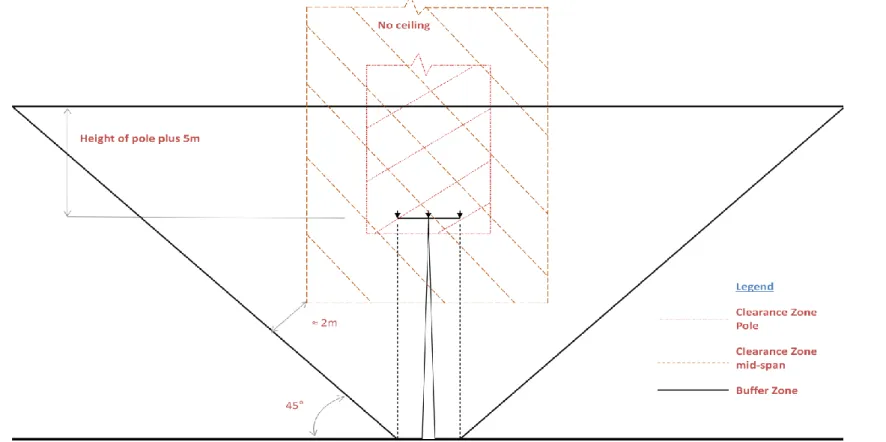
A buffer zone is an additional area around a clearance zone in bushfire risk areas. It defines the maximum extent to which the vegetation may be trimmed. Trimming beyond the buffer zone is not permitted. Trimming vegetation within the buffer zone is intended to ensure the clearance zone remains clear until the next trimming is due.
A regrowth zone is the area around a clearance zone in a non-bushfire risk area. It defines the indicative extent to which vegetation is likely to be trimmed. Trimming beyond the regrowth zone is not permitted, without consent from the owner of the tree. The extent of trimming within the regrowth zone will usually be dependant on factors such as the species of tree, the local climate, and the regrowth rate of the tree, to ensure any vegetation remains outside the clearance zone until the next trimming is due (currently cannot exceed three years).
Protocol for vegetation management near powerlines – Draft for consultation 15 | P a g e Bushfire risk areas
In bushfire risk areas, a clearance zone of 0.1 m is required for fully insulated powerlines and for uninsulated powerlines, the clearance zone depends on the voltage and length of span of the powerlines. It is important to note there is no ceiling for the clearance zone above uninsulated powerlines in bushfire risk areas.
The middle sections of a conductor between two poles can swing or sag more than the sections closer to the poles and require greater vertical and horizontal clearances.
Non bushfire risk areas (including prescribed areas)
In non-bushfire risk or prescribed areas, a clearance zone of 0.1m is required for fully insulated powerlines (all voltages) and uninsulated low voltage powerlines. For uninsulated high voltage powerlines, the clearance zone depends on the voltage and span of the powerlines.
A typical clearance zone and regrowth zone for an 11kV overhead powerline in the prescribed area (metropolitan Adelaide) is shown in Figures 2,3 and 4 below.
Figure 3: Image depicting typical clearance and regrowth zone Figure 2: Cross section of a powerline showing the clearance
Protocol for vegetation management near powerlines – Draft for consultation 17 | P a g e Figure 4: Image showing typical unisulated powerlines in non-bushfire risk areas
3.
Consultation, notification, communication and decision making
Commitment to stakeholders:
We will aim to keep you informed, listen and acknowledge concerns and provide feedback on how influenced decision or process
This section outlines the process undertaken by SA Power Networks and its contractors in respect to notifying or consulting with affected parties in relation to vegetation management near powerlines. It also outlines opportunities to improve how we inform stakeholders of our vegetation clearance program and how we will continue to engage with our key stakeholders.
3.1
Notification
How we engage with landholders and Councils and the notification/ consultation process is critical as a significant proportion of customer and community complaints are in relation to the current
notification process.
Our legislative requirements
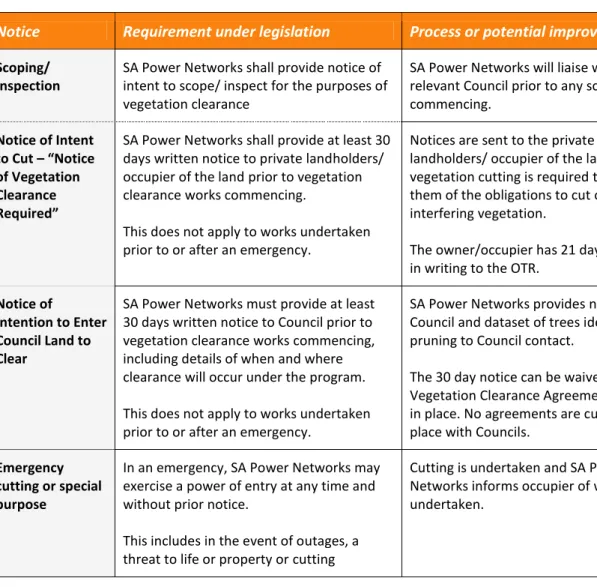
Table 2 outlines our legislative requirements in relation to notification requirements under the Act. Table 2: Notification requirements
Notice Requirement under legislation Process or potential improvements Scoping/
Inspection
SA Power Networks shall provide notice of intent to scope/ inspect for the purposes of vegetation clearance
SA Power Networks will liaise with the relevant Council prior to any scoping work commencing. Notice of Intent to Cut – “Notice of Vegetation Clearance Required”
SA Power Networks shall provide at least 30 days written notice to private landholders/ occupier of the land prior to vegetation clearance works commencing.
This does not apply to works undertaken prior to or after an emergency.
Notices are sent to the private
landholders/ occupier of the land where vegetation cutting is required to inform them of the obligations to cut or remove interfering vegetation.
The owner/occupier has 21 days to object in writing to the OTR.
Notice of
Intention to Enter Council Land to Clear
SA Power Networks must provide at least 30 days written notice to Council prior to vegetation clearance works commencing, including details of when and where clearance will occur under the program. This does not apply to works undertaken prior to or after an emergency.
SA Power Networks provides notice to Council and dataset of trees identified for pruning to Council contact.
The 30 day notice can be waivered if a Vegetation Clearance Agreement (VCA) is in place. No agreements are currently in place with Councils.
Emergency cutting or special purpose
In an emergency, SA Power Networks may exercise a power of entry at any time and without prior notice.
This includes in the event of outages, a threat to life or property or cutting
Cutting is undertaken and SA Power Networks informs occupier of work undertaken.
INF
OR
M
CON
SULT
INVOLVE
COLLABORATE
EM
POWE
R
Protocol for vegetation management near powerlines – Draft for consultation 19 | P a g e Notice Requirement under legislation Process or potential improvements
vegetation to re-establish clearances. Contact must be made with the occupier prior to or after the emergency to inform the occupier of what was done and why (verbal or written).
Inappropriate species
Where species contrary to the Regulations to the Electricity Act have been planted, SA Power Networks may advise the occupier of this in writing by letter ‘Vegetation Planted or Cultivated Near Powerlines’.
The occupier is given the option of either removing the vegetation, liaising with SA Power Networks regarding tree removal or applying for an exemption under the Act.
Notification of the occupier’s
responsibility to remove the vegetation shall nominate a realistic date by which this is to be done.
The OTR must be notified of any instances where the occupier wishes to retain inappropriate species and an exemption may be provided. A copy of the
exemption is provided to SA Power Networks.
Our commitment to effective notification and communication
Whilst under the legislation a number of requirements are placed on SA Power Networks, there are opportunities to improve our notification process to maximise coverage and community awareness of our vegetation clearance program in both bushfire and non-bushfire risk areas.
Timing of notification
SA Power Networks will provide Councils with 30 days between notification and cutting to enable Councils to provide information to residents and review the scope of pruning and where required, identify alternative approaches to clearance, such as tree removal or insulating powerlines. Maximising the notification process
To maximise coverage and community input, SA Power Networks will undertake a mixture of the following methods to notify landholders and residents when we will be undertaking clearance. Whilst this will depend on the area and specific Council requirements may include:
Advert(s) in local paper(s) outlining when pruning being undertaken in your Council area The use of social media via Facebook
Power@MyPlace™ and via SMS (if registered at Power@MyPlace) Online via our website
Provide information on vegetation clearance program to publish on Council websites, Council newsletters, Council forums or community meetings
It should also be noted that not all of these options will be available to rural landholders and written notification may be the only avenue of notification.
3.2
Community Information and Education
One of the key drivers for vegetation clearance is to ensure community safety and deliver a reliable electricity supply to customers. Educational material and information on why SA Power Networks undertakes its vegetation management program assists the public with understanding the clearance parameters and our legislative requirements.
SA Power Networks currently has a number of Fact Sheets, including:
Approved Tree List – provides a list of species considered appropriate for bushfire and non-bushfire risk areas for planting under powerlines
Tree Trimming near Powerlines – provides an overview of tree trimming around powerlines (eg responsibilities, considerations and legal requirements)
Bushfire Safety – outlines our approach to bushfire safety and measures to mitigate risk Entering your land – outlines the main reason SA Power Networks may enter your land and
your rights and responsibilities
Trees and Powerlines - booklet produced by the Office of the Technical Regulator to outline the legislative requirements for vegetation near powerlines.
Information and copies of the Fact Sheets are available on the SA Power Networks website,
www.sapowernetworks.com.au, or by calling 13 12 61 (general enquiries). Copies of the current Fact
Sheets are also provided in Appendix A.
To improve the approach to community information and education, the following initiatives will be pursued:
Develop a brochure to improve community understanding of our vegetation clearance requirements
Use of TV/ media to improve community education/ awareness on fire mitigation, especially pre-bushfire season
Appropriate Species List
SA Power Networks can assist and provide general advice to customers and the public on management, planting and maintenance of vegetation close to powerlines.
SA Power Networks has an appropriate species list (available on the website and via the OTR) that provides guidance on the types of trees appropriate for planting under powerlines based on bushfire risk areas or areas where lines are uninsulated (mature height <3m) and non-bushfire risk areas or areas where lines are insulated (mature height more than 3m but less than 6m).
The Botanic Gardens has developed an Interactive Plant Selector Tool which is a comprehensive online resource to help achieve more sustainable urban landscapes through improved plant selections. Detailed information is provided about each plant including suitability for different landscape types, soil and light preferences, physical appearance, growth habits, attraction for native fauna, common landscaping uses and other qualities and cautions. Additional information about trees includes suitability for a variety of urban placements and purposes. The tool is a valuable resource for landholders, Councils and the general public regarding appropriate species selection. SA Power Networks has funded development of additional capability for this online tool. Trees and plants suitable for growing under or near powerlines have been incorporated into the Plant Selector Tool to improve species selection around powerlines. The database has about 800 trees or plants that are considered appropriate for planting under powerlines, based on their bushfire boundary designation. There are also a number of species of trees that whilst they may require cyclic pruning
Protocol for vegetation management near powerlines – Draft for consultation 21 | P a g e are considered appropriate by some Councils and will perform successfully under powerlines in non-bushfire risk areas such as pear trees or crepe myrtles as an example.
The online tool will need to be used by Councils in conjunction with their Tree Management Plans in relation to species selection that suits and meets Council and community requirements.
3.3
Community and stakeholder engagement
SA Power Networks will continue to work with the community and develop partnerships to improve vegetation management. Community and stakeholder engagement is crucial to developing a long-term plan for vegetation management and improving consumers understanding of our vegetation clearance requirements.
To improve how we work with our stakeholders we have established the following:
LGA Working Group–a working group with the LGA and several member Councils has been established to improve how we manage vegetation near powerlines and develop a long-term plan for implementation.
Reference Groupfor Vegetation Management near powerlines– an independent group has been established to provide horticultural and arboricultural expertise on strategic vegetation management initiatives.
In addition, SA Power Networks will undertake the following activities to engage with our stakeholders:
Ongoing liaison and partnerships with Councils and stakeholders Improved education and engagement
Developing partnerships with key organisations eg educational and research institutions and government agencies, such as NRM Boards
Investigate working with schools and educational opportunities
Investigate establishing Regional Advisory Groups to improve vegetation management and implement strategic initiatives such as tree removal and replacement programs
Develop mechanisms for collating and managing feedback
Explore further opportunities for engaging with landholders and customers. Work with the CFS to improve community education/ awareness on fire mitigation.
3.4
Decision making
Management of customer issues
SA Power Networks has a Customer Charter that outlines our commitment to customers in relation to how we will provide our services, including requirements in relation to vegetation clearance, the obligations of property owners/ occupiers, our pre-summer bushfire mitigation preparations and property access requirements.
SA Power Networks values community feedback, which can be made via the following: General enquiries service – 13 12 61 (Mon – Fri 9.00am-5.00pm)
Email – [email protected] Website – www.sapowernetworks.com.au
Mail – Customer Response SA Power Networks GPO Box 77
Adelaide SA 5001 Facebook
Dispute resolution
Disputes may arise from decisions made by SA Power Networks in carrying out its responsibilities to maintain safe clearances around powerlines.
Resolving customer grievances is important to SA Power Networks and we will endeavour to resolve any dispute with those affected in accordance with our Complaint Management Process.
SA Power Networks aims to respond to or acknowledge all complaints or enquiries within five business days via the most practical and time efficient medium, whether this be via written correspondence, email, telephone, or social media.
If you are not satisfied that SA Power Networks has satisfactorily resolved an issue, the matter can be referred to the Energy and Water Ombudsman of South Australia:
Energy and Water Ombudsman SA Level 12, 50 Pirie Street
Adelaide SA 5000 GPO Box 2947 Adelaide SA 5001 Tel: 1800 665 565 Email: [email protected] Website: www.ewosa.com.au
The Energy and Water Industry Ombudsman is a totally independent industry body and will act as a mediator between the customer and SA Power Networks. This service is free of charge.
3.5
Opportunities to improve how we engage with our customers
There are a number of opportunities to improve how we engage and work with our key stakeholders in regards to vegetation management.
These include, but are not limited to, the development of:
‘One Stop Shop’ for Councils to communicate with SA Power Networks.
Online complaints email or customer service number for addressing vegetation management issues or concerns.
Consultation process for notifying Council staff eg Councils provide list of contact people in Council to notify for any vegetation clearance work.
Notification process to include written notification, incorporating a contact person, and followed up with a face to face meeting.
Investigate establishing Regional Advisory Groups to improve vegetation management and implement strategic initiatives such as tree removal and replacement programs
Partnerships with community and interest groups with a particular interest in vegetation management and wildlife management, including Trees for Life, Landcare, and wildlife groups.
Opportunities to work with local schools on education programs or replanting programs. Opportunities to work with Councils and customers to ensure vegetation originating on their
properties, encroaching into the street or over neighbour’s fences, is managed and controlled by the customer.
Protocol for vegetation management near powerlines – Draft for consultation 23 | P a g e In addition, SA Power Networks will continue to work with the LGA Working Group and Independent Reference Group for Vegetation Management near Powerlines to enhance the overall quality and sustainability of vegetation management and implement key strategic initiatives.
4
Agreements with Councils, community, landholders and other land
managers
Commitment to stakeholders:
We will seek direct advice in developing partnerships and opportunities for vegetation management improvements and seek your input into location or zone specific pruning programs
Working with Councils, landholders and other land managers to understand who is responsible for vegetation management, including pruning, tree removal and replacement, and species selection and the different roles they play, is fundamental to improving vegetation management near powerlines.
4.1
Interface between Council and SA Power Networks tree pruning and programs
There are a number of opportunities for improved coordination between Councils and SA Power Networks in relation to pruning activities and tree replacement/ renewal programs.Councils’ Street Tree Management Plans
The majority of Councils have a Tree Management Framework, Policy or Plan in place to provide vision and direction for the management of trees within their Council area, including street trees. Species selection and tree removals and replacement will need to align with Councils endorsed management plans.
Pruning work
There are opportunities for Councils and SA Power Networks to work more collaboratively to improve vegetation clearance outcomes. These could include:
Joint scoping to identify opportunities or alternatives to clearance
Additional pruning being undertaken by Councils following line clearance by SA Power Networks to achieve a better visual outcome
Formative pruning being undertaken by Council Street tree reviews
There are a number of Councils with ageing tree stocks and plans to replace these trees in the future, depending on life expectancy and other factors.
SA Power Networks and Councils should work together to identify aged trees, review and where possible align replacements with Councils’ Tree Management Plans and determine suitable replacement options over a one to 10-year timeframe.
Street renewal and replacement programs
A number of Councils undertake streetscape renewals, which involves replacing entire streets of trees, generally considered aged or inappropriate, with new species. There are opportunities for SA Power Networks to work with Councils as part of these renewals on replacement options and timeframes.
Management of culturally significant trees
SA Power Networks will consult with the relevant stakeholder prior to undertaking any pruning work on culturally significant trees. This includes:
INF
OR
M
CONSULT
INV
OLVE
CO
LL
ABO
RATE
EMPOW
ER
Protocol for vegetation management near powerlines – Draft for consultation 25 | P a g e Native Vegetation Council – roadside vegetation of environmental significance or protected
native vegetation
Local Council – heritage and national trust trees, culturally significant trees, avenues of honour
Local Council – significant trees (defined under the Development Act – metropolitan Adelaide)
Local Council/ DEWNR – trees that are particularly large, native to the area and/or significant National Trust of SA – maintain a Register of Significant Trees to help identify and conserve
trees of importance, including trees with historic or cultural value, environmental or botanical significance and avenues of honour.
4.2
Responsibilities/ allocation of costs
In South Australia, SA Power Networks accepts the costs and liabilities associated with vegetation clearance in bushfire and non-bushfire risk areas and on private or public lands, in accordance with the Electricity Act 1996 and the Electricity (Principles of Vegetation Clearance) Regulations.
SA Power Networks currently undertakes a program of vegetation clearance in bushfire and non-bushfire risk areas. This program is funded through the Australian Energy Regulator (AER) and
ensures compliance with the legislation. This approach is based on funding approved for 2010-2015. The protocol outlines the baseline programs for vegetation management for which funding is
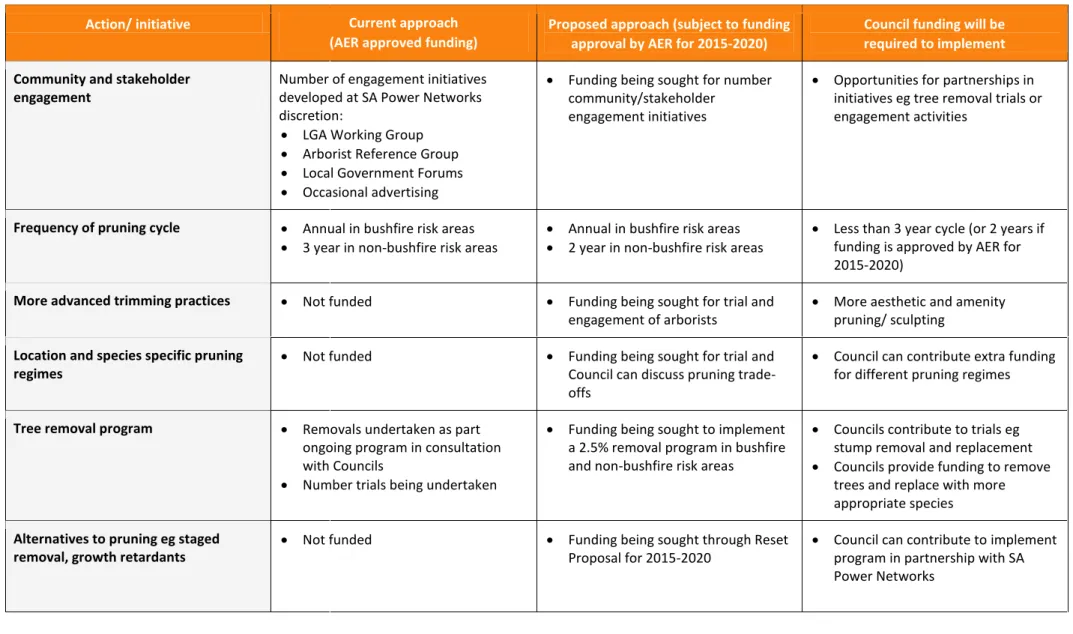
approved ie. What we do now, as well as for programs where funding is being sought through the Regulatory Reset Proposal for 2015-2020. Additional funding is being sought for a number of vegetation management initiatives and implementation will require funding approval. This includes for example, a shift to a 2 year cycle in selected non-bushfire risk areas and implementation of a tree removal and replacement program in bushfire and non-bushfire risk areas.
SA Power Networks would support proposals from Councils to introduce a different pruning regime or tree treatment as long as it meets our legislative and risk obligations or for which funding is provided. Furthermore, under current legislation Councils have the option to contribute to additional programs or take over trimming in their Council area (with the associated liability). If an individual Council require specific approaches that are above the baseline SA Power Networks programs, Councils will need to contribute funding for their specific programs/ approaches. The additional programs could be based on either a trade-off within a Council area or funded by Councils. For example, to reduce clearance costs within a Council area, Council might opt for removals in one location for more advanced pruning or additional pruning in another area.
4.3
Opportunities for partnerships with Councils
There are a number of opportunities for partnerships with Local Government. Councils are
responsible for managing street trees under their control to improve streetscape value and appeal and enhance biodiversity and habitat value. A large number of Council’s have Tree Management Policies and Plans in place to protect their street trees and provide a framework for their
management.
If individual Council require specific approaches for vegetation clearance that are above the baseline SA Power Networks clearance programs, Councils will need to contribute funding for their specific programs and needs. There are also opportunities for Councils and SA Power Networks to develop cost-effective solutions to reduce clearance costs.
SA Power Networks is also keen to work with Councils to develop location and species specific pruning programs. For example, Council might nominate different zones within its Council area where different pruning regimes and strategies could apply. SA Power Networks and the LGA would need to liaise with Councils on their concept of zones for different pruning regimes and strategies. Table 3 provides some examples of different zones where different regimes and strategies could apply.
Table 3: Different zones for different pruning regimes
Zone Possible strategies
Zone A - Low rainfall and limited trees
eg Ceduna, Roxby Downs
Shifting from a 3-year cycle to a 5-year cycle
Tree removal and replacement –arid appropriate species
Zone B – High rainfall
eg Mount Lofty Ranges (Stirling, Gumeracha)
More frequent tree trimming
Tree removal/ replacement
Span by span strategies eg multiple cutting on targeted spans
Growth retardants
Species specific removal programs eg fast growing species
Woody weed removal programs
Species specific pruning techniques
Sapling removal
Zone C – Rural townships
eg Cummins, Melrose
More frequent tree trimming
Tree removal/ replacement
Species specific pruning techniques
Sapling removal
Individual tree removal and replacement
Street tree renewals
Asset modification eg insulating the powerlines, undergrounding
Zone D - Agricultural areas
eg Yorke Peninsula, Mid North, South East
Tree removal/ replacement
Woody weed removal programs
Sapling removal
Zone E - High amenity areas (tourist/ historical precincts, high traffic areas, main streets and shopping centres, near schools or community centres)
eg Hahndorf, Glenelg, Port Elliot, Clare, McLaren Vale
Staged removal/ replacements
More frequent tree trimming
More advanced horticultural techniques
Species specific pruning techniques
Individual tree removal and replacement
Street tree renewals
Asset modification eg insulating the powerlines, undergrounding
Zone F - Metropolitan area (prescribed area) More frequent tree trimming
Staged removal/ replacements
More advanced horticultural techniques
Protocol for vegetation management near powerlines – Draft for consultation 27 | P a g e
Zone Possible strategies
Woody weed removal programs eg olives, Pines
Species specific pruning techniques
Sapling removal
Individual tree removal and replacement
Street tree renewals
Asset modification eg insulating the powerlines, undergrounding
Zone G – Natural/ environmentally sensitive areas
eg protected areas, environmentally sensitive areas, RMS sites
Sapling removal – non-naturally occurring
Woody weed removal
More advanced horticultural techniques
Zone H - Low visibility areas
egareas where tree removals relatively easy to implement or woody weeds, industrial areas, rural areas, low traffic areas
Tree removal/ replacement
Sapling removal
3 year cycle (compliance vs amenity)
Zone I - No Tree Zone, areas where there is significant service utility infrastructure (water pipeline, gas pipeline, sub transmission (66kV) and transmission (132kV and 275kV)
powerlines exist)
eg areas where trees should not be replanted if trees are removed
Tree removal
Shifting from a 3-year cycle to a 5-year cycle
Some specific opportunities for partnerships with Council include:
Developing partnerships to investigate alternatives to pruning such as tree removal and replacement, asset modification or implementing spacers
Data sharing opportunities between Councils and SA Power Networks, including scoping data, GIS information on street trees or native vegetation
Undertaking joint scoping with Councils to improve vegetation management outcomes Developing location and species specific pruning programs in partnership with individual
Councils
Opportunities for trade-offs within a Council area and developing detailed work plans for individual Council areas in consultation with Council
Engaging qualified arborists to provide expert advice and input into trimming practices, including a trial of more advanced trimming practices. Council arborists would be involved in the selection of trees for the trial and the specific trimming requirements.
5
Pruning and vegetation clearance
Commitment to stakeholders:
We will aim to keep you informed, listen and acknowledge concerns and provide feedback on how your issues and concerns have influenced the decision or process
5.1
SA Power Networks vegetation clearance program
SA Power Networks vegetation clearance program consists of the following programs to manage vegetation near powerlines:
Annual cyclic program in bushfire risk areas (approximately 430,000 line spans across the state)
Pre-fire danger season program in high bushfire risk areas – repatrol all spans that were inspected as part of the annual cyclic program prior to 1 May in that year
Three-year cyclic program in non-bushfire risk areas Metropolitan Council program – three-year cyclic program
Metropolitan 33kV/66kV Pre Fire Danger Season Program – preventative maintenance program on high voltage feeders
5.2
Scoping
The vegetation services contractors are responsible for undertaking the inspection of feeders for the purpose of scoping annual, cyclic and pre-summer cutting programs. Inspection is done using a 4WD vehicle to traverse the line, checking every span for potential and existing vegetation infringements. The required clearance under the Act (Section 6) is then determined for the cutting crew.
SA Power Networks is responsible for liaising with Council pre-inspection to gain their input into the scoping process. This allows Councils to provide information on:
Trees suitable for removal Culturally sensitive trees
Opportunities for integration with Council or other agency (eg DPTI, developers) pruning work
Stakeholder/ community issues or concerns Council inspect trees for consideration of options Trees under stress eg health, old age, decay, disease. SA Power Networks will:
Provide Councils with 30 days notice of their intent to scope
Provide Councils the scoping data 30 days prior to cutting to allow Council review,
consultation and identification of alternatives. A template outlining the scoping data to be provided to Councils to enable Councils to review the data within the 30 day period will be developed.
SA Power Networks will aim to develop an indicative schedule for the metropolitan and non-bushfire risk areas clearance program to provide advanced notice of when tree trimming is likely to occur in Council areas.
Meet with Council on-site to discuss the proposed program following the provision of cutting data and prior to the commencement of tree trimming.
INF
OR
M
C
ON
SULT
INVOLVE
COLLABORATE
EM
POWE
R
Protocol for vegetation management near powerlines – Draft for consultation 29 | P a g e
5.3
Pruning techniques
Pruning is the directed and purposeful cutting of a plant towards a pre-determined end, which in the case of SA Power Networks vegetation clearance program is to prune the branches of trees which do or may interfere with powerlines, in accordance with the legislation.
A number of specific issues have been identified by Local Government in relation to pruning, including:
Pruning needs to be more species and location specific
Native vegetation management – requires different pruning approach
One size fits all approach but different species have different regrowth and other factors need to be considered eg rainfall, weather
Provide information on the extent of pruning to be undertaken per tree.
It should be noted that improvement in these areas requires additional data being captured. There is a range of data that needs to be collected at the line span level to enable effective strategic planning and improve future optimisation of the program. SA Power Networks is working to improve its data capture to improve our understanding of different species, growth rates and regional differences. The following table outlines the different pruning techniques and their application for managing vegetation near powerlines.
The definitions for the pruning techniques have largely been sourced from the Australian Standard AS 4373 for the Pruning of Amenity Trees. Line clearance is defined as pruning to maintain
clearances around overhead services, such as powerlines, which should involve formative pruning, reduction pruning or remedial pruning.
Pruning technique
Description of pruning technique Application of technique Illustration of pruning techniques Formative
pruning
Formative pruning consists of the selective removal of specific branches to enhance form and improve structure, or to directionally shape the young tree. One of the aims of formative pruning is to accommodate site constraints and reduce encroachment on powerlines as the tree grows.
Future conflicts between vegetation and electricity infrastructure can be reduced by ensuring vegetation planted on Council controlled land is appropriately selected and formatively pruned during
development.
SA Power Networks is looking for Councils to undertake formative pruning to shape trees or improve the visual aesthetics of trees over time.
Formative pruning techniques should generally be used for Council street trees to reduce conflict with powerlines over time.
Selective pruning Selective pruning is the removal of identified branches that are causing a specific problem.
Selective pruning aims to reduce the height of the tree and maintain the required clearance zone.
Protocol for vegetation management near powerlines – Draft for consultation 31 | P a g e Directional
pruning
Directional pruning involves removing limbs growing into the powerlines and
encouraging growth away from the powerlines.
Directional pruning leaves trees healthier and ultimately reduces clearance costs over the long-term.
Whilst directional pruning may not always improve the trees appearance it is the preferred method for managing trees near powerlines.
Reduction pruning
Reduction pruning reduces the size of the crown of the tree in the height or spread. The ends of the branches are removed to internal lateral branches or stems.
Pollarding A pruning technique that establishes branches ending in a pollard head of buds and vigorous shoots.
Tree removal If the degree of pruning required is such that a satisfactory appearance cannot be maintained, then it may be preferable to remove the tree.
Under the current legislation there are no provisions for tree removal for visual or health reasons. SA Power Networks relies on working with Councils and landholders.
Protocol for vegetation management near powerlines – Draft for consultation 33 | P a g e
5.4
Pruning cycles
The frequency of tree trimming varies among Council areas, and even within Council areas, depending on the line voltage and area/ zone ie bushfire or non-bushfire risk areas. Bushfire risk areas
SA Power Networks undertakes an annual cycle of inspection and cutting in bushfire risk areas. Non-bushfire risk areas
SA Power Networks currently undertakes a three-year cycle in non-bushfire risk areas. Community engagement has indicated that a change to the trimming frequency would reduce the negative impact to the trees as a less severe cut would be required. Subject to funding, SA Power Networks proposes to move to a two-year trimming cycle in selected non-bushfire risk areas.
5.5
Species and specimen specific guidelines
Pruning should also consider a number of species and specimen specific constraints, including but not limited to:
Location (Council) Species (tree types)
Social (stakeholders/ community)
Importance of local knowledge and training
5.6
Timing and Scheduling
Timing
Timing of pruning needs to consider a range of factors including weather, species, environmental indicators (nesting times of birds), flowering and access to area
Greater lead in times – 30 days is provided to Councils between notification and pruning. Where considered warranted by SA Power Networks, a 30 day extension can be requested (subject to SA Power Networks approval), to allow more time to review the pruning schedule.
Timing and type of pruning
Different trees have different optimum times for pruning. For example:
Deciduous trees should be pruned when they are leafless as the branches are more easily seen and the direction of regrowth can be planned.
Evergreen trees should be pruned after flowering or bearing fruit but can generally be cut at any time.
Conifers can be pruned at any time but excessively heavy pruning will expose their limbs. If the degree of pruning required is such that a satisfactory appearance cannot be maintained, then it may be preferable to remove the tree.
Scheduling
Clearance work should be scheduled to minimise impacts to landholders, Councils and the community. Scheduling needs to also consider environmental factors, such as wildlife breeding seasons.
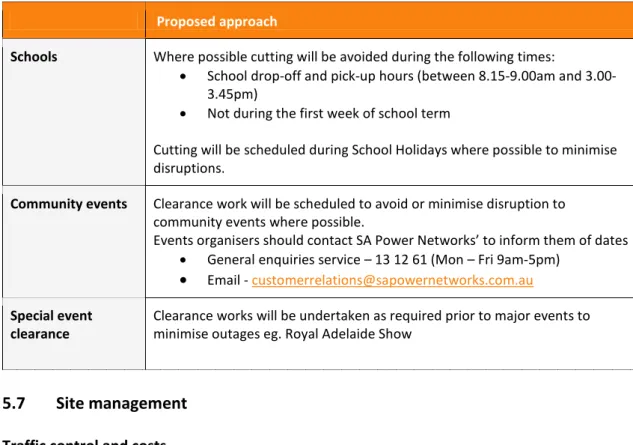
There are a number of factors that need to be considered when scheduling clearance work, with the size and nature of the street being the key determinants. Some of the specific issues that need to be considered are outlined in Table 4.
Table 4: Vegetation management scheduling
5.7
Site management
Traffic control and costsAppropriate traffic management must be put in place by the contractor prior to vegetation clearance work being undertaken.
All traffic management must adhere to the Road Traffic Act, Regulations, Codes of Practice and Australian Standards.
Safe work zones
The contractor is required to provide a safe work zone prior to clearance works being undertaken. Native vegetation management
SA Power Networks are exempt under the Native Vegetation Act 1993 from tree trimming and maintenance work and for clearance work undertaken in accordance with the Electricity Act 1996.
SA Power Networks will seek to minimise damage to native vegetation. SA Power Networks will work with the Native Vegetation Council to develop guidelines for tree removal and replacement and investigate developing a Standard Operating Procedure to meet our requirements for vegetation clearance.
The contractor needs to consider when vehicle access is or is not inappropriate to a site to protect and minimise damage to native vegetation. Councils have a role to play in identifying and flagging environmentally sensitive areas.
Proposed approach
Schools Where possible cutting will be avoided during the following times:
School drop-off and pick-up hours (between 8.15-9.00am and 3.00-3.45pm)
Not during the first week of school term
Cutting will be scheduled during School Holidays where possible to minimise disruptions.
Community events Clearance work will be scheduled to avoid or minimise disruption to community events where possible.
Events organisers should contact SA Power Networks’ to inform them of dates
General enquiries service – 13 12 61 (Mon – Fri 9am-5pm)
Email - [email protected] Special event
clearance
Clearance works will be undertaken as required prior to major events to minimise outages eg. Royal Adelaide Show