Protecting User Privacy for
Cloud Computing by Bivariate
Polynomial Based Secret Sharing
*
Ching-Nung Yang
1, Jia-Bin Lai
1and Zhangjie Fu
21Department of Computer Science and Information Engineering, National Dong Hwa University, Hualien, Taiwan 2School of Computer and Software, Nanjing University of Information Science and Technology, Nanjing, China
Cloud computing is an Internet-based computing. In cloud computing, the service is fully served by the provider. Users need nothing but personal devices and Internet access. Computing services, such as data, storage, software, computing, and application, can be delivered to local devices through Internet. The major security issue of cloud computing is that cloud providers must ensure that their infrastructure is secure, and pre-vent illegal data accesses from outsiders, other clients, or even the unauthorized cloud employees. In this paper, we deal with key agreement and authentication for cloud computing. By using Elliptic Curve Diffie Hellman (ECDH) and symmetric bivariate polynomial based secret sharing, we design a secure cloud com-puting (SCC). Two types of SCC are proposed. One requires a trusted third party(TTP), and the other does not need a TTP. Additionally, via the homomorphism property of polynomial based secret sharing, our SCC can be extended to multi-server SCC (MSCC) to fit an environment where a multi-server system contains multiple servers to collaborate for serving applications.
Keywords: cloud computing, authentication, secret shar-ing; key agreement, symmetric bivariate polynomial, homomorphism
1. Introduction
Cloud computing is a type of Internet-based computing, and it is one of the foundations of the next generation of computing. Computing ser-vices, such as data storage, software, comput-ing, and application, are delivered to local de-vices through Internet [1, 2]. In cloud comput-ing, the service is fully served by the provider.
Clients need nothing but personal devices and Internet access. The cloud computing can either be hosted on-site by the company or off-site such as Microsoft’s SkyDrive, Google Drive, Samsung’s S-Cloud service, Apple’s iCloud, Amazon’s Cloud Drive. Recent applications, e.g., multimedia streaming, virtual reality, and robotics [3, 4, 5], have used cloud computing to provide the services. Additionally, platforms like Google Apps(e.g., Gmail, Google Groups, Google Calendar, . . ., etc.), YouTube, Vimeo, Flickr, Slideshare and Skype, have adopted the cloud computing technology. As cloud com-puting becomes more and more popular, how to secure cloud computing and protect data se-curity deserves studying. Some sese-curity issues in cloud computing are surveyed and studied in [6–16].
For providing cloud services, the sensitive data for all clients should be stored in the cloud host. At this time, the data security and the personal privacy are assured. The cloud provider guaran-tees these data and personal information in host database against all accesses of the unauthorized insiders or the malicious outsiders. Accord-ingly, some secure cloud computing schemes based on secret sharing approach were proposed [17–20]. For example, Yeh’s PASS (Privacy by Authentication and Secret Sharing)prevents client’s data privacy from the unauthorized ac-cess [17]. PASS adopts public key cryptosys-tem to encrypt its share. So, in Yeh’s PASS,
the client cannot recover the secret key. En-cryption/decryption in PASS should be accom-plished with the help of encryption server and query server. If we easily store the secret key in the client side, the secret key will be leaked out when the client’s device is compromised. In this paper, we deal with cloud security ser-vices including key agreement and authentica-tion described in[17], and solve the above weak-nesses of PASS. By using symmetric bivariate polynomial based secret sharing, we design the secure cloud computing (SCC). Two types of SCC are proposed. One requires a trusted third party(TTP)in cloud like the scheme in[7], and the other does not need a TTP. Meantime, our SCC provides mutual authentication to avoid connecting the faked server. The proposed SCC can be extended to multi-server SCC (MSCC) to fit a multi-server environment[21].
The paper is organized as follows. Section 2 gives some preliminaries. Two types of SCC are introduced in Section 3, and the MSCC is proposed in Section 4. Performance evaluation, security analysis, and applications are shown in Section 5, and Section 6 is conclusion.
2. Preliminary
2.1. Elliptic Curve Diffie Hellman Protocol and Elliptic Curve Cryptography
Elliptic Curve Diffie Hellman(ECDH)key agree-ment protocol is based on elliptic curve discrete logarithm problem. On the same security level, the computation by elliptic curve discrete log-arithm is faster than the multiplicative group discrete logarithm, and thus has the computa-tional advantage. In ECDH, Alice randomly selectsnAand computesPA =nA×G, whereG is a point on elliptic curve. Then, Alice sends PAto Bob through public channel. By the same approach, Bob sends PB = nB ×G to Alice. Finally Alice and Bob can share a same secret key by calculatingK =nA×PB=nB×PA. On the other hand, Elliptic Curve Cryptography (ECC) can implement encryption and decryp-tion. Alice and Bob choose the public/private key (PA,nA) and (PB,nB), respectively. Alice encrypts the messagem by using Bob’s public keyPBand a random numberkasC ={k×G,
m+k×PB}. After receivingC, Bob decrypts this ciphertext by subtracting(nB×k×G)from (M+k×PB)to decrypt the messagem.
2.2. (k,n) Secret Sharing
Secret sharing is one of main research topics in modern cryptography and it has been stud-ied extensively in literature. In 1979, Shamir [22] and Blakley [23] independently proposed secret sharing solutions for safeguarding cryp-tographic keys. In a (k,n) secret sharing, the dealer divides the secret into nshares and dis-tributes shares amongnshareholders in such a way that anykor more thankshares can recon-struct this secret; but any(k−1)or fewer than (k−1)shares cannot obtain any information of the secret.
In this paper, we use Shamir’s(k,n)secret shar-ing in a bivariate polynomial type to imple-ment our SCC and MSCC. Thus, we describe Shamir’s(k,n)secret sharing(univariate poly-nomial based secret sharing)and the notion of bivariate polynomial based secret sharing.
2.2.1. (k,n) Secret Sharing Based on Univariate Polynomial
A polynomial based(k,n)secret sharing scheme was firstly proposed by Shamir[22]. By taking the secret data asg0 (constant term)in the fol-lowing(k−1)-degree polynomial g(x) where pis a prime number andgiis integer inGF(p), the dealer could construct n shares (xi,g(xi)) by choosingndifferentxi,i ∈[1,n], and sends them to shareholders.
g(x) = (g0+g1x+. . .+gk−1xk−1)modp (1) In secret reconstruction, any k shares (say k shares(x1,g(x1)),(x2,g(x2)), . . . ,(xk,g(xk))are used for reconstructingg(x)via Lagrange inter-polation formula in (2), and the secret is ob-tained fromg0=g(0).
g(x)=g(x1)(x(x−x2)(x−x3). . .(x−xk) 1−x2)(x1−x3). . .(x1−xk) +g(x2)(x(x−x1)(x−x3). . .(x−xk)
2−x1)(x2−x3). . .(x2−xk)+·s +g(xk) (x−x1)(x−x2). . .(x−xk−1)
The univariate polynomial based secret shar-ing schemes can be used for cloud computshar-ing which many users share and distribute their data to servers. For example, in [24], the authors adopted Shamir’s (k,n) secret sharing to de-sign a new secret sharing that can reduce the amount of shares in cloud computing environ-ment. The system in[24]has four entities, users, key-servers, data-servers, and a dealer. Users have multiple secrets (say m pieces secrets) and distribute these secrets in the cloud sys-tem. Key-server keeps only an initial and uses a keyed pseudo-random number generator to generate all the shares, and meanwhile the data-servers store all the required shares for thesem pieces secrets. Actually, in this cloud system, the key-servers are composed of small-capacity servers(because they store only the initial)but the data-servers are composed of large-capacity servers(they store all the shares formpieces se-crets). By subdividing servers into key-server and data-servers, this secret sharing scheme can reduce the amount of shares stored in servers.
2.2.2. (k,n) Secret Sharing Based on Bivariate Polynomial
There are two types of secret sharing using bi-variate polynomial. Some of them[25, 26, 27] use an asymmetric bivariate polynomial, and some [28, 29, 30] use a symmetric bivariate polynomial. All polynomials in[25–30]are of degree (k−1) for both variables. In [25, 26, 27], the dealer selects an asymmetric (k−1) -degree bivariate polynomial F(x,y), and sends two univariate polynomialsgi(x) = F(x,i)and fi(y) = F(i,y) to each shareholderPi. On the other hand, in[28, 29, 30], the dealer uses a bi-variate polynomialF(x,y), with the symmetric propertyF(x,y) =F(y,x), and sends only one univariate polynomial fi(y) to the shareholder Pi. When using symmetric bivariate polyno-mial, both polynomials gi(x) and fi(y) have the same coefficients(the symmetric property). Notice that this is why the dealer sends only one polynomial fi(y) to Pi. For most bivari-ate polynomial based schemes, using bivaribivari-ate polynomial is to adopt the advantageous fea-tures fi(j) = gj(i) when using the asymmetric polynomial, and fi(j) = fj(i) when using the symmetric polynomial, respectively.
A (k −1)-degree bivariate polynomial in (3) is symmetric, where F(x,y) = F(y,x). Ob-viously, we can select aij = aji to construct this symmetric bivariate polynomial because
0≤i,j≤(k−1)aijxiyj=0≤i,j≤(k−1)ajixiyj. F(x,y) =0≤i,j≤k−1aijxiyj (3)
Same as Shamir’s secret sharing [22], we em-bed the secret in a00 = F(0,0). The dealer selects a symmetric bivariate polynomial, and sends a (k− 1)-degree univariate polynomial f(IDi,y) =bi0+bi1y+. . .+bi(k−1)yk−1, 1≤
i ≤ n, to the shareholder Pi, where IDi is his/her identification. This bivariate polyno-mial based secret sharing also has the thresh-old value k, and this can be proven by Van-dermonde matrix. Whenkshareholders collab-orate, they reconstruct the polynomial F(x,y) from k shares. Then, the secret can be deter-mined from a00 = F(0,0). In this paper, we use the symmetric bivariate polynomial based secret sharing to adopt its symmetric property to design SCC and MSCC.
2.3. Yeh’s PASS
is hard to achieve but all clients know the public key of server is reasonable.
Our SCC avoids using public key cryptosys-tem to send the shares, and achieves the mu-tual authentication between the server and the client. To demonstrate our improvements, we only briefly describe the following phases in Yeh’s PASS: (i)secret key agreement, (ii) se-cret shares agreement, and (iii) client authen-tication between AS and the client. One can refer to other phases between AS, ES, and QS in Figure 1 of[17].
Secret Key Agreement:
Each client i and AP agree on a secret key Ki and two secret sharesCSi(known by the client) andSSi(known by AS). The sharesCSiandSSi are used for deriving the secret keyKi. ECDH algorithm, which adoptsy2=x3+ax+bover a primep, is used for this key agreement. (Step 1) AS and the client i choose a random number rs ∈ GF(p) and ri ∈ GF(p), respec-tively.
(Step 2)AS computes a pointRs =rs×Gand sends it to the client. Also, the client computes and sends a pointRi=ri×Gto AS.
(Step 3)AS and the client respectively compute a pointQi =rs×Ri =ri×Rs.
(Step 4)AS and the client choose thex-coordinate ofQias the shared secret keyKi.
Secret Shares Agreement:
After Ki is determined, two secret shares CSi and SSi are then generated separately by the clientiand AS, respectively.
(Step 1) AS and the client i computes a point (Qi+Di), whereDiis the public key of client i, and letabe thex-coordinate of this point. (Step 2)AS and the client can construct a same polynomial f(x) = Ki + ax (note: this one-degree polynomial can be used in a(2,2)secret sharing).
(Step 3) AS and the client i randomly gener-ate their secret shares as SSi = (x1,f(x1)) and SSi= (x2,f(x2)), respectively.
(Step 4)After the secret shares are chosen, AS and the client remove Qi and f(x) from their storages.
(Step 5) In a later query, the client i presents his share CSi to AS by using the public key of AS. AS uses CSi and its own share SSi to reconstruct the polynomialf(x) and determine the keyKi =f(0).
Client Authentication:
When receiving an authentication request from a client, AS starts client authentication proce-dure. After the successful authentication, the client can access his own data.
(Step 1) The client i sends an authentication request to AS, ENCDs(client’s counter CSi),
which is encrypted by AS’s public keyDs. (Step 2) AS uses its own private keyds to de-crypt the received request by DECds (ENCDs (client’s counterCSi)), and then retrieves the client’s counterand the secret shareCSi. (Step 3) AS uses the decrypted CSi and the stored SSi to recover the secret key Ki using Shamir’s(2, 2) secret sharing, as described in (Step 5)ofSecret Key Agreement.
(Step 4) AS computes the hash value h(Ki), and verifies whether this hash value equals the stored hash value or not. Also, the client’s counter should be the same as the server’s counter. Suppose that all the above are true Then the clientiis successfully authenticated.
3. The Proposed SCC
Yeh’s PASS scheme chooses not to store the cret key in the cloud server, but recovers this se-cret key from the received share from client and the share stored in server. For such key recov-ery, the client should use the public key of cloud server to encrypt and send its share to the server. Actually, ECC encryption/decryption was used in [17]. To avoid using public key cryptosys-tem, and achieving the mutual authentication between the server and the client, we use the symmetric property of secret sharing.
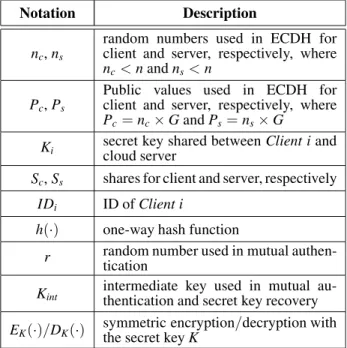
Client does not need the complex public cryp-tosystem to send the share to cloud server, but only uses the symmetric encryption instead. (4) The mutual authentication between client and server is achieved. (5)SCC can be extended to MSCC, and the authentication and key recovery of MSCC can be efficiently accomplished. Two types of SCC are proposed. One requires a trusted third party (TTP), and the other does not. Both types of SCC can provide the mu-tual authentication between the client and the cloud server. In the proposed SCC without TTP, ECDH is used to share the same secret key and the same bivariate polynomial. Besides, we do not use the public cryptosystem to send the se-cret shares. Subsequently, both types of SCC are described. Notations in these protocols are first defined in Table 1.
Notation Description
nc,ns
random numbers used in ECDH for client and server, respectively, where
nc<nandns<n
Pc,Ps
Public values used in ECDH for client and server, respectively, where
Pc=nc×GandPs=ns×G
Ki secret key shared betweencloud server Client iand
Sc,Ss shares for client and server, respectively
IDi ID ofClient i
h(·) one-way hash function
r random number used in mutual authen-tication
Kint intermediate key used in mutual au-thentication and secret key recovery
EK(·)/DK(·) symmetric encryptionthe secret keyK /decryption with
Table 1.Notations in the Proposed SCC.
3.1. Key Agreement Protocol without TTP
There are three phases, key sharing phase, mu-tual authentication phase, and key recovery phase in the key agreement without TTP. In this pro-tocol, we use ECDH to generate the bivariate polynomial, which is used in secret sharing to establish the key agreement.
Key Sharing Phase:
In this phase, client IDi and the cloud server generate their respective sharesScandSs. After
successfully generating the shares, they discard all sensitive information that could be used for compromising the secret. Also, both sides store the hash value of secret key h(Ki) for mutual authentication. Figure 1 shows the key sharing phase, and all the details are described step by step as follows.
Figure 1.Key sharing phase in the key agreement without TTP.
(Step 1) Client selects a randomnc and calcu-latesPc=nc×G. Then, it sends it to the cloud server.
(Step 2)The cloud server selects a random ns and calculatesPs =ns×G, and sends it to the client.
(Steps 3 and 4)Client and the cloud server cal-culate a pointQon elliptic curve bync×Psand ns×Pc, respectively.
(Steps 5 and 6) Client and the cloud server, respectively, choose the one-degree bivariate polynomialF(x,y) =a00+a01x+a10y+a11xy, where coefficients are determined in Eq. (4). The value of a00 is used as the secret key Ki. Also, we choosea01 = a10 to get the symmet-ricF(x,y).
a
00 =x-coordinate ofQ,
a01 =a01 =x-coordinate of(Q+Pc), a11 =y-coordinate of(Q+Pc)
(Step 8)The cloud server selects a random Xs and computes F(Xs,y) = fs(y). Then, server usesSs = (Xs,fs(y))as its share.
(Step 9)The client discardsQandF(x,y), and storesScandh(Ki).
(Step 10) The cloud server discards Q and F(x,y), and storesIDi,Ssandh(Ki)in database. Mutual Authentication Phase:
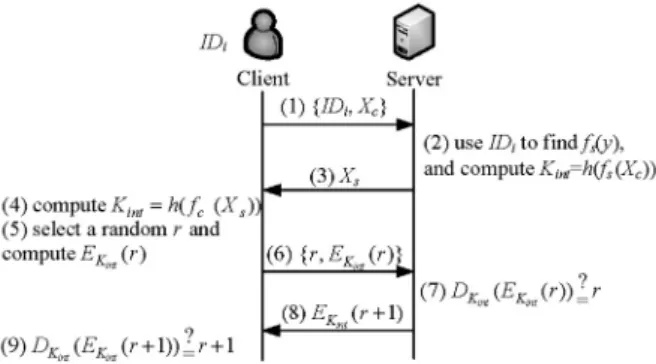
In Yeh’s PASS, the authentication is accom-plished by verifying the hash value of secret key. Instead of reconstructing the polynomial, we use the symmetric property in bivariate poly-nomial to share an intermediate keyKint. Then the mutual authentication is finished by using this intermediate key. This mutual authentica-tion can protect the privacy of client, and only allows the authenticated client to access his own data. Meantime, the client can assure that he connects the real server not a faked one. All steps are shown in Figure 2, and the details are briefly described below.
Figure 2.Mutual authentication phase in the key agreement without TTP.
(Step 1)The client sends{IDi,Xc}to the cloud server.
(Step 2) The cloud server uses IDi to find the corresponding fs(y) from database. Then, it determines the intermediate key Kint from h(fs(Xc)).
(Step 3)The cloud server sendsXsto the client. (Step 4)The client also obtains the intermedi-ate key Kint fromh(fc(Xs)). Becausefs(Xc) = fc(Xs) (the symmetric property ofF(x,y)), the client and the cloud server can share the same intermediate keyKint.
(Step 5)The client selects a randomrand com-putesEKint(r).
(Step 6) The client sends {r,EKint(r)} to the
cloud server.
(Step 7) The cloud server authenticates client by verifyingDK(EK(r)) ?= r.
(Step 8)The cloud server sends backEK(r+1) to the client.
(Step 9)The client authenticates the cloud server by verifyingDK(EK(r+1)) = (? r+1).
Key Recovery Phase:
In Yeh’s PASS, encryption and decryption are accomplished with the help of ES and QS. If we easily store the secret key in the client side, the client will risk losing his secret key when the local device is compromised. In the proposed SCC, we do not store the secret key Ki in the client. In SCC, we use the intermediate key to share the shares Sc and Ss. Finally, the secret keyKi is recovered, respectively, by the client and the server. All steps are shown in Figure 3, and the details are briefly described below.
Figure 3.Key recovery phase in the key agreement without TTP.
(Step 1 – Step 4) Same as the steps in mutual authentication, client and server share the inter-mediate keyKint.
(Step 5)The client sendsEKint(Sc)to the cloud
server.
(Step 6)The cloud server sendsEKint(Ss)to the
client.
(Step 8) The client does the same operation as in(Step 7).
(Step 9)Server and client useF(0,0)as the se-cret keyKi, and then useEKi(·)to secure their
transmission.
(Step 10) Moreover, the server can use EKi(·)
to encrypt the stored data in the cloud server to protect the client’s privacy.
3.2. Key Agreement Protocol with TTP
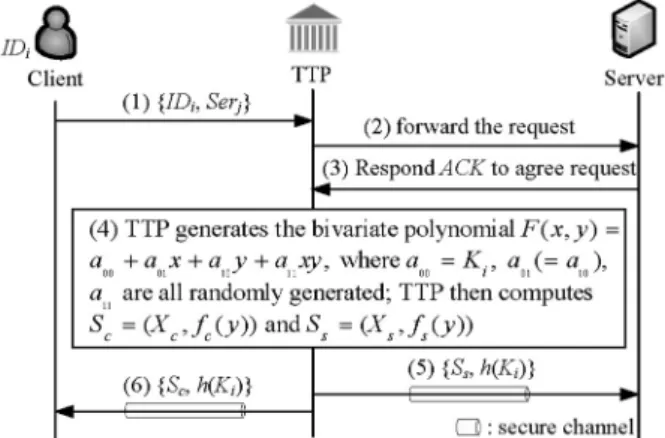
Suppose that we have a TTP in SCC system model [7]. Then, the polynomial F(x,y) = a00 +a01 +a10y+a11xycan be generated by TTP. Afterwards, TTP sends {Sc,h(Ki)} and
{Ss,h(Ki)}to the client and the cloud server, re-spectively, through a secure VPN channel. The mutual authentication phase and the key recov-ery phase in the key agreement with TTP are the same as those in the key agreement without TTP. As shown in Figure 4, we only describe the key sharing phase.
Figure 4.Key sharing phase in the key agreement with TTP.
(Step 1)If the clientIDi wants to share the se-cret key with the cloud server Serj, the client sends a request{IDi,Serj}to TTP.
(Step 2)TTP forwards this request to the cloud serverSerj.
(Step 3) The server responds a positive ac-knowledgement ACK to TTP for agreeing the request.
(Step 4) TTP generates a symmetric bivariate polynomialF(x,y) =a00+a01x+a10y+a11xy,
where a00 = Ki, a01(= a10), anda11 are ran-domly generated. Then, TTP computes Sc = (Xc,fc(y))andSs = (Xs,fs(y)).
(Steps 5 and 6) TTP sends {Ss,h(Ki)} and
{Sc,h(Ki)} to the cloud server and the client, respectively, through a secure channel.
4. Multi-Server Environment
A cloud service provider may build appropriate multi-server systems, and provides different ser-vices to clients. Each multi-server system con-tains multiple servers, which collaborate to pro-vide various services. Suppose that M servers (say Server #1, Server #2,. . ., Server #M)are devoted to serve a service application. If we use SCC approaches in Figure 2 and Figure 3, respectively, to perform authentication and key recovery, the client will repeatMtimes mutual authentication, and apply M times of key re-coveries to share M different secret keys with M servers, respectively. The proposed multi-server environment SCC(MSCC)takes the ad-vantage of summation homomorphism property of polynomial based secret sharing to efficiently finish authentication and key recovery, respec-tively, by a single operation.
Consider the case of multi-server environment that includesN servers, Serj, 1 ≤ j ≤ N, and n clients, IDi, 1 ≤ i ≤ n. Some notations in SCC should be modified for use in MSCC. For example, the share of clientSc is modified as the share of clientIDi with the correspond-ing cloud server Serj S(ci,j) = (Xc(i,j),fc(i,j)(y)). The selected polynomial betweenIDi andSerj is F(i,j)(x,y), and f(i,j)
c (y) = F(i,j)(Xc(i,j),y), whereXcused in SCC is changed toXc(i,j). For the share of server, the notation Ss is modified as Ss(i,j) = (Xs(i,j),fs(i,j)(y)), where fs(i,j)(y) = F(i,j)(Xs(i,j),y). Also, the notation Ki,j denotes
Lemma 1: IfF(i,j)(x,y), 1≤j≤M, is symmet-ric, then FM(x,y) = M
j=1
F(i,j)(x,y) is
symmet-ric.
Proof: We want to prove that the polyno-mial FM(x,y) is symmetric, i.e., FM(x,y) = FM(y,x). Because F(i,j)(x,y) is symmetric, it impliesF(i,j)(x,y) =F(i,j)(y,x). Therefore, we haveFM(x,y) =
M
j=1
F(i,j)(x,y) = M
j=1
F(i,j)(y,x) =
FM(y,x). The proof is completed.
Lemma 2: Suppose thatMsecret sharing sche-mes are constructed by polynomialsF(i,j)(x,y), 1≤ j ≤ M, respectively. The homomorphism property implies that the additive sum of shares ofF(i,1)(x,y),F(i,2)(xi,y), . . . ,andF(i,M)(xi,y)
(i.e.,F(i,1)(xi,y)+F(i,2)(xi,y)+. . .+F(i,M)(xi,y))
is the share of secret sharing constructed from the additive sum of polynomials FM(x,y) =
M
j=1
F(i,j)(x,y).
Proof: Construct a secret sharing scheme by FM(x,y) =
M
j=1
F(i,j)(x,y), and a share of this
se-cret sharing scheme isFM(xi,y). SinceFM(x,y)
= M
j=1F
(i,j)(x,y), we haveFM(xi,y) = M
j=1F
(i,j)
(xi,y). The proof is completed.
The above homomorphism property of bivariate polynomial is similar to the homomorphism in [31]. Additionally, there were some researches [32, 33]dedicated to authentication problem for multi-server. In this paper, we adopt the sum-mation homomorphism of polynomial to eas-ily and quickly finish authentication for multi-server environment in the proposed MSCC. As we know, the difference between SCC with TTP and SCC without TTP is the way of gener-ating polynomialF(x, y). Here, we only show MSCC with TTP to describe key sharing phase, mutual authentication phase, and key recovery phase.
Key Sharing Phase:
All steps in MSCC are same as those in Figure 4. Additionally, every IDi selects a common
numberXc(i)for all cloud servers, and then com-putes the multi share S1(i,j) = (Xc(i),f1(i,j)(y)), wheref1(i,j)(y) =F(i,j)(X(i)
c ,y). Also, all servers select a common number Xs(i) for the client IDi and then compute the multi share S(2i,j) = (Xs(i),f2(i,j)(y)), where f2(i,j)(y) =F(i,j)(Xs(i),y). Finally, both sides store multi sharesS(1i,j)(client) andS(2i,j) (server). Figures 5(a)and(b)are the contents stored in the clientIDi and the cloud serverSerj, respectively.
Figure 5.The contents stored in(a)the clientIDi (b)the cloud serverSerj.
Mutual Authentication Phase:
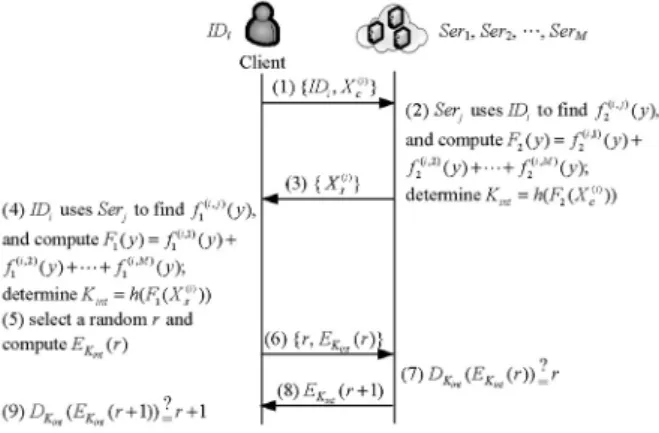
Suppose that the client IDi wants to log in a multi-server system including M servers (say Ser1,Ser2, . . . ,SerM). The common numbers Xc(i) and X(si) are used in MSCC to achieve the mutual authentication for theseMservers simul-taneously in one authentication operation. All steps in this mutual authentication are shown in Figure 6, and the details are briefly described below.
Figure 6.Mutual authentication phase in MSCC.
(Step 2)The cloud servers(Ser1,Ser2, . . .,SerM) useIDito find the correspondingf2(i,1)(y),f2(i,2) (y), . . . ,f2(i,M)(y), and computeF2(y) = M
j=1 f2(i,j)
(y). Then, determineKintfromKint=h(F2(Xc(i))). (Step 3)The cloud server sendsXs(i)to the client. (Step 4)The client also obtainsKint fromh(F1 (Xs(i))), where F1(y) =
M
j=1
f1(i,j)(y). Because
F1(X(si)) =F2(X(ci)) (see Theorem 1), the client and the cloud server can share the same inter-mediate keyKint.
(Step 5 – Step 9)Same as the steps in SCC.
Theorem 1: The valuesF1(X(si)) andF2(X(ci)) used in MSCC are equal.
Proof: Because F1(Xs(i)) = M
j=1f
(i,j)
1 (Xs(i)) and f1(i,j)(y) = F(i,j)(X(ci),y), we have F1(Xs(i)) =
M
j=1
F(i,j)(X(i)
c ,Xs(i)). Additionally, because
F2(X(ci)) = M
j=1
f2(i,j)(X(ci)) and f2(i,j)(y) = F(i,j)
(Xs(i),y), we have F2(Xc(i)) = M
j=1
F(i,j)(Xs(i),
Xc(i)). F(i,j)(x,y)is a symmetric bivariate poly-nomial, and thus F(i,j)(X(i)
c ,X(si)) = F(i,j)(Xs(i), Xc(i)). From Lemma 1, we have
M
j=1
F(i,j)(Xc(i),Xs(i))
= M
j=1
F(i,j)(Xs(i),Xc(i)), and implyF1(Xs(i)) =F2
(Xc(i)).
Key Recovery Phase:
In our MSCC, multiple servers collaborate to-gether to provide services. After the key re-covery phase, these multiple servers can share a common secret key with the client to secure the transmission and protect data privacy.
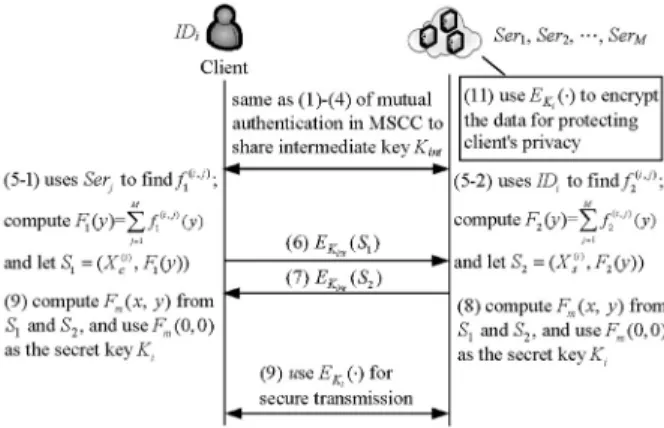
All steps in key recovery phase are shown in Figure 7, and the details are briefly described below.
Figure 7.Key recovery phase in MSCC.
(Step 1 – Step 4) Same as the steps of mutual authentication in MSCC, client and server share the intermediate keyKint.
(Step 5–1) From Ser1, Ser2, . . ., and SerM, client findsf1(i,j)and then computesF1(y) = M j=1 f1(i,j)(y). LetS1 = (X(ci),F1(y)).
(Step 5–2) These M servers find f2(i,j) forIDi, and then compute F2(y) =M
j=1f
(i,j)
2 (y). Let S2= (Xs(i),F2(y)).
(Step 6)The client sendsEKint(S1)to the cloud
servers.
(Step 7)The cloud servers sendEKint(S2)to the
client.
(Step 8) The cloud servers compute Fm(x,y) fromS1 andS2. Use Fm(0,0) =
M
j=1
Ki,j as the secret key Ki (note: the proof of Fm(0,0) =
M
j=1
Ki,jis given in Theorem 2).
(Step 9)The client does the same operation as in(Step 8).
(Step 10)UseEKi(·)to secure the transmission
between the client and this multi-server system. (Step 11) Moreover, we can use EKi(·) to
en-crypt the stored data in this multi-server system to protect the client’s privacy.
Theorem 2: The constant term inFm(x,y) is M
j=1Ki,j, i.e.,Fm(0,0) = M
Proof: Obviously, we can generate two shares of F(i,j)(x,y) by selecting x = X(ci) and Xs(i).
These two shares are (Xc(i),F(i,j)(X(ci),y)) and (Xs(i),F(i,j)(Xs(i),y)). Lemma 2 implies that the additive sum of shares, (Xc(i),
M
j=1
F(i,j)(X(i)
c ,y))
and(Xs(i), M
j=1
F(i,j)(X(i)
s ,y))are two shares of
ad-ditive sum of polynomials M j=1
F(i,j)(x,y). Since
S1=(Xc(i), M
j=1
f1(i,j)(y)) = (Xc(i), M
j=1
F(i,j)(Xc(i),y))
and S2 = (Xs(i), M
j=1f
(i,j)
2 (y)) = (Xs(i), M
j=1F
(i,j)
(Xs(i),y)) (see(Step 5–1)and(Step 5–2)). We can reconstruct the polynomial Fm(x,y) = M j=1
F(i,j)(x,y), and thusFm(0,0) =M
j=1
F(i,j)(0,0) =
M
j=1
Ki,j.
5. Performance, Security Analysis, and Applications
5.1. Performance Evaluation
Next, we discuss the following issues to com-pare Yeh’s PASS, the proposed SCC, and the proposed MSCC in detail.
Shares sent from server and client:
Although Yeh’s PASS[17]also uses secret shar-ing approach, its univariate polynomial does not have the symmetric property. Via the symmet-ric property of bivariate polynomial, our SCC and MSCC can share an intermediate key Kint between the client and the cloud servers. The client can use the symmetric encryption (e.g., AES)to send his share to the cloud server(i.e. the client sends EKint(S1) to the cloud server).
Also, the cloud server can sendEKint(S2)to the
client. However, in Yeh’s PASS, the client needs to use the public key of AS(Ds)to send its share ENCDs (client’s counter CSi) to AS. Instead
of using public cryptosystem, our scheme only uses symmetric encryption to transmit share be-tween AS and the client. Finally, we save the encryption/decryption cost.
Secret key:
A weakness of PASS using public cryptosys-tem to send the share is that the cloud server cannot send the server’s shareSSito the client. All clients know the public key of AS is rea-sonable, but AS knows public keys of all clients in cloud system are hard to achieve. Therefore, in PASS, the cloud server cannot send its share to the client by using public key cryptosystem. This causes that the client cannot recover the secret key from shares. Encryption/decryption in Yeh’s PASS should be accomplished with the help of ES and QS. If we easily store the se-cret key in the client side, the sese-cret key will be leaked out when the client’s device is com-promised. For example, the local computer or the smart card is cracked. In our schemes, the cloud server can also send its share using the in-termediate key, and thus the client can recover the secret key using his own share and the re-ceived share from the cloud server. Therefore, the client does not need to store the secret key. Authentication cost:
In Yeh’s PASS, AS decryptsCSiand then uses the stored SSi to recover the secret key Ki by Shamir’s(2, 2) secret sharing, as described in (Step 5)of Secret Key Agreement. By checking the hash value h(Ki), AS can verify the client. Our scheme adopts the symmetric property of F(x, y) (i.e., fs(Xc) = fc(Xs)) to share the in-termediate key, on which the authentication can be easily accomplished.
Mutual Authentication:
By the same intermediate key and using chal-lenge/response handshake, our scheme can achi-eve mutual authentication. Howachi-ever, the PASS can only finish the authentication of client. Homomorphism property in MSCC:
our MSCC can authenticateM servers simulta-neously in one operation. For key recovery, if using SCC for multi-server environment, we need M secret keys for these M servers. In MSCC, the homomorphism property lets the client share one common secret key with these M servers.
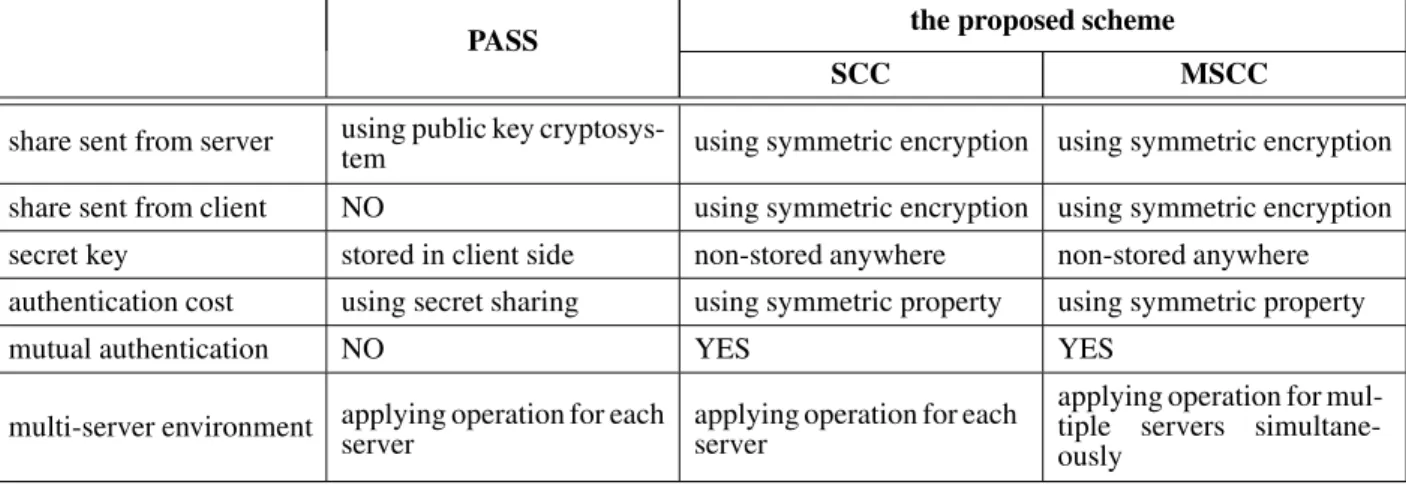
According to the above discussions, the com-parison among PASS, SCC and MSCC is sum-marized in Table 2.
5.2. Security Analysis
Our SCC has two types: one is with TTP and the other is without TTP. It is reasonable that TTP is assumed to be honest and is trusted by the client and the cloud server. For the SCC without TTP, we adopt ECDH to securely share the bivariate polynomial. Both types assure of securely sharing bivariate polynomial between the client and the cloud server. The main objec-tive of the proposed SCC/MSCC is to prevent malicious insiders in cloud server and outsiders to login the authorized account and determine the secret key.
We first define the scope of the security issues that our SCC and MSCC discuss:(i)outsider at-tack,(ii)insider attack. (iii)server side attack, and (iv) client side attack. Here, we use out-sider and inout-sider to represent the attacker who is unauthorized and authorized to the cloud server. For example, a hacker in the Internet is an out-sider, while a malicious cloud employee is an insider.
The difference between the protocols with TTP and without TTP is only the generation of bi-variate polynomial. So, we only give security analysis for SCC and MSCC for each security issue.
Outsider Attack:
An attacker from outside the perimeter is not authorized to access the cloud database. He can only intercept the information from the public channel, i.e., can only collect x-coordinates of the shares for the client and the cloud server.
SCC: As shown in Figure 2, the outsider can obtain the x-coordinate of client’s share Xc in (Step 1)and the x-coordinate of client’s share Xsin(Step 3). However, he does not havefc(y) and fs(y), and thus he cannot recover the in-termediate key Kint = h(fc(Xs)) = h(fs(Xc)). Because the shares and random number are en-crypted by Kint, the malicious attacker cannot obtain any information.
MSCC:All steps in MSCC are same as those in SCC except that every clientIDiselects a com-monx-coordinateXc(i) forM cloud servers and cloud servers also select a commonx-coordinate Xs(i) for the client IDi. By the same approach in SCC, we use the symmetric property to de-termineKint = h(F2(Xc(i))) = h(F1(Xs(i))) (see (Step 2) and (Step 4) in Figure 6). Although the attacker can get theX(ci) andXs(i)from pub-lic channel, he does not haveF1(y)andF2(y). Thus, attackers cannot recover the intermediate key. Same as SCC, the shares and random num-ber are encrypted byKint, finally the malicious attacker cannot obtain any information.
PASS the proposed scheme
SCC MSCC
share sent from server using public key cryptosys-tem using symmetric encryption using symmetric encryption
share sent from client NO using symmetric encryption using symmetric encryption
secret key stored in client side non-stored anywhere non-stored anywhere
authentication cost using secret sharing using symmetric property using symmetric property
mutual authentication NO YES YES
multi-server environment applying operation for eachserver applying operation for eachserver applying operation for mul-tiple servers simultane-ously
Insider Attack:
Suppose that malicious cloud employees can effectively acquire the access to an authorized database. So they can obtain the contents in Figure 5(b), i.e., they have server’s shares.
SCC: The share of the clientiand the serverj in SCC isSs(i,j). Although the insider hasSs(i,j), he does not have the client’s share S(ci,j). Due to the threshold of secret sharing, the malicious cloud employee cannot recover the polynomial F(i,j)(x,y). So, he cannot get the intermedi-ate key (using the symmetric property of poly-nomial) and the secret key(using the constant term of polynomial). The insider can get the hash value h(Ki,j)in database, but it is useless
to recover the secret key. On the other hand, the data of client is encrypted and protected by the secret key (see (Step 10) in key recovery phase of SCC). Finally, even though the mali-cious cloud employee can access the server, he gains nothing.
MSCC:The insider can get the shareS(si,j)from each server, and thus he can obtain the multi share S(2i,j) used in MSCC. However, he does not have the multi shareS1(i,j)in client side. So, the malicious cloud employee cannot recover the polynomialFm(x,y)in MSCC. Thus, same as SCC, the insider cannot get the intermedi-ate key and the secret key. Moreover, the hash value of secret keyh(Ki,j)in database is useless
to recover the secret keyKi = M
j=1
Ki,j. The data of client can be encrypted and protected by the secret key((Step 11) in key recovery phase of MSCC).
Server Side Attack:
The server side attack is defined as that the au-thorized cloud database is cracked by illegiti-mate users. Therefore, the contents in database (see Figure 5(b)) are revealed. The analysis of server side attack is same as that in insider attack. Illegitimate users gain nothing even though the cloud server is compromised. Client Side Attack:
Client side attack implies that the local devices (computer, smart phone, IC card,. . ., etc.) are cracked.
SCC:The attacker compromises the client side and gets the client’s share Sc(i,j) and the hash value h(Ki,j) in client side (see Figure 5(a)).
However, the attacker does not have the share S(si,j), and thus he cannot recover the polynomial F(i,j)(x,y)due to the threshold of secret sharing. The analysis of MSCC is similar.
Man-in-the-Middle-Attack:
The so-called man-in-the-middle attack [34]is that attackers can intercept messages and then either relay this message or substitute another message. Because ECDH algorithm is vulner-able to the man-in-the-middle attack, thus our SCC without TTP based on ECDH may also be vulnerable to such attack. In fact, this vulnera-bility comes from that server and client do not use identity authentication for each other in Fig-ure 1. It can be overcome with the use of digital signature and public-key certificate. Here, we adopt the approach of identification authentica-tion in[35]to resist man-in-the-middle attack in our scheme.
Our identification authentication is based on that server has saved a hash value of temporary IDi(TIDi)for each clientIDi. Note: thisTIDi is effective for a period, and should be renewed at the end of its lifetime. Also, the client has his ownTIDi. The concept ofTIDiis similar to the temporary mobile station identification(TMSI) in mobile communication protocol.
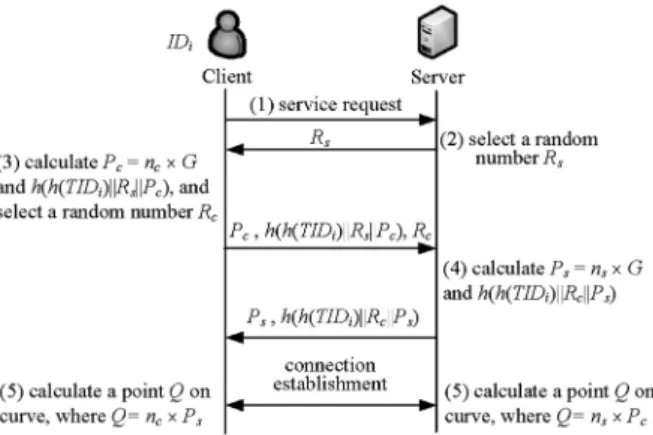
Steps (1)–(4) in Figure 1 are modified as the following five steps in Figure 8 to resist man-in-the-middle attack.
(Step 1)Client provides a service request.
(Step 2)Cloud server selects a randomRs and sends it to the client.
(Step 3)Client randomly selectsnc and calcu-latesPc =nc×G. Also, he uses his ownTIDito calculateh(h(TIDi)RsPc). Then, he selects a random Rc, and sends (Pc, h(h(TIDi)RsPc), Rc)to the cloud server.
(Step 4)Cloud server selectsns and calculates Ps = ns × G. Also, it uses h(TIDi) to cal-culate h(h(TIDi)RcPs). Then, it sends (Ps, h(h(TIDi)RcPs)to the client.
(Steps 5) Both sides verify whether the hash value is correct or not. If the verification is cor-rect, the client and the cloud server calculate a pointQon elliptic curve bync×Psandns×Pc, respectively.
5.3. Applications
In this paper, we propose two types of secure cloud computing: one is SCC and the other is MSCC. Also, the key sharing in both SCC and MSCC can be implemented with using TTP and without using TTP, respectively.
Here, we show two scenarios where our schemes can be applied: (i)single server or multi server (SCC or MSCC) (ii) using TTP or not using TTP(with TTP or w/o TTP)for key sharing. SCC or MSCC:
In SCC, a cloud server can provide services to customers alone. For some applications, the ser-vices need to be accomplished through different servers. In MSCC, a service provider may or-ganize resources and builds appropriate multi-server systems to provide various services to customers. Each multi-server system contains multiple servers, which can be devoted to serve one type of service requests and applications. However, more servers increase authentication cost when using SCC approach. Our MSCC is based on SCC, and uses the same approach through summation homomorphism. There-fore, when customers submit service requests to a service provider, the service provider deter-mines adopting SCC (single server)or MSCC (multiple servers)for providing services. As we know, everything on one server ( single-server environment) is easy for setting up an application quickly. However, it offers little in
the way of scalability and component isolation. Suppose that application and database contend for the same server resources. This case may cause poor performance. To prevent this prob-lem, a multiple-server environment is the most common application scenario. For example, we may install Microsoft Internet Information Ser-vices (IIS) and Microsoft SQL Server on dif-ferent computers. On the other hand, cloud computing is a large-scale distributed comput-ing paradigm where computcomput-ing resources are available to users. Therefore, a multi-server environment has the good scalability.
Here, we use an example of integrating multi servers to improve the performance in cloud computing [36] to demonstrate our advantage. For example, we can adopt the approach of us-ingload balancersto implement the server se-tups in cloud computing. Via distributing the workload across multiple servers, we can en-hance not only the performance but also the reliability. When one of the servers fails, other servers will handle the traffic until it recovers from a server failure.
With TTP or w/o TTP:
When using TTP to implement the key sharing phase, we need a secure channel, e.g., VPN, and this enhances the transmission cost. Also, we need a third party in SCC/MSCC. If we use ECDH in key sharing phase, we do not need TTP. However, Diffie Hellman-like proto-col will be compromised by the so-called clog-ging attack, in which an opponent sends a pub-lic Diffie Hellman key to the AS. The AS then computes the secret key. Repeated messages of this type can clog AS with useless work. As a result, AS spends considerable computing re-sources for doing useless computation.
6. Conclusion
SSC to MSCC, fitting the multi-server environ-ment. When compared with the previous PASS, our schemes have the better security and perfor-mance.
Acknowledgment
This research was supported in part by the Min-istry of Science and Technology under Grant 102-2221-E-259-009-MY2 and 103-2221-E-25 9-015.
References
[1] National Institute of Standards and Technology,The NIST definition of cloud computing. Information Technology Laboratory, 2009.
[2] K. STANOEVSKA-SLABEVA, T. WOZNIAK, S. RISTOL,
Grid and cloud computing – a business perspective on technology and applications. Springer-Verlag, Berlin, Heidelberg, 2009.
[3] Z. HUANG, C. MEI, L. LI, T. WOO, CloudStream:
delivering high-quality streaming videos through a cloud-based SVC proxy. Proc. of 2011 IEEE Infocom,(2011)USA.
[4] C. ROBERTSON, B. MACINTYRE, B. WALKER, An
evaluation of graphical context as a means for ameliorating the effects of registration error.IEEE Transactions on Visualization and Computer Graph-ics,15,(2009)pp. 179–192.
[5] Y. CHEN, Z. DU, M. GARCIA–ACOSTA, Robot as a
Service in Cloud Computing. Proc. of 2010 Fifth IEEE International Symposium on Service Oriented System Engineering,(2010)USA.
[6] T. K. MENDHE, P. A. KAMBLE, A. K. THAKRE,
Sur-vey on security, storage, and networking of cloud computing.International Journal on Computer Sci-ence and Engineering,4(2012), 1780–1785. [7] D. ZISSIS, D. LEKKAS, Addressing cloud
comput-ing security issues. Future Generation Computer Systems,3(2012), 583–592.
[8] M. D. RYAN, Cloud computing security: the sci-entific challenge, and a survey of solutions. The Journal of Systems and Software, (2012). (doi: http://dx.doi.org/10.1016/j.jss.2012.12 .025)
[9] S. A. ALMULLA, C. Y. YEUN, New secure storage architecture for cloud computing.Communications in Computer and Information Science,184(2011), pp. 75–84.
[10] D. J. HUANG, Z. B. ZHOU, L. XU, T. T. XING, Y.
J. ZHONG, Secure data processing framework for mobile cloud computing.Proc. of 2011 IEEE Con-ference on Computer Communications,(2011)pp. 614–618.
[11] J. S. LIN, Cloud data storage with group
collabo-ration supports.Communications in Computer and Information Science,136(2011)pp. 423–431. [12] G. W. XU, C. L. CHEN, H. Y. WANG, Z. P. ZANG, M.
G. PANG, P. JIANG, Two-level verification of data integrity for data storage in cloud computing. Com-munications in Computer and Information Science,
143(2011)pp. 439–445.
[13] L. ZHOU, V. VARADHARAJAN, M. HITCHENS,
En-forcing role-based access control for secure data storage in the cloud. The Computer Journal, 54
(2011), 1675–1687.
[14] Y. REN, J. SHEN, J. WANG, J. HAN, S. LEE, Mutual
verifiable provable data auditing in public cloud storage.Journal of Internet Technology,16(2015), 317–323.
[15] Z. XIA, X. WANG, X. SUN, Q. WANG, A secure and dynamic multi-keyword ranked search scheme over encrypted cloud data. IEEE Transactions on Parallel and Distributed Systems, (2015). doi: 10.1109/TPDS.2015.2401003
[16] Z. FU, X. SUN, Q. LIU, L. ZHOU, J. SHU, Achiev-ing efficient cloud search services: multi-keyword ranked search over encrypted cloud data supporting parallel computing. IEICE Transactions on Com-munications,E98-B, pp. 190–200, 2015.
[17] J. H. YEH, A PASS scheme in cloud computing –
protecting data privacy by authentication and se-cret sharing.Proc. of International Conference on Security and Management,(2011).
[18] R. D’SOUZA, D. JAO, I. MIRONOV, O. PANDEY,
Pub-licly verifiable secret sharing for cloud-based key management.Proc. of 2011 Indocrypt, pp. 290–309, 2011.
[19] H. Y. LIN, C. Y. YANG, M. Y. HSIEH, Secure map reduce data transmission mechanism in cloud com-puting using threshold secret sharing scheme. Soft-ware Engineering and Knowledge Engineering,2, pp. 761–769, 2012.
[20] S. NIRMALA, S. BHANU, A. PATEL, A comparative
study of the secret sharing algorithms for secure data in the cloud.International Journal on Cloud Computing: Services and Architecture, 2 (2012), 63–71.
[21] J. CAO, K. HWANG, K. LI, A. ZOMAYA, Optimal
multiserver configuration for profit maximization in cloud computing.IEEE Transactions on Parallel and Distributed Systems,24,(2013)pp. 1087–1096. [22] A. SHAMIR, How to share a secret.Communications
of the ACM,22, pp. 612–613, 1979.
[23] G. R. BLAKLEY, Safeguarding cryptographic keys.
Proc. of AFIPS’79 National Computer Conference,
48, pp. 313–317, 1979.
[24] S. TAKAHASHI, K. IWAMURA, Secret sharing scheme
[25] R. CRAME, I. DAMGARD, S. DZIEMBOWSKI, M. HIRT,
T. RABIN, Efficient multiparty computations secure
against an adaptive adversary. Proc. of EURO-CRYPT 1999, LNCS,1592, pp. 311–326, 1999.
[26] R. GENNARO, Y. ISHAI, E. KUSHILEVITZ, T. RABIN, The round complexity of verifiable secret sharing and secure multicast. Proc. of STOC 2001, pp. 580–589, 2001.
[27] M. FITZI, J. GARAY, S. GOLLAKOTA, C. P. RANGAN, K. SRINATHAN, Round–optimal and efficient
verifi-able secret sharing.Proc. of TCC 2006, LNCS3876, pp. 329–342, 2006.
[28] J. KATZ, C. Y. KOO, C. Y., R. KUMARESAN, Improv-ing the round complexity of VSS in point-to-point networks.Information and Computation, 207, pp. 889–899, 2009.
[29] A. PATRA, A. CHOUDHARY, T. RABIN, C. P. RANGAN,
The round complexity of verifiable secret sharing revisited.Proc. of CRYPTO 2009, LNCS5677, pp. 487–504, 2009.
[30] R. KUMARESAN, A. PATRA, C. P. RANGAN, The
round complexity of verifiable secret sharing: the statistical case. Proc. of ASIACRYPT 2010, LNCS
6477, pp. 431–447, 2010.
[31] J. C. BENALOH, Secret sharing homomorphisms: keeping shares of a secret.Proc. of the Crypto’86, LNCS263, pp. 251–260, 1987.
[32] X. LI, Y. XIONG, J. MA, W. WANG, An efficient and security dynamic identity based authentication pro-tocol for multi-server architecture using smart cards.
Journal of Network and Computer Applications,35
(2012), 763–769.
[33] X. LI, J. MA, W. WANG, Y. XIONG, J. ZHANG, A novel smart card and dynamic ID based remote user authentication scheme for multi-server envi-ronment. Mathematical and Computer Modelling,
58, pp. 85–95, 2013.
[34] R. RIVEST, A. SHAMIR, How to expose an
eaves-dropper.Communications of the ACM, April, 1984.
[35] T. HAN, N. ZHANG, K. LIU, B. TANG, Y. LIU, Analy-sis of mobile WiMAX security: vulnerabilities and solutions. IEEE 5th International Conference on Mobile Ad Hoc and Sensor Systems (MASS),(2008) pp. 828–833.
[36] V. INDHUMATHI, D. ANITHA, Integration of
mul-tiserver for profit efficiency in cloud computing.
International Journal of Current Engineering and Technology,4(2014), 500–503.
Received:December, 2014
Revised:April, 2015
Accepted: August, 2015
Contact addresses:
Ching-Nung Yang Department of Computer Science and Information Engineering National Dong Hwa University Hualien, Taiwan e-mail:[email protected] Jia-Bin Lai Department of Computer Science and Information Engineering National Dong Hwa University Hualien, Taiwan e-mail:[email protected] Zhangjie Fu School of Computer and Software Nanjing University of Information Science and Technology Nanjing, China e-mail:[email protected]
CHING-NUNGYANGreceived the B.S. Degree and the M.S. degree, both from Department of Telecommunication Engineering at National Chiao Tung University. He received the Ph.D. Degree in electrical engineering from National Cheng Kung University. He is presently a professor in the Department of Computer Science and Information Engineering at National Dong Hwa University, Hualien, Taiwan, and is also an IEEE senior member. He has published a number of journal and conference papers in the areas of information security, multimedia security and coding theory. He is the guest editor of a special issue on “Visual Cryptography Scheme” for Communication of CCISA, and a coauthor of a series of articles on “Image Secret Sharing” for the Encyclopedia of Multimedia. He is the coeditor of two books “Visual Cryptography and Secret Image Sharing” published by CRC Press/Taylor & Francis, and “Steganography and Watermarking” published by Nova Science Publishers, Inc. He serves as a technical reviewer for over 30 major scientific journals in the areas of his expertise, and serves in editorial boards of some journals. Also, he has served as a member of program committees of various international conferences. He is the recipient of the 2000, 2006, 2010, 2012, and 2014 Fine Advising Award in the The-sis of Master/PhD of Science, awarded by the Institute of Information & Computer Machinery. His current research interests include coding theory, information security, and cryptography.
JIA-BINLAIis a graduate student with the Department of Computer Science and Information Engineering, National Dong Hwa University, Hualien, Taiwan. His current research interests include network secu-rity and secret sharing