Okaforet al. Perceptions of Infertility and In-vitro Fertilization Treatment
African Journal of Reproductive Health December 2017; 21 (4):55
ORIGINAL RESEARCH ARTICLE
Perceptions of Infertility and
In Vitro
Fertilization Treatment among
Married Couples in Anambra State, Nigeria
DOI: 10.29063/ajrh2017/v21i4.6
Nneka I. Okafor
1, Ngozi N. Joe-Ikechebelu
2and Joseph I. Ikechebelu
3*
Department of Sociology/Anthropology, Faculty of Social Sciences, Nnamdi Azikiwe University, Awka, Anambra State, Nigeria1; Department of Community Medicine, Chukwuemeka Odimegwu Ojukwu University Teaching Hospital, Amaku Awka, Anambra State, Nigeria2; Department of Obstetrics & Gynaecology, Faculty of Medicine, Nnamdi Azikiwe University, Nnewi Campus, Anambra State, Nigeria3
*For Correspondence: Email: [email protected]; Phone: +2348034044189
Abstract
There is a high rate of infertility among couples in Nigeria. This challenge is perceived differently in each socio-cultural context in which it is experienced but solution to the problem is adversely affected by the people‘s perception of the phenomenon. This study thus explored the perceptions of infertility and in vitro fertilization (IVF) and how to enhance the use of IVF treatment among married couples. This was a cross-sectional survey in Anambra State, Nigeria involving household respondents (married couples) and hospital respondents (couples undergoing infertility evaluation). Structured questionnaire and key informant interview (KII) guide were used for data collection. Altogether 600 questionnaires were administered and 589 were validly completed and analysed. The main outcome measures included perceptions of infertility and IVF treatment, utilization of IVF treatment and association between some demographic variables and IVF utilization. The results showed that infertility was perceived majorly as - destiny/supernatural powers (17.1%), threat to men‘s procreativity/continuity of lineage (14.3%), women‘s problem only (15.6%). Solutions to the challenges were adversely affected by perception. The use of IVF treatment was low with misconceptions like it‘s too costly (15.4%) and unnatural (7.6%), giving rise to unmet need for assisted reproductive technology. Women (especially above 35 years) were more likely to accept IVF treatment than men. Reproductive health education and awareness creation should target the misconceptions about infertility/IVF and fertility treatment should be covered by national health insurance to reduce the cost of IVF treatment and improve its use in Anambra State. (Afr J Reprod Health 2017; 21[4]:55-66).
Keywords: Married couples, Infertility, In vitro fertilization, Perception, Anambra State, Nigeria
Résumé
Il y a un taux élevé de stértilité parmi les couples au Nigéria. Ce défi est perçu différemment dans chaque contexte socioculturel dans lequel il est vécu, mais la perception du phénomène par les gens nuit à la solution du problème. Cette étude a donc exploré les perceptions de la stérilité et de la fécondation in vitro (FIV) et comment améliorer l'utilisation de la FIV chez les couples mariés. Il s'agissait d'une enquête transversale menée dans l'État d'Anambra, au Nigéria, auprès de ménages interrogés (couples mariés) et d'hôpitaux (couples subissant une évaluation de la stérilité). Un questionnaire structuré et un guide d'entretiens avec des informateurs clés (EIC) ont été utilisés pour la collecte de données. Au total, 600 questionnaires ont été administrés et 589 ont été valablement complétés et analysés. Les principales mesures des résultats comprenaient la perception de l'infertilité et le traitement par FIV, l'utilisation du traitement par FIV et l'association entre certaines variables démographiques et l'utilisation de la FIV. Les résultats ont montré que la stérilité était perçue majoritairement comme - destinée / pouvoirs surnaturels (17,1%), menace pour la procréation chez des hommes / continuité de la lignée (14,3%), problème des femmes seulement (15,6%). Les solutions aux défis ont été négativement affectées par la perception. L'utilisation du traitement de FIV était faible avec des idées fausses telles que le coût excessif (15,4%) et non naturel (7,6%), ce qui donne lieu à un besoin non satisfait de technologie de reproduction assistée. Les femmes (surtout au-dessus de 35 ans) étaient plus susceptibles d'accepter un traitement de FIV que les hommes. L'éducation et la sensibilisation en matière de la santé de la reproduction devraient cibler les idées fausses sur la stérilité / FIV et le traitement de fertilité devrait être couvert par l'assurance maladie nationale pour réduire le coût du traitement FIV et améliorer son utilisation dans l'État d'Anambra. (Afr J Reprod Health 2017; 21[4]: 55-66).
Mots-clés: Couples mariés, Infertilité, Fécondation in vitro, Perception, État d'Anambra, Nigéria
Introduction
Nigeria has high rates of primary and secondary infertility1. The results of the Demographic and Health Survey of Nigeria2, indicate that
Okaforet al. Perceptions of Infertility and In-vitro Fertilization Treatment
African Journal of Reproductive Health December 2017; 21 (4):56
as a disease of the reproductive system that affects individuals and groups8. It is medically defined as the inability to achieve a pregnancy after a year or more of regular unprotected sexual intercourse9. In fact, ―Infertility belts‖ has been described in sub-Saharan African countries (SSA) where about 20-35 million couples are affected by the inability to give birth to a child10,11.
Medical advances have shown that most cases of infertility are treatable. All kinds of assisted reproductive technologies (ART) have been introduced to eliminate infertility problems. ART options include: intrauterine insemination (IUI), in-vitro fertilization (IVF), gamete intra fallopian transfer (GIFT), intracytoplasmic sperm injection
(ICSI)12. These are advanced medical techniques that aid conception in women in order to fulfill the personal and societal ideal of having children13. IVF has been used safely and effectively for more than two decades for successful treatment of infertility14. Since the first IVF baby was born in 1978 in England, the number of cycles performed in many developed countries has grown by 5–10% per annum over the past decades4,15-16. It is estimated that approximately 3.5 to 5 million children have been born worldwide following ART treatment17. There are no accurate figures and proper documentation of success rates in many African countries18, but in Nigeria, IVF has changed the prospect of thousands of married couples that were unable to have children.
Success rate varies from centre to centre, most importantly according to the patient‘s age. For women under 30 years of age, the success rate is approaching 60% while for those between 30 to 35 years, the success is about 50%, for those between 35 to 40 years, it is about 40% and over 40 years, it is about 33%6,19. According to available statistics based on the performance indicator from various centres across the country, it is estimated that over 40,000 babies have been born through IVF in Nigeria since 19894,5,20. The first IVF birth in sub Saharan Africa was led by the Dapo Ashiru and Giwa-Osagie team on March 17, 1989, at the Lagos University Teaching Hospital (LUTH), Idi-Araba 4,21. According to Ashiru21, Nigeria has recorded 40% increase in IVF pregnancy success rate from 10% in the 70s to 50% in the 2010s. The first IVF birth in Anambra state wasachieved by Joseph Ikechebelu‘s teamon August 6th, 2011, at Life Specialist Hospital, Nnewi23-25. Since the birth of baby Joseph (Anambra state‘s first
IVF birth) in 2011; more than 70 babies have been born through IVF in this centre26.
Some couples view IVF as a good option, however, many others are hesitant about it because there are a lot of misconceptions about IVF in Nigeria and in Igbo land in particular. IVF is perceived as a new phenomenon shrouded in secrecy and stigma due to social and cultural encumbrances, norms and values about natural process of reproduction, ignorance, and religious sentiments. Also, failure of IVF treatment after paying so much money plays prominent roles in Nigeria, and these are potential factors that may influence the use of IVF in the state. Therefore, the aim of this study was to explore the perceptions of infertility and IVF treatment among married couples in Anambra state, Nigeria.
Theoretical framework
Herbert Blumer‘s Symbolic Interactionist (SI) Theory which is a variant of the functionalist perspective with emphasis on meaning is adopted for the study to explain human behavior as it relates to perceptions and their influence on the use of in vitro
Okaforet al. Perceptions of Infertility and In-vitro Fertilization Treatment
African Journal of Reproductive Health December 2017; 21 (4):57
Methods
This was a cross-sectional survey in Anambra State, Nigeria involving household respondents (married couples) and hospital respondents (patients undergoing infertility evaluation). The study sample included a total of 600 married couples aged 18 years and above who were resident in Anambra state at the time of this study and were selected using the multi-stage sampling technique made up of cluster, simple random sampling and systematic sampling techniques. First, Anambra State was clustered into three Senatorial Districts made up of seven LGAs each, then using the balloting method of simple random sampling technique, two clusters were selected namely Anambra Central and Anambra South. The LGAs in the selected two clusters were numbered and then with the application of the simple random sampling technique, two LGAs were selected namely Awka South from Anambra Central and Nnewi North from Anambra South. The population of Awka South and Nnewi North LGAs - 345,097 were employed as the target population31. Then, married couples aged 18 years and above who are resident in Awka South and Nnewi North LGAs with a total population of 190,370 representing 55% of the target population were used as the study participants31. The sample size was statistically estimated and generated using the population proportion formula as follows:
n=Z
2(PQ)
e
2where:
n= sample size
Z= confidence level (95% or 1.96%)
P= population proportion (or its estimate 55%) Q= compliment of P
e= level of precision (0.042)
Therefore, the sample size is calculated thus: n= 1. 962 (.55)(.45)
0.042 n= 594.18
This figure was rounded up to six hundred (600).
Ten participants were interviewed using Key Informant Interview (KII) guide. They were purposively selected and include 2 medical practitioners (involved in IVF treatment), 4 women who had IVF treatment in the past and 4 who have not used IVF treatment.
The 600 participants were selected from the household and hospital participants as follows. The communities in Awka South and Nnewi North, were numbered and by simple random sampling, one community was selected from each namely Awka town in Awka South LGA and Umudim in Nnewi North LGA. Then the villages/streets in the 2 selected communities were numbered and by simple random sampling one village was selected from each of the two communities namely: Obunagu in Awka and Umuele, in Umudim Nnewi. Finally, households in the selected village/street were numbered and the systematic sampling technique was employed to select every kth household in the sampling frame from which a couple was selected as a respondent for the study. The sequence continued until a total of three hundred (300) respondents were drawn from the communities. Households without married couples aged 18years and above were skipped.
Specifically, in Nnewi North LGA, Life Specialist Hospital Ltd Nnewi was purposively chosen (the only hospital offering IVF treatment in Anambra state at the time of the study) to administer the questionnaires to three hundred (300) married couples seeking fertility treatment in the hospital using availability sampling technique.
Data were collected using the pre-tested questionnaire and the key informant interview (KII) guide. Informed consent was obtained from and questionnaires administered to sampled participants. The survey contained questions regarding demographic data, including sex, age, age at first marriage, duration of marriage, frequency of marriage, education, occupation, annual income and religion. Questions addressing views about infertility, causes of infertility, the experience of infertility, awareness of IVF treatment, sources of IVF treatment information, views about IVF treatments, as well as questions on utilization of IVF treatment were included in the questionnaire. Ethical approval was obtained from the ethical review board of Nnamdi Azikiwe University Teaching Hospital, Nnewi.
Okaforet al. Perceptions of Infertility and In-vitro Fertilization Treatment
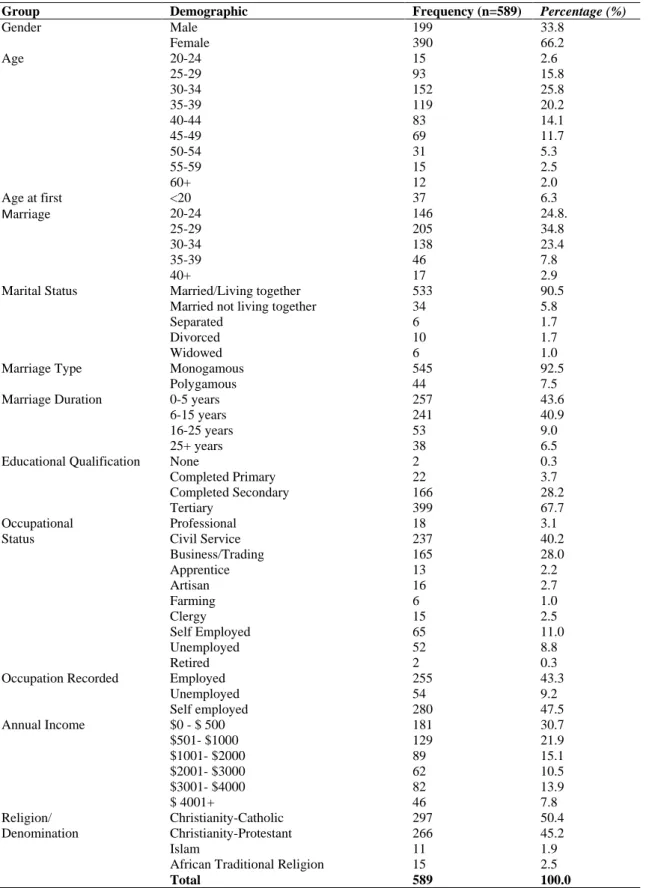
African Journal of Reproductive Health December 2017; 21 (4):58 Table 1: Distribution of Respondents by Socio-demographic Characteristics
Group Demographic Frequency (n=589) Percentage (%)
Gender Male 199 33.8
Female 390 66.2
Age 20-24 15 2.6
25-29 93 15.8
30-34 152 25.8
35-39 119 20.2
40-44 83 14.1
45-49 69 11.7
50-54 31 5.3
55-59 15 2.5
60+ 12 2.0
Age at first Marriage
<20 37 6.3
20-24 146 24.8.
25-29 205 34.8
30-34 138 23.4
35-39 46 7.8
40+ 17 2.9
Marital Status Married/Living together 533 90.5
Married not living together 34 5.8
Separated 6 1.7
Divorced 10 1.7
Widowed 6 1.0
Marriage Type Monogamous 545 92.5
Polygamous 44 7.5
Marriage Duration 0-5 years 257 43.6
6-15 years 241 40.9
16-25 years 53 9.0
25+ years 38 6.5
Educational Qualification None 2 0.3
Completed Primary 22 3.7
Completed Secondary 166 28.2
Tertiary 399 67.7
Occupational Status
Professional 18 3.1
Civil Service 237 40.2
Business/Trading 165 28.0
Apprentice 13 2.2
Artisan 16 2.7
Farming 6 1.0
Clergy 15 2.5
Self Employed 65 11.0
Unemployed 52 8.8
Retired 2 0.3
Occupation Recorded Employed 255 43.3
Unemployed 54 9.2
Self employed 280 47.5
Annual Income $0 - $ 500 181 30.7
$501- $1000 129 21.9
$1001- $2000 89 15.1
$2001- $3000 62 10.5
$3001- $4000 82 13.9
$ 4001+ 46 7.8
Religion/ Denomination
Christianity-Catholic 297 50.4
Christianity-Protestant 266 45.2
Islam 11 1.9
African Traditional Religion 15 2.5
Total 589 100.0
between variables in the study. The differences were compared using chi-square (X2) inferential statistics
Okaforet al. Perceptions of Infertility and In-vitro Fertilization Treatment
African Journal of Reproductive Health December 2017; 21 (4):59
Results
A total of six hundred (600) respondents from households and hospitals in Awka South and Nnewi North LGAs were approached out of which five hundred and eighty-nine (589) respondents validly completed the questionnaires. Majority of the respondents in the study were females 390(66.2%). The age range of the respondents was 20 to 65 years and the mean age was 37.59 years + 9.2SD and a median age of 36.00 years. Majority of the respondents were in monogamous setting 545(92.5%) and living together with their spouse 533(90.5%). The duration of infertility ranged from 1 to 25 years. Majority of the respondents had attained higher (tertiary) education (399; 67.7%), were employed [255(43.3%) employed by others and 280(47.5%) self-employed], with annual income of N1,000,000 (equivalent of $4000 USD) and below (543; 92.2%). The majority were Christians 563(95.6%) [Catholics 297(50.4%) and Protestants 266(45.2%)] (Table 1)
Perceptions on infertility
Respondents‘ views about infertility show that most of the respondents perceive infertility in one of these four major ways: (a) a predestined supernatural problem, [101(17.1%) respondents; 44(22.1%) males and 57(14.6%) females]. (b) a threat to men‘s procreativity/continuity of lineage [84(14.3%) respondents; 33(16.6%) males and 51(13.1%) females]. (c) women only problem [71(12.1%) respondents; 31(15.6%) males and 40(10.3%) females]. (d) state of childlessness [66(11.2%) respondents; 13(6.5%) males and 53(13.6%) females] (Table 2). A respondent for the KII however did not agree with these major perceptions about infertility. According to him;
Infertility is basically a medical condition which equally requires a medical cure. However, because Igbo culture is particularly rooted in a lot of fetish or supernatural projections, it tends to influence people‘s perceptions of things or events in Anambra state. Most people believe that their inability to conceive is usually caused by evil spirits/people and that is the reason for incessant increase in spiritual or traditional treatments for infertility in Igbo culture. Some others erroneously may perceive infertility as a punishment from God even
when God said that none shall be barren.
(Male medical practitioner, aged 50 years).
To further assess views of respondents on causes of infertility, their responses indicated that of all the couples who are experiencing infertility, 39(19.6%) male and 65(16.7%) female respondents said that it may be due to destiny or spiritual attacks/witchcraft; 35(17.6%) male and 41(10.5%) female respondents said sperm abnormalities; (Table 3). A KII respondent stated:
There are male factor causes like no sperm, low sperm, abnormal sperm, blocked spermatic passage/duct, erectile dysfunction, systemic diseases like neurological problem etc. Female factors include factors affecting the womb e.g. fibroid, uterine synechia, abnormal womb, absence of the womb; tubal factors e.g. blocked fallopian tube; ovulatory factors e.g. lack of or poor egg production; peritoneal factors e.g. adhesions from previous operation; endometriosis, hyper-prolactinemia, stress, etc. Unexplained or unknown factors are causes that available medical investigations to have not been able to ascertain the cause of the infertility (Male medical practitioner, aged 55 years).
To assess awareness level of respondents by their experience of infertility and the nature of infertility, more than half of the respondents 323 (54.8%) had experienced some difficulty in getting pregnant or impregnating their spouse and 250 (42.4%) said they never did, while 16 (2.7%) respondents were uncertain in their response.
The study further reviewed the type of infertility they had experienced. The commonest form of infertility reported by the respondents was primary infertility (230; 39.0%). Secondary infertility was reported by 93 (15.8%) respondents, 250(42.4%) did not have any fertility challenge and 16(2.7%) were not aware of any fertility challenge. This result shows that married couples are aware of the nature of infertility they had. This is not surprising especially in South-Eastern Nigeria generally and Igbo culture where couples with recurrent pregnancy loss - ‗ume
Okaforet al. Perceptions of Infertility and In-vitro Fertilization Treatment
African Journal of Reproductive Health December 2017; 21 (4):60 Table 2: Distribution of Respondents by Perception of Infertility
Response Male Female Total
It is a medical condition 20(10.1%) 38(9.7%) 58(9.8%)
It is a public health problem 3(1.5%) 14(3.6%) 17(2.9%)
It is an individual/private problem 9(4.5%) 23(5.9%) 32(5.4%)
It is undesirable 14(7.0%) 34(8.7%) 48(8.1%)
It means that one is childless 13(6.5%) 53(13.6%) 66(11.2%)
It is Socio-culturally constructed 10(5.0%) 24(6.2%) 34(5.8%)
It is a problem of women only 31(15.6%) 40(10.3%) 71(12.1%)
It is a problem of men only 1(0.5%) 11(2.8%) 12(2.0%)
It is men and women problem 18(9.0%) 32(8.2%) 50(8.5%)
It is predestined by God/supernatural problem 44(22.1%) 57(14.6%) 101(17.1%)
It is a punishment for ungodly behaviours 3(1.5%) 13(3.3%) 16(2.7%)
It is a threat to procreativity/continuity of lineage 33(16.6%) 51(13.1%) 84(14.3%)
Other, specify - - -
Total 199(100%) 390(100%) 589(100%)
Table 3: Distribution of Respondents‘ by Causes of Infertility
Response Male Female Total
Blocked fallopian tube 32(16.1%) 41(10.5%) 73(12.4%)
Perforated fallopian tube 2(1.0%) 15(3.8%) 17(2.9%)
Sperm abnormalities 35(17.6%) 54(13.8%) 89(15.1%)
Infection /STDs/Abortion 21(10.6%) 49(12.6%) 70(11.9%) Previous use of contraceptive device 9(4.5%) 41(10.5%) 50(8.5%) Destiny/Spiritual attack/Witchcraft 39(19.6%) 65(16.7%) 104(17.7%)
Exposure to toxic waste 3(1.5%) 11(2.8%) 14(2.4%)
Nutritional deficiency 8(4.0%) 11(2.8%) 19(3.2%)
Life style 29(14.6%) 47(12.1%) 76(12.9%)
Early age of marriage & first conception/attendant problems
5(2.5%) 14(3.6%) 19(3.2%)
Unexplained/Unknown 16(8.0%) 42(10.8%) 58(9.8%)
Total 199(100%) 390(100%) 589(100%)
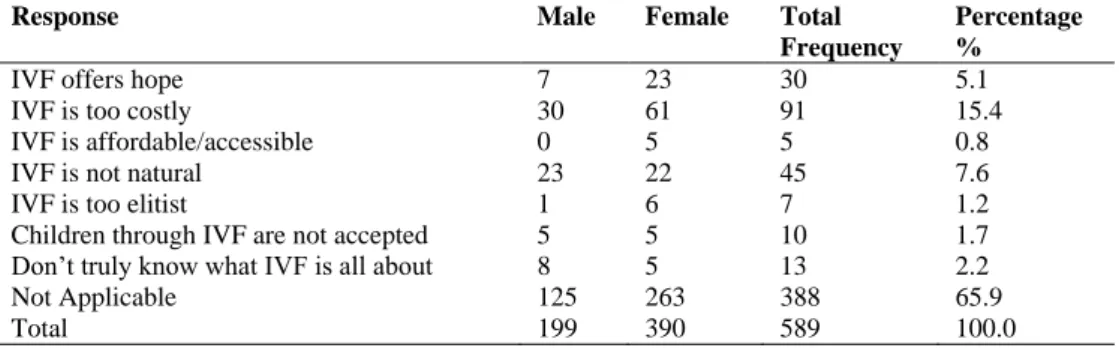
Table 4: Distribution of Respondents by Perception of In Vitro Fertilization (IVF)
Response Male Female Total
Frequency
Percentage %
IVF offers hope 7 23 30 5.1 IVF is too costly 30 61 91 15.4 IVF is affordable/accessible 0 5 5 0.8 IVF is not natural 23 22 45 7.6 IVF is too elitist 1 6 7 1.2 Children through IVF are not accepted 5 5 10 1.7 Don‘t truly know what IVF is all about 8 5 13 2.2
Not Applicable 125 263 388 65.9
Total 199 390 589 100.0
(that is those who have never experienced conception at all) who are viewed with disdain.
Perceptions of IVF
Two hundred and one (34.1%) of the respondents had heard about IVF before reading the information about it in the questionnaire, while two-third of the respondents 388(65.9%) had never heard about IVF. Views of respondent on source of IVF information showed that the commonest source was through family relations 86(14.6%) while the internet is the
least source (18; 3.1%) The other sources were friends (58; 9.8%), health facility (20; 4.4%) and mass media (19; 3.2%). Respondents were also asked how they perceived IVF treatment and majority of the respondents 91(15.1%) regarded it as too costly and 45(7.6%) as unnatural, while 30(5.1%) indicated that IVF offers hope (Table 4). This finding was supported by a KII respondent who said that:
Okaforet al. Perceptions of Infertility and In-vitro Fertilization Treatment
African Journal of Reproductive Health December 2017; 21 (4):61 not, they are as normal and natural as
naturally conceived babies. A look at the pictures of the IVF babies shows that these babies are not abnormal. In fact, it is even better as a woman to have your own baby through IVF conception than to sleep around with different men (not your spouse) to get pregnant (Male medical practitioner, aged 50 years).
Views of the respondents about utilization of IVF treatment shows that among respondents who were aware of IVF, majority of them 162(27.5%) had never used IVF while only 39(6.6%) had used IVF. This implies that awareness about the existence of IVF treatment is not the only likely reason why couples in Anambra state may not embrace or utilize IVF treatment. This finding was supported by a KII respondent who said that:
The problem with utilization of IVF treatment in Anambra state is that many people are not aware of this technology; even those who are aware cannot afford it because of the cost of the treatment. IVF helps but the cost scares away many people who need it. So, for me, creating the awareness is one thing but accessing it is another huge thing (Male Engineer, aged 59 years).
To further ascertain respondents‘ views on cost of IVF, 135(22.9%) said that the cost of accessing IVF treatment is unaffordable while only 66(11.2%) of the respondents felt that IVF treatment procedure is affordable. This implies that the procedure is still too expensive. This result was corroborated by an IVF client who said that:
IVF is not affordable; if the money is not there you cannot use it. It is only those that live in the bracket of above average income that can afford it and that is why it is not a popular option for many infertile couples in the state (Male Engineer, aged 59 years).
Furthermore, views of respondents on whether the awareness of IVF will significantly enhance its use shows that 78(38.8%) of the respondents strongly agree while 8(4.0%) strongly disagreed with the assertion. Others disagreed (27; 13.4%), Agreed (72; 35.8%) or were neutral (16; 8.0%). In the KII, lack of awareness of IVF is further captured thus:
I don‘t think people really understand the use of IVF because apart from the money that they need to spend, some still fear that the child might not survive. IVF might be of help to those seeking for the fruit of womb if they really understand its workability and if the child would survive (Female health worker, aged 45 years).
The response captured in totality, lack of basic awareness of IVF. However, another KII respondent felt that this is not an issue of belief. For him:
The success rate of IVF is 30 – 40 percent just like the natural process. This is because if 10 sound couples met on a cycle, there is probability that only five of the women will get pregnant. But the successful children through IVF method grow normally like any child who was born through natural conception. However, the IVF service in this country is still evolving, we lack specialized personnel compared to other countries (Male medical practitioner, aged 50 years).
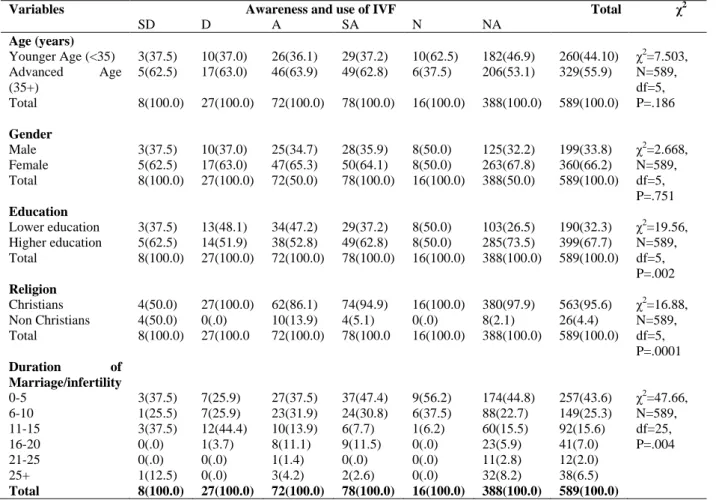
Table 5 shows the correlation between some socio demographic variables and awareness/utilization of IVF. The age distribution of respondents (χ2=7.503, N=589, df=5, P=0.186) and gender (χ2
=2.668, N=589, df=5, P=0.751) had no statistically significant difference in the level of awareness of IVF and subsequent utilization of the treatment. However, level of education (χ2=19.560, N=589, df=5, P=0.002), religious affiliation (χ2
=16.887, N=589, df=5, P=0.0001) and duration of marriage/infertility (χ2
=47.666, N=589, df=25, P=.004) had a significant statistical difference in the level of awareness of IVF and subsequent utilization of IVF treatment.
Okaforet al. Perceptions of Infertility and In-vitro Fertilization Treatment
African Journal of Reproductive Health December 2017; 21 (4):62 Table 5: Cross Tabulation of some Socio Demographic Variables and whether or not Awareness of IVF affects Utilization
Variables Awareness and use of IVF Total χ2
SD D A SA N NA
Age (years)
Younger Age (<35) 3(37.5) 10(37.0) 26(36.1) 29(37.2) 10(62.5) 182(46.9) 260(44.10) χ2
=7.503, N=589, df=5, P=.186
Advanced Age
(35+)
5(62.5) 17(63.0) 46(63.9) 49(62.8) 6(37.5) 206(53.1) 329(55.9)
Total 8(100.0) 27(100.0) 72(100.0) 78(100.0) 16(100.0) 388(100.0) 589(100.0)
Gender
Male 3(37.5) 10(37.0) 25(34.7) 28(35.9) 8(50.0) 125(32.2) 199(33.8) χ2=2.668,
N=589, df=5, P=.751
Female 5(62.5) 17(63.0) 47(65.3) 50(64.1) 8(50.0) 263(67.8) 360(66.2)
Total 8(100.0) 27(100.0) 72(50.0) 78(100.0) 16(100.0) 388(50.0) 589(100.0)
Education
Lower education 3(37.5) 13(48.1) 34(47.2) 29(37.2) 8(50.0) 103(26.5) 190(32.3) χ2=19.56,
N=589, df=5, P=.002
Higher education 5(62.5) 14(51.9) 38(52.8) 49(62.8) 8(50.0) 285(73.5) 399(67.7)
Total 8(100.0) 27(100.0) 72(100.0) 78(100.0) 16(100.0) 388(100.0) 589(100.0)
Religion
Christians 4(50.0) 27(100.0) 62(86.1) 74(94.9) 16(100.0) 380(97.9) 563(95.6) χ2=16.88,
N=589, df=5, P=.0001
Non Christians 4(50.0) 0(.0) 10(13.9) 4(5.1) 0(.0) 8(2.1) 26(4.4)
Total 8(100.0) 27(100.0 72(100.0) 78(100.0 16(100.0) 388(100.0) 589(100.0)
Duration of Marriage/infertility
0-5 3(37.5) 7(25.9) 27(37.5) 37(47.4) 9(56.2) 174(44.8) 257(43.6) χ2=47.66,
N=589, df=25, P=.004
6-10 1(25.5) 7(25.9) 23(31.9) 24(30.8) 6(37.5) 88(22.7) 149(25.3)
11-15 3(37.5) 12(44.4) 10(13.9) 6(7.7) 1(6.2) 60(15.5) 92(15.6)
16-20 0(.0) 1(3.7) 8(11.1) 9(11.5) 0(.0) 23(5.9) 41(7.0)
21-25 0(.0) 0(.0) 1(1.4) 0(.0) 0(.0) 11(2.8) 12(2.0)
25+ 1(12.5) 0(.0) 3(4.2) 2(2.6) 0(.0) 32(8.2) 38(6.5)
Total 8(100.0) 27(100.0) 72(100.0) 78(100.0) 16(100.0) 388(100.0) 589(100.0)
Table 6: Multiple Regression Analysis on whether Awareness about IVF Treatment will affect its Use
Independent Variables
Unstandardized Coefficients Standardized Coefficients
T Sig.
B(Mean) Std. Error Beta
(Constant) 80.020 13.674 5.852 .0001
Age -11.361 3.941 -.141 -2.883 .004
Gender -3.909 3.631 -.046 -1.077 .282
Education 13.889 3.504 .163 3.963 .0001
Religion -27.294 3.631 -.141 -3.415 .001
Duration 3.991 1.322 .143 3.018 .003
R=.260 R2= .068 F-value=8.440 P= 0.0001
Dependent Variable: Whether awareness about IVF treatment will affect its use
age, sex and religion are negatively associated with the level of awareness of the existence of IVF and its use. It implies therefore that education and duration of marriage/infertility are good predictors of awareness of the existence of IVF and utilisation of IVF treatment. The strength of the ‗T‘ values showed that education (3.963) was the most important influence on awareness of the existence of IVF treatment and its utilization. The multiple regression
model showed a significant linear relationship between education, religion, duration of marriage/infertility and age at (p<.0001, p<.001, p<.003 and p<.004 respectively) and awareness of the existence of IVF and utilisation of IVF treatment.
Okaforet al. Perceptions of Infertility and In-vitro Fertilization Treatment
African Journal of Reproductive Health December 2017; 21 (4):63
a KII respondent,
Majority of the IVF clients were already old both in age and in their marriages; those who were above 35years and are about six years and above in their marriages (Male medical practitioner, aged 50 years).
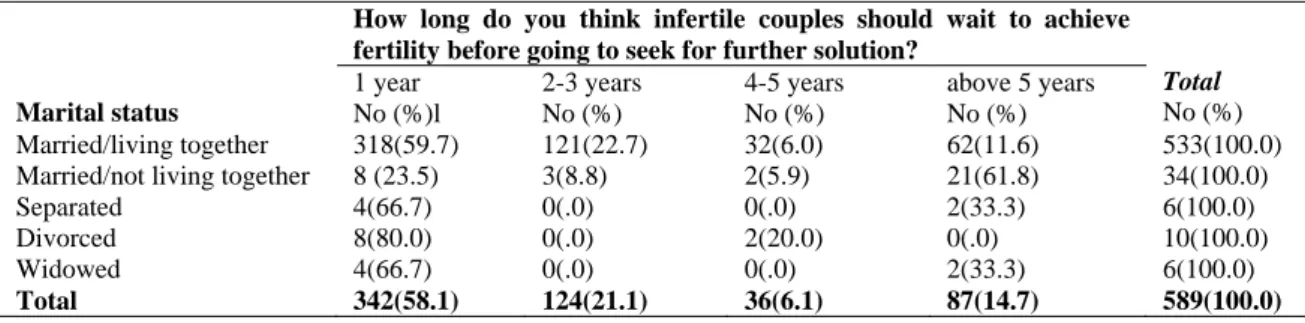
On how many years couples who are infertile should wait before going for assisted conception, Table 7 presents a cross tabulation of marital status and duration of marriage showing that majority of those married/living together (318; 59.7%), separated (4; 66.7%), divorced (8; 80.0%), and widowed (4; 66.7%) indicated 1 year. While majority of those married/not living together (21; 61.8%) indicated above 5 years. The χ2= 78.503, N = 589, df = 12, P< 0.05 (0.000) shows that the difference is significant. This was corroborated by the qualitative data:
Not many people want to go this way at all. But when the reproductive period is thinning out and no other alternative, we (the husband and wife) decided to give IVF a trial. We are exposed to a lot of ridicules; you cannot walk shoulder-high amid colleagues and friends. One is inadequate. The view is that they may want to ask who the father or the mother of the baby is (Female IVF client aged 46 years).
However, a Gynaecologist interviewed added that in older couples, ―between 3 to 6 months, is more than enough for a person to start looking for solution if there is no conception after regular unprotected sexual intercourse‖ (Male medical practitioner, aged 50 years). A KII respondent opined that:
Well, I cannot really say much but I think naturally it is only God who provides children for couples and not through the use of technologies. Culturally I disagree with the use of any form of assisted reproductive technology because as a cultured person, this idea about acting God counteract the totality of what we stand for (Male Civil servant aged 52 years).
A medical practitioner, among the KII respondents said that:
Procreation is important and deeply rooted in Igbo land. Anybody without a child is viewed with contempt. More so, when the general society gets to know about the
inability of a couple to have children and resorting to assisted methods (IVF) they may be stigmatized, call their children abnormal or not natural and therefore may not be accepted by members of the kinsmen as part of their family members. Therefore, IVF technology is still masked in secrecy, stigma, misconceptions, and religious sentiments in Nigeria. (Male medical practitioner, aged 55 years).
In Table 8 respondents‘ views on how to enhance the treatment of infertility using IVF in Anambra state shows majority of the respondents indicated creation of awareness about IVF treatment using the mass and print media [368 (94.4%) female respondents and 168 (84.4%) male respondents] and reduction of cost of IVF treatment [347(89.0%) of the female respondents and 160(80.4%) of the male respondents] are the major ways of improving the use of IVF. The χ2 = 15.889, p< 0.0001 and χ2 = 8.080, p<0.004 respectively showed that the differences are statistically significant. KII respondent interviewed also supported these findings.
IVF service is not well grounded. Aside Life Specialist Hospital, Nnewi, which is a private hospital, we do not have public fully fledged ART centre here in Anambra State. Therefore, IVF centers are not readily available to those who may want to access the services (Female IVF client aged 40 years).
Another KII respondent corroborated the observation and emphasized that:
Okaforet al. Perceptions of Infertility and In-vitro Fertilization Treatment
African Journal of Reproductive Health December 2017; 21 (4):64 Table 7: Cross Tabulation on Marital Status and Duration of Marriage/Infertility
Marital status
How long do you think infertile couples should wait to achieve fertility before going to seek for further solution?
Total
No (%) 1 year
No (%)l
2-3 years No (%)
4-5 years No (%)
above 5 years No (%)
Married/living together 318(59.7) 121(22.7) 32(6.0) 62(11.6) 533(100.0)
Married/not living together 8 (23.5) 3(8.8) 2(5.9) 21(61.8) 34(100.0)
Separated 4(66.7) 0(.0) 0(.0) 2(33.3) 6(100.0)
Divorced 8(80.0) 0(.0) 2(20.0) 0(.0) 10(100.0)
Widowed 4(66.7) 0(.0) 0(.0) 2(33.3) 6(100.0)
Total 342(58.1) 124(21.1) 36(6.1) 87(14.7) 589(100.0)
χ2
= 78.503, N = 589, df = 12, P< 0.05 (0.000)
Table 8: Cross Tabulation between Gender and Measures to Improve Perception on the Use of IVF
Gender Total χ2
Responses Male Female
Spouse co-operation and support Yes 100(50.3) 249(63.8) 349(59.3) χ2=10.087,
N=589,df=1, P=.001
No 99(49.7) 141(36.2) 240(40.7)
Total 199(100.0) 390(100.0) 589(100.0)
Reduction of cost of IVF treatment Yes 160(80.4) 347(89.0) 507(86.1) χ2=8.080,N=589,
df=1, P=.004
No 39(19.6) 43(11.0) 82(13.9)
Total 199(100.0) 390(100.0) 589(100.0)
Creation of awareness about IVF treatment using the mass and print media
Yes 168(84.4) 368(94.4) 536(91.0) χ2=15.889,N=589,
df=1, P=.0001
No 31(15.6) 22(5.6) 53(9.0)
Total 199(100.0) 390(100.0) 589(100.0)
Improved reproductive health
knowledge to reduce misconception and stigma attached to IVF practice
Yes 59(29.6) 162(41.5) 221(37.5) χ2=7.946,N=589,
df=1, P=.005
No 140(70.4) 228(58.5) 368(62.5)
Total 199(100.0) 390(100.0) 589(100.0)
Discussion
Fertility and parenthood are highly cherished in Nigeria and indeed Anambra state to the extent that procreation is more often than not considered the most vital reason for marriage12. Results of this study have shown that outside the clinical perception of infertility, there are so many other meanings that are attached to the concept of infertility. Infertility or barrenness is predominantly perceived as a curse, a condition predestined by God/supernatural problem. Some see it as a natural occurrence and that with necessary prayers and patience the person can be fertile. This finding is consistent with Ali et al32, who opined that beliefs in evil forces and supernatural powers as causes of infertility are still prevalent especially among people with lower level of education in Karachi, Pakistan. However, this is in contrast with the clinical findings of Ikechebelu et al33, Umeora et al34 and Okwelogu et al3 in south eastern Nigeria which attributed the aetiology of infertility as a disease or a medical problem than a social problem. This disparity in findings may have
been coloured by the researchers‘ hospital based data. Sociologically, the present population based survey found that in Igbo land, the predominant perception of infertility as a condition predestined by God/supernatural problem, or a threat to procreativity/continuity of lineage is not farfetched. This could be because Igbo people are predominantly religious and therefore, they attach a lot of religious connotations to many social situations and medical conditions.
Okaforet al. Perceptions of Infertility and In-vitro Fertilization Treatment
African Journal of Reproductive Health December 2017; 21 (4):65
conceived through this method are equally regarded as abnormal or inferior to those conceived naturally. This concurs with Giwa-Osagie20 and Ajayi35 who stressed that IVF technology is still a new phenomenon in the developing countries where people are still going around with the wrong perceptions about IVF. The treatment is shrouded in secrecy and stigma in Nigeria due to misconceptions, ignorance and religious sentiments. Lack of awareness about IVF is a major issue affecting how it is perceived by the participants. This finding supports Jegede and Fayemiwo36 who maintained that awareness in this respect is power, where this is lacking cultural beliefs and religious injunctions tend to fill the gap. These beliefs are still prevalent among people in the study area. Therefore, seeking care for infertility is often associated with supernatural forces and its cure may also be associated with supernatural method of treatment. Recourse to supernatural interpretation of infertility vitiates genuine attempts on IVF utilization. It is imperative to have adequate awareness of IVF before persons who are suffering from infertility can utilize it. Utilization is also a determinant of timely medical care and reactions or attitude to peoples‘ misconceptions or prejudice of such interventions. This finding is consistent with several reports which stress that utilisation of any assisted conception is a function of awareness, and perception of its existence.3, 36-38 Basic understanding of IVF is lacking or poor in Nigeria and many other sub-Saharan African nations. This has posed a problem to its acceptability and utilization.It appears that the respondents accepted that IVF is the last resort to overcoming infertility.
The respondents lamented on the huge cost of procuring IVF treatment. Therefore, government should subsidize the cost of infertility treatment or include infertility and ART among the conditions covered by the National Health Insurance Scheme (NHIS). In addition, relevant NGOs and the private sector should be encouraged to subsidize the cost fertility treatment. The study further recommends that National Orientation Commission initiate value reorientation among members of the society to redress suffocating cultural norms and values attached to procreation. This will increase the use of IVF treatment in the state.
Conclusion
This study has shown that infertility has always existed, but its discussion in Anambra state is often
culture-bound and supernatural beliefs are still prevalent among the people. The emergence of IVF in the treatment of infertility is a welcome development because it offers hope to infertile couples. However; there is low or lack of correct perceptions and awareness of IVF treatment in Anambra state. There is therefore an urgent need to vigorously create awareness about IVF treatment to dispel the misconceptions and enhance its utilization in Anambra state and Nigeria in general.
Conflict of Interest
None
Funding
The study was entirely funded by the authors.
Contribution of Authors
NIO and JII conceived and designed the study. NIO and NNJ were involved in the data collection and analysis. All the authors were involved in the writing and review of the manuscript. All the authors approved the final version of this manuscript.
References
1. Central Intelligence Agency (CIA). World Factbook: Nigerian people. Retrieved November 11, 2013. from www.cia.gov/../sp.html
2. National Demographic and Health Survey (NDHS). Nigeria development and health survey 2008, Abuja: NPC 3. Okwelogu IS, Azuike EC, Ikechebelu JI and Nnebue CKC.
In Vitro Fertilization practice: Awareness and perceptions among women attending fertility clinics in Okija, Anambra State, Nigeria. AFRIMEDIC Journal.
2012; 3, (2): 6
4. Ajayi RA. A decade of IVF in Nigeria: Our joy, their challenges. THISDAYONLINE, 2013; April 20, Pp 7.
Retrieved October 19, 2013 from
http://www.thisdayonline.com;www.fertilityworld.org 5. Ashiru AO. Nigeria health sector requires complete
revolution. The Guardian online publications, 2013. August 30, Pp 6.
6. Okewale T. Changing IVF‘s elitist veneer. THISDAY ONLINE, 2013. Retrieved December 10, 2013 from
http://www.ivfnigeria.blogspot.com/2013/12 7. Ikechebelu JI. Prevalence of gynaecological diseases in
Nnewi Nigeria. Nigerian Journal of clinical Practice.
2005: 8(2): 136 – 137.
8. Infertility: Facts, Disease Prevention and Treatment
Strategies, 2006. Retrieved June 8, 2013, from http://www.asrm.org/Patients/FactSheets/Infertility-Fact;
Okaforet al. Perceptions of Infertility and In-vitro Fertilization Treatment
African Journal of Reproductive Health December 2017; 21 (4):66
9. American Society for Reproductive Medicine (ASRM). Definitions of infertility and recurrent pregnancy loss.
Fertility & Sterility. 2008; 89, 1603
10. Vayena E, Rowe PJ, Griffin PD, Daar AS and Merali Z.
Infertility and social suffering: The case for ART in developing countries. In Vayena, E, Rowe PJ, Griffin PD, eds. Current Practices and Controversies in Assisted Reproduction. Report of a Meeting on Medical, Ethical and Social Aspects of Assisted Reproduction. Geneva, Switzerland: WHO. 2002; p. 15-21
11. Okonofua FE. Female and Male infertility in Nigeria.
University Press. Ibadan, Nigeria. 2005; p. 9
12. Ikechebelu JI. Assisted reproduction techniques (ART): The state of art in Nigeria. Journal of College of Medicine.
2003; 8(1):1–6
13. Inhorn MC. ―The Local‖ confronts the ―Global‖: Infertile bodies and new reproductive technologies in Egypt. In Inhorn, M.C & van Balen, F. (eds.), Infertility around the globe: A new thinking on childlessness and reproductive technologies, London: University of California Press, 2002; 263-282
14. Smith CA, Sheryl de Lacey, Chapman M, Ratcliffe J, Norman RJ, Neil J, Boothroyd C, et al. Acupuncture to improve live birth rates for women undergoing in vitro fertilization: A protocol for a randomized controlled trial. Trials Journal. 2012;Retrieved November 3, 2013 fromhttp://www.trialsjournal.com/content/13/1/60
15. CDC and ASRM/SART. Assisted reproductive technology
success rate: National summary and fertility clinic reports.US Department of Health and Human Services, Centers for Disease Control and Prevention (CDC) and the American Society for Reproductive Medicine (ASRM) and the Society for Assisted Reproductive Technology (SART). Atlanta, GA: CDC. 2008.
16. European Society of Human Reproduction and Embryology (ESHRE). Task Force on Ethics and Law 15: Cross-border reproductive care. Human Reprod, 2009a; 23: 2182-2184
17. European Society of Human Reproduction and Embryology
(ESHRE). Focus on Reproduction. Grimbergen,
Belgium: ESHRE. 2008.
18. Ajayi R A. Focus on IVF Business in Nigeria. Market Place Africa. CNN, 2012.
19. Wada I. Factors that determine IVF success rate. Retrieved October 2, 2013 from Reporters365.com 2013. 20. Giwa-Osagie OF. ART in developing countries with a
particular reference to sub-Saharan Africa, in: Vayena E, Rowe PJ and Griffin PD.(eds.) Current Practices and Controversies in Assisted Reproduction, Geneva, Switzerland: WHO. 2002.
21. Ashiru AO. Fertility fraud. Daily Sun 6(2343): 2012, April 14.
22. Solaja G. 60-year-old woman gives birth in Lagos ...After 31-year wait. Nigerian Tribune 2014, June 19.
23. First IVF Birth in Anambra State. FIDES Newspaper. 2011; Sept 17-30 vol. 18 no. 18
24. Onuoha D. Anambra Records First IVF Baby. Christian Outlook. 2011; Vol. 10 No 7 Sept: 24. www.nnewidiocese.org/outlook.htm
25. Ifeduba NC. First IVF Baby Delivered in Anambra. Pilot Newspaper. 2011;
26. Ikechebelu JI et.al. IVF births in Anambra State.
(unpublished data from Life Fertility Centre record at Life Specialist Hospital Nnewi). Dec. 2016
27. Kuwabara T, Yamaguchi K. An Introduction to the
Sociological Perspective of Symbolic interactionism
(Revised Edition). Journal of Economics and
Sociology, Kagoshima University, 2013; 80, 119 28. International Encyclopedia of Marriage and Family,
Symbolic Interactionism. 2003. Retrieved April 18,
2014 from Encyclopeda.com:
htpp://www.encyclopedia.com/doc/1G2-3406900426.html
29. Plummer, 1975 as cited in Wikipedia, the free encyclopedia Wikipedia, Symbolic Interactionism. 2014. Retrieved
April 6, 2014 from
http://en.wikipedia.org/wiki/symbolic_interaction 30. Stryker S and Vryan KD. The Symbolic Interactionist
Framework in Delamater, J. (eds.) Handbook of Social Psychology. New York: Kluwer Academic/Plenum Publishers, 2003; 3-28
31. National Population Commission (NPC). Population and housing census of Federal Republic of Nigeria. Abuja:
National population bureau 2006. Retrieved May 12, 2013 from www.index.com
32. Ali S, Raafay S, Imam AM, Khan FI, Ali SF, Shaikh A and Farid-ul-Hasnain S. Knowledge, perceptions and myths regarding infertility among selected adult population in Pakistan: A cross-sectional study. Biomedcentral (BMC) Public Health, 2011; 11, 760. doi:10.1186/1471-2458-11-760
33. Ikechebelu JI,Adinma JIB, Orie EF and Ikegwuonu SO. High prevalence of male infertility in south-eastern Nigeria. Journal of Obstetrics & Gynaecology. 2003; 23(6): 657 – 659.
34. Umeora OUJ, Igberase GO, Okogbenin SA and Obu ID. Cultural misconceptions and emotional burden of infertility in South East Nigeria. The Internet Journal of Gynaecology and Obstetrics, 2009;10 (2).
35. Ajayi RA. Most people are ignorant about IVF services.
Daily Trust, 2014; April 16.
36. Jegede AS and Fayemiwo AS. Cultural and ethical
challenges of assisted reproductive technologies in the management of infertility among the Yoruba of South Western Nigeria. African Journal of Reproductive Health, 2010; 14(2): 115-127
37. Widge A. Socio-cultural attitudes towards infertility and assisted reproduction in India. in: Vayena E, Rowe PJ, Griffin PD.(eds.), Current practices and controversies in assisted reproduction. Geneva Switzerland: WHO, 2002; 60-74