Original Research Article
Relationship between thyroid function and ICU mortality
(sick euthyroid syndrome)
Priyadarsini Bose, Ramesh Dasarathan*, Arun Shivaraman Mulaur Murugesan,
K. S. Chenthil
INTRODUCTION
Nonthyroid illness syndrome or sick euthyroid syndrome refers to alterations that occur in thyroid hormone levels in response to any critical illness like sepsis, ARDS, patients on mechanical ventilation and also any ICU patients.1 The metabolic response to any critical illness
involves every organ but the underlying pathology is not completely understood. Despite the primary diagnosis, as a stress induced response in critical illness, a state of hyper metabolism prevails leading to increased energy expenditure, hyperglycemia and muscle loss.
Thyroid hormone alterations commonly occur in critical illness in patients with no previous known intrinsic
thyroid disease.2 The changes in thyroid hormone levels
is not an isolated phenomenon as it is also associated with changes in other endocrine axis as a response to stress.
Various theories have been proposed for alterations in thyroid function. In early course of the illness, the peripheral conversion of T4 to T3 is reduced leading to decreased free T3 with normal or reduced T4 associated with an increase in reverseT3 (rT3) and no alterations in TSH.3 In prolonged illness, central hypothyroidism
occurs leading to reduced TSH and T4 along with T3. In this study, thyroid profile was taken from patients admitted in ICU on day 1 and day 7 and to correlate the levels the thyroid hormones and the outcome of the patients and also to know the outcome of the disease can
ABSTRACT
Background: Sick euthyroid syndrome refers to alterations that occur in thyroid hormone levels in response to any critical illness like sepsis, ARDS, patients on mechanical ventilation and also any ICU patients. This study aimed at the relationship between thyroid hormone level changes and critical illness in ICU patients and predict the mortality based on thyroid hormone levels.
Methods: A prospective study was designed to carry out in intensive care unit (ICU), Institute of internal medicine, Rajiv Gandhi government general hospital, Chennai for six months from May to August 2015. A total of 40 patients were selected who fulfilled the selection criteria.
Results: APACHE II scores were calculated for all the 40 patients to assess whether thyroid function tests could independently predict the outcome of the patients. Again, the thyroid profile was compared with APACHE II scores in predicting the outcome. Values showed statistically significance.
Conclusions: Thyroid profile can be used as an independent factor in predicting the outcome of the patients. Thyroid profile can also increase the sensitivity of APACHE II score in predicting the outcome.
Keywords: APACHE II, ICU patients, Sick euthyroid syndrome, TFT
Department of Internal Medicine, Madras Medical College, Chennai, Tamil Nadu, India
Received: 18 June 2017
Accepted: 26 July 2017
*Correspondence:
Dr. Ramesh Dasarathan,
E-mail: [email protected]
Copyright: © the author(s), publisher and licensee Medip Academy. This is an open-access article distributed under the terms of the Creative Commons Attribution Non-Commercial License, which permits unrestricted non-commercial use, distribution, and reproduction in any medium, provided the original work is properly cited.
be prognosticated with thyroid function tests in patients admitted in ICU.
The objective of this study was to study the relation between thyroid hormone level changes and critical illness in ICU patients. And to predict the mortality based on thyroid hormone levels in ICU patients.
METHODS
A prospective study was designed to carry out in intensive care unit (ICU), Institute of internal medicine, Rajiv Gandhi government general hospital, Chennai for six months from May to August 2015. A total of 40 patients were selected who fulfilled the selection criteria.
Inclusion criteria
• Patients admitted in ICU irrespective of the diagnosis • Patients with ICU stay more than 7 days.
Exclusion criteria
• Patients with previous intrinsic thyroid, hypothalamic: pituitary axis disease
• Usage of iodine contrast agents in the past 8 weeks • Usage of drugs causing hypothyroidism.
Data collection
Patients eligible for the study were subjected to clinical examinations and investigations.
Methodology
Patients admitted in ICU irrespective of their primary diagnosis were selected for this clinical study as per inclusion/exclusion criteria and were subjected to history taking and clinical examination after obtaining informed consent.
After clinical examination patients were subjected for routine investigations like complete hemogram, renal function tests, liver function tests, arterial blood gas analysis, blood and urine culture and sensitivity (if required). Patients were also subjected to thyroid function test on day 1 of their ICU stay.
All the patients in the study were followed up in ICU as they are getting treated and their status is monitored over a week. After 1-week time patients were again subjected to thyroid function tests (TFT) on day 7 of their ICU stay. Clinical progression over days was observed in terms of recovery from the illness or death of the patient. Finally, TFTs were analyzed whether they can predict the outcome of the patient by serial monitoring over 7 days. The APACHE II score (Acute Physiology and Chronic Health Evaluation) was calculated, a system for
status of the patients in ICU was usually revealed by this scoring system.4
Statistical analysis
Data were expressed as number and percentage of total. Demographic and clinical characteristics were analyzed by using Chi square test. The level of significance was estimated with 95% confidence intervals and P value <0.05. Software used was SSPS 2.0.
RESULTS
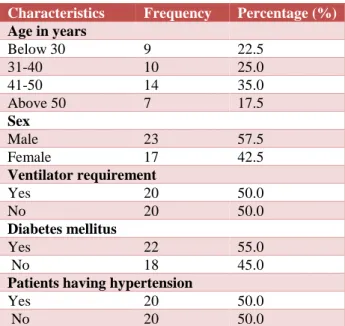
40 patients who fulfilled the selection criteria were subjected to history taking and clinical examination. Patients were followed up in ICU over day 1 and 7. Progress was observed in terms of recovery from illness. In this study, 14 out of 40 patients were in the age group between 41 - 50 years. But this is not statistically significant. Among 40 patients, 23 were found to be males and 17 were found to be females. Out of 40 patients 20 of them were on ventilator, 22 were having diabetes mellitus and 20 were having hypertension.
Table 1: Demographic and clinical characteristics of the study participants.
Characteristics Frequency Percentage (%)
Age in years
Below 30 9 22.5
31-40 10 25.0
41-50 14 35.0
Above 50 7 17.5
Sex
Male 23 57.5
Female 17 42.5
Ventilator requirement
Yes 20 50.0
No 20 50.0
Diabetes mellitus
Yes 22 55.0
No 18 45.0
Patients having hypertension
Yes 20 50.0
No 20 50.0
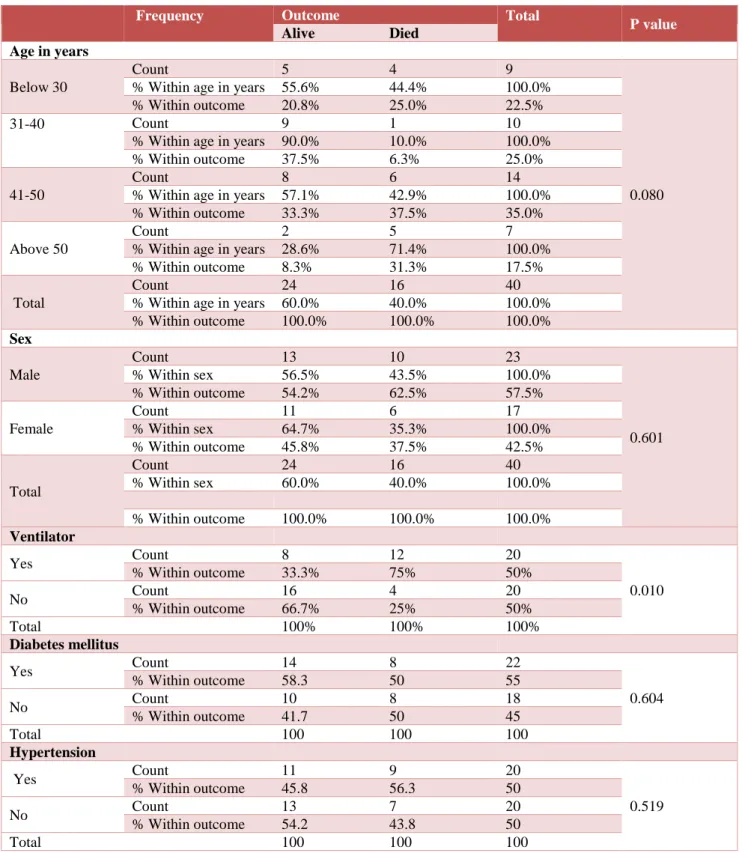
60% of patients out of 40 were alive at the end point and were discharged. 40% patients were expired. Even though 14 out of 40 patients were in the age group between 41- 50, this is not statistically significant. The male and female ratio was not shown any statistical significance. The p value is 0.601 which is not significant. The Acute Physiology and Chronic Health Evaluation (APACHE) II score levels correlated with mortality. The p value for this correlation is <0.001.
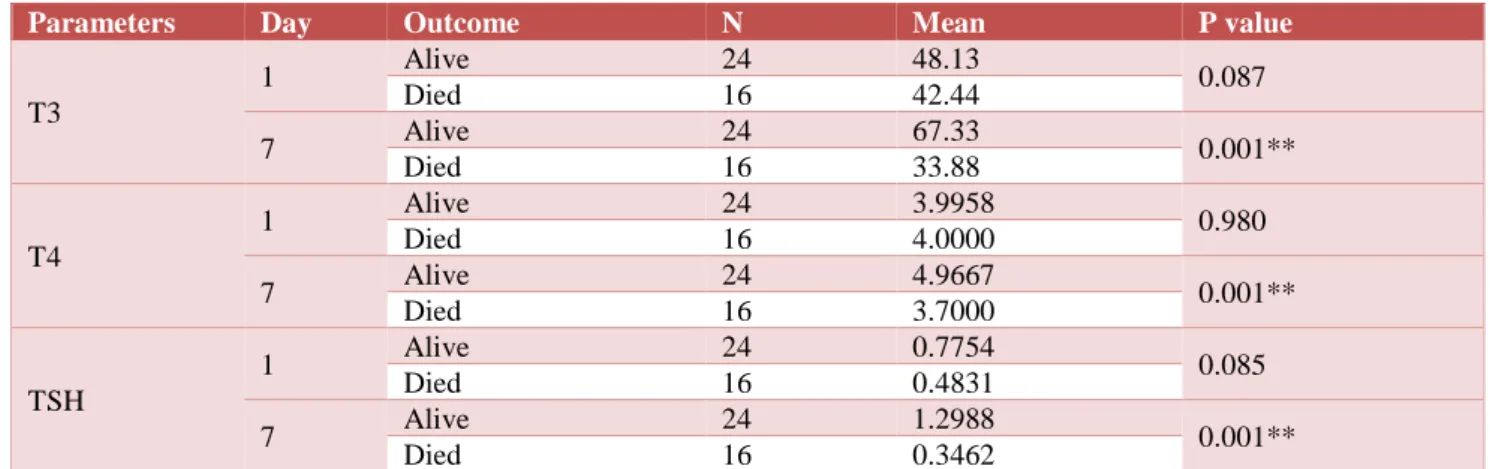
for day 7 is <0.001. The p value for TSH levels on day 1 is 0.085 and for day 7 is <0.001. Based upon the results, the serial measurement of T3, T4 and TSH levels will help in predicting the outcome of the patients as an
independent factor or in association with APACHE II scores. The significance increases depending on duration of illness.
Table 2: Comparison of demographic and clinical characteristics with outcome.
Frequency
Outcome Total
P value
Alive Died
Age in years
Below 30
Count 5 4 9
0.080 % Within age in years 55.6% 44.4% 100.0%
% Within outcome 20.8% 25.0% 22.5% 31-40
Count 9 1 10
% Within age in years 90.0% 10.0% 100.0% % Within outcome 37.5% 6.3% 25.0%
41-50
Count 8 6 14
% Within age in years 57.1% 42.9% 100.0% % Within outcome 33.3% 37.5% 35.0%
Above 50
Count 2 5 7
% Within age in years 28.6% 71.4% 100.0% % Within outcome 8.3% 31.3% 17.5%
Total
Count 24 16 40
% Within age in years 60.0% 40.0% 100.0% % Within outcome 100.0% 100.0% 100.0%
Sex
Male
Count 13 10 23
0.601 % Within sex 56.5% 43.5% 100.0%
% Within outcome 54.2% 62.5% 57.5%
Female
Count 11 6 17
% Within sex 64.7% 35.3% 100.0% % Within outcome 45.8% 37.5% 42.5%
Total
Count 24 16 40
% Within sex 60.0% 40.0% 100.0%
% Within outcome 100.0% 100.0% 100.0%
Ventilator
Yes Count 8 12 20
0.010 % Within outcome 33.3% 75% 50%
No Count 16 4 20
% Within outcome 66.7% 25% 50%
Total 100% 100% 100%
Diabetes mellitus
Yes Count 14 8 22
0.604 % Within outcome 58.3 50 55
No Count 10 8 18
% Within outcome 41.7 50 45
Total 100 100 100
Hypertension
Yes Count 11 9 20
0.519 % Within outcome 45.8 56.3 50
No Count 13 7 20
% Within outcome 54.2 43.8 50
Table 3: Comparison between APACHE II and outcome.
APACHE II
Outcome N Mean P value
Alive 24 34.54
<0.001** Died 16 43.81
Total 40
APACHE II score which is calculated within 24 hours of ICU admission is compared with thyroid function tests which is taken on day 1. The results obtained with this comparison is that on day 1 levels of T3 significantly correlated with APACHE II scores whereas T4 and TSH levels are not statistically significant.
Table 4: Significance of TFT on predicting outcome.
Parameters Day Outcome N Mean P value
T3
1 Alive 24 48.13 0.087
Died 16 42.44
7 Alive 24 67.33 0.001**
Died 16 33.88
T4
1 Alive 24 3.9958 0.980
Died 16 4.0000
7 Alive 24 4.9667 0.001**
Died 16 3.7000
TSH
1 Alive 24 0.7754 0.085
Died 16 0.4831
7 Alive 24 1.2988 0.001**
Died 16 0.3462
Table 5: Correlation between APACHE II and TFT.
Parameters Day Apache II
T3
1 P value 0.002
N 40
T4
1 P value 0.551
N 40
TSH
1 P value 0.216
N 40
T3
7 P value 0.001**
N 40
T4
7 P value 0.010
N 40
TSH
7 P value 0.013
N 40
DISCUSSION
This study was conducted in the patients admitted in ICU irrespective of the diagnosis. The study group size was 40. Patients included in the study were closely monitored and thyroid function tests were taken on day 1 and day 7 as explained in methodology. All the patients are followed till the outcome which was either recovery and discharge or death of the patient. Outcome analysis was done in comparison with whether thyroid function tests were able to predict the outcome of the patients independently. The significance is also assessed by comparison of thyroid hormone levels with APACHE II scores. Following were the main observations of the
Out of 40 patients, maximum number of patients was observed in the age group of 41 - 50 years with the percentage of 35% as observed in the frequency distribution table. Aging process influences various tissues to thyroid hormone.5 Out of 40 patients, 23
(57.5%) patients were male and 17 (42.5%) patients were female. There were no significant differences found in sexes which indicates both sexes are affected.3
Out of 40 patients, 22 patients were having diabetes mellitus and 18 were not having diabetes mellitus. 20 patients were having hypertension and 20 patients were without hypertension. In the study group population, 20 patients required ventilator support. Out of the 20 patients, 12 patients expired and 8 of them survived. Out of 20 patients not requiring ventilator support 16 of them survived and 4 patients expired.
APACHE II scores were calculated for all the 40 patients to assess whether thyroid function tests could independently predict the outcome of the patients. The observed p value for APACHE II score predicting the mortality separately was <0.001. As documented in previous studies, in this study also APACHE II score affects the outcome of the patients.4,6
was 0.980 and for TSH was 0.085. These values are not statistically significant. The p values, seen on day 7 for T3 in predicting the outcome was 0.001, T4 was 0.001 and for TSH was 0.001.
Again, the thyroid profile was compared with APACHE II scores in predicting the outcome. On day 1, the observed p values for the correlation for T3 were 0.002, T4 was 0.551 and for TSH was 0.216. T3 values on day 1 correlated with APACHE II scores in predicting the outcome based on statistical analysis. Wang et al in 2012 done a study on relation between thyroid function and ICU mortality also showed that low T3 can predict the mortality of the patients.6
Thyroid function tests obtained on day 7 were again compared with APACHE II scores in predicting the outcome. Based upon statistical analysis the observed p values were 0.001 for T3, 0.010 for T4 and 0.013 for TSH. All these values are statistically significant. Some reports are also given that addition of thyroid hormones to the APACHE II score improves the prediction of mortality for ICU patients.7,8
CONCLUSION
Thyroid profile can be used in predicting the morality in ICU patients. Serial monitoring of thyroid profile will increase the sensitivity in predicting the outcome. Outcomes assessed by thyroid profile are comparable with that of APACHE II scores. Thyroid profile can be used as an independent factor in predicting the outcome of the patients. Thyroid profile can also increase the sensitivity of APACHE II score in predicting the outcome.
Funding: No funding sources Conflict of interest: None declared
Ethical approval: The study was approved by the institutional ethics committee
REFERENCES
1. Qari FA. Thyroid function status and its impact on clinical outcome in patients admitted to critical care. Pak J Med Sci. 2015;31(4):915-9.
2. Neto AM, Zantut-Wittmann DE. Abnormalities of Thyroid Hormone Metabolism during Systemic Illness: The Low T3 Syndrome in Different Clinical Settings. Int J Endocrinol. 2016;2016:2157583. 3. Euthyroid Sick Syndrome. Available at
http://emedicine.medscape.com/article/118651-overview. Accessed 10 March 2017.
4. Nafae RM, Mohammed MA, Morsi AF, Ibrahim DA. Thyroid function in respiratory failure patients. Egypt J Chest Dis Tuberc. 2014;63(2):513-21. 5. Topal Y, Sebe A, Ay MO, Açıkalın A, Karanlık M,
Topal M, et al. Investigation of the relationship between thyroid hormone levels and mortality in old patients hospitalized in an internal medicine intensive care unit from the emergency service. JAEM. 2014;13:71-4.
6. Wang F, Pan W, Wang H, Wang S, Pan S, Ge J. Relationship between thyroid function and ICU mortality: a prospective observation study. Crit Care. 2012;16(1):R11.
7. Chinga-Alayo E, Villena J, Evans AT, Zimic M. Thyroid hormone levels improve the prediction of mortality among patients admitted to the intensive care unit. Intensive Care Med. 2005;31(10):1356-61.
8. Suresh M, Srivastava NK, Jain AK, Nandy P. Thyroid dysfunction in critically ill patients in a tertiary care hospital in Sikkim, India. Thyroid Res Pract. 2017;14:58-62.
Cite this article as: Bose P, Dasarathan R,