International Journal of Research in Engineering & Applied Sciences Email:- [email protected], http://www.euroasiapub.org
An open access scholarly, online, peer-reviewed, interdisciplinary, monthly, and fully refereed journals
102
A COMPARATIVE ANALYSIS OF IMAGE COMPRESSION BY DIFFERENT WAVELETS
TECHNIQUES USING MATLAB
Shalini Verma1,
Department of Computer Science and Engineering,
Faculty of Technology, Uttarakhand Technical University, Dehradun, India
Pawan Kumar Mishra 2,
Department of Computer Science and Engineering,
Faculty of Technology, Uttarakhand Technical University, Dehradun, India
Abstract
An image generally needs considerable storage and resources, so image compression is an effective technique to overcome these requirements. This paper includes different wavelet techniques used for data compression or image compression. Image Compression generally followed in computer graphics such as in Internet, digital library, mobile and multimedia. The volume of information stored in an image or video can be compressed by using Image compression techniques. There are many image compression techniques available such as JPEG, DCT (Discrete Cosine Transform), DWT (Discrete Wavelet Transform), Wavelet, Huffman Coding, Quantization, Lossy Compression or Lossless Compression. The main objective of this paper is to select the appropriate method of wavelet towards compression of the image. Also the quality of the reconstructed image has been estimated in terms of image quality metrics such as PSNR (Peak Signal-to-Noise ratio) and CR (compression ratio). In this paper, the various wavelets methods such as Haar, Daubechies, and Biorthogonal, Coiflets and Symlet wavelet are applied to an image and then their qualitative and quantitative analysis results are compared in terms of PSNR values, MSE and compression ratios.
International Journal of Research in Engineering & Applied Sciences Email:- [email protected], http://www.euroasiapub.org
An open access scholarly, online, peer-reviewed, interdisciplinary, monthly, and fully refereed journals
103
INTRODUCTION
International Journal of Research in Engineering & Applied Sciences Email:- [email protected], http://www.euroasiapub.org
An open access scholarly, online, peer-reviewed, interdisciplinary, monthly, and fully refereed journals
104
Image compression is to compress the number of bits (size) and represent an image by removing the correlation either between neighboring pixels.
TYPES Of COMPRESSION SYSTEMS:
There are basically two types of compression systems available, such as a. Lossy compression system b. Lossless compression system a. Lossy Compression System
In Lossy compression techniques, some of the finer details in the image can be renunciated for the sake of saving a little more bandwidth or storage space.
b. Loss less compression system
The Lossless Compression System aims to minimize the bit rate of the compressed output without distorting the image. The decompressed bit-stream is identical to original bit-stream.
Role of Wavelets in Image Compression
Wavelet transforms becomes one of the most promising and powerful tool for signal representation. At present, it has been used in image processing, data compression, and signal processing. In case of image compression, the wavelets tool decomposed the images into order of increasing resolutions. The wavelet transforms, specifically for orthonormal and biorthogonal wavelets have appeared as a new mathematical tool for multi-resolution decomposition purpose. The main application of the wavelet transforms are found in the compression and noise reduction of image. This improves the quality of an image.
MEASURE OF IMAGE QUALITY
The mean square error (MSE), peak signal to noise ratio (PSNR) between the original and compressed images is also known as Standard distortion measure [4]. PSNR parameter is not only used to determine the image quality, but also used as a standard level of similarity between reconstructed image and the original image. It has been noticed that the larger PSNR will ultimately make better image quality, expressed in decibels (db), The PSNR can be defined as,
𝑃𝑆𝑁𝑅 = 20 ∗ log
10(
2552𝑀𝑆𝐸
)
Eq. (1)The known and most frequently used objective assessments of the quality of a compressed image is mean square error (MSE) and peak signal to noise ratio and these are generally based on error measurement in the Norm, these measurements represent quality by a single number which is to be considered as aggregate measures of compression error. A least value of MSE means lower error. This can be given by the following equation.
𝑀𝑆𝐸 =
1𝑚,𝑛
∑ ∑(𝑋
𝑖,𝑗− 𝑌
𝑖,𝑗)
2
Eq. (2)
International Journal of Research in Engineering & Applied Sciences Email:- [email protected], http://www.euroasiapub.org
An open access scholarly, online, peer-reviewed, interdisciplinary, monthly, and fully refereed journals
105
Another quantitative parameter is the compression ratio which measures the performance ofcompression method. Compression ratio can be defined as –
Compression Ratio = ((original image size))/((compressed image size)) Eq. (3)
The objective of the compression ratio is to measure the capacity of image data compression, and can be determine by comparing the size of the original image against compressed image. Compression ratio (CR) can also be defined as the ratio of the number of nonzero elements in original matrix to the number of nonzero elements in updated transformed matrix.
TYPES Of WAVELETS FAMILIES
:Following are the wavelets families which are used for the compression analysis: Haar Wavelets
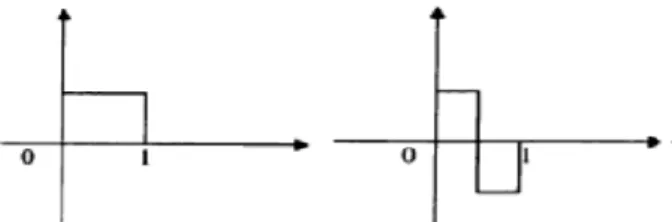
The base vectors of the Haar matrix are sequentially ordered. The Haar wavelet is a sequence of rescaled -square-shaped functions. The main disadvantage of Haar wavelet is that it is discontinuous type and hence not differentiable and resembles a step function. This property is generally considered to be as an advantage to inspect signals with sudden transitions, like tool failures monitoring in machines. It represents same wavelet as Daubechies 1.
Fig 1: Scaling and Wavelet functions of HAAR Daubechies Wavelets
A major challenge comes for the development of wavelets was the scaling functions that are compactly supported, orthogonal and continuous. These scaling functions were first developed by Ingrid Daubechies. The Daubechies are the low pass filter h and are equivalently comes under the Fourier series. Ingrid Daubechies developed compactly supported orthonormal wavelets and makes discrete wavelet analysis practicable [7].
Symlet Wavelets
Symlets are the symmetrical waveletsas proposed by Daubechies in modifications to the Db family, which selects each other set of roots to have nearer symmetry with linear complex phase. The remaining other properties of Daubechies and Symlet families are similar [4,8]. Symlets, found to be better when applied to signal and improves the Signal to Noise Ratio (SNR) of reconstructed image. It has been observed that the Symlets are efficient in denoising applications.
Coiflet Wavelts
International Journal of Research in Engineering & Applied Sciences Email:- [email protected], http://www.euroasiapub.org
An open access scholarly, online, peer-reviewed, interdisciplinary, monthly, and fully refereed journals
106
coiflet method is moderately rigid in visualizing any frequency of interest, its discrete form isuseful for digital implementation.
Some useful features of this wavelets are as follows:
i) This method gives good approximation of polynomial functions at various resolutions, hence improves the computation efficiency of the analysis.
ii) Coiflet transform presents both frequency and time information in an integral scheme.
Biorthogonal Wavelets
Biorthogonal wavelets lead the family of orthogonal wavelets and have applications in man signal and image processing area. The periodic biorthogonal wavelet transforms are precieve by Matrix-vector products with sparse, structured matrices [7, 9]. An open fact in filter theory community is that when same FIR filters are used for image decomposition and reconstruction process, the symmetry phenomenon and Perfect reconstructions are totally antagonistic. To overcome this difficulty, dual scaling and wavelet functions with following properties are used: (i)The Calculation algorithms maintained to be simple and set zero outside a segment.
ii) Symmetrical filter are used.
iii) Functions used to be for calculations are easier to build than those used in Daubechies wavelets.
PROPOSED ALGORITHM :
The following steps are used in compressing, decompression and reconstructed of image are:-
1. Read the image parameter form image dimension (512 × 512, 256 × 256, &128 × 128)
2. Apply 2D discrete wavelet transform (2D-DWT) using various wavelets and decompose the image from 1-level to 5 –level. ( By using 2D wavelet decomposition with respect to a dwt calculate from decomposition level with the estimate coefficients matrix CA and detail coefficient matrixes CH, CV, CD (horizontal, vertical & diagonal respectively) which is obtained by wavelet decomposition of the input matrix).
3. We have applied compression process with desired wavelets family and compressed image. 4. We can also reconstruct an estimate of the original image by applying the corresponding inverse transform process.
5. Calculate compression ratio , mean square error and peak signal noise ratio values for using different wavelets are apply for corresponding reconstructed images or original image.
6. The same process is repeated for different resolution of images and compares its parameter and result.
IMPLEMENTATION AND RESULTS
International Journal of Research in Engineering & Applied Sciences Email:- [email protected], http://www.euroasiapub.org
An open access scholarly, online, peer-reviewed, interdisciplinary, monthly, and fully refereed journals
107
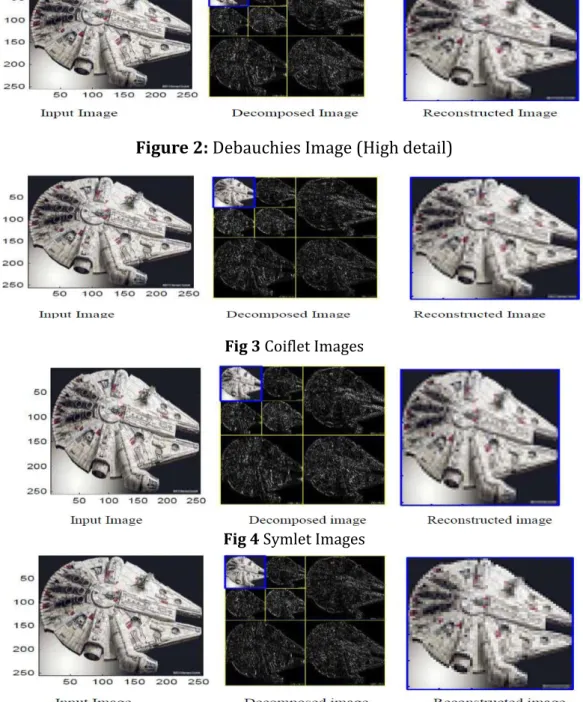
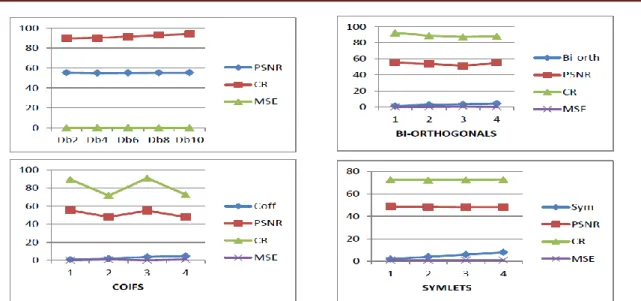
Image 1: High Detailed ImageFigures.2 to 6 and Table.1 of High detailed image clearly imply that, of all daubechies wavelets, Db2 produced high value of PSNR while the Compression ratio is more for Db10 family, Coif1 and Coif4 produced better values of PSNR and CR. In case of symlets, SYM2 and SYM4 wavelets have better PSNR, while CR values are better in SYM2 and SYM8. Bior4.4 and Bior1.3 generated large values of PSNR and also the CR values are higher in Bior2.8 and Bior4.4.
Figure 2:
Debauchies Image (High detail)
Fig 3 Coiflet Images
Fig 4 Symlet Images
International Journal of Research in Engineering & Applied Sciences Email:- [email protected], http://www.euroasiapub.org
An open access scholarly, online, peer-reviewed, interdisciplinary, monthly, and fully refereed journals
108
Fig 6 Comparison of PSNR, MSE & CR of different Wavelets on high detail ImageTable 1 (a, b,c,d).
Performance comparison between different wavelets on high detail
image
Observation Table 1 (a)
DbN PSNR CR MSE
Db2 55.48 89.73 0.1841
Db4 55.16 90.33 0.1983
Db6 55.33 91.64 0.1905
Db8 55.36 93.01 0.1893
Db10 55.42 94.02 0.1866
Observation Table 1 (b)
Bi-orth PSNR CR MSE
1.3 55.09 92.53 0.2014
2.8 53.74 88.83 0.2747
3.3 51.2 87.26 0.4936
4.4 55.01 88.06 0.2051
Observation Table 1 (c)
Coff PSNR CR MSE
1 55.47 89.6 0.1843
2 48.23 71.69 0.9773
4 55.05 91.01 0.2033
International Journal of Research in Engineering & Applied Sciences Email:- [email protected], http://www.euroasiapub.org
An open access scholarly, online, peer-reviewed, interdisciplinary, monthly, and fully refereed journals
109
Observation Table 1 (d)Sym PSNR CR MSE
2 48.6 72.55 0.8968
4 48.38 72.15 0.9449
6 48.16 72.35 0.9937
8 48.13 72.64 0.999
Medium Image Detailed Image:
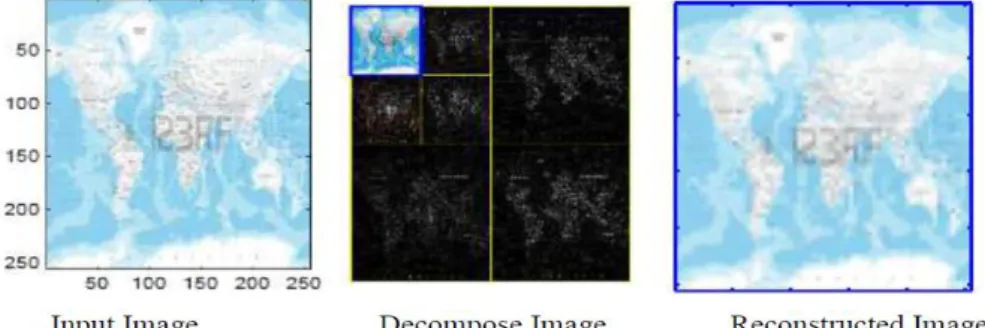
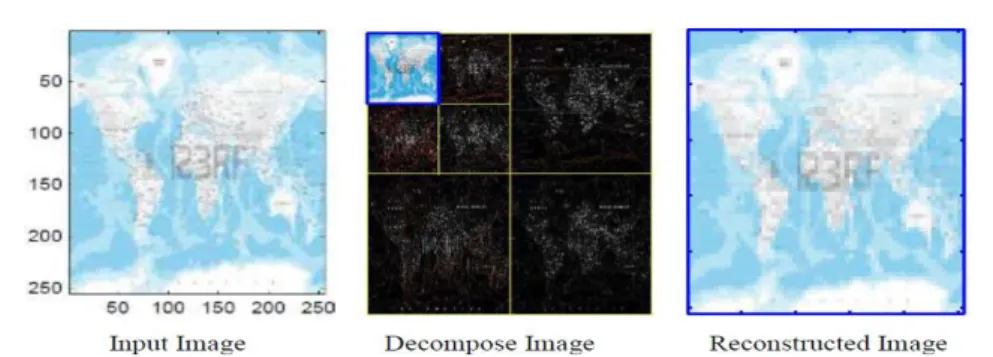
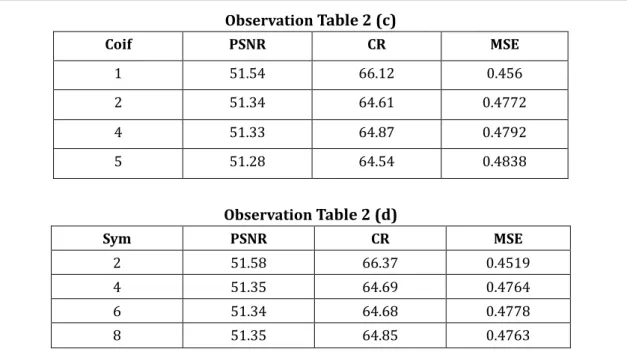
Figures 7 to 11 and Table 2 of medium detailed image clearly imply that, Db2 and Db4 wavelets have better values of PSNR and higher CR values are observed in Db2 and Db10 while the COIF1 and COIF4 wavelet produced large values of PSNR and CR. In the case of Symlets it was observed that SYM8 family generated large values of CR and SYM2 gives higher value of PSNR, However, Bior1.3 gives higher value of CR and Bior2.8 wavelets produced large values of PSNR and CR.
Fig 7
: Medium detail images Debauchies
Fig 8
Medium detail images Symlets
International Journal of Research in Engineering & Applied Sciences Email:- [email protected], http://www.euroasiapub.org
An open access scholarly, online, peer-reviewed, interdisciplinary, monthly, and fully refereed journals
110
Fig 10
Medium detail images Bi-orthogonal
Fig 11
(a, b, c, d):
Comparison of PSNR, MSE & CR of different Wavelets on medium
Image.
The following
Table 2 (a, b, c, d)
summarizes performance comparison between
suggested wavelet families .
Observation
Table 2 (a)
DbN PSNR CR MSE
Db2 51.58 66.37 0.4519
Db4 51.39 65.36 0.4727
Db6 51.33 65.86 0.4786
Db8 51.28 66.33 0.4846
Db10 51.25 66.74 0.4971
Observation Table 2 (b)
Bi-orth PSNR CR MSE
1.3 51.39 70.18 0.4721
2.8 50.17 63.17 0.6258
3.3 48.55 61.07 0.9082
International Journal of Research in Engineering & Applied Sciences Email:- [email protected], http://www.euroasiapub.org
An open access scholarly, online, peer-reviewed, interdisciplinary, monthly, and fully refereed journals
111
Coif PSNR CR MSE
1 51.54 66.12 0.456
2 51.34 64.61 0.4772
4 51.33 64.87 0.4792
5 51.28 64.54 0.4838
Observation Table 2 (d)
Sym PSNR CR MSE
2 51.58 66.37 0.4519
4 51.35 64.69 0.4764
6 51.34 64.68 0.4778
8 51.35 64.85 0.4763
Image 3: Group Image
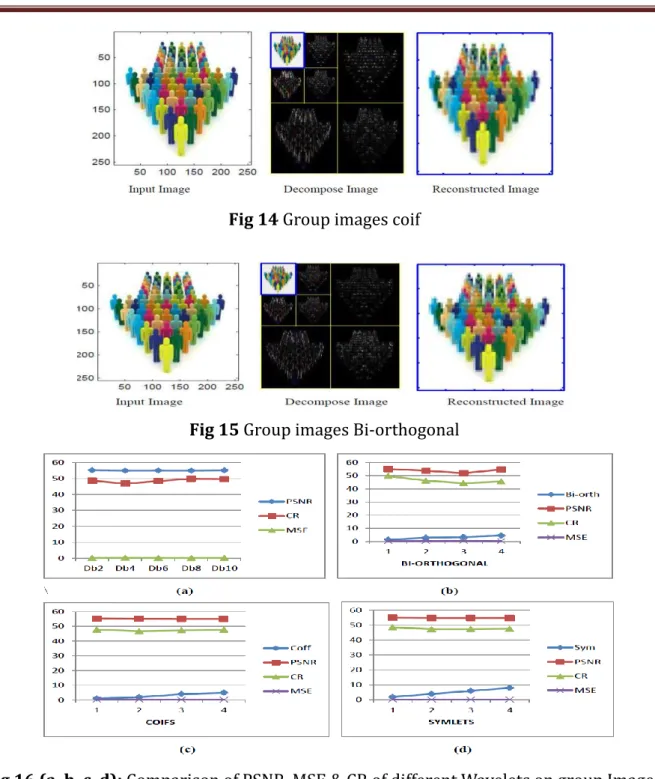
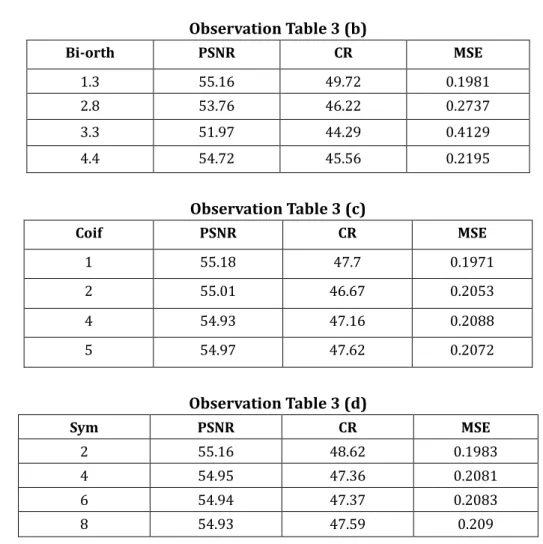
Figures. 12 to 16 and Table 3 of staff group image imply that, Db8 and Db10 wavelets
produced high values of PSNR and CR value, on the other hand Coif5 and Coif1 wavelets
resulted in better values of CR however better values of PSNR can be achieved in Coif1 and
Coif2, In case of Symlets, Sym2 wavelet generated better PSNR and CR values as well.
While Bior1.3 wavelet produced better values of PSNR and CR of all bi-orthogonal family
wavelets in contrast Bior3.3 wavelet produced the least value of CR.
Fig 12
Group images Debauchies
International Journal of Research in Engineering & Applied Sciences Email:- [email protected], http://www.euroasiapub.org
An open access scholarly, online, peer-reviewed, interdisciplinary, monthly, and fully refereed journals
112
Fig 14
Group images coif
Fig 15
Group images Bi-orthogonal
Fig 16 (a, b, c, d):
Comparison of PSNR, MSE & CR of different Wavelets on group Image.
The following
Table 3 (a, b, c, d)
summarizes performance comparison between
suggested wavelet families.
Observation Table 3 (a)
DbN PSNR CR MSE
Db2 55.16 48.62 0.1983
Db4 54.92 46.76 0.3096
Db6 54.97 48.36 0.2072
Db8 54.91 49.92 0.2098
International Journal of Research in Engineering & Applied Sciences Email:- [email protected], http://www.euroasiapub.org
An open access scholarly, online, peer-reviewed, interdisciplinary, monthly, and fully refereed journals
113
Observation Table 3 (b)Bi-orth PSNR CR MSE
1.3 55.16 49.72 0.1981
2.8 53.76 46.22 0.2737
3.3 51.97 44.29 0.4129
4.4 54.72 45.56 0.2195
Observation Table 3 (c)
Coif PSNR CR MSE
1 55.18 47.7 0.1971
2 55.01 46.67 0.2053
4 54.93 47.16 0.2088
5 54.97 47.62 0.2072
Observation Table 3 (d)
Sym PSNR CR MSE
2 55.16 48.62 0.1983
4 54.95 47.36 0.2081
6 54.94 47.37 0.2083
8 54.93 47.59 0.209
Single Image:
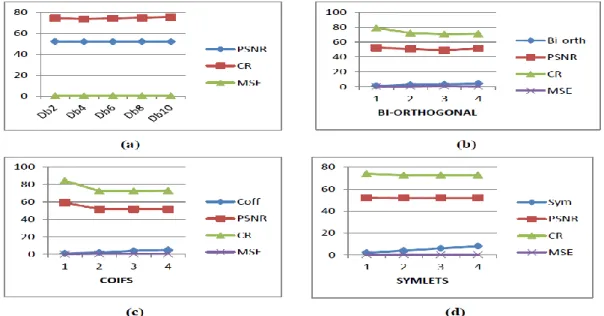
Figures 17 to 21 and Table 4 of medium detailed image clearly imply that, Db8 and Db10 wavelets have better values of PSNR and CR, while the COIF1 wavelet produced large values of PSNR and CR. In the case of symlets it was observed that SYM2 family generated large values of PSNR and CR, However, Bior1.3 wavelets produced large values of PSNR and CR, and Bior2.8 gives second higher value of CR, second PSNR value is higher in Bior4.4
.
International Journal of Research in Engineering & Applied Sciences Email:- [email protected], http://www.euroasiapub.org
An open access scholarly, online, peer-reviewed, interdisciplinary, monthly, and fully refereed journals
114
Fig 18
: Single image Symlets
Fig 19: Single image Coif
Fig 20 Single image Bi-orthogonal
Fig 21 (a, b, c, d):
Comparison of PSNR, MSE & CR of different Wavelets on single Image.
The following
Table 4 (a, b, c, d)
summarizes performance comparison between
International Journal of Research in Engineering & Applied Sciences Email:- [email protected], http://www.euroasiapub.org
An open access scholarly, online, peer-reviewed, interdisciplinary, monthly, and fully refereed journals
115
Observation Table 4 (a)DbN PSNR CR MSE
Db2 52.06 74.11 0.4043
Db4 51.91 73.36 0.419
Db6 51.9 73.97 0.4195
Db8 51.97 74.73 0.4128
Db10 51.91 75.55 0.4189
Observation Table 4 (b)
Bi-orth PSNR CR MSE
1.3 52.2 78.75 0.3921
2.8 50.73 72.05 0.55
3.3 48.66 70.47 0.8853
4.4 51.65 70.96 0.445
Observation Table 4 (c)
Coif PSNR CR MSE
1 59.18 84.42 0.07857
2 51.88 72.58 0.4214
4 51.91 72.57 0.4193
5 51.82 73.05 0.4275
Observation Table 4 (d)
Sym PSNR CR MSE
2 52.06 74.11 0.4047
4 51.94 72.54 0.4156
6 51.86 72.6 0.4235
8 51.91 72.72 0.4188
CONCLUSION AND FUTURE SCOPE:
International Journal of Research in Engineering & Applied Sciences Email:- [email protected], http://www.euroasiapub.org
An open access scholarly, online, peer-reviewed, interdisciplinary, monthly, and fully refereed journals
116
the debauchies Db10 gives better PSNR, CR but better MSE is achieved by symlet wavelet method.Though from all above discussions we can say that the debauchies wavelet method is superior one from the other above mentioned/ suggested wavelet methods as we have got better CR, MSE, PSNR values in comparison to other available wavelet methods in all given images formats.
For the future work, the above algorithms can be studied for video compression real time video compression also. Parallel model may be enhanced and modeled with in some combination of mathematical transformation or wavelet transform used.
REFERENCE
Ingrid Daubechies (1992): Ten Lectures on Wavelets, Society for Industrial and Applied Mathematics,Philadelphia.
Marc Antonini, Michel Berlaud and Pierre Marthieu (1992)- Image coding using wavelet transform, , IEEE.
Said A and Pearlman WA (1993): image compression using the spatialorientation tree, IEEE Intl. Symp.On circuits and Systems, pp.279-282.
Saipetch P, Ho BK, Panwar R, Ma M and Wei J (1995): Applying wavelet transforms with arithmetic coding to radiological image compression, IEEE Eng in Medicine and Biology,14(5),pp.587-593, 1995 the data compression book, 2nd ed. New York: M&T books, 1996
Howard L.Resnikoff & Raymond O. Wells,Jr,Springer (1998): Wavelet analysis: the scalable stracutre of information, 345-356
P. M. Long (1995): Text compression via alphabet representaion. Neural Networks, 12 (4–5), pp.755–765
Sonja Grgic, KreSimir Kers, Mislav Grgic (1999): Image compression using wavelets, IEEE Karen Lees (2002): Image compression using wavelets
Bhammar M.B and Mehta K.A (2012): SURVEY OF VARIOUS IMAGE COMPRESSION TECHNIQUES” IJDI-ERET- International Journal Of Darashan Institute On Engineering Research & Emerging Technology
B.Eswara Reddy and K.Venkata Narayana (2012): A lossless image compression using traditional and lifting based wavelets. Signal & Image Processing: An International Journal (SIPIJ) Vol.3, No.2, April 2012
Bhawna Gupta Manju Gupta Banita Chadha (2014): Image Compression Technique under JPEG by Wavelets Transformation. International Journal of Advanced Research in Computer Science and Software Engineering.
Hunny Sharma, Satnam Singh (2015): Image Compression Using Wavelet Based Various Algorithms. Volume 5, Issue 5, May 2015.
International Journal of Research in Engineering & Applied Sciences Email:- [email protected], http://www.euroasiapub.org
An open access scholarly, online, peer-reviewed, interdisciplinary, monthly, and fully refereed journals
117
Biography of Authors (10pt)Shalini Verma is a M.Tech student of Department of Computer Science and Engineering, Faculty of Technology, Uttarakhand Technical University, Dehradun, India