Original Research Article
The second to fourth digit ratio: a measure of hand grip strength?
Bijli Nanda
1, Prajna Paramita Samanta
2*
INTRODUCTION
The digit ratio is the ratio between the lengths of different digits or fingers. 2D:4D ratio is the digit ratio of the second to the fourth digits. It exhibits a sexually dimorphic pattern. It is usually measured from the midpoint of the most proximal crease (at the junction of the finger with hand) to the tip of the finger. Various methods have been used to determine 2D:4D ratio, including X-rays photocopies and scanned images.1-3
Computer based analysis has been reported to be superior to other methods.4 Men tend to have a ratio of less than 1.
Women may show a ratio more than 1.5,6 2D:4D ratio
correlates positively with the foetal testosterone to oestrogen level ratio in amniotic fluid.7 Hence, it has been
proposed as an indirect measure of exposure to foetal androgens. Adult circulating testosterone levels do not seem to correlate with 2D:4D ratio.8 2D:4D ratio has been
implicated in many gender differences e.g. low ratios have been associated with high sports performance.9
2D:4D ratios in volleyball players have been reported to be significantly lower compared to controls not participating in sports.10
Low 2D:4D has been shown to be important for high sprinting speed, endurance and Hand Grip Strength in
ABSTRACT
Background: The ratio of the lengths of the index and the ring finger (2D:4D ratio) is generally different between men and women. This has often been used as an indicator of the levels of prenatal androgen exposure. It has hence been suggested to have a role in many gender differences including performance in sports. Men generally outperform women in most physical abilities. However, reports in various studies have been inconclusive, depending upon the physical ability tested. Hand Grip Strength (HGS) is a good measure of overall strength of an individual. Hence, we decided to determine the relationship between 2D:4D and HGS of both hands in men and women.
Methods: Scanned images of both hands of young volunteers were analysed and the 2D:4D ratio calculated. HGS was measured and results correlated with 2D:4D.
Results: 2D:4D ratio of men was significantly less than of women for the right (p<0.001) and the left hand (p<0.001). HGS of men was significantly greater than that of women for the right (p<0.0001) and for the left hand (p<0.0001). 2D:4D ratio in men showed a weak but significant positive correlation with HGS of right(p<0.05) and left hand(p<0.05). A weak but significant positive correlation was also seen for the left hand in females. However, 2D:4D ratios did not show any significant correlation with HGS for the right hand in women.
Conclusions: We conclude that 2D:4D ratio is a measure of Hand Grip Strength in men, but is not a robust measure of HGS in women.
Keywords: 2D:4D ratio, Gender, HGS
1Department of Physiology, School of Medical Sciences and Research, Sharda University, Greater Noida, Uttar
Pradesh, India
2Department of Anatomy, School of Medical Sciences and Research, Sharda University, Greater Noida, Uttar Pradesh,
India
Received: 02 August 2017
Accepted: 11 August 2017
*Correspondence:
Dr. Prajna Paramita Samanta, E-mail: [email protected]
Copyright: © the author(s), publisher and licensee Medip Academy. This is an open-access article distributed under the terms of the Creative Commons Attribution Non-Commercial License, which permits unrestricted non-commercial use, distribution, and reproduction in any medium, provided the original work is properly cited.
school going boys. This correlation however was not found for girls.9 2D:4D ratio also was not associated with
success in a wrestling.11
Handgrip strength (HGS) is a good predictor of muscle strength and function.12,13 Men usually show a higher
HGS than women for both hands.14 Various
anthropometric measures of the hand have been tested in relation to HGS. Finger lengths, hand length and hand perimeter may be important predictors for handgrip strength.15 2D:4D ratios have also been widely studied in
relation to HGS but reports are inconsistent. A significantly negative association was found between 2D:4D and HGS in Caucasian and Mizo men but other studies, controlling for ethnicity, found no significant correlation in men or women.16,17 Such correlations may
be ethnicity specific. Moreover, digit ratios do not seem to be correlated with grip strength in women.18
More research is needed to establish the relation between 2D:4D ratio on both sexes with HGS in various populations. Aim of the study was to determine the relationship of 2D:4D ratio with Hand grip strength.
METHODS
The study was carried out in a university in North India on right handed healthy undergraduate student volunteers (19-25 years). Participants were recruited for the study after putting up a notice for voluntary participation. Written informed consent was obtained from the volunteers.
Any individual with hand deformity was excluded from the study. Those who had a history of hypertension, heart disease or were unable to perform the handgrip exercise for other reasons were also excluded from the study. Anthropometric measurements like height and weight were noted. Height was measured in centimetres using a stadiometer. Participants looked straight ahead with their arms hanging by their side and a bar was brought down to the top of the head to record the height. Weight was recorded in kilograms using a digital scale (Salter). Body mass index (BMI) was calculated using the formula:
BMI = weight (kilograms) / (height in meters). In addition, the following specific measurements were carried out.2
2D:4D ratio
All participants were asked to place both their hands, fingers together, on the surface of a scanner (Canon MP258). Scanned images were saved as pdf documents. The lengths of the second (2D) and fourth digits (4D) of the right hands were measured from the tip of the finger to the ventral proximal crease using the measurement tool in adobe.
In case, there was a band of creases at the base of the digit, measurements were done from the most proximal of these. The measurements were done twice and the average was calculated.19 The 2D:4D ratio was computed
using Microsoft excel.
The handgrip tests
The handgrip test was performed with the subjects seated on a chair, shoulders abducted, elbow fixed at 90, forearm in neutral and wrist between 0 and 30 of dorsiflexion as recommended by American Society of hand therapists (ASHT). Each subject was tested for handgrip strength for both right and left hands using Camry’s digital handgrip dynamometer. Two measurements from each subject were noted. Handgrip strength was recorded as maximum kilograms of force during the procedure.20 The higher of the two readings
was used for further analysis of each hand.
Statistical analysis
Statistical analysis was done using analysis tool Pak in MS excel. Descriptive statistics was done to determine Mean±SD values for 2D length, 4D length and 2D:4D ratio. Unpaired t-test was done to look for any significant gender differences in 2D:4D ratio, as well as HGS for both hands. Correlation between HGS and 2D:4D ratios were examined for the right and the left hand separately for men and women using the “correl” function in Excel and significance checked at “vassarstats.com”.
RESULTS
The present study depicts data from 61 young men and 73 women enrolled in the university. Mean age of participants was 20 years. Mean height (in meters) of men (1.717±0.0137 SD), was significantly greater than of women (1.586±0.012 SD); p<0.001. Mean weight (in Kg) of men (72.96±15.27SD) was significantly greater than for women (61.77±13.09 SD); p<0.001. However, mean BMI of men (24.21±4.68 SD) Kg/m2 was not
significantly different from women (24.11±4.93 SD) Kg/m2.
Right and left hand 2D:4D ratios were not significantly correlated with height or weight in men or women. Right 2D:4D ratio showed an increase with BMI but there was no significant correlation.
In men, HGS of the right hand was positively correlated with height (r=0.4, p<0.05), and weight (r=0.30, p<0.05). For the left hand, HGS was positively correlated with height (r=0.26, p<0.05) and weight (r=0.37, p<0.05). No significant correlations were found for HGS with BMI in men.
hand (r=0.7, p<0.05). No significant correlation was found for height or BMI with HGS.
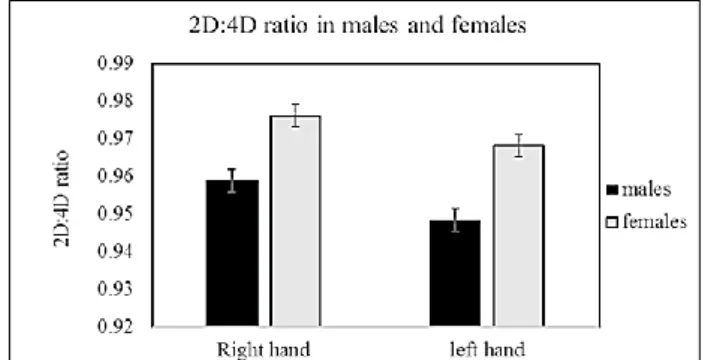
The mean right hand 2D:4D ratio in men (0.957±0.037 SD) was significantly less than in women (0.975±0.034 SD) (p<0.01) (Figure 1). The mean Left hand 2D:4D ratio in men (0.95±0.031 SD) was significantly less than women (0.968±0.030 SD), p<0.0001. There was a significant positive correlation between the right and left hand 2D:4D ratios in women (p<0.0001) and men (p<0.0001).
Figure 1: Comparison of 2D:4D ratio of males versus females
Figure 2: Comparison of handgrip strength of males versus females.
Figure 3: Correlation between 2D:4D ratio and Hand grip strength for the right hand (blue dots represent
data points for males, brown dots represent data points for females).
Mean HGS of the right hand in men (40.91±6.78 SD) was significantly greater than that of the left hand (37.17±6.89 SD). Mean HGS of the right hand in women (25.747±4.54 SD) was also significantly greater than that of the left hand (23.03±4.41 SD). HGS of the right hand was correlated positively with the left HGS in women (r=0.69, p<0.0001) and men (r=0.84, p<0.0001).
Figure 4: Correlation between 2D:4D ratio and hand grip strength for the left hand (blue dots represent
data points for males, brown dots represent data points for females).
HGS of the right hand in men was found to be significantly greater than women; p<0.0001 (Figure 2). For the left hand, men had a significantly greater HGS than women; p<0.0001. In addition, 2D:4D ratio showed a weak but significant negative correlation in men with HGS of the right hand (r=0.27, p<0.05) and of the left hand (r=0.24, p<0.05) (Figure 3). A weak but significant correlation was found between 2D:4D ratio and HGS in women for the left hand (r=0.19, p<0.05) but not for the right hand (Figure 4).
DISCUSSION
As computer based analyses have been found to be more accurate than other methods of measuring digit ratios, we used scanned images along with a computer based measurement tool (adobe measurement tool) for all our analyses.4
Low 2D:4D ratios appear to be associated with high levels of foetal testosterone relative to oestradiol, and high ratios with relatively high levels of foetal oestradiol.21 In accordance, women have been
consistently shown to exhibit a higher 2D:4D ratio than men.22,23 Present results were consistent with earlier
reports. Women demonstrated a greater 2D:4D ratio compared to men for both; the right and left hand. The sex differences attained a higher significance for the left hand. These results differed from other studies, which report a more significant sex difference in the ratios for the right hand compared to the left hand.24,25 The
in our population before making a conclusion to this effect.
There are various conflicting reports on the association of anthropometric variables with 2D:4D ratio. Some studies have reported no correlation of weight and height with 2D:4D ratio in men or women.26 However, other studies
have shown a positive correlation for 2D:4D to stature, mass, BMI, and waist circumference in girls, but the same correlation was not found for boys.9 In the present
study, we found a positive correlation between height and weight with 2D:4D ratio in men. A positive correlation was found between weight and 2D:4D ratio in women, but no correlation was seen between height and 2D:4D ratio in women. These results were similar for both right and left hands. It was reported in a study that the gender differences in 2D:4D could be attributed to differences in height and disappeared after controlling for height.27 This
however, this doesn’t explain our results in women. Based on our results, gender differ in 2D:4D ratio are not related to height, at least in women.
Body height has been reported to highly predict HGS in prepubertal boys and to a slightly lesser extent in girls.28
HGS was significantly associated with, BMI, height, weight, and gender in Italian children of age 9-10 years.29
We found only a weak but significantly positive correlation of HGS with weight, for right and left hand, in both men and women. HGS also showed a weak but significant positive correlation with height, in men but not in women.
High prenatal testosterone and low prenatal oestrogen (low 2D:4D) is implicated in high sprinting speed, endurance, and hand grip strength in boys. In girls low, prenatal testosterone and high prenatal oestrogen is associated with large body size.9 As was expected, in the
present study we found a higher grip strength in men compared to women.
Like studies in Caucasian and Mizo men, in the present study, HGS of both hands were significantly negatively correlated with 2D:4D ratio in men.16 Studies report a
negative correlation of right hand 2D:4D ratio with HGS in men of Hani ethnicity.14 However, no correlation for
any hand was seen in the Hui or Han ethnicity of the Chinese population.30,31
The present results on women were like many other studies.9 We found no correlation of 2D:4D of the right
hand with HGS in women. Similar results were found in studies from Han ethnicity.33 Studies on Hui and Han
ethnicities of the Chinese population reported a negative correlation of 2D:4D ratio of both hands with HGS in women.30,31 Other studies on the left hand report no
correlation.32 We found a weak but significant negative
correlation between the 2D:4D ratio and the HGS for the left hand.
It appears that the relation of 2D:4D ratio to HGS may depend on factors like ethnicity and cannot be generalized. Further studies should explore the relationship in populations of different ethnicities. 2D:4D has been reported to differentiate between basketball players competing at different standards but could not differentiate between players within the same competitive standard.34 The present study shows that
2D:4D of the right hand cannot differentiate between different handgrip strengths amongst women but is sensitive enough to be able to differentiate handgrip strengths of men from women. It can also differentiate between different strengths in men for both the hands and between different strengths in the left hand for women.
CONCLUSION
2D:4D ratio is a good measure of Hand grip strength in men, but is not a robust measure of HGS in women.
ACKNOWLEDGEMENTS
Authors are thankful to the staff and faculty of the departments of Anatomy and Physiology for their support towards data collection.
Funding: No funding sources Conflict of interest: None declared
Ethical approval: Institutional approval was taken from the Human Institutional Ethics Committee of Sharda University
REFERENCES
1. Paul SN, Kato BS, Hunk in JL, Vivekanandan S, Spector TD. The big finger: the second to fourth digit ratio is a predictor of sporting ability in women. Br J Sports Med. 2006;40(12):981-3.
2. Manning JT, Fink B, Neave N, Caswell N. Photocopies yield lower digit ratios (2D:4D) than direct finger measurements. Arch Sex Behav. 2005;34(3):329-33. 3. Bailey AA, Hurd PL. Finger length ratio (2D:4D)
correlates with physical aggression in men but not in women. Biol Psychol. 2005;68(3):215-22.
4. Allaway HC, Bloski TG, Pierson RA, Lujan ME. Digit ratios (2D:4D) determined by computer-assisted analysis are more reliable than those using physical measurements, photocopies, and printed scans. Am J Hum Biol. 2009;21(3):365-70.
5. Manning JT, Scutt D, Wilson J, Lewis-Jones DI. The ratio of 2nd to 4th digit length: a predictor of sperm
numbers and concentrations of testosterone, luteinizing hormone and oestrogen. Hum Reprod. 1998;13:3000-4. 6. Williams TJ, Pepitone ME, Christensen SE, Cooke
BM, Huberman AD, Breedlove NJ, et al. Finger-length ratios and human sexual orientation. Nature. 2000;404:455-6.
7. Lutchmaya S, Baron-Cohen S, Raggatt P, Knickmeyer R, Manning JT. 2nd to 4th digit ratios, fetal testosterone
8. Beaton A, Rudling N, Kissling C, Taurines R, Thome J. Digit ratio (2D:4D), salivary testosterone, and handedness. Laterality. 2011;16:136-55.
9. Ranson R, Stratton G, Taylor SR. Digit ratio (2D:4D) and physical fitness (Eurofit test battery) in school children. Early Hum Dev. 2015;91(5):327-31.
10. Panda K, Majumdar P, Umesh V, Sudhakar HH. Ratio of second to fourth digit as a predictor of performance in elite Indian volley ball players. Natl J Physiol Pharm Pharmacol. 2014;4(2):106-8.
11. De laCruz-Sánchez E, García-Pallarés J, Torres-Bonete MD L-GJ. Can our fingers alone raise us up to the sky? analysis of the digit ratio association with success in olympic wrestling. Coll Antropol. 2015;39:515-9. 12. Wind AE, Takken T, Helders PJM, Engelbert RHH. Is
grip strength a predictor for total muscle strength in healthy children, adolescents, and young adults? Eur J Pediatr. 2010;169:281-7.
13. Norman K, Stobäus N, Gonzalez MC, Schulzke J-D, Pirlich M. Hand grip strength: outcome predictor and marker of nutritional status. Clin Nutr. 2011;30(2):135-42.
14. Zhao D, Yu K, Zhang X, Zheng L. Digit Ratio (2D:4D) and handgrip strength in hani ethnicity. PLoS One. 2013;8(10):e77958.
15. Häger-Ross C, Schieber MH. Quantifying the independence of human finger movements: comparisons of digits, hands, and movement frequencies. J Neurosci. 2000;20(22):8542-50. 16. Fink B, Thanzami V, Seydel H, Manning JT. Digit
ratio and hand-grip strength in German and Mizos men: Cross-cultural evidence for an organizing effect of prenatal testosterone on strength. Am J Hum Biol. 2006;18(6):776-82.
17. Gallup AC, O’Brien DT, White DD, Wilson DS. Handgrip strength and socially dominant behaviour in male adolescents. Evol Psychol. 2010;8(2):229-43. 18. Van Anders SM. Grip strength and digit ratios are not
correlated in women. Am J Hum Biol. 2007;19(3):437-9.
19. Al-Zaid FS, Alhader A, AL-Ayadhi LY. The second to fourth digit ratio (2D:4D) in Saudi boys with autism: A potential screening tool. Early Hum Dev. 2015;91(7):413-5.
20. Mohan V, Shafiqah N, Shamsaimon B, Izzat M, Japri B, Effendi N. Fore arm circumference and hand length predicts maximal hand grip strength among Malaysian population. Middle-East J Sci Res. 2014;21(4):634-9. 21. Lutchmaya S, Baron-Cohen S, Raggatt P, Knickmeyer
R, Manning JT. 2nd to 4th digit ratios, fetal testosterone
and estradiol. Early Hum Dev. 2004;77(1-2):23-8. 22. Phelps VR. Relative index finger length as a
sex-influenced trait in man. Am J Hum Genet. 1952;4(2):72-89.
23. Agnihotri AK, Jowaheer AA, Soodeen-Lalloo AK. Sexual dimorphism in finger length ratios and sex determination: a study in Indo-Mauritian population. J Forensic Leg Med. 2015;35:45-50.
24. Manning JT, Churchill AJG, Peters M. The effects of sex, ethnicity, and sexual orientation on self-measured digit ratio (2D:4D). Arch Sex Behav. 2007;36(2):223-33.
25. Xu Y, Zheng Y. The digit ratio (2D:4D) in China: a meta-analysis. Am J Human Biol. 2015;27:304-9. 26. Oyeyemi BF, Iyiola OA, Oyeyemi AW, Oricha KA,
Anifowoshe AT, Alamukii NA. Sexual dimorphism in ratio of second and fourth digits and its relationship with metabolic syndrome indices and cardiovascular risk factors. J Res Med Sci. 2014;19(3):234-9. 27. Barut C, Tan U, Dogan A. Association of height and
weight with second to fourth digit ratio (2D:4D) and sex differences. Percept Mot Ski Percept Mot Ski. 2008;106(2):627-32.
28. Jürimäe T, Hurbo T, Jürimäe J. Relationship of handgrip strength with anthropometric and body composition variables in prepubertal children. HOMO- J Comp Hum Biol. 2009;60(3):225-38.
29. Montalcini T, Ferro Y, Salvati MA, Romeo S, Miniero R, Pujia A. Gender difference in handgrip strength of Italian children aged 9 to 10 years. Ital J Pediatr. 2016;42(1):16.
30. Lu H, Shen D, Wang L, Niu S, Bai C, Ma Z, et al. Digit ratio (2D:4D) and handgrip strength are correlated in women (but not in men) in Hui ethnicity. Early Hum Dev. 2017;109:21-5.
31. Shen D, Ma Z, Wang L, Huo Z, Lu H, Zhao J, et al. Digit ratio (2D:4D) and handgrip strength in a Chinese population of Han ethnicity. Early Hum Dev. 2016;103:141-5.
32. Peeters MW, Van Aken K, Claessens AL. The left hand second to fourth digit ratio (2d:4d) is not related to any physical fitness component in adolescent girls. PLoS One. 2013;8(4):1-7.
33. Zhao D, Li B, Yu K, Zheng L. Digit ratio (2D:4D) and handgrip strength in subjects of Han ethnicity: Impact of sex and age. Am J Phys Anthropol. 2012;149(2):266-71.
34. Frick NA, Hull MJ, Manning JT, Tomkinson GR. Relationships between digit ratio (2D:4D) and basketball performance in Australian men. Am J Hum Biol. 2017;29(3).