Analysis of Key Management Schemes
for Secure Group Communication
and Their Classi
fi
cation
R. Aparna
1and B. B. Amberker
21Department of Computer Science and Engineering, Siddaganga Institute of Technology, Tumkur, Karnataka, India 2Department of Computer Science and Engineering, National Institute of Technology, Warangal, Andhra Pradesh, India
Secure Group Communication is very critical for ap-plications like board-meetings, group discussions and teleconferencing. Managing a set of secure group keys and group dynamics are the fundamental building blocks for secure group communication systems. Several group key management techniques have been proposed so far by many researchers. Some schemes are information theoretic and some are complexity theoretic in nature. Users in the secure group may negotiate with each other to derive a common group key or may compute the group key on their own. Some schemes involve a trusted Key Distribution Center(KDC), which generates and distributes initial pieces of information, whereas in other schemes users themselves select their private information. Storage at each user and communication cost among members of the group vary from scheme to scheme. Here, in this paper, we discuss some of the key management schemes proposed earlier, based on the considerations mentioned above. We also analyze the schemes with respect to storage, communication and computation costs.
Keywords: secure group communication, secure group key, key distribution scheme, contributory key agreement, privileged user set
1. Introduction
The advancement of digital technologies and widening Internet bandwidth have increased the demand for new multimedia services. Some of the service types include video-on-demand, group discussions, board meetings, etc. There are many users who participate in such services. The communication among the users pertaining to any such service must be carried out confi-dentially.
Other scenarios may be out of the n users in a network, some t(t n) of them would like
to discuss on a common concern. Theset par-ties termedprivileged usersmust communicate themselves over a public channel in confidence and others must not be able to listen to the con-versation amongst thesetparties. Hence, there is a need to find new technology for such confi-dential communication termed asSecure Group CommunicationorSecure Conferencing. A Naive solution is to have a shared key between every pair of users, which leads to storing(n−1) keys with each user. To send a message, sender must encrypt the message to each user in the group separately. This increases the amount of storage at each user-end; computation and com-munication costs are also increased. Another possible solution would be to have a publicly available directory, called Public Key Infras-tructure(PKI). Here, user will have a(private, public) key pair, private key is known only to that user, whereas public keys of allnusers are stored in the publicly available directory. To send a message, sender uses public keys of all other group members to encrypt the message, so that other users can decrypt using their own private keys. This leads to(n−1)encryptions to send a single message and any non-group mem-ber can try to act as privileged user and send the message after encrypting it with public keys of privileged users. Since these default solutions require huge amount of storage, communication and computation, they do not fit for group com-munication scenario. Hence, the general goal of Secure Group Communication is to establish a commonsecret key, calledSecure group keyor
Many group key management techniques have been proposed so far. Some schemes are infor-mation theoretic in nature and some are com-plexity theoretic. There may be a trusted Key Distribution Center(KDC)involved in the sys-tem which generates and distributes initial pri-vate pieces of information to users in the group. Group key may be generated and distributed by the KDC or group members may compute the group key, either interactively or non-interacti-vely. Based on the involvement of KDC, key management techniques can be classified into two categories: (i)Key Distribution Schemeand (ii)Contributory Key Agreement Scheme. Key distribution scheme [4, 7, 20, 19, 16, 13, 18] involves a single entity termed as trusted KDC. There exists a pair-wise secure channel with the KDC and every group member. KDC is respon-sible for generating and distributing keys to all the members in the group via secure channel. It is also responsible for generating the group key and distributing it to all the users in the group. In key distribution scheme, after receiving the initial information from KDC, secure group key can be derived by the members in theprivileged set, either asynchronouslyor interactively. In asynchronous mode, each member in the priv-ileged group can derive a common group key on his own for secure conference with the help of information obtained by KDC. In interactive mode, users in the privileged group can commu-nicate with each other to set up secure confer-ence key. However, a KDC incurs management overhead and is a single point of failure. In contrast to key distribution scheme, contrib-utory key agreement schemes[6, 5, 10, 1, 2, 14, 11]require every group member to contribute an equal share to the common secret key. Secret key for secure group communication is com-puted as a function of all members contribution. Once a conference (group key)is set up, users in the group can communicate with each other in secured manner. Since the group is dynamic, membership in the group may change over time, i.e., new members may join the group and ex-isting members may leave the group. Group membership can change because a single mem-ber may join/leave the group or a set of mem-bers may join/leave the group simultaneously. Set of members join/leave scenario may arise because of the changes innetwork connectivity. These changes in network connectivity may be due to network partitions (which divides the group) and network re-heals (which combines
several groups together). A new member can always join the group voluntarily, but the mem-ber in the group may leave the group either vol-untarily or involvol-untarily(being forced by other members). Involuntary exit may be due to pro-cessor crash or network disconnect. Whenever there is a membership change, group key must be changed to prevent a new user from reading past communications, called backward access controland a departed user from reading future communications, calledforward access control. In key management schemes, anadversarymay try to eavesdrop on the conversation of the priv-ileged user set. An adversary may be an insider (member of amongnparties, but not a member of privileged set)or outsider(member of other thannparties). A group of users, termed mali-cious parties may collude with each other and try to derive the common group key. The se-curity of the group key management scheme is based on number of colluding parties. Scheme is termed ask-secure if it is not possible to derive the common key even after k non-group( non-privileged) members collude with each other, wherekis termed asthreshold.
The cost of the group key management scheme is determined by three factors: communica-tion, storageandcomputation, amongst which, communication and computation costs are very important. Usually, efficiency in one comes at the expense of the other. Schemes that require minimum computation usually require more communication among group members, while schemes minimizing communication re-quire more computations.
Many researchers have made surveys on group key management schemes[2, 15, 9]. In[2], per-formance evaluation has been made on five dis-tributed key management techniques. Rafaeli and Hutchison classify the schemes in[15]into centralized, decentralized and distributed key management protocols. In [9], Judge and Am-mar concentrate on providing security for mul-ticast content distribution in group key manage-ment.
agreement scheme,(ii)role of KDC(active only during initial stage or active throughout) (iii) se-curity (unconditional or conditional). Section 2 describes the protocols that come under key distribution scheme and Section 3 discusses key agreement protocols. We show the classifica-tions in Section 4. In Section 5, we analyze the protocols with respect to storage, communica-tion cost and computacommunica-tion cost. We conclude the paper in Section 6.
2. Key Distribution Schemes
As mentioned earlier, key distribution schemes are classified into asynchronous or non-interacti-ve and interactinon-interacti-ve modes. In asynchronous mode, each member in the privileged group can derive a common group key on his own, for se-cure conference, with the help of information obtained by KDC. In interactive mode, users in the privileged group can communicate with each other to compute secure conference key as described below.
2.1. Non-interactive Key Distribution Schemes
2.1.1. Blundo et al. Conference Keying Protocol
Blundo et al. [4] have proposed a protocol to derive a common conference key. In this ap-proach, a trusted off line server, which is active only at initial stage, distributes some informa-tion among a set ofnusers,(User1,User2, . . . ,
Usern)so that anytof them can join and
gener-ate a secure group key asynchronously. Figure
1 depicts the Blundo et al. non-interactive k -securet-conference protocol. It makes use of a symmetric polynomial intvariables(number of users in the group)of degreek(threshold)with coefficients over GF(q),q>n. In this scheme,
t is fixed beforehand. Each join/leave restarts the protocol from initial stage.
Maximum number of coefficients in the poly-nomial are
k+t−1
t−1
out of which each
user is required to store
k+t−2
t−2
val-ues from GF(q) and is required to perform at the most t∗
k+t−2
t−2
multiplications,
k+t−2
t−2
additions and k∗t exponentia-tion operaexponentia-tions.
2.1.2. Broadcast Encryption Zero Level Scheme
Fiat and Naor proposed a basic scheme [7] which allows users to determine a common key for every subset, which is resilient to any setS
of size≤ k. In this scheme, for a givenkeach user is preassigned with a set of keys such that, once the users are told which of them are in privilege set and which are not, each user in the privilege set can construct the common key on his own. This scheme considers a setU which comprises all users i.e.,|U|= n. For every set
B⊂U,0≤ |B| ≤k, a keyKBis defined andKB
is given to every userx∈ U−B. LetT denote the privileged user set. The common secret key to the privileged setTis obtained by performing exclusive-or of all keysKB,B∈U−T.
• KDC picks at random a symmetric polynomialP(x1, . . . ,xt)of degreekwithtvariables
with coefficients overGF(q),q>n.
• To each userUseri,i=1, . . . ,n, in the system, KDC distributes the polynomialfi(x2, . . . ,xt)
=P(i,x2, . . . ,xt), that is the polynomial obtained by evaluatingP(x1, . . . ,xt)atx1=i.
• If the usersUserj1, . . . ,Userjt want to set up a conference key, then each userUserji evaluatesfji(x2, . . . ,xt)at(x2, . . . ,xt) = (j1, . . . ,ji−1,ji+1, . . . ,jt).
• The conference key for usersUserj1, . . . ,Userjt is equal tosj1,...,jt =P(j1, . . . ,jt).
The scheme is resilient to every coalition of up to k users, since, even if up tok users collude, they will all be missing keyKS. Hence they are
unable to compute the common secret key. In this scheme, each user in the system is assigned with
k
i=0
n−1
i
keys and each user is
re-quired to perform
k
i=0
n−t i
exclusive-or operations to obtain the common secret key.
2.1.3. Broadcast Encryption One Level Scheme
This scheme developed by Fiat and Naor [7], considers a family of functionsf1,f2, . . . ,fl,fi:
U −→1, . . . ,mwith the property that for every subset S ⊂ U of size k, there exists some 1 ≤
i ≤ lsuch that for all u,v ∈ S : fi(u) = fi(v),
that means the family of functionsficontains a
perfect hash function (defined in [8], [12]) for all sizeksubsets ofUwhen mapped to the range
{1,2, . . . ,m}. This family can be used to obtain ak-resilient scheme from 1-resilient scheme. For every 1 ≤i≤land 1≤j≤m, an indepen-dent 1-resilient scheme R(i,j) is used. Every user u ∈ U receives the keys associated with schemes R(i,fi(x)) ∀ 1 ≤ i ≤ l. Suppose the
secret massage is M. To send this message to a privileged set T ⊂ U, KDC generates ran-dom strings M1, . . . ,Ml such that li=1Mi =
M. KDC broadcasts for all 1 ≤ i ≤ l and 1 ≤ j ≤ m the message Mi to the privileged
subset{u ∈ T|fi(u) = j}using schemeR(i,j).
Every user u ∈ T can obtain all the messages
M1, . . . ,Ml and by performing exclusive-or of
them can get the messageM.
Every user receives (n ∗ l) number of keys from KDC where l denotes number of func-tions, hence the storage required at every user is (n∗l)and 3 messages are broadcast by KDC.
2.1.4. Keystone Architecture
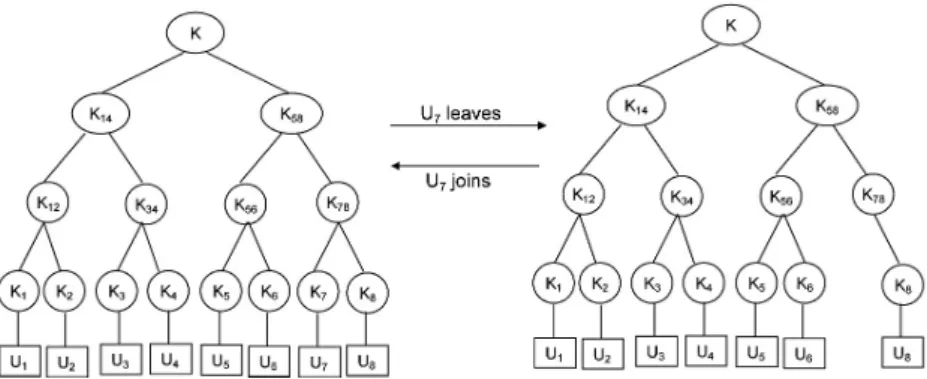
This scheme assumes a trusted key server which is responsible for distributing the keys; and, the key server uses key tree[20, 19, 3]for group key management. A key tree is a directed acyclic graph with two types of nodes, U nodes repre-senting members andknodes representing keys.
The nodes of the tree hold the keys at that par-ticular level. The leaves of the tree correspond to group members and each leaf contains indi-vidual key of that member. The key present at the root of the tree is the group key. Key server is at the root of the tree. Keys at the intermedi-ate levels of the tree are termedauxiliary keys
and will be used to convey new group key to the members in an efficient manner. A memberU
is given key k if and only if there is a directed path fromU-nodeutok-nodekin the key path. If the tree is a balanced binary tree and if there are t users in the group, then the height h of the tree islog2tand each member stores at most (h+1) keys. In general, if d is the degree of the tree and if there aret users, then height of the tree islogdt. Figure 2 depicts a binary tree
structure for t = 8 users. K-nodes represent keys andU-nodes represent users. UserU1, for example, knows the keys K1,K12,K14, and K whereK is the group key,K1isU1’s individual key, K12 and K14 are auxiliary keys along the path from leaf to root.
For each join/leave operation, server changes keys along the path from leaf to root from the po-sition where join/leave operation has occurred. For example, in Figure 2, if userU7 leaves the group, then the keys K78,K58 and K must be changed. Changed group key and auxiliary keys must be conveyed to remaining members in the group. New group keyK must be conveyed to usersU1toU6andU8,K58 must be sent to users
U5,U6,U8andK78 toU8. The following mes-sages are constructed to convey changed keys:
(Message {K}K indicates new key K en-crypted with keyK)
For usersU1toU4: {K}k14
For UsersU5,U6: {K58 }K56,{K}K58
For UserU8: {K78 }K8,{K58 }K78 ,{K}K58 Similarly, when it joins the group, keys at the same position are to be changed. The following messages are constructed:
For usersU1toU4: {K}K
For usersU5,U6: {K}K,{K58 }K58
For userU8: {K}K,{K58}K58,{K78 }K78
Figure 2.Tree structure forn=8 usersK-nodes represent keys andU-nodes represent users,K1toK8are user’s
private keys,K12,K34,K56,K78,K14,K58are auxiliary keys andKis the group key.
2.2. Interactive Key Distribution Schemes
2.2.1. Blundo et al. One-way Interactive Scheme
As in Blundo et al.[4]non-interactive scheme, here also trusted server chooses a symmetric polynomial, but in two variables of degree(k+ t−2)with coefficients over GF(q),q>n. Pro-tocol in Figure 3 realizes an one-time interactive
k-securet-conference key distribution scheme. The scheme is one-way interactive, since the
tth userUsert among users(User1,User2, . . . ,
Usert)selects the common secret key and sends
it securely to all the other t−1 users(User1,
User2, . . . ,Usert−1). In this scheme, each user
is required to store (t + k − 1) elements of
GF(q) and is required to perform at the most (k+t−2)∗2 exponentiations and same num-ber of multiplications and(k+t−2)additions and one exclusive-or operation. Usertsends
se-curely the group key to every other user in the group. Each join/leave operation re-initiates the protocol.
3. Contributory Key Agreement
3.1. Group Diffie-Hellman Key Agreement
In this scheme, secret key is never transmitted from one user to the other over the network. Group Diffie-Hellman Protocol in[17]
general-1. KDC chooses a symmetric polynomialP(x,y)of degree(k+t−2)with coefficients overGF(q),q>n.
2. To each useruseri,i=1, . . . ,n, in the system, KDC distributes the polynomial
fi(y) =P(i,y), that is the polynomial obtained by evaluatingP(x,y)atx=i.
3. If the usersUserj1, . . . ,Userjt, wherej1 <j2< . . . <jt, want to set up a conference key, then:
(a) Userjt, randomly chooses a secret keysinGF(q) (the valuesis the conference key). (b) Userjt evaluates the polynomialfjt(y)aty=jl, forl=1, . . . ,t−1, and, then,
he computes temporary keyssjt,jl =fjt(jl) (which is equal toP(jt,jl)). (c) Userjt sends toUserjl the valueγl=sjt,jl
s, forl=1, . . . ,t−1, whereis the bitwise ex-or.
(d) Forl=1, . . . ,t−1: Userjl, first computessjt,jl =sjl,jt =fjl(jt) (which is equal toP(jl,jt) =P(jt,jl)). Then,Userjl computessby taking the bitwise ex-or betweensjt,jl and the valueγlreceived byUserjt.
izes the basic 2 party Diffie-Hellman key ex-change discussed in[6]. In Diffie-Hellman, two parties agree on a common key. Group Diffie-Hellman protocol considers t users, instead of two users. The group agrees upon a pair of primesqandgand starts calculating intermedi-ate values. First member calculintermedi-ates first value,
gr1 and passes it to the next member. Each
sub-sequent member in the group receives the set of intermediate values and raises them using its own contribution generating a new set. A set generated by jthmember will havej
intermedi-ate values withj−1 exponents and anew value
comprising all the exponents. For example, the fifth member receives the set:
{gr2r3r4,gr1r3r4,gr1r2r4,gr1r2r3,gr1r2r3r4}
and generates the set
{gr2r3r4r5,gr1r3r4r5,gr1r2r4r5,gr1r2r3r5,
gr1r2r3r4,gr1r2r3r4r5}
The new value in this set is gr1r2r3r4r5. The
last member (t) can calculate the new value
K = gr1r2...rt. It raises all intermediate values to its contribution and multicasts it to the set. Each member extracts its respective intermedi-ate value and calculintermedi-ates group key K. During the first phase, all the users send gri i.e., one message is sent by each user. During the second phase, all the users sendgrirj,j=i,j=1 tot, i.e., (t−1)messages are sent by each user. During
the third phase, each user will send
t−1 2
messages and so on. Hence,
t−1
i−1
mes-sages are sent by each user during ith phase. Total number of communications required to set up group key=t∗{1+
t−1 1
+
t−1 2
+. . .+
t−1
t−1
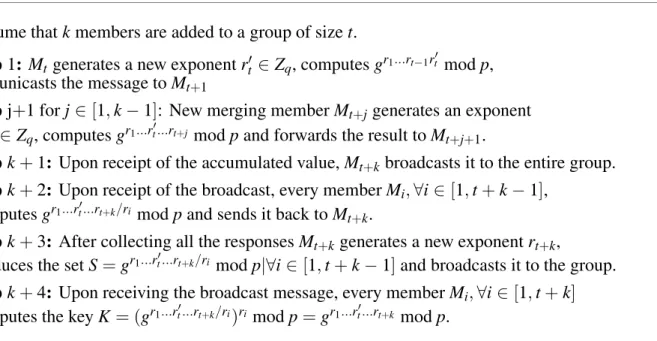
}=t∗(2t−1+1)and each user must perform(2t−1+1)exponentiations. If a set of k members want to join the group, then a list of partial keys for each member of the group is generated and sent. Upon receiv-ing partial keys each user uses its partial key to compute the common secret key. Usually, one particular member of the group(termed as controller)is responsible for generating and dis-tributing these partial keys. Figure 4 shows a protocol to mergek members to the group and Figure 5 shows a partition protocol.
In merge protocol the current group controller (usuallytthuser)removes its contribution from
the current group key, generates a new token and passes it to one of the new members. The new member adds its own contribution to the to-ken received by group controller and passes the token to the next new member. Every new mem-ber(except the last one)adds its own contribu-tion and passes it in the same manner. When the
Assume thatkmembers are added to a group of sizet.
Step1: Mt generates a new exponentrt ∈Zq, computesgr1...rt−1rt modp,
and unicasts the message toMt+1
Stepj+1 forj∈[1,k−1]: New merging memberMt+jgenerates an exponent
rt+j ∈Zq, computesgr1...rt...rt+j modpand forwards the result toMt+j+1.
Stepk+1: Upon receipt of the accumulated value,Mt+kbroadcasts it to the entire group.
Stepk+2: Upon receipt of the broadcast, every memberMi,∀i∈[1,t+k−1],
computesgr1...rt...rt+k/ri modpand sends it back toM
t+k.
Stepk+3: After collecting all the responsesMt+kgenerates a new exponentrt+k,
produces the setS=gr1...rt...rt+k/ri modp|∀i∈[1,t+k−1]and broadcasts it to the group. Stepk+4: Upon receiving the broadcast message, every memberMi,∀i∈[1,t+k]
computes the keyK = (gr1...rt...rt+k/ri)ri modp=gr1...rt...rt+k modp.
Assume that a set W of members is leaving a group of sizet.
Step1: The group controllerMd generates a new exponentrd ∈Zq, produces the set
S=gr1...rd modp|Mi ∈/W, and broadcasts it to the remaining members in the group. Step2: Upon receiving S, every remaining memberMi,∀i∈/ W computes the key
K= (gr1...rd/ri)ri modp=gr1...rd modp.
Figure 5.Group Diffie-Hellman partition protocol.
token reaches the last new member, it broadcasts the token to the group without adding its con-tribution. From now on, this becomes the new group controller. Upon receiving the token, ev-ery group member (including new members), removes(factors out)its contribution and sends it to the new group controller (last new mem-ber). After receiving this information from all the members, new controller adds its own con-tribution to each and this represents a partial key. After computing all the partial keys, it is broadcast to the group. Every member gets the new group key by adding its contribution to the corresponding partial key that was broadcast. In partition protocol, when a set of members leave the group, the most recent remaining group member is termed as the group controller. Group controller removes the corresponding partial keys of the leaving users from the list of partial keys, adds its new contribution after removing the previous contribution and broad-casts it to the group. Each remaining mem-ber in the group can compute the secret group key by adding its own contribution to the corre-sponding partial key in the list. For every join operation, (t+3) messages are sent and each user must perform(t+3)exponentiation
oper-ations. If any user leaves the group, one mes-sage is broadcast and each user performs one exponentiation operation, hence totally(t−1) exponentiation operations are performed.
3.2. Burmester-Desmedt Scheme
Burmester and Desmedt proposed a protocol [5]which is very efficient and executes in only three rounds. Figure 6 shows the Burmester-Desmedt protocol. The same protocol is exe-cuted irrespectively of the type of membership change (i.e, whether it is join or leave). This scheme does not involve any group controller, computation is distributed among members of the group. Users U1 through Ut with
individ-ual Diffie-Hellman exponentials zi = gri will
form a conference keyK =gr1r2+r2r3+...+rt−1rt. Every user is required to perform(t+1) expo-nentiations and(t−1)multiplications and must broadcast(2∗t)messages.
If any user joins the group,(2∗t+2)messages are broadcast and 3 exponentiation operations are performed. For a leave operation,(2∗t−2) messages are broadcast and 3 exponentiation operations are performed.
Any group oft≤nusers(U1, . . . ,Ut) (tn), derive a common group keyKas follows:
(Every userUiis aware of othert−1 members in the group)
1. EachUiselects a random integerri, 1≤ri≤p−2, computeszi=grimodp, and sends
zito each of the othert−1 group members.
2. EachUiafter receivingzi−1andzi+1, computesXi= (zi+1/zi−1)ri modp
(i.e.,Xi=gri+1ri−riri−1), and sendsXito each of the othert−1 group members.
3. Upon receivingXj, 1≤j≤texcludingj=i,UicomputesK=Kias
Ki= (zi−1)tri.Xit−1.Xit−+12. . .X2i+(t+3).Xi1+(t−2)modp=gr1r2+r2r3+...+rt−1rt modp.
4. Classification
The schemes discussed above are deliberately classified based on the factors like (i) method used to establish the group key(ii)role of Key Distribution Center and(iii)security.
4.1. Based on Group Key Establishment
Based on the way group key is derived, the schemes can be classified into (a) Key Distri-bution scheme(b)Contributory Key Agreement scheme. In key distribution scheme, as we saw earlier, there is a key distribution center which is responsible for generating and distributing keys to all the group members via secure channel. KDC also generates and distributes initial group key to the group members when the group is set up and also new group key whenever there is a membership change (join/leave). Again the schemes which come under Key Distribution can be further classified into Asynchronous or Non-Interactive and Interactive Key Distribu-tion schemes. In Non-Interactive, members in the privileged group can derive a common group key on their own with the help of the information obtained by KDC. Of the schemes discussed so far, Blundo et al. conference keying pro-tocol [4], Broadcast encryption zero level and one level schemes [7], and Keystone architec-ture scheme [21]are Non-interactive Key Dis-tribution schemes.
In Interactive, users in the privileged group can communicate with each other to set up the group key. Blundo et al. one-way interactive scheme [4]comes under this classification, astthuser is
choosing the group key and distributing it se-curely to the rest of the(t−1)members in the group.
In Contributory Key Agreement schemes, there is no KDC involved. Instead, each group mem-ber picks its own contribution (maybe some random number) to group key and interacts with other members to compute the group key. Schemes proposed by Diffie-Hellman [6, 17] and Burmester-Desmedt [5] come under this scheme.
4.2. Based on Role of KDC
The schemes under Key Distribution are based on a single entity called KDC. These schemes
are further classified based on the role of KDC. In some schemes, KDC is active only during initial stageof the protocol, i.e., KDC just gen-erates and distributes initial private pieces of in-formation among group members and becomes inactive. Blundo et al. Non-Interactive, Blundo et al. one-way interactive [4] and Broadcast encryption zero level schemes [7] come under this category. Where as in Broadcast encryp-tion one level scheme [7] and Keystone archi-tecture[21], KDC isactive throughoutthe pro-tocol. During initial stage, KDC generates and distributes securely initial private pieces of in-formation among the privileged user set. Dur-ing later stage, it becomes active durDur-ing each join/leave operation. In broadcast encryption one level scheme, KDC itself generates random strings for the message and broadcasts it to the privileged set, where as in keystone architec-ture, whenever there is a membership change (join/leave), KDC generates new group key and auxiliary keys and sends them to the group members in an optimized way.
4.3. Based on Security
Group key management schemes provide either
unconditional security or conditional security. In unconditional security, even if an adversary has unlimited computational resources, he can-not defeat the system. In conditional security, depending on the amount of computational ef-fort required, an adversary can defeat the sys-tem and the methods depend on the hardness of the problem. The following schemes pro-vide unconditional security: Blundo et al. non-interactive and one way non-interactive schemes[4], Broadcast encryption zero level and one level schemes[7], keystone architecture[21]. Where as the schemes proposed by Diffie-Hellman[6] and Burmester-Desmedt[5]provide conditional security.
5. Storage, Computation and Communication costs
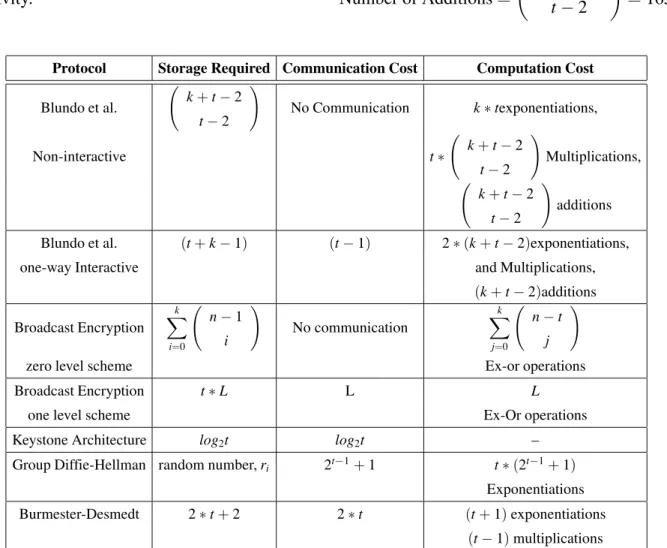
participatingtmembers. In the table,ndenotes total number of users in the system, t denotes size of the privileged set,kdenotes the threshold andLtotal number of functions.
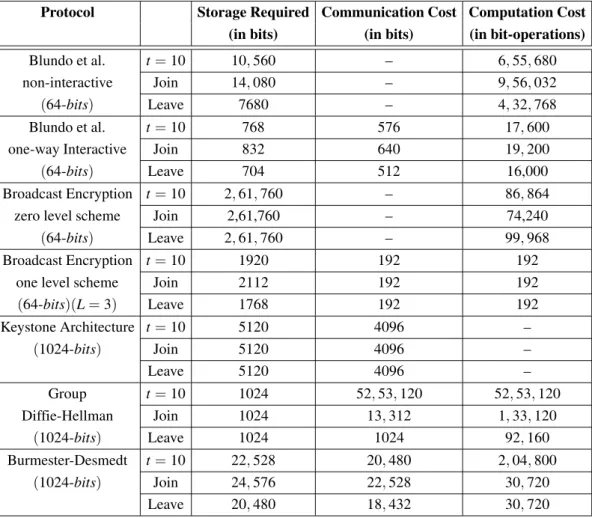
Let the number of users in the system,nbe 30, size of the privileged set t be 10 and threshold valuekbe 3. For Blundo et al. non-interactive, one-way interactive, Broadcast encryption zero level and one level schemes, we have consid-ered the size of the element fromGF(q)as 64-bits and for Group Diffie-Hellman, Burmester-Desmedt and Keystone architecture schemes, the size of the element is considered as 1024-bits. Table 2 shows the storage and communi-cation costs in bits and total computation cost in bit-operations for different protocols after con-sidering one join and one leave operations. If one member joins the group, size of the privi-leged set will be(t+1)i.e., 11 and if a member leaves, it is (t −1) i.e., 9. First row of each protocol indicates the storage, communication and computation costs during initial key set up activity.
Each exponentiation and multiplication opera-tion requiresWlog2W bit-operations, whereW is the size of the element. It is 64log264=384 bit-operations for the protocols for whichW = 64 and 1024log21024= 10240 bit-operations for the protocols withW =1024.
Calculations Illustration:
Consider Blundo et al. non-interactive scheme. Storage at each user is
k+t−2
t−2
=
11 8
=165 co-efficients from GF(q). Size of each co-efficient is considered as 64-bits, hence stor-age at each user=165∗64=10560 bits. Each term contains maximum 10 variables (t) with maximum degree 3 (k). Therefore, maximum number of exponentiations=10∗3=30.
Number of Multiplications=t∗
k+t−2
t−2
=10∗165=1650
Number of Additions=
k+t−2
t−2
=165
Protocol Storage Required Communication Cost Computation Cost
Blundo et al.
k+t−2 t−2
No Communication k∗texponentiations,
Non-interactive t∗
k+t−2 t−2
Multiplications,
k+t−2 t−2
additions
Blundo et al. (t+k−1) (t−1) 2∗(k+t−2)exponentiations,
one-way Interactive and Multiplications,
(k+t−2)additions
Broadcast Encryption
k
i=0
n−1 i
No communication
k
j=0
n−t j
zero level scheme Ex-or operations
Broadcast Encryption t∗L L L
one level scheme Ex-Or operations
Keystone Architecture log2t log2t –
Group Diffie-Hellman random number,ri 2t−1+1 t∗(2t−1+1)
Exponentiations
Burmester-Desmedt 2∗t+2 2∗t (t+1)exponentiations
(t−1)multiplications
Protocol Storage Required Communication Cost Computation Cost (in bits) (in bits) (in bit-operations)
Blundo et al. t=10 10,560 – 6,55,680
non-interactive Join 14,080 – 9,56,032
(64-bits) Leave 7680 – 4,32,768
Blundo et al. t=10 768 576 17,600
one-way Interactive Join 832 640 19,200
(64-bits) Leave 704 512 16,000
Broadcast Encryption t=10 2,61,760 – 86,864
zero level scheme Join 2,61,760 – 74,240
(64-bits) Leave 2,61,760 – 99,968
Broadcast Encryption t=10 1920 192 192
one level scheme Join 2112 192 192
(64-bits)(L=3) Leave 1768 192 192
Keystone Architecture t=10 5120 4096 –
(1024-bits) Join 5120 4096 –
Leave 5120 4096 –
Group t=10 1024 52,53,120 52,53,120
Diffie-Hellman Join 1024 13,312 1,33,120
(1024-bits) Leave 1024 1024 92,160
Burmester-Desmedt t=10 22,528 20,480 2,04,800
(1024-bits) Join 24,576 22,528 30,720
Leave 20,480 18,432 30,720
Table 2.Table depicting storage, communication and computation costs.
Total computation cost for Exponentiation, Mul-tiplication and Addition= (30+1650)∗384+ 165∗64=655680 bit-operations.
For every join/leave operation, the protocol must be restarted(i.e., KDC must pick another symmetric polynomial and distribute it) from the initial stage. For join operation, every user will have
12
9
= 220 coefficients and is required to perform 11∗3 exponentiation oper-ations, 2420 multiplications and 220 additions. Total storage is 220∗64=14080 bits and com-putation cost is (33+2420)∗384+220∗64 = 956032 bit-operations. If a user leaves the group, storage=120∗64=7680 bits and com-putation cost= (27+1080)∗384+120∗64 =432768 bit-operations.
For Diffie-Hellman protocol, each user must store only the random number whose size we have considered as 1024-bits. During initial group key set up, totally t ∗(2t−1 +1)
mes-sages are exchanged among privileged user set. Hence, communication cost=10∗(29+1) = 5130 messages * 1024 bits= 52,53,120 bits. Each user must perform 2t−1+1 exponentia-tions, which leads to 29 +1 = 513 exponen-tiations with 10240 bit-operations for each ex-ponentiation. So, total exponentiation cost = 513∗10240=52,53,120 bit-operations. If a user joins the group, only(t+3)messages are sent and(t+3)exponentiation operations are performed. Hence, total communication cost is 13,312 bits and computation cost is 1,33,120 bit-operations. For a leave operation, only one message is sent(1024bits)and(t−1) exponenti-ation operexponenti-ations are performed i.e., computexponenti-ation cost=9∗10240=92,160 bit-operations.
5.1. Performance Analysis
of storage required at each user and the compu-tation costs are larger, but there is no commu-nication among the group members. In Blundo et al. one-way interactive scheme, amount of storage required is very much less, compared to non-interactive scheme and it requires mod-erate computation cost with minimum com-munication cost. Broadcast encryption one level scheme requires moderate amount of stor-age with less communication and computation costs. In keystone architecture, no computa-tion cost is involved since KDC itself sends the group key. In Group Diffie-Hellman, storage re-quired is negligible, but requires more messages to be exchanged with high computation cost. Burmester-Desmedt scheme requires more
stor-Figure 7.Storage at each user.
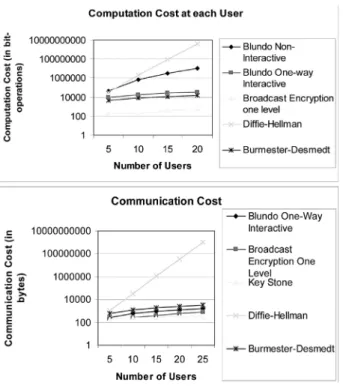
Figure 8.Communication and computation costs.
age; communication and computation costs are also high to set up the group key, but, compu-tation cost required is less for join/leave opera-tions as compared to Diffie-Hellman, Broadcast encryption zero level and Blundo et al. non-interactive schemes. Graphs depicting num-ber of users versus storage, communication and computation costs are plotted. Figure 7 gives the comparison for amount of storage at each user and Figure 8 about communication and computation costs. From the graphs we can see that amount of storage required for Diffie-Hellman is negligible, but communication and computation costs are too high.
For join/leave operations, the schemes pro-posed by Blundo et al. and broadcast encryp-tion zero level schemes require almost the same amount of computation as required for initial key set up, where as it is very much less in case of Diffie-Hellman and Burmester-Desmedt pro-tocols. Among the protocols discussed in the paper, broadcast encryption one level and key-stone architecture schemes are quite efficient as compared with other schemes.
6. Conclusion
We discussed several key management schemes and classified them based on the method used to establish the group key, involvement of Key Distribution Center in different phases of secure group communication and security factors. We analyzed the performance of the protocols based on the amount of storage required, communi-cation and computation costs during initial key set up activity and during join/leave operations. It is evident from the tables that the schemes which require more storage, require less amount of communication. But, at the same time, computation cost required for join/leave opera-tions is quite high. The schemes which require more communication among users, require less amount of computation for each join/leave op-eration.
References
[1] Y. AMIR, Y. KIM, C. NITA-ROTARU, J. SCHULTZ, J.
STANTON, G. TSUDIK, Secure Group
[2] Y. AMIR, C. DANILOV, M. MISKIN-AMIR, J.
SCHULTZ, J. STANTON, The Spread Toolkit: Archi-tecture and Performance. Technical Report, CNDS-2004-1, Johns Hopkins University, 2004.
[3] D. BALENSON, D. MCGREW, A. SHERMAN, Key
Management for Large Dynamic Groups: One-way Function Trees and Amortized Initialization. Internet Draft, draft-irtf-smug-groupkeymgmt-oft-00.txt, August 2000.
[4] C. BLUNDO, A. DESANTIS, A. HERZBERG, S. KUT -TEN, U. VACCARO, M. YUNG, Perfectly Secure Key
Distribution for Dynamic Conferences. InAdvances in Cryptology-CRYPTO’92, LNCS, 740(1993), pp. 471–486.
[5] M. BURMESTER, Y. DESMEDT, A Secure and Ef-ficient Conference Key Distribution System. Ad-vances in Cryptology – EUROCRYPT’94.
[6] W. DIFFIE, M. HELLMAN, New Directions in
Cryp-tography. IEEE Transactions on Information The-ory, IT-22(6): 644–654, November 1976.
[7] A. FIAT, M. NAOR, Broadcast Encryption. In D. R.
Stinson, editor, Proceedings of CRYPTO’93, pp.
480–491.
[8] O. GOLDREICH, S. GOLDWASSER, S. MICALI, How to
Construct Random Functions.Journal of the ACM
33, 1986, pp. 792–807.
[9] P. JUDGE, AMMAR, Security issues and solutions in multicast content distribution: A Survey.IEEE Network, Jan/Feb 2003.
[10] Y. KIM, A. PERRIG, G. TSUDIK, Simple and
Fault-tolerant Key Agreement for Dynamic Collaborative
Groups. In the 7th ACM Conference on Computer
and Communications Security. ACM Press, 2000, pp. 235–244.
[11] P. P. C. LEE, J. C. S. LUI, D. K. Y. YAU, Distributed
Collaborative Key Agreement Protocols for Dy-namic Peer Groups.Proc. IEEE International Con-ference on Network Protocols (ICNP), November 2002.
[12] K. MEHLHORN, Data Structures and Algorithms: Sorting and Searching. Springer-Verlag, Berlin Hei-delberg, 1984.
[13] S. MITTRA, Iolus: A Framework for Scalable
Se-cure Multicasting. InProceedings of the ACM SIG-COMM. Vol. 27, No. 4 (NewYork, Sept.), ACM, NewYork, 1997, pp. 277–288.
[14] A. PERRIG, Efficient Collaborative Key
Manage-ment Protocol for Secure Autonomous Group
Communication. Proc. of International Workshop
CrypTEC, 1999.
[15] S. RAFAELI, D. HUTCHISON, A survey of Key
Man-agement for Secure Group Communciation.ACM
Computing Surveys, September 2003.
[16] A. T. SHERMAN, D. A. MCGREW, Key
Establish-ment in Large Dynamic Groups Using One-way
Function Trees. IEEE Transactions on Software
Engg.2003, pp. 444–458.
[17] M. STEINER, G. TSUDIK, M. WAIDNER,
Diffie-Hellman Key Distribution Extended to Group
Com-munication. In SIGSAC Proceedings of the third
ACM conference on Computer and Communica-tions Security. New Delhi, India, March 1996., ACM, New York, pp. 31–37.
[18] M. WALDVOGEL, G. CARONNI, D. SUN, N. WEILER,
B. PLATTNER, The Versakey Frameworks: Versatile
Group Key Management.IEEE Journal on Selected
Areas in Communication (JSAC), Vol. 17, No. 9, September 1999, pp. 1614–1631.
[19] D. WALLNER, E. HARDER, R. AGEE, Key
Manage-ment for Multicast: Issues and Architectures. Re-quest For Comments (Informational) 2627, Internet Engineering Task Force, June 1999.
[20] C. WONG, M. GOUDA, S. LAM, Secure Group
Com-munication Using Key Graphs. InProceedings of
the ACM SIGCOMM’98, October 1998.
[21] C. K. WONG., SIMONS. LAM, Keystone: A Group Key Management Service. InProceedings of Inter-national Conference on Telecommunications, Aca-pulco, Mexico, May 2000.
Received:February, 2008
Revised:November, 2008
Accepted:December, 2008
Contact addresses:
R. Aparna Dept. of Computer Science and Engg. Siddaganga Institute of Technology Tumkur, Karnataka, India e-mail:[email protected]
B. B. Amberker Dept. of Computer Science and Engg. National Institute of Technology Warangal, Andhra Pradesh, India e-mail:[email protected]
R. APARNAobtained her M.S. from Birla Institute of Technology, Pilani, Rajasthan, India. She is presently working as an Assistant Professor in the Department of Computer Science and Engineering, Siddaganga Institute of Technology, Tumkur, Karnataka, India and pursuing Ph.D in the area of cryptography and network security.