c
⃝Journal “Algebra and Discrete Mathematics”
Finding proper factorizations in finite groups
Joseph Kirtland
Communicated by V. I. Sushchansky
Abstract. One focus in group theory has been to establish the properties of a finite group that can be written as the prod-uct of two proper subgroups whose properties are known. The investigation here will proceed in the other direction by establish-ing conditions for when a finite group can be written as a product of two proper subgroups and for when a specific proper subgroup is part of a product of proper subgroups that equals the group. A byproduct of this investigation is a classification of those finite groups which cannot be written as the product of any two proper subgroups.
Introduction
All groups are finite. A group 𝐺 admits a proper factorization, or is
factorizable, if there are proper subgroups 𝐴 and 𝐵 of𝐺 such that 𝐺=
𝐴𝐵. Any factorization of 𝐺=𝐴𝐵 into a product of proper subgroups𝐴 and 𝐵 results in a maximal factorization of 𝐺=𝑀1𝑀2, where 𝐴≤𝑀1,
𝐵 ≤ 𝑀2 and both 𝑀1 and 𝑀2 are maximal subgroups of 𝐺. In [10],
Ore showed for solvable groups 𝐺, that if 𝐻 and 𝐾 are any two non-conjugate maximal subgroups of 𝐺, then 𝐺=𝐻𝐾, and conversely that any maximal factorization of𝐺occurs this way.
Group factorizations have yielded significant results. For example, Itˆo [5] showed that if 𝐺=𝐴𝐵 with𝐴 and𝐵 abelian, then𝐺is metabelian, and Kegel [8] proved that if 𝐺 = 𝐴𝐵 with 𝐴 and 𝐵 nilpotent, then 𝐺 is solvable. More recently, this approach has turned to investigating groups which can be written as the product of two simple groups (a good
2000 Mathematics Subject Classification: 20D40; 20E07.
beginning reference is Walls [14]). An excellent reference on products of groups is the book by Amberg, Franciosi, and de Giovanni [1].
The avenue of research described in the previous paragraphs motivates the following two questions.
1. Given a group𝐺, when can𝐺be written as the product𝐴𝐵of two proper subgroups𝐴 and𝐵?
2. Given a specific proper subgroup 𝐴 of 𝐺, when does there exist a proper subgroup 𝐵 of 𝐺such that𝐺=𝐴𝐵?
The goal of this article is to answer these two questions. It should be noted that question (1) reduces to the following: Which noncyclic groups have the property that no pair of maximal subgroups are permutable? Scott, in 13.1.5 of [12], showed that a finite solvable group has a proper factorization if and only if it is not a cyclic 𝑝-group. A generalization of this result is given in Section 2.
Preliminary results needed to address both questions will be presented in Section 1. An answer to the first question will be given in Section 2 as a corollary to the classification of nonfactorizable groups. A nontriv-ial group 𝐺 is nonfactorizable if for all proper subgroups 𝐴 of 𝐺 there does not exist a proper subgroup 𝐵 of 𝐺 such that 𝐺 =𝐴𝐵. To begin to answer the second question, an approach involving 𝑎𝑆-groups will be used. A group 𝐺 is an 𝑎𝑆-group if it has order 1 or if for every non-trivial subgroup 𝐻 of 𝐺 there is a proper subgroup 𝐾 of 𝐺 such that 𝐺=𝐻𝐾. In Section 3, it will be shown that the collection of𝑎𝑆-groups forms a formation. The residual of this formation will be used to de-termine proper factorizations. The results established through Section 3 will be applied in Section 4, where conditions for determining whether a particular subgroup of a group is in a proper factorization for that group will be examined.
The notation used is standard. The Frattini subgroup of a group𝐺is denoted byΦ(𝐺), its commutator subgroup by𝐺′, and its center by𝑍(𝐺). If𝐻 is a subgroup of 𝐺, the centralizer of 𝐻 in𝐺 is denoted by 𝐶𝐺(𝐻)
1. Preliminary results
Consider a group𝐺, and suppose that for a subgroup𝐴of𝐺there exists a subgroup 𝐵 of 𝐺 such that 𝐺= 𝐴𝐵. It is somewhat cumbersome to only be able to refer to subgroup𝐵 using the factorization of 𝐺=𝐴𝐵. To help with the terminology, the following definition is made.
Definition 1. A subgroup 𝐴 of a group 𝐺 has a supplement in 𝐺 if there exists a subgroup𝐵 of 𝐺such 𝐺=𝐴𝐵.
When a group 𝐺has a proper factorization 𝐺=𝐴𝐵 for proper sub-groups 𝐴 and 𝐵, the subgroup 𝐵 is referred to as a proper supplement of𝐴 in𝐺.
Lemma 1. Let𝑁 and𝐴be proper subgroups of group 𝐺with 𝑁⊲𝐺and
𝑁 < 𝐴. If 𝐴/𝑁 has a proper supplement in 𝐺/𝑁, then 𝐴 has a proper supplement in𝐺.
Proof. Since there exist a proper subgroup𝐵/𝑁of𝐺/𝑁 such that𝐺/𝑁 =
𝐴/𝑁⋅𝐵/𝑁, it follows that 𝐺=𝐴𝐵.
Lemma 2. Let 𝐴 and 𝐻 be subgroups of 𝐺 such that 𝐴 is proper in 𝐺
and 𝐴 < 𝐻. If 𝐴 has a proper supplement in 𝐺, then 𝐴 has a proper supplement in𝐻.
Proof. The result follows if 𝐻 = 𝐺. Assume 𝐻 is a proper subgroup of 𝐺. Since𝐴 has a proper supplement 𝐵 in𝐺,𝐺=𝐴𝐵. By the Modular Identity, 𝐻 = 𝐺∩𝐻 = 𝐴𝐵∩𝐻 = 𝐴(𝐵 ∩𝐻). If 𝐵∩𝐻 = {1}, then 𝐴 = 𝐻, a contradiction. If 𝐵 ∩𝐻 = 𝐻, then 𝐴 < 𝐻 ≤ 𝐵, another contradiction. Thus𝐴 has a proper supplement in 𝐻.
The converse of Lemma 1 is not true as the group 𝐺= ⟨𝑎, 𝑏 ∣ 𝑎5 =
𝑏4
= 1, 𝑎𝑏=𝑏𝑎2
⟩ indicates. Let𝑁 =⟨𝑎⟩ and𝐴 =⟨𝑎, 𝑏2
⟩. The subgroup 𝐴has a proper supplement⟨𝑏⟩in𝐺, yet 𝐴/𝑁 has no proper supplement in𝐺/𝑁 as it is cyclic of order 4. Likewise, the converse of Lemma 2 is also not true as the group𝐺=⟨𝑎, 𝑏∣𝑎9
=𝑏9
= 1, 𝑎𝑏=𝑏𝑎⟩indicates. Consider the subgroups𝐻 = Φ(𝐺) =⟨𝑎3
, 𝑏3
⟩and𝐴=⟨𝑎3
⟩. The subgroup𝐴has a proper supplement in𝐻 as𝐻 =𝐴×⟨𝑏3
⟩, yet𝐴has no proper supplement in𝐺as𝐴 is contained in the Frattini subgroup of𝐺.
The last lemma of the section is obvious and presented without proof.
Lemma 3. If 𝐺 is a group such that 𝐺=𝐻𝐾 for subgroups 𝐻 and𝐾, then for any normal subgroup𝑁 of 𝐺, 𝐺/𝑁 =𝑁 𝐻/𝑁⋅𝑁 𝐾/𝑁.
2. Nonfactorizable groups
To determine when a group 𝐺 admits a proper factorization, a study of nonfactorizable groups is essential.
Definition 2. A group 𝐺 is nonfactorizable if ∣𝐺∣ ∕= 1 and for all proper subgroups 𝐴 of 𝐺, there does not exist a proper subgroup 𝐵 of 𝐺
such that 𝐺=𝐴𝐵.
The following proposition follows directly from Lemmas 1 and 3.
Proposition 1. Let 𝐺 be a group and 𝑁 be a proper normal subgroup of 𝐺.
(i) If 𝐺is nonfactorizable, then 𝐺/𝑁 is nonfactorizable.
(ii) If 𝐺/𝑁 is nonfactorizable for 𝑁 ≤Φ(𝐺), then 𝐺 is nonfactoriz-able.
The maximal factorizations of all of the finite simple groups have been determined by Liebeck, Praeger, and Saxland in [9]. One of the byprod-ucts of this investigation is that the nonfactorizable simple groups are also known. The abelian simple groups of order greater than 1 are nonfac-torizable, and the alternating groups 𝐴𝑛, for 𝑛≥5, are all factorizable.
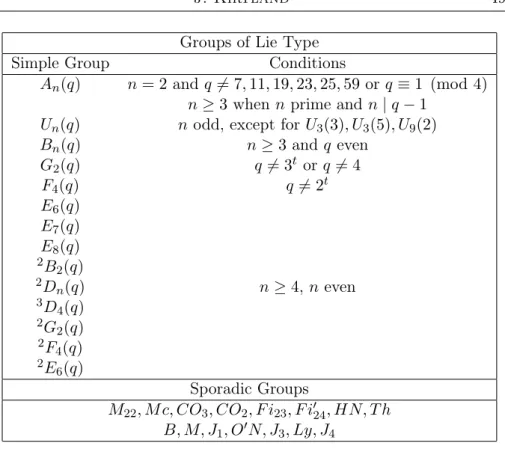
The nonfactorizable simple groups of Lie type and the nonfactorizable Sporadic simple groups are listed in Table 4.1. The number𝑞 is a power of a prime.
Theorem 1. Let 𝐺 be a nonfactorizable group. Then 𝐺 is one of the following three types of groups:
(i) a cyclic 𝑝-group;
(ii) a nonabelian nonfactorizable simple group (as listed in Table 4.1); (iii) a perfect group withΦ(𝐺)∕={1} and𝐺/Φ(𝐺) a nonabelian non-factorizable simple group.
Proof. Consider the commutator subgroup 𝐺′ of 𝐺. If 𝐺′ is a proper subgroup of𝐺, then𝐺′ ≤Φ(𝐺) implies 𝐺is nilpotent. Consequently, 𝐺 is cyclic of prime power order.
Now consider the case where 𝐺′ = 𝐺 or 𝐺 is perfect. If 𝐺 contains no proper normal subgroups other than the trivial one, then 𝐺is a non-abelian simple group. The nonfactorizable nonnon-abelian simple groups are known (as determined by Liebeck, Praeger, and Saxl [9]) and are listed in Table 4.1.
Groups of Lie Type
Simple Group Conditions
𝐴𝑛(𝑞) 𝑛= 2 and 𝑞∕= 7,11,19,23,25,59 or 𝑞≡1 (mod 4)
𝑛≥3when 𝑛prime and 𝑛∣𝑞−1
𝑈𝑛(𝑞) 𝑛 odd, except for𝑈3(3), 𝑈3(5), 𝑈9(2)
𝐵𝑛(𝑞) 𝑛≥3 and𝑞 even
𝐺2(𝑞) 𝑞 ∕= 3𝑡 or 𝑞∕= 4
𝐹4(𝑞) 𝑞∕= 2𝑡
𝐸6(𝑞)
𝐸7(𝑞)
𝐸8(𝑞) 2
𝐵2(𝑞) 2
𝐷𝑛(𝑞) 𝑛≥4,𝑛even
3
𝐷4(𝑞) 2
𝐺2(𝑞) 2
𝐹4(𝑞) 2
𝐸6(𝑞)
Sporadic Groups
𝑀22, 𝑀 𝑐, 𝐶𝑂3, 𝐶𝑂2, 𝐹 𝑖23, 𝐹 𝑖′24, 𝐻𝑁, 𝑇 ℎ
𝐵, 𝑀, 𝐽1, 𝑂′𝑁, 𝐽3, 𝐿𝑦, 𝐽4
Table 4.1: Nonfactorizable nonabelian simple groups
An answer to the question concerning when a group admits a proper factorization is an immediate consequence of this result.
Corollary 1. For a noncyclic group 𝐺, if 𝐺′ ∕= 𝐺, then 𝐺 admits a proper factorization.
Given a group𝐺 with𝐺′ =𝐺, Scott, in 13.1.8 of [12], showed that if 𝐺is a finite nonsolvable group such that every non-abelian composition factor group of𝐺has a proper factorization, then G has a proper factor-ization. Using Lemma 2, another corollary to Theorem 1 is obtained.
Corollary 2. Let𝐻 and𝐾 be subgroups of a group𝐺 such that𝐻 < 𝐾
and𝐾 is a cyclic 𝑝-group. Then 𝐻 has no proper supplement in 𝐺.
excellent reference. As a reminder, a group 𝐺 is quasisimple if 𝐺 is perfect and 𝐺/𝑍(𝐺)is simple.
Proposition 2. Let𝑝 be a prime. If𝐺is a Type III group with∣Φ(𝐺)∣=
𝑝, then Φ(𝐺) =𝑍(𝐺) and 𝐺is quasisimple.
Proof. Consider 𝐶𝐺(Φ(𝐺)), the centralizer of Φ(𝐺) in 𝐺. SinceΦ(𝐺) is
abelian and𝐶𝐺(Φ(𝐺))⊴𝐺, it must be that𝐶𝐺(Φ(𝐺)) = Φ(𝐺) or𝐺.
Given that 𝑝
∣𝐺/Φ(𝐺)∣, there is a Sylow 𝑝-subgroup 𝑆𝑝 of 𝐺 such that Φ(𝐺)< 𝑆𝑝. Since Φ(𝐺) ∩ 𝑍(𝑆𝑝) ∕= {1}, Φ(𝐺) ≤ 𝑍(𝑆𝑝). As a
result, there is an element 𝑥 ∈𝑆𝑝 where 𝑥 /∈ Φ(𝐺) and 𝑥 ∈ 𝐶𝐺(Φ(𝐺)).
Consequently, 𝐶𝐺(Φ(𝐺)) = 𝐺 and Φ(𝐺) = 𝑍(𝐺). Since 𝐺/𝑍(𝐺) is
simple,𝐺 is quasisimple.
One collection of Type III groups that satisfy the conditions of Propo-sition 2 are the groups 𝑆𝐿(2, 𝑞), for 𝑞 ∕= 7,11,19,23,25,59 or 𝑞 ≡ 1 (mod 4). In this case, ∣Φ(𝑆𝐿(2, 𝑞))∣ = 2 and 𝑆𝐿(2, 𝑞)/Φ(𝑆𝐿(2, 𝑞)) =
𝑃 𝑆𝐿(2, 𝑞), a nonfactorizable simple group.
Let 𝐺 be a Type III group. Using the fact that 𝐺 is perfect and 𝐺/Φ(𝐺)is simple, it is easy to show that ifΦ(𝐺)is minimal normal in 𝐺 with∣Φ(𝐺)∣=𝑝𝛼and𝛼≥2, then𝐶𝐺(Φ(𝐺)) = Φ(𝐺), and more generally
that there exists a normal subgroup𝑁 of𝐺such that𝑁 <Φ(𝐺),Φ(𝐺)/𝑁 is abelian, and 𝐶𝐺/𝑁(Φ(𝐺)/𝑁) = Φ(𝐺)/𝑁 or 𝐺/𝑁. However, at this
point, it is open as to whether Type III groups exist that satisfy these conditions.
3. The 𝔞𝔖-residual
Recall Lemma 1, which states that for a group 𝐺, if 𝐴/𝑁 < 𝐺/𝑁 has a proper supplement in 𝐺/𝑁, then 𝐴 has a proper supplement in 𝐺. Consequently, if every subgroup of 𝐺/𝑁 had a proper supplement in 𝐺/𝑁, then every subgroup𝐻 of𝐺, such that𝑁 < 𝐻 < 𝐺, would have a proper supplement in𝐺. This motivates the following definition.
Definition 3. A group 𝐺 is an aS-group if it has order 1 or if every
nontrivial subgroup has a proper supplement.
Theorem 2. A group 𝐺 is an𝑎𝑆-group if and only if 𝐺is supersolvable with elementary abelian Sylow subgroups.
In this section it will be shown that the collection of𝑎𝑆-groups forms a formation. The search for a proper factorization of an arbitrary group 𝐺is assisted by the existence of a proper normal subgroup𝑁 of 𝐺such that𝐺/𝑁 is an𝑎𝑆-group. This motivates the examination of the residual of the collection of𝑎𝑆-groups, which will also be done in this section.
Theorem 3. The class of𝑎𝑆-groups, denoted by𝔞𝔖, forms a formation.
Proof. Let 𝐺 be an 𝑎𝑆-group, and let 𝑁 ⊴𝐺. If 𝑁 = 𝐺, then 𝐺/𝑁 is trivially an 𝑎𝑆-group. Assume that 𝑁 ∕= 𝐺, and let 𝑃/𝑁 be a Sylow 𝑝-subgroup of 𝐺/𝑁. Thus there is a Sylow 𝑝-subgroup 𝑅 of 𝐺 such that 𝑅 is not contained in𝑁. By Theorem 2, 𝑅 is elementary abelian. Since 𝑅𝑁/𝑁 ∼= 𝑅/(𝑅∩𝑁), the Sylow 𝑝-subgroup 𝑅𝑁/𝑁 of 𝐺/𝑁 is also elementary abelian. Given that all Sylow𝑝-subgroups are conjugate, 𝑃/𝑁 is also elementary abelian.
Consider a chief series for 𝐺/𝑁. Trivially, it can be extended to a chief series for𝐺. Since, by Theorem 2, all chief factors for𝐺are cyclic, all chief factors for 𝐺/𝑁 are cyclic. Thus by Theorem 2, 𝐺/𝑁 is an 𝑎𝑆-group.
Now let 𝑁1 and 𝑁2 be normal subgroups of𝐺, with 𝑁1∩𝑁2 ={1},
such that 𝐺/𝑁1 and 𝐺/𝑁2 are both are 𝑎𝑆-groups. Since 𝐺/𝑁1 and
𝐺/𝑁2 are supersolvable,𝐺/(𝑁1∩𝑁2)∼=𝐺is also supersolvable.
Let 𝑃 be a Sylow 𝑝-subgroup of 𝐺. Then 𝑃 𝑁1/𝑁1 and 𝑃 𝑁2/𝑁2
are Sylow𝑝-subgroups of𝐺/𝑁1 and𝐺/𝑁2 respectively. Since𝐺/𝑁1 and
𝐺/𝑁2 are 𝑎𝑆-groups, 𝑃 𝑁1/𝑁1 and 𝑃 𝑁2/𝑁2 are elementary abelian by
Theorem 2. Thus Φ(𝑃) ⊆ 𝑁1 and Φ(𝑃) ⊆ 𝑁2. As a result, Φ(𝑃) ⊆
𝑁1 ∩𝑁2 = {1} and 𝑃 is elementary abelian. By Theorem 2, 𝐺 is an
𝑎𝑆-group.
Essentially, the formation 𝔞𝔖 = 𝔘∩ 𝔈, where 𝔘 is the formation
of supersolvable groups and 𝔈 is the formation of groups whose Sylow
subgroups are elementary abelian. The formation𝔞𝔖is not saturated as
indicated by the cyclic group of order 4.
Definition 4. Let 𝐺 be a group. The 𝔞𝔖-residual, denoted by 𝐺𝔞𝔖 or
more simply by 𝐺𝒮, is the intersection of all of the normal subgroups 𝑁
of 𝐺 such that 𝐺/𝑁 ∈𝔞𝔖.
The 𝔞𝔖-residual 𝐺𝒮 for a group 𝐺 is an important subgroup with
Lemma 4. For a group 𝐺 and the 𝔞𝔖-residual 𝐺𝒮 of 𝐺, the following
properties hold: (i) Φ(𝐺)≤𝐺𝒮;
(ii)𝐺′ is a proper subgroup of𝐺if and only if𝐺𝒮 is a proper subgroup of 𝐺;
(iii) If 𝑁⊴𝐺, then 𝑁𝒮 ≤𝐺𝒮 and 𝐺𝒮𝑁/𝑁 = (𝐺/𝑁)𝒮;
(iv) For a group 𝐿 with 𝔞𝔖-residual 𝐿𝒮,(𝐺×𝐿)𝒮 =𝐺𝒮×𝐿𝒮;
(v) 𝐺𝒮∩𝑍(𝐺)≤Φ(𝐺);
(vi) For any subgroup 𝐻 of 𝐺,Φ(𝐻)≤𝐺𝒮.
Proof. Statement (𝑖) follows from the fact thatΦ(𝐺)𝐺𝒮/𝐺𝒮≤Φ(𝐺/𝐺𝒮)
= 1𝐺/𝐺𝒮. The forward direction of (𝑖𝑖) follows from the fact that𝐺/𝐺′ is abelian. The converse follows from the fact that𝐺/𝐺𝒮 is supersolvable.
To prove the first part of (𝑖𝑖𝑖) note that the result follows if𝑁 ≤𝐺𝒮. If 𝑁 is not contained in 𝐺𝒮, then 𝐺𝒮𝑁/𝐺𝒮 is a nontrivial subgroup of the𝑎𝑆-group 𝐺/𝐺𝒮. Since𝐺𝒮𝑁/𝐺𝒮 is also an𝑎𝑆-group (3.5 in [6]) and 𝐺𝒮𝑁/𝐺𝒮 ∼=𝑁/(𝐺𝒮∩𝑁), 𝑁𝒮≤𝐺𝒮.
To prove the second part of (𝑖𝑖𝑖), let (𝐺/𝑁)𝒮 = 𝑆/𝑁. Given that
(𝐺/𝑁)/(𝑆/𝑁)∼=𝐺/𝑆, which is an 𝑎𝑆-group, 𝐺𝒮 ≤𝑆. Thus 𝐺𝒮𝑁/𝑁 ≤ 𝑆/𝑁 = (𝐺/𝑁)𝒮. If 𝐺𝒮𝑁 = 𝐺, then 𝐺/𝑁 = 𝐺𝒮𝑁/𝑁 ≤ (𝐺/𝑁)𝒮 and 𝐺𝒮𝑁/𝑁 = (𝐺/𝑁)𝒮. Now suppose that 𝐺𝒮𝑁 < 𝐺. Then it follows that
(𝐺/𝐺𝒮)/(𝐺𝒮𝑁/𝐺𝒮) ∼= 𝐺/𝐺𝒮𝑁. Since 𝐺𝒮 ≤ 𝐺𝒮𝑁 < 𝐺 and 𝐺/𝐺𝒮 is an 𝑎𝑆-group, then 𝐺/𝐺𝒮𝑁 is an 𝑎𝑆-group (see [6]). Thus (𝐺/𝑁)𝒮 ≤ 𝐺𝒮𝑁/𝑁 and 𝐺𝒮𝑁/𝑁 = (𝐺/𝑁)𝒮.
To start the proof of (𝑖𝑣) note that since (𝐺×𝐿)/(𝐺𝒮 ×𝐿𝒮) ∼=
𝐺/𝐺𝒮 ×𝐿/𝐿𝒮, which is an 𝑎𝑆-group, (𝐺×𝐿)𝒮 ≤ 𝐺𝒮×𝐿𝒮. By (𝑖𝑖𝑖), both 𝐺𝒮 and 𝐿𝒮 are contained in(𝐺×𝐿)𝒮. Thus𝐺𝒮×𝐿𝒮 ≤(𝐺×𝐿)𝒮
and 𝐺𝒮×𝐿𝒮 = (𝐺×𝐿)𝒮.
For (𝑣), assume that 𝐺𝒮 ∩𝑍(𝐺) = 𝐾 ∕= {1} and that 𝐾 is not contained inΦ(𝐺). Thus there is a maximal subgroup𝑀 of𝐺such that 𝐺 = 𝐾𝑀. Let 𝑔 ∈ 𝐺. Then 𝑔 = 𝑘𝑚, where 𝑘 ∈ 𝐾 and 𝑚 ∈ 𝑀, and 𝑀𝑔 = 𝑀𝑘𝑚. Since 𝑘 ∈ 𝑍(𝐺), 𝑀𝑔 = 𝑀𝑘𝑚 = 𝑀𝑚 = 𝑀 and 𝑀 ⊲𝐺.
Since𝑀 is maximal in𝐺,[𝐺:𝑀] =𝑝for some prime𝑝. Given that𝐺/𝑀 is an 𝑎𝑆-group and 𝑀 ⊲𝐺, 𝐺𝒮 ≤ 𝑀, which implies that 𝐾 ≤ 𝑀, a contradiction. Thus 𝐾≤Φ(𝐺).
To prove (𝑣i), consider the case that𝐻 is not contained in 𝐺𝒮. Then 𝐻𝐺𝒮/𝐺𝒮 is a nontrivial subgroup of 𝐺/𝐺𝒮. Consequently, by Theorem 2, 𝐻/(𝐻 ∩𝐺𝒮) has elementary abelian Sylow 𝑝-subgroups. Thus, by Theorem 2.3 in [2],Φ(𝐻)≤𝐺𝒮.
There do exist groups 𝐺where Φ(𝐺)< 𝐺𝒮 as indicted by the alter-nating group𝐴4. For this group,Φ(𝐴4) ={1}, but𝔞𝔖-residual𝐺𝒮 is the
Theorem 4. If 𝐺 is nilpotent group, thenΦ(𝐺) =𝐺𝒮.
Proof. By Lemma 4, all that needs to be shown is that 𝐺𝒮 ≤ Φ(𝐺). Since 𝐺 is nilpotent, 𝐺=𝑆1 × ⋅ ⋅ ⋅ ×𝑆𝑡, where for each 𝑖, 1 ≤𝑖≤ 𝑡, 𝑆𝑖
is a Sylow 𝑝𝑖-subgroup of 𝐺. Given that Φ(𝐺) = Φ(𝑆1)× ⋅ ⋅ ⋅ ×Φ(𝑆𝑡),
it follows that 𝐺/Φ(𝐺) ∼= 𝑆1/Φ(𝑆1)× ⋅ ⋅ ⋅ ×𝑆𝑡/Φ(𝑆𝑡). Since for each 𝑖, 1≤𝑖≤𝑡,𝑆𝑖/Φ(𝑆𝑖)is elementary abelian, 𝐺/Φ(𝐺) is an 𝑎𝑆-group. As a
result, 𝐺𝒮≤Φ(𝐺).
There do exist nonnilpotent groups G where Φ(𝐺) = 𝐺𝒮. Consider the group𝐺=⟨𝑎, 𝑏, 𝑐∣𝑎3
=𝑏3 =𝑐2
= 1, 𝑎𝑏=𝑏𝑎, 𝑎𝑐=𝑐𝑏, 𝑏𝑐=𝑐𝑎⟩. Here,
Φ(𝐺) = 𝐺𝒮 = {1}, yet𝐺 is not nilpotent. For a moment, consider the case whenΦ(𝐺) =𝐺𝒮 for some group𝐺. By Lemma 4, this would imply thatΦ(𝑃)≤Φ(𝐺)for all Sylow𝑝-subgroups𝑃 of𝐺. Both Bechtell in [2] and Doerk in [3] independently studied and established numerous results concerning groups with this Sylow𝑝-subgroup containment property. One additional result is mentioned here.
Lemma 5. If Φ(𝐺) = 𝐺𝒮, then for each Sylow 𝑝-subgroup 𝑃 of 𝐺, 𝑃∩Φ(𝐺) = Φ(𝑃).
Proof. Since Φ(𝐺) = 𝐺𝒮, 𝐺 is supersolvable. By Lemma 4, Φ(𝑃) ≤ 𝐺𝒮 = Φ(𝐺), and thus Φ(𝑃) ≤ 𝑃 ∩Φ(𝐺). Furthermore, the fact that 𝑃′≤Φ(𝑃)≤Φ(𝐺)results in𝑃′ ≤𝑃∩Φ(𝐺). Consequently, by Corollary 8 in [11], 𝑃∩Φ(𝐺)≤Φ(𝑃).
Determining when𝐺𝒮 has a proper supplement motivates results es-tablished in Section 5. Clearly, if 𝐺𝒮 is proper and nontrivial in a group 𝐺, then 𝐺𝒮 will have a proper supplement when 𝐺𝒮 ∕= Φ(𝐺). The only case that remains to examine is when 𝐺𝒮 is nilpotent.
Theorem 5. Let 𝐺𝒮 be a proper, nontrivial, and nilpotent subgroup of
a non-nilpotent group 𝐺. Then 𝐺𝒮 has a proper supplement in 𝐺 if and only if there exists a prime 𝑝 where 𝑝
∣𝐺𝒮∣ such that 𝑝 does not divide
[𝐺:𝐺𝒮]or𝐺𝒮∩𝑃 has a proper supplement in𝑃 for each Sylow𝑝-subgroup 𝑃 of 𝐺.
Proof. Given that 𝐺𝒮 is nilpotent, 𝐺 is solvable. Furthermore, since 𝐺 is non-nilpotent, there exist at least two distinct primes that divide the order of𝐺.
First, suppose 𝐺𝒮 has a proper supplement in 𝐺 and that for all primes𝑝𝑖,1≤𝑖≤𝑡, where𝑝𝑖
∣𝐺𝒮∣, that𝑝𝑖
[𝐺:𝐺𝒮]. Since𝐺𝒮 is nilpotent, 𝐺𝒮 =𝑃∗
1 × ⋅ ⋅ ⋅ ×𝑃𝑡∗ where for each𝑖,𝑃𝑖∗ is the Sylow𝑝𝑖-subgroup of𝐺𝒮.
of generality,𝑃1∗ is not contained in Φ(𝐺). Consequently, since 𝑃1∗⊲𝐺,
there is a proper subgroup 𝐻 of 𝐺 such that 𝐺 = 𝑃1∗𝐻. Let 𝑃1 be a
Sylow 𝑝1-subgroup of 𝐺. Since 𝐺𝒮 ∩𝑃1 = 𝑃1∗, 𝐺𝒮 ∩𝑃1 has a proper
supplement in𝑃1 by Lemma 2.
Conversely, suppose there is a prime𝑝such that𝑝
∣𝐺𝒮∣, but𝑝does not divide[𝐺:𝐺𝒮]. In this case,Φ(𝐺)∕=𝐺𝒮 and𝐺𝒮 has a proper supplement in𝐺. Now suppose there is a prime𝑝such that𝑝
∣𝐺𝒮∣,𝑝
[𝐺:𝐺𝒮], and for each Sylow𝑝-subgroup𝑃of𝐺that𝑃 = (𝐺𝒮∩𝑃)𝐻𝑝for a proper subgroup
𝐻𝑝 of 𝑃. By Lemma 4,Φ(𝑃)≤𝐺𝒮. As a result,Φ(𝑃)≤𝐺𝒮∩𝑃.
Suppose that𝐺𝒮∩𝑃 ≤Φ(𝐺). Given that𝑃′ ≤Φ(𝑃),𝑃′ ≤𝑃∩Φ(𝐺). By Corollary 8 in [11], this imples that 𝑃 ∩Φ(𝐺) ≤ Φ(𝑃). As a result, 𝐺𝒮∩𝑃 ≤𝑃 ∩Φ(𝐺) ≤Φ(𝑃), a contradiction. Consequently, 𝐺𝒮∩𝑃 is not contained in Φ(𝐺). Thus, since 𝐺𝒮∩𝑃 ⊲𝐺, there exists a proper subgroup𝐻 of𝐺such that𝐺= (𝐺𝒮∩𝑃)𝐻. As a result,𝐺=𝐺𝒮𝐻.
4. Determining proper factorizations
The main purpose of studying the 𝔞𝔖-residual 𝐺𝒮 of a group 𝐺 is to
obtain results concerning proper factorizations.
Theorem 6. Let {1}< 𝐻 < 𝐺. If 𝐺𝒮∩𝐻 ∕=𝐻, then H has a proper
supplement in 𝐺.
Proof. Since 𝐺𝒮∩𝐻 ∕=𝐻, it must be that 𝐺𝒮 ∕=𝐺. If 𝐺=𝐻𝐺𝒮, then 𝐻 has a proper supplement.
Suppose that 𝐺∕=𝐻𝐺𝒮. Then𝐻𝐺𝒮/𝐺𝒮 is a nontrivial and proper subgroup of 𝐺/𝐺𝒮, which is an 𝑎𝑆-group. Thus there is a proper sub-group 𝐾/𝐺𝒮 of 𝐺/𝐺𝒮 such that 𝐺/𝐺𝒮 = 𝐻𝐺𝒮/𝐺𝒮⋅𝐾/𝐺𝒮. Conse-quently, 𝐺=𝐻𝐾 where𝐾 is proper in𝐺.
A number of results are an immediate consequence of Theorem 6.
Corollary 3. Let 𝐺 be a group whose order is divisible by two or more primes. Then for each prime 𝑝, where 𝑝
∣𝐺/𝐺𝒮∣, each Sylow 𝑝-subgroup 𝑃 has a proper supplement in 𝐺.
Corollary 4. Let 𝐺 be a noncyclic group with 𝐺𝒮∕=𝐺.
(i) Every maximal subgroup 𝑀 of 𝐺has a proper supplement in 𝐺. (ii) The group𝐺admits a proper factorization where one of the proper subgroups is cyclic.
Proof. To prove (𝑖), consider the case that 𝐺 =∕ 𝐺𝒮𝑀. Then 𝑀 =𝐺𝒮 and 𝑀 ⊲𝐺. If 𝑀 = Φ(𝐺), then 𝐺 is a cyclic group. Thus 𝑀 ∕= Φ(𝐺)
For (𝑖𝑖), note that 𝐺𝒮 ∕=𝐺 implies that there exists an element 𝑔∈ 𝐺∖𝐺𝒮 such that𝑔∕= 1. Since𝐺is noncyclic,⟨𝑔⟩ ∕=𝐺and⟨𝑔⟩ ∩𝐺𝒮∕=⟨𝑔⟩. Thus by Theorem 6,⟨𝑔⟩ has a proper supplement in 𝐺.
Corollary 5. Let 𝐺 be a group such that 𝐺𝒮 ∕= 𝐺. Then 𝐺 is a cyclic
𝑝-group or 𝐺 admits a proper factorization 𝐺=𝑁 𝐻 where𝑁 ⊲𝐺, 𝐻 is supersolvable, and𝑁 ∩𝐻 =𝐺𝒮.
Proof. Suppose𝐺is not a𝑝-group and𝐺𝒮 < 𝐺. The result follows from the fact that𝐺/𝐺𝒮 is supersolvable and in the formation𝔞𝔖.
Determining proper factorizations involving normal subgroups of a group is more easily determined as normal subgroups are permutable. Recall that a subgroup 𝐴 of a group 𝐺 is permutable if 𝐴𝐵 = 𝐵𝐴 for all subgroups𝐵 of 𝐺. Essentially, if a normal subgroup is not contained in the Frattini subgroup (or is non-nilpotent), it will have a proper sup-plement. Some more detailed critrea for when a normal subgroup has a proper supplement are given in [7]. The only difficult case is determining when a nilpotent normal subgroup has a proper supplement. This, along with Theorem 5, motivates the following result.
Theorem 7. Let 𝑁 be a proper and nontrivial nilpotent subgroup of a non-nilpotent group 𝐺 such that 𝑁 ⊲𝐺 and 𝑁 is of square-free order. Then𝑁 has a proper supplement in 𝐺 if and only if there exists a prime
𝑝 where 𝑝
∣𝑁∣ such that 𝑝 does not divide [𝐺:𝑁] or 𝑁∩𝑃 has a proper supplement in𝑃 for each Sylow𝑝-subgroup𝑃 of 𝐺.
Proof. First, suppose that 𝐺 = 𝑁 𝑆 for some proper subgroup 𝑆 of 𝐺 and that for all primes𝑝, where𝑝
∣𝑁∣, that𝑝
[𝐺:𝑁]. Since𝑁 is nilpotent and normal in 𝐺,𝑁 =𝑁𝑝1 × ⋅ ⋅ ⋅ ×𝑁𝑝𝑡, where each 𝑁𝑝𝑖, for 1≤𝑖≤𝑡, is
a Sylow 𝑝𝑖-subgroup of 𝑁 and 𝑁𝑝𝑖 ⊲𝐺. If for each 𝑖,𝑁𝑝𝑖 ≤Φ(𝐺), then 𝑁 ≤Φ(𝐺), a contradiction. Thus, without loss of generality, 𝑁𝑝1 is not
contain in Φ(𝐺). Thus 𝐺=𝑁𝑝1𝐻, where 𝐻 is a proper subgroup of 𝐺.
Let 𝑃1 be a Sylow 𝑝1-subgroup of 𝐺. By Lemma 2, 𝑁 ∩𝑃1 =𝑁𝑝1 will
have a proper supplement in𝑃1.
Conversely, suppose there is a prime𝑝such that𝑝
∣𝑁∣and𝑝does not divide [𝐺:𝑁]. In this case, 𝑁 ∕= Φ(𝐺) and 𝑁 has a proper supplement in𝐺. Now consider the case where all primes that divide ∣𝑁∣also divide
[𝐺:𝑁]. Then for some prime𝑝that divides∣𝑁∣,𝑁𝑝 =𝑁∩𝑃 has a proper
supplement in each Sylow𝑝-subgroup𝑃 of 𝐺.
Suppose that 𝑁𝑝 ≤ Φ(𝐺). Given that ∣𝑁𝑝∣= 𝑝, 𝑁𝑝 ≤ 𝑍(𝑃). Since
𝑁𝑝⊲𝐺and 𝑁𝑝 ≤Φ(𝐺)∩𝑍(𝑃), Theorem 5 from [11] implies that 𝑁𝑝 ≤
and 𝐺 = 𝑁𝑝𝐻 for some proper subgroup 𝐻 of 𝐺. Consequently, 𝐺 =
𝑁 𝐻.
For both Theorems 5 and 7, the fact that, for some prime 𝑝, 𝑃 ∩
Φ(𝐺) ≤ Φ(𝑃) for all Sylow 𝑝-subgroups 𝑃 of 𝐺 was the main catalist. This motivates the following theorem. The proof of this theroem, which is similar to the proof of Theorem 7, is not given.
Theorem 8. Let 𝑁 be a proper and nontrivial nilpotent subgroup of a non-nilpotent group 𝐺 such that 𝑁 ⊲𝐺 and 𝑃∩Φ(𝐺) ≤Φ(𝑃) for each Sylow𝑝-subgroup of𝐺. Then𝑁 has a proper supplement in𝐺if and only if there exists a prime 𝑝where𝑝
∣𝑁∣such that𝑝 does not divide[𝐺:𝑁]or 𝑁∩𝑃 has a proper supplement in 𝑃 for each Sylow𝑝-subgroup of𝐺.
Attention will now be given to arbitray subgroups. Recall that for a proper normal subgroup𝑁 of a group𝐺,𝑁 will have a proper supplement or be part of a proper factorization for𝐺if and only if𝑁 is not contained in the Frattini subgroup of 𝐺. While this condition can be extended to arbitrary subgroups of nilpotent groups, it cannot be extended to arbitrary subgroups of non-nilpotent groups. As an example, consider the group𝐺=⟨𝑎, 𝑏∣𝑎5
=𝑏4
= 1, 𝑎𝑏=𝑏𝑎2
⟩. For this group,Φ(𝐺) ={1}, yet ⟨𝑏2
⟩ does not have a proper supplement. Another condition that cannot be generalized is the one established in the Schur-Zassenhaus Theorem.
Theorem 9 (The Schur-Zassenhaus Theorem). If 𝑁 is a normal sub-group of a sub-group𝐺such that(∣𝑁∣,[𝐺:𝑁]) = 1, then𝑁 has a complement in 𝐺 and all complements are conjugate.
At first glance, it does seem that the following statement could be true: if 𝐻 is a proper subgroup of a group𝐺 such that∣𝐻∣is relatively prime to its index [𝐺:𝐻], then 𝐻 will have a proper supplement in 𝐺. However, this is not the case. Consider the sporadic simple group 𝑀22.
It has a maximal subgroup 𝐻 of order 5760 = 27 32
5, which is relatively prime to its index[𝑀22:𝐻] = 77. However, 𝐻 has no proper supplement
in𝑀22 as𝑀22 is nonfactorizable.
However, using the 𝔞𝔖-residual𝐺𝒮, one generalization can be made.
Theorem 10. Let 𝐺 be a group with𝐺𝒮 ∕=𝐺, and let 𝐻 be a nontrivial
and proper subgroup of𝐺 such that (∣𝐻∣,[𝐺:𝐻]) = 1.
(i) If 𝐻 is not contained in𝐺′, then 𝐻 has a proper supplement in𝐺. (ii) If 𝐻 is abelian and 𝐻∩𝑍(𝐺) ∕= {1}, then 𝐻 has a proper sup-plement in 𝐺.
Assume that 𝐺′𝐻 ∕= 𝐺. If 𝐺′ = 𝐻, then 𝐻 ⊲𝐺 and 𝐻 has a proper supplement in𝐺 by Theorem 9.
Suppose𝐺′ ∕=𝐻. Since𝐻 is not contained in𝐺′,𝐺′𝐻/𝐺′ is a proper nontrivial normal subgroup of𝐺/𝐺′. Let∣𝐺′𝐻/𝐺′∣=∣𝐻/(𝐻∩𝐺′)∣=𝑑. By the Third Isomorphism Theorem, ∣(𝐺/𝐺′)/(𝐺′𝐻/𝐺′)∣= ∣𝐺/𝐺′𝐻∣ =
∣𝐺∣
∣𝐺′𝐻∣. However, given that ∣𝐺′𝐻∣ = ∣𝐺′
∣∣𝐻∣
∣𝐻∩𝐺′∣ > ∣𝐻∣, ∣𝐺∣
∣𝐺′𝐻∣ = 𝑙, where
(𝑙,∣𝐻∣) = 1. Since 𝑑
∣𝐻∣,(𝑙, 𝑑) = 1and 𝐺′𝐻/𝐺′ has a supplement𝐾/𝐺′ by Theorem 9. Consequently, 𝐺=𝐻𝐾 and 𝐻 has a proper supplement in𝐺.
For (𝑖𝑖), letℎ∈𝐻∩𝑍(𝐺), where∣ℎ∣=𝑝for a prime𝑝that divides the order of𝐻. Thus there is a Sylow 𝑝-subgroup 𝑃 of 𝐺, 𝑃∩𝑍(𝐺) ∕={1}. Given that 𝑃 is a proper abelian subgroup of 𝐺,𝐺′∩𝑍(𝐺)∩𝑃 ={1}. Since 𝑃 ∩𝑍(𝐺) ∕= {1}, 𝑃 cannot be contained in 𝐺′. Thus 𝐻 is not contained in𝐺′ and 𝐻 has a supplement in𝐺by part (𝑖).
The next natural step would be to generalize the result established in Theorem 5 to arbitrary subgroups. However, this is not possible as demonstrated in Example 1.
Example 1. There do exists groups𝐺 where a proper factorization for a Sylow 𝑝-subgroup 𝑃 of 𝐺 does not give rise to a proper factorization of 𝐺. Consider the symmetric group 𝑆4, where 𝑆4 =𝐴4⟨𝑏⟩ with ∣𝑏∣= 2.
Since the Sylow 2-subgroups of𝑆4 are isomorphic to the dihedral group
𝐷4, there is an element 𝑎∈𝐴4 such that ∣𝑎∣= 2 and 𝑎 /∈Φ(𝑃2), where
𝑃2 is a Sylow 2-subgroup of 𝑆4. Consequently, ⟨𝑎⟩ will have a proper
supplement in𝑃2. Suppose that𝑆4 =⟨𝑎⟩𝐾 for some proper subgroup𝐾
of𝑆4. Since∣𝑎∣= 2and ⟨𝑎⟩ ∩𝐾={1},𝐾 is normal in𝑆4 and has order
12. Thus𝐾 =𝐴4, which is a contradiction as 𝑎∈𝐴4.
In addition, as demonstrated in Example 2, adding the stronger con-dition that 𝑃 ∩ Φ(𝐺) ≤ Φ(𝑃) for all Sylow 𝑝-subgroups of 𝐺, is not enough to make the condition true (the condition that if 𝐻 ≤ 𝐺, and there exists a prime𝑝such that𝑝
∣𝐻∣,𝑝
[𝐺:𝐻], and𝑃 = (𝐻∩𝑃)𝐾 then 𝐻 has a supplement in 𝐺).
Example 2. Let𝐺=𝑆4×ℤ9 withℤ9=⟨𝑧⟩. By Example 1, there exists
an element 𝑎∈ 𝑆4 such that ∣𝑎∣= 2 and ⟨𝑎⟩ has no proper supplement
in 𝑆4. Since Φ(𝐺) = ⟨𝑧3⟩, for each Sylow 2- or 3-subgroup 𝑃 of 𝐺,
𝑃 ∩Φ(𝐺) ≤ Φ(𝑃). Consider the subgroup 𝐻 = ⟨𝑎, 𝑧3
⟩ = ⟨𝑎⟩ × ⟨𝑧3
⟩ of 𝐺 and suppose that 𝐺 = 𝐻𝐾 for some proper subgroup 𝐾 of 𝐺. Since ⟨𝑧3
⟩⊲𝐺, 𝐺 = ⟨𝑎⟩(⟨𝑧3
⟩𝐾). Given that ⟨𝑧3
⟩ ≤ Φ(𝐺), ⟨𝑧3
⟩𝐾 =𝐺 implies𝐺=𝐾, a contradiction. Thus ⟨𝑧3
⟩𝐾 is a proper subgroup of 𝐺. Consequently,𝑆4 =𝐺∩𝑆4 =⟨𝑎⟩(⟨𝑧3⟩𝐾)∩𝑆4 =⟨𝑎⟩(⟨𝑧3⟩𝐾∩𝑆4). Since
⟨𝑧3
A first step at approaching this generalization to arbitray subgroups motivates the following theorem.
Theorem 11. Let 𝐺 be a group such that Φ(𝐺) = 𝐺𝒮 and consider a proper nontrivial subgroup 𝐻 of𝐺. Then𝐺=𝐻𝐾 for a proper subgroup
𝐾 of 𝐺 if and only if for some prime 𝑝 such that 𝑝
∣𝐻∣ then 𝑝 does not divide [𝐺:𝐻] or for each Sylow 𝑝-subgroup 𝑃 of 𝐺 where 𝐻∩𝑃 ∕={1},
𝑃 = (𝐻∩𝑃)𝐾𝑝 where 𝐾𝑝 is a proper subgroup of𝑃.
Proof. Suppose that 𝐺 = 𝐻𝐾 for some proper subgroup 𝐾 of 𝐺 and that for each prime 𝑝 such that 𝑝
∣𝐻∣ that 𝑝 also divides [𝐺:𝐻]. Now suppose that for all Sylow subgroups 𝑃 of 𝐺 where 𝐻∩𝑃 ∕={1}, that 𝐻𝑝 = 𝐻∩𝑃 has no proper supplement in 𝑃. Then 𝐻𝑝 ≤ Φ(𝑃), and
by Lemma 5, 𝐻𝑝 ≤ Φ(𝐺). As a result, each Sylow subgroup of 𝐻 is
contained in Φ(𝐺). Thus 𝐻 ≤ Φ(𝐺), a contradiction. Thus for some prime𝑝, where𝑝
∣𝐻∣and𝐻𝑝=𝐻∩𝑃 =∕ {1},𝑃 =𝐻𝑝𝐾𝑝 for some proper subgroup 𝐾𝑝 of 𝑃.
Conversely, consider a proper nontrivial subgroup 𝐻 of 𝐺. Suppose there is a prime 𝑝 such that 𝑝
∣𝐻∣and 𝑝 does not divide [𝐺:𝐻]. If 𝐻 ≤
Φ(𝐺), then 𝑝
∣Φ(𝐺)∣ and 𝑝 does not divide [𝐺:Φ(𝐺)], a contradiction. Thus 𝐻 is not contained in Φ(𝐺). Consequently, 𝐻 is not contained in 𝐺𝒮. In this case, 𝐻 has a proper supplement by Theorem 6.
Now consider the case where for some prime 𝑝, where 𝑝
∣𝐻∣ and 𝑝
[𝐺:𝐻], that 𝑃 = (𝐻∩𝑃)𝐾𝑝 for some Sylow𝑝-subgroup𝑃 of 𝐺where 𝐻∩𝑃 ∕={1}and𝐾𝑝is proper in𝑃. If𝐻∩𝑃 ≤Φ(𝐺), then𝐻∩𝑃 ≤Φ(𝑃)
by Lemma 5. This contradiction implies that𝐻∩𝑃 is not contained in
Φ(𝐺). Thus 𝐻 is not contained in Φ(𝐺) =𝐺𝒮. Consequently, by Theo-rem 6, 𝐻 has a proper supplement in 𝐺.
References
[1] Amberg, B., Franciosi, S., de Giovanni, F. (1992).Products of Groups. New York: Oxford Mathematical Monographs, Oxford University Press.
[2] Bechtell, H. (1965). Elementary Groups.Trans. Amer. Math. Soc.114:335-362. [3] Doerk, K. (1994). ¨Uber endliche aufl¨osbare Gruppen, die sich gegen¨uber der
Frat-tinigruppe wie nilpotente Gruppen verhalten.J. Algebra 167:533-537.
[4] Holt, D.F., Plesken, W. (1989). Perfect Groups. New York: Oxford University Press.
[5] Itˆo, N. (1955). ¨Uber das product von zwei abelschen Gruppen. Math. Z. 62: 400-401.
[6] Kappe, L.-C., Kirtland, J. (2000). Supplementation in groups.Glasgow Math. J.
42: 37-50.
[7] Kappe, L.-C., Kirtland, J. (2003). Finite Groups with trivial Frattini subgroup.
[8] Kegel, O.H. (1961). Produkte nilpotenter Gruppen.Arch. Math.12: 90-93. [9] Liebeck, M.W., Praeger, C.E., Saxl, J. (1990). The maximal factorizations of the
finite simple groups and their automorphism groups.Mem. Amer. Math. Soc.86: no. 432.
[10] Ore, O. (1938). Contributions to groups of finite order.Duke Math. J.5: 431-460. [11] Rose, J.S. (1980). Frattini normal subgroups of finite groups. J. Reine Angew.
Math.316:83-98.
[12] Scott. W.R. (1987).Group Theory. New York: Dover.
[13] Suzuki, M. (1956).Structure of a Group and the Structure of its Lattice of Sub-groups. Berlin: Sprinver-Verlag.
[14] Walls, G.L., (1988) Groups which are Products of Finite Simple Groups. Arch. Math.50: 1-4.
Contact information
J. Kirtland Department of Mathematics Marist College
Poughkeepsie, NY 12601 USA
E-Mail: [email protected]
URL: http://foxweb.marist.edu
/users/joe.kirtland/