Transformational leadership and knowledge sharing
Ali Mohammadi
Islamic Azad University Central Tehran Branch Corresponding author: [email protected]
Zahra Boroumand
Islamic Azad University Central Tehran Branch Email: [email protected]
Abstract
The relationship between transformational leadership behaviors and knowledge sharing in Alvan Sabet Company is highlighted in this study. According to leaders of Alvan Sabet Co. the target populations of the research are totally 47 persons. Census Method has been used in this research due to population size. One main hypothesis and four sub-hypotheses which have been obtained from reviewing the related literature in the field were dealt with in this study. The target population responded to the questionnaires being distributed among them, and the final results displayed a high correlation between the transformational leadership style and knowledge sharing (0.771).
Keywords: Transformational Leadership, Knowledge Sharing
Introduction
In the past decade, organizational atmosphere has gone through changes and has made a whole new space within which we can experience change, flexibility, responsibility, speed agitation and complexity (Goudarzvand, 2010). Moreover, knowledge has turned out to be a valuable asset in every organization, making challenges and opportunities facing the firms to be understood and appreciated by the staff. Knowledge has become a basic resource for firms considering the fact that it is creating many changes in the world surrounding us. Activities in knowledge-based organizations include collaboration and sharing of knowledge, creation and metrics of knowledge, and altogether they constitute what is called knowledge management (Shieh-Chieh , Fu-Sheng & Kuo-Chien, 2005). Enhancing the incentive of sharing and learning knowledge among the employees is one essential factor for the firms to stay competitive (Jahani, Ramayah, & Effendi, 2011).
documents, organizational rules, working procedures, and personal experience (Jabar, Sidi, & Selamat, 2010).
In today's world, leadership and knowledge are becoming two topics of great importance in the organizations. Researches carried out on these subjects are found in important journals such as Strategic Management Journal, Harvard Business Review, Organizational Science, Journal of Management, Journal of Marketing, and Academy of Management Journal. As Bollinger and Smith (2001) argue, the main task of leadership is to establish a culture of respect for knowledge which reinforces its sharing and creates loyalty in the organization. A successful and skillful leader in a knowledge-based economy is crucial in managing and engineering knowledge resources in the organization (Holsapple & Joshi, 2000). Leadership in a knowledge-based company highlights knowledge sharing and its implementation. What is significant is the fact that a leader highly influences organizational knowledge sharing in a positive way by being innovator and teacher (Ynag, 2007).
As Holsapple and Joshi (2000) suggest, a successful leader plays a crucial role in managing and engineering knowledge resources in an organization. Also, Politis (2001) demonstrates that transformational leadership is constituted from human interaction and it enhances contribution of the staff to the process of decision making which is an essential part of KM. What it highlights in the style of transformational leadership is knowledge creation and sharing, commitment and trust of consumers, improvement in firm performance, competence and innovation (Fauji & Maulani, 2013).
Howell and Avolio (1993) in their study on the role of transformational leadership argued that unlike transactional leadership, transformational leadership enhances innovation and knowledge sharing among the employees in the firms. Transformational leaders encompass charisma, inspiration, intellectual stimulation and individualized consideration for their employees (Bass & Avolio, 2000). Encouraging explicit communication networks and a spirit of trust is what this type of leaders try to reinforce, which makes knowledge sharing and transmission possible (Slater & Naver, 1995). In knowledge-based organizations, leaderships are of great significance. Nevertheless, in has been extensively agreed that leadership plays a more crucial role in knowledge creation, sharing, and exploitation than in management, and that this attitude is hardly studied in the context of management of research organizations (Mushtaq & Bokhari, 2011).
Over the recent years, knowledge has grown very rapidly throughout the world and Iranian firms has also undergone rapid environmental changes but rival growth have led to the creation of an unclear and ambiguous atmosphere for Iranian business. Knowledge creation and knowledge sharing can play a crucial role in developing success in this competitive and vague atmosphere. To move towards knowledge creation and sharing, an infrastructural transformation in Iranian companies is needed which can be obtained from applying innovative management models such as transformational leadership.
Due to the fact that Alvan Sabet Co. has recently entered International Marketing and is also competing with many new rivals, knowledge creation and sharing can be effective for its future performances. The importance of this topic is realized as we try to demonstrate the relationship between transformational leadership and knowledge sharing.
leadership behaviors on knowledge sharing.
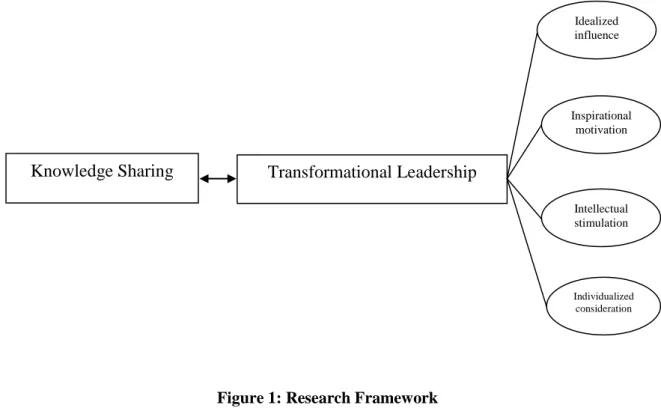
The proposed model: Fig. 1 depicts the proposed framework for studying the relationship between transformational leadership behaviors and knowledge sharing:
Figure 1: Research Framework
In this model, the elements of transformational leadership are derived from Bass and Alvalio (2000) model, and those of knowledge sharing is from Newman and Conrad (1999) model.
Review of Literature Transformational Leadership
While performing a detailed study of the life of political leaders, Burns (1978) has presented two styles of leadership known as "transformational and transactional". One feature of transactional leadership is a give-and-take kind of leadership which is more pragmatic in style. What is important is that in this kind of leadership, those collaborating in the activities, are promised a reward for their collaboration. As Burn (1978) suggests the core of transactional leadership lies in the notion that the leader provides incentives for the employees which motivates them to handle the problems differently. While common, transactional leadership relies on a set of assumptions about valuable goals. This is related to the behaviorist approach in which individuals in a company are effective as long as they are rewarded. The main factor regarding this kind of leadership is the fact that they encourage the spirit of coordination among the employees (Cacioppe, 2000).
After 1985 and considering the studies carried out by Burns, Bass (1990) suggested a model for leadership based on exercising both types to create stability and transformation. Furthermore, some other aspects of transformational leadership adapted from the previous
Knowledge Sharing Transformational Leadership
Idealized influence
Inspirational motivation
Intellectual stimulation
model were presented by Bass and Avolio (2000) which were introduced as a single model called "Multifactor Leadership Questionnaire (MLQ)."
It is argued that transformational leadership contains features which can be found in other leadership theories namely styles, situation and processes. A survey of the characteristics of such leaders throughout history in different companies has demonstrated that these traits are all in the same line with what Bass (1985) has depicted in his research.
In sum, Bass (1985) has discovered that transformational leadership is much more universal than it was thought to be and that it is based on devotion and interest which motivates all the followers to work eagerly. In essence, transformational leadership encourages employees to go beyond prescribed roles and also gives them incentives to exercise their thoughts and ideas through using modern methods. There are various elements through which the leader of an organization can improve the morale of its staff, for example, he can do it by enhancing their motivation and refining their performance. Transformational leadership impacts individuals' self-growth and the leaders impress others to follow their steps. Researchers define transformational leadership in terms of idealized influence, inspirational motivation, intellectual stimulation, and individual consideration (Bass, 1985; Nemanich & Keller, 2007). It should be mentioned that some authors have referred to 'idealized influence' as charisma (Schepers, Wetzels, & de Ruyter, 2005; Kark, Shamir, & Chen, 2003). Leaders with idealized influence can be trusted and respected by the associates to make good decisions. A study carried on the same topic by Seaver (2010) suggests that in transformational leadership individuals engage with one another while simultaneously motivating others to act in a moral way. Transformational leadership inspires others to promote other followers' self-interest for the good of the organization (Robbins, Judge, & Sanghi, 2009).
Hersey, Blanchard and Dewey (1997) defined transformational leadership as a process through which the individuals in the company can create changes which can improve the current situation of the company.
Idealized influence: This phrase is used interchangeably with charismatic influence. It actually refers to a leadership behavior in which the leader behaves in a way that other followers try to emulate with their own actions. These leaders try to impress their followers with their own actions which seems very attractive to their subordinates and increases their motivation to follow their footsteps. Moreover; these leaders are considered to have extraordinary capabilities and determination (Bass & Riggio, 2006).
Inspirational Motivation: It refers to the ability of a leader to provide meaning and context for his subordinates. He/She motivates others by giving them hope for the future, hence increasing team spirit, enthusiasm and optimism (Bass, Avolio, June, & Berson, 2003).
Intellectual Stimulation: It refers to the fact that the subordinates in a company are given a chance to think of some innovative ways due to their being allowed to contribute to the process of decision making. It will also provide the opportunity for them to find some solution to existing problems which influence their economic well-being. (Nwagbara, 2010).
Knowledge Sharing
Over the past few decades this topic has attracted much attention. Knowledge-based theory of the firm considers knowledge as the most important tool to improve the firm's performance and argues that knowledge is the criterion for assessing an organization's value (Kearns & Sabherwal, 2006; Kraaijenbrink, Spender, & Groen., 2010). Regarding the fact that individuals are the main owner of organizational knowledge, their willingness and operation in sharing the knowledge they own is crucial to identifying the real value of knowledge (Gibbert & Krause, 2002). In fact, knowledge sharing is an important part of KM (Bock & Kim, 2002).
Accoding to Bartol and Strivastava (2002) knowledge sharing refers to a series of actions carried out by employees of a company to distribute their information on some related issues to others within the company. Notably, successful knowledge sharing is based on attitudes and perspectives of the employees towards sharing their information and it is influenced by their intention (Gagne, 2009). By intention, we mean the eagerness of the employees to share their information (Bock & Kim, 2002).
What is important in the process of sharing knowledge is active interaction among the individuals (Wenger, McDermott, & Snyder 2002). It can thus be claimed that knowledge sharing refers not only to passing codified information, but also to beliefs, images, experiences and contextualized practices that are personalized information and belong to every single individual (Ambrosini & Bowman, 2001). Interestingly, mutual understanding among the members will be possible through this sharing (Nonaka & Takeuchi, 1995).
The significant fact about knowledge sharing is the fact that individuals let their information be utilized at organizational level, which makes it possible for the organization to change it into economic and competitive value (Hendriks, 1999). According to Stevens, Millage, & Clark. (2010) the transfer of knowledge is an important process which gives organizations competitive advantage by fully optimizing the knowledge they possess. Boland and Tenkasi (1995) also noted that the process of knowledge creation in an organization is performed through four major mechanisms: (1) contribution of knowledge to organizational databases; (2) sharing knowledge in formal interactions within or across teams or work units; (3) sharing knowledge in informal interactions within individuals; and (4) sharing knowledge within communities of practice, which are voluntary forums of employees formed around topics of interest. However, in practice, lack of knowledge sharing is a major barrier to the effective management of knowledge in organizations (Hendriks, 1999).
Transformational Leadership and Knowledge Sharing
Different approaches can be used to motivate people and also to implement plans of an organization. One of the approaches can be effective leadership. Interestingly, leadership acts more than just a factor to manage the organization; it also is influential in knowledge creation, sharing, and exploitation. In fact, leadership creates opportunities for an organization to act out its potentials.
What is considered to be one of the abilities of transformational leaders is to give the opportunity to their employees to get involved in different activities of the organization to know and understand the importance of the tasks which motivate them to perform better (Humphrey, 2002). Notably, people are the main entity in the process of sharing knowledge. In other words, knowledge exists in the mind of individuals and basically it starts at the individual level and gradually expands to the group and finally to organizational level. Therefore, through this process individuals can exchange experiences and technical information. However, for knowledge sharing to be effective, several factors should be taken into consideration, the most important one is leadership style (Xiong & Deng, 2008). Actually, leaders are responsible for setting a culture which respects knowledge, reinforces its sharing and creates loyalty in the organization (Bollinger & Smith, 2001).
It should be noted that leaders in a company are not the ultimate source of knowledge and should encourage the individuals to share their knowledge. However, the question raised is that what kind of leadership best suits a knowledge-based organization? (Bukowitz & Williams, 1999). Politis (2001) argues that the concept of knowledge sharing in a company creates transformational style of leadership. Moreover, for employees to share their knowledge new opportunities should be created by the leaders and the employees will then be considered responsible to increase their information. The leaders themselves should assess the potential of the workers to make the best use of their intellectual capacities. Transformational leaders guide others to make effective intellectual decisions based on their knowledge (Nonaka & Takeuchi, 1995).
As long as transformational leadership style supports knowledge sharing, the process will be effective, moreover this support takes place through intellectual stimulation (Chen & Barnes, 2007). As mentioned above Transformational leadership is positively related to knowledge sharing that occurs within an organization or company (Yang, 2007). As Carmeli and Levi (2010) propose the effectiveness of transformational leadership is based upon the exchange relationship between leaders and members. In fact, leaders are supposed to develop the relational identification of employees to increase the activity of knowledge sharing.
This study actually intends to show a positive relationship between transformational leadership and knowledge sharing. Although no empirical evidence can be found explicitly showing the relationship, we can refer to many studies carried out to imply the relationship (Dubinsky, Yammario & Spangler, 1995; Savery, 1991; Bass, 1985; Bass, Avolio & Goodheim, 1987; Yammarino & Bass, 1990; Chen & Barnes 2007; Jahani et al., 2011; Mushtaq & Bokhari, 2011).
Research hypotheses
Ha: There is a relationship between Individualized consideration and Knowledge sharing.
Hb: There is a relationship between Intellectual Stimulation and Knowledge sharing. Hc: There is a relationship between Inspirational Motivation and Knowledge sharing. Hd: There is a relationship between Idealized Influence and Knowledge sharing.
Research Methodology
The measurement instrument applied in this research was a questionnaire Developed by researcher, consisting of two parts As follows: The first part contained 20 questions relating to different aspects of transformational leadership developed by Bass (1990). The second part consisted 11 questions analyzing different aspects of knowledge sharing. The questionnaire is a five point Likert scale (1= very low to 5= very high) and its reliability and validity are also checked. 47 experts and technicians in the Alvan Sabet Co. formed the overall population of this research. It should be noted that due to limitation of the population, the number we have used is according to the census method. This process was bias-free. The survey research method which incorporated the use of the questionnaires was applied to obtain the required data from the respondents. This research type was an applied research and the survey data were analyzed using descriptive statistic. To investigate the correlation between variables and because of the abnormal distribution of components of Individualized consideration and also Idealized Influence, Spearman Correlation and Pearson Correlation were used.
Results
Main Hypothesis H: There is a relationship between transformational leadership and knowledge sharing.
Table 1
Relationship between transformational leadership and knowledge sharing
transformational leadership
knowledge sharing (N) Sig.(2-tailed) (Correlation Coefficient) Type of test
47 0.000 0.730** Pearson
**Correlation is significant at the 0.01 level (2-tailed)
To analyze this hypothesis, Spearman Brown Correlation coefficient was calculated. As Table 1 shows, the correlation coefficient (r) equals 0.730; and p = 0.000 which is < 0.01; indicating the significant correlation between transformational leadership and knowledge sharing. Therefore the main hypothesis is accepted.
Table 2
Relationship between Individualized consideration and Knowledge sharing
Individualized consideration
knowledge sharing (N) Sig.(2-tailed) (Correlation Coefficient) Type of test
47 0.000 0.713** Spearman
**Correlation is significant at the 0.01 level (2-tailed)
To analyze this hypothesis, Pearson Product moment Correlation coefficient was run. As it can be seen in Table 2, r = 0.713 and p = 0.000 which is < 0.01s 0.000, suggesting a significant correlation between Individualized consideration and knowledge sharing. Consequently, Sub-hypothesis Ha is accepted.
Sub-hypothesis Hb: There is a relationship between Intellectual Stimulation and Knowledge sharing.
Table 3
Relationship between Intellectual Stimulation and Knowledge sharing
Intellectual Stimulation
knowledge sharing (N) Sig.(2-tailed) (Correlation Coefficient) Type of test
47 0.000 0.841** Pearson
**Correlation is significant at the 0.01 level (2-tailed)
For this Hypothesis, we have made use of the Pearson Product moment Correlation coefficient as the method of analysis. As can be seen in Table 3, the correlation coefficient equals 0.841 and p=0.000 which is < 0.01, suggesting a significant correlation between Intellectual Stimulation and Knowledge sharing. Hence, Sub-hypothesis Hb is also accepted.
Sub-hypothesis Hc: There is a relationship between Inspirational Motivation and Knowledge sharing.
Table 4
Relationship between Inspirational Motivation and Knowledge sharing
Inspirational Motivation
knowledge sharing (N) Sig.(2-tailed) (Correlation Coefficient) Type of test
47 0.000 0.822** Pearson
**Correlation is significant at the 0.01 level (2-tailed)
To examine this hypothesis the Pearson Product moment Correlation coefficient has been applied. As is clear in Table 4, r = 0.822 and p=0.000 which is < 0.01, representing a significant correlation between Inspirational Motivation and Knowledge sharing. So, Sub-hypothesis Hc is also accepted.
Table 5
Relationship between Idealized Influence and Knowledge sharing
Idealized Influence
knowledge sharing (N) Sig.(2-tailed) (Correlation Coefficient) Type of test
47 0.000 0.721** Spearman
**Correlation is significant at the 0.01 level (2-tailed)
To investigate this hypothesis the Spearman Brown Correlation coefficient was used. As Table 5 indicates, r = 0.721 and p=0.000 which is < 0.01, asserting a significant correlation between Idealized Influence and Knowledge sharing. Therefore, Sub-hypothesis Hd is also accepted.
A regression analysis of factors of transformational leadership and knowledge sharing: In this study, to understand the effectiveness of transformational leadership changing components on knowledge sharing and to know their capacity in predicting the style of transformational leadership, we have applied "Regression Analysis".
As is clear in Table 6, among the four factors (Individualized consideration, Intellectual Stimulation, Idealized Influence, Inspirational Influence), only Intellectual Stimulation and Inspirational Motivation are meaningful according to their Error (Sig.) which is lower than 0.05. However, the same is not true for Intellectual Stimulation and Inspirational Motivation. In other words, Intellectual Stimulation and Inspirational Motivation are the only strong predictors for transformational leadership. Moreover, based on Beta rate (the higher the amount of Beta, the better it would be in prediction compared to other factors) it can be deduce that from Intellectual Stimulation and Inspirational Motivation, the former is a more suitable predictor.
Table 6
The results of regression coefficient between components of transformational leadership and knowledge sharing
Predictor Variables B Std. Error Beta T Sig.
Individualized
consideration -0.033 0.129 -0.033 -0.268 0.789
Intellectual Stimulation 0.445 0.103 0.487 4.308 0.000
Inspirational Motivation 0.287 0.111 0.330 2.588 0.014
Idealized Influence 0.436 0.251 0.202 1.739 0.091
(meaningful level is lower than 0.05) and it shows that the regression model of the research consists of four independent variables (Inspirational Motivation, Individualized Consideration, Intellectual Stimulation and Idealized Influence) and one dependent variable (knowledge sharing). The overall dependent variables are able to identify the changes in knowledge sharing. Finally, the coefficient of determination R2 demonstrates that transformational factors explain %79 of the changes in knowledge sharing.
Table 7
Multi-correlation between the components of transformational leadership and knowledge sharing
Sig. F Adjusted R Square The Correlation Coefficient (R)
0.000 51.455 0.792 0.910
Discussion and Conclusion
This study examined the relationship between transformational leadership and knowledge sharing in Alvan Sabet Company. The results of the main hypothesis testing showed a significant correlation between transformational leadership and knowledge sharing. Therefore; the main hypothesis was accepted. This finding goes beyond the earlier findings of Dubinsky et al., (1995), Savery (1991), Bass (1985), Bass et al., (1987), Yammarino & Bass (1990), Jahani et al., (2011), Mushtaq & Bokhari (2011) who also confirmed the relationship between transformational leadership and knowledge sharing. The result of this study has implication for leaders and decision makers in today’s increasingly knowledge-based, global world. Transformational Leadership is greatly influential on the way knowledge is shared in the company. This means that leaders and decision makers would be well advised to recognize the positive effect of idealized influence, inspirational motivation, intellectual stimulation, and individualized consideration on the sharing of internal knowledge. Thus, transformational leaders who play the role of a model for their subordinates can create an effective environment for the workers to willingly share their knowledge and information among the employees. In addition, transformational leaders who promote careful problem solving and provide personal attention to employees will also be more likely to improve knowledge sharing.
Recommendations
By and large, the relationship between transformational leadership and knowledge sharing has been examined in this study and ultimately it was found that there is a positive and meaningful relationship between the two. Therefore, training and development of transformational leadership alleviate the process of knowledge sharing and make the organization face a new and dynamic situation. In order to promote the style of transformational leadership and to implement knowledge sharing in the organization, this research proposes the following approaches and solutions:
1. To have an effective implementation, knowledge sharing is recommended. Organizations should put great emphasis on studying influential factors on the process of knowledge sharing such as organizational culture, IT, resources, organizational infrastructures and also the style of transformational leadership. They should recognize and improve influential parameters on the style of transformational leadership to be able to implement a temporary knowledge sharing.
2. We recommend that organizations improve the level of knowledge sharing - which is one of the parameters of knowledge management they should regard some factors such as creating a knowledge-based culture -which highly emphasizes sharing knowledge among the employees- updating knowledge before sharing, applying electronic gadgets, and also organizing negotiation sessions and attempting to implement theme in the organization.
3. It is recommended that organizations should move towards implementing the style of transformational leadership, and to create transformational leadership skills and then try to teach them. These skills include: empowerment, intuition, self-understanding, vision, and value congruence. If the leaders acquire these skills, in other words, if transformational leadership style be implemented in the organizations, the organization will be able to make benefit from its consequences including: knowledge management, organizational learning, organizational innovation, organizational entrepreneurship, organization guarantee of job satisfaction and organizational creativity.
References
Ambrosini, V., & Bowman, C. (2001). Tacit Knowledge: Some Suggestions for Operationalization. Journal of Management Studies, 38 (6), 811-829.
Bartol, K., & Srivastava, A. (2002). Encouraging knowledge sharing: The role of organizational rewards. Journal of Leadership and Organisation Studies, 9(1), 64-76. Bass, B. M., & Avolio, B. J. (2000). Improving Organizational Effectiveness through
Transformational Leadership. Sage Publications, Thousand Oaks, CA.
Bass, B. M., & Riggio, R. E. (2006). Transformational leadership (2nd ed.). Mahwah, NJ: Lawrence Erlbaum Associates Publishers.
Bass, B. M., Avolio, B. J., & Goodheim, L. (1987). Quantitative description of world-class industrial, political and military leaders. Journal of Management, 13, 7-19.
Bass, B. M., Avolio, B. J., June, D. I., & Berson, Y.(2003). Predicting Unit Performance by Assessing Transformational and Transactional Leadership. Journal of Applied Psychology, 88(2), 207-218.
NY.
Bock, G. W., & Kim, Y.G. (2002). Breaking the myths of rewards: An exploratory study of attitudes about knowledge sharing. Information Resources. Management Journal, 15(2), 14-21.
Bock, G. W., Zmud, R. W., Kim, Y. G., & Lee, J. N. (2005). Behavioral intention formation in knowledge sharing: Examining the roles of extrinsic motivators, Social-Psychological Forces, and organizational climate. MIS Quarterly, 29(1), 87–111.
Boland Jr, R. J., & Tenkasi, R. V. (1995). Perspective making and perspective taking in communities of knowing. Organization science, 6(4), 350-372.
Bollinger, A. S., & Smith, R. D. (2001). Managing organizational knowledge as a strategic asset. Journal of Knowledge Management, 5, 8-85.
Brown, R. B., & Wood, M. J. (1999). Managing knowledge wisely: A case study in organizational behavior. Journal of Applied Manage. Studies, 8, 175-198.
Cacioppe, R. (2000). Leadership moment by moment. Leadership and Organization Development Journal, 18(7), 335-345.
Carmeli, A. L. A., & Levi, A. (2010). How leadership enhances employees’ knowledge sharing: the intervening roles of relational and organizational identification, Journal Technol Transf, 36, 257–274.
Chegini, M. G. (2010). Study of relation of psychological factors of empowerment and entrepreneurship. American Journal of Economics and Business Administration, 2(1), 86. Chen, L. Y., & Barnes, F. B. (2007). Relationship between leadership behaviors and
knowledge sharing in professional service firms engaged in strategic alliances. Journal of Applied Management and Entrepreneurship, 11(2), 51-69.
Dubinsky, A. J., Yammarino, F. J., Jolson, M., & Spangler, W. D. (1995). Transformational leadership: An initial investigation in sales management. Journal of Personal Selling & Sales Management, 6, 17-31.
Gagne, M. (2009). A model of knowledge-sharing motivation. Human Resource Management, 48, 571-589.
Gibbert, M., & Krause, H. (2002). Practice exchange in a best practice marketplace pp. 89– 105. Erlangen, Germany: Publicis Corporate Publishing.
Hendriks, P. (1999). Why share knowledge? The influence of ICT on the motivation for knowledge sharing. Knowledge and process management, 6(2), 91.
Holsapple, C. W., & Joshi, K. D. (2000).An investigation of factors that influence the management of knowledge in organizations. The Journal of Strategic Information Systems, 9(2/3), 235-261.
Howell, J. M., & Avolio, B. J. (1993). Transformational leadership, transactional leadership, locus of control, and support for innovation: key predictors of consolidated-business-unit performance. Journal of Applied Psychology 78(6), 891–902.
Humphrey, J. H. (2002) Transformational Leader Behaviour, Proximity and Successful Service marketing. Journal of Service Marketing, 16(6), 487-502.
Jabar, M. A., Sidi, F., & Selamat, M. H. (2010). Tacit knowledge codification. Journal of Computer Science, 6(10), 1170.
Knowledge Sharing Among Academics? American Journal of Economics and Business Administration, 3(1), 87-94.
Kark, R., Shamir, B., & Chen, G. (2003). The two faces of transformational leadership: empowerment and dependency. Journal of Applied Psychology, 88(2), 246-55.
Kearns, G. S., & Sabherwal, R. (2006). Strategic alignment between business and information technology: A knowledge-based view of behaviors, outcome, and consequences. Journal of Management Information Systems, 23(3), 129–162.
Koskinen, K. U., PihIanto, P., & Vanharanta, H. (2003). Tacit knowledge acquisition and sharing in a project work context. International Journal of Project Management, Kidlington, 21(4), 281-290.
Kraaijenbrink, J., Spender, J. C., & Groen, A. J. (2010). The resource-based view: A review and assessment of its critiques. Journal of Management, 36(1), 349–372.
Mushtaq, R., & Bokhari, R. H. (2011). Knowledge Sharing: Organizational Culture And Transformational Leadership, Journal of Knowledge Management Practice, 12(2).
Nemanich, L.A., & Keller, R.T. (2007). Transformational leadership in an acquisition: a field study of employees. The Leadership Quarterly Vol. 18 No. 1, 49-68.
Newman, B. D., & Conrad, K. W. (2000, October). A Framework for Characterizing Knowledge Management Methods, Practices, and Technologies. In PAKM.
Nonaka, I., & Takeuchi, H. (1995). The knowledge-creating company: How Japanese Companies Create the Dynamics of Innovation. New York: Oxford University Press. Nwagbara, U. (2010). Towards a paradigm shift in the Niger delta: Transformational
leadership change in the era of post amnesty deal. Journal of Sustainable Development in Afric, 12(3).
Politis, J. D. (2001). The relationship of various leadership styles to knowledge management. Leadership & Organization Development Journal, 22(8), 354-364.
Robbins, S.P., Judge, T.A., & Sanghi, S. (2009). Organizational behaviour (13th ed), New Delhi: Doring Kindersley pvt. Ltd.
Savery, L. K. (1991). Perceived and preferred styles of leadership influences on employee job satisfaction. Journal of Managerial Psychology, 6, 28-32.
Schepers, J., Wetzels, M., & Ruyter, D, K. (2005). Leadership styles in technology acceptance: do followers practice what leaders preach? Managing Service Quality 15(6), 496-508.
Seaver, D. S. (2010). Effect of transformational leadership in a cross-cultural organization: A case study. Capella University.
Slater, S. F., & Naver, J. C. (1995). Market Orientation and the Learning Organization. Journal of Marketing, 59 (3), 63–74.
Stevens, R. H., Millage, J., & Clark, S. (2010). Waves of knowledge management: The flow between explicit and tacit knowledge. American Journal of Economics and Business Administration, 2(1), 129.
Utami, M. M. (2013). How Intellectual Stimulation Effects Knowledge Sharing, Innovation and Firm Performance. International Journal of Social Science and Humanity, 3(4), 420. Wenger, E., McDermott, R. A., & Snyder, W. (2002). Cultivating communities of practice: A
Xiong, S., & Deng, H. (2008). Critical success factors for effective knowledge sharing in Chinese joint ventures. ACIS 2008 Proceedings, 95.
Yammarino, F. J., & Bass, B. M. (1990). Long-term forecasting of transformational leadership and its effects among naval officers: Some preliminary findings. Leadership Library of America.