A Fast Chaos-Based Pseudo-Random Bit Generator Using Binary64
Floating-Point Arithmetic
Michael François
INSA Centre Val de Loire, Univ. Orléans, LIFO EA 4022, Bourges, France E-mail: [email protected]
David Defour and Christophe Negre
Univ. Perpignan Via Domitia, DALI F-66860, LIRMM UMR 5506 F-34095, Perpignan, France E-mail: {david.defour,christophe.negre}@univ-perp.fr
Keywords:PRBG, pseudo-random, logistic map, IEEE-754, cryptography
Received:June 27, 2013
Chaos-based cryptography is widely investigated in recent years, especially in the field of random number generators. The paper describes a novel pseudo-random bit generator (PRBG) based on chaotic logistic maps. Three logistic maps are combined in the algorithmic process, and a block of 32random bits is produced at each iteration. The binary64 double precision format is used according to the IEEE 754-2008 standard for floating-point arithmetic. This generator provides a considerable improvement of an existing generator in the literature. Rigorous statistical analyses are carefully conducted to evaluate the quality and the robustness of the PRBG. The obtained results showed the relevance of the proposed generator, which is suitable even for real-time applications.
Povzetek: V ˇclanku je opisan hitri psevdo-nakljuˇcni generator za kriptiranje.
1
Introduction
The generation of pseudo-random bits (or numbers) plays a critical role in various applications such as: statistical me-chanics, numerical simulations, gaming industry, commu-nication systems, cryptographic protocols and many oth-ers [1]. In practice, the generation of such numboth-ers with randomness properties is an open problem and continues to be investigated. There are two main classes of genera-tors: software and physical generators.
For the software generators, the term “pseudo-random” is applied to indicate that, the generator is defined as an algo-rithm allowing to produce sequences of bits with random-ness properties. From a single initial seed, these generators will always produce the same outputs. The assets of such generators are: a fast execution time, repeatability and re-producibility of the pseudo-random sequences. The second class of generators exploits physical random phenomena for the generation, but is not discussed here.
Some basic techniques are often used for generating pseudo-random numbers, such as: linear recurrence [2], non-linear congruence [3], linear feedback shift register (LFSR) [4], cellular automata [5], discrete logarithm prob-lem [6], quadratic residuosity probprob-lem [7], etc. Gener-ally, the security of a cryptographic generator is based on the difficulty to solve the related mathematical prob-lem. Beyond the security, such kind of generator is some-times too slow due to heavy computational instructions. For example, the Blum Blum Shub algorithm [7] has a
security proof, assuming the computational difficulty of the quadratic residuosity problem. The algorithm is also proven to be secure, relatively to the difficulty of integer factorization problem. However, the generator is imprac-tical unless extreme security is needed. The Blum-Micali algorithm [6] presents also an unconditional security proof based on the difficulty of the discrete logarithm problem, but is also ineffective.
One interesting way to design pseudo-random generators can be found in chaos theory [8, 9, 10]. Indeed, chaotic sys-tems are characterized by their high sensitivity to initial pa-rameters and some properties like ergodicity, mixing prop-erty and high complexity [8, 11]. A secret parameter should be sensitive enough to ensure the so-called avalanche prop-erty. A small deviation in the initial conditions should cause a large modification in the output, that makes chaotic systems very attractive for pseudo-random number genera-tion. These generators commonly use chaotic logistic maps and produce large pseudo-random sequences. For a high security level, it is necessary to combine several logistics maps, in order to increase the complexity of the cryptosys-tem. But, this is not always sufficient, because a rigorous analysis is more appropriate to evaluate the randomness level and the global security of the generator.
iteration a block of 32random bits. The pseudo-random sequences passed successfully the various statistical tests related to the randomness and correlation. The assets of the PRBG are: high sensitivity to initial seeds, high level of randomness and fast execution time. The paper is struc-tured as follows, in Sec. 2 the used chaotic logistic map and the description of the Patidar’s algorithm are given. Sec-tion 3, presents a detailed descripSec-tion of our algorithm and a brief discussion about the floating-point representation. The statistical analysis is given in Sec. 4. The security as-pect of the PRBG is discussed in Sec. 5, before concluding.
2
Background
2.1
The chaotic logistic map
Frequently used in chaos theory as well as in chaos-based cryptosystems, the form of the logistic map is given by:
F(X) =βX(1−X), (1)
withβbetween3.57and4.0[13]. Its chaotic behavior has been widely studied and several generators have already used such logistic map for generating pseudo-random num-bers [14, 15, 16, 17]. To avoid non-chaotic behaviour (is-land of stability, oscillations, ...), the value ofβ should be near4.0, which corresponds to a highly chaotic behaviour. The logistic map is used under the iterative form:
Xn+1=βXn(1−Xn),∀n≥0, (2)
where the starting seedX0is a real number belonging to the interval]0,1[. All the computed elementsXnare also
real numbers in]0,1[.
2.2
About the algorithm of Patidar
Patidar et al. [12] have proposed a PRBG based on two lo-gistic maps. The algorithm starts from random independent initial seedsX0, Y0, belonging to]0,1[. The chosen value ofβis4and the two logistic maps are given by:
Xn+1 = 4Xn(1−Xn),∀n≥0, (3)
Yn+1 = 4Yn(1−Yn),∀n≥0. (4)
The main idea of the algorithm is very simple and consists to compare the outputs of both the logistic maps in the fol-lowing way:
g(Xn+1, Yn+1) =
1 if Xn+1> Yn+1 0 if Xn+1≤Yn+1
Even if the idea is interesting, the algorithm presents sev-eral weaknesses:
1. Only one bit is generated after each iteration, that cor-responds to a very low throughput according to the relevance of the logistic maps.
2. The sequences produced with nearby seed values are extremely correlated.
3. The seed space has a much lower entropy than 128, due to the existing correlation between the pseudo-random sequences. Therefore, the generator presents weak or degenerate seeds.
4. At a given iteration n, in the case of eventual colli-sion betweenXn+1andYn+1(which is possible), the
output bit will always be0until the end of the output sequence.
The algorithm proposed in this paper also combines sev-eral chaotic logistic maps, but is designed to avoid all those weaknesses and then ensure a better security.
3
The proposed PRBG
3.1
Floating-point representation
As we know, digital computers use binary digits to repre-sent numbers. In the case of real numbers, there are two representation formats: fixed-point and floating-point for-mats. To represent integers or real numbers with a fixed precision, it is more suitable to adopt the first format. The second format can support a much wider range of values. Nowadays, the floating point arithmetic is standardized by IEEE/ANSI [18]. Two different floating-point formats are defined: single precision (binary32) and double preci-sion (binary64). In this paper, we only focus on binary64 floating-point format, which is generally used to achieve a higher simulation precision for the study of chaotic sys-tems.
Binary64 has two infinities, two kinds of NaN (i.e. Not a Number) and the set of finite numbers. Each finite number is described by three fields:sa sign represented on one bit (1indicating negative),ea biased exponent represented on
11bits andma mantissa represented on52bits (see Fig-ure 1). The bits of the mantissa can be divided into two blocks of20bits and32bits and the treatment is applied on the block of32bits (mantissa1).
3.2
Description of the algorithm
As in the paper of Patidar et al., our algorithm uses the same type of chaotic logistic map given by Eq. 1. In our case, the value ofβ is fixed to3.9999that corresponds to a highly chaotic case [19, 20]. Indeed, the Lyapunov exponent [21, 22] measures the chaotic behavior of a function and the corresponding Lyapunov exponent of the logistic map for
β = 3.9999is0.69very close to its maximum which is
0.59. The chaotic logistic map is used under the iterative form:
Xn+1= 3.9999Xn(1−Xn),∀n≥0, (5)
where the starting seedX0is a real number that belongs to
63 62 52 51 32 31 0
sign exponent mantissa0
mantissa
mantissa1
Figure 1: Floating-point representation in binary64 format.
in]0,1[.
Our algorithm takes into account the various weaknesses of the algorithm proposed by Patidar et al. Thus, to have a large space of output sequences, three logistic maps are used during the generation process. The same value ofβis used for each one and the corresponding equations are:
Xn+1 = 3.9999Xn(1−Xn),∀n≥0, (6)
Yn+1 = 3.9999Yn(1−Yn),∀n≥0, (7)
Zn+1 = 3.9999Zn(1−Zn),∀n≥0. (8)
For each computed value Xn, Yn and Zn, a binary64
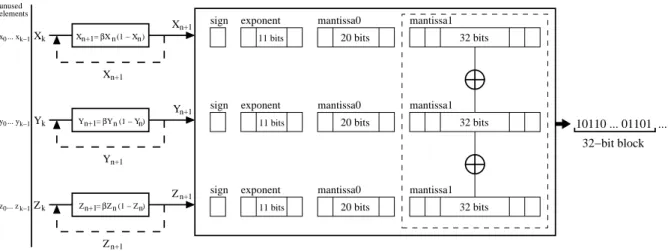
floating-point representation is used as shown in Figure 1. The algorithmic principle is simple and consists at each it-eration, to apply a xor operation on the32bits of mantissa1 of the three output elementsXn, YnandZn. Thus, the
al-gorithm allows to produce32random bits per iteration and therefore increase the throughput of the generator. The op-erating principle of the algorithm is shown in Figure 2. As one can see, the seeds from which the generation process starts areXk, Yk andZk. Indeed, for nearby seed values,
the elementsXn, YnandZnare almost identical in the first
rounds. Thus, to completely decorrelate the beginning of the pseudo-random sequences, it is necessary to start the generation only at thekth iteration. The number of prelim-inary roundskand the way to choose the initial seeds are presented in Sec. 3.3. The implementation of the algorithm in C language is simple: just include the file ieee754.h
and use the defined functions for extracting the bits of man-tissa1 for each computed elementXn, YnandZn.
3.3
The choice of initial parameters
3.3.1 Initial seed selection
To improve the randomness quality of the generated se-quences, the choice of the initial seed values should not be neglected. The coefficient values of the elementsXn, Yn
andZn, belong to]0,1[. Due to symmetric structure of the
logistic map, it is necessary to choose the starting seeds in one of the two half-intervals (here]0,2−1[) to avoid similar
trajectories. In binary64 floating-point format, the com-puted term(1−X)is equal to1.0for anyX in]0,2−53[,
then for a seed value in]0,2−53[, the computed value of
Eq. 2 is equivalent toβXn. To avoid such problem, initial
seed values must be chosen in]2−53,2−1[.
The three initial seeds must be different, then the differ-enceδ[2]between the values should be representable in
bi-nary64. The value ofδ[2]is in the worst case2−53, which
corresponds tolog10(253)(≈ 15.955) decimal digits. To
have a significant difference we choose δ[10] = 10−15,
which corresponds to δ[2] = 2−49.8289. Thus, to avoid
identical trajectories, the difference between each initial seed should be at leastδ[2]= 2−49.8289.
3.3.2 Number of preliminary rounds
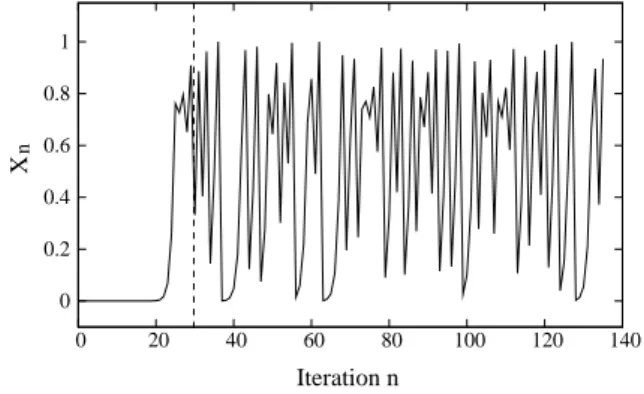
In the case where the values of initial seeds (X0, Y0andZ0) are very close, the beginnings of chaotic trajectories are al-most similar. To avoid such problem, it is necessary to ap-ply some preliminary rounds before starting to produce the random bits. Thus, it is necessary to see at which number of iterations, the differenceδ[2]begins to be propagated. We
consider that the initial seed isX0=δ[2]= 2−49.8289, and
the obtained trajectory with the Eq. 5 is shown in Figure 3.
n
0 0.2 0.4 0.6 1
0 20 40 60 80 100 120 140
0.8
Iteration n
X
Figure 3: Trajectory of the chaotic logistic map given in Eq. 5, forn= 135andX0= 2−49.8289.
One can see that, the trajectory starts to oscillate almost from the30th iteration. Thus, the generation of random bits will begin from the iteration30. That allows to decorrelate the outputs of the PRBG, and then increase the sensitivity related to the initial seeds.
4
Statistical analysis
X
Xn+1
sign exponent mantissa0 mantissa1
exponent mantissa0 mantissa1
Yn+1
Y
Zn+1
Zn+1 sign exponent mantissa0 mantissa1
32 bits
32 bits
11 bits
n+1
20 bits
20 bits
20 bits
11 bits
11 bits
32 bits
sign
β
n n n n+1
n
n+1
Xk x ... x
Yk
Zk z ... z
0
n+1
k−1 0
0
y ... y
β
n+1
n
10110 ... 01101 ...
32−bit block
Z = Z (1 − Z )n X = X (1 − X )
β
Y = Y (1 − Y )
k−1
k−1
unused elements
Figure 2: The operating principle of the proposed PRBG.
4.1
Randomness evaluation
The analysis consists in evaluating the randomness level of the sequences generated by the PRBG. In the literature, various statistical tests exist for analysing the randomness level of sequences. The NIST (National Institute of Stan-dards and Technology of the U.S. Government) proposes a battery of tests that can be applied on the binary se-quences [23]. One can also find other known libraries such as TestU01 [24] or the DieHARD suites [25]. Here, the se-quences are evaluated through statistical tests suite NIST. Such suite consists in a statistical package of fifteen tests developed to quantify and to assess the randomness of bi-nary sequences, produced by pseudo-random number gen-erators. Here, we define three approaches for testing the randomness level of sequences. LetN be the total num-ber of generated sequences and the binary size of each se-quence isM = 32×B, withBthe number of32-bit blocs. The three approaches are:
1. APP-1 (individual sequences): the produced se-quences are individually tested and the results are given as ratio of success relatively to a threshold deter-mined from the total number (N) of tested sequences. Such approach indicates the global randomness level of the tested sequences.
2. APP-2(concatenated sequence): all the individual quences are concatenated to form a new single quence. The randomness level of the constructed se-quence is analysed through the NIST tests. The con-structed sequence should pass the tests whether the original sequences are truly decorrelated and random.
3. APP-3 (resulting sequences): all the sequences are superimposed on each other (forming a matrix), and new sequences are constructed from columns. Thus,
Bresulting sequences of binary size32×Nare con-structed, by collecting for each position1 ≤ j ≤ B, the 32-bit bloc of each sequence. If the original se-quences are really random, the resulting sese-quences
should also be random (with B as large as N) and then pass the NIST tests. Such approach is very inter-esting, in the case of generating sequences by nearby seed values, and allows to detect some hidden linear structures between the original sequences.
These approaches are used to analyse a subset of gener-ated sequences. In the case of very distant initial seed values, the corresponding chaotic trajectories are different, and allow to produce good pseudo-random sequences. The worst case occurs when closed seed values are used, be-cause that can lead to highly correlated output sequences. That is why, the analysis is achieved on sequences gen-erated from nearby initial seed values. Here, a subset of N = 16000 pseudo-random sequences is produced, where the binary size of each sequence is 32000 (i.e.
B = 1000). We choose arbitrarily, one starting seed value
X0= 0.24834264038461704925, and thenY0=X0+δ[2]
andZ0 = Y0+δ[2], withδ[2] = 2−49.8289. These three
seeds allow to generate one pseudo-random sequence. The other sequences, are generated fromX0, Y0and by incre-menting ofδ[2]the last seed valueZ0in a simple loop.
In the case of Patidar’s algorithm, only two initial seeds are needed to produce a pseudo-random sequence. Here, the first two seeds values are given by:X00 =Y0andY00 =Z0.
For generating the other sequences, the same strategy is ap-plied and consists to make a loop by incrementing ofδ[2]
the seedY00. It should be noted that, for a better compar-ison, the same coefficient β (i.e. 3.9999) is used for the logistic map in the Patidar’s algorithm.
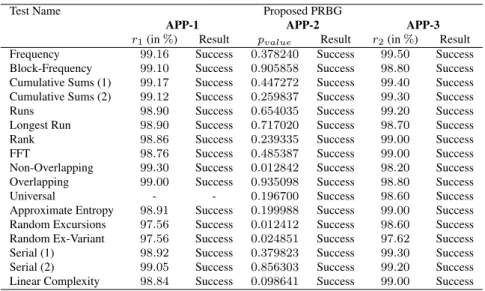
The results of NIST tests obtained for the two algorithms are presented in Table 4.1 and Table 4.1. For approach
APP-1 (resp. APP-3), the acceptable proportion should lie above98.76%(resp. 98.00% ) and does not concern the testsRandom Excursions-(Variant). ForAPP-2, a se-quence passes a statistical test forpvalue ≥0.01and fails
test is not applicable due to the size of initial sequences. One can remark that, for the proposed PRBG, all the tested sequences pass successfully the NIST tests. These results show clearly the quality of the tested sequences. For Pati-dar’s algorithm, individually, the sequences are not enough random, because there are many tests that are not success-ful, for example: Runs, Overlappingor evenSerialtests. The results of approaches APP-2 andAPP-3 show that, the tested sequences are extremely correlated. One should know that, in the article of Patidar et al., each sequence is produced from a randomly chosen initial seed belonging to]0,1[, then the seeds were too different from each other. That is why this problem has not been detected.
4.2
Correlation evaluation
A part of the correlation evaluation has already been done by applying the NIST tests (APP-2andAPP-3). Here, two additional methods are used to analyse the correlation be-tween the pseudo-random sequences. Firstly, the correla-tion between sequences is evaluated globally by computing the Pearson’s correlation coefficient [26] and secondly, by using the Hamming distance.
4.2.1 Pearson’s correlation coefficient
The analyse consists to compute the Pearson’s correlation coefficient between each pair of sequences, and to present the distribution of the values through a histogram. Con-sider a pair of sequences such as: S1 = [x0, . . . , xB−1]
andS2 = [y0, . . . , yB−1]. Therefore, the corresponding
correlation coefficient is:
CS1,S2=
B−1
P
i=0
(xi−x)·(yi−y)
B−1 P
i=0
(xi−x)2
1/2
·
B−1 P
i=0
(yi−y)2
1/2
, (9)
wherexi and yi are 32-bit integers, x = B−1
P
i=0
xi/B and
y=
B−1
P
i=0
yi/B, the mean values ofS1andS2, respectively.
Two uncorrelated sequences are characterized byCS1,S2= 0. The closer the value ofCS1,S2is to±1, the stronger the
correlation between the two sequences. In the case of two independent sequences, the value ofCS1,S2is equal to0.
Here we use the same subsets of16000sequences, and the coefficientsCS1,S2are computed. For the two algorithms,
the histograms are shown in Figure 4. For the proposed PRBG, around99.56%of the coefficients have an absolute value smaller than 0.09, then only a small correlation is detected. In the case of Patidar’s PRBG, around 99.26%
of the coefficients have an absolute value greater than0.33, that means the sequences are highly correlated.
Prop−PRBG Prop−PRBG Pat−PRBG
0 5 10 15 20 25 30
−0.2 0 0.2 0.4 0.6
Frequency (in %)
0.8 Correlation coefficient value
Figure 4: Histogram of Pearson’s correlation coefficient values on interval [−0.1,0.1](resp. [−0.5,0.5]), for the proposed (resp. Patidar’s) PRBG.
4.2.2 Hamming distance
Another type of correlation based on the bits of produced pseudo-random sequences is analysed. Given two binary sequencesS = [s0, . . . , sM−1]andS0 = [s00, . . . , s0M−1]
of same length (M), the Hamming distance is the number of positions where they differ. The distance is given as:
d(S, S0) =
M−1
X
j=0
(sj⊕s0j). (10)
For truly random binary sequences, the value of d(S, S0)
should be aroundM/2, that corresponds to the proportion
0.50. This distance is computed between each pair of gen-erated sequences (N = 16000), and all values are repre-sented through a histogram. For the two algorithms, the histograms are shown in Figure 5. One can see that for our
Prop−PRBG Prop−PRBG Pat−PRBG
0 10 20 30 40 50 60 70 80
0.25 0.3 0.35 0.4 0.45 0.5 0.55 0.6 0.65
Frequency (in %)
Hamming distance
Figure 5: Histogram of Hamming distances on interval
[0.48,0.52] (resp. [0.25,0.30]), computed between each pair of sequences for the proposed (resp. Patidar’s) PRBG.
Test Name Proposed PRBG
APP-1 APP-2 APP-3
r1(in%) Result pvalue Result r2(in%) Result
Frequency 99.16 Success 0.378240 Success 99.50 Success Block-Frequency 99.10 Success 0.905858 Success 98.80 Success Cumulative Sums (1) 99.17 Success 0.447272 Success 99.40 Success Cumulative Sums (2) 99.12 Success 0.259837 Success 99.30 Success Runs 98.90 Success 0.654035 Success 99.20 Success Longest Run 98.90 Success 0.717020 Success 98.70 Success Rank 98.86 Success 0.239335 Success 99.00 Success FFT 98.76 Success 0.485387 Success 99.00 Success Non-Overlapping 99.30 Success 0.012842 Success 98.20 Success Overlapping 99.00 Success 0.935098 Success 98.80 Success Universal - - 0.196700 Success 98.60 Success Approximate Entropy 98.91 Success 0.199988 Success 99.00 Success Random Excursions 97.56 Success 0.012412 Success 98.60 Success Random Ex-Variant 97.56 Success 0.024851 Success 97.62 Success Serial (1) 98.92 Success 0.379823 Success 99.30 Success Serial (2) 99.05 Success 0.856303 Success 99.20 Success Linear Complexity 98.84 Success 0.098641 Success 99.00 Success
Table 1: The results of NIST tests for the proposed PRBG on the 16000sequences. The ratior1 (resp. r2) ofpvalue
passing the tests are given forAPP-1(resp.APP-3). For the approachAPP-2the correspondingpvalueis given.
Test Name Patidar’s PRBG
APP-1 APP-2 APP-3
r1(in%) Result pvalue Result r2(in%) Result
Frequency 99.84 Success 0.000000 Failure 02.80 Failure Block-Frequency 99.99 Success 0.989313 Success 16.00 Failure Cumulative Sums (1) 99.80 Success 0.000000 Failure 03.10 Failure Cumulative Sums (2) 99.74 Success 0.000000 Failure 03.00 Failure
Runs 29.25 Failure - - 00.60 Failure
Longest Run 00.00 Failure 0.000000 Failure 00.00 Failure Rank 98.83 Success 0.442618 Success 04.00 Failure FFT 98.70 Success 0.000000 Failure 00.00 Failure Non-Overlapping 75.96 Failure 0.000000 Failure 71.80 Failure Overlapping 00.00 Failure 0.000000 Failure 99.00 Success Universal - - 0.000000 Failure 00.40 Failure Approximate Entropy 00.00 Failure 0.000000 Failure 00.00 Failure Random Excursions 98.55 Success - - 50.00 Failure Random Ex-Variant 97.82 Success - - 93.75 Success Serial (1) 95.10 Failure 0.000000 Failure 00.00 Failure Serial (2) 98.99 Success 0.000000 Failure 00.00 Failure Linear Complexity 98.81 Success 0.283356 Success 99.00 Success
Table 2: The results of NIST tests for the PRBG of Patidar et al., on the16000sequences. The ratior1(resp.r2) ofpvalue
sequences are correlated for the Patidar’s PRBG, then the algorithm is not enough sensitive to initial seed values. For more sensitivity, one must choose very different seed val-ues, which reduces considerably the key space and then the security of the PRBG.
4.3
Seed sensitivity
A small deviation from the initial seeds, should cause a large variation in the output sequences. Actually, in the NIST tests (APP-2 andAPP-3, Sec. 4.1) and the corre-lation evaluation (Sec. 4.2), the sensitivity related to the seeds was indirectly analysed. To make an additional anal-ysis, a large size of pseudo-random sequences is consid-ered. Here, the number of32-bit blocs isB = 10000000, then the binary sizeM = 320000000. A pseudo-random sequence (Seq1) is produced using the seed values:X0= 0.32164872553014364784, Y0 = X0 +δ[2] and Z0 = Y0+δ[2]. Two others sequences (Seq2andSeq3) are
pro-duced by adding the value ofδ[2]on the last seed valueZ0.
Between each pair of sequences, the correlation analysis is done by computing the linear correlation coefficient of Pearson, the correlation coefficient of Kendall [27] and the Hamming distance. The same analysis is applied on the Patidar’s algorithm with the starting seedsX0
0 = Y0 and Y00 =Z0. The results are given in Table 4.3 and show that:
our algorithm is highly sensitive to initial seeds, whereas in the case of the Patidar’s algorithm, the sensitivity is ex-tremely weak.
4.4
Speed analysis
Another important aspect for any PRBG is the execution time of the algorithm. Indeed, in real-time applications, the temporal constraint about the performance of a process is as considerable as the final results of the process. The speed evaluation is achieved on a work computer with pro-cessor: Intel(R) Xeon(R) CPU [email protected] ×4. The source code is compiled using GCC 4.6.3 on Ubuntu (64bits). The results are presented in Table 4.4 and one can see that, with no optimization option (-O0), the pro-posed algorithm enables to produce around2.62Gbits per second. However, with the classical optimization option (-O1), the throughput is approximately80Gbits per second.
PRBG Speed (Gbits/s)
-O0 -O1
Proposed 2.62 80.00
Patidar’s 0.06 1.18
Table 4: Comparison of speed between the two algorithms by using the options “-O0” and “-O1”.
The Table 4.4 presents the approximative throughput of some known pseudo-random number generators. One can remark that, the throughput of our generator is almost in the same order than CURAND.
Generator Speed (Gbits/s) GT120GPU GTX260GPU
(4cores) (27cores) MTGP11213 41.88 340.42
CURAND 96.97 533.33
Table 5: The approximative throughput in Gbits/s for MTGP11213 (Mersenne Twister for Graphic Processor) and CURAND (NVIDIA CUDA Random Number Gener-ation library).
5
Security analysis
Some points related to the security of the PRBG are dis-cussed here, such as: the size of the seed space, the period length of the logistic map and some basic-known attacks (brute-force attack and differential attack).
5.1
Seed space
Given today’s computational resources, a seed space of size smaller than 2128 is not secure enough. A robust PRBG
should have a large key space, to allow a large choice for the pseudo-random number generation. In order to enlarge the key space, three chaotic logistic maps are used during the generation process. Each logistic map needs to be ini-tialized with a seed corresponding to a binary64 floating-point number, selected from]2−53,2−1[. Knowing that the
difference between each seed value is2−49.8289, this allows
to have248.8289possible choices of initial seeds. Thus, the
total number of choices for the three initial seeds is:
248.8289×[248.8289−1]×[248.8289−2],
or about 2146.50. In the case of Patidar’s algorithm, the
entropy of the seed space is much smaller than128. Indeed, the algorithm uses only two logistic maps and possesses a weak sensitivity, that requires to choose very distant seeds to produce secure outputs.
5.2
Period length of the logistic map
The period length is a fundamental indicator of any PRBG. A generator should have a reasonably long period before its output sequence repeats itself, for avoiding attacks. The length of the period will indicate the maximal secure size for the producible pseudo-random sequences. The idea is to determine the cycle formed by each chaotic trajectory according to the different starting seed values. In a
period-pcycle,Xk =Fp(Xk)for someXk, whereFpis thepth
iterate ofF,e.g.,F3(X) =F(F(F(X)))forp= 3.
PRBG Tests Seq1/Seq2 Seq1/Seq3 Seq2/Seq3 Proposed
algorithm
Pearson Corr. Coef. −0.000460 0.000210 −0.000536 Kendall Corr. Coef. −0.000127 −0.000377 −0.000201 Hamming Distance 0.499985 0.499986 0.500010 Patidar’s
algorithm
Pearson Corr. Coef. 0.328897 0.328990 0.328856 Kendall Corr. Coef. 0.245210 0.242712 0.242441 Hamming Distance 0.333467 0.333379 0.333313
Table 3: Comparison using the Pearson’s and Kendall’s correlation coefficients, and also Hamming distance (in propor-tion) between each pair of sequences (Seq1, Seq2andSeq3), produced from slightly different seeds.
In binary32 format, the obtained smallest (resp. longest) cycle length is equal to1 (resp. 3055). Also, the logis-tic map has numerous pathological seeds (corresponding in minimum cycles of length 1) and globally the cycle lengths are too small. Therefore, the binary32 format is not appro-priate and must be avoided, when implementing a PRBG with such logistic map. Besides, this result is consistent with that published by Persohn and Povinelli [30].
For binary64 format, the cycle lengths are much longer. Due to the large size of the binary format, it is difficult to analyse all the corresponding trajectories. Only a rea-sonable set of randomly chosen seeds is considered. The length of the smallest cycle is2169558 (≈ 221.04), while
for the longest cycle is 40037583 (≈ 225.25). Here, the
computed cycle lengths are in the same order as those given in [28], and no pathological seed was found. This format was not studied by Persohn and Povinelli, and it is a format that benefits to the logistic map. Also, the used parameter
λ(equal to 4) does not provide the best chaotic behavior. In our case, combining three chaotic logistic maps allows to increase the length of the global resulting cycle, which is given by the LCM of the three cycle lengths. Also, the value ofβ(here3.9999) plays a crucial role, because it pro-vides a better chaotic behavior of the logistic map. How-ever, for a maximum security level, it might be better to limit the length of sequences to the smallest cycle length. The best way to avoid the problem of short period and use efficiently this PRBG, is to generate pseudo-random bit se-quences of only small sizes. However in case of need, long sequences can be constructed by concatenating sev-eral ones.
5.3
Brute-force attack
In theory, a brute-force attack [8] is an attack that can be used against any kind of PRBG. Such attack is usually uti-lized, when it is not easy (or possible) to detect any weak-ness in the algorithm, that would make the task easier. The strategy of the attack is simple and consists to check sys-tematically all possible keys until the original key is found. On average, just half of the size of key space needs to be tested to find the initial seeds. A large key space allows to frustrate such kind of attack. Nowadays a key space of size larger than2128 is computationally secure enough to
resist to such attack. The proposed PRBG has a key space
MAX MAX min
1
1000 2000 3000 4000
10 12 14 16 18 20 22 24
Cycle length
Mantissa (in bits)
Figure 6: The curve “MAX” (resp. “min”) shows the length of longest (resp. smallest) cycles, when varying mantissa bits between 10 and 25.
Number of cycles
Length of cycles 13 16
19 22 25 0
830 1660
2490 3320
4150
0 100000 200000 300000 400000 500000 600000 700000 800000
0 100000 200000 300000 400000 500000 600000 700000 800000
10
Mantissa (in bits)
Figure 7: Representation of the length of cycles and their total numbers, when the bits of the mantissa vary between
10and25.
of size 2146.50 and we consider that, such attack can not
succeed on the generator. In the case of Patidar’s PRBG, the entropy of the key space is logically much smaller than
128. Thus, such attack can be envisaged for breaking the generator.
5.4
Differential attack
differ-ence may be in the form of a subtraction modulus or a xor difference and the diffusion aspect is measured by a differ-ential probability. The proposed algorithm is designed to avoid such attack. Indeed, the initial seeds are chosen in the interval ]2−53,2−1[ and the bit-generation starts only
at the30th iteration. The results of the statistical analysis (Sec. 4) showed also that, even with a small difference on the seeds, the pseudo-random sequences are highly decor-related from each other. Thus, we consider that the pro-posed PRBG should resist to the differential cryptanalysis. On the other side, the attack can be possible on the Pati-dar’s PRBG, because the algorithm is not sensitive enough to the initial seed values.
6
Conclusion
A chaos-based PRBG, combining three chaotic logistic maps under binary64 floating-point arithmetic was pre-sented. It provides significant improvements of an existing generator. The principle consists at each iteration, to ap-ply a bitwise xor operator on the 32least significant bits of mantissa, from the computed elements of logistic maps. The algorithm is fast and allows to produce pseudo-random sequences formed of32-bit blocks. The assets of the PRBG are: the simplicity of implementation, a high randomness level for outputs, a high sensitivity related to the initial seeds and a fast execution time, allowing to use the algo-rithm even in real-time applications.
References
[1] F. Sun and S. Liu (2009). Cryptographic pseudo-random sequence from the spatial chaotic map.Chaos Solitons&Fractals, Vol. 41, No. 5, pp. 2216–2219.
[2] M. Matsumoto and T. Nishimura (1986). Mersenne twister: a 623-dimensionally equidistributed uniform pseudo-random number generator.ACM Transactions on Modeling and Computer Simulation (TOMACS), Vol. 8, No. 1, pp. 3–30.
[3] J. Eichenauer and J. Lehn (1986). A non-linear con-gruential pseudo random number generator. Statistis-che Hefte, Vol. 27, No. 1, pp. 315–326.
[4] A.K. Varshney, S.K. Sharma and R. Singh (2012). A study on the effect of shifting on LFSR PRNG. In-ternational Journal of Engineering, Vol. 1, No. 5, pp. 1–7.
[5] M. Tomassini, M. Sipper, M. Zolla and M. Perre-noud (1999). Generating high-quality random num-bers in parallel by cellular automata.Future Genera-tion Computer Systems, Vol. 16, No. 2, pp. 291–305.
[6] M. Blum and S. Micali (1984). How to generate cryp-tographically strong sequences of pseudorandom bits.
SIAM journal on Computing, Vol. 13, No. 4, pp. 850– 864.
[7] L. Blum, M. Blum and M. Shub (1986). A simple un-predictable pseudo-random number generator.SIAM journal on Computing, Vol. 15, No. 2, pp. 364–383.
[8] G. Álvarez and S. Li (2006). Some Basic Crypto-graphic Requirements for Chaos-Based Cryptosys-tems.International Journal of Bifurcation and Chaos, Vol. 16, No. 8, pp. 2129–2151.
[9] H.P. Hu, L.F. Liu and N.D. Ding (2012). Pseudoran-dom sequence generator based on Chen chaotic sys-tem. Computer Physics Communications, Vol. 184, No. 3, pp. 765–768.
[10] M. François, T. Grosges, D. Barchiesi and R. Erra (2013). A new pseudo-random number generator based on two chaotic maps.Informatica, Vol. 24, No. 2, pp. 181–197.
[11] J.M. Bahi, C. Guyeux and Q. Wang. A pseudo random numbers generator based on chaotic iterations. appli-cation to watermarking.In WISM 2010, International Conference on Web Information Systems and Mining, Vol. 6318 of LNCS, pp. 202–211, Sanya, China, Oc-tober 2010.
[12] V. Patidar, K.K. Sud and N.K. Pareek (2009). A Pseudo Random Bit Generator Based on Chaotic Lo-gistic Map and its Statistical Testing. Informatica, Vol. 33, No. 4, pp. 441–452.
[13] R. Bose and A. Banerjee. Implementing Symmetric Cryptography Using Chaos Functions, in: Proceed-ings of the 7th International Conference on Advanced Computing and Communications, pp. 318–321, 1999.
[14] M.S. Baptista (1998). Cryptography with chaos.
Physics Letters A, Vol. 240, No. 1, pp. 50–54.
[15] S. Cecen, R.M. Demirer and C. Bayrak (2009). A new hybrid nonlinear congruential number generator based on higher functional power of logistic maps.
Chaos Solitons&Fractals, Vol. 42, No. 2, pp. 847– 853.
[16] S. Xuan, G. Zhang and Y. Liao. Chaos-based true ran-dom number generator using image.in: IEEE Inter-national Conference on Computer Science and Ser-vice System (CSSS), Nanjing, China, pp. 2145–2147, 2011.
[17] M. François, T. Grosges, D. Barchiesi and R. Erra (2014). Pseudo-random number generator based on mixing of three chaotic maps. Communications in Nonlinear Science and Numerical Simulation, Vol. 19, No. 4, pp. 887–895.
[19] N.K. Pareek, V. Patidar and K.K. Sud (2006). Image encryption using chaotic logistic map.Image and Vi-sion Computing, Vol. 24, No. 9, pp. 926–934.
[20] M. François, T. Grosges, D. Barchiesi and R. Erra (2012). Image Encryption Algorithm Based on a Chaotic Iterative Process.Applied Mathematics, Vol. 3, No. 12, pp. 1910–1920.
[21] A. Wolf, J.B. Swift, H.L. Swinney, J.A. Vastano (1985). Determining Lyapunov exponents from a time series. Physica D: Nonlinear Phenomena, Vol. 16, No. 3, pp. 285–317.
[22] E. Aurell, G. Boffetta, A. Crisanti, G. Paladin, A. Vulpiani (1997). Predictability in the large: an exten-sion of the concept of Lyapunov exponent.Journal of Physics A: Mathematical and General, Vol. 30, No. 1, pp. 1–26.
[23] A. Rukhin, J. Soto, J. Nechvatal, M. Smid, E. Barker, S. Leigh, M. Levenson, M. Vangel, D. Banks, A. Heckert, J. Dray and S. Vo. A Statistical Test Suite for Random and Pseudorandom Number Generators for Cryptographic Applications.NIST Special Publi-cation Revision 1a 2010.
[24] P. L’ecuyer and R. Simard (2007). TestU01: A C li-brary for empirical testing of random number gener-ators.ACM Transactions on Mathematical Software, Vol. 33, No. 4, Article 22.
[25] G. Marsaglia (1996). Diehard: a battery of tests of randomness. http://stat.fsu.edu/geo/diehard.html
[26] J. Rodgers and W. Nicewander (1988). Thirteen ways to look at the correlation coefficient.The American Statistician, Vol. 42, No. 1, pp. 59–66.
[27] M.G. Kendall. Rank correlation methods.Fourth ed., Griffin, London, 1970.
[28] J. Keller and H. Hanno. Period lengths of chaotic pseudo-random number generators,in: Proceedings of the Fourth IASTED International Conference on Communication, Network and Information Security, pp. 7–11, 2007.
[29] The GNU MPFR library. http://www.mpfr.org
[30] K.J. Persohn and R.J. Povinelli (2012). Analyzing lo-gistic map pseudorandom number generators for peri-odicity induced by finite precision floating-point rep-resentation.Chaos Solitons&Fractals, Vol. 45, No. 3, pp. 238–245.
![Figure 4: Histogram of Pearson’s correlation coefficient values on interval [−0.1, 0.1] (resp](https://thumb-us.123doks.com/thumbv2/123dok_us/8041121.2129195/5.892.486.802.128.328/figure-histogram-pearson-correlation-coefficient-values-interval-resp.webp)