TECHNICAL UNIVERSITY OF CLUJ-NAPOCA
ACTA TECHNICA NAPOCENSIS
Series: Applied Mathematics, Mechanics, and Engineering Vol. 62, Issue II, June, 2019
CORROSION TESTS OF AlMn1 / Ni201 BRAZED JOINT BY SALINE AND ACIDIC SPRAYING
Nicu-Marian TRANDAFIR, George ARGHIR, Liviu BRÂNDUȘAN, Gabriel BATIN
Abstract: Heat exchangers of hybrid vehicles contain brazed joints composed by aluminum alloy AlMn1 and nickel Ni201. Depending on the environment in which they are located, these joints can corrode and, consequently, endanger the functionality of the heat exchanger. As the AlMn1 / Ni201 brazed joint is a metallic joint, it must be tested for corrosion, especially if the hybrid car circulates in areas with high salinity of air or water (sea breeze, saline mines etc.). At the same time, acid corrosion testing is required because hybrid vehicles contain more batteries and in case of battery failure, leakage or loss of sulfuric acid may corrode the AlMn1 / Ni201 brazed joint. In this work, it is demonstrated that the acid corrosion rate is higher than the saline corrosion rate due to the higher aggressiveness of acetic acid compared to that of sodium chloride.
Key words: brazing, aluminum-nickel brazing
1. INTRODUCTION
The connection discussed in this article was achieved by the brazing of two base metals, parts of a heat exchanger (cooler) for the automotive industry, respectively, for hybrid vehicles named HEV. These provide high torque density, efficiency, mechanical robust structure, low cost and small weight [1]. The cooler has several brazed joints, of which the most sensitive is the junction between an Al-Mn alloy and pure Ni, in which the clearance is 0.05 – 0.08 mm [2]. Between these two base materials a silicon-containing filler metal was inserted named Nocolok Sil Flux; the silver addition would improve the bonding of the base materials and reduce the actions of the oxygen, but at the brazing temperature, the silver corrodes the alloy AlMn1 [3, 4]. In some cases, a synthetic adhesive may be used instead of filler metal, especially if different materials (metal-glass) are to be bonded [5]. The silicon content in the Nocolok Sil Flux, is to increase the fluidity of the material at the brazing temperature (reducing the viscosity), being favorably to the process of filling the capillary spaces and adhering well to both the aluminum alloy and nickel [6]: moreover, in the metallography, silicon appears like colonies
having a fine distribution at the edge of rounded aluminum dendrites [7]. Base metals used are aluminum alloy with 1-1.5 % Mn. More manganese can lead to a decrease in the density of this base metal [8]. Testing of the brazed joints at corrosion was carried out in a special installation by spaying, which is actually a tank with a capacity of 114 liters and encompasses external water softener, manometer, control panel, power supply panel heating panels, saline/acetic spraying nozzles, temperature sensor, sample shelves [9]. Actually, the samples are positioned on the shelves inside the tank and sprayed with saline or acid solution. The pH range should be maintained between 6.5 and 7.2 for saline solution and 2.8 until 3, for acid solution, according to ASTM standard B117; if pH is too low sodium hydroxide is added and if the pH is too high, hydrochloric acid is added.
2. EXPERIMENTAL
distance between the Ni201 plates is corrosion attacked; also, for the calculation of corrosion rate the initial mass of a sample is known (160 g). Both for salt and acid corrosion were tested after 600 hours. This testing time is correlated to the number of pits and the time corresponding to the failure [10].
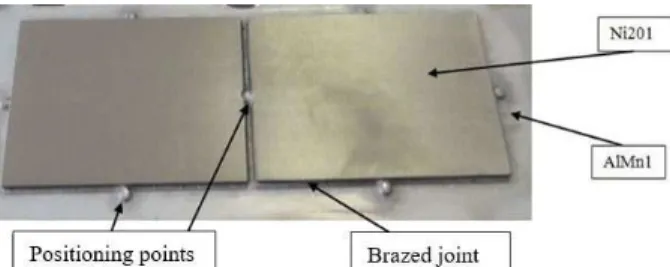
Fig. 1 Brazed joint before corrosion testing.
Under visual inspection, Figure 1 shows that the brazed joint between the two base materials is clean, without excess material (flux excess) without fluctuations in thickness, with a specific metallic gloss, with a contour uninterrupted. The six AlMn1 positioning points around the nickel plates were designed to fix and stabilize these plates during brazing.
2.1 Spraying with saline solution
The 5% saline solution was obtained by dissolving 5 grams of salt in 95 ml of water and the pH value of the solution was monitored throughout the spraying and was 6.75 - 6.9. Crystals composed of salt and aluminum molecules contain certain natural luminescent
formations which can then be used to measure corrosion by infrared radiation [11] or by electrical potential; thus, it has been found that with higher electrical potential, corrosion is greater [12]. At the end, even a corrosion rate can be calculated [13].
As shown in Figure 2, it is obvious that the saline solution was deposited around the brazing joint and at the distance between the Ni201 plates; corrosion attacked these areas the most. It is observed the formation of some crystals composed by salt and particles of AlMn1, deforming its surface, after 600 hours of spraying with saline solution. Noteworthy, the surface of nickel was very little attacked by saline corrosion.
Fig. 2 Brazed joint after 600 hours of salt spraying.
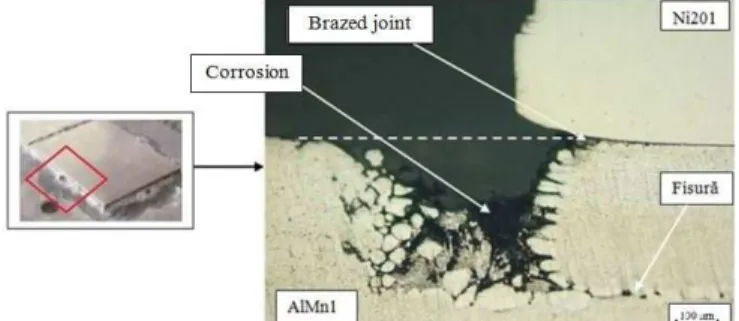
From this figure, however, it is not possible to determine the depth of corrosion and how much corrosion has entered inside the brazed joint. In order to achieve this goal, a cross-section metallography was made to this joint, Figure 3.
With regard to the metallography of Figure 3, the saline solution did not corrode the nickel base material nor the brazed joint but the AlMn1 alloy base material, producing a fairly large cavity. However, the AlMn1 alloy under Ni201 was not corroded, but the saline solution only attacked the aluminum alloy around the joint. Corrosion depth was measured and 0.67 mm was found from the surface of AlMn1, like white dotted line shows; also, a maximum cavity width of 0.98 mm were found. This corrosion could be inhibited by castor oil extracts or Morus nigra and Monodora myristica extracts [14, 15]. The molecules of
these inhibitors adsorb on the surface of aluminum and their action is even stronger as their concentration is higher; however, the increase in temperature reduces this inhibitory action [16]. Finally, we can calculate the corrosion rate (Rc, mm/year), knowing the following parameters:
- mass loss, Pm = initial mass - final mass and therefore, Pm = 1934 mg;
- AlMn1 alloy density, ρ = 2.8 g / cm3;
- sample area, A = 8.75 cm2;
- maximum time testing, t = 600 h. Rc = 87.6 x Pm / (ρ x A x t);
Rc = 87.6 x 1934 / (2.8 x 8.75 x 600); Rc = 11.52 mm / year.
2.2 Spraying with acidic solution
The acetic acid concentration required for the acidic corrosion test was determined by diluting 10 ml of concentrated acetic acid into one liter of softened water and monitoring the pH of the acidic solution, keeping it between 2.8 - 3. Wetting and dispersion of acid on the surface of AlMn1 base material largely
depends on the roughness of the aluminum alloy surface and its chemical reactivity [17].
Fig. 4 Brazed joint after 600 hours of acetic acid spraying.
Respect the Figure 4, the acetic acid solution was concentrated around the brazed joint giving a black color, and after 600 hours there was a clear corrosion in the AlMn1 base material as a result of occupying a considerable area and depths; again, the nickel surface was not attacked by corrosion. In the case of saline corrosion, the salt had been deposited around the brazed joint forming many conglomerates composed by NaCl and aluminum oxides, some of which being quite difficult to remove. However, there is also the case of corrosion due to acetic acid because according to Figure 4, there are no high-rise areas, but the entire joint is surrounded by very low relief areas corresponding to some depths in the surface of the base material of AlMn1 (0.4 mm) made by the acid acetic.
Corrosion in acidic environment is deeper if the acid concentration is higher; at the same time, the higher temperature in acid environment accelerates the corrosion of aluminum [18, 19]. Similar to first case, a cross-section metallography was made to this joint, Figure 5.
As a rule, acid corrosion occurs in the form of exfoliation [20]. But, according to figure 6, acetic acid corroded not only the base material of AlMn1, but also the brazed joint, penetrating it with 0.41 mm. Acetic acid caused the AlMn1 alloy to be fragmented, the resulting cavity being 1.18 mm and a depth of 0.78 mm from the AlMn1 alloy surface. In addition, acetic acid reached the bottom of the cavity, began to corrode the aluminum base material, causing it a crack of 0.36 mm long, under the brazing joint. For corrosion protection, instead of the AlMn1, it can be used an aluminum alloy containing zinc [21, 22], sodium molybdate [23] or it can increase the hardness of the base materials [24]. In this test, acetic acid was selected to produce acidic solution because spraying with a stronger acid like HCl,H2SO4 would damage the test
facility. Anyway, the strength of the joint
corroded by salt is greater than that of joint corroded by acid, due to the formation of an aluminum oxide layer [25]. At the end the corrosion rate (Rc) would be:
- mass loss, Pm = initial mass - final mass and therefore, Pm = 3117 mg;
- AlMn1 alloy density, ρ = 2.8 g / cm3;
- sample area, A = 8.75 cm2;
- maximum time testing, t = 600 h. Rc = 87.6 x Pm / (ρ x A x t);
Rc = 87.6 x 3117 / (2.8 x 8.75 x 600); Rc = 18.57 mm / year.
3. CONCLUSIONS
All measurements obtained from corrosion test with saline and acetic acid of the AlMn1 / Ni201 brazed joint are summarized in Table 1.
Table 1. Values measured after corrosion test with saline and acetic acid
Calculate measures Corrosion in salin solution Corrosion in acid solution
pH monitored 6,75 – 6,9 2,8 - 3
The form of corrosion conglomerates, deposites cavities, deposites
High areas, mm 0,9 0,2
Lower areas, mm 0,4 0,41
Corrosion in joint, mm 0 0,36
Cavity width, mm 0,98 1,18
Cavity depth, mm 0,67 0,78
Mass loss, mg 1934 3117
Corrosion rate, mm / year 11,52 18,57
Both types of tested solutions had certain corrosive effects on the joint, with characteristic differences. However, it should be noted that the nickel base material has not been corroded by either the saline solution or the acidic solution due to its physical properties. However, the same thing cannot be said about the AlMn1, which was corroded in both tests. However, the major difference between the two tests was the acetic acid solution that corroded not only the AlMn1 base material but also the brazed joint, being much more aggressive and penetrating it with 0.36 mm (the saline solution did not corrode the joint). Also, the acid solution produced a deeper and wider cavity (0.78 mm and 1.18 mm, respectively), as compared to the saline solution (0.67 mm and 0.98 mm,
joint is corroded by sulfuric acid. From this point of view, it can be concluded that the AlMn1/Ni201 brazed joint is more vulnerable to acidic than to saline medium. For this reasons, sulfuric acid leakages from accumulators is far more dangerous for brazed joint than the saline environment in which these vehicles can be found.
REFERENCES
[1] M. Moroșanu, L. Someșan, M. Ruba, I. A. Viorel, Analysis of a flux switching and a switched reluctance machine used in automotive, Acta Techica Napocensis,
Applied Mathematics, Mechanics and
Enineering, Vol. 57, Issue II, 2014, p. 251-256. [2] N. M. Trandafir, G. Arghir. L. Brândușan,
Examination of brazing nickel-aluminum,
Science and Engineering, The 17-th
International Multidisciplinary Conference Professor Dorin Pavel, Sebeș, Alba, 2017, Vol. 35, p. 279-286.
[3] N. M. Trandafir, G. Arghir. L. Brândușan,
Brazing of AlMn1/Ni 201 cladded with Ag45CuZnSn, Science and Engineering, The
18-th International Multidisciplinary Conference Professor Dorin Pavel, Cluj-Napoca, Romania, 2018, p. 1-6.
[4] J. F. Dante, J. Averett, F. Friedersdorf, C. Vestal, Accelerated Corrosion Testing of Galvanic Couples, Luna Innovations, 2015, p.
1-12.
[5] G. Pintye, G. Achimas, G. Patai, Mechanical features of symthetic glue bonding of metals with ceramic glass, Acta Technica Napocensis,
Applied Mathematics, Mechanics, and
Engineering Vol. 58, Issue III, September 2015, p. 447-456.
[6] N. M. Trandafir, G. Arghir, Reasearch of nickel-aluminum brazing, Acta Technica
Napocensis, Applied Mathematics, Mechanics, and Engineering, Vol. 60, Issue II, June 2017, p. 303-312.
[7] A. G. Jumolea, G. Arghir, Mechanical properties of Al-Si composite materials obtained by stir casting, Acta Technica Napocensis,
Applied Mathematics, Mechanics, and
Engineering, Vol. 58, Issue II, november 2015, p. 591-596.
[8] C. Suciu, G. Arghir, I. Petean, Manganese addition influence on the density, size, compactibility and porosity of mixed iron-manganese sintered compacts, Acta Technica
Napocensis, Applied Mathematics, Mechanics, and Engineering Vol. 55, Issue II, 2012, p. 509-512.
[9] L. Sidorovas, K. Cedeno, M. Rodriguez,
Evaluacion del comportamiento mecanico y microestructural del acero AISI 201 expuesto a corrosion acelerada, Revista Ingenieria UC,
Vol. 21, Nr. 1, 2014, p. 50-61.
[10] G. Ouaziz, O. Savadogo, The Cathodic Breakdown Test to Assess Chromic Acid Anodized Aluminum Alloys Corrosion Protection Performance, in Correlation with Salt Spray (Fog) Testing, International
Scholarly Research Network, ISRN Materials Science, 2012, Article ID 140624, p. 1-10. [11] E. Sahiner, N. Meric, Infrared Stimulated Luminescence (IRSL) Properties of Natural Aluminum Corrosion, Tandoğan, Ankara,
Turkey, Geochronometria, Vol. 39, Nr. 3, 2012, p. 227-232.
[12] M. Iannuzzi, K. L. Vasanth, G. S. Frankel,
Unusual Correlation between SKPFM and Corrosion of Nickel Aluminum Bronzes, Journal
of The Electrochemical Society, 2017, Vol. 164 Nr. 9, p. 488-497.
[13] P. S. Desai, S. M. Kapopara, Inhibitory action of xylenol orange on aluminum corrosion in hydrochloric acid solution, India, Indian
Journal of Chemical Technology, Vol. 21, 2014, p. 139-145.
[14] A. I. Ali, N. Foaud, Inhibition of aluminum corrosion in hydrochloric acid solution using black mulberry extract, Benha, Egipt, J. Mater.
Environ. Sci., Vol. 3, Nr. 5, 2012, p. 917-924. [15] I. Ukpong, O. Bamgboye, O. Soriyan,
Synergistic Inhibition of Mild Steel Corrosion in Seawater and Acidic Medium by Cathodic Protection and Monodora myristica Using Zinc Anode, Nigeria, Hindawi, International Journal
of Corrosion, 2018, p. 1-8.
[16] I. Hamdou, M. Essahli, A. Lamiri,
Inhibition of aluminum corrosion in 0.1 M Na2CO3 communis oil, Settat-Moroco,
Mediterranean Journal of Chemistry, Vol. 6, Nr. 4, 2017, p. 108-116.
Al-Lohedan, Assessment of Salt and Acid Droplets Evaporations on the Corrosion Mechanism of Aluminum, Int. J. Electrochem. Sci., 2015, Vol.
10, p. 6392 – 6404.
[18] P. S. Desai, Effect of Temperature of Calotropis Gigantea leaves on Aluminum Corrosion in Hydrochloric Acid, India,
International Journal of Advanced Research in Science and Engineering, Vol. 6, Nr. 9, 2017, p. 1055-1064.
[19] H. A. Karem, Y. Al Mashhdania, K. A. Al-Saadie, Corrosion Protection of Carbon Steel in seawater by alumina nanoparticles with poly (acrylic acid) as charging agent, Moroccan
Journal of Chemistry ISSN: 2351-812X, 2018, Vol. 6, Nr. 3, p. 455-465.
[20] E. Rendell, A. Hsiao, J. Shirokoff, Effect of Partial Cladding Pattern of Aluminum 7075 T651 on Corrosion and Mechanical Properties,
Advances in Materials Science and Engineering, Article ID 5282659, 2017, p. 1-7.
[21] W. Liu, Z. Yang, L. Li, D. Zhou, An Investigation on Corrosion Behavior of a Multi-layer Modified Aluminum Brazing Sheet,
MATEC Web of Conferences, 2016, Vol. 61, p. 1-8.
[22] F. T. Shirehjini, I. Danaee, H. Eskandari, S. Nikmanesh, D. Zarei, Improvement of the sacrificial behavior of zinc in scratches of zinc-rich polymer coatings by incorporating clay nanosheets, Corrosion testing Materialography,
Munchen Materials Testing, 2017, Vol. 59, Nr. 7-8, p. 682-689.
[23] M. G. Rubio, P. Ocón, A. Climent-Font, R.W. Smith, M. Curioni, G. E. Thompson, P. Skeldon, A. Lavía, I. García, Influence of molybdate species on the tartaric acid/sulphuric acid anodic films grown on AA2024 T3 aerospace alloy, Corrosion Science, 2009, Vol.
51, p. 2034–2042.
[24] Q. Luo, Q. Zhang, Z. Qin, Z. Wu, B. Shen, L. Liu, W. Hu, The synergistic effect of cavitation erosion and corrosion of aluminum copper surface layer on nickel-aluminum bronze alloy, Journal of Alloys and
Compounds, 2018, Vol. 747, p. 861-868. [25] M. S. Kaiser,Corrosion behavior of Al-12 Si-1Mg, automotive alloy, in acidic, alkaline and salt media containing Zr traces, Journal of
Chemical Technology and Metallurgy, 2019, Vol. 54, Nr. 2, p. 423-430.
Testarea îmbinării brazate AlMn1/Ni201 la coroziune prin pulverizare salinăși acidă
Rezumat: Schimbătoarele de căldură ale vehiculelor hibrid conțin îmbinări brazate compuse din aliaj de aluminiu AlMn1 și nichel Ni201; în funcție de mediul în care sunt amplasate, aceste îmbinări se pot coroda și, în consecință, pot pune în pericol funcționalitatea schimbătorului de căldură. Deoarece îmbinarea brazată AlMn1 / Ni201 este o îmbinare metalică, ea trebuie testată la coroziune, mai ales dacă autovehiculul hibrid circulă în zone cu salinitate ridicată a aerului sau a apei (briza marină, mine saline etc.). În același timp, este necesară testarea îmbinării la coroziune acidă, deoarece vehiculele hibrid conțin mai multe baterii, iar în cazul unor scurgeri sau pierderi de acid sulfuric, îmbinarea brazată se poate coroda. În această lucrare se arată că, coroziunea acidă este mai dăunătoare decât cea salină, datorită agresivității mai ridicate a acidului acetic comparativ cu cea a clorurii de sodiu.
Nicu-Marian TRANDAFIR, Engineer and Brazing Team Manager at SC RAAL S.A. Prundu Bârgăului, PhD student, Technical University of Cluj-Napoca, [email protected], [email protected]
George ARGHIR, Professor Emeritus, PhD, Technical University of Cluj-Napoca, Department of Materials Science and Technology, georgearghir@hotmail,com, [email protected]
Liviu BRÂNDUȘAN, Professor, PhD, Department of Materials Science and Technology, Technical University of Cluj-Napoca, [email protected]