TECHNICAL UNIVERSITY OF CLUJ-NAPOCA
ACTA TECHNICA NAPOCENSIS
Series: Applied Mathematics, Mechanics, and Engineering Vol. 61, Issue Special, September, 2018
FACILITATED LEARNIG IN A HIGH-TECH MANUFACTURING ERA
Hannelore ILESAN, Dan BERINDE
Abstract: This paper introduces a lasting learning process for engineers in a high-tech manufacturing era. We conducted a qualitative multinational research focused on the manufacturing industry, conducted under the statement: Why strategies do fail at an organizational level. The results indicate that an intensive current education in “engineering science”, based on just-in-case and not just-in-time project specific requirements, does not create managers and team leaders able include global, cultural, and business contexts.
Key words: engineering education, business education, multinational case study.
1. INTRODUCTION
The robots are parts of the manufacturing systems, which are performing complex operations in order to achieve the imposed task. In keeping with the fact that the systems during operations are performing moving trajectories situated in the configuration space, or in the Cartesian space, it’s imposed a continuous control of every driving joint, in order to achieve a proper control of the kinematic parameters of the mechanical system, hence the purpose of the paper is to determine the kinematic equations for a Cartesian robot structure, presented in Figure 1.
In the context of economic globalization, technology, in general and high-tech industries in particular are key factors in enhancing growth and competitiveness in business, sustaining international trade and improving performance through their dynamics in other sectors. Hence, a focus on investment in research, development, innovation and skills is the leading policy for the EU in order to drive economic growth and to develop a knowledge-based economy. According to Eurostat, 33.9 million people were employed in 2015 in the manufacturing sector in the EU 28, representing 15.4 % of total employment, out of which 2.4
million were employed in high-tech manufacturing. In addition to these numbers, 6.4 million people were employed in high-tech knowledge intensive services [7].
On the other hand, the key resource behind all leading policies for the EU within these branches is the human resource – i.e. the engineers that create research, innovation and business development.
The present paper is structured as follows: We state the scope of our research, present the study approach and the results, after which we focus in the next sections first on conclusions and secondly on recommendations driven from the observed pattern, as well as further discussions and research question.
Scope of the Paper
[17]. We could not help but wonder: Where does specific knowledge reach its borders, where and when does another set of skills become relevant?
The quest for innovative methods for engineering and business education within organizations, as well as the heritage and development of national culture under economic globalization, and as a career development over time, motivated us to focus on the current organizational difficulties encountered in the (high-tech) manufacturing sector. We approached these themes indirectly by focusing on the questions: Why do strategies fail and how is it possible to facilitate learning within an organization as specific as that of (high-tech) manufacturing? Which approaches consolidate engineering and business learning in a digital era?
2. QUALITATIVE STUDY APPROACH
We contacted 42 managers and team leaders of manufacturing and high-tech manufacturing plants from the Germany, Switzerland and Romania, which revenue exceeded 4 mil.€ p.a., inviting them to take part to our research by filling out our questionnaires. In 45% of the cases the revenue even exceeded 1bn.€ in the last financial year.
In order to cover a wide spectrum of (high-tech) manufacturing we included multinational corporations, all of them being technological pioneers in their field (e.g. medical technology, equipment and components for the automotive and rail industry, production of tools for the mining industries, steel production).
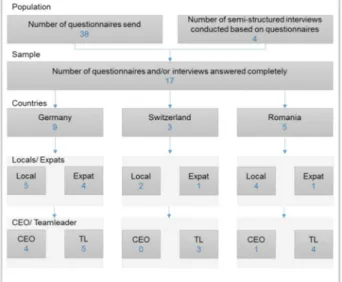
We intended to avoid failing into the trap, which Aristotle postulate by writing. “The kinds of questions we ask are as many as the kinds of things which we know.” [2], by including brief open-structure interviews in this particular study. This undertaking served first to validate that the way the questionnaires were understood, was the way we intended them to and validating if these have been answered consequently. The second purpose of this extension was to allow them to expand and add factors we might have been omitting by not being aware of them. The result of the completely filled out questionnaires and
conducted interviews is systematic represented through PRISMA – see Figure 1:
Fig. 1 Feedback overview on the research question of our paper
The questionnaires were constructed based on the research of E. Turner [18], who is dedicated to industrial and commercial learning. His research concluded that most strategies failed due to several factors, which we incorporated completely in our questionnaire. Its bold title (Why strategies DO fail) did not provoke any dissent, which confirmed that it’s an agreed on statement. Managers and team leaders were invited to distribute 100% of strategy’s failure among the following eight categories:
I. Lack of relevance: Strategies are crafted are too remote from the daily business and tasks of those responsible for implementing them
II. They are poorly defined; they are filled with metaphors and ambiguities; they lack simplicity and clarity.
III. Set goals are too ambitious: Strategies do not take into consideration, neither the time nor then effort required.
IV. Strategies fail to achieve ownership: Most top-down strategies are poorly defined and their understanding and true engagement was not ensured.
V. Teams are not resourced adequately: Time, people and budgets are often inadequate.
VII. Success of the strategy is not measurable or measured. Vital elements like good measuring criteria and a good measurement process are poorly tracked and lack continuous implementation.
VIII. Achievement is inadequately rewarded. Identification and conformance to intrinsic and extrinsic rewards is poorly perused.
In addition to these, after they were returned to us, we conducted interviews with the participants and asked for any other reasons they might have encountered, recommendations to remediate the current situation as well as for their “wish list” for the new generations of engineers starting their carriers within the organizations they are part of.
3. RESULTS OF THE QUALITATIVE STUDY
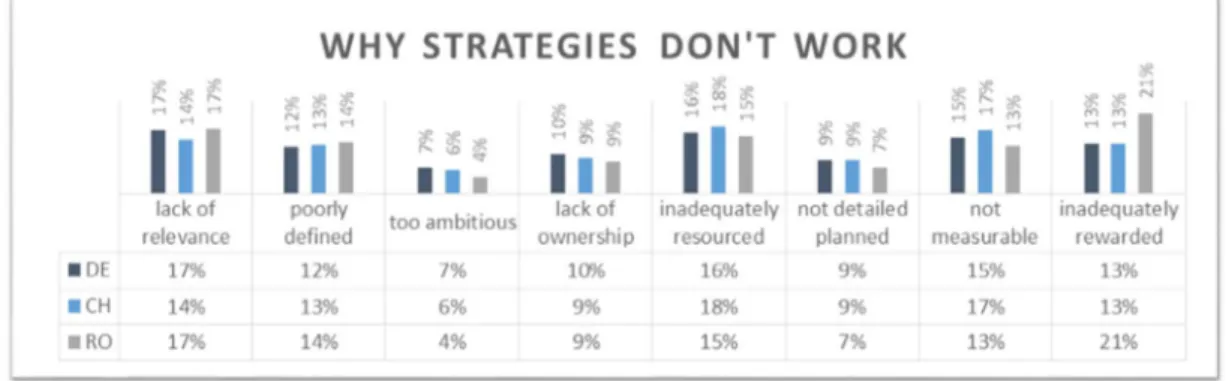
The general opinion, based on the percentages allocated in Figure 2, is that strategies do not work at an organizational level due to:
1. Lack of (understood) relevance and inadequate resourced projects.
2. Not measurable success and inadequate rewarding (including appreciation) 3. Poorly defined task and lack of
ownership (of these tasks).
This can be further broken down along three dimensions: management level, cultural appurtenance and national perceptions.
The first dimension reveals an unexpected result: The managers themselves complain about not measureable strategies, which are not detailed planned and they feel under pressure of time and increasing lack of proper educated and trained engineers to believe in a successful implementation of the strategies (they or their CEOs at a concern level) imposed. On the other had the team leaders feel that the projects of their department are too ambitions under current constrains, poorly defined and foremost they do not understand the relevance of the imposed strategies and resulting tasks, as shown in Figure 3.
Fig. 2: Results of the questionnaire: Why do strategies not work?
Fig. 3: First dimension: Team leader versus manager perception
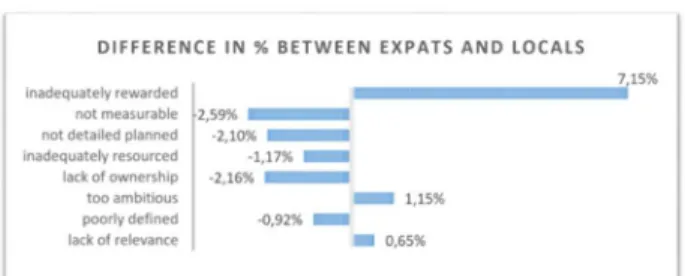
The second dimension we considered of a great importance in today’s organization structures is the local appurtenance. Especially the global
Fig. 4: Second dimension: Expat versus local perception The third dimension is given by national differences. Romanian owned companies or local subsidiaries complain mostly about an inappropriate reward, 72% of them referring strictly to the wage system. The second important reason for failure in Romania is the perceived lack of relevance of certain project and (international) imposed strategies. The last difference is given by the feeling of poorly defined job descriptions and specific tasks, therefore poorly defined project specific requirements for each one of them. German and Swiss companies on the other and feel that all the other mentioned reasons have a greater weight in the failure of organizational strategies, as represented in Figure 5.
Fig. 5: Third dimension: Romanian versus German & Swiss perception
4. CONCLUSIONS
If classic education of engineers is based today mainly on an “engineering science” model consisting of is a solid basis in science and mathematics, skills like the ability to tolerate ambiguity, to handle uncertainty, to be prepared to make decisions, think as part of a team in a social process are not part of the curricula [6]. This fact does not correlate to the growing need to develop leaders within corporations, which has been identified in literature [4]. Hence, our conclusion supports the actual academic sustained importance for engineers “to be skilled not only in terms of their particular technical field, but also in their ability to
identify non-technical aspects of problems, the interaction between these aspects and possible solutions” [13].
We first draw the conclusion upon each analyzed dimension, after which we synthetize these into a collective study conclusion.
Conclusion of the first dimension: Team leaders and managers are not facing extremely different requirements of their job fulfillment, if compared to the specialists, and even so they have different outtakes on the tasks provided to them.
Conclusion of the second dimension: The number of outsourced and offshored products, processes and R&D project within manufacturing is constantly increasing and the practice of sending expats, specialists from within their headquarter structure, which are expected to assure the implementation of the desired local strategy, is a common practice nowadays. The expats are considered “notoriously bad at adapting to local culture….and fuel a belief among local employees that there is a ceiling on their own potential in the company” [11].
This fact is resented not only by locals, but also by expats and they state be feel misunderstood and misjudged. They even related of project where locals did refuse to collaborate and they were unable to find owners of the broken-down tasks within their teams.
Conclusion of the third dimension: As expected, Germany and Swiss are very alike in their appreciation of the causes of failure and have another understanding of success and failure when providing strategic project description.
research that even if the partitioned percentage tends to rename this problem, the name is the same form all the analyzed angles: Strategies do not work because they fail to generate ownership and to be cascaded in a comprehensive, measurable, well defined way down the organization structure.
5. RECOMMANDATIONS AND
FURTHER DISCUSSIONS
We identified are two main trends in literature and practice when it comes to the future of effective and lasting learning, which are already accepted and successfully applied (mostly in US):
• one is specialized to engineers and presented in a series of publications, out of which we focused on the first parts “The future of engineering education I, II, III” [15]. This method is called Engineering Criteria 2000 (EC2000), is a method focused on outcomes (what is learned) rather than what is taught and is provided by the Accreditation Board for Engineering and Technology, Inc. in the United States [1].
• and one is more boarder applied, not to engineers specific, includes students and professionals alike, is named ARL-method, i.e. Action-Reflection-Learning [14], focused on the adult learning. Even is the second method is more broaden described, after studying both approaches, we find its elements within the EC2000.
6. REFERENCES
1. ABET EC 2000 – details retrieved on August 13th, 2017 from Web site:www.abet.org. See also Felder, R. M. (1998). ABET Criteria 2000: An Exercise in
Engineering Problem Solving, Chemical
Engineering Education, 32(2), 126–127 2. Aristotle; J. Barnes (transl.) (1994).
Posterior Analytics. 2nd edition, New York,
Oxford University Press.
3. Berggren, K. F., Brodeur, D., Crawley, E. F., Ingemarsson, I., Litant, W. T., Malmqvist,
J., & Östlund, S. (2003). CDIO: An
international initiative for reforming
engineering education. World Transactions
on Engineering and Technology Education, 2(1), 49-52.
4. Charan, R., Drotter, S., & Noel, J. (2010).
The leadership pipeline: How to build the
leadership powered company (Vol. 391).
John Wiley & Sons.
5. Duderstadt, J. J. (2007). Engineering for a changing road, a roadmap to the future of
engineering practice, research, and
education.
6. Dym, C. L., Agogino, A. M., Eris, O., Frey, D. D., & Leifer, L. J. (2005). Engineering
design thinking, teaching, and learning.
Journal of Engineering Education, 94(1), 103-120.
7. Eurostat (2016). High-tech statistics –
employment. Retrieved August 23rd, 2017,
from http://ec.europa.eu/eurostat/statistics- explained/index.php/High-tech_statistics_-_employment#Further_Eurostat_information 8. Felder, R. M., Woods, D. R., Stice, J. E., & Rugarcia, A. (2000). The future of engineering education II. Teaching methods
that work. Chemical Engineering Education,
34(1), 26-39.
9. Hinrichs, G., & Newman, D. (2013).
Developing cultural adaptability: Four cases of executive coaching support for
leader/managers. 2013 Proceedings of the
Southwest Academy of Management, 64-79. 10. Hynes, B. (1996). Entrepreneurship
education and training-introducing
entrepreneurship into non-business
disciplines. Journal of European Industrial
Training, 20(8), 10-17.
11. Joerres, J. A. (2011) Beyond expats:
Better managers for emerging markets.
McKinsey Quarterly 2.
12. Lamancusa, J. S., Jorgensen, J. E., & Zayas Castro, J. L. (1997). The learning factory—A new approach to integrating
design and manufacturing into the
engineering curriculum. Journal of
Engineering Education, 86(2), 103-112. 13. Lehmann, M., Christensen, P., Du, X., &
innovative learning strategy for sustainable
development in engineering education.
European journal of engineering education, 33(3), 283-295.
14. Rimanoczy, I., & Turner, E. (2012).
Action reflection learning: Solving real business problems by connecting learning
with earning. Nicholas Brealey Publishing.
15. Rugarcia, A., Felder, R. M., Woods, D. R., & Stice, J. E. (2000). The future of engineering education I. A vision for a new
century. Chemical Engineering Education,
34(1), 16-25.
16. Wallace, E. (2016). The role of coaching in facilitating the transition from engineer to
manager. (Doctoral dissertation).
17. Tang, J. (2000). Doing engineering: The
career attainment and mobility of
Caucasian, Black, and Asian-American
engineers. Rowman & Littlefield.
18. Turner, E. (2006). Industrial and commerce training: Learning that lasts.
Industrial and Commercial Training, 38(3), 137-142.
19. Westkämper, E. (2007). Digital Manufacturing in the global Era. Digital Enterprise Technology, 3-14.
20. Woods, D. R., Felder, R. M., Rugarcia, A., & Stice, J. E. (2000). The future of engineering education III. Developing critical skills. change, 4, 48-52.
Învățământul facilitat într-o era de fabricație high-tech
Rezumat: Această lucrare prezintă un proces de învățare durabil pentru inginerii într-o epocă de
fabricație de înaltă tehnologie. Am efectuat o cercetare multinațională calitativă axată pe industria
prelucrătoare, desfășurată în cadrul declarației: De ce strategiile eșuează la nivel organizațional.
Rezultatele indică faptul că o educație intensivă actuală în domeniul științei inginerești, bazată pe
cerințele specifice proiectelor, nu doar pentru a-și construi personalul, nu creează conducători și
lideri de echipă capabili să includă contexte globale, culturale și de afaceri.
Hannelore ILESAN, Department of Industrial Design and Robotics, Technical University of Cluj-Napoca, No.103-105, Muncii Blvd., 400641, Cluj-Cluj-Napoca, [email protected].