Refereed paper
Complex adaptive systems: a tool for
interpreting responses and behaviours
Beverley Ellis MA PhD FHEA MBCS CITP
Principal Lecturer in Health Informatics, School of Health, University of Central Lancashire, Preston, UK
Introduction
This paper presents empirical research on quality improvement through case studies conducted in two English National Health Service (NHS) Primary Care Locality Organisations. This body of work1,2 contrib-utes to public service management theory by provid-ing a new sociotechnical model for understandprovid-ing the role of primary care informatics in helping to improve quality within locality organisations in England. Ap-plying a complex adaptive system (CAS) conceptual framework helps to explain responses and behaviours resulting from change instigated by the introduction of policy.
Whilst relationships and knowledge tend to be framed by prior knowledge, experience3theory recog-nises that they have a strong informational com-ponent.4,5 Many studies provide evidence that one
tends to find what one expects, which helps to link the psychologies of first impressions to long-term re-lationships by showing how expectancies are sustained or modified through behavioural sequences.3–7 Inter-estingly, from an informatics perspective, responses to a survey reveal some clear differences in the relative importance attributed to each of the principles that underpin medical record standards.8It is likely that each respondent group answered the questionnaire in terms of what was most important to them. This would imply that work on reaching consensus on the standards for the structure and content of medical records may be particularly pertinent.9Where there is asymmetry in information there will be uncertainty. Conversely, where there is symmetry of information, confidence and implementation are more likely. The
ABSTRACT
Background Quality improvement is a priority for health services worldwide. There are many barriers to implementing change at the locality level and misinterpreting responses and behaviours can effectively block change. Electronic health records will influence the means by which knowledge and information are generated and sustained among those operating quality improvement programmes.
Objective To explain how complex adaptive sys-tem (CAS) theory provides a useful tool and new insight into the responses and behaviours that relate to quality improvement programmes in primary care enabled by informatics.
Methods Case studies in two English localities who participated in the implementation and develop-ment of quality improvedevelop-ment programmes. The research strategy included purposefully sampled case studies, conducted within a social constructionist ontological perspective.
Results Responses and behaviours of quality im-provement programmes in the two localities in-clude both positive and negative influences associated with a networked model of governance. Pressures of time, resources and workload are common issues, along with the need for education and training about capturing, coding, recording and sharing infor-mation held within electronic health records to support various information requirements.
Conclusions Primary care informatics enables in-formation symmetry among those operating quality improvement programmes by making some aspects of care explicit, allowing consensus about quality improvement priorities and implementable sol-utions.
results of this study show that information symmetry is found among those operating quality improvement programmes enabled by developments in informatics that include consensus about the need for standard-ised clinical coding and clinical audit, which makes some aspects of the quality of care explicit.
Aim
The aims of this study were to identify the key themes and management tools that underpin the effective governance of quality improvement programmes.
Methods
The research strategy includes purposively sampled contrasting case studies – two localities in the north-west of England. Data were generated through multiple methods and carried out within a social constructionist conceptual framework.10–12This approach provides insight into and practical examples of responses and behaviours that relate to the implementation and development of quality improvement programmes from the perspective of those involved between 1999 and 2005. The method and analysis are described in detail elsewhere, including the relative strengths and weaknesses of the data collection methods utilised in the study.13
Complex adaptive systems
A CAS is defined as one made up of a large number of parts that have many interactions and interdepend-encies.14–20Cilliers gives a comprehensive list of key elements and properties that describe a CAS:
A CAS would typically exhibit the whole system element of self-organisation, producing order of a changeable and varied type. Such self-organisation is not merely the result of processes like feedback or regulation described linearly. It involves disorderly, non-linear processes.17
Non-linear is defined as:
the result of an action formed by the history and prop-erties of the elements at a given time as well as the size of the input, as these can be variable. Small inputs may have large effects, and vice versa. Individual components within a system operate on local information and general principles.17
CAS are understood by observing the rich interaction among multiple components within the system. CAS thinking integrates positive (self-reinforcing) ideas
and attitudes through the sharing of information and feedback, supported by technology and automated processes, new ideas and outcomes emerging from the subsequent interaction. This element of emergence provides a rich foundation for thinking about ‘CAS that evolve through the recombination of agents or their schemata’ (p. 225).18
CAS as a management tool
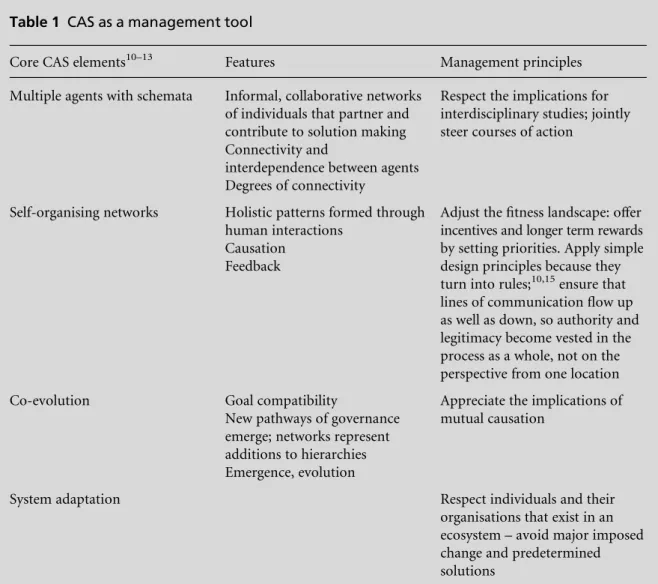
CAS as a management tool is summarised in Table 1. The interacting component units within a CAS result in a system-wide governance of quality improve-ment because influence is exercised both by the system on the units, and by the units on the system, termed mutual causation. Developments in primary care informatics enable network governance models of quality improvement – characterised by self-organis-ing, interpersonal networking. Several CAS authors claim that the rationality of this model is neither procedural, goal driven nor substantive, but ‘reflex-ive’.19,20This is expressed through continued efforts to generate and share information, proposing horizontal networks of interdependencies to replace hierarchies.
Results
For the sake of brevity, the themed results presented next relate to responses and behaviours attributable to active participation in the implementation and devel-opment of quality improvement in two localities.
Theme 1: Multiple stakeholder
perceptions, preferences and
priorities
Initially, there was no consensus among participants about either the topics or priorities to inform quality improvement programmes. Responses to the survey summarised in Table 2 show this.
audit and significant event analysis. These findings show that managers need to appreciate the desire to retain control of these functions at a given team or system level that included general practices. Further, they highlight the importance of encouraging co-operation leading to joint decisions about quality improvement priorities.
Theme 2: Development of
communication and information
systems
The development of communication and information systems supported by technology was emphasised. There was a recognised need to develop the use of electronic health records and to automate information sharing based on clinical audit, in order to improve patient outcomes. For example, more accurate and comparable computer-coded information in order to compare results.6 Techniques included data collection using templates and guidelines, analysis and interpretation.
Evidence supporting this theme included statements such as ‘The PCT has invested in IT to support its GPs, community and corporate services. This forms part of an on-going programme that will lead to the devel-opment of electronic GP records and integrated care records’ (locality organisation Chair).
Theme 3: Education, training and
development
In recognition of the need to build capability and capacity through education and training; an emphasis was placed on developing practical skills across multi-disciplinary teams, to be delivered via a range of flexible approaches.6 Seventy-six percent of survey respon-dents ranked the need to develop informatics skills as needed, or very much needed.
Table 1 CAS as a management tool
Core CAS elements10–13 Features Management principles
Multiple agents with schemata Informal, collaborative networks of individuals that partner and contribute to solution making Connectivity and
interdependence between agents Degrees of connectivity
Respect the implications for interdisciplinary studies; jointly steer courses of action
Self-organising networks Holistic patterns formed through human interactions
Causation Feedback
Adjust the fitness landscape: offer incentives and longer term rewards by setting priorities. Apply simple design principles because they turn into rules;10,15ensure that lines of communication flow up as well as down, so authority and legitimacy become vested in the process as a whole, not on the perspective from one location
Co-evolution Goal compatibility
New pathways of governance emerge; networks represent additions to hierarchies Emergence, evolution
Appreciate the implications of mutual causation
System adaptation Respect individuals and their
Theme 4: Resource concerns
All respondent staff groups showed concern about resources, emphasising the need for adequate dedicated time to deliver change.
Theme 5: Emphasis on a positive
approach
Low morale and apathy were frequently noted. The above results align with themes identified earlier in this body of work,1,2and suggest that the variety of opinions, responses and behaviours shown by partici-pants in the study added to their development; such as recognition of the need to develop practical informatics skills. Table 2 summarises multidisciplinary responses to a survey question that sought to determine quality improvement. The results reveal some clear differences between respondent groups in the relative importance attributed to topics. It is likely that each respondent group answered the questionnaire in terms of what was most important to them.
Considering individuals’ perceptions tells us much about their views of the official definitions of quality improvement. Observed responses and behaviours revealed an associated positive or negative effect on
other components in the quality improvement pro-gramme, or on the wider primary healthcare system.
Discussion
Discussion focuses on how primary care informatics improves symmetry of information, applying the asso-ciated CAS management tool to the findings. In response to being perturbed by the introduction of new quality improvement policy, a fusion of ideas was observed aimed at implementing arrangements locally. Perceived consequences of potential lapses in the quality of care meant that the problem of quality im-provement was considered collectively in each locality, which guided early discussion. Each individual shed some of their existing ideology in conjunction with others to establish a response to flux and change brought about by quality improvement policies. Individual responses and behaviour are explained as a need to engage in evolutionary learning, to develop commu-nication systems, to share information among a wide range of interested parties. This is enabled by primary care informatics, including developing practical skills and tools (templates, guidelines and automated
pro-Table 2 Prioritised quality improvement topics
Survey respondents’ occupation/role
Priority 1 Priority 2 Priority 3
General practitioner Audit information, coding and recording Time for any of these
Health needs assessment Use of computers in consultation
Information Technology Audit using your computer
How can we best do it?
Nursing PHCT members
Clinical risk management
Provision of resources including equipment to treat conditions, e.g. leg ulcers – Dopplers ETD to help improve understanding of quality improvement process
Audit for staff Central venous lines (equipment to measure rate of arterial/venous circulation)
Professional nursing issues
Financial issues
IT training
Looking at specific areas for quality improvement Review needs of
professionals annually
Managers Provision and
development of information technology (electronic health records), READ codes, templates
Cancer care
Sharing good practice – encourage general practitioners to train together – to accept their limitations
cesses) in response to the challenges brought about by social, organisational and policy changes. Applying CAS principles as a tool helps a manager to avoid being overly influenced by the viewpoint of any one indi-vidual or team involved in quality improvement pro-grammes. One of the important aspects of applying CAS thinking is that it does not deny or reject any particular world-view. Instead, it allows a manager to add another level of thinking, providing a more holistic local context, and for the convergence (or otherwise) of beliefs over time.
The notion of structure is observed as a patterning of relational dimensions within each quality improve-ment system. Different professional groups and agencies sought to affect the nature of the standards used within each locality to develop quality outcome indi-cators. An emphasis was placed on developing the workforce through the acquisition of practical skills, templates and guidelines to facilitate the capture, coding, recording and sharing of information held within electronic health records, which linked to work-based processes. The analysis suggests that the process started with initiatives that connected to a professional agenda, which linked to continuous professional development. Various techniques were attempted, which were observed linking individual, local and national quality improvement objectives. Rules that emerged locally focused on the standardised coding, capture of the diagnosis and management of chronic disease, before there was any formal requirement to do so. It was also focused on multidisciplinary team development. Rules generated structure for each quality improvement programme. One PCO focused on an incentivised local health improvement programme and the other on a Quality Team Development scheme, because the state that is the output of one application becomes the input of another. Dealing with complex problems is essentially a matter of mutual adjustment and co-operation brought about by rule-based responses to positive and negative feedback. The argument for con-sidering such insight is premised on thinking outside the hierarchy and about interpersonal relations and the potential offered by updating internal images based on experience, where there may be no instructive interaction. This analysis suggests that updating qual-ity improvement programmes will be based on ex-periences; any part can influence any other through connectedness and interdependencies.
Implications of the findings
In practice, the lessons learned provide opportunities to inform future management approaches and the role of primary care informatics improving quality within the NHS in England.
Limitations of the method
As reported elsewhere,9 limitations of case study methodology include a tendency to provide selective accounts, potential bias and/or the trivialisation of findings, and context specificity, leading to a lack of generalisability. The researcher’s interpretation of reality, as a social construction, may not resonate with that of another. Reasonable attempts were made to minimise bias. The diversity of data collection methods used in the study was an attempt to counterbalance the limitations highlighted in one method by the strengths of others.
Conclusion
Information asymmetry is reduced among those operating quality improvement programmes enabled by developments in primary care informatics.
Applying CAS theory as a management tool helps thinking about the totality of responses observed; and the greater scope for influence to ripple through quality improvement systems. The findings of this study emphasise the usefulness of CAS as a tool to explain responses and behaviours attributable to a multidisciplinary stakeholder perspective. CAS theory encourages an appreciation of the emergence of be-haviour that includes distributed responsibilities; and the importance of feedback and the networked exchange of information among interested parties enabled by developments in primary care informatics.
ACKNOWLEDGEMENTS
Thanks to the Editorial Board, in particular Stuart Ian Herbert and Simon de Luisignan for helpful com-ments on previous drafts.
REFERENCES
1 Ellis B. Complexity in practice, understanding primary care as a complex adaptive system.Informatics in Pri-mary Care2010;18(2):135–40.
2 Ellis B and Herbert SI. Complex adaptive systems (CAS): an overview of key elements, characteristics and appli-cation to management theory.Informatics in Primary Care2011;19(1):33-7.
3 Jones EE. Interpreting interpersonal behaviour: the effects of expectancies.Science1986;234(4772):41–6. 4 Akerlof GA. The market for ‘lemons’: quality
uncer-tainty and the market mechanism.Quarterly Journal of Economics1970;84(3):488–500.
6 Ellis B. Agreeing a PCG coding policy.BCS Healthcare Computing, 2001.
7 Darroch K and Ellis B. Development and use of inte-grated electronic records.Community Practitioner2003; 76(2): 53–5.
8 The Audit Commission.PbR Data Assurance Framework 2007/08: Findings From the First Year of the National Clinical Coding Audit Programme. London: The Audit Commission, 2008.
9 Department of Health Digital and Health Information Policy Directorate.A Clinician’s Guide to Record Stan-dards – Part 1: Why Standardise the Structure and Content of Medical Records? Part 2: Standards for the Structure and Content of Medical Communications When Patients are Admitted to Hospital. London: Department of Health Digital and Health Information Policy Direc-torate, 2008. www.rcplondon.ac.uk/clinical-standards/ hiu/medical-records.
10 Berger PL and Luckman T.The Social Construction of Reality. London: Penguin, 1966.
11 Gergen K. The social constructionist movement in modern psychology. American Psychologist 1985;40: 266–75.
12 Gergen, K.An Invitation to Social Construction. London: Sage, 1999.
13 Ellis, B.Managing Governance Programmes in Primary Care; lessons from case studies of the implementation of clinical governance in two primary care trusts. PhD Thesis, University of Central Lancashire, Preston, 2008. 14 Reynolds CW. Flocks, herds and schools: a distributed behaviour model, proceedings of SIGGRAPH087. Com-puter Graphics1987;21(4):25–34.
15 Kauffman SA. Origins of Order: self organisation and selection in evolution.Oxford: Oxford University Press, 1993.
16 Gell-Mann M.The Quark and the Jaguar. New York: Freeman, 1994.
17 Cilliers P. Complexity and Post-Modernism. London: Routledge, 1998, pp. 3–5.
18 Anderson P. Complexity theory and organization sci-ence.Organization Science1999;10(3):216–32. 19 Lewin R and Regine B.The Soul at Work: embracing
complexity science for business success.London: Orion Business, 1999.
20 Agranoff R and McGuire M. After the network is formed: power, process and performance. In: Mandell MP (ed)Getting Results Through Collaboration. Westport, CT: Quorum Books, 2001.
CONFLICTS OF INTEREST
None
ADDRESS FOR CORRESPONDENCE
Beverley Ellis School of Health
University of Central Lancashire BB242 Victoria Street
Preston, PR1 2HE UK
Email: [email protected]