Halley L. Hair. Investigating the information needs of interdisciplinary research
centers: A content analysis. A Master's paper for the M.S. in L.S. degree. April,
2015. 32 pages. Advisor: Rebecca Vargha
This study describes a content analysis of the websites of interdisciplinary
research centers co-located on and associated with university campuses. The
purpose of the study was two-fold; first, to determine whether the information
needs of interdisciplinary research centers were indicated on their websites, and
second, whether these needs appear to be met by current academic library
partnerships or services. Little evidence was observed of services or
partnerships between academic libraries and interdisciplinary research centers.
This analysis fills a gap in the literature, as research on the relationships
between interdisciplinary research centers and academic libraries has been
limited. The study uses a small sample of twenty-five websites in order to
develop themes and categories upon which later research might be based.
Headings:
Information needs
Research centers
INVESTIGATING THE INFORMATION NEEDS OF INTERDISCIPLINARY RESEARCH CENTERS: A CONTENT ANALYSIS
by Halley L. Hair
A Master's paper submitted to the faculty of the School of Information and Library Science of the University of North Carolina at Chapel Hill
in partial fulfillment of the requirements for the degree of Master of Science in
Library Science.
Chapel Hill, North Carolina April, 2015
Approved by
Table of Contents
Introduction...2
Background...3
History...3
Affordances & Challenges...5
Literature Review...6
Research Questions...9
Methodology...9
Limitations...12
Sampling...12
Results...13
Overview...13
Website Content...14
Evidence of Library Collaboration...16
Discussion...17
Conclusions...19
References...23
Appendix A – List of Interdisciplinary Centers Websites...26
Introduction
Interdisciplinarity, once the new kid on the academic block, has firmly entered the public consciousness of the research community. The number of research projects
drawing on multiple, diverse fields has soared in the past few decades. As colleges and universities have scrambled to cover costs in a changing economic environment, securing federal grant sources has increasingly been utilized to fill the gaps. Interdisciplinary research projects have often been seen as the magnet for these crucial research dollars in the era of shrinking state support and dwindling endowments (Glied et al., 2007).
Although the interdisciplinary research center is a now common feature of the university campus, real institutional change has been slow to come because the nature and longevity of interdisciplinary research has not been determined. Interdisciplinary research centers can be quite detached from traditional disciplinary departments, as they exist somewhat outside the traditional organizational structure of the institution. They tend vary in size, specialization/generalization, stability, longevity, and commitment to their mission because their makeup varies according to the type and sustainability of their research projects (Glied et al., 2007: 29). Many of these traits are positive. They can often make more agile research decisions than their departmental counterparts, because they are relatively independent. However, they can also be easily derailed by lack of funding or withdrawal of institutional support. Such centers also present challenges to the community, for example academic libraries which, like their parent institutions, can be slow to change in response to these developing user populations.
The purpose of this study is to investigate the information needs of
interdisciplinary research centers, to determine whether these are generalizable, and to develop theory about how they are being supported by their respective institution’s academic libraries.
Background History
on interdisciplinary research focuses exclusively on scientific projects and initiatives. Many are specifically health focused, which is understandable given that the National Institutes of Health (NIH) award the most grant dollars of any federal organization. Scientists working on health problems also have a jump on other researchers in terms of consilience—or, “the jumping together of knowledge to promote a common groundwork of explanation,” because the healthcare field has long demanded the collaboration of various experts to work on a single problem (Wilson 1996: 6). Academic science was quicker to embrace this idea, so the process of developing interdisciplinary projects is long underway (Rhoten, 2004).
Faculty members in the sciences have regularly been splitting their time, sometimes almost equally, between traditional academic departments and
interdisciplinary research teams starting in the 1970s and 1980s (Rhoten, 2004). This shift away from academic departments with information silos and toward
interdisciplinary research in the sciences makes sense, as the goal of the sciences is to engage with the natural and physical world; as in nature, “nothing exists [academically] in isolation from the rest of the world” (Byrne, 2014: n.p.). Defense contracts and other White House initiatives have also encouraged more interdisciplinary research in the sciences since the 1980s (McDonald, 1986).
sciences; this is especially true of projects in the realm of Digital Humanities. Big Humanities projects involve large, multidisciplinary teams situated across geographical space working together on projects, similar to extant scientific research projects in so-called Big Science. This organizational structure makes them more competitive for similar types of grants and other external funds as the sciences.
Affordances & Challenges
Centers and institutes focused around interdisciplinary topics help to alleviate the endemic problem of information overload in interdisciplinary research. Knowledge upkeep and research tasks are spread across team members, and because “there is no theoretical limit to the number and variety of specialties that might be specified in the cognitive budget [of an interdisciplinary research team]” the team is better able to handle the full cognitive load (Wilson, 1996: 194). The establishment of a focused
interdisciplinary center also lends legitimacy and helps to attract research dollars by creating a name and dedicated team to reference in grant applications.
However, universities have been slow to adjust to this new emphasis on interdisciplinarity and particularly slow to reward the research output of their scholars working in interdisciplinary fields. Often, publications created by researchers in
usually organized around broad and/or loose themes and lack guiding definitions, interdisciplinary research centers can also lose focus or drift away from their original mission (Rhoten, 2004). It is in this way that many centers and institutes lose their institutional recognition and support.
Specialized research centers also challenge their institutional libraries, as
academic libraries were initially set up to serve populations organized along departmental lines (Allen & Sutton, 1993: 499). Like universities, academic libraries have for the most part failed to implement systemic changes to go along with the changing mores of
research. For better or worse, libraries are a part of their institutional system, and like their institutions they are “sometimes [...] affected by institutional inertia and remain organized along traditional disciplinary boundaries even when those boundaries no longer reflect the academic communities” (Allen & Sutton, 1993: 499). This is especially true for interdisciplinary organizations on campus that are established from the outset without the collaboration of library professionals.
Literature Review
disciplines so as to qualify for tenure or other university placement requirements (Rhoten, 2004: 8). Despite all of these challenges, scholars and information professionals have noted that an increasing number of research fields in modern science draw on scholars from more than one discipline in the past few decades (Raasch et al., 2013).
Raasch et al. (2013) also noted that interdisciplinary research and publications in interdisciplinary journals has historically been essential to defining emerging fields, but interdisciplinary publishing can be seen to dip off once the field is better defined.
However, their findings might also point to the fact that high-involvement
interdisciplinary research and publication is difficult for researchers to sustain in the absence of adequate institutional and library support. The development of
interdisciplinary research centers might be seen in some ways as an attempt to replicate this missing institutional support, as they provide legitimacy and space to pursue interdisciplinary research.
Despite all of these developments interdisciplinary research centers remain hard to define, which has been troubling for information specialists seeking to serve such organizations. Some centers are large and academically influential, while others are tiny, underfunded, and extremely specialized. Particularly well funded centers can afford to maintain their own staffs, including dedicated information professionals, while others rely heavily on resources from their institution’s academic library. This
non-standardization is one barrier to developing standards for providing information services. Setting priorities for research support in libraries can be difficult when
divergent course that crosses disciplinary boundaries” even in the humanities (86). Palmer and Neumann specifically urge research libraries to support inherently interdisciplinary research, as “research libraries are critical nodes in the networks of humanities scholarship” (112).
McNamara and Matre (2002) and Lorenzetti and Rutherford (2012) both focus on the role of an information professional in the interdisciplinary research process itself. McNamara and Matre question the role of the reference librarian, specifically, in interdisciplinary research. They also posit that “traditional models for research and bibliographic instruction are not always sufficient to help students find the resources they need to complete assignments and research projects that increasingly require cross-disciplinary searching” (71). As an aid to other reference librarians, they engage in the definitional debate surrounding “interdisciplinary research” and “interdisciplinarity.” In so doing, they hoped to contribute to the building of frameworks to support
interdisciplinary research in research libraries. Lorenzetti and Rutherford (2012), however, focus on the nature of successful collaborations rather than on collections and the reference librarian. They investigate the role that information professionals play as members of interdisciplinary teams, often playing roles seemingly outside of the scope of the profession (275). In so doing, they are enhancing the ability of the team to tackle complex problems.
work of medical and allied health professionals, who hope to encourage objectivity, empathy, and global thinking in medical practitioners (Kirklin, 2003). Curran suggests library support in the form of interdisciplinary spaces, incorporating art and humanities into health sciences library programming, and building collections. In this way health sciences students, who may or may not be directly involved with research in the medical humanities or any other interdisciplinary field, can be introduced naturally to the output of the allied interdisciplinary centers and programs.
Research Questions
Given that interdisciplinary research centers are an increasingly common part of the average research university campus, academic libraries must endeavor to meet the information needs and support the research goals of these institutions. Interdisciplinary research center websites are the public face of these organizations, and therefore the most accessible source of information about the information needs and resources of these organizations. This exploratory study focuses on two interrelated research questions:
1) What is the focus of content on the websites of interdisciplinary research centers? 2) Is there evidence that the essential processes of interdisciplinary research centers
are being supported by their respective institution’s academic libraries?
Methodology
The practice of social research. An exploratory qualitative study is the most appropriate method to answer the research questions posed given that little has been published on the relationships of interdisciplinary research centers to their institutional libraries. This study will employ a qualitative content analysis of interdisciplinary research centers’
websites in order to systematically identify themes and patterns in their web content.
Babbie (2007) identifies content analysis as an appropriate method for analyzing the content of websites. Content analysis is a form of investigation originally indigenous to communication research (Krippendorff 1989: 403). The subjective interpretation involved in qualitative content analysis is preferred to merely counting words because this study is meant to be a theory-generating one (Krippendorff 1989).
Content analysis is a widely used qualitative research technique with three distinct approaches: conventional, directed, and summative (Hsieh & Shannon, 2005). The
conventional, or latent, approach to content analysis is the basic process of interpretation of content (Holsti, 1969). The focus of any study employing qualitative content analysis is on unearthing the underlying meanings of the words or content through a coding process so as to organize large quantities of text into fewer content categories (Holsti, 1969; Hsieh & Shannon, 2005: 1285). Since the 1950s, content analysis has been an increasingly popular qualitative method (Nandy & Sarvela, 1997). It is a naturalistic method, as it allows researchers to observe a phenomenon in a natural setting rather than in a controlled laboratory setting (Hsieh & Shannon, 2005).
communication medium is read, processed, and labeled according to themes that emerge from the data through inductive category development (Hsieh & Shannon, 2005;
Mayring, 2000). This is often referred to as emergent coding, as the labels and categories emerge organically from the data.
The first step in any content analysis is for the researcher to read all of the data completely, so as to immerse themselves in the data to be studied. Emergent codes are then derived from words and phrases that appear to highlight key concepts or important variables. Combined with the constant comparative approach, meaningful codes can quickly begin to develop. Codes are labeled with words in the qualitative approach, rather than being assigned numbers, and then those codes are sorted into relevant categories based on relationships or linkage. As this sorting process generates ideas, the researcher stops to write a memo about the categories’ and/or subcategories’ relationship to the research question; these memos will be used in writing up the results later in the research process (Glaser & Strausss, 1967; Mayring, 2000). Conclusions are drawn based on the coded data and related audit trail provided by the memos written throughout the code development and coding process (Glaser & Strauss, 1967).
Limitations
Unlike with quantitative studies, the replicability of qualitative content analyses is low; since the “categories are obtained from the very material being analyzed, findings are not generalizable much beyond the given data” (Krippendorff, 1989: 407). Computer analysis can make intercoder reliability higher and results more replicable, but human analysis was preferred for this study due to time and resource constraints as well as the subjective matter of the study.
Relatedly, there is potentially low internal validity, or credibility. The study is completely in the hands of the researcher in a conventional qualitative content analysis, since there is no developed theory to use as a guide. If the researcher misidentifies or fails to identify key categories, then the results will not accurately represent the data (Hsieh & Shannon, 2005).
The sampling, coding, and data entry were all performed by the researcher. Due to time and resource limitations, this study did not have the benefit of having a second person to act as an observer and controller during the coding and data entry processes.
Sampling
the largest search engine indexes list only a fraction of the Web sites in existence at any given time” (Thompson, 2012: 71).
This study is limited to campus-affiliated centers and institutes, so the sampling frame was built mostly from lists of interdisciplinary research centers available on
university websites. The sampling frame included interdisciplinary research centers on 58 different university campuses. Due to limitations of the researcher, the frame was also limited to university centers with an English language web presence. Websites were chosen for analysis by assigning each interdisciplinary research center’s website in the sampling frame a number and then choosing twenty-five numbers at random.
Results
Overview
Table 1. Originating Disciplines. Discipline Social
Sciences
Medicine Arts & Humanities
Formal Sciences
Natural Sciences
Percentage 28% 16% 12% 16% 28%
As stated in the sampling parameters, only interdisciplinary research centers located on a university campus were included in the study. The large majority of those sampled were independent institutions on a single university campus. Three of the center websites analyzed were part of a medical school, two were hosted by a school of
engineering, one by a school of nursing, one by a school of arts and humanities, and two of the centers were run collaboratively by teams on multiple universities.
Website Content
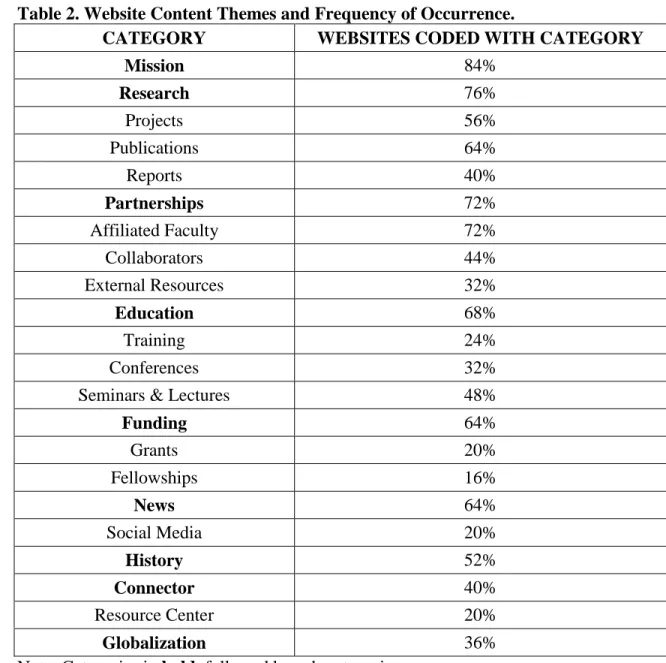
fellowships. Social media was a sub-category of news that emerged in some of the websites. Resource center, a theme that emerged early in the coding, was eventually collocated under the category connector. See Appendix B: Codebook of Website Content for definitions of each category and sub-category.
Table 2. Website Content Themes and Frequency of Occurrence.
CATEGORY WEBSITES CODED WITH CATEGORY
Mission 84%
Research 76%
Projects 56%
Publications 64%
Reports 40%
Partnerships 72%
Affiliated Faculty 72%
Collaborators 44%
External Resources 32%
Education 68%
Training 24%
Conferences 32%
Seminars & Lectures 48%
Funding 64%
Grants 20%
Fellowships 16%
News 64%
Social Media 20%
History 52%
Connector 40%
Resource Center 20%
Globalization 36%
Note: Categories in bold, followed by sub-categories.
common feature on the interdisciplinary research centers’ websites sampled, but
sometimes mission was implied on the About or Home pages rather than grouped under an explicit heading. Research refers to explicit statements of research objectives of past and current initiatives. It was, understandably, the next most dominant theme throughout the websites. Partnerships and affiliated faculty were almost as common as explicit descriptions of research efforts, both ranking third with representation in 72% of the websites sampled.
Evidence of Library Collaboration
Documentation of library-center relationships was rare. None of the twenty-five interdisciplinary research centers’ websites sampled noted a librarian or information specialist on either the core or affiliated staff. Only twenty percent of the interdisciplinary research centers’ websites indicated any explicit relationship with their respective
institution’s academic libraries:
1) The Interdisciplinary Center for Innovative Theory and Empirics (INCITE) at Columbia University is allied with the Columbia Center for Oral History. The two are collaborating on a project, the assembled papers of which are housed at the Columbia Center for Oral History Archives in the Rare Books & Manuscripts Library.
Manuscripts, reports, and publications are physically housed at Steenbock Library, the campus agricultural library.
3) The Center on Urban Poverty and Community Development at Case Western Reserve University is one of the older centers sampled. The archive of the Poverty Center is housed at the Kelvin Smith Library. Publications and reports are
available for download from Digital Case Western, the university’s repository. 4) HumanFIRST Laboratory of the University of Minnesota houses its papers and reports at the Center of Transportation Library, an institution affiliated with the university libraries.
5) The Interdisciplinary Research Center in Cyber Security at the University of Kent has integrated all of its publications into the Kent Academic Repository, an open access database run by the Kent Library.
Discussion
That research was not an even more common theme was surprising. Several interdisciplinary research centers’ websites mentioned in passing their commitment to supporting interdisciplinary research on their respective campuses, but neglected to detail any past or current research projects undertaken at the center or by its affiliates. Some of the centers sampled had the phrase “interdisciplinary research centers” in their name or description, but seemed to function more as Resource Centers than as functioning research hubs. This brings to mind the conversations in the literature about whether interdisciplinary research is a real trend in education and research or just a buzzword to attract funders (Rhoten, 2004; Strober, 2010).
More non-medical or health-related interdisciplinary research centers were caught in the sample than expected, given that the National Institutes of Health is the single biggest grant funder for interdisciplinary research. Funding structures for humanities and social sciences related interdisciplinary research centers were often different from those more rooted in the biomedical, natural, or formal sciences; one such center had been founded by a wealthy private citizen, and several seemed to rely on donations at least as much as on grant monies. Almost all of the centers appeared to benefit from partnerships either within their institutions or in related centers and organizations. Community
partnerships also looked fruitful; these were more prevalent in the social sciences oriented research centers than those oriented toward more the more physical science.
The relative lack of documented university library collaborations with
archives, which could certainly have benefitted from a professional’s touch. Wikis maintained for internal use and data libraries could be maintained more efficiently with the help of an on-staff information specialist. However, due to the relative youth of many of the centers analyzed and indeed within the sampling frame, libraries may not have had time to adjust their service offerings appropriately.
Conclusions
Qualitative content analysis was employed to explore the web presence of a small sample of interdisciplinary research centers. This textual data represents the research and educational objectives of these centers which have become woven in the fabric of
university campuses of late; the researcher hoped to discover whether this data was generalizable and whether it would be useful for the staff of university libraries endeavoring to develop collections and resources for researchers affiliated with such institutions. The qualitative focus was chosen because little has been written about interdisciplinary research centers and academic library relationships or on
interdisciplinary research center websites in general.
Textual data “has a cognitive consequence for their senders, their receivers, and the institutions in which their exchange is embedded” (Krippendorff, 1989: 403). The senders in this study are the website content developers and by proxy the directors of the interdisciplinary centers represented, the receivers are any outside stakeholders or
their identity. So, if the website of an interdisciplinary research center makes no mention of their information needs or information partners, then their identity doesn’t include
responsible, dedicated, or long-term information management. The more robust,
information-laden websites are more attractive to potential partners and funders partially because they appear to be more committed to their respective causes purely because they have more developed documentation processes.
Time will tell whether interdisciplinary research is a true transition, but it is omnipresent at this intellectual moment. Interdisciplinary graduate programs abound; indeed, in this study, one of the most frequently mentioned aspects of an interdisciplinary research center was its educational offerings and objectives. Libraries owe it to these interdisciplinary-from-the-start students to provide services and help make collections accessible for those operating outside of traditional disciplinary boundaries. Since interdisciplinary research centers are typically already in place to support these students, collaborating with these centers to develop collections and resources would be more efficient than employing staff members in drawn out citation analyses.
future research into this phenomenon could start on more solid footing (Glaser & Strauss, 1967; Mayring, 2000).
Further research will be required to make any sound conclusions about the relationship of libraries to their on-campus centers and institutes. The categories developed in this investigation might be used to guide a more expansive look at
interdisciplinary research centers, either through a larger-scale study of a similar nature, or to guide interview questions for library subject liaisons and/or directors of
interdisciplinary research centers. Case studies in the literature talk of developing collections for interdisciplinary departments, but because of the ephemeral nature of grant-dependent research centers different methods might need to be employed; a
researcher who was well-situated and with more time and resources might develop a very useful case study of the developing partnership between interdisciplinary research
References
Allen, B.L. & Sutton, B. (1993). Exploring the intellectual organization of an interdisciplinary research center. College & research libraries, 499-515. Babbie, E. (2007). The practice of social research (11th ed.). California: Thomson
Wadsworth.
Basken, P. (2011). As budgets tighten, big science gets a new opportunity to make its case. The chronicle of higher education, 57(30). Retrieved from
http://chronicle.com/article/As-Budgets-Tighten-Big/126891/
Birnbaum, P. H. (1978). Academic contexts of interdisciplinary research. Educational administration quarterly, 14(2), 80-97.
Bryman, Alan (2004). Social research methods (2nd ed.). New York: Oxford University Press.
Buchtel, F. S. (1972). Implications of interdisciplinary research centers for university policies and practices. Journal of research and development in education, 5(4), 58-62.
Byrne, S. (2014, February 19). Interdisciplinary research: why it’s seen as a risky route. The guardian. Retrieved from http://www.theguardian.com/higher-education- network/blog/2014/feb/19/interdisciplinary-research-universities-academic
Curran, M. (2012, July). A call for increased librarian support for the medical humanities. Journal of the medical library association, 153-155. DOI:
Dobson, C., Kushkowski, J. D., & Gerhard, K. H. (1996). Collection evaluation for interdisciplinary fields: A comprehensive approach. Journal of academic librarianship, 22(4), 279-284. Retrieved from
http://search.proquest.com/docview/57392837?accountid=14244
Glied, S., PhD., Bakken, S., D.N.Sc, Formicola, A., D.D.S., Gebbie, K., PhD, & Larson, E.L., PhD. (2007). Institutional challenges of interdisciplinary research centers. Journal of research administration, 38(2), 28-36. Retrieved from
http://search.proquest.com/docview/216588602?accountid=14244
Halpern, N. (2013). Content analysis of European airport websites. Journal of air transport management, 26, 8–13.
Harder, C. T., & Jordan, M. M. (2013). The transparency of county websites: a content analysis. Public administration quarterly, 37(1), 103-128. Retrieved from http://search.proquest.com/docview/1355856130?accountid=14244
Kannappanavar, B. U., Jayaprakash, & Bachalapur, M. M. (2011). Content analysis of engineering college library websites. Library philosophy and practice, 1-13. Retrieved from
http://search.proquest.com/docview/1220621467?accountid=14244 Kirklin, D. (2003). The Centre for Medical Humanities, Royal Free and University
College Medical School, London, England. Academic medicine, 78(10), 1048-1053.
http://repository.upenn.edu/asc_papers/226
Law, R. (2012-01-01). Representation of destination cultural factors on hotel websites: content analysis of Beijing hotel websites. Asia Pacific journal of tourism research, 17(2), 210-229. doi: 10.1080/10941665.2011.616903
Lin, H. (2008). Opportunities and challenges for interdisciplinary research and education. Journal of natural resources & life sciences education, 37, 83-91.
Lorenzetti, D.L. & Rutherford, G. (2012). Information professionals’ participation in interdisciplinary research: a preliminary study of factors affecting successful collaborations. Health information and libraries journal 29, 274-284.
Mayring, P. (2000). Qualitative content analysis. Forum : qualitative social research, 1(2). Retrieved from
http://search.proquest.com/docview/867646667?accountid=14244
McDonald, K. (1986). White House pushing campus centers for interdisciplinary science research. Chronicle of higher education, 33, 1.
McNamara, L., & Matre, R. (2002). Interdisciplinary research: the role of the reference librarian. Texas library journal, 78(2), 71-74.
Nandy, B. R., & Sarvela, P. D. (1997). Content analysis reexamined: A relevant research method for health education. American journal of health behavior, 21, 222-234 Palmer, C. & Neumann, L. (2002). The information work of interdisciplinary humanities
scholars: exploration and translation. Library quarterly 72(1), 85-117. Raasch, C., Lee, V., Spaeth, S., & Herstatt, C. (2013). The rise and fall of
http://search.proquest.com/docview/1418112601?accountid=14244
Rhoten, D. (2004). Interdisciplinary research: trend or transition. Items and issues, 5, 6-12. Retrieved from http://www.ssrc.org/publications/items/items_5.1- 2/interdisciplinary_research.pdf
Shannon, S. E., & Hsieh, H.-F. (2005). Three approaches to qualitative content analysis. Qualitative health research, 15(9), 1277–1288. doi: 10.1177/1049732305276687 Strober, M. H. (2010). Interdisciplinary conversations: challenging habits of thought.
Palo Alto, CA, USA: Stanford University Press. Retrieved from http://www.ebrary.com
Taylor-Powell, E., & Renner, M. (2003). Analyzing qualitative data (GS3658-12). Madison, WI: University of Wisconsin-Extension, Cooperative Extension Publications.
Thompson, S. K. (2012). Wiley desktop editions : sampling (3rd edition). Somerset, NJ, USA: John Wiley & Sons. Retrieved from http://www.ebrary.com
Wildemuth, B.M. (2009). Applications of social research methods to questions in information and library science. Westport, CT: Libraries Unlimited. Wilson, P. (1996). Interdisciplinary research and information overload. Library
trends, 45(2), 192-203. Retrieved from
Appendix A List of Interdisciplinary Center Websites
Center URL Host Institution(s)
Interdisciplinary Center for
Innovative Theory and Empirics
(INCITE) http://incite.columbia.edu/
Columbia University in the City of New York Institute for Language Education in Transcultural Context (ILETC) http://www.gc.cuny.edu/Page- Elements/Academics-Research-Centers- Initiatives/Centers-and-Institutes/Institute- for-Language-Education-in-Transcultural-Context CUNY Graduate Center
Center for Global
Health & Disease http://www.case.edu/orgs/cghd/
Case Western Reserve University School of Medicine Interdisciplinary Center for Inductively-Coupled Plasma Mass Spectrometry
(ICPMS) http://icpms.ucdavis.edu/
University of California at Davis Center for
Interdisciplinary Research on
Complex Systems http://www.circs.neu.edu/
Northeastern University
Land Tenure Center http://nelson.wisc.edu/ltc/index.php
University of Wisconsin-Madison Center on Urban
Poverty and Community
Development http://povertycenter.case.edu/
Case Western Reserve University
The Center for Interdisciplinary Studies in Security and Privacy
(CRISSP) http://engineering.nyu.edu/crissp/
New York University Polytechnic School of Engineering
Center for the Future
of Work http://fow.heinz.cmu.edu/
Carnegie Mellon University Brudnick Center on
Violence and
Comfort http://www.northeastern.edu/brudnickcenter/
Center for
Collaborative and International Arts
(CENCIA) http://cencia.gsu.edu/
Georgia State University Center for the Study
of Inequality http://inequality.cornell.edu/ Cornell University
University Center on
Aging and Health http://fpb.case.edu/Centers/UCAH/
Case Western Reserve University School of Nursing
Center for the Study of Children at Risk
http://www.brown.edu/research/projects/child ren-at-risk/
Brown University School of Medicine Center for
Interdisciplinary Study of Museums
(CISM) http://www.utdallas.edu/ah/cism/
University of Texas-Dallas School of Arts & Humanities
Interdisciplinary
Center for Bioethics http://bioethics.yale.edu/ Yale University Center for
Interdisciplinary Research in Women's Health
(CIRWH) http://www.utmb.edu/cirwh/
University of Texas Medical Branch Institute on Race and
Justice http://www.northeastern.edu/irj/
Northeastern University Human Factors Interdisciplinary Research in Simulation and Transportation (HumanFIRST)
Laboratory http://www.humanfirst.umn.edu/
University of Minnesota, Engineering Department
Center for Research and Education in
Wind (CREW) http://crew.colorado.edu/
University of Colorado Boulder, Colorado State University, and Colorado School of Mines
Nicholas Institute for Environmental
Poverty Solutions http://nicholasinstitute.duke.edu/ Duke University Interdisciplinary
Research Centre in
Interdisciplinary
Center on Aging http://medicine.missouri.edu/aging/
University of Missouri Combustion Energy
Frontier Research
Center http://www.princeton.edu/cefrc/
Princeton University and affiliates
Ford Instittue for
Human Security http://www.fordinstitute.pitt.edu/
Appendix B Codebook for Website Content
Coder: Author was only coder for this study.
Unit of Analysis: The unit of analysis for this study is the entire website of each interdisciplinary research center.
Procedure: Website content will be saved as an HTML file. Coder will read content of websites thoroughly two times through, while taking notes on content. In third run, coder will highlight themes. As patterns appear inductively, coder continues to memo about relationships and monitors themes for growth or decay.
Definitions of codes (by category and sub-category):
Category Definition
Mission
The guiding aim or objective of a center, often found under the heading Mission Statement.
Research Explicit description of past or current research initiatives.
Projects
Time-delimited or grant-funded projects associated with research, usually with an associated research team.
Publications
Publications in scholarly journals, interdisciplinary or otherwise.
Reports
Reports made to government agencies, annual reports, white papers, working papers, and any other formal written material produced by a member of the research center, which might not otherwise be counted as a scholarly publication.
Partnerships
Alliances with any group outside of the research center (e.g. community group, organization, or government agency).
Affiliated Faculty
Faculty from other departments within the university, or visiting scholars.
Collaborators
Other centers or institutes with whom the research center maintains formal or informal working agreements.
External Resources
Education
Teaching activities, including specialized courses, undergraduate and graduate programs.
Training
Teaching activities that involve external stakeholders or specifically non-student groups (e.g. nurses, community members, grass-roots organizations.)
Conferences
Events hosted by the research center in which a topic of interest to the research center is discussed at length, including talks, presentations, or roundtables.
Seminars & Lectures
Short meetings to discuss topics relevant to the center, usually on a regular time schedule or arranged in a short series.
Funding
Revenue streams that support research, both offered by the center for student research and solicited externally to support the mission and ongoing projects of the center.
Grants
Non-repayable funds disbursed by a government agency or other funding group involving a formal application process, including reports to be filed.
Fellowships
A merit-based scholarship or funded position provided by the research center.
News
Noteworthy information about current events related to the research center.
Social Media
Blogs, twitter, Facebook, Instagram, etc. used to promote interaction with the research team or its current initiatives.
History
Details provided about the founding, development, and/or past objectives of the research center.
Connector
Centers which aim to provide connections or build networks between their partners or stakeholders within the research community.
Resource Center
Provides information, assistance, services, and/or materials to community members.
Globalization