Triage Performance of First-year Medical Students Using a Multiple Casualty Scenario Paper Exercise
By Robert F. Sapp
A Master’s Paper submitted to the faculty of the University of North Carolina at Chapel Hill
In partial fulfillment of the requirements for the degree of Master of Public Health in
the Public Health Leadership Program.
Chapel Hill 2007
___________________________ Advisor ________________________________ Second Reader ________________________________
Introduction:
With current international concern regarding terrorist attacks, natural disasters, bioterrorism, and mass casualty incidents, the ability of emergency medical systems to appropriately and rapidly respond to disaster situations is critical. A disaster may be defined as ―a calamitous event, especially one occurring suddenly and causing great loss of life, damage, or hardship.‖ 1
The World Health Organization has further defined a disaster event as a "sudden ecological phenomenon of sufficient magnitude to require external assistance," while the American College of Emergency Physicians states that a disaster has occurred "when the destructive effects of natural or man-made forces overwhelm the ability of a given area or community to meet the demand for health care." 2
Disaster incidents are commonly divided into two categories – natural or
disrupt the emergency infrastructure and overwhelm the capacity of even the most advanced emergency medical systems across the globe.
In the event of a disaster situation, the main priorities for patient care are triage, treatment, and transport. The most important medical function in a mass casualty
incident may be the accurate identification of patients who will benefit substantially from early scene intervention or transport.4 Prehospital medical providers perform triage of disaster victims in the field and make decisions on which patients to treat on scene and which to immediately transport to a nearby hospital or other medical facility.
Triage has been defined as the sorting of medical conditions intodifferent
categories to achieve a true priority of care,5 seeking to classify victims based on severity of illness or injury and maximize available medical resources. The term triage is derived from the French word trier, meaning "to sort." 6 Surgical triage was initially developed by the French in the early 1800s out of the need to prioritize the care of injured soldiers in battlefield settings, providing immediate care to the most seriously injured.7 Triage developed gradually from the military setting into hospital Emergency Departments, although this practice was not widely adapted in the United States until the latter half of the 1900s. There are other potential applications for triage besides mass-casualty incidents (MCI) in developed countries, such as its use in areas of relative heath care poverty in Sub-Saharan Africa, Southeast Asia, etc.
mass casualty incident. Therefore, the most severely ill or injured patients may actually be treated last, after a large number of lesser acuity patients have already been helped.
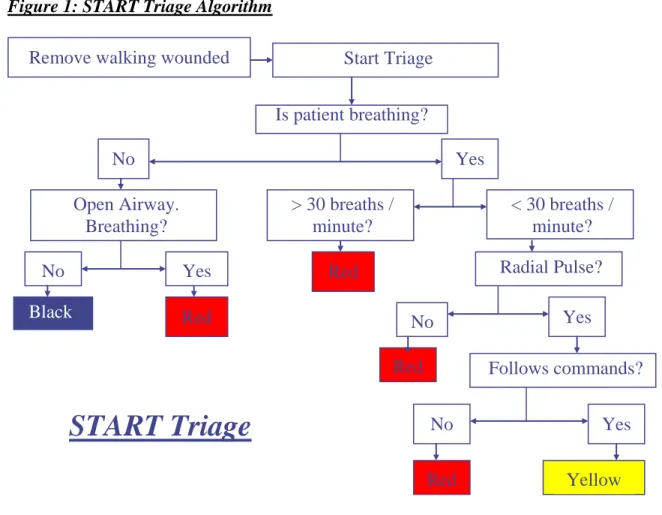
There are many different triage methodologies currently in use around the world, but there is not a single, universally-accepted ―gold standard‖ system of triage. Medical triage algorithms used in disaster situations must allow for the rapid identification of critically injured patients without the need for lengthy examinations of all involved victims.8 In the United States, the most widely-used triage methodology is the Simple Triage and Rapid Treatment (START) system, which uses the physiologic variables of respiratory rate, radial pulse/capillary refill, and the ability to obey commands in order assess a patient’s stability and priority level.8
The Triage Sieve methodology is used predominantly in the United Kingdom and stratifies patients based on respiratory rate and capillary refill or heart rate. The CareFlight Triage algorithm, used throughout Australia, classifies patients based on the ability to obey commands, the presence of respirations, and the presence of a radial pulse.8 A version of the START algorithm, named the JumpSTART system, has adapted the variables of the adult triage protocol for use in pediatric patients. Several other countries have developed their own specific triage systems and have adapted them nationally, but variations in the practice of triage exist within countries and between providers.
triage Red (Priority 1 –immediate life-threatening illnessor injuries); triage Yellow (Priority 2 – seriously illness or injuries); or triage Black (Priority 4 – dead or moribund). Medical providers in the field follow the START algorithm in patient evaluation, first determining a patient’s ability to walk, then assessing respiratory effort and rate, radial pulse, and the ability to follow commands. The specific clinical criteria for triage category Yellow are a respiratory rate less than 30 breaths per minute, presence of a radial pulse, and adequate mental status denoted by the ability to follow commands. Criteria for triage category Red are a respiratory rate greater than 30 breaths per minute, absence of a radial pulse, or the inability to follow verbal commands. Patients who are not breathing and who do not begin breathing spontaneously with opening of the airway are triaged as category Black.
Triage is typically performed in the field by basic or advanced EMS providers, registered nurses, or physicians, and this process is repeated at various intervals of patient care. Each patient is reassessed and reassigned specific triage levels as they enter the different sectors of medical care, such as ambulance transport or hospital emergency departments. The goal of triage is to prioritize victims based on severity and most effectively utilize the limited medical resources available. However, triage that is performed incorrectlymay actually hinder attempts to mitigate disaster outcomes and may ultimately lead to greater harm than good.9
where many patients with non-severe injuries are classified as urgent medical priorities. Large numbers of patients with less emergent medical needs who are prioritized for immediate medical attention might further increase the burden placed on limited emergency medical resources in a disaster situation, resulting in patients with more severe injuries to be overlooked or turned away. In order to evaluate the existing research evidence on the performance of disaster triage and the accuracy of triage decisions, a systematic review of the medical literature was performed.
Systematic Review of Studies of Triage Performance
Methods:
Results of Systematic Review:
After completing a focused review of the medical literature, several previous studies were identified that evaluated the performance of triage by emergency physicians, registered nurses, paramedics, and other prehospital emergency providers around the world. These studies utilized paper-based triage questionnaires or simulated clinical patient scenarios to assess the accuracy of triage decisions made by different groups of medical providers. The term ―triage accuracy‖ is defined in the disaster medicine literature as the mean percentage of correct answers achieved by respondents on standardized triage performance exercises.
A study by Kilner in 2002 found that emergency medicine physicians and registered nurses triaged standardized patient scenarios with a mean accuracy score of 65%, while paramedics achieved a slightly lower accuracy score of 59%.10 This study used a 20-question multiple casualty scenario paper exercise to evaluate the triage decisions made by prehospital emergency care providers, finding that physicians and nurses scored somewhat better than ambulance paramedics on the standardized triage questionnaire. This was a well-designed study consisting of 100 doctors, 59 nurses, and 74 ambulance paramedics who were allowed 10 minutes to complete the 20-scenario written exercise. The study authors found clinically-significant rates of both over-triage (15%) and under-triage (20%) in all three professional medical groups, identifying the dangers presented by both types of errors in triage designation in the case during a disaster situation.
pediatric triage exercise, finding only moderate levels of triage accuracy and agreement among pediatric health care professionals.11 This study evaluated 39 registered nurses and 24 pediatric emergency physicians and found that the mean percentage of correct triage responses for registered nurses was 64.2% (±8.0%) and was 53.5% (±8.1%, p < 0.01) for pediatric emergency physicians. The kappa level of agreement was 0.453(95% CI 0.447 to 0.459) among pediatric RNs and was 0.419 (0.409 to 0.429)among pediatric emergency physicians, showing a lack of consensus between health care professionals in triage assessment.
A follow-up study by Bergeron and Gouin in 2004 assessed triage level
assignments made by 29 registered nurses and 15 pediatric emergency physicians on an identical 55-scenario written triage exercise.12 The authors found that, using the Pediatric Canadian Triage and Acuity Scale (P-CTAS), registered nurses achieved a mean triage accuracy score of 64% (± 27%), compared to a mean accuracy score of 60% (± 22%) for pediatric emergency physicians (p = 0.31). These results were similar to those found in a 2006 study of emergency department triage performed by 423 registered nurses using the Canadian Triage and Acuity Scale (CTAS), resulting in a mean triage accuracy score of 58% (range 22%-89%). 13
under-triage (18%) and over-triage (21%) were similar to the results found in previous studies in the literature.
Billittier et al found that non-certified prehospital Emergency Medical Services providers achieved a mean triage accuracy of only 32.6% on a written triage exercise, while certified pre-hospital providers performed triage assessment with a mean accuracy of 41.1%.15 This study evaluated a total of 311 pre-hospital providers from 20 randomly selected EMS agencies using a 14-scenario clinical questionnaire. The study authors concluded that, based on the poor triage accuracy of both certified and non-certified EMS providers on the written triage exercise, there is a substantial need for further education and training of prehospital emergency medical services providers with respect to triage and transportation decisions. A similar study by Richards in 1999 examined hospital admission decisions made by EMS providers on an 887-case questionnaire, finding a mean accuracy score of 79%.16 These results suggest that EMS providers may have more difficulty in accurately performing initial patient triage than in predicting final patient disposition in the hospital.
and Rapid Treatment (START) triage system. Compared to mean overall accuracy scores between 45% and 65% found in previous studies utilizing paper-based triage questionnaires, this study suggests that triage performance in real-world clinical
situations by well-trained EMS personnel may actually be better than that seen in written exercises.
Another related study identified in the systematic literature review evaluated the ability of Emergency Medical Technicians and paramedics to assign patient transport options in the field following established protocols.18 This observational study used a retrospective chart review of 1,300 study patients to evaluate EMTs’ decisions to: 1) transport patients by ambulance; 2) send patients to the emergency department by alternative means; 3) contact patients’ primary care provider; or 4) treat and release patients. The authors found that the overall sensitivity and specificity for EMT and paramedic identification of patients requiring ambulance transport were 94.5% and 32.8%, respectively, highlighting significant risks to patient safety due to substantial rates of under-triage (10.8%).
A similar study by Hauswald in 2002 evaluated the ability of paramedics to accurately determine which patients require ambulance transport or emergency
of under-triage (9.6%) in assessments performed by 54 paramedics on 1,180 patients in the field.20 Further research may clarify the ability of paramedics to safely and accurately perform triage and transport decisions.
On the national level, there are currently no published guidelines regarding triage accuracy in the EMS system, and there are multiple different triage systems and protocols in use across the country. The CanadianAssociation of Emergency Physicians has
suggested targeting rates of under-triage below 5% and rates of over-triage below 50% for field triage and transport decisions.21 The American College of Surgeons also endorses an over-triage rate of up to 50% in order to avoid substantial rates of under-triage.22 Higher rates of under-triage would allow potentially life-threatening conditions to go unrecognized, while high rates of over-triage would risk overwhelming limited medical resources even further during a mass-casualty incident.5 Prehospital providers who perform medical triage would ideally achieve an acceptable balance between under- and over-triage to most effectively prioritize patients in crisis situations.
Educational methods useful in aiding providers with the triage decision-making process and in improving the accuracy of triage assignment would be of great benefit in large-scale disaster scenarios. A study by Risavi et al found that a brief educational intervention for prehospital providers using the START (Simple Triage and Rapid Treatment) method led to a significant increase in triage accuracy, improving from an initial pre-test mean score of 55% to a post-test mean score of 75% on a repeated exercise.23 The two-hour START training session was administered to a total of 109 prehospital providers, including paramedics, prehospital registered nurses, and
administered before and after the triage educational session were compared. The dramatic improvement in triage performance noted after a single teaching session
suggests that similar focused training sessions might be successful when given to medical providers in a mass casualty disaster situation. However, this study administered an identical triage questionnaire before and after completion of the START training session, so the results may have been markedly affected by participant recall of the clinical scenarios.
An evaluation of educational training with the JumpSTART program, a version of the START triage system adapted for use in the pediatric emergency setting, found a resulting increase in triage accuracy of pediatric patient scenarios from an initial mean score of 56.5% to a post-test mean score of 75% on a repeated exercise.24 This study utilized 10 child patient-actors to simulate different clinical scenarios, evaluating the performance of 32 prehospital nurses and emergency medical technicians before and after the educational session. This one-hour standardized JumpSTART training was found to produce a statistically-significant improvement in triage performance; however, the extremely small sample size of this study and few patient scenarios limit the
generalizability of the study results. The authors’ repetition of identical evaluation measures before and after JumpSTART training may have allowed participant recall to affect the clinical significance of the study results.
In addition to evaluating the success of educational training sessions in improving the accuracy of triage decisions, previous studies have looked at other methods of
accuracy of triage decisions made by police firearms officers with no medical training beyond basic first-aid classes.25 The improvement seen in the number of correct
responses on the repeated, identical triage exercise was primarily due to a reduction in the rate of under-triage by these officers. This study was well-designed and utilized a 30-scenario paper-based triage exercise to evaluate triage accuracy with (81.37%) and without (60.20%) the use of printed materials outlining the triage algorithm. Despite the relatively small sample size of 82 police firearms officers and its use of a repeated evaluation measure, the results of this study are very important to the literature on disaster preparedness, as it was one of the first and only research studies to evaluate the triage performance of non-medical personnel. These results show the potential success of using printed triage decision-making tools to improve the accuracy of triage assignment in a mass casualty incident.
A related research study by Schell et al examined the use of a Personal Data Assistant (PDA) electronic triage program in assisting prehospital emergency medical service providers with triage decisions.26 Although limited by a small sample size of only 57 study participants, this study utilized a very extensive triage exercise involving 8 different disaster scenarios and a total of 400 patients. The authors found that the
A study by Sadeghi et al examined the use of an automated computer application based on Bayesian network technology to assist nurses and physicians in triage decision-making.27 The triage assessments performed by the computer triage system on patient scenarios derived from 90 emergency department patients were compared to those performed by emergency medicine physicians, revealing an equal level of accuracy (56%) for the triage system and emergency physicians when compared to the actual patient disposition in the emergency department. These results suggest that computer-based tools may be useful in assisting medical practitioners who are not emergency medicine specialists with patient triage decisions.
Almost all of the triage studies identified in the literature review evaluated the performance of triage by physicians, registered nurses, paramedics, or EMTs, but one study by Kilner and Hall examined the triage accuracy achieved by police firearms officers with no medical training beyond basic first-aid classes.25 While certified prehospital medical providers may be able to contain disaster events of a limited scale, large-scale incidents may overwhelm the infrastructure and capacity of even the most advanced emergency medical systems. When the volume of patients and demand for medical care outweigh the available number of emergency medical providers, a disaster situation may require the participation and aid of volunteer, non-medically-trained citizens.
Volunteers in a mass casualty incident might be asked to assist medical personnel in various capacities, such as assisting with patient transport, patient check-in and
identification, or patient support at a field medical facility. However, the Kilner and Hall study highlights the potential for non-medical volunteers to be trained to perform initial triage of incoming patients to a field medical facility in the event of a disaster incident of great magnitude. Another article identified in the literature review addressed the
potential for neighborhood-based disaster preparedness organizations and community programs to utilize volunteers as potential resources for patient triage and treatment following a large-scale disaster event.29 In order to serve in this capacity and achieve the goal of patient prioritization, non-medically-trained volunteers must be able to perform triage with an acceptable level of accuracy.
Despite the aforementioned studies on triage performance, educational
non-medically-trained volunteer citizens and the effect of such decision-support materials on the performance of triage by these individuals have yet to be evaluated. Research data supporting the effectiveness of available educational tools and documenting sufficient accuracy of triage performed by non-medical volunteers would support their potential utility in mass casualty incidents. In addition, the application of such research evidence to the performance of triage by volunteers in the developing world has not been
addressed in the current medical literature. A study by Tamburlini in 1999 found that the Emergency Triage Assessment and Treatment (ETAT) algorithm, developed by the World Health Organization for use in pediatric triage decisions in the developing world, achieved a sensitivity of 96.7% and a sensitivity of 90.6% when used by nurses in developing countries.30 Other English-language educational tools that have been successful in improving the accuracy of triage designation by prehospital medical providers in North America must be evaluated for applicability in other languages and other cultures. Further research may shed more light on the potential utilization of non-medical volunteers in large-scale disaster scenarios around the world.
Methods:
Study Design:
This study was a non-randomized, cross-sectional, observational study designed to evaluate the performance of medical triage by newly-enrolled first-year medical students. A paper-based triage exercise was designed involving 15 individual clinical scenarios for which brief but sufficient details for priority assignment were provided. This questionnaire was administered to a total of 315 first-year medical students at the University of North Carolina School of Medicine on the first day of medical school orientation as part of a tabletop disaster exercise dealing with medical triage and the Incident Command System. For each patient scenario, participants were instructed to assign the appropriate triage level based on the START (Simple Triage and Rapid Treatment) triage protocol, which classifies patients into one of four triagecategories: Red tags (emergent priority), Yellow tags (urgent priority), Green tags (delayed priority), and Black tags (dead). A pilot evaluation of the instrument was completed by
Emergency Medicine resident physicians and paramedics at the University of North Carolina at Chapel Hill prior to its use in this research study. This research study was approved by the institutional review board of the University of North Carolina.
Study Setting & Participants:
Chapel Hill, North Carolina on the first day of medical school orientation. These students had all previously completed undergraduate study but had yet to receive any training in medical school classes. A total of 160 students from the UNC School of Medicine class of 2008 and 155 students from the class of 2009 were recruited in two successive years to participate in this research study as part of class activities on medical school orientation day.
Study subjects were initially given two brief educational lectures in a large-group classroom setting by Emergency Medicine faculty and EMS Medical Directors at the UNC School of Medicine. The first 10-minute lecture was on Sarin gas, which was the basis of the tabletop disaster exercise on orientation day. The second brief lecture dealt with disaster management, including disaster triage. This lecture specifically detailed the START triage algorithm and the specific criteria for each categorical designation, as well as describing the components of the Incident Command System at UNC Hospitals.
Participants from the medical school class of 2008 received the 10-minute introductory lecture detailing triage assessment and the START protocol, but were not given any printed support materials or additional resources. On the other hand,
participants from the medical school class of 2009 were provided with a decision-making support card listing the START triage algorithm and the criteria for each categorical designation (Figure 1), in addition to receiving the identical large-group educational intervention.
Figure 1: START Triage Algorithm
facilitator was assigned to each group of students in order to administer the table-top disaster exercise and the triage questionnaire. This session involved a simulated Sarin gas exposure generating approximately 300 casualties in the field, requiring students to perform disaster triage and activate the Incident Command System. Each facilitator was instructed to administer the 15-scenario triage questionnaire without providing any additional information or help to students and to serve as timekeepers for the triage exercise. Participants were given the paper-based triage questionnaire and were allowed exactly four minutes to complete the entire written triage exercise, at which point the facilitator terminated the triage exercise and collected each questionnaire. This limited time period was selected in order to simulate the rapid decision-making necessary for
Remove walking wounded Start Triage
Is patient breathing?
No Yes
Open Airway. Breathing?
No Yes
Black Red Yes
Red
Red > 30 breaths /
minute?
< 30 breaths / minute? Radial Pulse?
No
Follows commands?
No Yes
Red Yellow
performing triage in a mass casualty disaster situation, providing slightly more than 15 seconds per scenario for the completion of patient evaluation and triage assignment.
Survey Content and Administration:
The 15-scenario clinical triage questionnaire was developed by an Emergency Medicine physician and EMS medical director at the University of North Carolina School of Medicine. Patient scenarios were selected to include an equal balance of triage levels and to provide clear-cut answers that would directly fit the START triage criteria. Background information on patient age, clinical symptoms, vital signs (respiration rate, pulse rate, capillary refill, etc.), and mode of arrival to the medical facility were provided for each clinical scenario. The correct triage assignment for each patient scenario was determined a priori by clinical consensus between three Emergency Medicine/EMS physicians at UNC Hospitals who each have received direct disaster management training and have direct disaster response roles in the region. Four patient scenarios were
designated as triage Red, four were triage Yellow, four were triage Green, and three were triage Black. The exercise included scenarios involving an array of patient ages between 25 and 63 years old and was designed to fit onto one page for ease in administration. The complete triage questionnaire is provided in (Appendix A).
Two variations of the triage questionnaire were created prior to study
Subjects were given one of the two questionnaire types at random and were required to complete the exercise without assistance from other participants or from the study facilitators. Students in the medical school class of 2008 were not allowed to use any outside resources while completing this questionnaire, while students in the medical school class of 2009 were allowed to refer to the START triage card provided. Each student was given exactly 4 minutes to complete the triage exercise, at which point all questionnaires were collected by study facilitators. The strict time limit was designed to provide slightly more than 15 seconds per triage scenario, most
effectively assessing the ability of volunteer subjects to make rapid triage decisions in the field during a disaster situation. Due to the significant time limitations imposed, some students were unable to complete the entire triage questionnaire before the time limit had expired and the exercises were collected. Any unfinished scenarios were left blank and recorded as incorrect answers.
Data Analysis:
After collecting a total of 315 triage questionnaires, data from each completed exercise were entered into a spreadsheet in Microsoft Excel 2002. Each answer choice selecting triage level Red was labeled as a value of 1, triage level Yellow was labeled as a value of 2, triage level Green was labeled as a value of 3, triage level Black was labeled as a value of 4, and blank responses were labeled as values of zero. A priori, all cases were assigneda correct triage level by a consensus decision of three emergency
incorrect-over triaged, or incorrect-under triaged in the Excel spreadsheet. The answer key for type A exercises was adjusted to correct for the inverted question order of the type B questionnaire, and each individual answer sheet was scored against the respective answer key.
Once the answer values given by each of the 315 study participants for the 15 clinical scenarios were recorded, the resulting Excel spreadsheet was imported into the Statistical Package for the Social Sciences (SPSS) for Windows statistical program, Version 14.0. New variables were created for each of the 15 triage questions to record whether the correct triage assignment was made for each scenario, labeled as
―questionX_correct.‖ A value of ―1‖ was entered into this variable if the participant provided the correct answer choice, and a value of ―0‖ was entered if an incorrect answer was given for that scenario. The triage accuracy score for each individual participant was determined by calculating the sum of the values for the 15 ―correct score‖ variables and dividing this total by 15, the number of possible correct answers on the written exercise. The overall mean triage accuracy score was calculated by totaling the 315 individual accuracy scores for each participant and dividing the sum by the total number of participants.
determine the difference in mean triage accuracy scores between the various subject groups. A p-value of less than 0.05 was considered to be significant for purposes of statistical analysis.
Results:
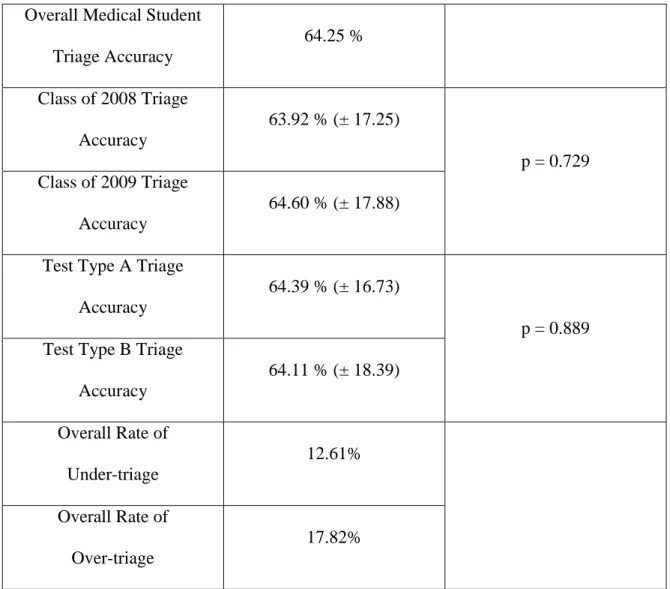
A total of 315 first-year medical students at the University of North Carolina School of Medicine attended the educational session and completed the written triage exercise, 160 students from the class of 2008 and 155 students from the class of 2009. The overall mean accuracy score of triage assignment by medical student volunteers after a brief START triage training session was 64.25%. The mean accuracy score achieved by subjects from the class of 2008 was 63.92% (± 17.25%) compared to a mean accuracy score of 64.60% in participants from the class of 2009 (± 17.88%, two-tailed p = 0.729). Detailed triage performance results are provided in (Table 1).
An additional comparison of test types A and B, differing by the order in which patient ages were assigned to the clinical scenarios, revealed a mean overall accuracy value of 64.39% (± 16.73%) for test type A (n = 161) and a mean accuracy score of 64.11% (± 18.39%) for test type B (n = 154), p = 0.889. The overall rate of under-triage (assigning a less severe triage category than that suggested by the START criteria) was 12.6%. The overall rate of over-triage (assigning a more severe triage category than that suggested by the START criteria) was 17.8%.
Discussion:
The results of this research study show that newly-enrolled first-year medical student volunteers with no formal training in medical school were able to perform
disaster triage assessment with a mean accuracy score of 64.25% on a 15-question written clinical exercise after receiving a brief START training session. This overall triage accuracy score was comparable to that achieved by emergency medical physicians and registered nurses (65% accuracy) and actually better than that achieved by paramedics (59% accuracy) on a 20-question written triage exercise in the 2002 Kilner study.10 Pediatric emergency physicians performed triage on a 55-scenario questionnaire with a mean accuracy score of 53.5% in the Bergeron and Gouin study, while registered nurses scored a mean accuracy of 64.2%.11 The first-year medical students evaluated in our research study performed disaster triage with better accuracy than that seen in certified prehospital EMS providers (41.1% accuracy score) on a similar written exercise.15
suggested by the START criteria) was 17.8%, falling well within the CAEP and ACS recommended target of rates less than 50% of over-triage.22 This value suggests that the study participants avoided drastically overburdening the EMS system with over-triaged patients, but potentially at the cost of allowing serious injuries to go unrecognized and untreated.
Despite being provided with a printed triage decision-making tool detailing the START protocol, students in the class of 2009 did not achieve accuracy values that were significantly better than those of the class of 2008 (two-tailed p value = 0.729). The lack of statistical significance observed in the difference between the two medical school classes may place into question the additional value of printed support materials after an educational intervention has already been provided. Alternatively, differences in pre-existing medical knowledge or ability to perform triage between the two classes may account for the discrepancies in triage accuracy observed.
The lack of a statistically-significant difference in the accuracy values observed in participants completing test type A and those completing test type B may suggest that patient ages in the varying clinical scenarios did not have a substantial effect on the ability of medical student volunteers to correctly triage patients on the clinical
questionnaire. The effect of patient age may potentially have a greater effect on triage performance in real-world situations, as non-medical volunteers may consider older patients to be of more urgency in receiving medical care, while young adults may be assumed to be healthier overall and of lesser severity.
available regarding acceptable levels of accuracy in triage performance or suggested goals for over- and under-triage. Multiple research studies were identified in the focused literature review that addressed the accuracy of physicians, nurses, paramedics, and/or emergency medical technicians in performing triage on written questionnaires or with simulated patient-actors. These previous studies showed that emergency physicians and nurses triaged standardized patient scenarios with an overall mean accuracy of 65%, while paramedics achieved a slightly lower accuracy of 59%.10,11 Other studies have shown that prehospital Emergency Medical Services providers achieved substantially lower levels of accuracy in triage exercises, as low as 32.6% accuracy in the case of non-certified EMS personnel.15
The study results showed that first year medical student volunteers performed triage decisions on a paper-based clinical exercise at a level of performance that was similar to that observed in emergency medicine physicians, registered nurses, and ambulance paramedics. The extent to which scores on triage exercises consisting of written patient scenarios correspond to scores on simulated patients or real-life mass casualty incidents has not been fully evaluated, so the actual clinical performance of medical triage by first-year medical students may vary from these results in real disaster situations. However, the favorable scores seen on the written exercise suggest the
performance by first-year medical students may be considered to be sufficient for use in large-scale disaster situations if the written scores translate to triage performance in the field. Future research should evaluate the link between triage performed on paper-based exercises and triage performed in the field.
In addition, the time limit allowed for the completion of the 15-scenario
questionnaire was only 4 minutes, a much more restrictive test condition than was present in other triage studies in the literature. This time frame gave study participants only about 15 seconds per question in order to simulate the necessity for rapid triage decisions in a disaster situation, and some students were unable to complete the entire triage
questionnaire in the time provided. Clearly, unfinished clinical scenarios on a written questionnaire are representative of unevaluated patients in the field, so this study shows the difficulty experienced by the participants in performing triage under time pressure. However, if given time periods similar to those enforced in other studies, the first year medical students may have performed triage decisions with an even better degree of accuracy.
Several studies identified in the literature review showed that educational training with the START triage system, the pediatric JumpSTART system, or internet modules helped significantly improve the triage accuracy of pre-hospital medical
time in which benefits are maintained from triage educational sessions is unclear, this study supports the effectiveness of providing brief training sessions to volunteers with or without previous triage education.
The lack of statistical significance observed in the difference in triage accuracy between the two medical school classes may place into question the additional value of printed support materials after an educational intervention has already been provided. Although previous studies showed that paper-based triage materials helped markedly improve triage accuracy,25 the results of this study did not show a similar improvement when participants were supplied with START triage cards. One possibility for this finding is that the strict time restraints imposed upon the study participants led to lesser utilization of the decision-support tool in the group provided with START triage cards. A second possible explanation is that students who received a training session prior to completing the triage exercise were able to clearly remember the START criteria and did not need to rely on the printed START card. Alternatively, differences between the two classes in pre-existing medical knowledge or in prior experience with medical triage may potentially account for the differences in triage accuracy observed, although we have no reason to believe that this is so.
Statistical significance was also not observed in the evaluation of the difference in triage accuracy between test type A and test type B. These data suggest that the order of patient ages in the varying clinical scenarios did not have a substantial effect on the ability of medical student volunteers to correctly triage patients on a clinical
evaluation of pediatric patients. The effect of patient age on the perceived severity and triage assignment by non-medically-trained volunteers may potentially have more of an impact in a real-world situation than on a written exercise, so further studies might evaluate the true effects of patient age on triage by utilizing patient-actors in simulated clinical scenarios. Additionally, future studies might focus on the ability of non-medical volunteers to perform triage on pediatric patients or on a mix of pediatric and adult patients to further simulate potential conditions in a disaster scenario.
Strengths and Limitations
One strength of this study was its evaluation of triage decisions made by a specific group of potential disaster volunteers – medical students. The study population of first-year medical students at the University of North Carolina School of Medicine was evaluated on the first day of orientation, so students had yet to receive any training in medical school. This is an eager, hard-working, and easily-trainable population that would likely be very willing to volunteer to help medical professionals in a disaster situation. Triage may be a potential function performed by these student volunteers in large-scale emergency scenarios, so a research study designed to evaluate this particular group may be of great benefit to future disaster preparedness programs across the country and around the world.
medical technicians.10-19 A study by Kilner and Hall was one of the first to the evaluate triage performance of non-medical professionals, investigating the triage decisions of British police firearms officers with little or no medical training beyond basic first-aid.25 The use of a study population of first-year medical students on the first day of medical school orientation captures these individuals before they have received any formal medical school training, most effectively representing educated but non-medical volunteers as a whole.
A second major strength of this study was the strict time limit enforced during the administration of the study questionnaire. While other studies in the literature allowed anywhere from 30 seconds per question to unlimited time for exercise completion,10,11,25 participants in this study were provided with only 4 minutes to complete 15 clinical scenarios, slightly more than 15 seconds per question. As triage decisions in disaster situations must be rapid and accurate, this study more effectively evaluates the triage ability of participants than did studies that provided unlimited, unrealistic time frames for exercise completion. While real-life disaster situations would require additional time for actually assessing patients and obtaining the necessary clinical information, the study results suggest that medical student volunteers were able to perform rapid triage with sufficient accuracy.
82 police officers, 233 physicians, nurses and paramedics,or 311 prehospital EMS providers.10,15,24,25 Secondly, this study evaluated the effect of decision-making tools on triage performance by separately testing one study group with access to START triage cards and one group with no access to reference materials. Previous studies investigating the benefit of decision-support tools tested the same group of study participants with and without printed triage cards or PDA-based triage programs using the same clinical scenarios.25,26 Other studies tested the effectiveness of educational interventions by administering triage exercises immediately before and immediately after training sessions, presenting the potential for recall to affect the results of the second triage questionnaire.23,24,25 Finally, the ability of this study to evaluate the effect of patient age on perceived triage severity was a strength. The triage questionnaire administered was created in two variants, type A and type B, with inverted ranges of patient age values to assess whether medical student volunteers perceived older patients to be of greater severity than younger patients. The lack of a statistically-significant difference in the accuracy scores of test type A and test type B suggest that, at least in the case of a written exercise, patient age did not affect the ability of participants to correctly assign triage levels to clinical scenarios.
One notable limitation of this research study was that biographical information was not collected on the medical student participants prior to administration of the
potentially gaining personal experience in medical triage. Various other educational and clinical activities prior to enrollment in medical school might have played a role in the ability of incoming medical students to perform medical triage decisions. As data on previous medical training and triage experience was not collected, it is more problematic to generalize the results observed in the study group to the total population of first-year medical students across the country or to the overall population of educated but non-medically-trained citizens across the country. Future studies might evaluate other potential confounding variables and obtain biographical data on study participants in order to better assess the external validity of the study results.
Future Research
A direct follow-up study to this research investigation might evaluate the
performance of triage by first-year medical students on simulated clinical scenarios using patient-actors. It is unclear to what extent accuracy scores on written questionnaires translate to scores in simulated or real-life patient scenarios, so the results of a follow-up study may directly address this question. A research evaluation with actual injured patients would clearly be unethical, so the use of simulated patient actors would likely present the best means to evaluate field triage performance in first-year medical student volunteers. Evidence that medical student volunteers are able to rapidly and accurately triage simulated patients in the field would support their potential use as a labor pool for medical triage in a mass casualty incident.
participating in this exercise had yet to receive any classroom or clinical training in medical school. A comparison of triage decisions made by medical students at different stages in their medical training might show marked improvement over the course of medical school or, conversely, may show that increased clinical experience leads to decreased adherence to the START triage protocol and greater reliance on personal clinical experiences and knowledge.
Another potential source of volunteer labor in a disaster situation is the vast pool of graduate and undergraduate students in college and university settings across the country. While this particular research study tested newly-enrolled medical students, similar studies in the future might examine the ability of students in various graduate-level programs, such as law, business, public health, pharmacy, et cetera, or in
undergraduate-level programs to perform medical triage after receiving a brief training session. If these students were found to perform adequately on triage questionnaires and/or simulated patient scenarios, they may represent an enormous potential resource in the event of a major disaster or mass casualty incident. Future research studies might also evaluate other pools of potentially capable volunteers in disaster situations. While one previous study evaluated the triage decisions made by police firearms officers,25 other research might address the triage performance of adult professionals in other fields, such as business, law, education, public health, engineering, etc.
Additionally, methods of maintaining and rapidly accessing the pool of potential volunteer labor in disaster events must be developed and studied, as the Incident
Command System must be able to access these resources for them to be of overall benefit in an emergency response.
In addition to performing field triage in large-scale disaster scenarios, the results of this study suggest that medical student volunteers may potentially be of use in
performing triage in other non-crisis situations. Typical primary care clinics are currently overwhelmed with the volume of patient phone calls to medical offices, requiring clinics to hire registered nurses specifically to answer phones and perform triage decisions over the phone. It is possible that medical students or other graduate students could be trained in a variant of the START triage protocol adapted for primary care settings and could work in telephone triage, freeing up the nation’s limited pool of registered nurses for actual patient care. Medical students at various stages in their medical training might also be utilized to initially triage routine cases presenting in emergency room fast-track environments or urgent care settings. While further research would clearly be necessary before any procedural changes in emergency department triage could occur, the results of this study highlight the potential for more efficient utilization of medical resources around the country.
Legal issues surrounding the use of non-medically-trained volunteers are of particular importance in relation to disaster situations. The liability of these volunteers in a mass casualty incident might present substantial controversy, as questions arise
volunteers with no formal medical training, and hospital or physician malpractice insurance coverage would not apply to non-medically-trained or non-employed
volunteers. Further investigation and policy clarifications would help determine whether the so-called ―Good Samaritan Law‖ would apply to volunteers in such a disaster
situation.
Global Health Implications
In addition to their application to mass casualty incidents across the United States, the results of this research study may hold great importance in regards to the use of non-medical volunteers in disaster situations in the developing world. Large scale events may overwhelm even the largest, most prepared emergency medical systems in the developed world, but the potential burden placed by natural and man-made disasters on the limited medical resources of developing nations is completely overwhelming. In regions around the globe where there are very few medical providers per capita, health systems may be forced to utilize any and all potential workers in crisis situations.
0.20 per 1000 in Myanmar, 0.21 per 1000 in Mozambique, and 0.23 per 1000 in Sierra Leone. A map detailing the imbalance in the global distribution of health workers is provided in Figure 2.
In addition to poor overall supplies of physicians and nurses, there are extreme imbalances in the urban/rural distribution of global medical resources caused by the high concentration of medical providers living in urban areas. In Cambodia, 85% of the national population lives in rural areas, but only 13% of government health workers live in these rural regions. Another striking example of the urban/rural imbalance in medical resources is Nepal, where only 20% of rural physician posts are filled.32 Inadequate pay and benefits, combined with poor working conditions in the developing world, tend to drive trained medical personnel to urban areas or to more developed countries with higher wages.
The World Health Organization estimates that there are 59.8 million health workers worldwide, without whom prevention and treatment of disease cannot reach those in need.33 Fifty-seven countries, primarily in Africa and Southeast Asia, have been classified by the WHO as facing severe health workforce crises. The WHO estimates that at least 2,360,000 health service providers are needed around the globe to correct these workforce shortages and fill the existing gap in medical care. Sub-Saharan Africa faces the greatest health workforce challenges – it contains 11 percent of the world's population and 24 percent of the global burden of disease, but has only 3 percent of the world's health workers.33
resources are overwhelmed by the number of incoming patients seeking medical attention. In the event of a large-scale disaster situation, such pronounced medical
workforce shortages could lead to terrible consequences. The World Health Organization has suggested that each country establish a comprehensive preparedness plan for a
workforce response to outbreaks and emergencies.33 However, with such limited medical resources and shortages in available medical providers, developing countries must look for ways to involve non-medical personnel in these disaster response plans to maximize the efficiency of human resources. This may include collaboration between health
workers and personnel in the military, transport and education sectors, or may involve the recruitment of citizen volunteers in the event of a crisis situation.
Figure 2: World Distribution of Health Workers
Source: The world health report 2006 – Working together for health. Geneva, World Health
Very little research has been performed in the developing world in relation to disaster preparedness or in the performance of medical triage. One notable study by Tamburlini evaluated the triage performance of nurses in rural Brazil using a simplified triage algorithm developed by the World Health Organization.30 This system, named the Emergency Triage Assessment and Treatment (ETAT) algorithm, was found to perform well as a triage prioritization tool and as a guide to emergency treatment for nurses in a pediatric hospital setting. Further studies might test the performance of this simplified ETAT triage algorithm in other parts of the developing world and in multiple different languages, seeking to determine the applicability of this tool to disaster situations across the globe.
Conclusions:
The results of this study showed that newly-enrolled first-year medical students who received a brief START triage educational session performed triage assessments on a 15-question written exercise with a mean accuracy score of 64.25%, a value
Table 1: Medical Student Triage Performance Results
Overall Medical Student Triage Accuracy
64.25 %
Class of 2008 Triage Accuracy
63.92 % (± 17.25)
p = 0.729 Class of 2009 Triage
Accuracy
64.60 % (± 17.88)
Test Type A Triage Accuracy
64.39 % (± 16.73)
p = 0.889 Test Type B Triage
Accuracy
64.11 % (± 18.39)
Overall Rate of Under-triage
12.61%
Overall Rate of Over-triage
References
1
"Disaster." Dictionary.com Unabridged (v 1.1). Random House, Inc. Last Accessed June 01, 2007. Available online at: http://dictionary.reference.com/browse/disaster.
2
Goolsby C. Disaster Planning. eMedicine. May 25, 2006. Available online at: http://www.emedicine.com/emerg/topic718.htm.
3
Newton S. Orange County Emergency Management: Guide to Initial Response, Scene Management, and Victim Care in a Mass Casualty Incident. June 26, 2003.
4
Waeckerle JF. Disaster Planning and Response. New England Journal of Medicine. 1991;324:815-821
5
Greaves I, Dyer P, Porter K. Handbook of Immediate Care. London: WB Saunders, 1995.
6
"Triage." The American Heritage® Dictionary of the English Language, Fourth Edition. Houghton Mifflin Company, 2004. Last accessed June 01, 2007. Available online at: http://dictionary.reference.com/browse/triage.
7
Derlet R. Triage. eMedicine, August 8, 2006. Available at: http://www.emedicine.com/emerg/topic670.htm
8
Garner A, Lee A, Harrison K, Schultz C. Comparative Analysis of Multiple-Casualty Incident Triage Algorithms. Annals of Emergency Medicine. 2001;38:541-548.
9
Kennedy K, Aghababian RV, Gans L, et al. Triage: Techniques and Applications in Decision-making. Annals of Emergency Medicine. 1996;28:136–44.
10
Kilner T. Triage Decisions of Prehospital Emergency Health Care Providers, Using a Multiple Casualty Scenario Paper Exercise. Emergency Medial Journal. 2002
Jul;19(4):348-53.
11
Bergeron S, Gouin S, Bailey B, Patel H. Comparison of Triage Assessments Among Pediatric Registered Nurses and Pediatric Emergency Physicians. Academic Emergency Medicine. 2002 Dec;9(12):1397-401
12
13
Goransson KE. Emergency Department Triage: Is There a Link Between Nurses’ Personal Characteristics and Accuracy in Triage Decisions? Accid Emerg Nurs. 2006 Apr;14(2)83-8.
14
Considine J. The Australasian Triage Scale: Examining Emergency Department Nurses’ Performance Using Computer and Paper Scenarios. Annals of Emergency Medicine. 2004 Nov;44(5):516-23.
15
Billittier AJ, Lerner EB, Moscati RM. Triage, Transportation, and Destination
Decisions by Out-of-hospital Emergency Care Providers. Prehospital Disaster Medicine. 1998 Apr-Dec;13(2-4):22-7.
16
Richards JR. Triage Ability of Emergency Medical Services Providers and Patient Disposition: a Prospective Study. Prehospital Disaster Medicine. 1999
Jul-Sep;14(3):174-9.
17
Schenker JD, Goldstein S, et al. Triage Accuracy at a Multiple Casualty Incident Disaster Drill: the Emergency Medical Service, Fire Department of New York City Experience. Journal Burn Care Res. 2006 Sep-Oct;27(5):570-5.
18
Schmidt T, Atcheson R, Federiuk C, et al. Evaluation of Protocols Allowing Emergency Medical Technicians to Determine Need for Treatment and Transport. Academic Emergency Medine. 2007 Jun;7(6):663-9.
19
Hauswald M. Can Paramedics Safely Decide which Patients do not Need Ambulance Transport or Emergency Department Care? Prehospital Emergency Care. 2002 Oct-Dec;6(4):383-6.
20
Pointer JE. Can Paramedics Using Guidelines Accurately Triage Patients? Annals of Emergency Medicine. 2001 Sep;38(3):268-77.
21
Wesson DE, Scorpio R. Field Triage—Help or Hindrance? Canadian Journal of Surgery. 1992;35:19–21.
22
American College of Surgeons Committee on Trauma. Resources for Optimal Care of the Injured Patient: 2006. Available online at:
https://web2.facs.org/timssnet464/acspub/frontpage.cfm?product_class=trauma
23
Risavi BL, Salen PN, Heller MB. A Two-hour Intervention Using START Improves Prehospital Triage of Mass Casualty Incidents. Prehospital Emergency Care. 2001 Apr-Jun;5(2):197-9
24
25
Kilner T, Hall FJ. Triage Decisions of United Kingdom Police Firearms Officers Using a Multiple-casualty Scenario Paper Exercise. Prehospital Disaster Medicine. 2005 Jan-Feb;20(1):40-6.
26
Schell CL, Wohl R, Rathe R, Schell WJ. Automated vs. Manual Triage for Bioterrorist Disaster: A Blinded Crossover Feasibility Study Comparing Personal Digital Assistant to Paper-based Triage. American Journal of Emergency Medicine. 2006 Nov;24(7):843-6.
27
Sadeghi S et al. A Bayesian Model for Triage Decision Support. Int J Med Inform. 2006 May;75(5):403-11.
28
Baez AA, Sztajnkrycer MD, et al. Effectiveness of a Simple Internet-based Disaster Triage Educational Tool Directed Toward Latin-American EMS Providers. Prehospital Emergency Care. 2005 Apr-Jun;9(2):227-30.
29
Simpson DM. Non-institutional Sources of Assistance Following a Disaster: Potential Triage and Treatment Capabilities of Neighborhood-based Preparedness Organizations. Prehospital Disaster Medicine. 2000 Oct-Dec;15(4):199-206.
30
Tamburlini G. Evaluation of Guidelines for Emergency Triage Assessment and Treatment in Developing Countries. Arch Dis Child. 1999 Dec;81(6):478-82.
31
World Health Organization. WHO Statistical Information System (WHOSIS). Core Health Indicators, 2006. Available online at:
www.who.int/whosis/database/core/core_select_process.cfm
32
World Health Organization. The World Health Report 2000. Health Systems: Improving Performance.
33
World Health Organization. The Global Shortage of Health Workers and its Impact. Media Centre Factsheet No 302, April 2006.