pages. Advisor: Arcot Rajasekar and Reagan Moore
A Policy Domain is a concept introduced by Ward, Xu, Conway, et al. It describes a bridge between the low-level model of a Policy Enforcement Point in iRODS and a high-level representation of an event where policies may be applied. This proposal describes a project to concretely define and implement a policy domain as applied to a portion of the OAIS Reference Model, showing the properties of a policy domain, and pointing towards a general mechanism for creating well defined policy sets, metadata, and constraints appropriate for a domain. This provides a flexible and powerful enhancement to the successful policy management approach of iRODS, and points to new methods of composing policy-managed systems.
Headings:
Digital Preservation Data Curation
Information Resources Management Software Archives – Security Measures
by
Michael C. Conway
A Master’s paper submitted to the faculty of the School of Information and Library Science of the University of North Carolina at Chapel Hill
in partial fulfillment of the requirements for the degree of Master of Science in
Information Science.
Chapel Hill, North Carolina November, 2017
Approved by
1.
Table of Contents
1. Introduction ... 2
1.1. iRODS and Policy-Driven Data Management ... 2
1.2. Trusted Digital Preservation ... 6
1.3. iRODS as a Platform for Trusted Preservation ... 12
2. Policy Domains Design and Implementation ... 19
2.1. Design Forces and Considerations ... 19
2.2. State Machines ... 24
2.3. State Machines and Knowledge Encapsulation in Preservation Environments ... 26
3. Policy Domain Implementation ... 32
3.1. Software Components of a Prototype Policy Domain System ... 34
3.1.1. Python Rule Engine ... 34
3.1.1. Region Processing with AMQP ... 36
3.1.2. Message Bus and Event Translation ... 37
3.1.3. State Machine Implementation ... 40
3.1.4. High-Level Policy Enforcement Point Callbacks ... 42
3.1.5. Policy Functions ... 42
4. Evaluation ... 46
5. Discussion ... 52
6. Bibliography ... 60
7. Appendix I – Refactored Table 2.2 from Trustworthy Policies for Digital Repositories ... 64
1.
Introduction
1.1.
iRODS and Policy-Driven Data Management
iRODS is the “Integrated Rule-Oriented Data System” (iRODS 2016). This unique platform provides an abstraction of underlying storage technology accessible through a global logical name-space, a catalog that captures both system and user provided
metadata, and a rule engine that can apply management policies triggered by events that occur in the grid. These event-triggered policies are termed policy enforcement points (Xu et al. 2017). Rules in iRODS can be composed of microservices, which are
specialized components that encode a capability. The actions of rules and microservices alter the state of the data management environment. This state can be audited and
evaluated in order to ascertain that policies are being appropriately enforced. This creates a complete, verifiable policy management environment. Policy domains are introduced in this project as a method of organizing these elements. Policy domains are a formalization of these interlinked elements, serving to encapsulate and unify policies and metadata as applied to a particular context. The policy domain encapsulates knowledge about how data is managed. Knowledge encapsulated in the policies (rules), capabilities
(microservices), and state (metadata), applied for a particular purpose is the essence of a policy domain.
for a collection, representing “a consensus of the persons collaborating on a data
Figure 1. Reproduction of Figure 8 in Moore et al. - Policy Based Data Management
Concept Graph (Moore et al. 2015)
A policy domain is somewhat akin to a “class” in object-oriented design, acting as a template for representing the data and responsibilities of a certain abstract or concrete “thing”. A class can be instantiated and utilized to carry out a particular task, or fulfill a certain purpose. A policy domain can also be thought of as an “archetype” as described by Beale. An archetype is a higher level of abstraction, a “model defining some domain concept, expressed using constraints on instance structures of an underlying reference model” (Beale, 2002).
policy domains have characteristics that can be leveraged to produce a trustworthy and verifiable digital preservation environment.
1.2.
Trusted Digital Preservation
Digital preservation is a long-studied area of information science. Recent efforts have focused on the specification and development of systems to preserve digital information with an assurance of trust. Rosenthal noted that “digital preservation systems have a simple goal, that the information they contain remain accessible to users over a long period of time” (Rosenthal et al. 2005). Rosenthal described many threats to digital data including hardware and software failure and obsolescence, as well as a variety of human and system level errors. Preservation systems must provide capabilities to counter a variety of threats. Beyond mere preservation of data streams, Hedstrom focused on the need to preserve the significant properties of digital objects so that they may be
understood and utilized by a community of interest. This includes descriptive data as well as data that expresses the structure of a digital object composed of multiple data streams (Hedstrom et al. 2002). Chowdury (2010) distinguished between passive and active management, noting digital preservation systems must proactively manage the data streams, and must actively keep them accessible. Simple replication and backup were seen as an insufficient approach. Beagrie (2008) stressed the importance of active management, pointing out that this distinguishes digital preservation environments from “digital mortuaries”.
policies, and through the preservation of metadata and state information that prove that the digital objects are what they claim to be. Duranti went on to say that digital
preservation solutions, “many of which center on migration and emulation, are unrealistic and focus too heavily on narrow aspects of the problem: they are the kinds of solutions that we have described previously as artisan” (Duranti 1995). In order to be flexible and generalizable, solutions must consider many focus areas and take a comprehensive view of the full lifecycle of digital objects as well as the full range of functional requirements implied by the goal of long term digital preservation with reliability and authenticity.
Innocenti et al (2011) pointed out that “in order for digital curation to be continuous, scalable, interoperable, dynamic and automated, one of the key points would be to
substantially improve the ways we describe, represent and manage the objects themselves and their context”. Moore points out that the context is not only embodied in the data streams and metadata in an archive, it is also embodied in the policies that manage data themselves. Systems that can describe policies in computer actionable rules are thus capturing and representing knowledge. Other methods of representing knowledge in an archive include provenance and descriptive metadata, information describing workflows applied to data objects, and microservices that interact with external data sources (Moore 2013). Policy domains are a refinement and organization of these forms of knowledge embodied in a preservation system, applying constraints on the application of this
Efforts in the 1990’s in the area of digital preservation focused on standards for describing digital preservation systems (CCSDS 2002). A significant effort was undertaken by the U.S. National Aeronautics and Space Administration to deal with valuable space data. This effort resulted in the formation of the Consultative Committee for Space Data Systems (CCSDS) and the eventual development of the Open Archival Information Systems (OAIS) model of a digital preservation environment, an ISO standard. Lee et al. (2007) stressed that the OAIS is actually a reference model, and is thus implementation independent. A detailed specification of how to implement a digital preservation environment is not provided in OAIS.
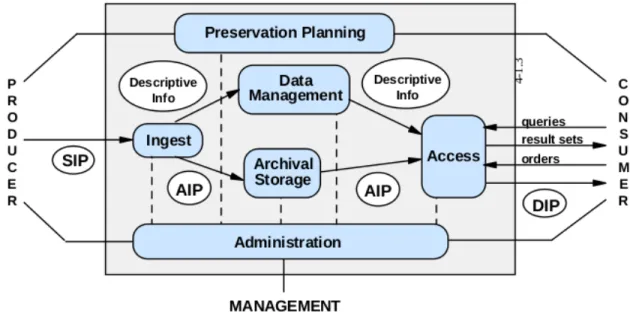
OAIS describes a system that carries out several archival functions, including:
• Ingest
• Archival storage
• Data management
• Access
• Dissemination
In OAIS, the ingest -> archival storage -> dissemination data flow maps onto different models of information object at each state. These are, respectively, the SIP (Submission Information Package), the AIP (Archival Information Package), and the DIP
(Dissemination Information Package). The various functional entities in OAIS are related in the following figure from the reference model (CCDS 2002).
Figure 2. From Consultative Committee for Space Data Systems / Reference Model for
an Open Archival Information System (CCSDS 2002)
At each of the points in the main data flow, OAIS highlights roles and responsibilities. For ingest, key responsibilities include validation and verification, data formatting, and production of an information object suitable for preservation. For archival storage, preservation actions like format migration, failure detection and prevention, and other periodic preservation actions are indicated. For access or dissemination, this can include various access controls, and production of information objects in response to consumer requests, often in a form tailored to the nature of the request. These roles, as well as the responsibilities of the management functions, provide guidance on the nature of policies that would characterize a compliant preservation environment.
Beyond the functional description of digital archives, there is a large body of research in defining and measuring trustworthiness. Research Libraries Group and Online Computer Library Center took the OAIS Reference Implementation as a starting point to investigate trustworthiness. Emphasis was placed on the processes required to audit and certify trustworthiness (Beagrie et al. 2002). The Research Libraries Group stressed the long-term viability of digital objects, methodologies for evaluation of a repository, and
auditable and measurable policies to carry out the diverse responsibilities necessary. The Research Libraries Group defined a wide array of organizational and technical
Moore (2008), in his “Theory of Digital Preservation” took a holistic view of
trustworthiness. He described microservices in the iRODS system as the “minimal set of preservation functions”. These preservation functions are combined through rules to describe a “self-consistent” set of capabilities. In this model, these capabilities are automated as reactive processes or through periodic invocation. The effects of these operations must be recorded as state or metadata. Assessment criteria can then be developed to make assertions against this recorded state, yielding a trusted system. This idea was amplified by Smith and Moore who mapped recorded preservation state in an archive against the PREMIS standard, noting that a complete mapping of preservation state to an appropriate community assessment standard creates a “closed system”. Smith and Moore noted “when the system is closed, that is, an assessment criterion has been defined for each preservation metadata attribute, and a set of preservation metadata exists for each assessment criterion, one can expect the system to provide self-consistent
preservation management. We believe this methodology can ultimately lead to
implementations of preservation environments that are provably self-consistent” (Smith Moore 2008). Downs and Giaretta identified elements of trusted repositories that map neatly onto Smith and Moore’s model. They identified workflows to carry out the requirements of the preservation environment, synonymous with Smith and Moore’s focus on rules and capabilities. They also introduce the concept of assessment, though not directly linked to recorded state metadata (Downs et al. 2014).
These efforts have culminated in the ISO 16363, the Audit and Certification of Trustworthy Digital Repositories standard, a formalization of the TRAC standard
presents a set of criteria that, when subjected to a successful audit, will certify a
repository as trustworthy (Rodrigues et al. 2014). Rodrigues et al. carried out an audit of twenty-six repositories using ISO 16363, on a 1-5 scale of maturity, and found a general level of maturity that was around the “3.0” level, indicating a “formative” or “in
implementation” status. It appears that this area presents an opportunity for advancement.
1.3.
iRODS as a Platform for Trusted Preservation
Before delving into the details of this project, it is important to understand policy based data management in the iRODS system. iRODS is a mature open source data grid that carries out four main functions (iRODS 2016). These are data virtualization, data discovery, workflow automation, and secure collaboration. The qualities of iRODS provide necessary technical capabilities that fulfill many basic needs of a digital preservation environment. Data virtualization means that the underlying storage
of rules through policy enforcement points is a key iRODS feature that this project aims to extend.
iRODS has its roots in digital preservation, given the long-standing relationship between iRODS and the U.S. National Archives and Records Administration. However, it is important to note that the notion of policy is broadly applicable. A good deal of emphasis in the past few years has been on the role of policy in managing scientific data, especially for reproducible research (Moore Rajasekar 2014). This is a useful reminder that, even though the emphasis in this project is digital preservation, the proposed policy domain mechanisms can organize and apply policy for many purposes. This notion of the link between purpose and policy is highlighted by Moore, Rajasekar, and Wan (2010), who stressed that “the decision to preserve data is typically driven by an over-riding purpose that determines the properties that the records should possess”.
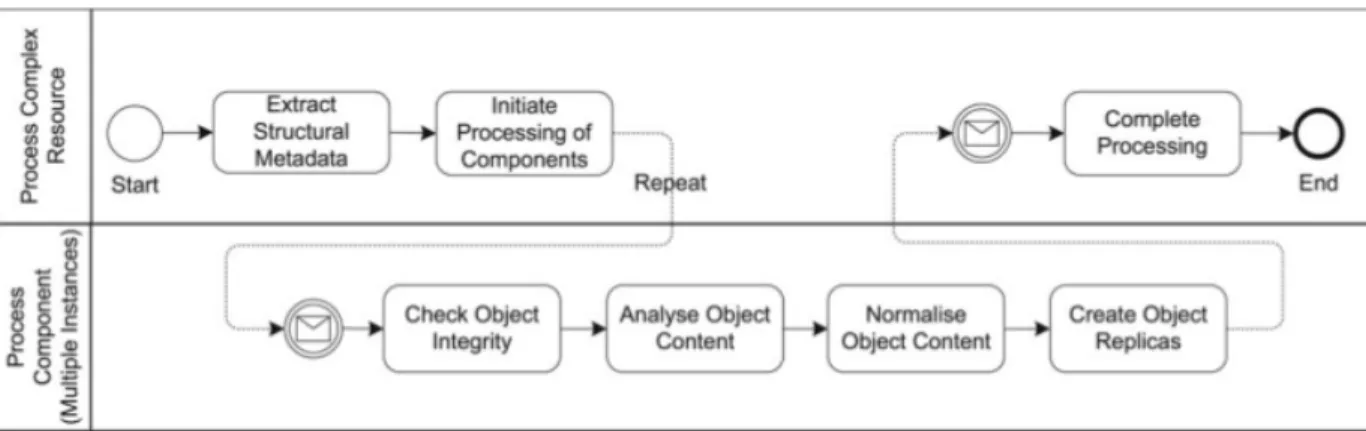
Figure 3. From M. Hedges et al. (2008) / Future Generation Computer Systems
CeRich ingest included integrity and verification checks, as well as preservation actions, like transforming file formats to a preservation-ready standard. The implementation used iRODS rules with conditions, so that multiple rules that responded to the same policy enforcement point could be defined for different purposes, and so that condition checking would fire the proper rule for the appropriate abstract phase of the preservation workflow. Hedges found that event-based triggering of policies encoded as rules was a successful strategy in prototype, but noted that a production implementation would encounter a higher level of complexity that would require a great deal of effort. Hedges noted the difficulties involved in binding their system to the policy enforcement points, which presented some level of impedance mismatch. In addition, achieving consistency was a barrier. Hedges noted “there is no automated way of checking the rule base, so
iRODS has been used as the basis for a formal effort to define policies that automate much of the ISO 16363 standard. This effort by Moore et al. (2017) identified in great detail the policies, metadata, and assessment criteria needed to certify a repository as trusted under the ISO 16363 standard. This review specified metadata values to capture preservation state, defined micro-services that encapsulated necessary preservation capabilities, and defined reporting and audit information that could be used to produce a certification of trustworthiness. The key components of Moore et al. were:
• Management documents in compliance with the standard
• Repository parameters and global variables
• Metadata attributes to capture preservation state
• Audit mechanisms (for assessment)
• Policies to manage data
There raw materials map neatly onto the preservation capabilities, state, and assessment criteria in the “Theory of Digital Preservation”. The central question of this project is the manner in which the relationship between the policies and the state reflecting the actions of those policies are linked, and whether there are intrinsic mechanisms that are missing in the underlying technology that can more explicitly describe the preservation state and the policies that manage that state.
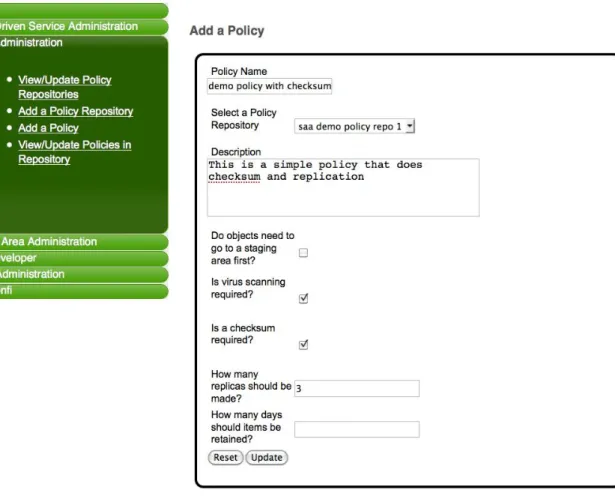
policy in rules written in one of the supported iRODS rule languages (iRODS 2017). These rules contain conditions that determine when they should run, and are configured in server configuration files. The current practice has been to utilize conditions and the ability to specify multiple rule implementations for a policy enforcement point so that non-necessary rules will fail and yield to other rules until a rule successfully fires. Conway et al. (2011) experimented with an approach for dynamic policy binding and resolution to create a more user friendly, accessible form, allowing a curator to
Figure 4. Arch Interface (Conway, Ward, de Torcy 2011)
Preservation capabilities in microservices were mapped through metadata to higher level abstractions. These human readable capabilities could be stored in a preservation
limited to a particular part of the OAIS data flow, ingest of a SIP in a staging area. This was a limitation of the Arch model, as the authors noted:
An important conceptual exercise to further define a bridge between high-level policy and computer-actionable rules within iRODS would be a mapping of events in an archive to the policies that pertain to that particular event at an abstract level. This will be most important in any elaboration of a “policy resolution” component that recognizes such an event, resolves the applicable policy, and applies the policy at the correct time within iRODS...Limiting the prototype to a subset of the ingest process allowed us to proceed in development, but the lack of such conceptual event mapping is a significant limitation to creating a generalizable solution (Conway et al. 2011).
Arch suffered from an inability to recognize the semantic meaning of a low-level storage event. Mapping high-level abstractions onto low-level policy enforcement points created a brittle system, where the knowledge about the meaning of a low-level storage event, such as the creation of a file, was encoded within the rule conditions. This is particularly hard to manage as complexity increases.
The introduction of a state machine brings formalism into the heart of the design. A state machine not only defines a consistent structure for preservation metadata, it also
constrains the preservation metadata to a certain set of possible states. Measuring the state of a data object and making assertions about the conformity of the preservation environment is thus greatly simplified. The authors noted “Our approach makes the assessment of the preservation state of the archive amenable to formal, automated validation via state transition events metadata” (Ward Xu Conway 2013). This project applies these insights and general principles and attempts to synthesize these ideas of trusted digital preservations into an operating system that can be practically developed and deployed as a software package. The design process begins with a discussion of the elements and principles applied in the system design, and the discussion continues with an outline of the actual implementation.
2.
Policy Domains Design and Implementation
2.1.
Design Forces and Considerations
Arch, and the subsequent response to Arch in Ward, Xu, Conway et al. are the genesis of this idea of state machines employed in a configurable policy domain. The system allows curators to apply dynamically applied high-level policies in a manner that allows
assessment and validation of the preservation environment. This assessment enables audit and certification as a trusted environment in the manner of ISO 16363.
emphasis on rules and actions that occur close to data sources and are automatically applied regardless of access methods. The fact that iRODS focuses on providing appropriate policy enforcement points that are triggered regardless of the access
method while remaining neutral to how each site utilizes these policy enforcement
points may be the key to its success, and this approach is thus adopted as a central
design tenet of policy domains.
A key force in the design is the recognition of the diversity of problems that can be viewed with a policy-based data perspective. Records Information Management (RIM) and archival administration ask key questions that can orient a policy domains approach to digital preservation based on purposes that drive digital curation, including
“determining what the information is, where it came from, how it was used, when it was created, who created it, and who benefits from it” (Cohen 2016). Aspects of policy-based data management have been identified in industry and academic research. For example, Information Lifecycle Management (ILM) has been a topic of research in enterprise data systems. ILM is concerned with “assigning a time-dependent value to information to facilitate storing the information according to its value, and deleting it at the appropriate time” (Al-Fedaghi 2013). It could be argued that ILM and RIM, are actually specific instances of policy-based data management, and each is colored by the purpose of the respective data collections.
The management of scientific research data has been recognized as a significant
environments and research data management systems. This is especially seen in the National Science Foundation’s “Cyberinfrastructure Vision for 21st Century Discovery” which calls for management of research data so that it is “openly accessible while suitably protected, and are reliably preserved” (Bement 2007). The DataNet Federation Consortium explicitly linked the stages of the research data lifecycle to data management policies at each stage, as illustrated by this figure (DataNet Federation Consortium 2017):
Figure 5 from DFC Community-based Collections Lifecycle
The common thread through these varied data management approaches is that they can be addressed through policy-based data management. A key force on the design of policy domains is that it must be flexible enough and complete enough to serve a wide
range of domains beyond trusted digital preservation. Maintaining a focus on a
incumbent on implementers to provide the policies and define the relationship of their management policies to the events that can trigger them as well as to the metadata that represents the result of the application of these policies. Policy domains do not replace the current mechanisms of iRODS, they must define the relationships between
policies and the key properties managed by these policies.
iRODS has evolved into a platform with a multi-faceted plug-in architecture. Rule engines, microservices, authentication services, and even the iRODS network protocol have been transformed into pluggable components. Policy sets have been offered as a way to provide pre-configured sets of policies for particular domains in a way that they can be shared among groups. A complexity of policy sets is that they may require a number of different components addressing different types of plug-ins along with
external software tools and frameworks. Pulling together components and capabilities of various types and tying them together as a coherent package is thus a key
requirement of a policy domains system, essentially defining the components of a
policy set and their packaging and installation.
The focus of policy domains is on the rules and policy enforcement points presented by iRODS. Policy enforcement points can be likened to aspects in aspect-oriented
method or procedure. Examples include data transformation, logging, alteration of invocation parameters or results, or application of authorization for actions. In this example from the iRODS Rule Language reference, a policy is applied in response to a put operation that ingests data into an iRODS grid. The following rule, from the iRODS rule language documentation, creates a copy of any new object with a new name as a response to a put operation (iRODS 2017).
acPostProcForPut {
on($objPath like "*.txt") {
msiDataObjCopy($objPath,"$objPath.copy");
} }
These types of policy enforcement points were sufficient to develop and enforce policies that could encompass the ISO 16363 standard in Moore’s “Trustworthy policies for distributed repositories” (Moore et al. 2017). As in Arch, the policies produced by Moore required the maintenance of sophisticated preservation metadata generated by the
application of these policies in order to support validation and assessment of the effect of these policies. and to control and orchestrate the proper application of these policies. In order to provide a trusted repository environment that complies with ISO 16363, one can apply Moore’s Theory of Digital Preservation and devise assessment criteria that can be used to certify trustworthiness.
elements it is necessary to discuss state machines and how they help order and regulate the various policies and metadata in a domain.
2.2.
State Machines
State machines are an abstraction allowing the encoding of an algorithm or workflow. State machines provide structure and rigor to the functioning of a system. A simple definition of a state machine is provided by Shead, who observed that “a state machine will read a series of inputs. When it reads an input, it will switch to a different state. Each state specifies which state to switch for a given input” (Shead 2011). A state machine functions as mechanism for transduction of a stream of inputs to a stream of outputs. The transduction involves an ordering and constraining of the inputs to a stream of outputs (Kaelbling 2011). This transduction function can be utilized to interpret low-level policy enforcement points as high-level abstract events to which policy domain capabilities can be attached. This transduction function occurs over time. Schneider notes that the outputs of a state machine are “completely determined by the sequence of events it processes, independent of time and any other activity in a system” (Schneider 2017). Policy domains operate on top of finite state machines. The National Institute of Standards and
• A set of delineated states. These states are described in a particular policy domain as a plug-in to the transduction function.
• A set of inputs. This is termed an input vocabulary by the author. In policy domains, this vocabulary consists of the low-level policy enforcement point, directly triggered event, or timed event that will be interpreted by the transduction function.
• A set of outputs. This is termed the output vocabulary. The primary manifestation is the high-level policy enforcement point that is triggered, along with the context that is provided to the triggered high-level policy enforcement point.
• A next state function. This is the function that “maps the input at time t and the state at time t to the output at time t”. This is the function that decides on the proper transition to take given the input vocabulary and the current state at t.
• An output function that will result in an action at the state transition. In policy domains that results in the invocation of a high-level policy enforcement point in iRODS.
There are two primary types of finite state machines. These are deterministic and nondeterministic state machines. Deterministic state machines have only a single
State machines provide an enforceable ordering to the flow of a data object in a
preservation environment. An AIP cannot be ingested into archival storage before it has been properly assembled and validated. A SIP cannot be processed before it is checked for viruses. The advantage of a state machine was recognized in response to the
requirements of Arch. What follows is a discussion of how state machines enhance and order a preservation environment when we consider the role of state machines in maintaining the various forms of knowledge encapsulated in a policy-managed preservation environment.
2.3.
State Machines and Knowledge Encapsulation in Preservation
Environments
In Trustworthy Policies for Distributed Repositories, Moore developed an
implementation of the ISO 16363 standards for audit and certification of trustworthy repositories. This implementation consisted of preservation capabilities (microservices), policies (rules), and associated preservation metadata and audit logs that could be validated via assessment criteria to arrive at a certification of trustworthiness (Moore et al. 2017). Moore describes these components in his implementations as forms of
knowledge, in four classes. We can consider each of these forms of knowledge and how the application of policy domain concepts can result in a refactored, rigorous design.
The segmentation of a policy domain into specific areas creates what are termed regions. This provides a coarse-grained segregation of low-level events into general categories and provides boundaries between areas of a policy domain which can be controlled by role. This enhances the ability of a policy domain to interpret a low-level storage event in a domain, producing an event that can be sent into the state machine to trigger
appropriate transitions. This device is somewhat analogous to a system of hierarchical states, where each region has well defined entry and exit points, encouraging a
partitioning of data objects and metadata and reducing the information leakage between policies responsible for these regions.
The second form of knowledge in Moore are the “dynamic properties that define
information about each archived record”. This translates to iRODS Attribute-Value-Unit (AVU) metadata. The introduction of policy domains has a significant impact on this form of knowledge. This project focuses on the dynamic metadata values enumerated in Table 2.2 in Trustworthy Policies. These metadata correlate with the ingest and archival storage responsibilities in the OAIS Reference Model. Using the notion of policy
domains as state machines, we can refactor these metadata and express them in the form of a state machine. Metadata that can be expressed in the policy domain state machine design are called intrinsic metadata. Some of the metadata values defined in 2.2 remain in the policy domains arrangement as preservation metadata that may be managed by
machine to refactor several variables from Table 2.2. The distinction between intrinsic and automatic metadata is worthy of a more detailed exploration.
As an example of intrinsic metadata, we can consider the various flags that denote required checks. Examples include Archive-CheckIntegrity, Archive-CheckMetadata, and Archive-CheckProtected. These flags represent knowledge about the policies active in a preservation environment. Refactoring these flags into state transitions and
accompanying actions provides an encapsulation of the same knowledge. Each of these actions, checking integrity of an archive, checking for required metadata, and checking for protected data, can be depicted as actions fired by state transitions. The actions that occur at these state transitions, as we will see, result in the invocation of high-level policy enforcement points that can either invoke preservation capabilities appropriate to that repository, or can simply provide a noop pass-through to the next state.
The third form of knowledge are the policies themselves. These policies are intimately connected to the dynamic preservation metadata they maintain. In addition to providing a translation of these intrinsic metadata, the policy domain makes explicit the relationship of intrinsic metadata to the services that maintain these metadata. A policy domain maintains this intrinsic metadata via a well-defined pipeline, introducing ordering and prerequisites. A policy domain, by specifying the inputs and outputs at each policy enforcement point, encapsulates information about the knowledge required at each point. This encoding of the meaning of intrinsic metadata describing the archival workflow is a novel feature of policy domains.
The fourth form of knowledge described by Moore are policy functions. Which are small units that can be described as utilities or focused capabilities that can be utilized by various policies. These small capabilities can be reimagined in policy domains as representing additional packages, functions, and libraries. While not in the scope of this project, it is certainly possible to take the further step of encapsulating preservation capabilities in the form of virtual machines or containers, and deploying these capabilities as part of the policy domain, easing installation and operational concerns, while allowing the possibility to preserve these capabilities in the environment itself. Given this
complete capture of scope, and a preservation of the original arrangement of the deposited SIP, it could also be possible to replay an archival workflow as a validation step, or even as an error correction capability.
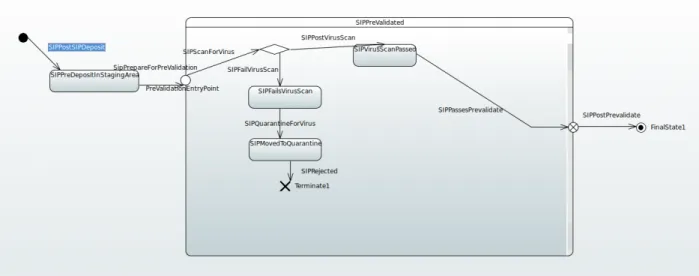
This discussion of knowledge can be illustrated by exploring the intrinsic and automatic metadata embodied in this segment of an ingest process.
This example demonstrates a scenario suggested by portions of the Table 2.2 for ingest. The overall flow, from right to left, depicts the deposit of material to the landing zone in the Ingest area of OAIS. What we see is an initial state where an event, such as an upload, causing a transition SIPPostSIPDeposit. This transition will fire an action in the state machine that are surfaced as a high-level policy enforcement point carrying with it the context data associated with this event. This hook would allow a curator to encode their own pre-checks or external actions that result in a transition to the
SIPPreDepositInStagingArea state. This state occurs in a region of the policy domain where the low-level action of a put of a file can be easily interpreted. This first transition is triggered by an external event, originating as an iRODS policy enforcement point, and utilizing the region construct to recognize the intent.
These patterns of event -> transition -> action -> state repeat over and over again,
involving multiple layers of cooperating components. It is important to note that unless a valid result is returned from the virus scan action, it will be impossible to advance to later states in the SIP validation, such as replication or checks for sensitive information. It is to this system of cooperating components that we now turn our attention.
3.
Policy Domain Implementation
Building on the capabilities of iRODS, and recognizing the various forms of knowledge embodied in a digital preservation environment, a state machine mediated policy domain representing these forms of knowledge is demonstrated. This policy domain prototype consisted of several software components that define a packaged policy set representing an arbitrary vertical application. The elements of this prototype illustrate a solution upon which systems like Arch can be built. This system maintains the spirit of iRODS as a user configurable policy framework.
The iRODS data grid is at the heart of the policy domains system. Our focus here is on the role of the rule engine in enforcing policy through the notion of policy enforcement points that can trigger computer actionable rules to control the function of the
preservation environment, and to maintain system and preservation metadata as a result of these actions.
actions that are triggered by state transitions and internal events. iRODS sends these events to registered listeners. These listeners manage data coming from parts of the policy domain in iRODS and transform them into events understood by a state machine that manages the lifecycle of data objects in the domain. Ultimately, the goal is to utilize the guidance of the state machine to define high-level events and respond by firing actions corresponding to the appropriate state transition as a new high-level policy enforcement point. In order of review, the primary components of a policy domain are:
• The iRODS Python rule engine, linked to policy enforcement points.
• An iRODS hierarchy divided into regions, along with associated roles and global metadata values.
• A link from the rule engine to an AMQP asynchronous queue.
• A message bus subscribed to region events to translate low-level policy enforcement points into state machine events.
• A state machine associated with a policy domain that maintains state for a managed object and enumerates the states, transitions, and triggering events.
• Actions associated with state transitions that trigger the iRODS rule engine, causing the firing of high-level translated policy enforcement points associated with a domain.
• Associated tools, workflows, and capabilities that provide services to high-level policy enforcement point implementations.
• Automated validation of assessment criteria to certify the proper handling of data objects in a domain.
These components provide a structure that can capture the various types of knowledge required to fulfil the goal of a trustworthy preservation environment. In developing this prototype, some thought has been given to extracting common framework code from domain specific components. It is proposed that development of supporting framework code and standardized installation procedures can lead to more precise and repeatable definitions of policy sets.
3.1.
Software Components of a Prototype Policy Domain System
3.1.1.
Python Rule Engine
iRODS by default comes with a core set of policy enforcement points. These rules are placed in an /etc/irods directory on the storage resource and consist of policies that will fire based on actions within the storage resource, such as placing or deleting a file, annotating with metadata, or accessing a file. This portion of a policy domain is fairly generic and can be thought of as a general framework across domains. The key capability here is to extract the state information in the scope of the policy enforcement point to produce a data structure, and then to pass this event on as a message posted to an AMQP exchange or topic. As part of this message creation process, this prototype introduces a component that can scan and recognize paths where actions occur. For the purposes of this pilot, the classification of paths as regions where activities occur is sufficient to recognize the appropriate topic mapping, as in this example:
def classify_path(self, path):
if path.startswith("/zone1/home/ingest/landing_zone"): self.logger.info("landing_zone")
return "landing_zone"
if path.startswith("/zone1/home/ingest/sip_validated"): self.logger.info("sip_validated")
return "sip_validated"
if path.startswith("/zone1/home/ingest/aip_assembly"): self.logger.info("aip_assembly")
return "aip_assembly"
if path.startswith("/zone1/home/ingest/aip_pickup_window"): self.logger.info("aip_assembly")
return "aip_pickup_window"
raise LookupError("Cannot resolve path %s" % path)
3.1.1.
Region Processing with AMQP
Note that the return value of the path evaluation processing is a string representing the assigned domain. More sophisticated policy domains can go beyond region to interrogate current state, state history, and other metadata to make this determination. This region is appended to the globally named policy domain to derive an exchange name. For this example, the global domain is “ingest”. A deposit of a SIP into the landing zone will arrive in a path defined by a region, and will result in the publication of a postProcForPut message to the AMQP topic “ingest:landing_zone”.
Figure 8. AMQP queues bound to the ingest exhange
The policy enforcement point thus processes low-level events arising from a region, classifies them in a domainname:region scheme, and transmits these events to the core policy domain service.
3.1.2.
Message Bus and Event Translation
and that provided a basis for a plug-in extensible model adaptable to specific policy domain implementations. This pilot adopts the Spring Integration framework, which is an enterprise-class open source platform that supports a dependency injection form of programming. Spring Integration is especially suitable for developing a pluggable
framework as it is able to scan supplied extension libraries and discover and wire together
domain specific components. These domain specific components can be registered per
region to handle messages appropriately while having common domain services injected
by Spring.
The region construct’s differential routing of policy enforcement point information is one
component of the critical low-level to high-level mapping process that is the central
function of a policy domain. This mapping process actually has several sources of
information to draw from, including region data, data about the current and permitted
states, and the state of any properties that guide the operation of a domain. Ultimately, it
is the listener component receiving the regional events from the message queue that
determines the proper event to send to the state machine from several sources.
First, there are the policy enforcement points themselves as well as the contextual data
supplied by the rule engine as session state variables, or rei data structures. This supplies
information to identify the region, the user’s role information, and the identity of the data
objects and collections involve. Second is the existing state of the target data object in the
state machine. This history can be interrogated to arrive at a constrained set of anticipated
events. Reducing this universe of possible choices though expression of a domain as a
action. At this point, events can be rejected in the message bus layer as violating the
expected operations. For example, manually moving a SIP that has not complete the
entire pre-validation pipeline would trigger the deposit of a SIP in the AIP assembly
region. While iRODS will faithfully report this region event as a proper policy
enforcement point, the state machine for the object does not show this deposit of a
validated SIP as an expected event. Depending on the details of the policy domain
implementation, this could be rejected in the message bus layer as an unsupported
operation, or a guard condition in the state machine could recognize that this is not a
valid state transition. This prototype suggests that the message handler should make the
direct interpretation of the proper event, and if that event is seen as a possible candidate,
it should be passed on to the state machine, which can make the actual decision as to
whether the transition should fire.
Upon receipt of this event, it is up to the state machine to make the final determination on
the correctness of the next indicated event and to call the next appropriate high-level
policy enforcement point or internal event. The distribution of responsibility between the
event interpreter and the state machine conditional evaluation of events is an interesting
design tension. There is not a clear separation, and domains may emphasize the roles in
different ways. It is important to consider the various sources of information that the
cooperating components can use to properly interpret events at the time a message arrives
on the message bus. It is also important to consider how various error states and invalid
states are modeled, and where and when such error events should be surfaced in a
Refining this division of responsibility is one of the critical design points that needs to be
resolved before a full implementation would be possible.
3.1.3.
State Machine Implementation
The state machine component of a policy domain is the final link in the message bus tier.
As noted, regional events appear on a topic queue, and the message bus listener interprets
the contextual data and current state to arrive at the possible valid events. The event is a
construct understood by the state machine and configured in the state machine
initialization code. The event is a trigger to go from one state to another via a state
transition. The state transition is associated with an action that is largely a gathering of
appropriate contextual data and the subsequent calling of appropriate processes or
high-level policy enforcement points that carry out the appropriate activities at that state
transition. In this prototype, Spring State Machine is used. These state machines can be persistent, and distributed across multiple platforms, matching the distributed nature of the iRODS platform. Spring State Machine provides a full implementation of state machine functions, including hierarchical states, complex state flows, parallel processing with forks and joins, as well as a rich model for transitions, guards, events, and actions.
preservation environment, this definition within the preservation environment has some interesting possibilities. For the purposes of this demo, the straight-forward programmatic route was chosen. In configuring Spring beans that represent the domain, Spring State Machine can inject a StateMachineFactory implementation that can dynamically build the policy domain state machine configuration. The higher level generic framework can bootstrap supporting components and expect the factory and resulting state machine to be provided by specific domain implementations.
States are described, along with the transitions that link states. These transitions are fired
from events. To this point, the focus has been on events derived through the interpretation
of low-level policy enforcement points in iRODS. While this is a key event source, it is
not the only way that events can be presented to the state machine. Some events can be
explicitly fired from high-level policy enforcement points. For example, a high-level
policy enforcement point may invoke a virus scan process on a file. The outcome of that
scan could directly send an event that causes a state transition to the next valid state. A
policy domain implementation ultimately could include a set of utility rules that represent
calls to acknowledge the completion of an action, and that should trigger the next event.
It is possible to handle these high-level generated events in several ways. Such events can
result in the deposit of a new event in the message queue, signaling processing on the
message bus layer. This fits well with the signal-to-state-machine-event cycle. Such
signals can be created by calling rules and microservices provided in the policy domain
package as part of the iRODS rule base. The standard noop mode in a high-level policy
enforcement point can simply pass on the action and fall through to a call to trigger the
type of event is especially relevant in the archival storage functions of OAIS to carry out
fixity checks and format migrations.
3.1.4.
High-Level Policy Enforcement Point Callbacks
Actions are the final link in the chain of policy domains. Actions gather appropriate
contextual information associated with the state transition and ultimately call back
iRODS using the rsExecMyRule function. The rule that is fired is the high-level policy
enforcement point in iRODS. This high-level policy enforcement point is the surface of
the policy domain and that ultimate point of configuration by the programmer or
administrator responsible for tailoring policies appropriate to their site.
3.1.5.
Policy Functions
Second, it allows the preservation environment to be self-describing to a maximum extent, even to the point of preserving versions of a preservation workflow such that operations can be replayed or reproduced.
Policy domains are partially motivated by the notion of policy sets. Policy driven mechanisms of iRODS provide a substrate for different vertical implementations. Packages of policies and capabilities could be created and shared to let iRODS take on various roles. Policy domains encompass global configuration, policy enforcement points, policies, metadata and capabilities in a rigorous fashion. Technologies such as Ansible could be used to orchestrate the provisioning and administration of a policy domain on a given zone. In this prototype, the artifacts are installed by manual configuration, including the configuration of the rule sets, installation of the message queues, and the startup of the externally attached message bus and state machine. These tasks are suitable for automation. In addition, the policy domain python libraries do include an init() step that provisions the exchanges and queues associated with a policy domain. Going forward, it is proposed that a new iCommand could be created, leveraging the notion of an archetype as implemented in the Maven build framework. An
iinitdomain iCommand is proposed that could take a policy domain as an archetype, such that
iinitdomain oais-ingest
especially interesting in that the focus of a policy domain is primarily not on defining a complete solution in a one-size-fits-all fashion. A policy domain is designed as a
scaffolding, in the form of high-level policy enforcement points, that allows an individual repository to tailor their operations in specific areas while accepting sensible defaults in other areas.
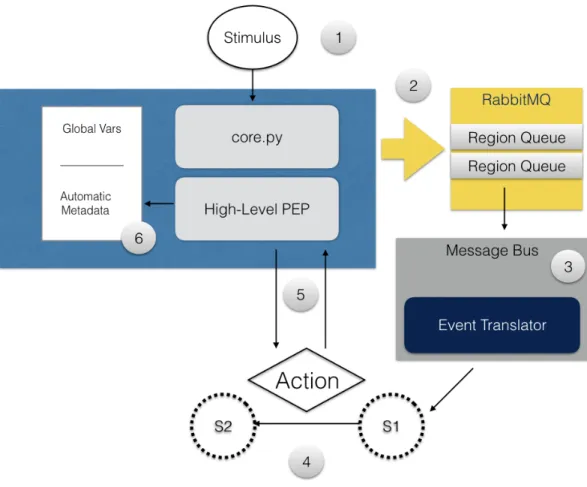
Figure 9. Policy domain system flow
1. External stimulus causes a low-level policy enforcement point (PEP) to fire 2. PEP formats region message and expected values and publishes to a regional topic 3. Region queue bound to topic activates the policy domain message bus. Message
transform function will consult region, metadata, and current state to produce an event in the state machine
4. State machine transition is triggered by the event, firing an action
5. Action activates an iRODS rule, providing a contract for the inputs and outputs as well as a site-configurable implementation of the required policy function,
producing output data to gauge the success of the action
4.
Evaluation
At its heart, this project is a refactoring of the policy enforcement architecture of the iRODS data grid. Policy domains are a mechanism to establish explicit relationships between policy enforcement points in terms of ordering and the nature of the automatic metadata produced by the system. This prototype has gone through several architectural changes as the capabilities and limitations inherent in the current rule engine architecture became apparent.
This being said, there are several areas where the prototype is incomplete. This work can thus inform follow-on efforts around policy domains, as well as general architecture developments for the iRODS grid.
One of the biggest issues encountered during the development of this prototype was the mismatch between the presentation of the current PEPs in iRODS and the eventual form the high-level PEPs had to take. The original intent of the project was to provide .re or .py files that could be implemented in the /etc/irods rule-base, so that domain
configuration could be centralized, and so that it would be familiar to the iRODS community. For example, this snippet of a default core.re shows a range of PEPs and associated policies, including default noop actions:
acCreateUser {
acPreProcForCreateUser; acCreateUserF1;
acPostProcForCreateUser; } acCreateUserF1 {
ON($otherUserName == "anonymous") { msiCreateUser ::: msiRollback;
msiCommit; } } acCreateUserF1 {
msiCreateUser ::: msiRollback;
acCreateDefaultCollections ::: msiRollback; msiAddUserToGroup("public") ::: msiRollback; msiCommit; }
Figure 9. iRODS Policy Enforcement Points
In this design, the individual PEPs are presented as stand-alone rule files which may be stored in iRODS, and which can be initially provisioned in the initialization of the policy domain. The rules are then called by actions triggered by state transitions, and can report back the success or failure, as well as provide a specification for the expected return values. This arrangement provides an amount of familiarity to the iRODS community while allowing the state machine action to throw any exceptions or errors at the
appropriate point in the state transition. This shift of the locus of control out to the state machine thus challenges some aspects of traditional iRODS PEPs.
The mismatch between the form of low-level policy enforcement points as they exist in iRODS and the high-level policy enforcement points that specify input as well as output data as a contract was initially seen as a design problem. After analysis, the binding of input and output parameters to a policy enforcement point emerges as a key design improvement of policy domains. Returning to Appendix I and observing the policies around protected data, the policy domain approach provides several enhancements. First, the prerequisites and ordering of protected data scanning policies are now strictly
Third, the strict contracts in the high-level policy enforcement points guide the
implementing curator to properly convey the required automatic metadata values if the site opts to do protected data scanning, while a noop at this state transition can by default record that no protected data scanning was done.
Appendix II is a state machine UML diagram of a policy domain refactoring of the ingest portions of Appendix I. Table 2.2 has been augmented with explicit classifications of properties as implicit and automatic metadata. For example, these items regarding virus scanning from Table 2.2:
SIP Archive-CheckViru s Flag for whether to check for virus intrinsic metadata
Can be set by high-level PEP checkForVirus SIP Audit-CheckViru s Status flag set to “1” if a virus is detected in a SIP
intrinsic metadata
High level PEP checkForVirus can result in setting an invalid SIP contains virus and halt SIP processing
Have been converted into implicit (Archive-CheckVirus) metadata and automatic (Audit-CheckVirus) metadata. Using a state transition and associated action that can call an iRODS policy domain rule with an explicit contract for output variables, we can see how a preset default with no virus scan manages these properties:
archiveCheckVirus {
#Input parameters are: # sipCollectionPath #
#Output parameter is:
# virusScanAgent: None | ClamAV | Norton
# virusDetectionDetails: message regarding virus detected writeLine("stdout","archiveCheckVirusFor *collectionPath");
# insert virus scan capability here
# noop return values are default
*virusScanAgent = "None"; *virusDetectionDetails = ""; *virusScanStatus = "-1";
}
INPUT *collectionPath="/path"
OUTPUT ruleExecOut,*virusScanStatus,*virusScanAgent,*virusDetectionDetails
In initializing a policy domain, the system could have various policy enforcement points with noop defaults, passing appropriate responses back to record as automatic metadata, or they could have default error processing if the site has not configured a policy
properly. In other circumstances, a default policy could invoke a capability that is also installed during policy domain initialization, such as a Docker version of ClamAV. Again, it is worth stressing that this arrangement controls the order of policies, the possible states and transitions from any point in a curation workflow, as well as the global variables that are automatically recorded at each point.
are two areas in particular where the prototype does not fully address side effects. First, there is the dependency on the proper encoding of the high-level policy enforcement points and the included user actions at these PEPs. The rule being called from the state transition can only trust that the PEP is properly handled, and that any side effects are properly accounted for. Second, the asynchronous arrangement and the delegation of control from the rule engine to an external media serves to increase the surface area of the system vulnerable to side-effects. Failures, misrouting of events and messages, and errors in event interpretation are areas for future concern.
A very interesting area that is only proposed in this prototype is the form and
effectiveness of assessment criteria that can validate the described intrinsic and automatic metadata in certifying trustworthiness in an automated fashion. The prototype describes a mechanism, but a demonstration of automated assessment and certification is left as a follow up. The methods to access and interpret policy domain intrinsic metadata in an assessment would be an interesting follow up activity.
data are preserved in the archival storage area, it is also possible to replay the function of a policy domain, either as a validation, or as a method of transformation.
In truth, much of the development of this prototype included basic infrastructure needed to form the proper messages and to integrate rules, especially the new Python rule engine, into the system. Going forward, the impedance mismatch between the current function of an iRODS policy enforcement point and a policy enforcement point that might be under the control of, and might require a return of values and status to a policy domain driver is an important question. Developing approaches that more closely tie iRODS policies to wider infrastructure while limited and managing side effects may be one of the
development challenges going forward. Policy domains may, in fact, point towards a more expansive role for the policy-based data management capabilities of iRODS.
5.
Discussion
ingest pipelines, digital media processing platforms, and, for this specific project, trusted digital preservation platforms.
Policy domains as a concept arose from prior work on systems supporting dynamic binding of high-level policies for digital preservation systems via the Arch prototype. Arch led to the identification of a particular problem, which is the translation and
interpretation of the low-level policy enforcement points native to iRODS to higher level events in an archive. That is, is this postProcForPut hook indicating the deposit of a SIP, or the creation of an AIP after the completion of an AIP assembly and validation
pipeline? In order to accomplish this task with a level of rigor, Ward, Hao, and Conway proposed the utilization of a state machine mechanism that defined high-level policy enforcement points mapped onto actions resulting from state transitions in these state machines. This mapping of events onto state machines provides a structure to the
metadata used to describe the disposition of data objects into the system, limits operations to only appropriate sequences of events, and provides a basis for automated evaluation of the validity, authenticity, and provenance of a system, guaranteeing that stated policies are being correctly implemented.
Much of the work here on policy domains has been informed by Moore’s “Trustworthy Policies for Distributed Repositories”. This work defined in great detail the configuration, state metadata, and policies that could automate a verifiably trustworthy repository
provides a concrete implementation of the first three forms of knowledge and points towards techniques for encompassing the fourth in a manner that allows provisioning and preservation of containerized tools and capabilities.
This policy domains approach installs a structure of regions on an iRODS zone. These regions create isolated areas that produce low-level policy enforcement point events. These events are organized and broadcast on asynchronous message exchanges, organized by the region and type of event. A message bus receives these regionally segregated events and can act as a further interpretation layer to produce an event to be sent to a state machine. This event producing layer can avail itself of the originating event in a region and its context in the form of the session state information in iRODS. The event producing layer can consult the history and current state of the appropriate state machine in order to arrive at the correct event translation. This event is then sent to the state machine in order to determine the next response. Ultimately, it is the high-level policy enforcement points that define a policy domain.
Returning to the OAIS Reference Model, it is now useful to review how policy domains can be used to fully implement a preservation environment that absorbs and orders the policies, state metadata and configuration offered by Moore through the eyes of a data curator responsible for standing up and configuring a preservation environment at a location.
through application of security and preservation policies. Given the complexity of OAIS, it is proposed that these various components should be a composition of iRODS zones, with each zone dedicated to a particular overall function. Focusing on the SIP, AIP, and DIP handling in ingest, archival storage, and dissemination, this represents three iRODS zones. As data flows through this process, the policy domain arrangement can limit the entry and exit points through an explicit model of landing areas and pickup windows. A SIP can be deposited by a curator in an isolated area, triggering a pre-validation flow that admits this submission into a process that validates and formats an AIP. This AIP can be placed into a pickup window for a handoff to the archival domain, and so forth. This has the benefit of increasing the separation of concerns, and can increase security, even to the point of providing a human-in-the-loop air gap between these domains. This domain-to-zone mapping also reduces complexity that can result from the intermingling of code between domains in rule bases and microservices.
The iinitdomain function would carry out these actions:
1. Create folder hierarchies that divide each zone into regions, representing internal flows with their own entry and exit points.
2. Install and configure domain specific rule bases that tap into low level policy enforcement points in each region.
3. Create appropriate roles and access controls for each region. 4. Initialize AMQP exchanges and topic to queue mappings.
5. Install appropriate commands, microservices, and plugins, and Docker components, perhaps using a tool like Ansible.
6. Install mid-tier listener and state machine components.
7. Install high-level policy enforcement points with appropriate default actions and references to default tools and capabilities.
At this point, the curator now has an operational OAIS repository. The key interface for curators becomes this default set of high-level policy enforcement points.
If we focus on the first component, the ingest area, the default rule base could include a high-level policy enforcement point when a SIP is deposited. This default behavior may include a call to a pre-configured Docker image running an anti-virus tool such as ClamScanAV. This default would make the call, evaluate the response, and then optionally trigger the next event, which is that the SIP has been virus checked.
the curator, the archive can exhibit sensible default behavior, yet the curator could elect to use a different virus checking tool and configure this with relative ease by
manipulating the rule base. Note that each archive may have different requirements, thus many high-level policy enforcement points may simply take a noop and pass back events to proceed through the data flow. Our curator may not be dealing with potentially
sensitive information, and have no cause to run data detection for Social Security or credit card numbers. The policy domains thus provide comprehensive configurability where needed and low barriers to entry where every element is not mandatory.
SIPs proceed through regions in each policy domain, conceptually this matches
hierarchical states in a state machine. Ingest may move from initial validation of a SIP to construction of a fully documented AIP by passing through multiple regions. The end of the SIP processing would result in a fully packaged AIP deposited into a region on the ingest domain serving as a pickup window. This arrival is a terminal state on ingest. The AIP process may include a periodic scan of the pickup window, or, as mentioned, AIPs could even be physically carried across an air gap as a deposit into the AIP initial region, starting the process again.
This process can be repeated through multiple regions, each with well-defined entry and exit points, and across multiple domains. As data is maintained in the archival storage domain, periodic rules can evaluate the state of archives to guard against data loss. As user actions access archival information, they can cause actions that produce
A critical function of policy domains is the preservation of knowledge. Trustworthiness requires the ability to audit and verify the operation of a preservation environment. This project is motivated by the notion that the rigor of state machines and the potential to preserve not only the policies and metadata, but also the explicit relationship between these policies and resulting preservation metadata can provide greatly enhanced ability to automate the certification of a repository as existing in a correct and trustworthy
condition. It is this ease of configuration resting on top of knowledge encapsulation and rigor in organizing preservation metadata for assessment that is the central goal of policy domains. Policy domains do not replace the current iRODS policy-managed data
approach or alter the central function of the iRODS rule engine and the notion of
configurable policy enforcement points. Policy domains do refactor common patterns of rules and metadata markers addressed by conditional branching. Harmonizing policy domains with existing successful practices is an important undertaking. This does not replace previous work on trusted preservation environments, rather it opens the door to refactoring and installation support that can make such a system available to a wider audience.
6.
Bibliography
Al-Fedaghi, Sabah. "Information management and valuation." International Journal of Engineering Business Management 5 (2013): 1.
Beale, Thomas. 2002. “Archetypes: Constraint-Based Domain Models for Future-Proof
Information Systems.” In OOPSLA 2002 Workshop on Behavioural Semantics. Vol. 105. http://gpo.asu.tusur.ru/p/MIS/export/35/%D0%9F%D0%B5%D1%80%D0%B5%D0%B 2%D0%BE%D0%B4/archetypes_beale_oopsla_2002.pdf.
Beagrie, Neil. 2008. “Digital Curation for Science, Digital Libraries, and Individuals.” International Journal of Digital Curation 1 (1):3–16.
Beagrie, Neil, Meg Bellinger, Robin Dale, Marianne Doerr, Margaret Hedstrom, Maggie Jones, Anne Kenney et al. "Trusted Digital Repositories: Attributes and
Responsibilities." Research Libraries Group & Online Computer Library Center, Report (2002).
Bement Jr., Arden. "Cyberinfrastructure visions for 21st century discovery." NSF 07 28 (2007). https://www.nsf.gov/pubs/2007/nsf0728/index.jsp
Chowdhury, Gobinda. "From digital libraries to digital preservation research: the importance of users and context." Journal of documentation 66, no. 2 (2010): 207-223.
Cohen, Stephen. "Applying archival appraisal concepts to information lifecycle management." Information Management Journal 50, no. 3 (2016): 29-33.
Conway, Mike, Reagan Moore, Arcot Rajasekar, and Jean-Yves Nief. 2011. “Demonstration of Policy-Guided Data Preservation Using IRODS.” In , 173–74. IEEE.
https://doi.org/10.1109/POLICY.2011.17.
Conway, M. (2017). “policy-domains: Master’s thesis work”. https://github.com/michael-conway/policy-domains
“DataNet Federation Consortium. October 8, 2017, from http://datafed.org/