Matthew Hopkins. Archiving Scientific Data: Needs and Challenges for Chemistry Researchers. A Master’s paper for the M.S. in L.S. degree. April 2009. 70 pages. Advisor: Catherine Blake. Scientific data preservation is an ongoing challenge for the information sciences. This study focuses on one subgroup, chemistry. Our goal is to elicit data practices and opinions on sharing data from chemistry researchers at the institution of UNC‐Chapel Hill to inform the
development of an IR. To achieve this goal, we conducted a survey of faculty and students. Findings from the 31 participants (a response rate of 10.3%) revealed that chemists use data repositories infrequently. Participants were most comfortable sharing data with students, followed by collaborators and researchers in their own discipline. The researchers surveyed did not express interest in an institutional repository, although certain sub‐groups—data repository users, researchers comfortable sharing data, and biological chemists—showed more interest. Of researchers that used data repositories, most had done so through the journal publishing process, which could provide an alternative way to preserve research data in chemistry. Headings:
Chemistry / Databases
Chemistry / Information Systems Scientific Research / Academic Libraries Scientific Research / North Carolina
by
Matthew Hopkins
A Master’s paper submitted to the faculty of the School of Information and Library Science of the University of North Carolina at Chapel Hill
in partial fulfillment of the requirements for the degree of Master of Science in
Library Science.
Chapel Hill, North Carolina April 2009
Approved by
1
Introduction
Datasets are the foundation of the scientific process. However, once scientists analyze
and process raw data into charts and graphical displays, formulate conclusions and revise
theories, raw data is often discarded. Historically, disseminating raw data to other researchers
has not been practical, but technological advances have made it possible to archive the
original data along with the polished results that the data helped create.
There are two fundamental aspects of science that make archiving raw data
worthwhile. Science is evidence‐based; being able to refer back to the raw data gives
researchers another level on which to assess a paper’s validity. The raw data can enable other
scientists to replicate the experiment and thus better judge methods and analysis, rather than
only the conclusions of a paper. Also, science is cumulative. Archives of scientific data would
allow researchers to build their own studies off the data produced by their peers, just as they
already do when results are disseminated in an article.
Data sharing is not completely new to the sciences. By necessity, the discipline of
astronomy was one of the pioneers. Astronomers collect data with large, expensive
equipment, such as telescopes they can point at only one area of the sky at any given time.
This dictates shared usage among researchers, of instruments and data. This is especially
relevant for space‐based instruments, such as the Hubble Telescope; no researcher can lay
The current trend in the literature has been to try to extend this collaborative process
to all the scientific disciplines (Freeman, 2005). The goal is to create a centralized digital
repository where raw data can be stored. A set of software and hardware, called
cyberinfrastructure (CI) in the United States, would provide functionality for the data. Ideally,
this functionality would operate in two directions. That is, published scientific articles would
contain links to the data’s storage location in the CI. Furthermore, researchers could
manipulate data within the CI and follow links towards subsequent published works that were
based on that data. Freeman (2005) sees the CI as a type of collaboratory, since it provides a
forum for researchers across the world to work together in teams (pg. 690). In the United
Kingdom, this topic falls under the general heading of e‐Science.
Many different data storage systems have been proposed, from large comprehensive
projects such as the UK’s e‐science initiative to individual science publication packages
(Hunter, 2006). Some of this variety follows naturally from the varied natures of different
scientific disciplines. The unique data requirements of one discipline (or specialty within a
discipline)—size, format, scale, relevant metadata categories—will not necessarily be
compatible with the requirements of another. Thus, many different scientific data repositories
may be needed to cover all the sciences, each one focusing on a specific area of research or a
specific body of users. This is called the disciplinary approach. Another method—the
institutional approach—is to create multiple smaller multipurpose institutional repositories
(IRs), which capture data of different types (Freeman, 2005).
Much of the work in this area has focused on the disciplinary approach, because it
brings together larger numbers of researchers across a wider geographical area. However,
example, in sub‐disciplines such as synthetic chemistry, the information content is held in the
step‐by‐step method of collection, not just the final result, so comprehensive metadata is
crucial in unlocking the value of the data (Pryor, 2007). Other reasons are described in more
detail in the literature review. Thus, there are fewer options for these researchers to provide
their raw data, and these data are being lost to the scientific community.
This paper will investigate the possibility for an Institutional Repository (IR) at the
University of North Carolina—Chapel Hill focused on the data produced by the Chemistry
Department. Specifically, our goal is to find out what UNC’s chemistry researchers currently
do with their data and if they would be interested in placing their data in an IR run by the
University Library. We will also consider if certain types of researchers are more amenable to
a repository, such as frequent data sharers and collaborators.
It is important to get input from scientists, because people are usually averse to
changing their habits. The more aligned a data repository is to how scientists work, the more
likely it is that they will use the repository. Their concerns are doubly important, because
scientists will be both data contributors and managers. That is, they will be searching
repositories to find data for their own work, but they will also act as the source of raw data,
organizing it with their own metadata tags. This study will address the following research
questions:
1) What do scientists currently do with their own research data, in all stages of the
data lifecycle?
2) In the course of their research, do scientists ever use data collected and published
by others?
2
Related
Work
This study seeks to assess the use of data repositories—both in sharing and
retrieving—by researchers in the Chemistry Department at UNC‐Chapel Hill, as well as their
position towards the concept of open access data repositories in general, and their interest in
using an institutional repository offered through UNC Libraries. The literature demonstrates
the importance of preserving scientific data in general, the current strategies in effect, and the
inherent difficulties in the discipline of chemistry. We also consider the researchers’
perspectives on data archiving. Finally, literature on scientific researchers at UNC‐Chapel Hill
will be discussed.
2.1
Scientific
Data
Preservation
2.1.1 Importance
The reasons to archive and preserve scientific data are shared across different
branches of science, because they are derived from the scientific method. Scientific results
should be reproducible and verifiable, and when these conditions are met, new scientific ideas
can be built on top of existing ideas. Having access to the raw data that accompanies
published articles enhances each of these requirements. Androulakis (2008) states that raw x‐
ray diffraction data is important for the following reasons: access is necessary to validate the
algorithms and processing methods to be applied to old data; and it will enable old structures
to be continually updated as the data is analyzed with these improved methods. However, a
single raw data set can often be as large as 100 GB; thus archiving all raw datasets from
around the world in a single repository is not feasible. For this reason, Androulakis proposes
that x‐ray diffraction data be maintained in individual repositories at the institution in which it
was created. This is just one example of the difficulty of archiving chemical data; more will be
discussed later.
2.1.2 Approaches
Freeman (2005) gets to the core of scientific data issues. The researchers begin by
pointing out the underlying explanations for the recent explosion of data and its inherent
problems and possibilities. Technological advancements have allowed researchers to store
and process more data than before. Researchers can also draw on a wealth of shared data. As
a result, scientists are learning the programming skills necessary to capitalize on these
opportunities. The authors see two emerging trends. Scientists are able to collaborate with
more of their peers in virtual research environments. At the same time, the fruits of these
labors can be utilized by lone researchers with computer access, which promotes individual
work. Both types of research are enabled by CIs, which the authors separate into two classes,
shared CIs and domain‐specific CIs which reflect the institutional and disciplinary approaches
respectively. The former can be applied to diverse areas of research, while the latter are
uniquely tailored for particular disciplines and data sets. The initial focus in the information
community has been on group collaboration rather than individual research, and large‐scale
domain‐specific projects rather than general, all‐purpose ones. The authors claim that these
efforts will “expand the envelope” and create exemplars for the less expansive disciplines,
2.1.2.1 Domain‐specific Repositories
Freeman (2005) surveys the large‐scale CIs that cover disciplines such as astronomy,
high‐energy physics, or the biological sciences (pg. 684). The researchers in these disciplines
have incentive to share data due to prohibitively expensive equipment, e.g. super‐colliders,
and because the data is useful to many other researchers in many different ways, such as in
the complete mapping of an animal’s genome. Much of this work takes a community‐based
approach, as seen in Freeman (2005), creating methods and technologies that can be used by
scientists doing similar types of research, all over the world.
2.1.2.2 Institutional
Institutional‐based repositories preserve the data of an institution, which might cover
datasets of varying forms. Downing (2008) applies this to chemical data archives and asks
whether they should be subject‐based or institution‐based. While many other disciplines, like
astronomy or biology, have successfully gone the subject‐based route, some types of
chemistry data do not lend themselves to such an approach. For instance, highly specialized
datasets might only be valuable to a handful of researchers. Other datasets might not be
readily usable, requiring large amounts of metadata to provide the appropriate context.
However, the problem with institution‐based repositories is that they have the
potential to become isolated islands. Downing (2008), et al, proposes a compromise of sorts, a
federation of institutional repositories. Thus, within each institution, the chemistry
department might work with the library to create a suitable repository. Downing describes an
open‐source software project called SPECTRa that will manage this ingestion. Later, the
2.2
Chemical
Challenges
Although the reasons for preserving scientific data are similar across all different
disciplines, the challenges in doing so vary widely. Chemistry researchers are not driven by the
same factors that motivated researchers in other scientific fields to adopt e‐science and the
use of large, subject‐based repositories. Research institutions are often able to afford their
own equipment to collect their data, so there is not the same urgency to acquire the means to
share data that there is for researchers who rely on space telescopes or particle accelerators.
A chemical researcher’s data are often useful to their closest peers, but not in the universal
way that genomic information can be used by those in the biological sciences, an incentive for
their vast data banks. For these and other reasons, many chemistry researchers do not have
the option of large disciplinary‐based repositories, which forces them to find other options to
preserve their data.
2.2.1 Variety of Disciplines
Several aspects of chemical data make it difficult to archive in meaningful context so
that the data can be reused by others. One issue is that chemistry is a diverse field
encompassing many different kinds of data. As Downing (2008) points out, this means that
data is collected from many different instruments and in many different formats, not all of
which have long life‐spans. The authors outline three distinct areas of research. These are
computational chemistry, synthetic chemistry, and crystallography. Computational chemistry
is itself difficult because it is so varied; instead of standardized experiments it relies on
theoretical work, which can take all sorts of forms. Pryor (2007) describes how this data is
often organized in a “tree structure,” a system of folders within folders, of which some are
creation of new compounds—is that it is not exactly the end result that is important, but the
steps within the process. Thus, metadata collection becomes even more important.
2.2.2 Crystallography
Crystallography, which involves determining the atomic structure of compounds, has
engendered more activity in the information science literature than other chemistry sub‐
disciplines. Duke (2005) outlines many of the difficulties. In journal publications,
crystallographic data is usually presented as a diagram. This prevents other researchers from
checking the validity of the paper’s methods, or reusing the data. Allen (2004) elaborates on
this latter point. The same data that must be collected to derive an accurate structure is also
complete enough to explore the synthesis process of the material, interactions, bonds, and
crystal engineering, so other researchers might benefit from access to the data. Another
possibility for reuse of data is offered in “Federated repositories of x‐ray diffraction images”
(Androulakis, 2008). New algorithms and processing methods for turning raw diffraction
images into structure diagrams are being constantly devised and updated. If the underlying
data is available, then published structures can be updated as well. Otherwise, researchers
will have to collect data again to take advantage of the improved methods.
Public crystallographic databases, such as the Crystallography Open Database (COD),
offer a potential solution. However, the 300,000 structures found in the various public
crystallographic databases make up one fifth of the estimated 1.5 million structures that have
been translated (Duke, 2005). Allen (2004) puts the problem in different terms. Public
databases contain only about 5% of the possible structures in existence. The largest of these,
the Cambridge Structural Database (CSD), contains less than 3%. Although research into
decreasing. Although researchers are working to bridge this gap by finding new structures,
their data is getting held up in the publication process, because some journal publishers won’t
publish structures that are already available in the public domain. Thus, researchers may delay
releasing their data into a database until their paper is published. The backlog in the
publishing process pushes the data release date far into the future.
2.3
Scientists
and
Data
Repositories
We envision that researchers would be the primary producers and consumers of
scientific data repositories. They might also share some of the custodial duties, such as
keeping metadata tagged to their data. The first section considers the research process, and
the second section considers the opinions of scientists about data repositories.
2.3.1 Changing the Research Process
Frey (2008) focuses on how commonly practiced scientific methods can be adapted so
that the standards of data curation are incorporated into the process. He notes that many
ideals of archiving and records management are already employed by scientists. For instance,
they take great care to include the provenance of all materials used in the experiment and the
details relating to all equipment. The primary reason for this is so that their methods might be
reproducible—others can conduct the same experiment. Thus, Frey argues that if scientists’
data is to be re‐used, they would be willing to take the same care in recording all necessary
metadata. He discusses different methods for doing so that would reduce the burden of such
curation efforts. For instance, electronic laboratory notebooks (ELNs) allow scientists to
record observations in a form that can be linked to the data itself, unlike a scrap of paper
Project which automatically collects and stores metadata for its data files, as well as providing
links between related content.
Hunter (2006) proposes an alternative method that would change how scientists carry
out research. They would use the Resource Description Framework (RDF), a technology that
automatically captures metadata as data is collected. One of its important features is that it
preserves and highlights the relationships between datasets. This is important because some
scientific data loses much of its value when considered separate from its workflow history.
Upon completion of the project, the scientists could generate a Science Publication Package
(SPP), a digital object that contains within a complete picture of their work, including the
original data that they recorded for analysis. This could then be stored in an institutional
repository. The lineage of this SPP could be tracked as well, incorporating links to other
research that draws on its contents.
2.3.2 Scientists’ Opinions
2.3.2.1 Scientific Data Practices of UK Researchers
Project StORe is a proposed set of middleware that would work between a variety of
institutional repositories, providing two‐way links between published articles and archived
source data. Pryor (2007) reports the results of a survey of scientific researchers, taken to find
ways to improve its design. Invitations were sent out to over 3,000 researchers in the United
Kingdom. The survey took an overview of science as a whole, reaching seven different
disciplines—Archaeology, Astronomy, Biochemistry, Biosciences, Chemistry, Physics, and
Social Policy/Political Science. As such, it demonstrated the inherit differences in disciplines,
both in the type of data that they collect and the data collection methods. Furthermore, it
least one chemist expressed doubts that his data would be helpful for other researchers,
because most of the valuable information content was not just stored in the datasets
themselves, but in the relationships between the progressive datasets. The research is
organized in a tree‐like structure, the whole picture of which is necessary for adequate
understanding. Pryor found that 65% of chemistry respondents had never used a data
repository, either as a depositor or a searcher. This was one of the highest figures out of all
the scientific disciplines surveyed.
2.3.2.2 Chemists’ Data Awareness
Downing (2008) also surveyed chemists. The results were not encouraging as the
study revealed that much of the data collected during experimentation was not available
electronically. For instance, this would include paper laboratory notebooks. They found that a
significant portion of the chemistry researchers were unaware of digital repositories. Of those
that were aware, many would want to restrict access to their stored research data, at least for
a certain amount of time. This embargo period would ensure that they could reap the full
rewards of their research efforts.
2.3.2.3 Chemistry Preprint Server
Brown (2003) surveyed authors that used the Chemistry Preprint Server (CPS),
launched by Elsevier in 2000, but is since defunct. The CPS was an open‐access database of e‐
prints. At the time of the study, less than a year after its inception, the CPS contained 217
papers. Brown asked authors why they published in the database. Two of the most common
reasons were “wide distribution and rapid dissemination” (Brown, 2003, pg. 365). When asked
if they would submit work to the CPS in the future, 92% responded positively, with some citing
with the highest Impact Factors. Of 17 respondents, one journal accepted e‐prints for
publications, while half explicitly did not.
2.3.2.4 General Scientists’ Opinions on Data Sharing
Birnholtz (2003) also gets the perspectives of practicing scientists, but in a unique
manner. The authors observed three different groups of researchers and then reflect on the
topic of data sharing. They reiterate the importance of data sharing to the practice of science,
in the way it is used to confirm the findings of others and then how it is used to build on that
work. They name three difficulties: willingness to share, locating shared data, and using
shared data. On the first point, the authors suggest that when scientists want to limit access
to their data, they typically want to limit it to people or communities that they have a social
relationship with. Thus, the researchers argue that any data sharing system should include a
facility for communication, so that scientists can communicate with those using their data, if
they wish.
2.4
Data
Repositories
Beyond
Science
More literature can be found by removing the scientific context. The following articles
consider general researchers and their feelings toward IRs. Pickton (2006) interviewed
research students at a British university, about two years after a repository had been put in
place. Through interviews, the authors found that subscription‐based resources were the
most used, followed by free resources like Google Scholar, with open access (OA) resources in
third. Approximately half of the students expressed an awareness of OA issues. When asked
whether they would deposit specific types of material in the IR, around 60% were against
submitting their datasets. They also found that datasets were one of the least wanted items,
publication involved intellectual property issues, including worries that they would not be able
to publish the same material elsewhere, that they would be violating their publisher’s
copyright, or that others might use their work inappropriately. However, the most positive
reasons for publishing in IRs were greater accessibility and impact of their work.
Kim (2007) focused on contributions to IRs rather than use of them. The authors
applied the socio‐technical network method—which looks at how users conform to a given
system—along with social exchange theory—in which actors follow cost‐benefit motivations—
to interpret the results of their survey. It was a pilot survey with limited participants; out of
the 67 invitations, 31 responded. Only 3 of these respondents were in the discipline of
science, although 24 were categorized in engineering. When asked whether they planned to
contribute to an IR in the future, 18 in total answered no, or were unsure. Some reasons for
contributing included preservation, recognition from the institution, communication with
peers, and greater dissemination of their work. On the other hand, the author found that
those who did not plan to contribute were more influenced by grant funders than the group
that did not intent to contribute. The author did not study grant funders themselves, but
speculated that they may not have encouraged open access storage.
2.5
Background
on
the
UNC
Scientific
Population
Hemminger (2007) does not address institutional repositories directly, but provides
background information on the information needs and practices of general scientists. The
authors surveyed scientific researchers at UNC‐Chapel Hill to determine how they find and use
sources of information. From the more than 900 individuals that completed the survey, 82
were general chemistry researchers, not including those classified in related fields, such as
subgroup could be analyzed in isolation, but instead we must look at the results as a whole).
Their results showed that the majority of users preferred electronic sources over print sources.
Asked to assess the factors that contributed to choosing a journal to publish in, the option to
publish data was not a choice. However, one factor was the journal’s support of open access.
This choice received a score of 2.09 on a scale with 1 being “Insignificant” and 5 “Significant,”
which ranked it 5th among the 9 options.
Blake (2006) interviewed chemistry researchers who were members of the Center for
Environmentally Responsible Solvents and Processes (CERSP), some of whom were affiliated
with the University of North Carolina at Chapel Hill. The study investigated the idea of
scientific discovery. In seven out of nineteen cases, the scientists talked about building on
existing ideas. This is one way that raw data from previous experiments can be useful. Blake
also found that few of the discovery systems available to researchers incorporated technology
3
Methods
This section will introduce the theory behind survey studies, including questionnaires
in particular. Then it will introduce the study population, chemistry researchers at UNC‐CH,
and how they were recruited. Next, ethical issues will also be discussed, such as informed
consent, fairness, and privacy. We will briefly discuss how the results will be analyzed, before
considering the survey questions in detail. This will begin by dividing the questions into basic
themes and explaining the reasoning behind each of these types. After that, the actual survey
questions will be considered.
3.1
Survey
Studies
It is difficult to observe how chemists manage their data directly. Datasets are not
necessarily collected at one specific time during the course of an experiment; scientists could
collect data of numerous types in different ways throughout the entire process. They might
decide what to do with this data immediately after collection, or weeks later, and the
researcher might act on this decision in the privacy of the their own office, with just the click of
a few buttons. To follow this process, an outsider would have to be embedded in the research
group. Instead, a survey allows for responses from many different research groups, cheaply
and quickly. Babbie (2007) discusses some of the advantages and disadvantages of this
method in comparison with others. Surveys are particularly appropriate to use when people
3.1.1 Questionnaires
A questionnaire is just one type of survey. Its primary benefit in this case is its
flexibility. This is especially useful for an exploratory study, because it allows the researcher to
address a number of different areas. Thus, when it is time to analyze the results, the
researcher has a great deal of freedom and is able to focus on the areas with the most
interesting results. Questionnaires also allow for the possibility of standardized responses.
This can make the analysis easier and provides for greater reliability. On the downside,
questionnaires limit the potential responses, which could cause the researcher to miss out on
illuminating information. Although surveys are generally reliable, due to their uniformity, their
validity is not as strong. If the purpose of this study was to get hard data on chemists’ specific
practices, then another method might be chosen, but this study only seeks the general picture.
3.2
Recruiting
The study population consists of chemistry researchers at the University of North
Carolina—Chapel Hill. We did consider faculty from the Biology Department and the Medical
School, but decided to include only those researchers affiliated with the Chemistry
Department. There are about 50 faculty members within that department, and about as many
postdoctoral associates. The survey also included the 200 graduate students and 400
undergraduate chemistry majors. This study invited faculty and post‐docs first; then it was
extended to include graduate students.
3.2.1 Designing the Survey
Once devised, the survey questions were transformed into an online survey format
described above. The last page of this survey contained a link to the second survey, which was
used to provide compensation to subjects (see section 3.2.3).
3.2.2 Running the Survey
The link to the primary survey was included at the bottom of an invitational email that
introduced the project, described how the information would be used, and provided contact
information (see Appendix A). To begin the study, this email was sent to the chairman of the
Chemistry Department at UNC‐CH, who agreed to forward it to the faculty listserv. After two
weeks, we sent out a shorter reminder email to the same listserv. At this point the number of
responses was not adequate, so the original invitational email was sent to the Chemistry
Department Manager, who agreed to forward it to the graduate student listserv. The same
reminder email was sent out about one week later. At this point, the number of responses
was sufficient for analysis, at 18, but had still not reached the minimum goal of 30. The
original email was sent to the president of the student group ACGS (Association of Chemistry
Graduate Students), who forwarded it to the group members. It was hoped that the members
of this group would be more likely than the average chemistry graduate student to participate
in research, and more likely to make an academic career out of the study of chemistry. For
these reasons, they would perhaps be more likely to respond to the survey and able to give
more informed answers.
3.2.3 Compensation
The last step in this process involves handing out compensation. As described in the
invitational email, participants had the opportunity to enter a drawing to win one of three gift
where they could input their email address. Thus, when the survey is complete, three emails
will be randomly selected and these people will be contacted.
3.3
Ethical
Issues
3.3.1 General Issues
There will be at most three contacts for each subject. Faculty will receive only the
initial email and its follow‐up email (see Appendix A), as will some graduate students. Those
graduate students in ACGS will receive a third email. Three individuals will be contacted once
more to collect their prize.
The subjects’ participation involves filling out an online survey. It is estimated that this
will take no more than 25 minutes to complete, and potentially much less, depending on the
length of the free responses. There will be no costs other than this time to participate.
Compensation is offered in the form of a raffle. There are three identical prizes
available, a $25 gift card to the Daily Grind, a coffee store on campus.
3.3.2 Informed Consent
The invitational email for the survey will also serve as the letter of consent, and
participants will imply consent by choosing to take the survey. It was determined that
attempting to get signed consent would not be worthwhile, since it would only lessen the
existing anonymity of the participants, and it would create physical evidence linking them to
the survey. This is especially important in regards to a voluntary online survey, where the
greatest risk to participants is a breach of confidentiality. The text of this letter, as well as the
The letter contains the information typically found in an informed consent document.
It explains the purpose of the study, and describes what is required of participants, in terms of
time. However, it also makes it clear that participation is voluntary and that within the survey,
each individual question is voluntary, and the survey can be exited at any time. It explicitly
describes the costs and benefits of participation, the only direct benefit being the gift cards
used as compensation.
Finally, the letter includes contact information for the primary investigator, the faculty
advisor, and the Institutional Review Board. Before offering the link, it notifies participants of
the coming reminder email and thanks them for their time.
3.3.3 Fairness and Exclusion
Subjects will be chemistry researchers operating at UNC‐Chapel Hill. One of the aims
of this study—in addition to determining how chemists currently manage their information—is
to garner information for a potential chemical data repository at UNC that is tailored to meet
its users. Other types of researchers are excluded because they would not directly benefit
from or contribute to the results.
Undergraduate students, some of whom may conduct research, are excluded as well.
One basis for this decision was competency to answer the survey questions. Student
researchers typically work on teams run by a faculty member. They may only work on one
aspect of the experiment, without complete knowledge of the others.
No one will be excluded on the basis of gender, ethnicity, race, or age, nor are there
any expectations based on these classifications. As all subjects have undergraduate degrees,
Finally, all individuals who complete the survey to enter their email address will be
equally likely to receive compensation. The email addresses that make up the drawing are
part of a separate survey and not linked to the individual’s survey responses. The three
winners will be chosen randomly. In this way, a participant’s particular answers will have no
bearing on whether they receive the prize.
3.3.4 Privacy Issues
The potential risks all involve a breach of confidentiality, which could potentially result
in emotional distress or embarrassment. However, the fallout from these risks is minimal. The
survey deals with general questions about how the participants conduct research, so that no
specific information of their research is needed. They are also asked to offer opinions which
they might prefer to keep secret. These statements will only be referred to or quoted in the
results of this study in such a way that minimizes the potential for indirect identification.
However, that doesn’t make protecting participants privacy any less important. Potential
privacy loss could come in two main forms: data compromise and indirect identification.
3.3.4.1 Data Compromise
The first risk to minimize is data compromise. The primary survey results themselves
are anonymous. They do not ask for any personal identification information. Even the
researcher will not know the identity behind each set of results. Furthermore, since there was
no direct contact with participants, instead acting through the intermediary of a listserv, the
researcher will not even know the identities of the potential participants. Nevertheless, the
survey results will only be accessible through a user name and password known only to the
researcher. The results will be downloaded to a laptop, on a secure internet connection, for
After the analysis is complete, the results will be deleted permanently from the laptop and
from the Qualtrics site.
The second survey, if participants choose to complete it and enter themselves for a
prize, does collect a personal identifier, an email address. These results will be handled even
more carefully than the results. Since no analysis is necessary, they will not be downloaded to
a computer. The results will only be looked at through the secure Qualtrics site. Even then,
not all the results will be looked at. Three will be randomly chosen, and those individuals will
be emailed. After contact has been made, the entirety of the results will be erased. Finally,
since these results are kept in a separate file, unlinked with the survey results, it acts as a
firewall. The email addresses only say who took the survey, not what their responses were,
and the responses are anonymous. Furthermore, even with both sets of data in hand, they are
not linked together.
3.3.4.2 Indirect Identification
Indirect identification is another possible form of a breach of confidentiality. In this
case, the data is secure, but someone deduces aspects of it from how the results are
presented in their public format. This is an especially important issue in this case because the
sample population is so explicitly identified, and because it is small. Here is how it could occur.
If only one researcher at UNC uses the Cambridge Structural Database (CSD), then publicizing
that response will let others know that that person took the survey. Furthermore, my data
analysis involves comparing responses across categories, so I could reveal even more
information by linking additional responses to that one—i.e., by saying that those who used
the CSD viewed a similar repository at UNC favorably. Therefore, I will only compare groups
respondents who used the Cambridge Structural Database were more likely to support X, but
instead say that respondents who used data repositories were more likely to support X,
assuming that more than one respondent indicated use of a data repository. This risk was also
explained in the implied consent form.
3.4
Data
Analysis
Since the survey will pose different types of questions, the resulting answers will have
to be analyzed in different ways. This section will discuss the qualitative and quantitative
methods that will be used.
3.4.1 Qualitative Methods
Some of the questions ask participants to give a free response in a text box.
Sometimes these results will just be summarized. For instance, when a question is exploring
all the different tools that chemists use to share their data, then it is important to record each
unique answer. Other times, only answers of particular interest will be quoted. If similar
responses are made more than once, then those answers can be coded into a category, and
the frequency of different categories can be compared. This leads into quantitative methods.
3.4.2 Quantitative Methods
In some cases, different types of responses will be summed and perhaps converted to
a percentage. These differences can be compared against each other. When questions force
participants to respond in the same way, as in giving the number of papers they publish per
year, then a mean and standard deviation can be determined. Some questions use a Likert
scale, which allow them to be analyzed quantitatively, even though they are measuring
appropriate, the responses of certain subgroups will be analyzed separately, so that their
mean can be compared to the sample group at large.
3.5
Survey
Questions
The survey comprised 26 questions spread over 8 pages (see Appendix B). The
questionnaire comprises both multiple choice and free response questions. Some of the
multiple choice questions are fact based; others use a Likert scale to assess opinion. Likewise,
some of the free response questions look for directed answers and others are open‐ended,
giving the respondent freedom to voice their own thoughts. After discussing the basic ideas
behind the construction and design of the survey, I will discuss the individual questions in
depth. This study has three primary purposes: background information, research practices,
and data sharing opinions.
3.5.1 Background Questions
The background questions will be used to differentiate respondents. First, the results
from the other types of questions will be compiled to get an overall picture of the participants,
their data needs and goals. But then it might be instructive to see how different subgroups
within the sample answered questions. The group as a whole might not appear to have a
strong opinion on a particular question, while deeper investigation could reveal a clean split,
with one subgroup strongly feeling one way, and another subgroup the opposite. So, the
background questions open up further layers of analysis, allowing the results to be compared
across groups of respondents.
3.5.1.1 Questions 15
1. What is your position in the Chemistry Department
b. Post‐doc
c. Other
2. When did you start your first chemistry research project? (The project may have been initiated
by someone else, such as your advisor.)
3. When did you start your first self‐directed research project?
4. What is your field(s) of research?
5. On average, how many scholarly chemical paper do you publish per year?
The first questions look for categorical information that can divide the sample.
Specifically, they allow for the comparison of faculty to graduate students (1), veterans to
novices (2 and 3), organic chemists to physical chemists (4), and prolific publishers to less
prolific ones (5).
3.5.2 Research Practices
Other questions will ask respondents to talk about the research process, especially
how they manage their data. While these responses can also be used for differentiation, they
also have great importance in themselves. It is important to know how researchers handle
their own data when trying to institute a repository to handle it for them. Also, those that
store their data, reuse it, or share it might be more interested in a program that could help
them with these tasks. On the other hand, someone that does not practice those tasks might
be interested in having someone else do it for them.
3.5.2.1 Questions 610
6. Briefly describe the format and the size of the data you collect in your research.
7. Estimate the percentage of your research that is done in collaboration with other faculty
8. Consider the project where you spend most of your time this year. How many faculty
collaborators are involved with that project?
9. On average, how many faculty collaborators do you have on a given research project?
10. On average, how many of these collaborators are from institutions other than UNC‐Chapel Hill.
Question 6 has a dual purpose. While it can also be used to differentiate the
respondents, to see if researchers with one kind of data needs are more open to a data
repository than others, it also begins to contribute to another of this study’s goals, learning
how to tailor a data repository to fit the needs of chemistry researchers. Knowing the
characteristics of the data helps to determine what basic features are necessary.
Questions 7 to 10 investigate collaboration. These questions are important, because it
is expected that those who collaborate more frequently, especially with researchers from
institutions outside UNC, will have more need for a local data repository.
3.5.2.2 Questions 1114
On average, how many times per year do you…
11. Use chemical data previously collected by others, in your own research? (Please list any specific
data repositories that you have used.)
12. Deposit your own chemical datasets in a chemical data repository? (Please list any specific data
repositories that you have used.)
13. Reuse your own data (not just results) in more than one scholarly chemical paper?
14. Share your data with other researchers?
The next four questions (11 to 14) introduce the concept of data sharing. These are
very basic questions to see how frequently they conduct data sharing, in four basic forms. On
the use side, these involve recycling their own data from past research (13) and getting data
from other researchers, including data repositories (11). On the sharing side, these involve
depositing their data in a repository (12), and sharing it more informally with other researchers
(14). In questions 11 and 12 they are asked to list any chemical data repositories they have
used. This will show examples of the types of repositories they are familiar with. It could also
serve as a check to see if they understood the question, depending on how they answer.
Finally, it will be interesting to see different ways in which the researchers’ own data practices
are related to their opinions on data sharing, how their prior use of such a resource might
affect their interest in using one in the future.
3.5.2.3 Questions 1519
15. Who do you share your data with? Please check all that apply.
a. Collaborators in the UNC Chemistry Department
b. Collaborators at UNC outside your department
c. Collaborators from other institutions
d. Students
e. Other(s) – Please explain
16. How do you share your data? Please check all that apply.
a. Printouts
b. CDs
c. Flash drives
d. Email
e. Online database
17. Do you use any of the following data management tools in the course of your research? Please
check all that apply.
a. Electronic notebooks
b. Hand‐written notes
c. Shared network drive
d. Automatically captured metadata
e. Wikis
f. Other(s) – Please explain
18. On average, for how long (in years) do you or a member of your research group maintain your
own data in retrievable form after you have finished using it in your research?
19. What motivates you to maintain your data?
Now that the researchers have begun to think about times in which they share and
collect data, the next few questions become more specific. They aim to fill in some of the
detail of the subjects’ data practices, to get a clearer picture of their data management needs.
Question 15 asks who they are sharing their data with. These answers could inform what
access restrictions they would find appropriate. The next two questions ask how they share
their data (16), and how they collect their data (17). These are important factors to be aware
of when trying to craft a data repository that can efficiently ingest material and make it
accessible. These three questions are multiple choice, listing as many potential answers as
possible, both to make it easier for the participants and to further clarify the question.
However, it is hoped that they will use the last answer choice to fill in any possibilities that
On the next question (18), the participants will indicate how long they maintain their
own data. It will be interesting to see if this answer is related to their desire for a data
repository. On the one hand, someone that does not retain their own data, even for
themselves, might do so because they do not feel it has much value, even to others, once it
has been used. A researcher that does retain their data might see some value in it, and would
welcome the opportunity to place it in a repository. On the other hand, someone that has
learned to maintain their own data, developing their own strategies and cataloging systems,
might not see much use in a repository, while someone that has never been able to store their
own data, for reasons of time or space or otherwise, might be grateful to have someone else
share the burden. Question 19 is tied to this one, as it basically asks why to the previous
question. However, it is important on its own, because, having thought about these issues in
answering standardized questions, it gives them a chance to share their own thoughts in their
own words. As an opinion question about their own data practices, it fits best at the end of
this section.
3.5.3 Opinions
The last type of question to consider is those that ask directly for opinions. After all,
that is one of the main goals of the study, to assess researcher interest in a local data
repository. Also, it is important to give respondents a chance to speak in their own words to
clarify viewpoints that are not being addressed by the survey questions.
3.5.3.1 Questions 2026
Please select the choice that describes you best.
20/21. I am comfortable making my datasets available, before/after publication, to…
• Collaborators
• Potential collaborators
• Faculty within my discipline
• Faculty within my department
• Faculty at my university
• The public
a. Strongly Agree
b. Slightly Agree
c. Neutral
d. Slightly Disagree
e. Strongly Disagree
Discuss your reasons below.
22. In what ways do your data sharing practices represent those of your colleagues?
23. List barriers that you experienced when sharing your data.
24. List barriers that you experience when using data from other researchers.
25. What services might motivate you to share your data?
Please select the choice that describes you best.
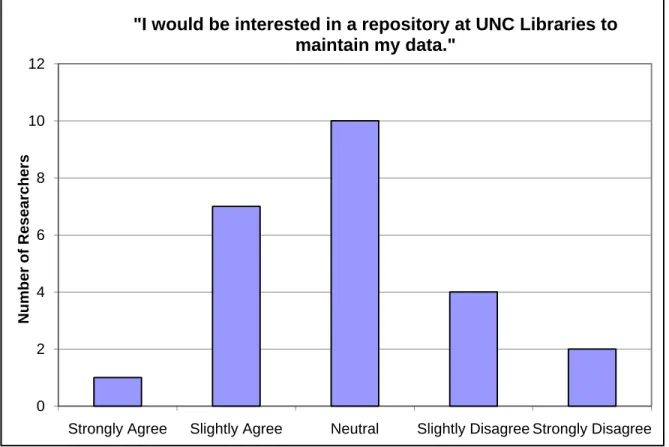
I would be interested in a repository at UNC Libraries to maintain my data.
• Strongly Agree
• Slightly Agree
• Neutral
• Slightly Disagree
• Strongly Disagree
Please use this space to add any further comments about this survey.
The next set of questions moves from a researcher’s data collection and data sharing
practices to broader issues involved with data curation. Questions 20 and 21 ask the
researcher to mark on a Likert scale how comfortable they are sharing data with students,
group collaborators, general faculty within their discipline, department, and university, and
the general public. Our working hypothesis is that the potential effects on publication abilities
will be a major concern for researchers, so I ask this question and after publication. A
researcher’s opinions on data sharing can be translated into goals for a data repository. For
example, a researcher’s comfort level in sharing with the various categories of people will
dictate the security requirements of an institutional repository. Different opinions in pre‐ or
post‐publication would impact when a researcher would want the repository to ingest
material, and if the ingestion should be automatic, or if the researcher would like to control
the ingestion process. Also, both of these questions leave room for free responses, so that
participants can explain the thinking behind their choices.
At this point, the next question (22) asks if the researcher’s data sharing practices are
representative of their colleagues. This is a good way to assess the climate of opinion in this
area. It is also a good barometer to see if the particular issues and concerns of our sample
should be extrapolated to the department at large.
The survey then asks respondents to list barriers that they have encountered when
sharing their own data, or using the data of others. These questions were placed near the end
of the survey in the hopes that the participants would have been primed to think about these
question asks the researcher to think of services that might motivate them to share their raw
data. These questions help provide direction for a potential data repository. If they indicate
that they want a repository, then question 25 reveals important features. If they do not want
a repository, then questions 23 and 24 provide a place to articulate potential reasons and
issues that would need to be resolved before a repository should be considered.
Although these inquiries help determine the data practices and opinions of
researchers, which can indirectly inform the need for, enthusiasm for, and requirements for a
data repository, the last few questions elicit these responses directly. Once again the
researcher is presented with a Likert scale on which to place their interest level in a data
repository at the UNC Libraries. The final questions request their reasons on the repository
4
Results
and
Discussion
This section will present the results from each question. We consider all of the survey
questions but not in the same survey order; rather questions are grouped in similar categories,
which include sample demographics, research and data practices, and opinions. In the final
section will compare how subgroups within the sample felt about a repository at UNC,
compared to the sample as a whole.
4.1
Sample
Demographics
The online survey elicited 31 respondents. Of these, 25 completed the survey, and the
other six respondents proceeded far enough that their results could be included. The majority
of the sample identified themselves as graduate students, 25 in all. There were also three
respondents who called themselves research assistants, two post‐docs, and one faculty
member. Three respondents started their first research project in the 1990’s. The rest of the
respondents fell in the range 2002‐2008, with the median between 2005 and 2006. Of those
surveyed, 20 had also conducted self‐directed research projects. The dates of these first
projects were skewed towards recent years. One respondent indicated 1990, one indicated
2000, and the rest fell in the range 2006‐2009. The median and mode response was 2007. Of
all respondents, 58% (18) estimated that they published one or more chemical papers per
year. The majority of these, 13, published one paper, with four publishing two papers, and
one average four papers. Of the remaining 13 respondents, 29% (9) of them had published
Although we invited all faculty, postdocs, and graduate students, the majority of
respondents were graduate students. The average participant in this study began their
research career in the last few years, and would probably not have published many chemical
papers. This is an important caveat as we try to draw conclusions from the responses.
However, the sample was diverse in the sub‐disciplines represented.
4.1.1 Disciplines within chemistry
Thirty of the thirty‐one respondents provided their specialty. For the respondent’s
field, or fields, of research, the responses were coded into 20 unique categories. Of the 30
respondents for this question, 13 submitted more than one answer. As shown in Figure 1,
analytical chemistry was the most popular result, with nine answers (30%), followed by
biochemistry, with five answers (17%). The other major branches of chemistry indicated were
organic and organometallic, with four each, inorganic and physical chemistry, with two each,
and electrochemistry, named by one respondent. Two respondents identified themselves in
the field of biology. The other results were harder to classify. Two respondents listed
combinations of these sub‐disciplines—bio‐organic chemistry and bio‐analytical chemistry.
We treated these two responses as a separate group. Others used greater specificity. The
following could probably be classified as analytical chemistry: separations (2 responders),
mass spectrometry (2), liquid chromatography (1), and microscopy (1). However, we treated
these as separate categories to show how the respondents classified themselves. Other
0
2
4
6
8
10
12
14
16
Disciplines
Disciplines Within Chemistry
Number of Researchers
Figure 1. Chart showing the number of participants from different chemistry sub‐disciplines.
4.2
Research
and
Data
practices
The following questions elicited how participants collected and used their data, as well
as their general research processes. The first set of questions looked at data specifically (size,
format, and how long data is stored). The next set of questions investigates collaboration,
which is often a necessary precondition of data sharing (how many projects include
collaboration, how many collaborators are on those projects, and how many of those
collaborators come from outside UNC). Another group of questions consider data sharing
(frequency and tools used). The final set of questions gauge their opinions (who researchers
are comfortable sharing data with, the costs and benefits of data sharing, and their level of