Deborah Barreau.
The International Union of Practical and Applied Chemistry (IUPAC) is a digital library that is host to numerous collections and journals on chemistry. In response to increasing demand over the last few years, they want to improve the Iupac.org website. To do so, they must first determine how the site is being used, so that they may make the
appropriate changes that would best improve the digital library. Therefore, the goal of this study is to analyze web usage logs and survey users so that future designs of iupac.org will adequately address the needs of its target audience.
Headings:
Digital Libraries
Surveys
by
Sean M. Slovney
A Master's paper submitted to the faculty of the School of Information and Library Science of the University of North Carolina at Chapel Hill
in partial fulfillment of the requirements for the degree of Master of Science in
Information Science.
Chapel Hill, North Carolina November, 2004
Approved by:
Table of Contents
Table of contents………..1
List of Tables………...2
List of Figures………..3
Introduction………..5
Background………..8
Digital Libraries………...10
International Union of Pure And Applied Chemistry………26
Web Analytics………34
Urchin Web Analytics Software………43
Web Survey with phpESP………..51
Iupac.org Web Statistics………66
Conclusion……….81
Appendix A………....84
List of Tables
Table 1: Question 1 results………55
Table 2: Question 2 results………55
Table 3: Question 3 results………56
Table 4: Question 4 results………56
Table 5: Question 5 results………....57
Table 6: Question 6 results………58
Table 7: Question 7 results………58
Table 8: Question 8 results………59
Table 9: Question 9 results………59
Table 10: Question 10 results………60
Table 11: Question 11 results………61
Table 12: Question 12 results………61
Table 13: Question 13 results………62
Table 14: Question 14 results………63
List of Figures
Figure 1: Iupac.org Website………...26
Figure 2: IUPAC Member Chart………28
Figure
3:
IUPAC Member Countries……….28
Figure
4: Urchin Competition Matrix………49
Figure 5: PHP Survey Results………...52
Figure 6: Internet Domains………67
Figure 7: Lower Level Internet Domains………...68
Figure 8: Countries Visiting Iupac.org………..69
Figure 9: Referrals……….69
Figure 10: Search Terms Used in Referrals………...70
Figure 11: Robots………...71
Figure 12: Browsers and Platforms………72
Figure 13: Sessions………73
Figure 14: Session Lengths………....74
Figure 16: Hits and Bytes………..76
Figure 17: File Types……….77
Figure 18: Summary………..77
Figure 19: Clicks To and From………..78
I. Introduction
The International Union of Practical and Applied Chemistry (IUPAC), is a chemical digital library that is home to collections of specialized journals and articles on chemistry. Over the past nine months, a web programmer was hired to increase the functionality and usability of the site by adding a search engine, forums for users, and creating and
maintaining website statistics. Now that most of these elements have been implemented, the Board of directors at Iupac.org is faced with one question: What should be done to Iupac.org in order to make the site better for its intended audience of chemistry enthusiasts and professionals? In order to answer this question, we first need to know how the site is being used, so that we will know what needs to be changed and what does not.
between this study and the two studies mentioned. Both studies used surveys that specifically focused on aspects of the search engine, while the survey used in this study asked questions about the search engine as well as questions about other aspects of the site, including the collections used and the architecture of information.
The survey complemented the section of the study that examined site usage statistics provided by web server logs to look at what, why, and how people are doing things on the site itself. These statistics will help determine if there are any trends in things such as the average time that people stay on the site, what days/hours of week seem to generate the most traffic, and the most frequent search terms used in the search engine. The other difference between this study and the studies conducted in the past is the statistical package used to analyze the web server logs. A web metrics program called Urchin is used in this research to generate reports and graphs from the web server logs for IUPAC. Studies in the past have used custom analytical packages created specifically for use with their studies, while this one used a commercial statistical application.
The participants were recruited through a mass email and the only inducement that was used to garner their participation was mentioning the potential improvements to the site that could come from their participation in the study. Because the survey was
II.
Background
The first step in figuring out how to study and answer the research question is to do a literature review of previous research in the general area of interest relating to digital library usage. “Scholarly Communication and the Digital Library: Problems and Issues” by Steven P Harter and “Digital Libraries – Some Analog Issues” by Jacob D Vakkayil are articles that cover all facets involved in the creation and maintenance of digital libraries as well as touch on the issues and problems that are associated with them. “Bits and Bytes and Still a Lot of Paper: Astronomy Libraries and Librarians in the Age of Electronic Publishing”, by Uta Grothkopf on the other hand talks about the advantages and disadvantages of digital library usage. It is essential to review this information before even considering how to make an existing digital library better for its potential users.
“Transaction Log Analysis of a Digital Library” by Steve Jones, Sally Jo Cunningham, Rodger McNab and Stefan Boddie, and “Evaluating Overall Usage of A Digital Health Sciences Library” by Michael P DAlessandro, M.D., Donna M.
DAlessandro, M.D. Jeffrey R. Galvin, M.D., William E. Erkonen, M.D. are studies on digital library usage that document and analyze site usage. Each of the studies used web server transaction logs to generate reports on usage and surveys to gauge user satisfaction with search engine results. The methods used in these studies can be replicated to
Finally, given the fact the studies on digital library usage used web analytics software, it will be useful to research the methodology behind such applications. ‘A Survey of Web Analytics’ by Dhyani & Bhowmick, although on the low side of the
practical business use of web analytics, provide good insight as to how the web analytics tools work, which will be discussed in greater detail later on. There were also three other articles which focused more on the practical usage of web analytics, and the importance of businesses utilizing these metrics to help them reach return on investment, which are the following: ‘Web Performance Analytics That Matter’ by Keith Regan, ‘Web Analytics That Matter’ by Susannah Patton, and ‘E-Analytics: Business Analytics For the New
III. What is a Digital Library?
A digital library, also known as a data warehouse, electronic library, or virtual library, is a collection of digital representations of numerous types of media, such as documents, images and sounds that are stored in an information repository and are available either through a local computer network or anywhere via the Internet. They typically support the functions of a traditional library rather than replacing them by providing online methods of searching and browsing for content in an always organized and efficient manner. Naturally, providing materials in a digital format makes the content much easier to manage, store, search for and retrieve. Libraries in the private and public sector, as well as government agencies and educational institutions have realized this, and as a result digital library systems are being adopted at a rapid rate.
Advantages.
In “Bits and Bytes and Still a Lot of Paper: Astronomycomputer based cataloging systems, so more than likely the average person would not have to physically search for materials, but you would still have to physically retrieve it. In a digital library setting, all a patron would have to do is click on the link to retrieve the document instantly. This also makes it much easier for the patron to find exactly what he or she is looking for when they are not sure of exactly what they want. Instead of
physically retrieving each book and skimming through it for content, a digital library can be used to retrieve each book instantly without having to go anywhere, and skim through it at their leisure.
The second advantage is ease of navigation through content. With a digital library, patrons can navigate to specific sections of documents with ease, such as specific chapters, references, graphics or charts, as well as doing searches for specific words or phrases within the documents, making the decision process much easier. It is much more difficult, if not impossible to do the same thing with hard copies of the documents. And again, patrons can do this at their leisure whenever they have the time to do it and have access to the system.
situations it is more desirable for the library to keep multiple if not all editions of a text. However, digital libraries offer a more practical solution in a situation where space is an issue. Given the fact that the texts would be stored digitally, more than likely with each text being in portable data format (pdf) with each chapter being a separate PDF file, adding or updating the content would be as easy as literally opening the file and making the appropriate changes. If space issues were present, and the library could not store each separate edition of the text, it could just simply update the text as new information or findings were discovered. If space is not an issue, the library could easily store each edition of the text with the system.
Ease of referencing is the next advantage, and it ties in with the navigation features of a digital library. Each document stored with the system will list any references that were used during the creation of the document. If the reference is available with the system, it will be available for download or viewing. This feature greatly adds to the overall experience for patrons. With a physical library, if a patron wanted to know more about a topic after reading a book by following up on the references, he or she would have to physically search for it and if the library has it, physically retrieve it. But with a digital library system, all of an article’s or book’s references are essentially a click away.
them for a set period of time. With a digital library, this is not an issue, since numerous people can view the same document simultaneously for as long as they like. Also,
electronic versions of journals are usually available before printed versions are published, and users can browse the contents tables of forthcoming issues, giving digital library patrons an added incentive to browse electronic versions of journals.
Disadvantages.
Despite all of the advantages of digital libraries, thereare just as many drawbacks. Grothkopf identifies reading and browsing issues, bandwidth issues, added expenses to the customer, package, or institution, and added expenses for the library are the four main disadvantages to using a digital library system. Issues such as these are normal when trying to offer content online over a distributed network and are unavoidable. These systems can provide a great service to patrons and enhance the overall quality and effectiveness of a library, but strategies on how to deal with the drawbacks must first be considered before even considering implementing a system.
Bandwidth issues are the next drawback with using digital libraries, and again, it is something that is inevitable. Network/online resource usage and overall performance has a negative or inverse relationship - as the number of people who are simultaneously using the same resource increases, the level of overall performance will decrease. A classic example of this relationship is performance on an online class registration system. At 8 am when the system first comes online on the first day of registration, system
performance is extremely sluggish due to the high volume of users attempting to simultaneously access the system at once. Digital Library systems have the same types of issues, and again, they are unavoidable. Possible ways around this could be to increase the amount of bandwidth that is normally available to the system, which could be
accomplished by mirroring the content available on the system to other servers, reducing the overhead on the system or increasing the overall network throughput to the system.
Criteria for Inclusion.
Every university or institution that has adigital library has criteria for what materials are allowed to be included with the system, since it is not practical to include everything. This criteria usually reflects the interests of the institution that is running the digital library, and since interests vary from university to university and institution to institution, it is rare to find two digital libraries that have the exact same criteria. Rather than generally addressing some of the things that most institutions look for in material that will potentially be digitally archived, the Columbia University digital library will serve as an example. The Columbia University system is a model example for other universities and institutions to follow. Their criteria system, available at http://www.columbia.edu/cu/libraries/digital/criteria.html, is broken down into five main sections: value of material, demand of material, intellectual property rights of the material, preservation of the material, and technical feasibility of hosting material. Materials being considered for digital preservation must meet the requirements of each section before being included with the system.
possible that the material that is being considered to be added may reinforce content on the system that was previously not sufficient to represent a specific topic or concept. And finally, materials that can enhance the image of the institution or university are very welcome, as many institutions take pride in hosting collections or material that is very rare and is unique to the collection.
The second aspect that is looked at is the overall demand of the material that is being considered. Essentially, will the benefits of having this material justify the effort and costs required to acquire and preserve the material? If an institution wanted to create a large collection on the artifacts of the Stone Age, it would certainly want to have
Intellectual property rights representation for the material being considered is the next aspect that is looked at. Does the institution legally have the right to offer the material that is being considered? Can the institution accurately give credit to the individual(s) who created and/or own the intellectual rights to the material? Will the institution have to limit or restrict access to the material based on the intellectual property laws that apply to the material? Can the institution offer the materials in accordance to all applicable intellectual property laws, and will any special provisions have to be made to do so? All of these questions and many more will have to be considered and
researched before making a decision on whether or not to include the material with the system.
The fourth aspect is preservation of the materials being considered. Can the material that is being considered be digitally preserved safely while not causing any damage to it? Some materials, especially old letters and photos tend to be extremely fragile, and any attempts to handle them without extreme care could cause permanent damage. However, there is an advantage to taking the risk if indeed the document is fragile, and it would reduce the overall handling of the material if the digital preservation was successful. In addition, the added benefit would be that patrons would now have access to materials that they would normally not have access to because of their fragility in the past. Will the preservation protect material that is at a high risk of theft or
digitally preserving the document, one could still give people access to the material without putting the material in danger of being stolen or mutilated.
The fifth and final aspect that is considered is the technical feasibility of being able to host the material. Is it technically possible with current technology to capture, present, store and host the material being considered? Will the materials display well in a new digital format? How long will the digital content last before needed a rescan or re-preservation, taking current technology and new technological advances on the horizon? All these questions and many more will be carefully researched and answered before making a final decision as to whether or not the material in question will be included with the system.
Once material is reviewed and meets all the required criteria to be included with the digital library, it is digitally preserved with the system. Depending on the system that is being used by the institution, the preservation process may be as simple as just placing the material on a scanner and scanning it, or as complicated as using advanced software and hardware to prepare and preserve it.
Methods of Preservation.
Digital preservation or digital archivingby Alison Bullock in “Preservation of Digital Information: Issues and Current Status”: migration, emulation, hybrid conversion, or preservation of legacy technology.
Migration is one of the most common ways to digitally preserve materials. It covers everything from copying, converting or transferring digital information from one generation of technology to another one, ensuring the longevity of that information. So for example, copying digital information from a medium that is becoming obsolete or physically deteriorating to a newer one, such as copying information that is on a floppy disk to a DVD is migration. Other examples could be converting documents from one format to another, such as ASCII format to PDF format, or moving documents from one operating platform to another, such as from Microsoft Windows to UNIX.
Emulation, as Bullock describes it is the process of creating new software that replicates the functions of older software or hardware in order to reproduce its
performance. Although not a flawless replication of the original technology, it is enough to provide the intended features and functionality of the content as it was originally available with the original software or hardware. New advances in software and hardware do not necessarily mean backwards compatibility with older technology, and when trying to integrate the two together, librarians quickly realized that it may be necessary to keep legacy systems in order to keep the materials that were dependent on them. Emulation started to gain notoriety mainly as a virtual modeling simulator
where it has a Windows based digital content viewing application, and after switching to a Linux based operation system, the application does not work anymore. Rather than keeping the system that has the original content viewing application, the library could use an emulator to simulate the functionality of the original application on the new system, saving the cost of maintaining more systems than needed, or re-preserving the content that depended on the older application.
Hybrid conversion is a method of essentially taking a document and preserving it in two or more forms of media. This is usually done when you have a document that cannot be accurately archived by preserving it in just one form of media. Although it is not practical to preserve every single document in a hybrid conversion, for some
documents it is the only way to fully capture all features of the document. A classic example of this is creating both microfilm and digital copies of a document to reformat the paper originals of that document. The digitally preserved hypertext copy of the paper document enhances access and functionality of the original, and the microform copy acts as an archival surrogate to the original. However, hybrid conversion has quite a few drawbacks, with added redundancy to the system, something that most digital libraries strive to avoid.
technical support for newer systems, librarians will have to pay the same if not more for the legacy system, something that was probably not taken into consideration during budget planning. Yearly budgets are far from unlimited, and the unexpected costs of maintaining a legacy system could prove devastating to a budget. However, if a library must have the material in its native format with original layout and functionality, keeping the legacy systems may be the only option, and therefore the cost of maintaining the systems would be justified.
Once all materials in a digital library have been digitally preserved, they are placed within the system, and are then available to be accessed by users. Digital library systems range from simple web pages that provide links to digital content, or vast systems like Science Direct, ACM Portal or MetaPress, which provide powerful search functions to help patrons.
Challenges.
Providing materials online or over a network for patrons touse is no small accomplishment. Even after all of the careful planning and testing of a digital library system, there can always be issues that no matter how well the system is implemented. Issues with administration, storage, presentation, classification, and retrieval are the most common. However these issues are challenges to the system rather than disadvantages, because these aspects must be present in a system. Although these aspects are challenges, if handled correctly, they can be a plus with a digital library system.
while personal and private collections have restricted access so that only a single
individual or a select group of individuals has access to it. These measures must be taken in order to protect certain materials from unauthorized access, use or disclosure.
Administrators must also protect the identities of all users, to ensure that users are comfortable browsing not just controversial material, but all materials.
Storage is another obstacle for a digital library system. Most systems use a database of some sort to manage the content, usually a Database Management System (DBMS). There are two types which are normally used in conjunction with digital libraries: relational database systems and object oriented database systems. Whatever system used, it must be capable of storing all the digital material for the digital library, which in many cases tends to be a lot of data, in a variety of formats while providing access to this material potentially 24 hours a day. However, the real issue here is not so much the ability to store every single thing on the system, but rather offering as much of it in quick a period as possible, or at least at an acceptable rate of transfer. Fortunately, there are ways to improve access performance, one of them being compression
techniques.
to improve system performance is to use hierarchical storage mechanisms (HSM). Basically, the way an HSM works is that all data stored on the system are spread across numerous hard drives, more than likely in a redundant arrays of inexpensive disks
(RAID) configuration. Content that is more frequently used is stored on hard drives with faster access speeds to accommodate the more popular content that most of the user’s access, thus improving the performance of the system. System performance is the number one priority with these systems, and because of these requirements, a lot of time and money is invested in these systems to ensure that performance is optimal and that they stay up and running.
resolutions for images or different connection speeds for streamed video media are ideal examples of trying to accommodating all patrons that might visit the system.
Classification of content is the next challenge faced by digital library systems. All content that is collected by the system must be classified with related content into groups before being put into the system. Usually the content is arranged in groups that are intuitive to patrons, so that theoretically they can find what they are looking for. However, given the fact that individual perceptions of what should be grouped where does vary from patron to patron, there will always be users who will not agree with the classification schemes, and as a result issues with groupings usually turn out into endless topics of debate among patrons and librarians alike. In addition, classification can be a slow and extremely tedious process which can lead to exorbitant amounts of material waiting to be indexed.
Information retrieval, which in itself can be a challenge, is something that must also be looked into when offering content through a digital library. There are three ways digital materials are usually searched in a system: searching by subject, full text
document searching, or metadata searching. Out of the three, metadata searching would arguably appear to be the most accurate and effective because of the way metadata is structured and describes content with its attribute fields. But, no matter how
IV. International Union of Pure & Applied Chemistry
Fig. 1. Iupac.org website, Iupac.org 25 October 2004: http://iupac.org
The International Union of Pure and Applied Chemistry (IUPAC) is a not-for-profit international organization that is dedicated to the advancement of the global
terminology, and standardized methods for measurement for chemical and atomic materials. It is responsible for the following standards that are present in modern chemistry today:
• Standardization of the symbols and terminology in chemistry,
• Standardization of atomic weights,
• Standardization of physical constants,
• Editing tables of properties of matter,
• Standardization of methods of data analysis and presentation,
• Standardization of the formats of publications,
• Nomenclature of inorganic and organic chemistry, and
• Data exchange standards for computers and instruments
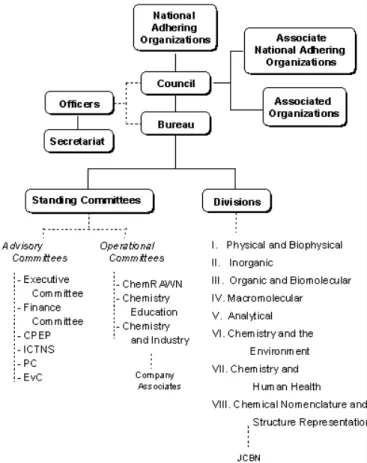
Fig. 2. IUPAC member chart, Iupac.org 25 October 2004: http://iupac.org
The NAO has 45 countries who are members, and the ANAO has 20 member countries. Combined, there are 65 countries and over 1,000 chemists throughout the world that volunteer their scientific knowledge to Iupac, primarily through projects which are in any one of the eight divisions of research that IUPAC specializes in the following:
1. Physical and Biophysical Chemistry 2. Inorganic Chemistry
3. Organic and Biomolecular Chemistry 4. Macromolecular
5. Analytical Chemistry
6. Chemistry and the Environment 7. Chemistry and Human Health
8. Chemical Nomenclature and Structure Representation
Iupac.org, the official website for the organization, is the online digital library which represents the wealth of knowledge that Iupac has amassed over the years.
Infrastructure.
As mentioned earlier, some digital library systems usecustom or proprietary hardware and/or software to run their digital libraries. However, such is not the case with Iupac.org. The IUPAC needs are relatively small compared to corporations and institutions, and can easily provide the content without the need for such hardware or software. IUPAC’s target audience is chemistry professionals and
To satisfy this audience, IUPAC has decided to provide unrestricted online access to chemistry related journals, books and reports.
The procedure for reviewing material for inclusion with the digital library tends to be a fairly simple process. All of the journals and reports are sponsored by IUPAC, so all of them are included in the system. Books are a different matter since not all of the authors are IUPAC-funded scientists. There is a review process, but it is fairly easy for a book under consideration to be included with the system. If a book is being considered for inclusion, it will be approved unless there are some conclusions or views in the book that IUPAC strongly opposes. In any event, once a journal, report or book is given the approval to be included with the system, there is no need to begin a digital conversion of the material, since most of the documents were originally created in either PDF or html formats.
So now that all of the PDF and html files are created, how are they hosted? Representatives from Iupac.org went to Ibiblio.org, a not-for-profit digital archive and data repository and asked for an account with them. With help from the Ibiblio staff, IUPAC was able to set up a website that provides access to all of the journals, books and reports that they own. The setup of the chemical digital library is composed of webpages that provide listings for the digitally archived documents, with each document in the list providing a link for viewing or downloading. All of the documents are organized based on what they are (journal, book or report), and the year they were released.
documents that IUPAC hosts. Therefore, this makes administration of the site fairly simple, and the only issue that comes up every now and a again is spikes in bandwidth with IUPAC’s host, Ibiblio.org, which can lead to reduced performance in the overall site. However, given the fact that the majority of material offered is in a text based format, viewing and downloading is usually fast or at relatively acceptable transfer rate, even in times of high bandwidth usage.
Iupac.org Digital Library.
IUPAC’s digital library, Iupac.org,offers a wide range of digital content to serve the chemistry community worldwide. Members and visitors of the site have access to daily news and announcements in the IUPAC and chemistry community, information about ingoing projects that they are funding, and summaries for sponsored conferences and symposium. However, it is perhaps the digitally archived content that is of the most interest to members and visitors alike. Currently, Iupac.org is home to 124 digital books, 265 reports, and five chemical journals with a combined total of 292 digital issues.
The reports offered at Iupac.org are available from the reports section of the site, and provide download listings that are sorted by division within the discipline of
IUPAC is also home five scholarly chemical journals: Chemistry International, Pure & Applied Chemistry, Macromolecular Symposia, Chemistry Educational
International, and Solubility Data Series, which are available from the publications
section of the site. Chemistry International is the official newsmagazine of IUPAC which provides news about the organization, funded chemists, latest publications in the community, and upcoming conferences. Chemistry International is up to its 26th
volume, with each volume composing a year’s worth of publication, which is six issues. Currently, 42 issues in volumes 19 to 26, which are publications from 1997 to the present, are available online for download in PDF format.
The Pure & Applied Chemistry journal has, since 1960 strived to publish IUPAC recommendations on nomenclature, standardization, collaborative studies and data
compilations. Pure & Chemistry is up to its 76th volume, with each volume composing a year’s worth of publication, which is 12 issues. Currently, volumes 67 to 76, which are publications from 1995 to the present, have a total of 120 issues available online for download in PDF format. Macromolecular Symposia, another journal available at Iupac.org, publishes recent advancements and contributions in the field of
Chemistry Education International, the official newsletter of the Committee of
Chemical Education, is a journal that is for high school seniors and first year college students who are seriously considering a career in chemistry. It provides aspiring chemists with facts and figures about careers in the field, as well as reports and essays from the committee regarding the current and future states of the field. Starting in 2000, the journal is up to its 5th volume, with each volume composing of a years worth of publication, which is 1 issue. Currently, volumes 1 to 5, which are publications from 2000 to the present, at total of 5 issues are available online for download in PDF and HTML formats. Solubility Data Series, the 5th journal offered at iupac.org, publishes compilations of all experimental determinations of solubility discovered by chemistry professionals in both the industrial and public sectors around the world. It also
V. Web Analytics
Companies and businesses invest time and money into creating and maintaining web pages in hope of generating sales or getting people interested in their products. Each organization envisions what it believes to be the best way to advertise and market their products and/or services, and the company webpage is where these ideas take form. However, the marketing of products and services does not end with the creation of the web page; in fact it only begins. Once the web page is up, organizations need to be able to somehow monitor and measure how well the website actually helps or hurts overall revenue, and this is where web analytics comes in. There are numerous metrics that can be computed to figure out how good or bad a web page is marketing products and services, and with some metrics, you can even pin-point your best and worst areas of a web page.
organization, any web analytic package that is selected must itself meet the needs of the analysts that are trying to gauge the effectiveness of the web page.
The Value of Web Analytics
.
Web analytics, also known as web
analytics and e-analytics, is a tool that in the right hands, can be used to make cost-effective decisions. Computing analytics such as net dollar per visitor, customer drop-off rates, loyalty index, and average time spent on the system can prevent costly redesign fees associated with updating a company website. In addition, these analytics can
provide significant reasons for making decisions. Currently in today’s economy, requests for IT spending are usually placed under a lot of scrutiny, and without proper justification for the spending, the proposed IT project will be shelved. But with the information available from these analytics managers will have the justification they need to get the funding needed. As Susannah Patton of CIO.com stated regarding e-analytics and IT spending:
“measuring a website's success can be crucial when CIO’s are forced to defend e-business spending”(Patton 1) But, despite the vast amount of information that is available through analyzing web traffic, many organizations do not take full advantage of what these analytics can offer. Netgenesis, a firm that specializes in web analytics, has stressed over the years how important these analytics are, suggesting they:
Netgenesis, along with other firms and organizations that use web analytics, are a part of a growing sentiment towards the advancement of the importance of web analytics. Companies such as Amazon.com that monitor their web traffic consistently and make decisions based on those analytics tend to do better than those that do not. Keith Regan, of E-Commercetimes.com, sees the need for collecting and analyzing data to increase over the years and has stated that:
“the web analytics sector will be worth US$1 billion annually within three years”(Regan 2).
The Best of The Best.
Once a webpage is setup and is receivingregular traffic, managers will then want to purchase a package that will analyze the traffic and compute analytics, but which one should be chosen? As mentioned earlier, there are numerous packages available that can do the job, but according to E-Consultancy, a firm that specializes in web analytics and business intelligence, the general rule of thumb for purchasing a web analytics package is that large companies should purchase in-house software, and mid-size or small companies should purchase a hosted service. Based on that principle, E-Consultancy has identified what it believes are the five top leaders in providing web measurement and analytics solutions, which are the following:
Unfortunately, the web analytics solution that Iupac.org utilizes, Urchin, is not in this list. In fact, it is not even in the top ten, according to E-Consultancy. However, it should be noted that although E-Consultancy is not the only firm that specializes in web analytics and business intelligence, they have amassed an impressive reputation over the last couple of years, and their views and opinions are valued very highly in the business intelligence community, due to their team of talented and respected analysts and
scientists from the mathematical and statistics community. In any event, that is not to say that Urchin is not an exceptional application, it just means that perhaps it has not
garnered enough exposure to the community to be recognized as a leader.
Clickstream is a commercial log analysis tool that monitors a visitor’s clickpaths, which is the route that visitors choose when navigating or “clicking” through a site. At any given time, a web analyst can see all the pages viewed by any given visitor, presented in their succession of mouse clicks, which is the order the pages were viewed. From this information, an analyst can tell when and where a person came in to a site, all the pages they viewed, the time they spent on each page, and when and where they left. Like all commercial log analysis tools, they are on average more accurate and supply significantly more information, but at a high price.
of frustration with existing website analysis tools, and as a result appears to be a great success not only in the US, but in Europe as well.
Nedstat is a subscription-based, hosted web analytic tool. This means that an online server runs the package and all of the information it records is kept on a server. Because the service is hosted, the package can provide you with information 24 hours a day in real-time. Nedstat essentially provides the same level of service as Clickstream, however since it is a subscription based service, the price is significantly cheaper in the short run than any commercial log analysis tool.
WebAbacus is another commercial log analysis tool that monitors user clickpaths. It provides the same features as Clickstream and Clicktracks, but it does one thing that the others do not; it provides possible routes of action in e-commerce, marketing, and knowledge management based on what information is tracked in the log files. This feature makes this package live up to its name.
WebTrends is again another commercial log analysis tool that monitors and logs user activity on WebPages. Somewhat similar to WebAbacus, it provides information in detailed segments such as e-commerce, marketing, merchandizing, content and
Choosing the best web analytic package will make it much easier to determine what should be done to Iupac.org in order to make the site better for its intended audience of chemistry enthusiasts and professionals.
Findings Based On Comparison.
After researching eachpackage by going to its website and reading reviews on its performance, it is easy to see that most packages offered the same kinds of services, and there was always one service that they excelled in or put the most emphasis or effort towards.
Nedstat was the only service that was an Application Service Provider (ASP) only hosted package, meaning that the software does not need to be installed on a machine, but this also meant that if the server hosting the service was down, the service would not be logging all activity, and that is what was frequently happening, according to reviews of customers. Although Nedstat performs most of the standard features of web analytic tools such as reporting, analyzing and monitoring web traffic, and its two areas of excellence are low price and multi-language support. But there are also issues about whether or not the data being displayed is correct because of lapses in web monitoring due to server downtime.
recording user activity is much more efficient than gathering web logs from various servers and other locations. Which is better for a website depends on the preferences for information retrieval and system architecture. Using tags in WebPages to monitor user activity is certainly a more efficient way of monitoring, but if the architecture does not support this, then Webtrends has lost its advantage.
ClickTracks, was the leader in path analysis, which is strengthened by their emphasis on simplicity and straightforwardness. This is done by making as many screens and features utilize as much graphical content as possible. Their main goal in designing a system was to make it so that anyone could understand it, since there have been
considerable complaints about these systems being too complex and hard to understand. The last package, WebAbacus, features robust reporting power, which is its biggest strength. It has a reputation of being able to provide powerful custom reporting and data manipulation, automatic alerts for analytics that need to be addressed based on
monitoring, and the ability to provide suggestions for courses of action based on recorded data.
Now that all of the top five clients have been introduced and compared which is the best web analytic tool available? Any of the four web analytic tools, ClickStream, ClickTracks, WebAbacus, and WebTrends are worthy solutions, so the choice depends on what the focus for the your system. If user tracking is most important, then
Challenges Associated With Analytics.
Although thepotential benefits of utilizing web analysis software appears to be limitless, further research into the current state of the field proves otherwise. There are four challenges that are associated with web analytics. The first is an overall lack of analytical
professionals to analyze the results. Just because the software is generating results does not necessarily mean that anyone can interpret the results, despite what the vendors say. An individual who has the ability to consider all the possibilities behind why certain results were computed is needed, since the same set of data can be interpreted hundreds of different ways. It is impractical to purchase any one of these packages without someone who is competent in that area to properly analyze the data.
The next challenge is industry standards for web analytics. Currently, there are no benchmarks for excellence in the field, so when organizations analyze the results generated by their web analysis applications, they have nothing to compare or test it against. This can prove to be frustrating considering the amount of time and money invested into computing web metrics. Although there are annual conferences and summits on what constitutes excellence in the field, scientists and vendors from all over the world have not been able to agree on a set of standards. And not having an industry wide standard for excellence makes upper management wary of investing in these applications.
organizations on the idea of how these applications can not only benefit them, but also generate a profit at the same time. And given the three previous challenges just
VI. Urchin Web Analytics Software
Urchin v.5, the web analytics package that is used by Ibiblio.org, which is the host of Iupac.org, retails for $895.00, which includes the base license for use of the package. It is primarily intended for Internet Service Providers (ISP) and large corporate web sites to handle all log analysis for generating web statistics. It features a browser based online reporting system, multilingual functionality, and runs on 15 different variants of UNIX, Windows NT, Windows 2000 and even Cobalt, a legacy programming language.
Urchin, despite its lack of notoriety, provides features and levels of functionality that are beyond the details of most other web analytics packages. Because of this, the information provided by Urchin gives management and clients alike the ability to make informed decisions about how to advertise or organize content on their web sites. Most web analytic software packages are able to provide detailed reports on web statistics areas such as the total number of page views, hits, visitors, bytes transferred, entrance pages visited, exit pages visited, top pages visited, search engine keywords used, browser types, computer types and referrals.
encompasses a goal. Goals in Urchin can be tracked rather easily, such as number of times a visitor comes to a specific page and the length of time it takes each user to reach that particular goal. In addition, with the E-Commerce and the Campaign Tracking Modules, which are part of the UTM, each web page on a site can be fine tuned to increase the overall success rate for that individual page and the entire site.
How a visitor stumbles upon a site is just as important as what actions the visitor took after arriving at the site. Referrals, which are the methods to which a visitor
discovers a site, can prove to be very useful in determining user actions in Urchin. The information that Urchin processes from each referral can provide invaluable data on where the user came from, such as another website or a search engine. Additionally, the information provided from each referral can be further processed to determine which web sites and search engines brought a site the most traffic and even which keywords the visitor used on a search engine to find a site.
In the end, most web sites need analytic software packages like Urchin that can tell them how and why visitors are coming to their sites, and what they are doing once they get there. And knowing how and why visitors behave in specific ways is a benefit that is invaluable to an institution or organization.
Benefits
.
General benefits of using any web analytics package are the
following:
• Automated report generation, which means no need to manually produce reports;
• User and referral tracking, which helps determine what users are doing on a website, and where they are coming in from;
• Search engine reports, which helps determine which search engines provide traffic to a website and what are the keywords that visitors used while trying to search for a website; and
• Real-time web statistics, to see what is happening on website as it happens, as opposed to hours or sometimes days later.
The specific benefits of using Urchin however mainly affect management, web developers and IT staff responsible for maintenance on web servers.
For management, the first benefit is reducing the overall management burden, because Urchin in a sense coordinates integration of all of the different data tracking processes to produce accurate reports. Imagine for example each data tracking process is a department or team in a company. After tens, maybe even hundreds of these
departments finished collecting data, they would then be going to a department head or manager to coordinate the integration process to create one massive report. That is no small feat, and the management overhead for an integration of that size would be massive. But with Urchin it is a simple task.
that is highly valued by management, and the built in features in Urchin make it as easy as pointing and clicking to find this information. And finally, learning more about an organization’s primary visitors and how to retain them is the last benefit to management. The detailed reports provided by Urchin allow management to see who is normally visiting the website, and specifically where and when visitors are coming in and leaving. Information like this makes it much easier to potentially focus in on areas of the site that generate the most traffic and referrals, and areas that are generating the least amount, to maximize traffic on all levels of the site.
provided in usage and e-commerce reports will make it even easier to decide how good or bad a decision was.
IT staff responsible for web server maintenance is the last group of people that directly benefit from Urchin. The first and maybe the most useful benefit is being able to track down and fix outdated or broken links, redirect errors and referral errors. Again, given the fact that Urchin is an all purpose tool, IT staff can use one single tool to do all of these tasks, as opposed to either using free or fee-based online or offline tools to do this task. It is a nice bonus to the people who are considering which web analytics software package to buy, since it provides so many useful web site maintenance tools in addition to the main statistical reporting features which are standard. Minimizing server resources for web analytics is the next benefit to IT staff. Again, with Urchin being a single all-in-one solution to a statistics problem, the IT staff will not have to run numerous statistical applications to get the same detailed information. And this in turn means an overall reduction of server resource overhead, which is good for the IT people and good for management, since they will not have to buy any more servers to meet the demands of the statistics initiative.
could be possibly used as something to compare their own results from other bandwidth and usage utilities that they use.
Features.
Urchin Software Corporation has provided a very detailed andexhaustive list of all features and functions at
http://www.Urchin.com/products/v5/feature_list_master.html. A complete list of the features of Urchin is found in appendix a.
Comparison Against Competition.
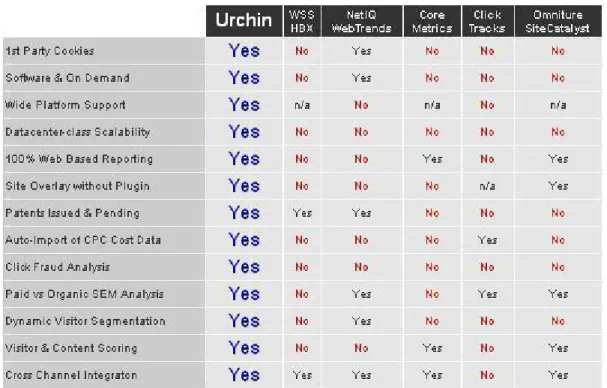
So, how does Urchin,which is marketed as an enterprise level application at a mid-market price, stack up against other web analytics packages? Well, to answer this question, the Urchin Software Corporation first came up with 13 aspects that they feel a successful analytics package should have, which are the following:
1. 1st Party Cookies 2. Software & On Demand 3. Wide Platform Support 4. Datacenter-class Scalability 5. Web Based Reporting 6. Site Overlay without Plugin 7. Patents Issued & Pending 8. Auto-Import of CPC Cost Data 9. Click Fraud Analysis
12.Visitor & Content Scoring 13.Cross Channel Integraton
Then, in order to make this a fair comparison, they picked other packages that they felt were in the same league as them, which are the following: WSS HBX, NetIQ WebTrends, Core Metrics, ClickTracks, and Omniture SiteCatalyst. Ironically, 2 out of the 6 chosen, WebTrends and ClickTracks, are in E-Consultancy’s top 5 web analytics packages, which was mentioned earlier. Finally, they provided a competition matrix which shows how they compare against these 6 packages, which is displayed below:
Fig. 4. Urchin Competition Matrix, Urchin.com 25 October 2004: http://www.urchin.com/products/v5/matrix_competition.html
VII. Web Survey with phpESP
The best way to approach answering the question of what should be done to iupac.org in order to make the site better for its intended audience of chemistry enthusiasts and professionals would be to do a survey of users to gauge the overall satisfaction level. After a bit of searching, phpESP, an open source survey tool emerged as being the best option to create and distribute the survey.
phpESP provides a way to create and administer web-based surveys online. It also has an administrative component which allows owners of surveys to view the results of each survey. In addition, every time a respondent submits a completed survey, an email notifies the owner of that survey. As stated earlier, phpESP anonymously stores participant responses in an online database. Each response is identifiable only by a unique survey number, which can in no way identify the specific respondent who completed the survey.
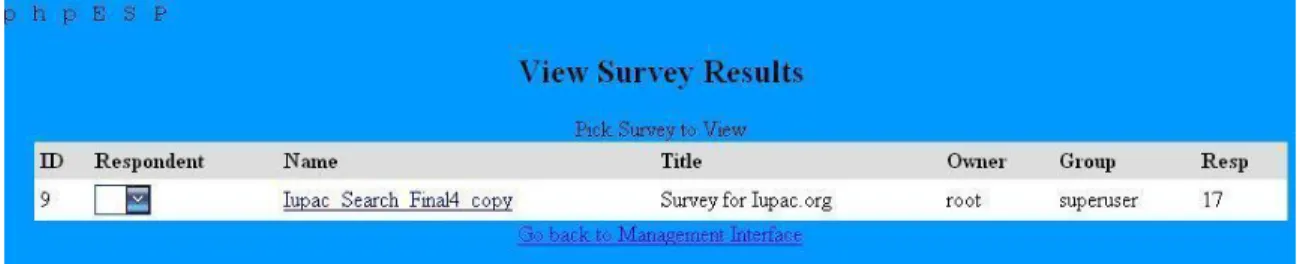
contacted, 17 responded back.
Fig. 5. phpESP survey results.
Questions.
When the survey went online on October 7th, the followingquestions were included:
1) Are you a member at IUPAC? 1 - Yes
2 - No
2) How often do you visit Iupac.org? 1 - rarely
2 - sometimes 3 - often
3) How often do you use the search function at iupac.org? 1-never
2-rarely 3-sometimes 4-often
1-poor 2-fair 3-good 4-excellent
5) Do you have any problems using the search function?
-open ended
6) Do you feel that the search function returns the appropriate results?
-open ended
7) How many times do you usually have to do a search before you find what you are looking for?
1- 1 to 2 times 2- 2 to 5 times 3- 5 to 10 times 4- more than 10 times
8) How many pages of results do you usually go through before you find what you are looking for?
1- 1 to 2 pages 2- 2 to 5 pages 3- 5 to 10 pages 4- more than 10 pages
1- the terms used in my search were not sufficient 2- the search function itself
3-other
10) Are there any things you would like improved with the search function?
-open ended
11) How would you rate the content available at IUPAC? 1-poor
2-fair 3-good
4-very good
5-excellent
12) What sections of Iupac.org do you visit the most?
-open ended
13) Do you think that it is easy to navigate through the site to find what you're looking for?
1- yes
2- no
14) Are there any sections of the site that could be improved?
-open ended
Here are the results of each question, followed by initial comments and observations on the results.
Table 1. Question 1 results.
As predicted, more members of IUPAC participated in the survey, but it is surprising that the percentage between members and non-members would be so close, as it is 58.8% to 41.2%.
Table 2. Question 2 results.
Table 3. Question 3 results.
The majority of the participants, 52.9% sometimes used the search function, while 29.4% rarely used the search function, and 11.8% used the search function often. The one respondent who said that he never uses the search function was a non-member. This is not much of a surprise, but then again, one would assume that since the respondent that said that they rarely visit the site was a member, it can also be assumed that the
respondent that said that they never use the search function would also be a member, if not the same respondent who answered “rarely” for question 2. Cross tabulating the results based on member affiliation, the majority of members, 50.0% sometimes used the search function, and the majority of non-members, 57.1 also sometimes used the search function.
Table 4. Question 4 results.
was good. But it is interesting that no one thought that it was excellent. The percentages for fair and poor ratings for the search function are not a surprise. In any event, after cross tabulating the results based on member affiliation, it was found that the majority of members felt that the search engine was good, whereas all of the non-members felt that it was good as well.
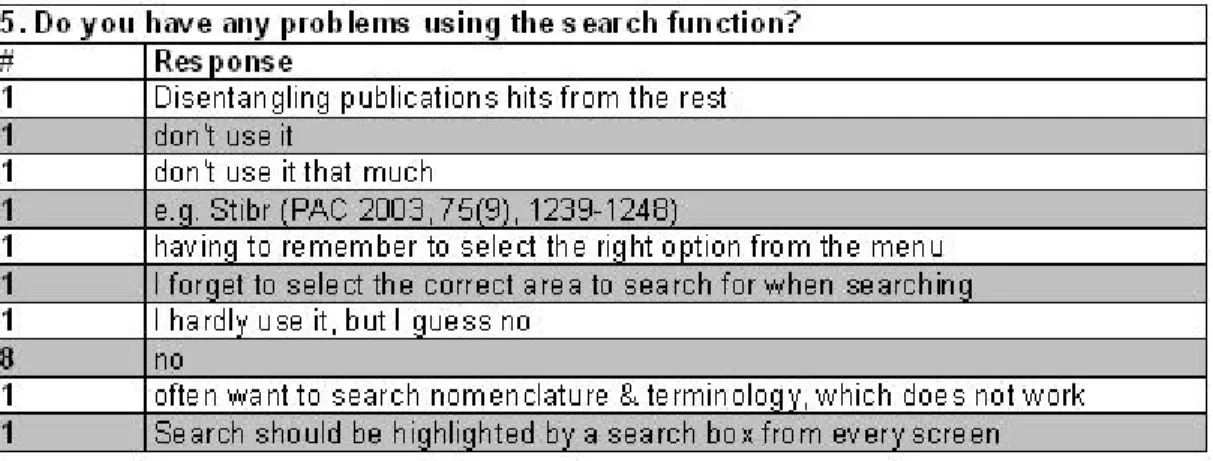
Table 5. Question 5 results.
Table 6. Question 6 results.
As expected, it appears as if the majority of respondents to question six felt that the search function does indeed return the correct results. Cross tabulation of results by member affiliation showed that 77.8% percent of members felt that the search engine does yield correct results. Out of the non-members, after throwing out 2
responses(“don’t” and “I don’t know”), 5 of them felt as if the search did indeed return the correct results.
Table 7. Question 7 results.
searches. Cross tabulation of results based on member affiliation showed that the majority of members, 60%, performed a search 2 to 5 times, and the same applied to the non-members.
Table 8. Question 8 results.
The majority of respondents searched through 1 to 5 pages of results to find what they were looking for. It is interesting to note that the numbers were split so evenly for the majority response between “1 to 2 pages” and “2 to 5 pages”. Cross tabulation of results based on member affiliation showed that the majority of members searched through “2 to 5 pages” of results, and the same applied to the non-members
Table 9. Question 9 results.
respondents neither blaming themselves nor the search function itself. And after cross tabulation of results based on affiliation, it was discovered that the majority of members felt that it was the search terms used that were the main cause for undesired results, whereas the majority of non-members felt that it was the search engine itself that was at fault for returning undesired results. The one person who blamed undesirable results on the content that is hosted on Iupac.org was a member.
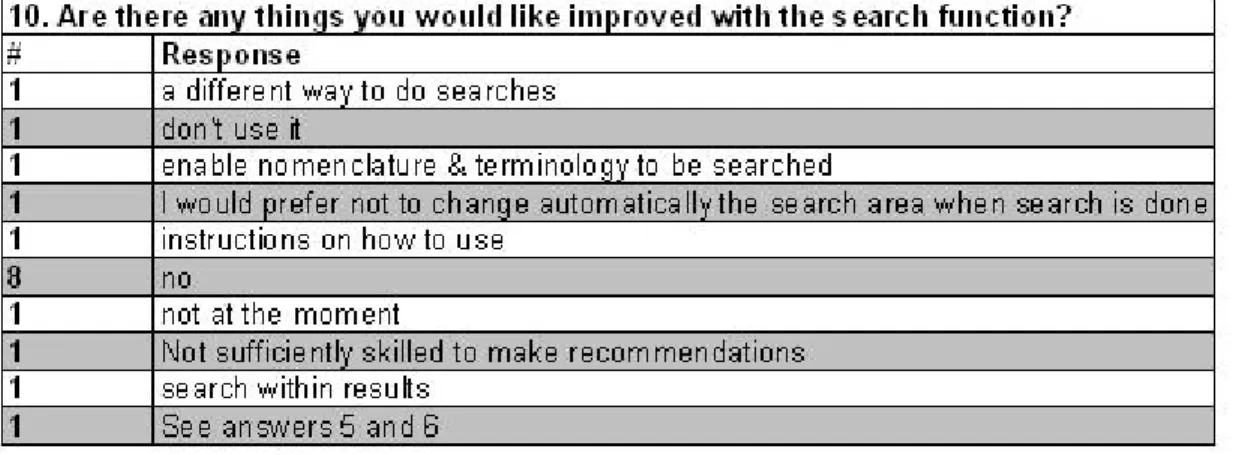
Table 10. Question 10 results.
Table 11. Question 11 results.
The majority of respondents had favorable views of the content provided by IUPAC. Cross tabulation of results based on member affiliation showed that the majority of members felt that the content at Iupac.org was good, whereas the majority of non-members felt the content was either very good or excellent. It is an educated guess that the members of IUPAC are harder to please as far as content is concerned, and that may be why they were less impressed with the content than non-members.
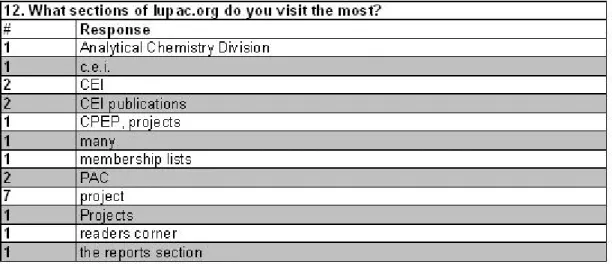
Table 12. Question 12 results.
Readers Corner area, as well as Reports and PAC, one could also say that the most visited section of the site is the Readers Corner area. Cross tabulation of results based on
member affiliation showed that the members visited the Reports section the most, while the majority of non-members visited the CEI area of the site.
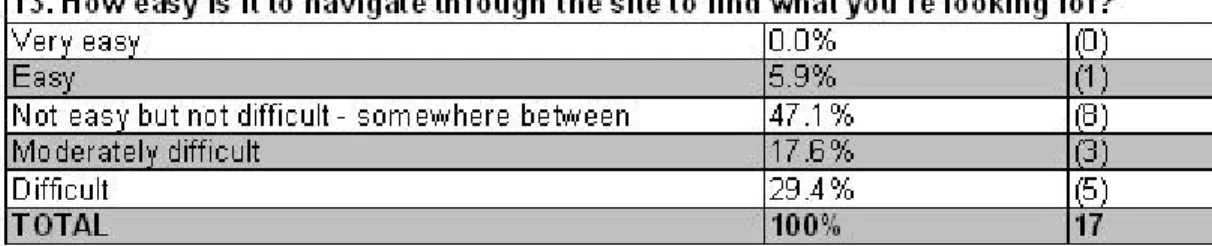
Table 13. Question 13 results.
Table 14. Question 14 results.
Table 15. Question 15 results.
Given the fact that this last question was a general suggestions or comments question, the varying results are not a surprise. Participants suggested or commented about the navigation, the search engine, and the overall site design. Again, as mentioned earlier, all suggestions and comments will be taken into mind when looking at
recommendations for improving the site.
Preliminary
Observations.
So, what does this survey say aboutnon-members felt it was the search engine itself. Ironically, the majority of respondents did not feel that the search engine needed to be improved, but there were some who
suggested that instructions on how to use it are needed.
As expected, most respondents had very favorable reviews of the content
available at Iupac.org, although non-members thought more favorably of the content than the majority of members. As also expected, since Iupac.org is home to so many
chemistry related publications and books, it was no surprise that a vast majority of
VIII. Iupac.org Web Statistics
Now that the voice of the users of Iupac.org, both member and non-member was heard, it is useful to see if what they said about their experiences on the site was the same as what they were doing on the site. Once the survey results were analyzed and compiled, the next step was to analyze the web server logs to determine user behavior on the Iupac.org. User activity was limited to October 7,2004 to November 6, 2004, roughly around the time when the web survey was distributed to the participants of the study. Before beginning, here are a few terms that one should know before looking at these statistics:
• Session: A series of hits to the site over a specific period of time by one visitor.
• Pageview: A request to the web server by a visitor's browser for any web page; this
excludes images, JavaScript, and other generally embedded file types.
• Hit: Any successful request to a web server from a visitor's browser.
• Bytes: The quantity of network bandwidth used by the files requested during a
specific date range.
Fig. 6. Internet domains.
Domains.
Looking at the results (figure 6), excluding visitors who haddomains that were not able to be identified (“no entry” on the chart), most of the visitors were from the .com, or commercial business domain name, with .net (network
Fig. 7. Lower level internet domains.
Excluding the “no entry” results for users who had domains that were
Fig. 8. Countries visiting Iupac.org.
Looking at the top ten countries of visitors that come to Iupac.org (figure 8), It would appear as if The United Kingdom, Canada, Germany, Australia, Japan and France are home to IUPAC’s most frequent users. But then again, it is possible that a large percentage of the .com, .net and .edu domains could be U.S. visitors.
Referrals.
Referrals are URLs that bring traffic to a website, whether it be awebsite or a search engine. Looking at the results, it would appear as if the majority of referrals are Google searches from the U.S., Canada, United Kingdom, France and Australia, with the rest of the referrals coming from Yahoo and MSN searches.
Fig. 10. Search terms used in referrals.
Not surprisingly, the top ten search terms used in referrals, shown in figure 10, shows that the number one search term (excluding the “other” result at number one) is “iupac” and that “pure and applied chemistry” is number three. Naturally this makes sense, and it should be noted that since the majority of respondents stated that they visited the “Readers Corner” section of the Iupac.org the most, which is composed of
that are identified as other are terms that are not strings, so it is possible that the “other” searches could be searches where a visitor did not type in a search term.
Fig. 11. Robots.
Robots. Robots are the spiders or “web-crawlers” that are used to search
content in a domain and return the results to a search engine for reference. Search engines frequently use this technology to determine what a website has to offer, and then indexes the data from the web-crawling to use with their searches. Figure 22 shows the top ten robot technologies used on Iupac.org. Not surprisingly, the Google robot
Fig. 12. Browers and platforms.
Browsers.
Users of Iupac.org primarily used Internet Explorer as their webFig. 13. Sessions.
Traffic.
The first aspect of traffic that was looked at was the number ofFig. 14. Session lengths.
Fig. 15. Pageviews.
Pageviews, which again is a request to the web server by a visitor's browser for a web page, averaged 24,839.35 a day, with the lowest Pageviews per day being 13,877 and the highest being 37, 218. The most popular pages were the main page to iupac.org (“/”, “/dhtml_home” – a DHTML menu driven version of the main page, and
viewed, since the majority of respondents in the web survey stated that they visited that section the most.
Fig. 16. Hits and bytes.
Fig. 17. File types.
Taking a look at the breakdown of file types on Iupac.org, it is no surprise that the site averaged 939.58 megabytes transferred a day, considering that 76% of the files available are PDF files, at a total size of 21.62 gigabytes.
Fig. 18. Summary of sessions, pageviews, hits and bytes transferred.
Click Paths.
Click Paths, which are the route that a visitor takes whileFig. 19. Clicks to and from.
As expected, most users go to the publications section after coming into
Fig. 20. Query search terms.
Search Queries.
Search queries, or the keywords used on the Iupac.orgIX. Conclusion
What should be done to iupac.org in order to make the site better for its intended audience of chemistry enthusiasts and professionals? First, looking at what offered and visitor feedback, it seems clear to see that content does not have to be added or removed from the site. However, the organization of that content is something that will probably have to be addressed. Although the majority of participants felt that Iupac.org did not need any improvements, suggestions were primarily associated with the organization and navigation of the site. Among the suggestions were a better navigation menu, an easier to read publication list display, and journals in HTML format as opposed to PDF format. Given the large size of Iupac.org, it could certainly benefit from a better navigation system, possibly by adding a path or tree aspect to the navigation to let visitors see where they are on the site and where they can go.
he was looking for, and another one said that he had to search through a lot of the site to find things, since the navigation was not clear about where things are. The publications section also needs to be refined as it was ranked by Urchin as the number one destination that visitors of the site go to after entering the main page. One possible way to refine that section is to make aesthetic changes to the area, to make it more attractive to the large audience of people who already come there, and to possibly attract a new audience, as well as possibly offering different versions of the index and journal files themselves. The FAQ section could also be refined by essentially keeping it up to date and making
frequent changes to it based on user feedback. Therefore, it would be a good idea to offer a separate feedback and comments page, as opposed to having it as part of the “Contact” section. One of the participants stated that he had trouble using the search engine, and felt that instructions should have been provided. That is something that could easily be remedied by offering a section about the search engine in the FAQ.
Finally, Iupac.org would be better for its intended audience of chemistry
enthusiasts and professionals if the search engine, were refined. Search was one of the 4 most popular areas of the site, according to participants and Urchin. Participants of the survey wanted the search function to be able to search within more areas of the site, mainly the nomenclature and technology section. In addition to a set of instructions on how to use the search, participants also wanted the ability to search within the results of a previous search, to potentially provide an even higher level of search accuracy.
However, it should be noted that the most participants did not have any problems with the search function, and web analytics of average searches done by visitors of the site