2012. 93 pages. Advisor: Paul Jones
This study uses a mixed methods approach to evaluate the information sharing behavior of Transition Initiatives, place-based organizations that work to improve the
environmental sustainability of their local communities. Research questions center on the presence or absence of non-hierarchical methods of online communication and sharing. The study also looked for evidence of “resilient” and “diverse” practices in knowledge sharing through and beyond organization websites.
A content analysis of thirty web sites and four supplementary interviews with Transition Initiative organizers suggest that these organizations share information in a wide variety of ways both on and off the web. While the use of particular website platform types by individual groups appeared to have had some impact on how information was shared and how many participants authored content, observed social effects on information sharing were more numerous than structural ones.
Headings:
Information sharing
Electronic discussion groups Information society
Content analysis (Communication) Environment
BUILDING LOCAL KNOWLEDGE ON AND OFF THE WEB: INFORMATION SHARING AND THE TRANSITION TOWN MOVEMENT
By Madeline Veitch
A Master's paper submitted to the faculty of the School of Information and Library Science of the University of North Carolina at Chapel Hill
in partial fulfillment of the requirements for the degree of Master of Science in
Library Science.
Chapel Hill, North Carolina April, 2012
Approved by:
Table of Contents
Introduction………3
Emergence and Complex Systems Theory………4
Research Approach………8
Literature Review……….10
The Ecological Crisis and Discourses of Transition………10
Transition Towns……….………….………14
History.……….………17
Structure………18
Critiques and Responses………21
Community and Theory………26
Communities, Engagements, and ICT .………28
Social Movement Organizations and ICT………34
Methodology….………38
Content Analysis………..………….…38
Study Design………40
Challenges and Solutions……….…47
Interviews……….………49
Discussion………50
Participatory Process and Pragmatic Hierarchies………50
Organizing and “Letting Go”………..53
Transition Initiative Web Use………58
Diversity and Information Sharing………62
Online / Offline – Information Sharing and Resilience……….65
Local vs. Global: TIs as Place-Based and Transnational………..72
Conclusion……….77
References……….…81
Appendix A: List of Official United States Transition Initiatives………87
Appendix B: Call for Participants……….……90
Introduction
The Transition Town Movement is committed to getting things done. Sprung from a desire to meet the dual challenge of the climate change crisis and peak oil issues, individual Transition Initiatives (TIs) create local projects that increase the resilience of their communities. Among these undertakings are community gardens, local health care directories, workshop series, and local currency projects. Although its roots are firmly planted in environmental politics and permaculture principles, the Transition Town (TT) Movement is neither a “social movement organization” in the traditional sense, nor a fully formed philosophical model. It is one of a host of contemporary organizations using both in-person and techno-mediated communication to create place-based changes that envision “around” a host of environmental and economic problems facing
contemporary societies.
According to Michael Buckland, “information-as-process is situational,” which is to say that information is determined to be information by contextual factors such as “pertinence,” “probability,” and “importance” (1991, p. 356-357). In the case of Transition Initiatives, one might also suggest that certain values play a role in what is considered “information,” or perhaps even “knowledge.” While the global TT Movement does have lead organizers, it is the information sharing of individuals in place-based TIs that create real change in communities. There is high value placed on participation and diversity of approach among these groups, which can be observed in TI website
This study looks at how Transition Initiatives share information, particularly through the websites they create. It seeks to explore the following trio of questions related to the structure, philosophy, and geographical nature of information sharing by TIs:
(RQ1) How do Transition Initiatives make use of horizontal or
non-hierarchical modes of information sharing and knowledge creation? Is there evidence of these practices in the digital spaces they create?
(RQ2) What role does “diversity” play in creating resilient “spaces” for knowledge both online and in the physical world?
(RQ3) How are “local” and “global” defined in theory and practice of Transition Initiative projects?
The first and third questions employ language and theoretical concepts drawn from interdisciplinary research about the organizing and communication behaviors of social movement organizations. The second question draws on the language of the Transition Town Movement itself to explore how a values-based investment in diversity and resilience might manifest in the information sharing performed by TIs. To better contextualize these inquiries, the following section will situate this use of language and concepts within the larger theoretical premise that systems (including information systems) are complex and reveal emergent social behavior. A subsequent section of the introduction will provide a brief overview of the study and address its purpose and limitations.
Emergence and Complex Systems Theory
creators and the ability to access and employ appropriate tools for disseminating information to the rest of the group or community at large. Horizonality refers to
organizing methods that allow all participants to take active and engaged roles in agenda setting and decision-making in social movement work. Occupy Wall Street is one example of a group (or groups) that have recently practiced horizontal organizing (Feldman, 2011).
Both of these concepts can be linked ontologically to notions of emergence and complex systems theory. These models were first developed in the sciences, and have recently been applied to phenomena like the Internet and global movements for change like the alter-globalization movement. Johnson (2001) defines a complex system as one “with multiple agents dynamically interacting in multiple ways, following local rules and oblivious to any higher-level instructions” (p.19). Emergence might be defined as “macrobehaviors” that results from a complex system at work. These theories suggest a view of the world that privileges the collective action of individuals who move toward new ways of being under their own power, rather than at the suggestion of a leader or authority figure. In the field of biology this emergent behavior has been observed in slime molds, which coalesce from single-cell existence into a mass when the
environmental conditions are optimal for cooperation (Johnson, 2001). No leader directs this behavior; every cell makes its determination independently, though that
determination ultimately leads to highly collective action.
non-hierarchical. Individual groups with specific struggles for liberation from corporate imposition have created place-based movements that feed into a larger, “global” conversation in which no single narrative dominates yet there is great resonance and complimentary calls for a better world. Many of these groups are involved not only in mounting opposition to oppressive economic models, but also envisioning new ways of being that might replace them. With as many different approaches as there are locales, these groups act to “dissolve power” rather than seizing it, as advocated by Holloway (2010) among others. In We Are Everywhere: The Irresistible Rise of Global
Anticapitalism, the authors frame this emerging form of resistance and re-visioning in
mathematical terms, echoing back to the scientific expressions of complex systems theory:
“A dynamic geometry of social struggle is emerging, fractal-like, where local autonomy is repeated and magnified within networks that overflow geographic, cultural, and political borders.” (Notes from Nowhere [organization], p. 111) While the central leadership of the TT Movement has created texts and procedures for local TIs in a manner its critics have found to be somewhat hierarchical, there is an emergent and fractal quality to the growth of TIs. They arise of their own accord as grassroots organizations, developing a uniquely local set of concerns, objectives, and projects. If one were to take a wide view of TI accomplishments, they would appear as clusters of distinct local achievements within a larger framework of ecological transition. Whether this translates into high levels of local participation and horizontality in the digital spaces TIs create is central question to be explored through the present study.
theoretical framework for understanding information in its contemporary forms, not as “media message[s]” that move in a linear fashion from “sender to receiver” but as a “meshwork of overlapping cultural formations” (p. 1). These information meshworks encompass local to global spaces, as well as the complex virtual “space” of the web, which reflects not only a collapsed geography and temporality, but also an unprecedented dynamism of movement.
Working to unravel Claude Shannon’s assumptions, which define information through measures of communication and materiality, Terranova has explored how information may be conceived not only as a “thing” which may be copied, shared, or disseminated in a controlled way, but as a force inseparable from the “information milieu” in which it exists. Created within a given topology, its “massless flow” in turn affects the typology itself, shaping the “network of networks” that makes up the Internet (p.41-42).
information, this study accepts the premise that information cannot be easily separated from the social and technological environment in which it was forged.
Research Approach
This study includes a content analysis of websites produced by individual Transition Initiatives, which allows for examination of the use of particular website features both in relation to the research questions, and to a similar study of United States social movement organizations performed by Stein (2009). The content analysis has been augmented by a small number of interviews intended to reveal more of the “real world” information sharing practices of TI participants, as well as needed background on how TIs have organized and negotiated their online information sharing.
The literature review explores several discrete bodies of scholarship that situate this inquiry at a juncture between information science, communication studies, and the interdisciplinary study of social movement organizations. While it may not be
knowledge. Within this new framework, libraries would serve as “hubs” for knowledge shared by community members and unique to their geographic locales.
Literature Review
The following literature review, which is far from comprehensive, presents an effort to explore several discrete areas of scholarship relevant to the study of information sharing among TIs. The first section situates the Transition Town Movement within a larger ecological crisis and contrasts the response from more traditional environmental activist organizations with place-based and action-oriented groups like TIs. The next three sections present a short overview of the philosophy, history, and structure of the TT Movement, after which I discuss the critiques and responses to this distinctive organizing approach. The final three sections explore the theoretical issues and research trends in the study of how communities and organizations engage with information and
communication technologies (ICT). The literature presented here crosses several disciplines including information science, communications studies, and sociology.
The Ecological Crisis and Discourses of Transition
projects 20-30% extinction rates, unabated natural disasters, food shortages, and increased illness and mortality among human populations (2007, p.13-14).
Climate change is only one of several environmental crises facing current and future generations, among them water, air, and ground pollution from two centuries of industrial capitalism. According to a report from the Commission for Environmental Cooperation, mercury levels in the atmosphere have increased between 200 and 400 percent since the middle of the 19th century, primarily due to the burning of coal (no date, p. 2). Threats of environmental contamination from nuclear power and weaponry are another concern, with the nuclear power industry generating over 2,000 metric tons of spent fuel every year that must be stored and contained (Nuclear Energy Institute, 2012).
In the United States, the modern environmental movement has been working for over sixty years to address these and other concerns through policy change. In 1962, Rachel Carson published Silent Spring, which revealed the dangerous effects of
agricultural and industrial pollutants on water quality and inspired a tremendous growth in research and action around the environment. The Environmental Protection Agency (EPA) was founded in 1970 and charged not only with setting regulatory standards for pollution, but enforcing them (“EPA History,” n.d.). Greenpeace was founded in 1971, initially to monitor and raise awareness about nuclear testing in the world’s oceans, a mission they have expanded to include lobbying and advocacy work around a variety of climate and pollution-related issues (“Our History,” n.d.). Earth First! and Earth
In her book, Environmental Culture: The Ecological Crisis of Reason, Val Plumwood has explained how the environmental problems the planet is currently facing are rooted in a deep philosophical schism between societies, especially capitalist
societies, and the natural world. Powerfully linked to western dualisms and narrow definitions of “rationality,” the illusion of separateness and power over natural processes has caused humans to pursue a barrage of “techno-fix” solutions to environmental pollution, as opposed to abating the pollution itself. As Plumwood explains,
The ecological crisis can be thought of as involving a centric and self-enclosed form of reason that simultaneously relies on and disavows its material base, as ‘externality’, and a similar failure of the rationalized world it has made to acknowledge and to adapt itself adequately to its larger ‘body’, the material and ecological support base it draws on in the long-denied counter-sphere or ‘nature’.” (p.4)
There is an important distinction to be made between modern environmental activism and groups engaged with what anthropologist Arturo Escobar has called
contemporarydiscourses of transition (2011). Contemporary transition-oriented groups
According to Escobar, the ultimate value underlying contemporary discourses of transition is some sense of “living well,” a premise with ecological, cultural, and even spiritual significance (Escobar, 2011, p. 138). Although diverse groups around the world are pursuing some version of this project, there is no claim to universality of approach; rather the strength in contemporary transition discourses is that they represent not a single universe of ideas, but a place-based “pluriverse” of embodied knowledge. Escobar quotes a Zapatista definition of a pluriverse as, ‘a world where many worlds fit,’ one in which no way of living in community and with the land lays claim to superiority over others (p. 139). Unlike traditional social movements, contemporary transition discourses tend to imagine “around,” rather than actively targeting, the ontological and political structures for which they provide alternatives. They present a more embodied form of knowledge, one that flourishes by creating new ways of being that meet the social, environmental and cultural needs of the communities that have created them.
In her 1998 book Coming Back to Life: Practices to Reconnect our Lives, our
World, eco-philosopher Joanna Macy has described this shift in approach from one
characterized by “power-over” to “power with,” or a living systems theory model. In a “power over” worldview, all the elements that make up life on earth are
compartmentalized and discrete, “resources” to be commanded and employed for the benefit of those who use their energy to do so (p. 52). In contrast, the “power with” approach favors diversity, resilience, and open systems over the competitive or discrete (p. 52-53).
place-based tactics observed by Escobar, these principles are certainly woven into many of the structures, projects, and philosophies of individual TIs and even the larger
movement itself. By engaging with the place from which they arose - its unique landscape, community, and economic, social, and religious variables - many TIs find ways of acting locally to increase the quality of life for members of their communities. They do so not by following a strict set of instructions (although they do employ a transnationally shared set of “ingredients” in their organizing, which has drawn certain criticisms). Rather, they engage with their communities in a dynamic way, by asking what life might look (and smell and taste) like in their community should that community manage a transition to a more environmentally sustainable and resilient way of life (“Visioning,” n.d.).
Transition Towns
earth to warm. Citing the magnitude and urgency of both climate change and peak oil, Hopkins suggests that they are really “two aspects of the same problem,” both of which might be addressed by the re-localization of certain aspects of life, such as food
production, energy generation, and medicine (p. 38).
The concept of “relocalization” is closely knit with notions of “resilience.” As defined by Walker & Slat (2006), resilience relates to the ability of a system (be it a natural system like ocean currents or a social system like a community) to adapt or effectively transform in response to change or shocks. In the third chapter of the
Transition Handbook, a primer for Transition Initiatives, Hopkins breaks this principle
down into three essential components: diversity, modularity, and the tightness of feedback loops.
Diversity refers to the presence of several kinds of variety. Diversity at a local community level might mean using a given space in a number of different ways, and it also might mean that the people who make up the community have a wide variety of skills and abilities. Privileging diversity between systems or communities suggests that there is no one right way to organize or to plan a life beyond cheap oil. Each location will come up with its own unique and diverse set of strategies.
Modularity is related to the nature of social and economic linkages; a more
resilient community will have more links, and that those links will be to people or entities that are closer rather than farther away. For example, in a community with high
Tightness of feedback loops refers to the speed with which a member of a given system or community receives evidence that a social or environmental practice is
working or not working. In a system with tight feedback loops, members are less likely to allow a problem to persist because they are quickly made aware of how that problem affects their community. For example, if one were to rely on fish from a local lake, pollution of that lake affecting the health of fish populations would be quickly realized and likely corrected.
These elements that make up resilience - diversity, modularity, and the tightness of feedback loops - play a role not just in creating stronger communities, but also, perhaps, in strengthening how those communities create and share information. Each of these three components of resilient systems can be observed at several different “nested” levels within a larger social or community system. This kind of tiered interplay of scales, or “panarchy,” has been defined by Gunderson & Holling (2002) as a key structure of dynamic and cross-scale transformations in systems, which are constantly changing and adapting with one another, although they may do so at different levels and speeds. Information sharing may happen at various levels within a community and while it is largely beyond the scope of this study to do so, examining the interplay between one-to-one and community-wide sharing could provide a useful view of “panarchy” as a lived experience.
face to face in workshops, printed on paper, or made into a video. While evaluating community resilience in the face of documented “shocks” to a community is beyond the scope of this study, the research does point to related questions about reaching a broad and diverse audience through multiple methods of communication.
History
Transition Town Movement founder Rob Hopkins, who has a background in teaching permaculture and natural building techniques, began thinking about how to use permaculture principles to create a plan for moving away from oil reliance while teaching in Kinsale, Ireland in the early 2000s. When he moved to Totnes, England around 2005 he began to collaborate with Naresh Giangrande to create what would become the first “official” transition town, Transition Town Totnes (Hopkins, no date). In 2008, he published the Transition Handbook: From Oil Dependency to Local Resilience, which served both as rational for and primer to those looking to start their own local initiatives. Since then, there have been several other guidebooks published about creating TIs, among them Shaun Chamberlain’s Transition timeline (2009), and Hodgson’s Transition
in action (2010), which is a published version of the Energy Descent Action Plan
(EDAP) developed by Transition Town Totnes. Along with Pete Lipman and Ben
Brangwyn, Hopkins founded the Transition Network, an organization created “to inspire, encourage, connect, support and train communities as they adopt and adapt the transition model on their journey to urgently rebuild resilience and drastically reduce CO2
place-based organizations. They also provide continually updated versions of The Transition
Primer, a foundational text for organizing TIs that has been maintained as a digital-only
document. Transition United States, a hub created in partnership with Transition Network, uses a similar structure to provide information and spaces for American initiatives to be put “on the map” so others might find and join them. While Transition United States only includes TIs in the U.S., the Transition Network connects initiatives worldwide.
Structure
unchanged regardless of title, have been reproduced here in full as they speak strongly to the character and nature of the endeavor:
Twelve Steps [“Ingredients” on the Transition Network website] 1. Set up a steering group and design its demise from the outset 2. Raise awareness
3. Lay the foundations
4. Organize a great unleashing 5. Form groups
6. Use Open Space
7. Develop visible practical manifestations of the project 8. Facilitate the great reskilling
9. Build a bridge to local government 10. Honour the elders
11. Let it go where it wants to go
12. Create an Energy Descent Action Plan (Hopkins 2008, 148-175)
Some of the “ingredients” are relatively simple and transparent, while others use language specific to the transition concept. Number four, “organize a great unleashing” refers to creating an inspiring night of speakers and engaged activities for the community to learn about and discuss the transition concept. It is intended to set the stage for the initiation of the working groups and “practical manifestations of the project” that come after. Number six, “use Open Space,” refers to employing Open Space Technology to organize a larger meeting of community members. With this technique, there is no preset agenda; participants set the agenda and nearly every other aspect of the event. The guidelines for Open Space events are as follows: “Whoever comes are the right people, whatever happens is the only thing that could have, whenever it starts is the right time, when it’s over, it’s over” (Hopkins, 2008, p.168).
Number eight, “facilitate the great reskilling” involves coordinating local
growing medicinal herbs. The final two steps present an interesting tension in TI organizing between rules and order and non-hierarchical processes. “Let it go where it wants to go” is a nod to the localized nature of the endeavor. Each initiative will focus its undertakings in a unique way, based on the people involved as well as the culture,
geography, and economy of the place in which they are operating. In contrast, the final step refers to the creation of a structured Energy Descent Action Plan, which serves to capture the vision of the TI and chart a course for future action. Hopkins hopes that all initiatives can create some sort of concrete plan that will allow them to move away from reliance on cheap oil over the next twenty years. The Transition Town Totnes EDAP, published as Transition in Action, is a visually appealing overview of the communities current needs, transitions underway, and projected goals as applied to a variety of areas such as “food production” “health and wellbeing” and “building and housing” (Hodgson, 2010, “table of contents”).
To become an “official” Transition Initiative, a group must first form to discuss the concepts and related readings. The Transition Network, which is based out of the UK, asks that groups in this phase contact them so they can be marked on the Network’s website as a newly formed group in the “mulling” stage. This information is posted on the global directory so other potential members may search online and find a nearby group that’s just forming (or an “official” group; these are listed as well).
least 4-5 people, maintaining a current website, and pursuing organizer training in transition and permaculture. More value-driven criteria include a commitment to seek help from other initiatives or the Transition Network when needed, to establish “minimal conflicts of interests in the core team,” and to promise to network and collaborate with other initiatives (Slayton, n.d.). While individual TIs maintain control over their own funds, if any, the Transition Network requests assistance (e.g. numbers, data) in seeking grant funding for the organization as a whole.
Critiques and Responses
The Transition Town Movement is not without detractors. The most commonly articulated criticisms are that the meta-organization and framework are largely apolitical, and that while claiming to be grassroots, the movement forwards some very hierarchical organizing principles. Connors & McDonald (2011) and Chatterton & Cutler of the Trapese Collective (2008) both offer cogent criticisms of the model and the movement. In the activist circles and web-based dialogues that these arguments have been channeled through, organizers and members of the TT Movement have both incorporated and challenged these critiques. In 2012, an updated version of Hopkins’ Transition Town
Handbook was published - The Transition Companion. In order to illustrate how
critiques have been framed and addressed, the following paragraphs present arguments as presented by Connors & McDonald and Chatterton & Cutler, and related materials or responses Rob Hopkins’ blog, Transition Culture, and The Transition Companion.
They found evidence of this when speaking with people in Totnes, the very first TI, and wondered why it occurred when the organization’s own philosophy emphasizes building good relationships with similarly aligned groups and local government. The course of this
study revealed that TIs are often highly successful at publicizing events and projects, whether planned by their organization or another. In interviews, organizers from one TI, Transition Putney, articulated this as a strength of their TI’s approach, and did not suggest any conflict in serving their community in this capacity.
The question posed by Connors & McDonald relates to situations in which a project had been well underway before the TI became involved. If an undertaking like a community garden had history, a mission, and devoted members before a TI joined, but it was the TI that photographed it, shared articles, publicized events, and recruited its founders as participants, to what degree have they overstepped the framework of the original project? In a 2009 blog post addressing a separate concern, that the TT
Movement does not provide enough structure, Hopkins’ explains that he does see the TT Movement in this coordinating, information-sharing role:
“We see Transition as a catalyst, something people start and then projects and initiatives emerge. We are keen to not be prescriptive, and as a result, Transition looks different in all the places it starts. We see our role as being more to gather the successes and failures of projects and to link to people already doing things so that wheels aren’t reinvented. (“Responding to Ted Trainer…” para. 11)
The second major critique, that the TT Movement is so inclusive it’s apolitical, gets to the heart of the matter. For organizations that have been doing environmental work for a decade or more before the TT Movement came into being, there may be real concerns that the political foundations of that work would be suppressed in the course of collaboration. Hopkins has proposed that the TT Movement can get the most practical “on the ground” transition work done by focusing on the work itself rather than on possible structural problems that these solutions envision “around” or “beyond.” At times, this argument has been presented as a matter of politics and numbers. In a 2008 blog post responding the Trapese Collective’s critique of the Transition framework, Hopkins states “I make no apologies for the Transition approach being designed to appeal as much to the Rotary Club and the Women’s Institute as to the authors of this report [the Trapese Collective].” (“Rocky road to a real transition: a review,” para. 6) It seems that in working to make transition a common and widely accepted concept, Hopkins has chosen to address it separately from the strongly held principles of other
alter-globalization or re-localization groups. Many of these groups, which may also place transition high among their priorities, argue that addressing advanced capitalism and the politics of power in environmental policy are integral to successful transition work.
“get things done” sooner rather than later, even if it means setting politics to the side. As he explains in a 2008 blog post:
If we hamstring ourselves to the extent that we don’t believe we can do anything effective until capitalism has met its demise first at the hand of a revolution, then we give away such a great deal of power that we become, in effect, marginalized and useless. (“Responding to various critiques,” para. 18)
It may be that the TT Movement situates itself less as a position and more as an experiment, a notion born out in the “cheerful disclaimer” that prefaces the 2012
Transition Companion, and appears on many individual TI websites. A succinct
confession, it lays claim to a desire to act in spite of myriad unknowns:
“Transition is not a known quantity. We truly don’t know if transition will work. It is a social experiment on a massive scale.
What we are convinced of is this:
• If we wait for the governments, it’ll be too little, too late. • If we act as individuals, it’ll be too little.
• But if we act as communities, it might be just enough, just in time…” (p. 17,
formatting in original)
The final critique to be addressed here may have the most direct impact on this study. Connors & McDonald (2011) have suggested that while the TT Movement lays claim to a self-organizing structure, it is in fact more hierarchical in nature. One of the three major research questions to be addressed here is whether or not a non-hierarchical organizing structure bears out in the ways individual TIs have created and shared their information. It’s certainly a complex task to parse out the forces at work in what is arguably a global but local movement. As Connors & McDonald have pointed out, the TT Movement does have a spokesperson-founder, as well as powerfully structuring visioning documents, or, as they refer to the Transition Primer “a prescriptive manifesto” (2011, p. 567). They also note the presence of distinct hurdles facing groups who want to be listed as “official,” criteria which have a great deal to do with the image of the
this, it’s worth noting that most of the works produced by Rob Hopkins and the Transition Network have invited feedback at every step of the way from transition initiatives around the world. As Hopkins explains about the Transition Companion,
“each of the ‘tools’ and ‘ingredients’ was written in draft and posted to my blog, transitionculture.org, as well as on the Transition Network’s site. Comments and feedback were invited. Transition initiatives from around the world were invited to send in their stories and photos, which abound in this book….Even the title was thought up by Martin Tepper when I put a post on Transition Culture asking for ideas as to what this book should be called” (2008, p. 15)
It’s difficult to know how initiatives are impacted by what are certainly elements of hierarchy or top-down structure. From much of what’s written by supporters of the TT Movement, it seems that the suggestions culled from around the world, reformulated and presented back through the Transition Network are appreciated more than anything else. How this “global” hierarchy compares with local information sharing willbe addressed in the discussion section of this study.
Communities and Knowledge Organization: Digital and Place-Based
To properly situate this study on the Transition Town Movement and its
information sharing practices, it’s necessary to touch on several discrete sets of literature that address community, technology use, and social change. Literature on social capital and communitiarianism provide frameworks for understanding the social and
organizational variables that apply to transition initiatives as community-based groups with a particular theoretical outlook. Literature from information science and
political engagement between SMOs, which are engaged in activist work, and transition initiatives, which tend to be more apolitical, both groups organize to create change and therefore share some overlapping behaviors when it comes to their information sharing behaviors.
Community and Theory
In Conceptualizing Community: Beyond the State and Individual, sociologist
David Studdert addresses current debates about community and describes a variety of models for understanding how communities conceptualize their functioning, including communitarianism. Communitarianism emphasizes the importance of the social and moral aspects of geographic community, including reciprocity and the development of shared community values. Social capital, a catch phrase used in discussions of
community across disciplines, often with allusion to Robert Putnam’s designation, is defined by Studdert as that which “encompasses norms, relationships, expectations, that bind people together within all forms of communities and as such… is predominantly concerned with what creates stable communities and enhances their co-operative capacity, particularly in an economic sense.” (2005, p. 34) This definition, which takes into account both the social and material health of communities, gets at the heart of communitarianism and the transition concept, and indeed the creation of social capital has been a frequently touted benefit to the movement, both by members and in literature produced by the Transition Network.
heavily in the success of co-operation and trust among self-organized groups, which aim to propose new solutions to problems that governments have failed to address, rather than fighting for change in government policy (p. 49). The TT Movement has embraced the idea that waiting for government change will result in “too little, too late” and instead created organizations focused on facilitating on-the-ground change from the grassroots.
In her detailed overview of the theoretical models bearing on relationships between information and democracy, Brenda Dervin offers further insight into why communitarianism aptly describes transition organizing. According to her analysis, it presents a conceptual move from the examination of “entities and states” to “processes and dynamics.” It is an “and/with” model that does not rule out essentialist ground, but also fully embraces “ontological as well as epistemological incompleteness.” (1994, p. 86) It looks at how order is made and unmade in dynamic processes. Finally, it allows for the use of utopias to theorize “toward” new ways of being while remaining incomplete and without essential outcomes. Even a cursory review of TT Movement activities can bring this into focus. The movement’s official steps or “ingredients” embrace the notion of creating real change while acknowledging the imperfection and experimental nature of the project – it’s epistemic incompleteness. The focus on “visioning” and “backcasting” in which communities describe possible transformations as if they had already occurred illustrate the power of utopias as a useful tool for communitarian projects.
different kinds of information systems altogether (1994, p. 382). To take steps in this direction would require acknowledging that epistemologies and ontologies will never be complete, and that human relationships with information go beyond fact-finding and other truth-centered approaches. Users must be incorporated from the start, not catered to as an afterthought in an already constituted system of order. Responsiveness is a key concept here, one closely linked with the “feedback loops.” The content analysis portion of this study attempts to measure the degree of participatory sharing online, a mode of communication that allows for a greater diversity of ideas in the creation of
organizational “knowledge.”
Communities, Engagements, and ICT
There has been a great deal of debate among social scientists and activists alike about whether or not it’s possible to create a real community online. In her
historiography of community theory, Kayahara argues that the conceptual divide between neighborhood and online communities can be grounded in fundamentally different
definitions of “community,” a term with great diversity of historical meaning and use. She provides an overview of several schools of thought around community, beginning with Ferdinand Tönnies, who argued that Gemeinschraft (community) in a nonurban environment is defined by “intimacy, sympathy, trust, and common values,” and can be aligned around blood (kinship, memory), locality (place-based), and the mind (similarity, intellectual views) (2006, p. 129). Tönnies developed a separate framework for modern urban environments and argued that they were driven not by “natural will” but by “rationality.”
pre-modern and non-urban discourses on morality, suggesting that to uphold moral standards, there must be strong neighborhood communities. These communities could
re-conceptualize ideas about the family – there was no argument that one need adhere to tradition – but the community must have a set of shared values and a dense mesh of connections between members, not simply one-to-one interaction. Putnam (2000) built on this “mesh of connections” with his ideas about reciprocity and community social capital. His analysis has been criticized for lacking a cultural dimension, for overemphasizing trust, and also for scaling a one-to-one concept up to a community level. Social
constructionists have taken a looser view, emphasizing the examination of boundaries as a means to understand how a community defines itself.
Contemporary scholars have argued that certain elements of community are possible online such as support, sense of belonging, sociability, and access to information but not certain other elements such as group gatherings, ritual, and institutions (Kayahara, 2006). Some have suggested that there is an irreplaceable relationality inherent in
geographic community. Several studies have suggested that support may be a key
community element that can be offered online, whether in the form of emotional support, information, or even the beginnings of a geographic relationship. Criticism of online communities has focused on the narrowness of connections, selective participation, anonymity, and lack of accountability. For each issue there is a counterpoint. For example, while it’s easy to drop out of an online community due to conflict, it may also
In summarizing the differences between those who highlight the efficacy of online communities over neighborhood communities, Kayahara has explained that online communities are touted for their benefit to individual users, who are able to go online, find like-minded people, get support and information, and leave when their needs have been met. In contrast, those who criticize online communities often do so in the name of the collective, arguing that it is only in-person community that can help people learn to co-operate and move beyond their own needs for the good of the whole (2006, p. 144) Further critiques center on the inequality of access to online communities, which are quickly becoming a retreat for those with economic privilege. Kayahara has discussed contemporary arguments about how the “virtual community” model might repackage consumption-oriented Internet use - previously explained in libertarian or free market terms - in a way that suits a middle-class liberal user-base and its notions of “community” (p. 153).
To analyze the impact of ICT on communities, or communities on ICT, it’s
critical to recognize the inherent complexity of use, disuse, and adaptations. Evans (2004) has referred to this as the ‘messy’ and bi-directional utility of ICT. The hegemonic
narrative propagated by neoliberal culture and economy is that ICT is a ‘universal good’ that improves every corner of social life it touches (2004, p. 26). This presumption must be thoroughly interrogated to develop any useful set of understandings about how a community interacts with ICT and what ICT truly means to their organization within its unique social, cultural, and environmental context. In Mobilities, Networks,
Geographies, Larson, Urry, & Axhausen (2006) have added a spatial dimension to this
diverse connections, which are more or less at a distance, more or less intense and more or less mobile” (p. 19). There is a dynamic interplay between the interactions pursued “face-to-face” and the ability to move oneself or one’s communication across geographic distance. In examining Transition Initiatives, these “messy” engagements with ICT and mobilities must be kept firmly in mind. ICT is used both to cut distance and time, by individuals whose lives have been shaped by ICT is positive and negative ways, both directly and in engagements with a shifting lived environment.
Evans has argued that the credit ascribed to ICT for creating community is often exaggerated (2004, p. 61), a finding echoed by several others including Kavanaugh & Patterson, authors of a 2002 study on ICT use and community involvement in
more people adopted technology over time, only a small group of the population already civically active continued to be active and expand that activity to online environments (Kavanaugh & Patterson, 2002).
Katz & Rice have painted a slightly different picture of ICT and political
involvement. In their 1995- 2000 telephone surveys about ICT use and communication, they found that Internet use correlated with increased community involvement
particularly with regard to political engagement (2002, p. 135). But while they suggested this might be a benefit of ICT, they have been cautious not to embrace a wholesale endorsement of technology as an inherently positive tool for creating community. Their findings were relatively limited in scope, and spoke particularly to involvement with electoral politics, which is a very small subset of community engagement.
While there have been a fair number of wholesale condemnations of ICT’s impact on community, the more useful critiques seek to address attendant variables that play a role in when and how ICT is useful for creating community. To begin with, it’s important to note how ICT has changed physical spaces in real and tangible ways. McCluskey (2006) has reflected on local knowledge and questions the underlying theoretical assumptions employed in arguments for “universal access” to the Internet and its
balance. The Internet has allowed the “global” to usurp the local, a trend that seems to occur across many dimensions of corporate globalization. As part of this imbalance, tools (hardware) are emphasized over knowledge creation and preservation. Consuming is privileged over creating, a problem McCluskey links to an education system in which expert perspectives are privileged not just for the information they convey, but as sole proprietors of the tools needed to unpack knowledge or critically understand it (p.105). He suggests that when people participate in spaces where they can act as creators of knowledge, they experience value and self-worth outside of the limiting role of worker-producer, an important aspect of building strong community (p. 105).
It is possible to use digital arenas as part of a project that brings knowledge back into balance, but a key element of this use is the recognition that “not all knowledge needs to be or should be written down” (McCluskey, 2006, p. 108). McCluskey has argued that a balanced approach will privilege dialog and an invitation for knowledge to be shared orally, not just in text on a screen. He has situated this in terms of local and global dimensions, suggesting that when the local community is vibrant and engaged, notions of “globalization” are less threatening to social capital and place-based knowledge sharing (p. 99).
In his analysis of the literature on community and ICT, Wilken (2011) has drawn attention to the relative absence of place and space in contemporary scholarship on these issues. He explained that whether scholars choose to discuss it or not, truly geographic notions of place will continue to impact the effects of ICT on community and vice versa:
community building projects; the ‘place’ of everyday computer-use, such as the office or domestic home; as well as the notion of ‘glocalization’ and the broader context of global-local interchange.” (p. 85)
Transition Initiatives, which are so heavily grounded in their originating communities, raise important questions about how local knowledge might be nurtured and supported as local or place-based knowing. This knowledge may be at its most useful when expressed face-to-face or, if online, dialogically and in ways that extend “real time” and place-based sharing into an asynchronous space.
Social Movement Organizations and ICT
The literature described thus far has dealt with the creation of community and how ICT might play a role in levels of civic engagement and knowledge sharing. However, among transition initiative work there is an “action” oriented element that requires further illumination. The literature on Social Movement Organizations (SMOs) and their use of ICT, while not a perfect fit, can facilitate a better understanding of how organizations interact with ICT in the course of working toward tangible objectives.
In a 2000 article on the virtual and “real” networks created by social movements, Diani examined computer-mediated communication (CMC) as observed among different types of SMOs and discussed how their efforts may be impacted by technology use. He argued that the spread of e-mail technology might contribute to an increase in
communication links between individuals and the organizations they belong to, as well as growth in links across local, national, and transnational branches of coalitions. He
Citing the 1997 findings of Virnoche & Marx, Diani outlined a typology of virtual social systems, including community networks, in which members share close
geography; virtual extensions, in which members share some geography but more
significantly other association like work or voluntary membership in an organization; and virtual communities, which are built solely around ideas. Keeping these distinctions in mind, he outlined sub-types of SMOs that embody discrete objectives and related degrees of “virtuality.”
If one were to situate the TT Movement or individual Transition Initiatives within his framework, they might overlap with two very different designations. First, they might be compared with the SMOs he defined by their commitment to “mobilizing mainly participatory resources,” which tend to be grassroots, focused on “ideological and solidarity incentives to direct action” (p. 393). Diani argues that these groups are less likely to create ties virtually and more likely to reinforce the ties already in place through their use of CMC, a description that seems apt for describing the working of individual Transition Initiatives (p. 394). However, the TT Movement as a whole is better described as a “transnational organization,” a type of SMO that benefits tremendously from the ability of CMC to reach a dispersed membership across geographic distance. Diani has argued that e-mail technology has allowed transnational organizations to collaborate with members around the world, increasing the “density” of organizers by allowing them to operate in tandem in the same asynchronous communication space (p. 395).
use. He explains that the three major benefits touted in literature about how activists use technology could be characterized as follows:
1. It can reduce the cost of participation. 2. It can promote “collective identity.”
3. It can assist in creating community. (Numbering added, p. 204)
Some have argued that when costs can be freed up by ICT, participation can increase as more communication is achieved with less funding (e.g. updating a website or sending out a mass e-mail rather than printing hundreds of flyers or pamphlets). The counterpoint to this argument is that members or recipients may become “overloaded” and unable to absorb information shared with increasing speed and quantity, an argument forwarded by Bimber (2000). Others have argued that ICT fortifies possible participants by providing them a shared sense of common experience or collective identity, even across a broad geographical area. While this can motivate more individuals to act, the counterargument is that activists may become polarized, surrounding themselves only with those who share identical perspectives. This kind of environment, in which activists subdivide into increasingly narrow groups, can result in a brittle or fractured community. Finally, arguments in the literature about SMOs and their use of ICT echo those expressed by Kavanaugh & Patterson and others; while it’s difficult to identify cases in which ICT has truly “created” community, it could be argued that it is used as a tool to reinforce
networks people have already made or to strengthen relationships in the space between face-to-face meetings.
increasingly frequent updates from organizations they are affiliated with, “allowing an individual to access relevant information quickly and easily when she/he is most
Methodology
This study employs a mixed methods approach comprised of website content analysis and interviews. The goal in pursuing these two very different methods of data collection was to augment quantitative data with more explanatory or qualitative accounts. The scope of the content analysis was broad, with nearly one third of United States TIs examined. In contrast, the interviewing portion of the study was quite limited, with less than 10% of the sampled initiatives consulted. Though the interviews may have been limited in number, they were nonetheless invaluable to addressing some of the questions posed by the study. Interviews with members of purposively selected
initiatives from within the content analysis sample provided perspective not only on how individual initiatives organize their information, but where the content analysis process might fall short in capturing knowledge organization and information sharing behavior.
Content Analysis
Content analysis can be roughly divided into two sub-types: manifest content analysis and latent content analysis. Manifest content analysis is more strictly
quantitative, and involves counting the occurrence of certain pre-determined elements (e.g. words, symbols, strings) within a given sampling unit, such as an article or book. In contrast, latent content analysis attempts to capture the presence or absence of pre-determined “constructs” which are usually conveyed in a variety of ways, not only through the presence or absence of a single term (Neuendorf, 2002, p. 23). Krippendorff (2004) explains that both manifest and latent content analysis can help researchers to identify “trends, patterns, and differences” within systems, from which larger
extrapolations can be made (p. 49-51). This study primarily employs manifest content analysis (e.g. presence of an RSS feed) but certain criteria have qualitative dimensions (e.g. whether a given piece of writing be classified as a “how-to” article).
To produce both reliable and valid data using content analysis, there are a number of important issues the researcher must consider. Reliability, or the ability for a study to by replicated by other researchers to similar result, relies heavily on consistent and granular criteria of analysis. Having more than one “rater” or coder of texts introduces the possibility of inconsistency in the application of criteria (Krippendorff, p. 217). The “noise” introduced by this problem can be minimized by very clearly defining the terms for each criteria to allow for consistent application over time and across raters
(Krippendorff, p. 217), an effort that was made in defining the more qualitative or latent elements in this study.
important objective, as choosing too few elements may produce vague conclusions that cannot be extrapolated to deal with the issues the researcher intended to address. For example, this study intends to address the presence or absence of non-hierarchical organizing, and as such requires comprehensive inclusion of interactivity and
organizational items, not just a selection of one or two related website features. Construct validity requires that the researcher not only address all aspects of a construct, such as “non-hierarchical organizing” but then be able to correlate their results with existing definitions of that concept (Krippendorff, p. 315).
Study Design
In her 2009 assessment of Internet use by social movement organizations (SMOs) in the United States, Stein created a helpful typology and content analysis instrument, which has been significantly altered and adopted to meet the needs of this study. Stein was interested in looking at how a movement website “provides information, assists action and mobilization, promotes interaction and dialog, makes lateral linkages, serves as an outlet for creative expression, and promotes fundraising and resource generation” (p. 5-6). Her original instrument, which charts the presence or absence of specific
website features, such as an RSS feed, read-only listserv, or organization history section, has 63 parts organized among the 6 high-level categories quoted above.
During a preliminary study design period, the researcher experimented and altered Stein’s instrument. A preliminary survey of TI websites suggested that creative
such has been excluded from analysis. While Stein’s remaining four categories provided a useful framework for developing criteria for this study, only 6 of her items have been adopted in their original form, and another 13 in adapted forms. The remaining 11 items are original to this project. This instrument was developed through a process of
preliminary testing in order to weed out redundant elements and clarify collection
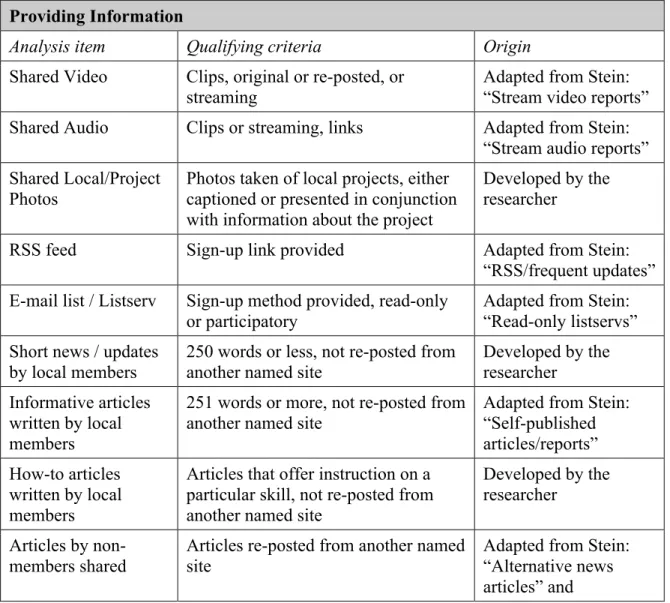
practices so they best serve the study research questions The final list of items, along with specific analysis criteria and the original source for the each item are outlined in Table 1.
Table 1: Content Analysis Instrument
Providing Information
Analysis item Qualifying criteria Origin
Shared Video Clips, original or re-posted, or streaming
Adapted from Stein: “Stream video reports” Shared Audio Clips or streaming, links Adapted from Stein:
“Stream audio reports” Shared Local/Project
Photos Photos taken of local projects, either captioned or presented in conjunction with information about the project
Developed by the researcher
RSS feed Sign-up link provided Adapted from Stein: “RSS/frequent updates” E-mail list / Listserv Sign-up method provided, read-only
or participatory
Adapted from Stein: “Read-only listservs” Short news / updates
by local members
250 words or less, not re-posted from another named site
Developed by the researcher
Informative articles written by local members
251 words or more, not re-posted from
another named site Adapted from Stein: “Self-published articles/reports” How-to articles
written by local members
Articles that offer instruction on a particular skill, not re-posted from another named site
Developed by the researcher
Articles by
“Mainstream news articles”
Further research suggestions / Bibliographies
Three or more citations or titles Adapted from Stein: “Further research suggestions” Leadership speeches
and articles
Notes from self-identified organizer or committee member or presence of an article expressing sentiments about future direction of the initiative (e.g. missions, goals, reasons)
From Stein:
“Leadership speeches and articles”
Media/press releases Titled as such (also noted presence of flyers but did not code as “present” simply for flyer inclusion)
From Stein:
“Media/press releases”
Reference to paper or
pdf newsletter Adapted from Stein: “Newsletter”
Reference to a
physical collection of print, DVD resources
Developed by the researcher
Information about Organization space
Physical address, name of building Developed by the researcher
Action and Mobilization
Analysis item Qualifying criteria Origin
Coordinates online actions
Includes online petitions and letter-writing campaigns
From Stein:
“Coordinates online actions”
Plans local Speakers/
Workshop Includes re-skilling workshops, in-person speakers on any topic Developed by the researcher Plans local meetings Meeting with discussion but no
workshop, film; includes “potlucks with purpose”
Developed by the researcher
Plans local actions or projects
Action-oriented activities such as gardening, building, and big events like fairs.
Adapted from Stein: “Plans local actions”
Calendar of events Either in list form or as an embedded
calendar From Stein: “Calendar of events” Interaction and Dialog
Member or supporter profiles (through Facebook, Twitter,
Profiles appear on the initiative site
Gmail, Yahoo, etc.) Linked Facebook group
Group where people can “like” the initiative and make comments
Developed by the researcher
Member or supporter
contact information E-mail, phone; anonymous input tools excluded From Stein: “Member or supporter contact information”
Participatory forums Any space where comments or questions are posted publicly
From Stein:
“Participatory forums” Lateral Linkages
Analysis item Qualifying criteria Origin
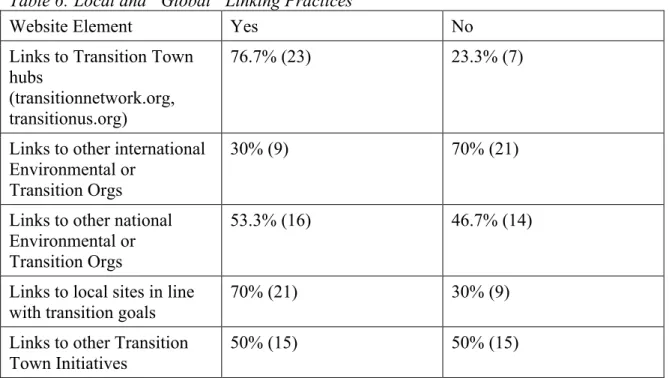
Links to Transition Town hubs
transitionnetwork.org, transitionus.org, transitioninaction.com
Adapted from Stein: “Links to SMO sites of primary movement” Links to other
international Environmental or Transition
Organizations
Includes policy organizations and 350.org, which is based in the US but international in scope
Adapted from Stein: “Links to international SMOs”
Links to other national
Environmental or Transition
Organizations
Includes policy organizations Adapted from Stein: “Links to national SMOs”
Links to local sites in line with transition goals
Local defined as within state, anything From environmental groups to farms, to green businesses.
Developed by the researcher
Links to other Transition Town Initiatives
Developed by the researcher
Blogroll List of 3 or more blog links Developed by the researcher
organizational information (e.g. uploaded documents, pdfs) it has been excluded as a platform for analysis. “Named author” was defined broadly to incorporate as many content-generators as possible. Contribution of photos, comments, blog posts, or articles were all construed as acts of authorship, with the only structural criteria being the
inclusion of the poster’s name or profile ID.
A sampling frame of 108 official TIs was obtained from the Transition United States homepage. While the International Transition Town Network site includes over 260 initiatives in the United States, their listing was rejected because it combines fully-formed groups with organizations in the early stages of attracting a steering committee. The process of developing an initiative, as outlined on Transition United States, includes three phases. In the first phase a group of people get together to discuss a shared interest in the concept of transition. Should they decide to move towards starting an initiative, the second phase, known as “mulling” involves the creation of an active reading group that will read and discuss some of the primary transition town texts, such as Hopkins’
Transition Town Handbook. At this point, a member of the “mulling” group contacts the
To select a random sample from the 108 official US initiatives included in the study, the researcher consulted a freely available random number generator developed by Dr. Mads Haar, a professor at the School of Computer Science and Statistics at Trinity College in Dublin, Ireland. This tool is accessible online [http://www.random.org/] and uses atmospheric noise to generate truly random numbers within a user-determined range. The generator does not offer sampling without replacement, which can cause duplicate selections to occur. To obtain 30 unique initiatives, the generator was employed 41 times, with 11 of the draws repeating earlier selections. The final sample includes the following list of TIs:
108. Transition Marbletown, Stone Ridge, NY 90. Transition Snoqualmie Valley, Carnation, WA 2. Sandpoint Transition Initiative, Sandpoint, ID 71. Transition Northfield (MA), Northfield, MA
34. Hardwick Area Transition Towns, Hardwick Area, VT 18. Transition Mount Shasta, Mount Shasta, CA
56. Transition Keene, Keene, NH
93. Transition Milwaukee, Milwaukee, WI 77. Transition Newton, Newton, NJ
52. Hay River Transition Initiative, HRTI Prairie Farm, WI 6. Transition Santa Cruz, Santa Cruz, CA
72. Pelham Transition, Pelham, MA 41. Transition Olympia, Olympia, WA 26. Transition Ann Arbor, Ann Arbor, MI
53. Transition Westminster/Arvada/Broomfield, Westminster, CO 75. Transition Sewickley, Sewickley, PA
7. Transition Town Montpelier, Montpelier, VT 24. Transition SLO County, San Luis Obispo, CA 97. Transitions Lehigh Valley – PA, Bethlehem, PA 42. Transition Town Chelsea, Chelsea, MI
14. Transition Pima, Pima, AZ
20. Transition Louisville, Louisville, CO
10. Transition Laguna Beach, Laguna Beach, CA 62. Transition Putney, Putney, VT
38. Transition Media, Media, PA
96. Transition Joshua Tree, Joshua Tree, CA 23. Transition PDX, Portland, OR
40. Transition Houston, Houston, TX
89. Transition Centreville-Clifton, Centreville-Clifton, VA
In order to increase reliability, all data collection was performed by the researcher in the one week period between January 22nd and 27th of 2012. Choosing to use a single coder had both benefits and drawbacks. While there was no chance of inconsistency between coders, there was also no way to measure statistical significance with regard to reliability. It is entirely possible that even a single coder will introduce inconsistent application of criteria, a problem the researcher intended to guard against by employing narrow and specific guidelines for each element to be measured.
A single browser (Mozilla Firefox) was used to minimize any discrepancies in display or website functionality. For each item in the analysis, the collection was framed as an observation-based question. For example, for the item “shared video” the researcher navigated between every sub-page of each site and asked, “Does this site include shared video?” If video was found to be present, a “yes” was marked in the corresponding column of an Excel spreadsheet. For cases in which observational data proved too ambiguous to adequately judge the presence or absence of a particular item, the data was coded as “N/A” or not applicable.
The study criteria included several items with qualitative components, including coding for the presence or absence of “how-to” articles posted by members,
Challenges and Solutions
Producing high quality content analysis data requires a well-defined and neatly bounded sampling unit, such as one page in a book, or a single episode of a television show. In this study, creating a discrete “sample” from the web, which is essentially a vast field of interconnected nodes, was a challenge. Ning, one of the popular web-based platforms used by TIs, has been employed to create not only single initiative sites, but statewide sites within which there are dozens of groups, some thematic, others serving as the central site for a particular town-based or regional initiative. In these cases, the “official” Ning group for the town or regional initiative was considered to be the whole site in its entirety, which in practice eliminates some authorship and contributions made by a regional initiative (e.g. Transition Montpelier) to another local Ning group that extends the transition mission (e.g. Vermont’s statewide permaculture group). Often it was clear that certain regional or town initiative members were posting only in thematic groups and not in their “home” group; these postings were not counted as they would have extended the boundaries of the sample considerably beyond a locale. However, if an initiative’s main site was a Ning group within a statewide network that connected them with other TIs, this was considered enough to meet the criteria for the presence of a lateral linkage to other TIs. Arguably this is a structural link forged without the clear intention of an embedded hyperlink, but the presence of the connection was significant to the TIs operation and thus has been included.
website itself, almost as if participatory forums had been outsourced to Facebook and therefore did not appear on the home site for the group. Despite this complicating factor, it was determined that a sampling unit could not include Facebook pages and a formal website as their varied structures and use could not be clearly articulated in a single analysis.
Though the content analysis had been pre-tested, it’s not surprising that a few qualification issues arose once the testing itself was underway. The definition of “international organization” was not as self-explanatory as anticipated, as it could be interpreted as referring to organizations based outside of the United States, or
organizations with an international scope of operations, regardless of location. Given that the Transition Town Movement itself is international by the later criteria, this definition was preferred in determining lateral linkages. 350.org, which is based in the United States but coordinates actions around the world, became a commonly cited link that met the criteria. The Transition Network site (which is out of the UK) was counted toward the “transition town hub” criteria and not as an international organization (thereby preventing any double counts).
Where elements appeared on the site posed another challenge to the data
Interviews
Interviews served as a secondary method in this study. Representatives from seven Transition Initiatives within the thirty selected for content analysis were contacted via e-mail or other web-based methods provided through the TI website itself. Four individuals responded, representing three initiatives: Transition Putney, VT (two respondents), Transition Montpelier, VT (one respondent), and Transition Westminster/Arvada/Broomfield, CO (one respondent).
The 13 questions asked of respondents were intended to augment or provide deeper understanding of trends observed in the content analysis. The interviews were conducted by phone, audio recorded, and transcribed by the researcher. Coding for major research themes was performed, and in the discussion section interview trends and excerpts are brought to bear on the three primary research questions in this study.