Efficient Statement Identification for Automatic Market Forecasting
Henning Wachsmuth
Universit¨at Paderborn Software Quality Lab [email protected]
Peter Prettenhofer and Benno Stein
Bauhaus-Universit¨at Weimar Web Technology & Information Systems
Abstract
Strategic business decision making in-volves the analysis of market forecasts. Today, the identification and aggregation of relevant market statements is done by human experts, often by analyzing doc-uments from the World Wide Web. We present an efficient information extrac-tion chain to automate this complex nat-ural language processing task and show results for the identification part. Based on time and money extraction, we iden-tify sentences that represent statements on revenue using support vector classifica-tion. We provide a corpus with German online news articles, in which more than 2,000 such sentences are annotated by do-main experts from the industry. On the test data, our statement identification al-gorithm achieves an overall precision and recall of 0.86 and 0.87 respectively.
1 Introduction
Touch screen market to hit$9B by 2015. 50 sup-pliers provide multi-touch screens, and that num-ber is likely to rise.1
Strategic business decision making is a highly complex process that requires experience as well as an overall view of economics, politics, and technological developments. Clearly, for the time being this process cannot be done by a computer at the level of a human expert. However, important tasks may be automated such as market forecast-ing, which relies on identifying and aggregating relevant information from the World Wide Web (Berekoven et. al., 2001). An analyst who inter-prets the respective data can get a reasonable idea about the future market volume, for example. The
1
Adapted from http://industry.bnet.com.
problem is that a manually conducted Web search is time-consuming and usually far from being ex-haustive. With our research we seek to develop an efficient system that finds and analyzes market forecast information with retrieval, extraction and natural language processing (NLP) techniques.
We contribute to the following situation. For a given product, technology, or industry sector we identify and aggregate statements on its market development found on relevant websites. In par-ticular, we extract time information (“by 2015”) and money information (“$9B”) and use support vector classification to identify sentences that rep-resent market statements. The statements’ sub-jects (“touch screen”) are found by relating recog-nized named entities to the time and money infor-mation, which we then normalize and aggregate. In this paper we report on results for the statement identification. To the best of our knowledge no data for the investigation of such market analysis tasks has been made publicly available until now. We provide such a corpus with statements on rev-enue annotated in news articles from the Web; the corpus was created in close collaboration with our industry partner Resolto Informatik GmbH.
We pursue two objectives, namely, to support human experts with respect to the effectiveness and completeness of their analysis, and to estab-lish a technological basis upon which more intri-cate analysis tasks can be automated. To summa-rize, the main contributions of this paper are:
1. We show how to decompose the identifi-cation and aggregation of forecasts into re-trieval, extraction, and normalization tasks.
2. We introduce a manually annotated German corpus for computational linguistics research on market information.
com-bined to precisely identify statements on rev-enue.
1.1 Related Work
Stein et. al. (2005) were among the first to con-sider information extraction for automatic mar-ket forecasting. Unlike us, the authors put much emphasis on retrieval aspects and applied depen-dency grammar parsing to identify market state-ments. As a consequence their approach suffers from the limitation to a small number of prede-fined sentence structures.
While we obtain market forecasts by extract-ing expert statements from the Web, related ap-proaches derive them from past market behavior and quantitative news data. Koppel and Shtrim-berg (2004) studied the effect of news on finan-cial markets. Lavrenko et al. (2000) used time-series analysis and language models to predict stock market prices and, similarly, Lerman et al. (2008) proposed a system for forecasting public opinion based on concurrent modeling of news ar-ticles and market history. Another related field is opinion mining in the sense that it relies on the ag-gregation of individual statements. Glance et al. (2005) inferred marketing intelligence from opin-ions in online discussopin-ions. Liu et al. (2007) exam-ined the effect of Weblogs on box office revenues and combined time-series with sentiment analysis to predict the sales performance of movies.
The mentioned approaches are intended to re-flect or to predict present developments and, therefore, primarily help for operative decision making. In contrast, we aim at predicting long-term market developments, which are essential for strategic decision making.
2 The Problem
Market forecasts depend on two parameters, the topic of interest and the criterion to look at. A topic is either an organization or a market. Under a market we unite branches, products, and tech-nologies, because the distinction between these is not clear in general (e.g., for semiconductors). In contrast, we define a criterion to be a metric at-tribute that can be measured over time. Here we are interested in financial criteria such as revenue,
profit, and the like. The ambitious overall task that we want to solve is as follows:
Task description: Given a topicτ and a finan-cial criterion χ, find information forτ on the de-velopment ofχ. Aggregate the found values onχ
with respect to time.
We omit the limitation to forecasts because we could miss useful information otherwise:
(1) In 2008, the Egyptian automobile industry achieved US$ 9.96bn in sales.
(2) Egypt’s automotive sales will rise by 97% from 2008 to 2013.
Both sentences have the same topic. In Particu-lar, the 2008 amount of money from example (1) can be aggregated with the forecast in (2) to infer the predicted amount in 2013.
As in these examples, market information can often only be found in running text; the major source for this is the Web. Thus, we seek to find web pages with sentences that represent state-ments on a financial criterion χ and to make these statements processable. Conceptually, such a statement is a 5-tuple Sχ = (S, g, T, M, td),
whereSis the topical subject, which may have a geographic scopeg,Tis a period of time,M con-sists of a growth rate and/or an amount of money to be achieved duringT with respect toχ, andtd
is the statement time, i.e., the point in time when the statement was made.
3 Approach
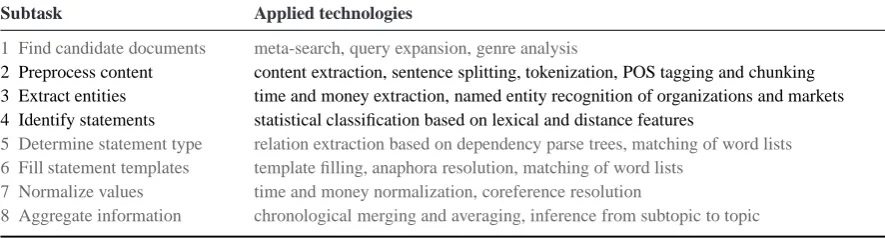
Our goal is to find and aggregate statements on a criterionχfor a topicτ. In close collaboration with two companies from the semantic technology field, we identified eight high-level subtasks in the overall process as explained in the following. An overview is given in Table 1.
3.1 Find Candidate Documents
Subtask Applied technologies
1 Find candidate documents meta-search, query expansion, genre analysis
2 Preprocess content content extraction, sentence splitting, tokenization, POS tagging and chunking 3 Extract entities time and money extraction, named entity recognition of organizations and markets 4 Identify statements statistical classification based on lexical and distance features
5 Determine statement type relation extraction based on dependency parse trees, matching of word lists 6 Fill statement templates template filling, anaphora resolution, matching of word lists
7 Normalize values time and money normalization, coreference resolution
8 Aggregate information chronological merging and averaging, inference from subtopic to topic
Table 1: Subtasks of the identification and aggregation of market statements for a specified topic. Experiments in this paper cover the subtasks written in black.
a genre analysis, which classifies a document with respect to its form, style, and targeted audience, may be deployed afterwards to further improve the quality of the result list efficiently. In this way, we only maintain candidate documents that look promising on the surface.
3.2 Preprocess Content
Preprocessing is needed for accurate access to the document text. Our overall task incorporates re-lating information from different document areas, so mixing up a web page’s main frame and side-bars should be avoided. We choose Document Slope Curve (DSC) for content detection, which looks for plateaus in the HTML tag distribution. Gottron (2007) has offered evidence that DSC is currently the best algorithm in terms of pre-cision. Afterwards, the sentences are split with rules that consider the specific characteristics of reports, press releases and the like, such as head-lines between short paragraphs. In succeeding subtasks, tokens as well as their Part-of-Speech and chunk tags are also used, but we see no point in not relying on standard algorithms here.
3.3 Extract Entities
The key to identify a statement Sχ on a
finan-cial criterion χis the extraction of temporal and monetary entities. Recent works report that sta-tistical approaches to this task can compete with hand-crafted rules (Ahn et. al., 2005; Cramer et. al., 2007). In the financial domain, however, the focus is only on dates and periods as time infor-mation, along with currency numbers, currency terms, or fractions as money information. We found that with regular expressions, which
rep-resent the complex but finite structures of such phrases, we can achieve nearly perfect recall in recognition (see Section 5).
We apply named entity recognition (NER) of organizations and markets in this stage, too, so we can relate statements to the appropriate subjects, later on. Note that market names do not follow a unique naming scheme, but we observed that they often involve similar phrase patterns that can be exploited as features. NER is usually done by se-quence labeling, and we use heuristic beam search due to our effort to design a highly efficient overall system. Ratinov and Roth (2009) have shown for the CoNLL-2003 shared task that Greedy decod-ing (i.e., beam search of width 1) is competitive to the widely used Viterbi algorithm while being over 100 times faster at the same time.
3.4 Identify Statements
Based on time and money information, sentences that represent a statement Sχ can be identified.
Such a sentence gives us valuable hints on which temporal and monetary entity stick together and how to interpret them in relation. Additionally, it serves as evidence for the statement’s correct-ness (or incorrectcorrect-ness). Every sentence with at least one temporal and one monetary entity is a candidate. Criteria such as revenue usually imply small core vocabulariesLpos, which indicate that
a sentence is on that criterion or which often ap-pear close to it. On the contrary, there are sets of wordsLnegthat suggest a different criterion. For
a given text collection with known statements on
χ, bothLposandLnegcan be found by computing
that contain terms fromLposand lack terms from
Lneg, but problems arise when terms from
ent vocabularies co-occur or statements on differ-ent criteria are attached to one another.
Instead, we propose a statistical learning ap-proach. Support Vector Machines (SVMs) have been proven to yield very good performance in both general classification and sentence extraction while being immune to overfitting (Steinwart and Christmann, 2008; Hirao et. al., 2001). For our candidates, we compute lexical and distance fea-tures based onLpos,Lneg, and the time and money
information. Then we let an SVM use these fea-tures to distinguish between sentences with state-ments on χand others. At least for online news articles, this works reasonably well as we demon-strate in Section 5. Note that classification is not used to match the right entities, but to filter the small set of sentences onχ.
3.5 Determine Statement Type
The statement type implies what information we can process. If a sentence contains more than one temporal or monetary entity, we need to relate the correctTandM to eachSχ, now. The type ofSχ
then depends on the available money information, its trend and the time direction.
We consider four types of money information.
χ refers to a period of time that results in a new amount A of money in contrast to its preceding amount Ap. The difference between A and Ap
may be specified as an incremental amount ∆A
or as a relative growth rate r. M can span any combination of A, Ap, ∆Aand r, and at leastA
and rconstitute a reasonable entity on their own. Sometimes the trend of r (i.e. decreasing or in-creasing) cannot be derived from the given val-ues. However, this information can mostly be ob-tained from a nearby indicator word (e.g. “plus” or “decreased”) and, therefore, we address this prob-lem with appropriate word lists. Once the trend is known, any two types imply the others.
Though we are predominantly interested in forecasts, statements also often represent a decla-ration on achieved results. This distinction is es-sential and can be based on time-directional indi-cators (e.g. “next”) and the tense of leading verbs. For this, we test both feature and kernel methods
on dependency parse trees, thereby determiningT
andM at the same time. We only parse the iden-tified sentences, though. Hence, we avoid running into efficiency problems.
3.6 Fill Statement Templates
The remaining subtasks are ongoing work, so we only present basic concepts here.
BesidesT andM, the subjectS and the state-ment time td have to be determined. S may be
found within the previously extracted named enti-ties using the dependency parse tree from Section 3.5 or by anaphora resolution. Possible limitations to a geographic scope g can be recognized with word lists. In market analysis, the approximate
tdsuffices, and for most news articlestd is
simi-lar to their release date. Thus, if no date is in the parse tree, we search the extracted temporal enti-ties for the release date, which is often mentioned at the beginning or end of the document’s content. We fill one template (S, g, T, M, td) for each Sχ
where we have at leastS,T, andM.
3.7 Normalize Values
Since we base the extraction on regular expres-sions, we can normalize most monetary entities with a predefined set of rules. Section 3.5 implies that M∗ = (A∗, r∗) is a reasonable normalized form whereA∗isAspecified in million US-$ and
r∗isras percentage with a fixed number of deci-mals.2 Time normalization is more complex. Any period should be transformed to T∗ = (t∗s, t∗e) consisting of the start date t∗s and end date t∗e. Following Ahn et. al. (2005), we consider fully qualified, deictic and anaphoric periods. While normalization of fully qualified periods like “from Apr to Jun 1999” is straightforward, deictic (e.g. “since 2005”, “next year”) and anaphoric men-tions (e.g. “in the reported time”) require a refer-ence time. Approaches to resolve such referrefer-ences rely on dates or fully qualified periods in the pre-ceding text (Saquete et. al., 2003; Mani and Wil-son, 2000).3
2Translating the currency requires exchange rates at
state-ment time. We need access to such information or omit the translation if only one currency is relevant.
3
without interference
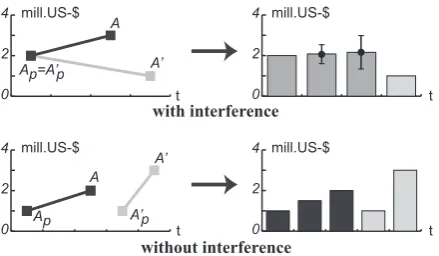
Figure 1: Example for merging monetary values.
9
Figure 2: Example for the inference of relative in-formation from absolute values.
If we cannot normalizeM orT, we discard the corresponding statement templates. For the oth-ers, we have to resolve synonymous co-references (e.g. “Loewe AG” and “Loewe”) before we can proceed to the last step.
3.8 Aggregate Information
We can aggregate the normalized values in either two or three dimensions depending on whether to separate statements with respect totd.
Aggre-gation then incorporates two challenges, namely, how to merge values and how to infer information on a topic from values of a subtopic.
We say that two statements on the same topic
τ and criterion χ interfere if the contained peri-ods of time intersect and the according monetary values do not coincide. In case of declarations, this means that we extracted incorrect values or extracted values incorrectly. For forecasts, on the contrary, we are exactly onto such information. In both cases, an intuitive solution is to compute the average (or median) and deviations. Figure 1 graphically illustrates such merging. The subtopic challenge is based on the assumption that a mean-ingful number of statements on a certain subtopic ofτ implies relative information onτ, as shown in Figure 2. One of the most interesting relations are organizations as subtopics of markets they pro-duce for, because it is quite usual to search for
Statements Total Forecasts Declarations
Complete corpus 2075 523 (25.2%) 1552 (74.8%)
Training set 1366 306 (22.4%) 1060 (77.6%) Validation set 362 113 (31.2%) 249 (68.8%) Test set 347 104 (30.0%) 243 (70.0%)
Table 2: Statements on revenue in the corpus.
information on a market, but only receive state-ments on companies. Approaches to this relation may rely e.g. on the web page co-occurrence and term frequencies of the markets and companies.
Altogether, we return the aggregated values linked to the sentences in which we found them. In this way, we make the results verifiable and, thereby, compensate for possible inaccuracies.
4 Corpus
To evaluate the given and related tasks, we built a manually annotated corpus with online news ar-ticles on the revenues of organizations and mar-kets. The compilation aims at being representa-tive for target documents, a search engine returns to queries on revenue. The purpose of the corpus is to investigate both the structure of sentences on financial criteria and the distribution of associated information over the text.
Loewe AG: Vorl¨aufige Neun-Monats-Zahlen
Kronach, [6. November 2007]REF — Das Ergebnis vor
Zinsen und Steuern (EBIT) des Loewe Konzerns konnte in den ersten 9 Monaten 2007 um 41% gesteigert wer-den. Vor diesem Hintergrund hebt die [Loewe AG]ORG
ihre EBIT-Prognose f¨ur das laufende Gesch¨aftsjahr auf
20 Mio. Euro an. Beim Umsatz strebt Konzernchef [Rainer Hecker]AU T H [f ¨ur das Gesamtjahr]T IM E ein
h¨oher als urspr ¨unglich geplantes [Wachstum]T REND
[von 10% auf ca. 380 Mio. Euro]M ONEY an. (...)
Figure 3: An annotated document in the corpus. The text is taken from www.boerse-online.de, but has been modified for clarification.
4.1 Annotations
In each document, every sentence that includes a temporal entity T and a monetary entity M and that represents a forecast or declaration on the revenue of an organization or market is marked as such. T andM are annotated themselves and linked to the sentence. Accordingly, the subject is tagged (and linked) within the sentence bound-aries if available, otherwise its last mention in the preceding text. The same holds for optional en-tities, namely a reference time, a trend indicator and the author of a statement. Altogether, 2,075 statements are tagged in this way. As in Figure 3, only information that refers to a statement on revenue (typed in bold face) is annotated. These annotations may be spread across the text.
The source documents were manually selected and prepared by our industrial partners, and two of their employees annotated the plain document text. With respect to the statement annotations, a preceding pilot study yielded substantial inter-annotator agreement, as indicated by the value
κ = 0.79 of the conservative measure Cohen’s Kappa (Carletta, 1996). Additionally, we per-formed a manual correction process for each an-notated document to improve consistency.
5 Experiments
We now present experiments for the statement identification, which were conducted on our cor-pus. The goal was to evaluate whether our com-bined extraction and classification approach suc-ceeds in the precise identification of sentences that
comprise a statement on revenue, while keeping recall high. Only exact matches of the annotated text spans were considered to be correct identifi-cations. Unlike in Section 3, we only worked on plain text, though.
5.1 Experimental Setup
To find candidate sentences, we implemented a sentence splitter that can handle article elements such as subheadings, URLs, or bracketed sen-tences. We then constructed sophisticated, but efficient regular expressions for time and money. They do not represent correct language, in gen-eral, but model the structure of temporal and mon-etary entities, and use word lists provided by do-main experts on the lowest level.4 For feature computation, we assumed that the closest pair of temporal and monetary entity refers to the enclos-ing candidate sentence.5 Since only positive in-stancesIP of statements on revenue are annotated
in our corpus, we declared all candidates, which have no counterpart in the annotated data, to con-stitute the negative classIN, and balancedIP and
IN by “randomly” (seed 42) removing instances
fromIN.6
For the vocabularies Lpos = {P1, P2} we first
counted the frequencies of all words in the unbal-anced sets IP and IN. From these, we deleted
named entities, numbers and adjectives. If the pre-fix (e.g. “Umsatz”) of a word (“Umsatzplus”) oc-curred, we only kept the prefix. We then filtered all terms that appeared in at least1.25%of the in-stances inIP and more than 3.5 times as much in
IP as inIN. The remaining words were manually
partitioned into two lists:
P1 ={umgesetzt, Umsatz, Ums¨atze, setzte}(all
of these are terms for revenue)
P2 ={Billionen, meldet, Mitarbeiter, Verband}
(trillions, announce, employee, association)
Lneg={N1, N2}was built accordingly. In
ad-dition, we set up a listG1with genitive pronouns
4
More details are given at http://infexba.upb.de.
555% of the candidate sentences in the training set
con-tain more than one temporal and/or monetary entity, so this assumption may lead to errors.
6
and determiners. Based on Lpos, Lneg and G1,
we computed the following 43 features for every candidate sentences:
• 1-8: Number of terms from P1 (N1) insas
well as in the two preceding sentences and in the following sentence.
• 9-10: Number of terms fromP2(N2) ins.
• 11: Occurrence of term fromG1 next to the
monetary entity.
• 12-19: Forward (backward) distance in to-kens between the monetary (temporal) entity insand a term fromP1(N1).
• 20-27: Forward (backward) distance in num-ber of symbols from O1 = {‘.’,‘?’,‘!’}
be-tween the monetary (temporal) entity in s
and a term fromP1(N1).
• 28-43: Same as 20-27 forO2={‘:’,‘;’}and
O3={‘,’}, respectively.
We trained a linear SVM with cost parameter
C = 0.3(selected during validation) on these fea-tures using the Weka integration of LibSVM (Hall et. al., 2009; Fan et. al., 2001). Further features were evaluated, e.g. occurrences of contraposi-tions or comparisons, but they did not improve the classifier. Instead, we noticed that we can avoid some complex cases when we apply two rules af-ter entity extraction:
R1: Delete temporal and monetary entities that
are directly surrounded by brackets.
R2: Delete temporal entities that contain the
word “Vorjahr” (“preceding year”).
Now, we evaluated the following five statement identification algorithms:
• Na¨ıve: Simply return all candidate sentences (to estimate the relative frequency of state-ments on revenue in the corpus).
• Baseline: Return all candidate sentences that contain a term from the listP1.
• NEG: Use the results from Baseline. Return all sentences that lack terms fromN1.
Recall Training Validation Test
Sentences 0.98 0.98 0.96
Temporal entities 0.97 (0.95) 0.97 (0.94) 0.98 (0.96) Monetary entities 0.96 (0.96) 0.96 (0.96) 0.95 (0.94)
Table 3: Recall of sentence and entity extraction. In brackets: Recall after applyingR1andR2.
• RB: Filter candidates usingR1andR2. Then
apply NEG.
• SVM: Filter candidates using R1 and R2.
Then classify sentences with the SVM.
5.2 Results
Table 3 shows that we found at least 95%of the sentences, time and money information, which re-fer to a statement on revenue, in all datasets.7 We could not measure precision for these since not all sentences and entities are annotated in the corpus, as mentioned in Section 4.
Results for the statement identification are given in Figure 4. Generally, the test values are somewhat lower than the validation values, but analog in distribution. Nearly all statements were recognized by the Na¨ıve algorithm, but only with a precision of 0.35. In contrast, both for Baseline and NEG already around 80% of the found state-ments were correct. The latter paid a small gain in precision with a significant loss in recall. While RB and SVM both achieved86%precision on the test set, SVM tends to be a little more precise as suggested by the validation results. In terms of re-call, SVM clearly outperformed RB with values of 89% and 87% and was only a little worse than the Baseline. Altogether, theF1-Measure values
show that SVM was the best performing algorithm in our evaluation.
5.3 Error Analysis
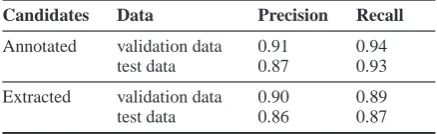
To assess the influence of the sentence, time and money extraction, we compared precision and re-call of the classifier on the manually annotated and the extracted data, respectively. Table 4 shows
7
0,75
Figure 4: Precision, recall and F1-Measure of the five evaluated statement identification algorithms.
SVM is best in precision both on validation and test data and outperforms RB in recall significantly.
that only recall differs significantly. We found that false statement identifications referred to the fol-lowing noteworthy error cases.
False match: Most false positives result from matchings of temporal and monetary entities that actually do not refer to the same statement.
Missing criterion: Some texts describe the de-velopment of revenue without ever mentioning revenue. Surrogate words like “market” may be used, but they are not discriminative enough.
Multiple criteria: Though we aimed at dis-carding sentences, in which revenue is mentioned without comprising a statement on it, in some cases our features did not work out, mainly due to intricate sentence structure.
Traps: Some sentences contain numeric values on revenue, but not the ones looked for, as in “10% of the revenue”. We tackled these cases, but had still some false classifications left.
Hidden boundaries: Finally, we did not find all correct sentence boundaries, which can lead to both false positives and false negatives. The pre-dominant problem was to separate headlines from paragraph beginnings and is partly caused by the missing access to markup tags.
5.4 Efficiency
We ran the identification algorithm on the whole corpus using a 2 GHz Intel Core 2 Duo MacBook with 4 GB RAM. The 1,128 corpus documents contain 33,370 sentences as counted by our algo-rithm itself. Tokenization, sentence splitting, time and money extraction took only 55.2 seconds, i.e., more than 20 documents or 600 sentences each second. Since our feature computation is not op-timized yet, the complete identification process is a little less efficient with 7.35 documents or 218
Candidates Data Precision Recall
Annotated validation data 0.91 0.94
test data 0.87 0.93
Extracted validation data 0.90 0.89
test data 0.86 0.87
Table 4: Precision and recall of the statement identification on manually annotated data and on automatically extracted data, respectively.
sentences per second. However, it is fast enough to be used in online applications, which was our goal in the end.
6 Conclusion
We presented a multi-stage approach for the au-tomatic identification and aggregation of market statements and introduced a manually annotated German corpus for related tasks. The approach has been influenced by industry and is oriented towards practical applications, but is, in general, not specific to the German language. It relies on efficient retrieval, extraction and NLP techniques. By now, we can precisely identify most sentences that represent statements on revenue. This already allows for the support of strategists, e.g. by high-lighting such sentences in web pages, which we currently implement as a Firefox extension. The overall problem is complex, though, and we are aware that human experts can do better at present. Nevertheless, time-consuming tasks can be auto-mated and, in this respect, the results on our cor-pus are very promising.
References
Ahn, David, Sisay F. Adafre, and Maarten de Rijke. 2005. Extracting Temporal Information from Open Domain Text: A Comparative Exploration. Journal of Digital Information Management, 3(1): 14–20.
Berekoven, Ludwig, Werner Eckert, and Peter
El-lenrieder. 2001. Marktforschung: Methodische
Grundlagen und praktische Anwendung, 9th Edi-tion, Gabler, Wiesbaden, Germany.
Carletta, Jean. 1996. Assessing Agreement on Classi-fication Tasks: The Kappa Statistic. Computational Linguistics, 22: 249–254.
Cramer, Irene M., Stefan Schacht, and Andreas Merkel. 2007. Classifying Number Expressions in German Corpora. In Proceedings of the 31st An-nual Conference of the German Classification Soci-ety on Data Analysis, Machine Learning, and Appli-cations, pages 553–560.
Fan, Rong-En, Pai-Hsuen Chen, and Chih-Jen Lin. 2001. Working Set Selection Using Second Order Information for Training Support Vector Machines. Journal of Machine Learning Research, 6: 1889– 1918.
Ferrucci, David and Adam Lally. 2004. UIMA:
An Architectural Approach to Unstructured Infor-mation Processing in the Corporate Research Envi-ronment. Natural Language Engineering, 10(3–4): pages 327–348.
Glance, Natalie, Matthew Hurst, Kamal Nigam, Matthew Siegler, Robert Stockton, and Takashi Tomokiyo. 2005. Deriving Marketing Intelligence
from Online Discussion. In Proceedings of the
Eleventh International Conference on Knowledge Discovery in Data Mining, pages 419–428.
Gottron, Thomas. 2007. Evaluating Content Extrac-tion on HTML Documents. In Proceedings of the 2nd International Conference on Internet Technolo-gies and Applications, pages 123–132.
Hall, Mark, Eibe Frank, Geoffrey Holmes, Bernhard Pfahringer, Peter Reutemann, and Ian H. Witten. 2009. The WEKA Data Mining Software: An Up-date. SIGKDD Explorations, 11(1).
Hirao, Tsutomu, Hideki Isozaki, Eisaku Maeda and Yuji Matsumoto. 2002. Extracting Important Sen-tences with Support Vector Machines. In Proceed-ings of the 19th International Conference on Com-putational linguistics, pages 342–348.
Koppel, Moshe and Itai Shtrimberg. 2004. Good
News or Bad News? Let the Market Decide. In Pro-ceedings of the AAAI Spring Symposium on Explor-ing Attitude and Affect in Text: Theories and Appli-cations, pages 86–88.
Lavrenko, Victor, Matt Schmill, Dawn Lawrie, Paul
Ogilvie, David Jensen, and James Allan. 2000.
Mining of Concurrent Text and Time Series. In
Proceedings of the 6th ACM SIGKDD Interna-tional Conference on Knowledge Discovery and Data Mining Workshop on Text Mining, pages 37– 44.
Lerman, Kevin, Ari Gilder, Mark Dredze, and Fer-nando Pereira. 2008. Reading the Markets: Fore-casting Public Opinion of Political Candidates by News Analysis. In Proceedings of the 22nd Inter-national Conference on Computational Linguistics, pages 473–480.
Liu, Yang, Xiangji Huang, Aijun An, and Xiaohui Yu. 2007. Arsa: A Sentiment-Aware Model for Predict-ing Sales Performance UsPredict-ing Blogs. In ProceedPredict-ings of the 30th Annual International ACM SIGIR Con-ference on Research and Development in Informa-tion Retrieval, pages 607–614.
Mani, Inderjeet and George Wilson. 2000.
Ro-bust Temporal Processing of News. In Proceedings of the 38th Annual Meeting of the Association for Computational Linguistics, pages 69–76.
Ratinov, Lev and Dan Roth. 2009. Design
Chal-lenges and Misconceptions in Named Entity
Recog-nition. In Proceedings of the Thirteenth
Confer-ence on Computational Natural Language Learn-ing, pages 147–155.
Saquete, Estela, Rafael Mu ˜noz, and Patricio Mart´ınez-Barco. 2003. TERSEO: Temporal Expression Res-olution System Applied to Event Ordering. Text, Speech and Dialogue, Springer, Berlin / Heidelberg, Germany, pages 220–228.
Stein, Benno, Sven Meyer zu Eissen, Gernot Gr¨afe, and Frank Wissbrock. 2005. Automating Market Forecast Summarization from Internet Data. Fourth International Conference on WWW/Internet, pages 395–402.
Steinwart, Ingo and Andreas Christmann. 2008. Sup-port Vector Machines, Springer, New York, NY.
Xu, Jinxi and Bruce W. Croft 2000. Improving the ef-fectiveness of information retrieval with local
con-text analysis. ACM Transactions on Information