Kozak, Kari A. The Usage of Article Databases and Electronic Journals by Academic Atmospheric Scientists. A master’s paper for the Master’s of Science in Library Science. April 2007. 34 pages. Advisor: Claudia Gollop
Researchers in the atmospheric science field rely on journal articles to gather information relevant to their work. These scientists use electronic journals and article databases more and more. Their use of these interfaces prompts questions of how they actually conduct their searches and, more specifically, what tools they utilize. This paper examines questionnaire responses from academic atmospheric scientists on why and how they use these databases. The data from these questionnaires were analyzed for trends. The results confirmed that many atmospheric scientists use article
databases and electronic journals to find current as well as older literature. The results did not offer any startling discoveries but did help verify previous beliefs that
atmospheric scientists use article databases and electronic journals regularly. These results can ultimately be used for the design of both better interfaces and more effective instructional courses.
Headings:
Information Seeking Behavior - Electronic Atmospheric Scientists - User Surveys Meteorologists – User Surveys
THE USAGE OF ARTICLE DATABASES AND ELECTRONIC JOURNAL BY ACADEMIC ATMOSPHERIC SCIENTISTS
by Kari A. Kozak
A Master's paper submitted to the faculty of the School of Information and Library Science of the University of North Carolina at Chapel Hill
in partial fulfillment of the requirements for the degree of Master of Science in
Library Science.
Chapel Hill, North Carolina April, 2007
Approved By:
Table of Contents
Introduction
1
Literary Review
3
Methodology 8
Results
12
Summary
and
Conclusion 15
References
17
List of Figures
Figure
1:
Years
of
Experience
25
Figure 2: Methods of Finding Scientific
Articles
25
Figure 3: Frequency of Looking for Scientific Articles
26
Figure 4: Frequency of Using Databases or
Electronic
Journals
26
Figure 5: Reasons for Using Databases or
Electronic
Journals
27
Figure 6: Favorite Features of Databases or
Acknowledgments
I would like to thank the Atmospheric Science Librarians International for
their help in preparing the survey and support throughout the project. I
would also like to thank my friends and family for all their help in editing
Introduction
In recent years, scientists have become more dependent on article databases and electronic journals to obtain information pertinent to their current research. The conclusions in this paper will show how and why atmospheric scientists search online for articles.
The general research parameter for this paper is serial publication use within the science field and the process of searching for relevant articles. This parameter
includes serials that are in both electronic and print format. The electronic format has become more popular and allows for searches to be done in a more convenient and efficient manner.
The results of this research may assist in the evolution of methods for the scientist to obtain relevant articles in a more efficient way. In order for this to occur, there must first be an understanding of what scientists currently do and what they look for to ensure the articles are relevant. This study examined atmospheric scientists as a specific type of science researcher. Atmospheric scientists are an adequate model for this study since they use many different databases and a variety of science fields to conduct their research. Often, they look at a wide range of articles from areas such as chemistry, dynamics, environment studies, and medicine. An example of this would be a meteorologist studying air pollution. He or
she may need to know about the dynamics of the atmosphere and the chemistry
narrow the field to academic research meteorologists because a current, easily accessible list exists of these professionals through the American Meteorological Society.
There is very little known about how meteorologists currently conduct their searches using article databases and electronic journals. Another challenge emerges if scientists change their strategies over the years; this makes previous studies outdated. The constant change of the digital environment may be the cause of changes in search strategies, which makes them difficult to capture completely. This study will produce a better understanding of what scientists currently think and, in doing so, use the results to facilitate easier access to pertinent information.
Literary Review
Over the last decade, many researchers have studied the information seeking behavior of scientists, especially concerning scientists' use of electronic journals and article databases. The field of atmospheric science has been studied several times with varying results. Previous research has investigated a variety of scientists’ behaviors when using databases and electronic journals, and focused on the importance and problems of these resources. However, there has been little focus on the information seeking behavior of atmospheric scientists when using electronic journals or
databases. The previous research has produced unclear results as to the information seeking behavior of atmospheric scientists in the use of databases and electronic journals. With a better understanding of this information seeking behavior, it will be possible to create improved interfaces and training sessions for scientists.
There is a vast amount of articles concerning the importance of electronic journals to scientists. The first of these articles is Information-Seeking Behavior of Academic
Meteorologists and the Role of the Information Specialist by Julie Hallmark. This
retrieval is a critical information need of meteorologists” (“Academic Meteorologists” 57).
Hallmark later published another article, Access and Retrieval of Recent Journal
Articles: a Comparative Study of Chemists and Geoscientists, which also looked at the
importance of databases and electronic journals to the science community.
Questionnaires were sent to chemists and geoscientists to ask them about a specific citation that they had used in a published article. This study was conducted both in 1998 and in 2002, and the results were compared. There was a tremendous amount of change in the use of the internet to access and retrieve journal articles. Chemists used the Internet to access 85 percent of the journal articles they used in 2002 and 83 percent in 1998. This represents an infinitesimal change and exists in stark contrast to the change in usage seen by chemists when they used the internet to retrieve journal articles 5 percent of the time in 1998 to 96 percent in 2002. Geologists also saw a significant increase in use for retrieval of articles via the Internet, going from 4 percent in 1998 to 88 percent in 2002 (“Chemists and Geoscientists” 57-58). The internet has proven to be a great asset to scientists. One geologist pointed out simply that, ‘The Internet has streamlined my research”(“Chemists and Geoscientists” 59). In other words,
“the Internet’s role in enhancing collaboration and communication among colleagues had revolutionized scientific communication in facilitating
awareness, recommendations of useful articles to one another, and exchange of preprints and reprints” (“Chemists and Geoscientists” 59).
Astronomical Society that asked them about their reading patterns and electronic usage (Tenopir et al. 791). It was found that close to 80 percent of the journal articles read come from electronic sources (Tenopir et al. 800). There are three factors that may help explain why astronomers use electronic resources so extensively:
“First, among the predictors, the major bibliographic database in the field (ADS) is linked to all the major electronic journals and provides many special features oriented to user needs. … Second, astronomers in all subfields of the discipline have available convenient electronic access to their major journals in convenient and user-oriented formats as pioneered by the AAS. … Third, the abstracts and journals are seamlessly linked to the major astronomical
databases, providing a complete information system, which serves the needs of the user” (Tenopir et al. 800-801).
This research can be used to show how scientists across many different disciplines, particularly those studying astronomy, are becoming increasingly more dependent on electronic journals.
The last journal article concerning the importance of electronic resources is entitled The Use of Electronic Journals by Dutch Researchers: a Descriptive and
Exploratory Study by Voorbij and Ongering in 2006. The authors surveyed faculty in
the Netherlands on their use of electronic journals and conducted personal interviews focused on understanding the differences between searching and browsing, as well as the effects of electronic journals on the interviewees’ research (Voorbij and Ongering 226). The researchers found that
“…the features that relate to functionality (full-text searching and hyperlinks from bibliographic description to the full-text of an article) are
“Written comments… illustrate that electronic journals shorten the time needed for literature searches, advances currency of research, and stimulate interdisciplinary research” (Voorbij and Ongering 231). This study shows that natural scientists and social scientists believe that electronic journals have motivated their research and have greatly impacted their research activities in a manner that was not possible with print journals. Thus, rendering electronic journals essential to more productive and useful research. (Voorbij and Ongering 232).
From these articles, it is evident that electronic journals play an important role in scientists’ research. Several of the articles show that electronic access to journals has decreased the amount of time a researcher must spend looking for citations. In addition, the electronic journals have proven to be incredibly convenient. This theoretically allows the scientist to spend more of his/her time actually doing new research. The use of electronic journals has also been shown to broaden the scope of reference literature used, while also facilitating more in-depth research. Both of these elements have created a greater literary base for the scientist and potentially allow him/her to produce a better study. The research conducted in this paper will attempt to understand how scientists use article databases and electronic journals to adapt the database features to better suit their needs.
Some research results indicate that some atmospheric scientists do not see the same benefits as their colleagues. Information-Seeking Behavior of Meteorologists
and Other Atmospheric Scientists: Access and Retrieval of Cited References, by Julie
to the primary author to ask how they obtained the citations they used. She found that “35 percent of the respondents in this study do not use e-journals, citing expense and lack of availability” (“Meteorologists and Other Atmospheric Scientists” 8). She also stated that some scientists were upset by the lack of archives for online journals and were bewildered when using databases. One of the participants said, “Using MGA, ISI, and AMS for journal articles are overwhelming; there’s just too much stuff… It’s like drinking from a fire hose” (“Meteorologists and Other Atmospheric Scientists” 9). One the other hand, the few scientists who did use the American Meteorological
Society’s electronic journals greatly enjoyed the usability, quality, and convenience of using the journals from their home or office (“Meteorologists and Other Atmospheric Scientists” 8).
Importance and problems of databases and electronic journals have been discussed by a wide variety of articles. This research shows that electronic journals and article databases are essential to the science community. With a better
Methodology
To research the usage of article databases and electronic journals, a questionnaire was distributed to academic atmospheric scientists. These questionnaires are the primary source for gathering information for this study.
This survey was a self-administered, electronic-format questionnaire sent to two hundred atmospheric scientists listed as faculty on the American Meteorological Society website. Using a questionnaire is an appropriate method to collect data concerning the usage of article databases, as it allows for a wide range of atmospheric scientists to be surveyed and minimizes geographical restrictions.
It was decided to narrow the field to academic faculty because a current list for the group was easily accessible. The scientists were chosen from a random sampling of this list. First, the list of atmospheric scientists was downloaded into Microsoft Excel and those without email addresses were removed. Next, each scientist was assigned a number using the random number generator located within Microsoft Excel. The top two hundred were chosen as the sample. This list of two hundred atmospheric scientists was downloaded into the Qualtrics.com survey distributing software.
The atmospheric scientists were sent an email that explained this research and provided a link to the survey (Appendix A). After ten days, the scientists were sent another email reminding them of the survey (Appendix B). The survey and
approved by the Odum Institute and allowed for secure and anonymous distribution and collection of the surveys.
The survey consisted of a series of twelve open-ended and close-ended questions that inquired about their online searching strategies and the use of different features of the interfaces (Appendix C). At the beginning of the questionnaire, the subject was asked background questions, such as years of experience in their field and areas of expertise, in addition to how often they look for journal articles and how they obtain these resources. Subjects were also asked if they use electronic journals or article databases as a contingency question so that it could be determined if the respondents were familiar with the online searching. This allowed for those who are not using article databases or electronic journals to not have to answer any further questions. Due to a review of the latest research that showed most scientists use article databases and electronic journals, this research did not focus on the use of print resources. (Hallmark, 2003).
The analysis of this data was partially completed through the use of software provided by the company that hosted the survey. The author reviewed the data collected and grouped the answers for the open ended questions into relevant
keywords, ease of use, print from computer, listed in other resources, related articles, author search, convenient, specific article, and search a variety of sources.
The third open question, What databases do you use most frequently?, was categorized by Science Citation Index, Web of Science, American Meteorological Society Journals, Google Scholar, GeoRef, American Geophysical Union,
Meteorological and Geophysical Abstracts, ScienceDirect, Scirus, Quarterly Journal of the Royal Meteorological Society, Biological Abstracts, Academic Search Premier, Library Database, Google, NASA Astrophysics Data System, and Ingenta. The fourth question, What electronic journals do you use most frequently?, was categorized by publisher, as that was the only thing given, or else it was broken down by the actual journal name. The possible journal names are: American Meteorological Society Journals, American Geophysical Union Journals, Journal of Geophysical Research, Geophysical Review Letters, Atmospheric Environment, Nature, Science, Proceedings of the National Academy of Science, Ecology, Journal of the Atmospheric Sciences, Quarterly Journal of the Royal Meteorological Society, Journal of Climate, Journal of Hydrometeorology, GBC, Bulletin of the American Meteorological Society, Space Weather Journal, The Physics Teacher, Monthly Weather Review, Atmospheric Chemistry and Physics, EOS - Transactions of the American Meteorological Society, Journal of Atmospheric and Solar Terrestrial Physics, Journal of Atmosphere,
The last open question was, What feature(s) on database or electronic journals would you like to see added to help in your research?, and the categories for this question were journal abbreviation, thesaurus, more coverage, index, times cited, links in bibliography, citation generator, related articles link, other articles by author link, and ease of name identification and date. The data from the questions were inserted into Microsoft Excel spreadsheets so that graphs and statistics could be constructed and analyzed.
With this survey, the researcher gathered information from academic
Results:
The results of the research add to the knowledge base of how atmospheric
scientists use article databases and electronic journals. Even though the results did not offer any surprises, they did help to confirm previous beliefs.
The questionnaire received an 18.5 percent response rate of the two hundred surveys distributed and the responses came from a wide variety of atmospheric scientists. This allows for a more comprehensive assessment of their online
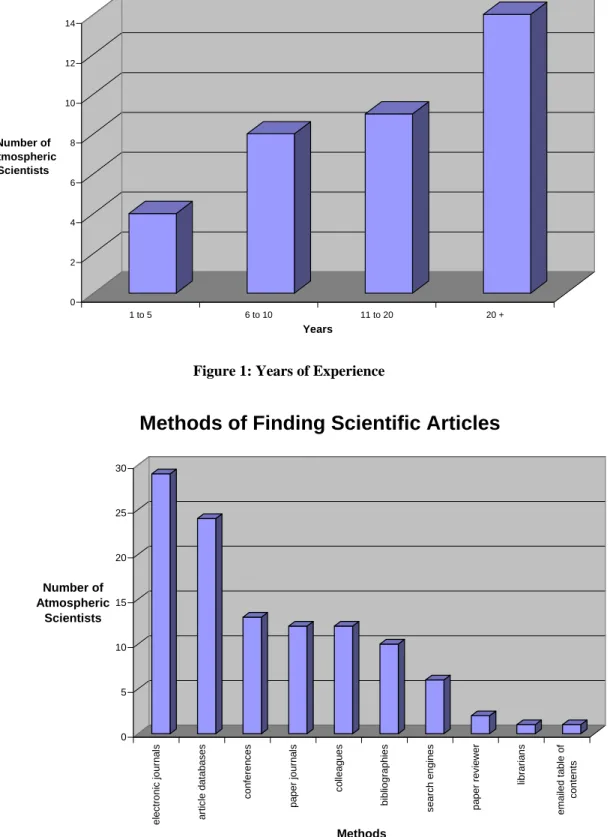
information seeking behaviors. The atmospheric scientists’ background varied greatly in both years of experience (see Appendix E: Figure 1) and expertise. The list of expertise noted by survey respondents can be found in Appendix D. All but two of the respondents have a doctoral degree.
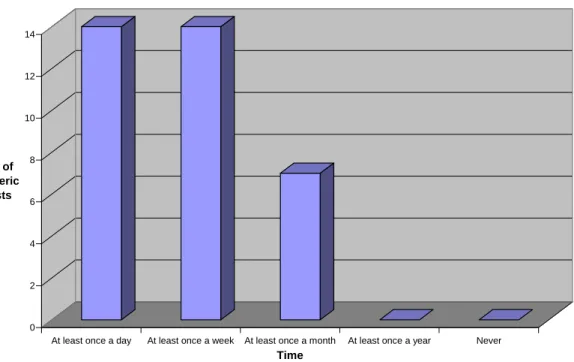
As a result of the survey’s findings, the research was able to confirm previous studies’ results about why and how atmospheric scientists use article databases and electronic journals. This began with the idea that most atmospheric scientists use electronic journals and article databases. This concept was illustrated in that only one scientist stated that he/she does not use them. The study also asked what resources the atmospheric scientists use to find articles. Most respondents stated that they
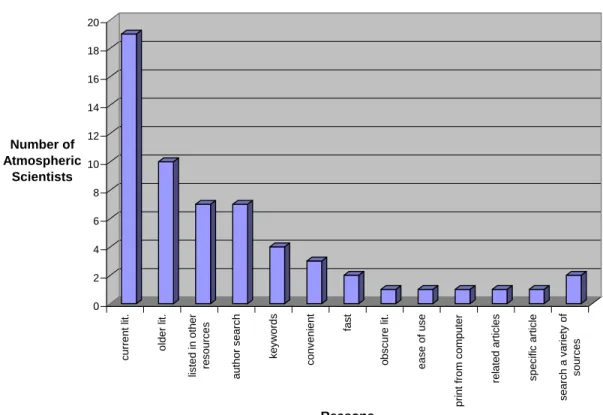
Appendix E: Figure 4). The results show that many scientists search for articles on a daily basis and use online resources increasingly more often. This study did not, however, show the scientist using the online resources as their main daily source, illustrating that the other methods are still beneficial and should be taken into account when looking into scientists’ searching behaviors.
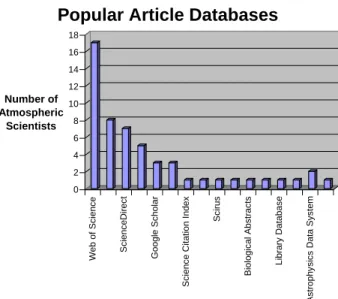
The results also gave insight into why atmospheric scientists use article database and electronic journals. The scientists stated that they use the online resources mainly to find current literature, followed closely by looking for older literature (see
Appendix E: Figure 5). This behavior can likely be attributed to the desire or need to stay up-to-date on the latest research. The survey also asked what features of the database atmospheric scientists used the most. They stated that they most often preformed searches by author and then by keyword (see Appendix E: Figure 6). This is likely due to many of the atmospheric scientists’ areas of expertise being very narrow so they know who is currently conducting research in the area. Another theory is that they have found the citation of the article they are looking for from another source and are now trying to find the entire article.
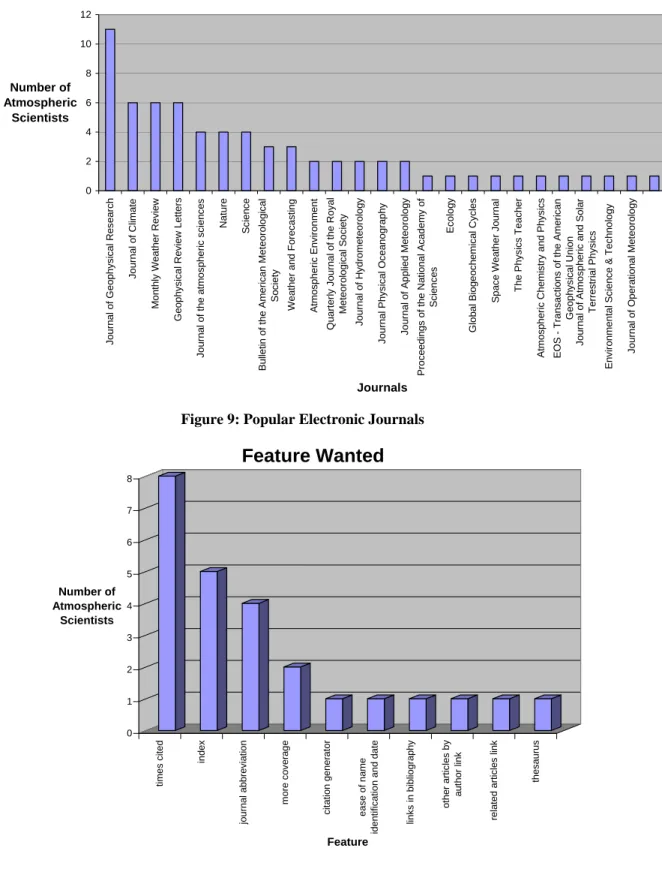
The electronic journals that were chosen most often by respondents were those by the American Meteorological Society and the American Geophysical Union (see Appendix E: Figure 8). Some specific journals that were ranked the highest include the Journal of Geophysical Research, Monthly Weather Review, and Journal of Climate (see Appendix E: Figure 9).
The questionnaire concluded by asking each atmospheric scientist what features he/she would like to see added to these online resources. The most common requests were from times citied, an index, and journal abbreviations (see Appendix E: Figure 10).
Summary and Conclusions:
Atmospheric science is a field that has unique information needs. Scientists rely heavily on journal articles to stay informed about developments in their area of expertise and to provide background for research they conduct. When looking for journal articles, most scientists use article databases and electronic journals.
This paper, specifically, examined how atmospheric scientists use article databases and electronic journals. Using a questionnaire, atmospheric scientists in academic settings with email addresses were asked about their information-seeking behavior. In particular, they were asked about their knowledge and usage of article databases and electronic journals. This questionnaire was used to explore the
information needs of atmospheric scientists and to describe these needs in detail. The scientists were also asked about the different features of the interface and the search process they used.
The information gained from this study can be utilized in the development of better web interfaces and instruction courses for atmospheric scientists, as well as for use in budgeting decisions concerning serials. This study will be beneficial to both librarians, especially those within the science field, and system designers. It will help the librarians and designers when ascertaining patrons’ habits. These results may also help librarians when providing instruction to pinpoint new features to emphasize when assisting scientists. Both groups will have a larger understanding of the process atmospheric scientists use when collecting journal articles on the web and what features of the interface are used. With this knowledge, librarians will be better able to answer reference questions and develop instructional courses on search strategies and features that are most appropriate for scientists. The interface designers will be better able to take the information from this research and develop interfaces that will be geared toward their primary users.
This research set forth several questions concerning atmospheric scientists’ search for information, such as the purpose for the information being solicited and the need to know more details about how they conduct searches. These may be useful questions to ask in future studies.
References:
American Meteorological Society. 2003. UCAR/AMS Curricula: Index of University & College Faculty, Alphabetical. 6 March 2007.
<http://www.ametsoc.org/amsucar_curricula/curriculaFaculty.cfm?index=A> Hallmark, Julie. "Access and Retrieval of Recent Journal Articles: A Comparative
Study of Chemists and Geoscientists." Issues in Science and Technology Librarianship 39 (2004)
---. "Information-Seeking Behavior of Academic Meteorologists and the Role of Information Specialists." Science and Technology Libraries 21.1/2 (2001): 53-64. ---. "Information-Seeking Behavior of Meteorologists and Other Atmospheric
Scientists: Access and Retrieval of Cited References." Issues in Science and Technology Librarianship 38 (2003)
Tenopir, C., et al. "Relying on Electronic Journals: Reading Patterns of Astronomers." Journal of the American Society for Information Science and Technology56.8 (2005): 786-802.
Appendix A: Invitation Email
Initial Letter:
Subject: Questionnaire on usage of Databases and Electronic Journals
Date
Dear Participator’s Name:
Hello. My name is Kari Kozak and I am a graduate student at the School of
Information and Library Science at the University of North Carolina – Chapel Hill. For my master’s paper, I am currently investigating the ways by which atmospheric scientists obtain the journal articles used in their research. I am specifically interested in the advantages and challenges arising from the use of article databases and
electronic journals.
Studies such as this one which contribute to our overall knowledge of the information-seeking behavior of scientists should provide useful data for improving access to the journal literature, so critical to the scientific endeavor. The results for this data will be helpful in the design of better interfaces and the creation of more effective
instructional courses.
Would you please take a moment to complete a brief questionnaire found at this web address (http://uncodum.qualtrics.com/SE?SID=SV_5sVlhCobFlk1qra&SVID=Prod)? It should only take roughly 15minutes to complete.
Thanks very much for your help.
Sincerely,
Appendix B: Reminder Email
Reminder Email:
Subject: REMINDER: Questionnaire on usage of Databases and Electronic Journals
Date
Dear Participator’s Name:
Hello. This is a reminder email. If you have already completed the survey, then thank you very much. If not, my name is Kari Kozak and I am a graduate student at the School of Information and Library Science at the University of North Carolina – Chapel Hill. For my master’s paper, I am currently investigating the ways by which atmospheric scientists obtain the journal articles used in their research. I am
specifically interested in the advantages and challenges arising from the use of article databases and electronic journals.
Studies such as this one which contribute to our overall knowledge of the information-seeking behavior of scientists should provide useful data for improving access to the journal literature, so critical to the scientific endeavor. The results for this data will be helpful in the design of better interfaces and the creation of more effective
instructional courses.
Would you please take a moment to complete a brief questionnaire found at this web address (http://uncodum.qualtrics.com/SE?SID=SV_5sVlhCobFlk1qra&SVID=Prod)? It should only take roughly 15minutes to complete.
Thanks very much for your help.
Sincerely,
Appendix C: Questionnaire
University of North Carolina-Chapel Hill Information about a Research Study
___________________________________________________________________ IRB Study # 07-0407 Consent Form Version Date: 03-15-2007
Title of Study: The Usage of Databases and Electronic Journals by Atmospheric Scientists
Principal Investigator: Kari Kozak
UNC-Chapel Hill Department: School of Information and Library Science Faculty Advisor: Dr. Claudia Gollop
Study Contact telephone number: 515-520-7191 Study Contact email: [email protected]
_____________________________________________________________________ What are some general things you should know about research studies?
You are being asked to take part in a research study. To join the study is voluntary. You may refuse to join, or you may withdraw your consent to be in the study, for any reason, without penalty.
Research studies are designed to obtain new knowledge. This new information may help people in the future. You may not receive any direct benefit from being in the research study. There also may be risks to being in research studies.
Details about this study are discussed below. It is important that you understand this information so that you can make an informed choice about being in this research study. You will be given a copy of this consent form. You should ask the researchers named above any questions you have about this study at any time.
What is the purpose of this study?
The study looks into how databases and electronic journals are used by atmospheric scientists within the academic settings. The data from the questionnaires will be analyzed for trends, and these trends can then be used for the design of better interfaces and in the design of more effective instructional courses.
How many atmospheric scientists will take part in this study?
If you decide to be in this study, you will be one of approximately 200 people in this research study.
How long will your part in this study last?
Appendix C: Questionnaire (Cont.)
What will happen if you take part in the study?
The online questionnaire will ask you questions about how you use databases and electronic journals. You do not have to answer any questions that you do not wish to answer, for any reason.
What are the possible benefits from being in this study?
Research is designed to benefit society by gaining new knowledge. Your participation is important to help us understand the way of which people in the atmospheric science community use databases and electronic journals, but you may not benefit personally from being in this research study.
What are the possible risks or discomforts involved from being in this study? We do not think you will experience any discomfort or risk from the questionnaire. How will your privacy be protected?
This questionnaire is completely anonymous. There will be no personal information asked. Since this is on an electronic platform, there will be no way to connect the questionnaire to you.
Will you receive anything for being in this study?
I am not going to pay you for your information, but your information is very important to us.
Will it cost you anything to be in this study? There are no costs for being in the study. What if you have questions about this study?
You have the right to ask, and have answered, any questions you may have about this research. If you have questions, or concerns, you should contact me by email at [email protected] or by phone at 515-520-7191 or my advisor by email at [email protected] or by phone at 919-962-8362.
What if you have questions about your rights as a research participant?
All research on human volunteers is reviewed by a committee that works to protect your rights and welfare. If you have questions or concerns about your rights as a research subject you may contact, anonymously if you wish, the Institutional Review Board at 919-966-3113 or by email to [email protected].
Thank you for helping me with this study.
Do you understand this form and agree to participate in this study? o I agree (Start Survey)
Appendix C: Questionnaire (Cont.)
1. How many years have you been employed as a research scientist? a. 1 - 5
b. 6-10 c. 11-20 d. 20+
e. Other – Please Explain 2. What is your area(s) of expertise? 3. What is your highest level of education?
a. Bachelor’s Degree b. Master’s Degree c. Doctor of Philosophy d. Other – Please Explain
4. On average, how often do you need to find scientific articles? a. At least once a day
b. At least once a week c. At least once a month d. At least once a year e. Never
5. Where do you find information for your research? (Please rank in order of priority) (Examples: article databases, electronic journals, paper journals, bibliographies in other resources, talking to colleagues, attending conferences, working with a librarian, etc)
6. Do you use databases or electronic journals to search for research information? a. Yes
b. No
If you answered no to question five, you may stop at this point, Thank you for your time. If you answered yes to question five, please continue to question seven. 7. On average, how often do you use databases or electronic journals?
a. At least once a day b. At least once a week c. At least once a month d. At least once a year e. Never
Appendix C: Questionnaire (Cont.)
9. What is the main feature you use when searching for articles? a. Keyword
b. Author c. Journal Title d. Specific Article e. Other - Please Explain
10. What database do you use most frequently? (Please rank in order of priority) (Examples: Web of Science, Meteorological and Geophysical Abstracts,
ScienceDirect, Arctic and Antarctic, etc.)
11. What electronic journals do you use most frequently? (Please rank you top electronic journals in order of priority)
12. What feature(s) on database or electronic journals would you like to see added to help in your research? (Example: thesaurus, index, times cited, journal
Appendix D: List of Expertise
List of the respondents’ expertise:
Atmospheric chemistryAtmospheric sciences
Ecosystem ecology, biogeochemistry Tropical dynamics, mesoscale dynamics Atmospheric Sciences- Climate Variability Biogeochemical Cycles and Climate Geochemistry
Tropical meteorology
Lightning, atmospheric chemistry, atmospheric thermodynamics Ionospheric and magnetospheric physics
Climate change, land/atmosphere interaction Mesoscale Meteorology and Cloud Microphysics Data assimilation in meteorology
Radiative transfer atmospheric chemistry air quality planetary atmosphere airglow Polar meteorology and climate, numerical modeling
Atmospheric chemistry Oceanography
Synoptic Meteorology, Weather Analysis and Forecasting, Mesoscale Meteorology Mesoscale meteorology, nwp, coastal meteorology
Hydrology
Synoptic and mesoscale meteorology Geomagnetism, planetary magnetic fields Climate dynamics
Ocean dynamics, data assimilation, tropical ocean processes Agricultural Meteorology, crop simulation modeling
Arctic climate, climate change Meteorology
Cloud physics and remote sensing
Synoptic meteorology and regional climate modeling Mesoscale meteorology.
Appendix E: Figures
0 2 4 6 8 10 12 14 Number of Atmospheric Scientists1 to 5 6 to 10 11 to 20 20 +
Years Years of Experience
Figure 1: Years of Experience
0 5 10 15 20 25 30 Number of Atmospheric Scientists el ectroni c j ourna ls ar ti c le da ta ba s e s con ferences pa per j ourna ls c o lle agu es bi bl iograp hi es s e ar ch eng in es pa per revie w e r libraria ns e m a ile d ta bl e o f cont ents Methods
Methods of Finding Scientific Articles
Appendix E: Figures (Cont.)
0 2 4 6 8 10 12 14
Number of Atmospheric
Scientists
At least once a day At least once a week At least once a month At least once a year Never Time
Frequency of Looking for Scientific Articles
Figure 3: Frequency of Looking for Scientific Articles
0 2 4 6 8 10 12 14
Number of Atmospheric
Scientists
At least once a day At least once a week At least once a month At least once a year Never Time
Frequency of Using Databases or Electronic Journals
Appendix E: Figures (Cont.)
0 2 4 6 8 10 12 14 16 18 20 Number of Atmospheric Scientists c u rren t l it. old e r l it. lis ted in oth er re sou rces au tho r s e a rc h ke ywo rd s c o nv e ni e nt fast o b scu re l it . ease o f us e pri nt from c o m p u ter re late d a rtic les s p ec if ic a rti c le s earch a v a ri ety o f so u rce s ReasonsReasons for Using Article Databases and Electronic Journals
Figure 5: Reasons for Using Article Databases and Electronic Journals
0 2 4 6 8 10 12 14 16 18 20 Number of Atmospheric Scientists
Keyword Author Journal Title Specific Article Date Feature
Favorite Features of Article Searching
Appendix E: Figures (Cont.)
0 2 4 6 8 10 12 14 16 18 Number of Atmospheric Scientists Web of Sc ienc e S c ienc eD ir ec t Google S c holar Sci e n c e C ita ti o n In d e x Sci ru s B iol og ic al Abs tr a c ts Libr ar y D atabas e A s tr o p h y si cs D a ta S yste m Databases Popular Article DatabasesFigure 7: Popular Article Databases
0 5 10 15 20 25 30 35 40
Number of Atmospheric Scientists A m eric an M e teoro lo g ic al S o c ie ty A m eric an Geophy s ic a l Union A m er ic a n As s o c iatio n for the A d v a ncem en t of S c ienc e Na tu re P u bli s hin g Gro u p El sev ie r R o y a l Mete or o log ical S o c iety A m eric an Che m ic al S o c iet y N a tion al A c ad em y of Sc ie nc e s N a ti ona l Wea the r A s s o c ia ti o n Eu ro pe an Ge os cie nces U n io n A m e rica n A sso ci a ti o n o f P h ysi cs Te a ch e rs E c ol og ic al S o c iet y of A m eri c a S p rin ger Publishers
Publishers of Popular Electronic Journals
Appendix E: Figures (Cont.)
Popular Electronic Journals
0 2 4 6 8 10 12 J o u rna l of G e oph y s ic a l Res ear c h J o ur n a l of Climat e Mo nt hly Wea ther Re v iew Ge o p h ysi cal Re vi e w Le tt ers J o ur nal of t he at mo s phe ri c s c ie nc es
Nature Scie
nc e Bulle tin of t h e Amer ic an Me teor olo g ic al S o ci et y We at he r and F or e c as ting A tm o sph e ri c E n vi ro nm e n t Q u a rt e rl y J our na l o f t he Ro y a l Me te or olog ic al So c iet y J o u rn a l of Hy dr o met eo ro logy J o u rna l Phy s ic a l Oc e a n ogr ap hy Jou rna l o f A pp lie d M e te oro log y Pr o c ee ding s of t he N at iona l Ac ad emy of Sc ie n c es Ec o logy Gl ob a l B iog eo ch em ic a l Cycl es Sp ac e We at he r J o u rna l The P h ysi cs Te ach e r A tmo sp he ri c C h e m is try an d P h ysi cs EO S T ra n s a c ti ons of t he Am er ic a n Ge o p h ysi cal Un io n J our na l o f At mo s phe ri c an d So lar Te rr e s tr ia l P h ysi cs Env ir on m en ta l S c ien c
e & T
ec h no logy J o ur n a l of Op er at iona l Met e o rolo g y Journals Number of Atmospheric Scientists
Figure 9: Popular Electronic Journals
0 1 2 3 4 5 6 7 8 Number of Atmospheric Scientists tim es cited in dex jour nal abbr ev iat io n m ore c ov erag e c it at ion gen erat or ea se o f na m e ident if ic at io n an d da te link s i n b ibl iogr aphy ot her art ic les b y aut hor l ink re la te d a rticle s lin k th es au rus Feature Feature Wanted