Creating an Educational Website to Enhance Access to Prenatal Care among Latina Women in Wake County, North Carolina
By Pierce Do
Senior Honors Thesis School of Nursing
University of North Carolina at Chapel Hill
March 22, 2019
Approved:
Author Note
Pierce Do, School of Nursing, The University of North Carolina at Chapel Hill.
Abstract
Objective: To construct an educational website that enhances knowledge and access to prenatal care for Latina Women in Wake County, North Carolina.
Methods: From September (2018) to March (2019) we collected data using literature review, surveys and meetings regarding the significance of prenatal care, access barriers to prenatal care for the Latina population in the United States, and more specifically in Wake County. Applying the Evaluating Printed Education Materials (EPEM) model, we built an educational website. The content of the website was evaluated by the Patient Education Materials Assessment Tool
(PEMAT). For the pilot test, the website was published and tested on multiple technological platforms.
Results: Survey results and information extracted from meetings were gathered, assessed, and considered while developing the website content: www.cuidadoprenatal919.com. The website informs Latina women about the significance of prenatal care, general information regarding prenatal care, and what to expect at their first appointment. Additionally, essential information concerning Women, Infants and Children (WIC) Program, Medicaid, domestic violence, and the Wake County Prenatal Clinic are covered.
Conclusion: The website is currently live and disseminated via flyers, word-of-mouth, and promotion by local organizations. The website should be used to promote the initiation of prenatal care among the Latina population of Wake County, North Carolina. The subsequent phase of the EPEM model, the Evaluation Phase, is required to assess the website’s efficacy.
Introduction
Significance of Prenatal Care
Since the commencement of the 20th century, prenatal care has served as the cornerstone
of America’s health care system for pregnant women (Holtz & Bairan, 2006, p. 95). Prenatal care is essential for the health and wellbeing of the mother and baby. An expanding body of evidence demonstrates the correlation between adverse health outcomes, for the mother and baby, and inadequate prenatal care (Martin, Hamilton, Osterman, Curtin, & Mathews, 2013). Consequently, the Healthy People 2020 initiative has promoted goals toward amplifying the proportion of women receiving quality prenatal care in the first trimester (Healthy People 2020, 2013). Without the implementation of prenatal services, a newborn’s risk for low birth weight is tripled (Prenatal Care, 2019). Low birth weight often results in infant disabilities or death (“Prenatal Care Access,” 2005). The baby’s risk for mortality is five times more likely without adequate prenatal care (“Prenatal Care,” 2019). Receiving early, regular, and thorough prenatal checkups can serve as a preventative measure against premature births, low birth weight babies, neonatal deaths, and maternal deaths (Holtz & Bairan, 2006, p. 96).
According to the Center for Disease Control and Prevention, 25% of neonatal
low-income minority women and the health care system. Perceiving prenatal care as a gateway into receiving healthcare accentuates its ability to have a positive multigenerational effect (Prenatal Care Access, 2005).
Aside the effect early prenatal care has on health outcomes of the mother and baby, it is essential to consider the monetary consequences of inadequate health care during pregnancy. The Center for Disease Control and Prevention states the investment of $1.00 into adequate prenatal services saves $3.00 in health care expenditures following the birth of the child (CDC
Reproductive Health Information Source Fact Sheet, 2000; Monjaraz, 2001). Consequently, the perception of prenatal care necessitates a more intricate level of thinking. Only considering the immediate effects prenatal care has on health outcomes is a costly mistake. Proper initiation of prenatal care in the first trimester not only has the capacity to save millions in medical
expenditures, but it also holds the ability to uniquely enhance quality of life for the mother and baby.
The Latino Population in North Carolina
Analyzing the Hispanic population from a statistical vantage point accentuates the necessity for further evaluation of this group. As of 2018, 11% of Raleigh, North Carolina’s population is of Hispanic or Latino descent (U.S. Census Bureau, 2018). According to the United State Census Bureau, the Hispanic population in Wake County, North Carolina has increased exponentially over the course of two decades. In 1990, the government reported
Wake County (10% of Wake County’s total population) (Pew Research Center, 2019). Figure 1 portrays the positive growth trend of the Latino population in Wake County, North Carolina. According to the United States Census Bureau’s most recent 2018 demographic analysis, Hispanics make up 9.8% of North Carolina’s total population (U.S. Census Bureau, 2018).
Figure 1. United States Census Bureau; Wake County, NC: Hispanic population (Pew Research Center, 2019; U.S. Census Bureau, 2018)
On a national scale, individuals of Hispanic or Latino origin make up the largest, and most rapidly expanding, ethnic or racial minority group in the United States (Baxley & Ibitayo, 2015, p. 389). As of 2017, roughly 17.8% of the American population is Hispanic or Latino (US Census Bureau, 2018). Due to the prevalence of the Hispanic population on a local, state, and national scale, it is imperative to assess their access to quality healthcare. Minimizing the barriers that impede Latinas from prenatal care is a key element while constructing impactful
Access Barriers to Prenatal Care for the Latina Population
Latinas have been shown to consistently underutilize prenatal services despite
the efforts of Healthy People 2020 (Healthy People 2020, 2013; Martin et al., 2013). Evidence demonstrates this trend in behavior is multifaceted and intricately tied with socioeconomic and demographic factors. The pregnant Latino population faces a multitude of barriers that can hinder or discourage the initiation of prenatal care. These barriers include lack of health insurance, insufficient translation services, lack of transportation to and
from appointments, domestic abuse, personal illicit drug use, skepticism regarding the efficacy of prenatal care, limited access to childcare, and chronic health issues (Holtz & Bairan, 2006, p. 97). Frequently, concerns regarding legal status in the United States discourage Latinos from seeking any form of medical treatment (Berman & Connaughton, 2013). Many Latinos, both documented and undocumented, fear leaving the safety of their homes due to the budding number of arrests conducted by the United States Immigration and Customs Enforcement (ICE) in North Carolina. While these factors can seriously impede Latinas from prenatal care, often trust in the healthcare system is the primary limiting factor.
level of distrust amongst the Latino patients in the healthcare system. Lacking trust in the competency of the health care provider severely reduces the likelihood of Latinas returning for subsequent appointments (Baxley & Ibitayo, 2015; Berman & Connaughton, 2013). In the conclusion of this study, the participants voiced their desire for the health care provider to share their knowledge openly, be direct about good and bad news, be culturally competent, and be bilingual (Baxley & Ibitayo, 2015). From a sociological standpoint, it is imperative to assess the manner in which the environment influences access to prenatal care.
A research study assessing barriers to prenatal care for pregnant Latinas in the state of Georgia discovered a large proportion of women have concerns regarding their safety outside of the home (Holtz & Bairan, 2006, p. 112). Knowing these concerns of pregnant Latinas serves as an asset to health care providers and pregnancy care managers. Conducting thorough home visits can serve as a constructive measure in assessing the patient’s quality of life, stressors, sanitation risks, and safety. Honing the focus on interventions addressing financial aid, public safety, access to transportation, adequate childcare during appointments, and competent Spanish interpreters can have a radical impression on the utilization of prenatal services.
Lack of Health Insurance and Public Funding for Latinas
Compared to other racial and ethnic groups in the United States, Latinos have a higher risk of lacking a consistent source of health care (Holtz & Bairan, 2006, p. 97). A vast majority of the disparities Latinas encounter can be attributed to a lack of health coverage. A
a large portion of Latina immigrants cannot afford private health insurance due to living in severe poverty (Prenatal Care Access, 2005). According to a 2018 analysis completed by the Kaiser Family Foundation, 22% of Hispanics residing in North Carolina live in poverty. Hispanics are tied with Native Americans for having the highest rate of poverty in North Carolina. Latinos lack health insurance due to the high acquisition of jobs which offer low pay and minimal benefits (Kaiser Family Foundation, 2018). Lastly, some Latina immigrants may lack health insurance because they are not aware of what public funding they are qualified for during pregnancy. There is often an erroneous notion that applying for public benefits may result in subsequent deportation (Prenatal Care Access, 2005). While undocumented Latinas are
entitled to some forms of public funding during pregnancy, federal and state legislation severely limit monetary assistance for prenatal care. Without fundamental health coverage, many Latinas are hindered from accessing prenatal services, preventative care, routine
screenings, and diagnostic tests (Healthcare Access and Latina Women, 2001).
Health Risks in the Latina Population
Historically, the Latina population has suffered higher mortality rates during live births than women of European white-descent (CDC Surveillance and Research, 2004). Although research has demonstrated prenatal care lowers the risk of maternal mortality during pregnancy, Latinas persist in lacking substantive prenatal care. The absence of prenatal care is especially unsettling due to the rapidly mounting pregnancy rate among Hispanic adolescents (U.S.
Baker, & Kenny, 2010; Martin et al., 2013; U.S. National Library of Medicine, 2011). The combination of young age, adverse health conditions, and a lack of prenatal care pose a
substantial threat against the health of the child and mother. Subsequent cases of prematurity and low Apgar scores often lead to detrimental abnormalities or death (Cederbaum,
Putnam-Hornstein, King, Gilbert, & Needell, 2013; Martin et al., 2013; U.S. National Library of Medicine, 2011; Weng et al., 2014).
Due to the evident barriers that Latinas in the United States face to access prenatal care, it is essential to emphasize the significance of preventative care during pregnancy. In order to properly guide Latinas about prenatal care in the United States, it is crucial to construct culturally competent and bilingual resources that are easily accessible. These resources need to dually act as an educational tool regarding prenatal care, and a support system that will guide them to local resources. This article covers the process of developing an online resource to teach Latinas about prenatal care. Additionally, this resource acts a guide for Latinas to access affordable prenatal services in Wake County, North Carolina.
Methods The EPEM Model
phases that mirror primary principles of the nursing process: Assessment, planning,
implementation, and evaluation. The five phases of the EPEM model include: The Predesign Phase, the Design Phase, the pilot test of the PEM, the Implementation/Distribution Phase, and the Evaluation Phase.
The Predesign Phase
The Predesign Phase consisted of identifying the PEM’s purpose, goal, intended
audience, and objectives. Collection of data from the Latino community, prenatal care providers, and pregnancy care managers was key during the predesign phase. Gathering data from a wide assortment of personnel involved in the delivery of prenatal care helped identify the scope, purpose, and goals of the PEM. While the scope of the PEM is what kind of content will be shared, the purpose of the PEM is the intended outcome of the intervention (Bernier, 1993).
From the outset of the project, the website’s purpose was to optimize prenatal care access for Latinas of Wake County. Conducting a survey, and coordinating meetings, was perceived as an instrumental step in gathering further information regarding the specific needs of local
Latinas. Collecting qualitative data via survey and meetings was necessary to articulate the scope and goals of the website.
A five-question survey was developed to gather data from Latinas in Wake County, North Carolina. The survey received approval from the University of North Carolina Institutional Review Board (IRB, #18-3254). Question 1 assesses if the Latina received prenatal care during her pregnancy. Question 2 investigates if prenatal care was difficult to access during pregnancy. Question 3 asked the participant to identify factors that impeded access to prenatal care.
ways to either enhance the prenatal care experience, or improve prenatal care accessibility for participants who did not receive medical treatment during their pregnancy.
The initial plan for conducting the survey was to distribute it among churches in regions of Raleigh, North Carolina heavily populated by Latinos. Utilizing data collected by Statistical Atlas, regions of Raleigh with high percentages of Latinos were identified. Four churches were subsequently found which reside in the eastern, southern, western, and central portions of Raleigh (Beacon Baptist Church, Comunidad Cristiana Hosanna, Raleigh Church of Christ, and Sacred Heart Catholic Church). Meetings were coordinated with representatives from each church. All four churches denied participating in the survey.
As an alternative, International Food - Su Tienda Hispana on Chapanoke Road in Raleigh was chosen as the location to conduct the survey. The grocery store attracts Latinos from all sectors of the Triangle. The entire shopping center on Chapanoke Road is home to an
assortment of Latin American restaurants and shops. A combination of convenience sampling and purposeful sampling was incorporated while conducting the survey. Convenience sampling is reflected due to the survey being completed in a Latin American grocery store. The location itself made the Latina population more accessible. Purposeful sampling occurred because the choice on whether to approach an individual was given to the surveyors. Every female that entered the store was asked to fill out a survey. It was up to the surveyor to decide if a female appeared too young to have children. The survey was completed over the course of two days. A female Spanish translator was present both days. Permission to conduct the survey in
read the questions and answers aloud. After two days of conducting the survey, 32 surveys were completed. The survey provided information regarding barriers in the Latina community.
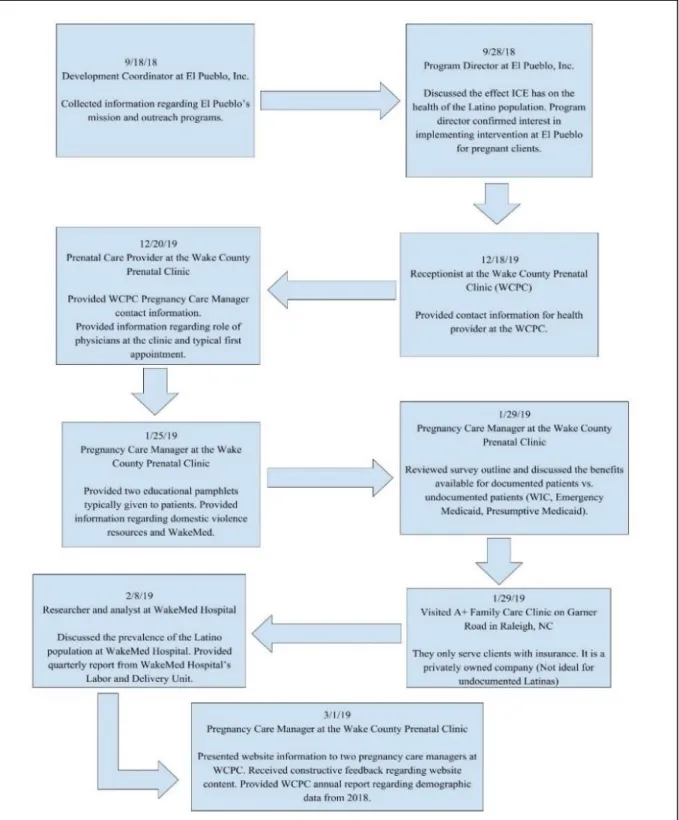
A second crucial aspect of the Predesign Phase was meeting with individuals from El Pueblo (A nonprofit organization based in Raleigh, North Carolina), the Wake County Prenatal Clinic, and WakeMed Hospital. Figure 2 portrays the meeting regimen between September (2018) and March (2019). The meetings served as a method to record the perspectives of health care providers, pregnancy care managers, and other personnel involved in the prenatal care process. Research on the internet was conducted to supplement the information gathered during meetings. Details regarding prenatal care, danger signs during pregnancy, and the importance of prenatal care were extracted from www.womenshealth.gov.
An extensive review was performed regarding online resources currently tailored towards pregnant Latinas in Wake County, North Carolina. Upon searching www.google.com, there were no websites available that explain both prenatal care and local resources specifically for Wake County residents. While the Wake County Prenatal Clinic’s website
Upon reviewing the Wake County Prenatal Clinic’s website, a primary goal for the project website was to create a resource where information could be seamlessly translated between English and Spanish. A second goal was to construct a website where Latinas could access information regarding multiple essential subjects regarding prenatal care, pregnancy, and resources. A major issue identified for current online resources is the lack of websites that present a wide variety of information in a low-grade reading level. Instead of having to visit multiple websites to collect information, the project website would serve as a melting pot for basic information that is often misunderstood or sought after by pregnant Latinas.
The Design Phase
During the Design Phase, the information and data collected during the Predesign Phase was shaped into a coherent body. The primary intention of the design phase was to produce a draft of the PEM. Subsequently, the main focus was on content, organization, motivation, linguistics, and graphics (Bernier, 1993).
The content of the website consisted of elements drawn from multiple resources. Primary subjects for the website content were selected based on survey results, qualitative material extracted from meetings, and information stemming from online resources. These primary subjects included: prenatal care, frequently asked questions about prenatal care, danger signs during pregnancy, WIC, and Medicaid. The purpose, mission, and creative team were visibly placed under the “Who are we?” tab.
sentences brief, and presenting one primary subject at a time. Motivation was a central theme of the website. The intention of the website was to assist Latinas in initiating prenatal care early in their pregnancy. Elaborating on the consequences of no prenatal care was never intended to scare website users. Instead, providing factual and plausible outcomes instills a sense of urgency within the user. Utilization of the words “you,” “my,” and “I” encourage engagement and personal application of the content.
Having the content available in English and Spanish was necessary in order to tailor the website towards Latinas. After the content of the website was reviewed by the Prenatal Care Manager at the Wake County Prenatal Clinic, a professional translator was hired to convert each section into Spanish. A high quality translation service was employed because cultural
competence plays a significant role in earning the trust of the Latino community. Additionally, language barriers and insufficient translation services were marked as being primary barriers to prenatal care on the survey. Having a resource proficiently written in Spanish may alleviate this barrier. While constructing the website content, the goal was to maintain a 5th grade reading level or below. Sentences were intentionally structured to be without multiple clauses, double
negatives, and scarcely used words.
Wix.com was used to create the website. The “Unlimited” premium plan was purchased to allow for unlimited bandwidth and 10 gigabytes of storage. The domain
www.cuidadoprenatal919.comwas purchased to establish the brand, shape the perception of users, and enhance the credibility of the website. The Spanish phrase “cuidado prenatal” is translated as “prenatal care” in English. The combination of Spanish, and the area code “919,” communicates the intended audience of the website: Latinas seeking prenatal care in the Triangle area. The website was edited to be fully compatible on laptops and mobile devices. A multilingual option on Wix.com allowed the creators to manually input translated content in a second language.
The content of the website was evaluated by using the Patient Education Materials Assessment Tool (PEMAT). The PEMAT is used to assess the understandability and actionability of education materials. The PEM receives an understandability score and an actionability score based on its content. The content of the website received an 88.2%
understandability score (15/17), and an 83.3% actionability score (5/6). The higher the PEMAT score, the more understandable or actionable the tool is considered to be (Shoemaker, Wolf, & Brach, 2013).
The Pilot Test of the PEM
Cuidadoprental919.com was published on March, 16th, 2019. Upon its publishing, the website was reviewed on multiple platforms. It’s compatibility on both the laptop and mobile device was confirmed.
The Implementation/Distribution Phase
will be the primary endorser of the website. Acquiring support from local churches, Latino organizations, restaurants, and businesses will help establish Cuidado Prenatal 919’s brand in Wake County.
Results
The results from the 32 surveys are represented in Figures 3-4. All 32 participants reported receiving some form of prenatal care during their pregnancy. Twenty (63%) of these women reported not having difficulty receiving prenatal care, while twelve (37%) stated there was some difficulty. The Wake County Prenatal Clinic-WakeMed Hospital was marked as being the most common place to receive prenatal care among the 32 participants (19 out of 32
participants selected The Wake County Prenatal Clinic-WakeMed Hospital).
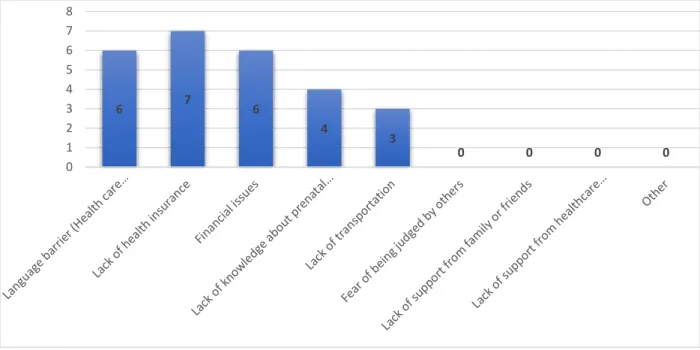
Upon interpreting the results from Figure 3, lack of health insurance was indicated as being the most problematic when accessing prenatal care. A total of 7 participants selected health insurance as a barrier. An absence of health coverage can be multifactorial: Being an
undocumented immigrant, personal or family income too high to qualify for government assistance services, lack of knowledge regarding what programs are available, or unaware of which programs you qualify for. When assessing the remainder of Figure 3’s data: 6 selected language barriers, 6 selected financial issues, 4 selected lack of knowledge regarding prenatal care resources, and 3 selected a lack of transportation. None of the participants identified
Figure 3. Barriers in accessing prenatal care.
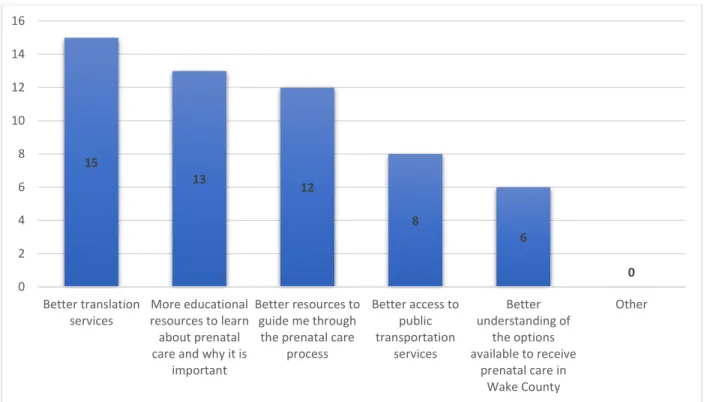
When questioning the survey participants about ways in which access to prenatal care could be optimized, 15 Latinas indicated better translation services as a viable method, 13 selected more educational resources regarding prenatal care, 12 selected enhancing the availability of guidance tools, 8 selected better public transportation services, and 6 selected obtaining further information regarding prenatal resources in Wake County (Figure 4).
6 7 6
4
3
0 0 0 0
Figure 4. Suggestions to optimize access to prenatal care.
WWW.CUIDADOPRENATAL919.COM
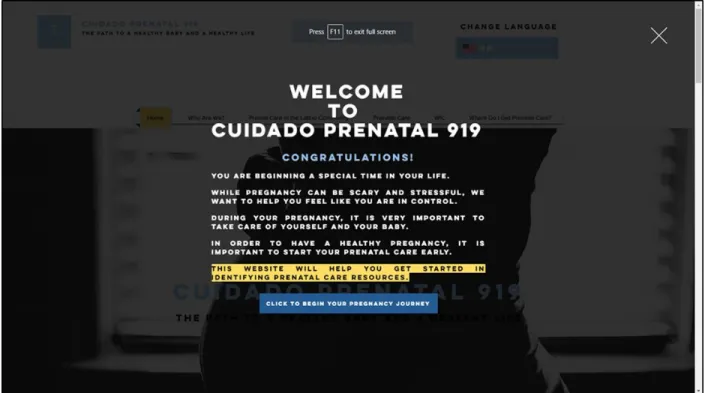
Upon arrival to the website, a “lightbox” appears and welcomes the viewer to
www.cuidadoprenatal919.com(Figure 5). The “lightbox” feature was included because it aids in establishing the website’s sense of individuality, warmth, and credibility. Most importantly, the “lightbox” immediately establishes the purpose of the website for the viewer (Initiating prenatal care early in pregnancy). From the limited text in the “lightbox,” the website user can gather who the site is for, what the site will provide, and why the site is necessary.
15 13 12 8 6 0 0 2 4 6 8 10 12 14 16 Better translation services More educational resources to learn about prenatal care and why it is
important
Better resources to guide me through
the prenatal care process
Better access to public transportation services Better understanding of the options available to receive
prenatal care in Wake County
Figure 5. “Lightbox” that automatically appears upon uploading the “home” page.
A box in the top right corner of the website allows the user to transition seamlessly between English and Spanish. A primary goal during website development was to simplify the process of translating the content for the user. The process of switching languages takes two clicks. The process of switching back to the original language is the identical process (Figure 6).
credibility. Making the creators of the website known and including a personal word from one of the researchers, creates a sense of trust, openness, and sincerity.
Figure 6. Clicking the box in the top right corner to switch between English and Spanish.
The section elaborating on “Prenatal Care in the Latino Community” was included to provide context for the website user. Being cognizant of the severe lack of prenatal care among the Latino community is important to understand in order to grasp the necessity for
www.cuidadoprenatal919.com.
Hovering over the “Prenatal Care” tab allows you to access three pages: “What is
there are very minimal resources that provide bilingual content regarding prenatal care at a low-grade reading level. These three pages of the website act as a solution to the severe lack of educational resources tailored for Latinos. The “Frequently Asked Questions” page briefly covers why initiating prenatal care early is beneficial, the negative implications of late, or absent, prenatal care, when prenatal care should be initiated, and what to expect at their first prenatal appointment. The “10 Danger Signs of Pregnancy” informs Latinas of symptoms to be cognizant for during pregnancy, and what the next steps are if these symptoms are present. Elaborating, not only on the subject at hand, but also about the next steps to be taken during an emergency
contributes toward the website’s higher actionability score under the PEMAT.
Hovering over the “WIC” tab takes you to two pages further covering the North Carolina WIC program: “What is WIC?” and “Who is WIC for?” These pages regarding WIC were included to elucidate a government program that is often misunderstood within the Latino community. While on the topic of public funding, the “How Will I Pay for Prenatal Care” page under the “Where Do I Get Prenatal Care” tab also serves to shine light on Emergency Medicaid and Presumptive Medicaid: Two government funded forms of health coverage that are applicable to undocumented immigrants. As Figure 3 indicates, financial issues and a lack of health
coverage can severely restrict one’s access to prenatal care. The Prenatal Care Manager at the WCPC explained many of their clients hold off on initiating prenatal care because they are not aware of the funding they are eligible to receive. Subsequently, the researchers of this project deemed it necessary to include information regarding WIC and Medicaid to enhance the understanding of government assistance among the Latino community.
translators at WCPC. As Figure 3 and Figure 4 indicate, lacking competent translators is a chief barrier between Latinas and prenatal care. Emphasizing the current presence of Spanish speaking providers and Pregnancy Care Managers serves as a factor to motivate Latinas in visiting WCPC.
The “Domestic Violence” page under the “Where Do I Get Prenatal Care?” tab was solely created due to the input from two Pregnancy Care Managers at WCPC. During a meeting at WCPC, the Pregnancy Care Managers emphasized the importance of bringing awareness to domestic violence in the Latino community. Like many eastern cultures, the Latino culture is very much a male dominated one. While domestic violence is not necessarily common among the Latino community, Latinas are at great risk for being silent victims of domestic violence. The “Domestic Violence” page seeks to inform Latinas of the negative impact abuse can have on pregnancy outcomes. The contact information for INTERACT, a local outreach organization that provides support for domestic violence victims, was included to promote action.
Discussion
In this honors project, we set out to create a website that promotes the initiation of early and regular prenatal care among Latinas in Wake County. We collected information via literature review, surveys within the Latino community, and meetings with stakeholders to get information about access barriers to prenatal care, ways to improve access to prenatal care, and resources available to improve Latino health.
participate in the survey were understandably skeptical. Due to the recent ICE activity in the Triangle region, none of the churches wanted to risk a research study jeopardizing the safety of their congregation. Thus, we collected survey data from a local Latino shopping center. Due to the small sample size of the survey, the results extracted from International Food - Su Tienda Hispana may not be entirely representative of the actual Latina population of Wake County. Since nonprobability sampling methods were employed (purposeful sampling and convenience sampling), the difference from the sampling error cannot be calculated. As a result, the degree to which the collected data differs from the entire Latina population of Wake County is unknown.
All the survey participants interestingly reported receiving prenatal care during their pregnancy. These results counter the statistics showing Latinas underutilizing prenatal resources (Healthy People 2020, 2013; Martin et al., 2013). This result may be a product of a social desirability bias, where survey participants provide an answer they perceive as being correct or desirable. Rather than answering the question truthfully, they provide an answer that is
considered socially respected or responsible (Polit & Beck, 2004). The Hawthorne effect occurs when your behavior or answer choices are impacted due to the conscious awareness of knowing you are a part of a study. In this case, the survey participants may submit an answer without considering what the question is truly asking. All five questions in the survey, however, were explicitly worded in positive and negative directions and reviewed for use of double negatives and unfamiliar vocabulary.
The overwhelming majority of women who stated they received prenatal care at the Wake County Prenatal Clinic – WakeMed Hospital gives the impression finding prenatal care in Raleigh, North Carolina is not necessarily the issue. Instead, the true concern may revolve
County Prenatal Clinic, stated many women do not apply for WIC, or stop attending
appointments because they are not aware of the types of financial aid they can receive as an undocumented immigrant.
While www.cuidadoprenatal919.com acts as a tool to lead Latinas to the Wake County Prenatal Clinic, it dually serves as a portable educational resource to teach them about prenatal care, danger signs during pregnancy, domestic violence, and financial resources available in the Triangle region. The websites’ seamless ability to transition between English and Spanish widens the range of individuals it can assist. Due to the prevalence of smart phones in today’s modern society, an online resource is advantageous when trying to reach a large population at one time. Another benefit of a website based intervention is the low cost it requires to be
maintained, edited, and shared. Local organizations in Wake County can easily display a link to Cuidado Prenatal 919 on their own websites.
In order to further optimize access to prenatal care, the expansion of prenatal services needs to occur. Federal and state policies have historically prevented undocumented immigrants from accessing benefits from Medicaid. Emphasis needs to be placed on prenatal care’s ability to lower the occurrence of infant mortality, maternal mortality, and low birth weight babies. In addition, the massive costs related to the absence of prenatal care serves as a persuasive argument for expanding coverage to undocumented Latinas.
deported. The complex relationship health and society share requires further development of interdisciplinary teams.
Aside from expanding health coverage for undocumented immigrants, it is crucial to provide financial support to local Wake County clinics that support undocumented Latinas. Issues regarding transportation can be remedied through the establishment of prenatal clinics in rural areas of Wake County. The Wake County Prenatal Clinic has attempted to do so through the foundation of clinics in Wake Forest, Fuquay-Varina, and Zebulon. Increased funding to local prenatal clinics will also allow for better staffing, interpreters, and training for cultural competency. Cuidado Prenatal 919 will not only guide patients to WWPC, but also assist the staff in providing culturally competent education.
Often, prenatal care is the first time many Latinas enter the realm of healthcare in the United States. In a sense, www.cuidadoprenatal919.com acts as a gateway for Latinas to initiate the process of receiving quality medical care. The long-term goal of this interventional project is to improve the health of immigrant mothers, their babies, and future Latino generations in North Carolina.
The website is now in the Implementation/Distribution Phase. It is necessary to
This project received funding from the board of Sigma Theta Tau Alpha Alpha Chapter. These funds will be used to pay for the two year subscription fee under Wix.com. More funding will be sought after to support promotion of cuidadoprenatal919.comvia flyers and posters. In order for the website to be sustainable, the online content must be monitored frequently for accuracy and depth.
Conclusion
Conducting a survey, and partaking in local meetings, provided a valuable perspective into the barriers present for Latinas of Wake County, North Carolina. In order to better tailor care towards the Latina population, it is crucial bilingual translators and culturally competent health care providers are employed at local prenatal clinics. Cuidado Prenatal 919 is a positive step towards assisting Latinas in becoming more informed and competent. The baseline motive of this project was to ensure Latino babies have an equal opportunity to live a healthy life. The impact prenatal care has on maternal and infant health is undeniable. Investing in prenatal clinics and culturally competent resources, such as www.cuidadoprenatal919.com, will have a
References
Baxley, S. M., Ibitayo, K. (2015).Expectations of pregnant women of Mexican origin regarding their health care providers. Journal of Obstetric, Gynecologic, and Neonatal Nursing, 44(3), 389-396.
Bergman, A. A., & Connaughton, S. L. (2013). What is patient centered care really? Voices of Hispanic prenatal patients. Health Communication, 28, 789–799.
Bernier, M. J. (1993). Developing and Evaluating Printed Education Materials: A Prescriptive Model for Quality. Orthopaedic Nursing, 12(6), 39-46.
Cederbaum, J., Putnam-Hornstein, E., King, B., Gilbert, K., & Needell, B. (2013). Infant birth weight and maltreatment of emerging adult mothers. American Journal of Preventative Medicine, 45, 197–201.
CDC Reproductive Health Information Source Fact Sheet. (2000). Increased risk of dying from pregnancy among Hispanic women in the United States. Retrieved
from http://www.cdc.gov/needphp/drd/surv_hispwus.htm
CDC Surveillance and Research. (2004). Reproductive health. Retrieved November 21, 2005, from http://www.CDC.gov.reproductivehealth/index.htm
Health Care Access and Latina Women. (2001). Access and barriers to care. Retrieved from www.aapho.org/site/aapho/content.php?type=1&id=9727
Healthy People 2020. (2013, August 22). Maternal, infant and child health. Retrieved from http://www.healthypeople.gov/ 2020/leading-health-indicators/infographic/maternal-infant-andchild-health
Kaiser Family Foundation (2018). Poverty rate by race and ethnicity. Retrieved from
https://www.kff.org/other/state-indicator/poverty-rate-by-raceethnicity/?currentTimeframe=0&sortModel=%7B%22colId%22:%22Location%22,% 22sort%22:%22asc%22%7D
Khashan, A., Baker, P. N., & Kenny, L. C. (2010). Preterm birth and reduced birth weight in the first and second teenage pregnancies: A register-based cohort study. BMC Pregnancy and Childbirth, 10, 36. doi:10.1186/1471-2393-10-36
Martin, J. A., Hamilton, B. E., Osterman, M. J. K., Curtin, S. C., & Mathews, T. J. (2013, December 30). Births: Final data for 2012. National Vital Statistics Reports, 62(9). Retrieved from http:// www.cdc.gov/nchs/data/nvsr/nvsr62/nvsr62_09.pdf
Monjaraz, C. (2001). A study of the relationship of early prenatal care to birth weight: Does the first trimester make a difference? Retrieved from
http://www.unomaha. edu/"'wwwpa/project/monjaraz.html
Shoemaker, S. J., Wolf, M. S., Brach, C. (2013). Patient education materials assessment tool for printable materials. Retrieved from https://www.ahrq.gov/professionals/prevention-chronic-care/improve/self-mgmt/pemat/index.html
Pew Research Center (2019). Latinos by geography. Retrieved from http://www.pewhispanic.org/states/county/37183/
Prenatal Care. (2019). Retrieved from https://www.womenshealth.gov/a-z-topics/prenatal-care Prenatal Care Access Among Immigrant Latinas. (2005). Retrieved
from http://latinainstitute.org/sites/default/files/PrenatalCare-2_0.pdf
Statistical Atlas (2018). Map of race and ethnicity by neighborhood in Raleigh. Retrieved from https://statisticalatlas.com/place/North-Carolina/Raleigh/Race-and-Ethnicity Torres, R. (2016). Access barriers to prenatal care in emerging adult Latinas. Hispanic Health
Care International, 14(1), 10-16.
U.S. Census Bureau (2018). North Carolina: Race and Hispanic origin. Retrieved from https://www.census.gov/quickfacts/nc
U.S. Department of Health and Human Services. (2013). Trends in teen pregnancy and childbearing. Retrieved from http://www.hhs.gov/ash/oah/adolescent-health-topics/reproductivehealth/teen-pregnancy/trends.html
U.S. National Library of Medicine. (2011, September 12). Adolescent pregnancy. Retrieved from https://www.nlm.nih.gov/medlineplus/ ency/article/001516.htm
Weng, Y., Yang, C., & Chiu, Y. (2014). Risk assessment of adverse birth outcomes in relation to maternal age. PLoS One, 9(12), e114843.
What Happens at Prenatal Care Appointments? (2019). Retrieved