29
The application of Azolla filiculoides biomass in acid blue 15 dye (AB15) removal from aqueous solutions
Mohammad Ali Zazouli1, Davoud Balarak2*, Yusef Mahdavi2, Fatemeh Karimnejad2
1. Department of Environmental Health Engineering, Health Sciences Research Center,
Mazandaran University of Medical Sciences, Sari, Iran
2. Department of Environmental Health Engineering, Mazandaran University Of Medical
Sciences, Sari, Iran
Abstract
Introduction: Industrial wastewater is one of the most important environmental pollutants. Discharging the colorful industrial effluents into receiving waters can lead to eutrification which has many adverse effects on human health. Therefore, the present study aimed at evaluatingacid blue 15 dye removal from aqueous solution by dried Azolla.
Materials and methods: Azolla biomass was dried in the sunlight, and then crushed and sieved to particle sizes in range of 1-2 mm. Next, it was treated with 0.1 M HCl for a period of 5 hours. The Azolla was washed with distilled water and used as absorbent. The effect of operating parameters such as pH, contact time, AB 15 concentration and adsorbent dose on the AB15 removal efficiency was investigated. The dye concentration was measured by spectrophotometer (DR4000) at λmax =565nm.
Results: In optimum condition (pH 3, contact time 90 min , absorbent dose 10 g/l and AB15 concentration 10 ppm), application of Azolla removed 98% of AB15 from aqueous solutions. The equilibrium data was best fitted on Langmuir isotherm and the adsorption kinetic model followed a pseudo-second model.
Conclusion: The obtained results showed that the dried Azolla can be used as a high efficiency and low-cost absorbent to treat textile effluents.
Keywords:Azolla filiculoides, AB15 dye, isotherm’s model, adsorption, water treatment
Introduction
Synthetic dye is one of the most serious problems for environment because it may become toxic due to decomposition (1, 2). The amount of generated dye is estimated in the range of 7×10⁵-106 ton/year which is used in many industries such as production of cosmetic, leather, paper and textile (3-5). Maximum dye consumption is used in
textile industry and these industries can produce high volume wastewater with dye concentration in the range of 10-200 mg/l(3, 6). Approximately, 10-20% of total world production of dyes is lost during the painting process and is released into wastewater streams (7, 8). The dyes are formed with different chemical structures such as acidic,
*Corresponding author: Tel: +98 1513543237; fax: +98 01513543237
Address: Department of Environmental Health Engineering, Health Sciences Research Center, Faculty of Health, Mazandaran University of Medical Sciences, Sari, Iran
E-mail: dbalarak2 @gmail.com
Received 28/12/2013; revised 18/1/214; accepted 1/2/214
Received 1/12/2013; revised 20/1/214; accepted 21/1/214
30
basic, reactive, disperse, azo, anthraquinone and metal dyes (9, 10). Discharging the wastewaters into receiving waters leads to eutrification and interference in the ecology (11). Most dyes have carcinogenic and mutagenic properties and can cause allergy and dermatitis (11). Various methods were used to treat the textile effluents such as biological, membrane process, advanced oxidation process, etc. (12-14). Most conducted studies on dye removal are based on advanced oxidation process; however, the formation of by-product and their high cost is considered as a major problem (9). Adsorption process is one of the most common processes used in water and wastewater treatment (15, 16). Typically, adsorption process is performed by activated
carbon. Although the advantages of
activated carbon are the high capacity and adsorption surface, it is expensive and requires expertise (17, 18). Therefore, researchers have attempted to use the natural and low cost adsorbents instead of commercial carbon (11, 18, 19). Nowadays,
different natural adsorbents such as chitosan, fly ash, peach kernel, olive, charcoal, barley and wheat straw, sawdust are used to remove organic and inorganic pollutants (11, 18, 20-22). A number of studies suggest the using of biosorption methods such as plant biomass to treat these wastewaters (23). Azolla is a flouting aquatic fern which has a rapid growing rate in stagnant waters and wetlands and can rapidly cover the surface of water (24, 25). Therefore, it can be a serious problem for aquatic life and many studies are conducted to eliminate this plant in the Anzali wetlands. Dried Azolla is used as high efficiency and inexpensive adsorbent to remove the organic substances such as dyes and heavy metal in many countries of the world due to its adsorbing properties. Table 1 shows the sorption capacity for Azolla adsorbent used to remove pollutants (26-31). Therefore, the purpose of this study was to use dried Azolla as an effective and low cost adsorbent to remove reactive Acid Blue15 from aqueous solutions.
Table 1. The removal efficiency of pollutant by using the Azolla.
Author Pollutant Removal efficiency
Balarak D Pyrocatechol 97%
Balarak D Phenol 99%
Padmesh TVN Acid red 88, acid green 3, acid orange 7 99%
Pandey VC Heavy metals 96%
Material and method
Adsorbent preparation: Azollafiliculoides was collected from rice fields of Sari. It was sun dried then crushed and finally sieved to particle sizes in the range of 1–2 mm. The biomass was treated with 0.1 M HCl for 5 h followed by washing with distilled water and then dried in shade (32). The resultant
biomass was subsequently used in
absorption experiments. The specific surface area of adsorbent was determined by the BET method using the Gemini2357 of
micrometrics Co. Scanning electron
microscopy (SEM ( of the modified
Azollafiliculoides were carried out using Philips, Eindhoven.
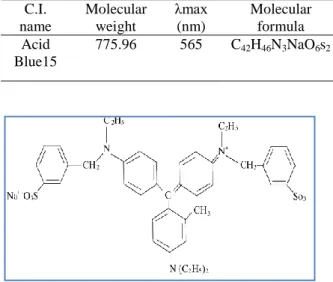
Materials: The AB15 dye was supplied from Alvansabet Co. the stock solution (1000mg/l) was prepared and desired concentration of dye solution was prepared by dilution of stock solution. The General characteristics and chemical structures of AB15 are presented in Table 2 and Figure 1, respectively.
31
Table 2. Properties of AB15(33).
Molecular formula λmax
(nm) Molecular
weight C.I.
name
C42H46N3NaO6s2 565
775.96 Acid
Blue15
Figure 1. The chemical structures of AB15 (33).
Batch adsorption experiments: The literature review indicated that the most important effective variables on adsorption are pH, adsorbent dose, contact time, and pollutants concentrations. Therefore, the initial AB15 concentration was selected (10-200 mg/l). The effect of absorbent dosage
(0.2-1.4 g/100 ml), contact time (10 - 180
min) and pH (3- 11) were investigated. The experiments in batch system were carried out using 100ml in a 250 ml Erlenmeyer flask Meyer. In each adsorption experiment, certain concentration of AB15 solution was added into the flask. In every experiment, a certain concentration of AB15 and specific dose of absorbent poured into the Flask and completely mixed with magnetic stirrer at 3600 rpm for 60 minutes. Then, the sample was centrifuged at 3600 rpm for 10 minutes. Finally, the residual concentrations were measured using spectrophotometer at λmax of 565 nm (33). The amount of adsorbed AB15 was calculated according to the following Eq 1(34).
qe = (CO − Ce) V/m Eq1
Where qe is the amount of adsorbed (mg/g),
C0 and Ce are the initial and equilibrium
concentrations of liquid phase (mg/L),
respectively. V is the volume of the solution (L), and m is the mass of the adsorbent (g).
Adsorption isotherms: The equilibrium
adsorption isotherm is an important
parameter for the design of adsorption
systems. Although several isotherm
equations are available, two important isotherms of Langmuir and Freundlich isotherms were selected. The Langmuir isotherm is presented in the Eq2 (34, 35).
Ce / qe =1/qm KL + Ce / qm Eq2
Where qe is the amount of sorbatebiosorbed
at equilibrium (mg/g); Ce is the equilibrium
concentration of the sorbate or the sorbateunadsorbed in the solution (mg/L);
qm (mg/g) is the maximum theoretical
biosorption capacity and KL (L/mg) is a
measure of biosorption energy that is indicated on the affinity between biosorbent and sorbate.
The Freundlich equation is given by the following Eq3 (36, 37):
Log x/m = 1/n log Ce + log KF Eq3
Where qe is the sorbatebiosorbed at the
equilibrium (mg/g); Ce is the
equilibriumconcentration of the sorbate or the unabsorbed sorbate in the solution
(mg/L); KF is a constant, indicative of
biosorptioncapacity(36). Table 2 shows the Freundlich and Langmuir equation obtained
for the biosorption of AB15 onto dried A.
filiculoides.
Adsorption kinetics: Kinetic models are used to examine the rate of the adsorption process and potential rate controlling step. In the present study, obtained kinetic data were analyzed from batch studies using the pseudo second-order and pseudo First-order model.
The pseudo-first-order rate equation is
expressed as Eq 4 (38):
log (qe − q) = log qe − k1t / 2.3 Eq4
32
Where qe and q are the amounts of AB15
adsorbed (mg/g) at equilibrium and at time t (min), respectively, k1 is the rate constant of
adsorption (min−1). Values of k1 were
calculated from the plots of log (qe-q) versus
(t) for different concentrations.
Also, equation 5 provides the pseudo-second-order rate equation:
dq / dt = k2 (qe −q)2 Eq5
Where K2 is the second order rate constant
(g mg −1min−1), q and qe are the amount of the adsorbed on the adsorbent (mg/g) at equilibrium and at time t. The integration fromEq 6is as follows:
t/q = 1/k2qe2 + 1/ qet Eq6
If the second-order kinetic equation is applicable, the plot of t/q against t of Eq (6) will give a linear relationship. The qe and K2 can be determined from the slope and the intercept of the plot.
Results
Scanning electron microscopy (SEM)
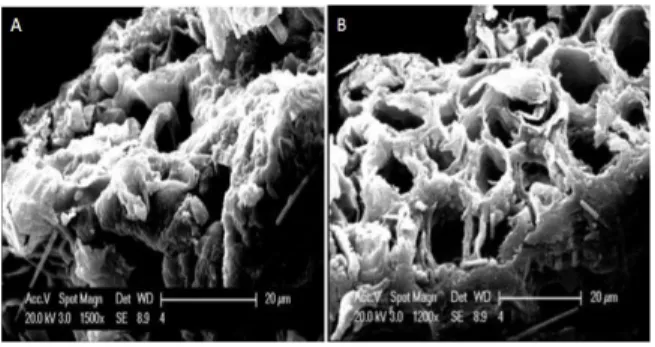
images were used to analyze the surface structure of A. Filiculoides (Fig. 2). It was found that the adsorbent has Heterogeneous surface structure with deep pores. The specific surface area of modified Azolla was
determined in the size of 36 m2/g.
Figure 2. SEM photographs of adsorbent: (A) before use,(B) after use.
The effect of contact time and initial dye concentration: Increasing the contact time raised the adsorption percentage; however, adsorption ratio reached equilibrium after 90 min. The dye removal efficiency was
decreased by increasing initial
concentration. Figure 3 presents the effect of contact time and initial dye concentration on dye removal. As can be observed,in dye concentration of 200 and 10 mg/l, the dye removal efficiency is 49 and 98%, respectively.
Figure 3. Effect of contact time and initial dye concentration on removal efficiency (pH = 3, adsorbent dosage 1 g/100cc).
The effect of pH and adsorbent dosage:
Figures 3, 4 and 5 shows the effect of pH and adsorbent dosage on adsorption rate. As it is seen, the maximum adsorption rate was performed in acidic pH and it is decreased in alkaline pH. The adsorption rate was raised by increasing the adsorbent dosage up to the concentration of 10 g/L, and then reached to equilibrium. As a result, adsorption rate was also enhanced by increasing the adsorbent
dosage.
Adsorption kinetics and isotherms: Table 2 and 3 show the isothermal models and adsorption kinetics.
0 20 40 60 80 100
10 20 30 45 60 90 120180
%
Re
m
o
val
Time(min)
10 ppm 25 ppm 50 ppm 100 ppm
33
Figure 4. Effect of pH on removal efficiency of AB15 (contact time = 90min, dose: 10g/l, AB15 concentration: 10ppm).
Figure 5. Effect of adsorbent dose on removal efficiency of AB15 (contact time = 90 min, PH = 3, AB15 concentration: 25 ppm).
Table 3. The isotherms constants for the removal AB15 dye.
Table 4. The kinetic model constants for the removal AB15 at 10, 25, 50 mg/L dye concentrations
Pseudo second-order model Pseudo First-order model
co(mg/L) K2(g/mg min) R2 q)mg/g) k1(1/ min) R2 q)mg/g)
10 0.07 0.988 1.84 0.060 0.948 1.45
25 0.10 0.992 3.90 0.075 0.964 3.40
50 0.114 0.998 5.90 0.088 0.978 5.60
Discussion
The specific surface area is related to the number of active adsorption sites of dried A. filiculoides.The adsorption was increased with the specific surface area and pore volume of the sorbent. The specific surface area of themodified Azolla was determined
in the size of 36 m2/g. This situation
indicated that the modified Azolla has a
relatively good ability to remove the pollutants (9).
With regard to the present study, the dye removal efficiency enhances by increasing contact time which is due to more contact between pollutant and adsorbent. The dye adsorption was rapidly performed in initial minutes of the sorption process. Adsorption rate decreases with time which can decline
Langmuir model Freundlich model
b(ml/g) R2 qm KF R2 1/n
1.11 0.998 7.1 51.2 0.963 1.02
0 20 40 60 80 100
0 0.2 0.4 0.6 0.8 1 1.2
3 5 7 9 11
Bios
o
rp
tio
n
(m
g/g)
pH Biosorption % Removal
%
Re
m
o
val
0 20 40 60 80 100
0 1 2 3 4 5 6
2 4 6 8 10 12 14
Bios
o
rp
ti
o
n
(mg
/g
)
Dose (g/L) Biosorption % Removal
%
Remo
va
l
34
the dye concentration and lower active points on adsorbent surface area. There are a lot of empty spaces in the early stages of adsorption and they were occupied by dye molecules with time. This situation is consistent with several studies that were conducted on dye removal by Azolla (29, 39).
The greater adsorption occurs in low concentrations and dye removal efficiency reduces with increasing initial concentration of dye. Since the adsorbents have little adsorption sites, their adsorption capacity is therefore saturated by increasing the pollutant concentration and the removal efficiency will reduce.
The results of this study are in line with previous studies (30, 36). pH plays an important role in all processes and adsorption capacity. It can influence various aspects of adsorption including adsorbent surface charge, the degree of ionization, and separation of functional groups on the active sites of adsorbent and solution chemistry. Many researchers have reported that pH plays a main role in electrostatic force between adsorbent and AB15. In this study, the maximum AB15 removal was obtained in pH=3 which is similar to previous studies on dye removal by azolla. This is probably due to the binding group between adsorbent and adsorbate (9, 29).The adsorption rate enhances by an increase in adsorbent dose which is due to increasing the active surface of adsorbent. The results show that although efficiency rises with increasing adsorbent dose, the dye adsorbed per gram of adsorbent decreases and active sites of adsorbent are not saturated because of it. So,
when the adsorbent dose increases, the total capacity of the adsorbent surface points is not completely used and this reduces the adsorption rate per unit mass of the adsorbent (3, 12).
The Freundlich equation is based on the hypothesis of multi-layer biosorption and the linear form is given by the following equation and Langmuir isotherm assumes monolayer coverage of a sorbent on the solid surface of adsorbent, uniform energy of sorption, and no transmigration of sorbate in the surface of plant. The obtained equilibrium data from AB15 adsorption by this plant indicated that the data is better fitted on Langmuier isotherm (R2=0.998) than Freundlich isotherm (R2=0.963) which is in line with the studies that are performed by this plant for dye removal (6, 28, 30). Kinetics of adsorption was well described by pseudo-second order model. The result of this study is consistent with other studies(19, 29, 32).
Conclusion
According to the obtained results, Azolla can be used as an effective, inexpensive, and available adsorbent to treat the effluents with organic compound (dye) such as textile wastewater. The dye removal efficiency depends on various parameters such as contact time, pH, adsorbent dose, and initial dye concentration.
Acknowledgement
The authors are grateful to Student research committee of Mazandaran University of Medical Sciences for supporting this study.
References
1. KhorramfarS, Mahmoodi NM, Arami M,
Gharanjig K. Dye removal from colored
textile wastewater using
tamarindusindica hull: adsorption
isotherm and kinetics study. DyeSci Technol. 2012;3(1):81-8.
2. GokO, Ozcan AS, Ozcan A. Adsorption
behavior of a textile dye of Reactive
35
Blue 19 from aqueous solutions onto modified bentonite. Appl Surf Sci. 2010; 256 (17):5439-43.
3. Zazouli MA, Yazdani J, Balarak D,
Ebrahimi M, Mahdavi Y. Removal Acid Blue 113 from Aqueous Solution by Canola. J Mazandaran Uni Med Sci. 2013; 23(2):73-81.
4. Yazdanbakhsh AR, Mohammadi AS,
Sardar M, Mohammadi H, Zarabi M. Investigation of Iron Powder, Hydrogen Peroxide and Iron Hydrogen Peroxide for Removal of Acid Yellow Powder 36 Dye from Aqueous Solutions. Health Environ. 2010; 2(4):295-302.
5. Samarghandi MR, Sepehr MN, Zarrabi
M, Norouzi M. Mechanism and Removal Efficiency of C.I. Acid Blake 1 by
Pumice Stone Adsorbent. Health
Environ. 2011; 3(4):399-410.
6. Patil AK, Shrivastava VS.
Alternantherabettzichiana plant powder as low cost adsorbent for removal of Congo red from aqueous solution.
International journal of chemistry
technology resources. J Health. 2010; 9(2):842–50.
7. Lin L, Zhai S-R, Xiao Z-Y, Song Y. Dye
adsorption of mesoporous activated carbons produced from NaOH-pretreated rice husks. Bioresource Technol. 2013; 10(136):437–43.
8. Mahvi A, Heibati B. Removal efficiency
of azo dyes from textile effluent using activated carbon made from walnut wood and determination of isotherms of acid red18. Public Health J. 2009; 1(3):7-15.
9. Zazouli MA, Balarak D, Mahdavi Y.
Effect of Azollafiliculoides on removal of reactive red 198 in aqueous solution. J Adv Environ Health Res. 2013; 1(1):1-7.
10.Tan L, Ning S, Xia H, Sun J. Aerobic
decolorization and mineralization of azo dyes by a microbial community in the absence of an external carbon source. Int
Biodeterior Biodegrad. 2013:7( 85):210-6.
11.Zazouli MA, Balarak D, Mahdavi Y,
Ebrahimi M. Adsorption rate of 198 reactive red dyes from aqueous solutions by using activated red mud. Iran J Health Sci. 2013; 1(1):29-40.
12.Safa Y, Bhatti HN. Adsorptive removal
of direct textile dyes by low cost
agricultural waste: Application of
factorial design analysis. Chem Engin J. 2011; 12(167):35–41.
13.Naddafi K, NabizadehNodehi R,
Jahangiri Rad M. Removal of Reactive Blue 29 Dye from Water by Single-Wall Carbon Nanotubes. Iran J Health Environ. 2011; 3(4): 359-68.
14.Shokouhi R, Hosseinzadeh E, Zare M,
Torabi E. Sodium Alginate Magnetic Beads for Removal of Acid Cyanine 5R from aqueous solution. Hormozgan Med J. 2011;1(2):101-11.
15.Tan C-y, Li G, Lu X-Q, Chen Z-l.
Biosorption of Basic Orange using dried A. filiculoides. Ecol Engin. 2010; 5(36):1333–40.
16.Shokohi R, Jafari Z. removal dye Acid
Blue 113 from aqueous environment by adsorption on Activated red mud. J Med Kordestan. 2011; 16(4):55-65.
17.Garg VK, Renuka G, AnuBala Y,
Rakesh K, Dye removal from aqueous solution by adsorption on treated sawdust, Bioresour. Technology. 2003; 89(3):121-7.
18.Toor M, Jin B. Adsorption
characteristics, isotherm, kinetics, and diffusion of modified natural bentonite for removing diazo dye. Chem Engin. 2011; 6(187):79-88.
19.Ponnusami V, Krithika V, Madhuram R,
Srivastava SN. Biosorption of reactive dye using acid-treated rice husk: Factorial design analysis. J Hazardous Mat. 2007; 8(142):397–403.
36
20.Crini G, Badot PM. Application of
chitosan, a natural aminopolysaccharide, for dye removal from aqueous solutions by adsorption processes using batch studies: A review of recent literature. Prog Polymer Sci. 2008; 33(4):399-447.
21.Oladoja NA, Aboluwoye CO, Oladineji
YB. Studies on castor seed shell as a sorbent in basic dye contaminated wastewater remediation. Desalination. 2008; 14(227):190-203.
22.Wang S, Boyjoo Y, Choueib A, Zhu ZH.
Removal of dyes from aqueous solution using fly ash and red mud. Water Res. 2005; 39:129-38.
23.Dianati RA, Yazdani J, Belarak D.
Effect of sorbitol on phenol removal rate by lemna minor. Mazandaran Uni Med Sci. 2013; 22(2):58-64.
24.Jain SK, Gujral GS, Jha NK, Vasudevan
P. Production of biogas from
Azollapinnata R.Br and Lemna minor L.: Effect of heavy metal contamination. Bioresource Technol. 1992; 41(3):273-7.
25.Filizade Y. Survey Ecology Excessive
Growth Of Azolla In Anzali Wetland
And Quality Control. Iran Nat
Resources. 2003; 55(1):65-82.
26.Zazouli MA, Balarak D, Mahdavi Y.
Pyrocatechol Removal from Aqueous Solutions by Using Azolla filiculoides. Health Scope. 2013; 2(1):1-6.
27.Diyanati RA, Yousefi Z, Cherati JY,
Balarak D. Adsorption of phenol by modified azolla from Aqueous Solution. J Mazandaran Uni Med Sci. 2013; 22(2):13-21.
28.Diyanati RA, Yousefi Z, Cherati JY,
Balarak D. The ability of Azolla and lemna minor biomass for adsorption of phenol from aqueous solutions. J Mazandaran Uni Med Sci. 2013; 23(106).17-23.
29.Padmesh TVN, Vijayaraghavan K,
Sekaran G, Velan M. Application of Azollarongpong on biosorption of acid
red 88, acid green 3, acid orange 7 from synthetic solutions. Chem Engin J. 2006; 11(122):55-63.
30.Tan C-y, Li M, Lin Y-M, Lu X-Q, Chen
Z-l. Biosorption of Basic Orange from
aqueous solution onto dried A.
filiculoides biomass: Equilibrium,
kinetic and FTIR studies. Desalination. 2011:266(1-3):56-62.
31.Pandey VC. Phytoremediation of heavy
metals from fly ash pond by
Azollacaroliniana. Ecotoxicol Environ Safety. 2012:82(2):8-12.
32.Padmesh TVN, Vijayaraghavan K,
Sekaran G, Velan M. Batch and column studies on biosorption of acid dyes on
fresh water macro alga
Azollafiliculoides. J Hazardous Mat. 2005; 4(125):121-9.
33.Samanjit A, Walia TPS, Ravneet K.
Removal of health hazards cuasing acidic dyes from aqueous solution by the process of adsorption. J Health Allied Sci. 2007; 6(3):14-21.
34.Zazouli MA, Balarak D, Mahdavi Y,
Barafrashtehpour M, Ebrahimi M.
Adsorption of bisphenol from industrial wastewater by modified red Mud. J Health Develop. 2013; 2(1):1-11.
35.Dogan M, Abak H, Alkan M.
Biosorption of Methylene Blue from Aqueous Solutions by Hazelnut Shells: Equilibrium, Parameters and Isotherms. Water Air Soil Poll. 2008; 192(1-4): 141-53.
36.Zazouli MA, Balarak D, Mahdavi Y.
Application of azollafiliculoides biomass for 2-Chlorophenol and 4-Chrorophenol Removal from aqueous solutions. Iran J Health Sci. 2013; 1(2):20-30.
37.Nateghi R, Bonyadinejad GR, Amin
MM. Nickel oxide nanoparticles
application as an efficient adsorbent for dye removal from synthetic wastewater treatment. Health Sys Res. 2009; 6:1015-21.
37
38.Zazouli MA, Balarak D, Karimnejhad F.
Kinetics modeling and isotherms for adsorption of fluoride from aqueous solution by modified lemna minor. J Mazandaran Uni Med Sci. 2013; 23(107):31-39.
39.Vafaei F, Khataee AR, Movafeghi A,
SalehiLisar SY, Zarei M. Bioremoval of an azo dye by Azollafiliculoides: Study of growth, photosynthetic pigments and antioxidant enzymes status. Int Biodeter Amp Biodegrad. 2012:75:194-200.