Higher Post-transplant Costs and Resource Utilization in
Adult Living Donor Liver Transplant Recipients
Compared to Deceased Donor Liver Transplant
Recipients
By
Jason D. Conway, MD Master's Paper Presented to the Faculty of
THE UNIVERSITY OF NORTH CAROLINA AT CHAPEL HILL SCHOOL OF PUBLIC HEALTH
PUBLIC HEALTH LEADERSHIP PROGRAM In partial fulfillment of the requirements for the degree of
MASTERS OF PUBLIC HEALTH
THE UNIVERSITY OF NORTH CAROLINA AT CHAPEL HILL SCHOOL OF PUBLIC HEALTH
ABSTRACT
Living donor liver transplantation (LDLT) is an alternative to traditional deceased donor liver transplantation (DDLT) that has grown out of the shortage of deceased donor livers available for transplantation. The two procedures have similar clinical outcomes, but costs have been shown to be higher in living donor liver transplantation (LDLT) than in deceased donor liver transplantation
(DDLT). The aim of this study was to compare the medical resource utilization, costs, and complication rates between LDLT and DDLT. Data were collected on the first 24 LDLT recipients performed at the University of North Carolina at Chapel Hill School of Medicine and were compared to 24 DDLT recipients matched on age, etiology of liver disease, year of transplant, and model for end stage liver disease (MELD) score at the time of transplantation. The study time period was the first 30 days after transplantation. Compared to DDLT recipients, LDLT recipients had significantly longer lengths of stay, 23.2 vs. 15.9 days, p<0.001, as well as number of laboratory tests 2,403 vs. 1,509, p=0.001 and radiology tests, 29.9 vs. 14.7, p<0.001 . Costs for ICU care were higher in the LDLT recipients compared to DDLT recipients, $15,504 vs. $7,243, p=0.006. Total costs for LDLT recipients was higher at $61,488 vs. $34,973 for DDLT recipients, p=O.OOl. The increase in total costs in the LDLT group was largely driven by complications, with are-transplantation rate of 25%. Resource
INTRODUCTION
Liver transplantation is the only curative treatment for patients with acute or chronic liver failure. Cadaveric or deceased donor liver transplantation (DDLT) entails removal of the donor liver from the cadaveric donor and implantation into the recipient after resection of the diseased liver. The first successful transplant was performed over 35 years ago 1. With increasing technical experience and improvements in immunosuppressive drugs, both the number of transplants and the survival rates has grown dramatically in the past several years 2·3. From 1989 to 1999 the number of liver transplants performed in the US increased from 2,201 to 4,700 4. During this same time period, average 1-year survival rates increased from 81.5% to 86.2% and are currently greater than 90% 5. Liver transplantation is now standard of care for patients with end-stage liver disease (ESLD).
Unfortunately, the number of patients requiring liver transplantation will likely increase in the future. The peak of the hepatitis C epidemic has not yet been reached 6. There are approximately 25 million Americans infected- many of who do not know they are infected until they develop ESLD. As many as 20% of these patients infected with hepatitis C may eventually develop ESLD and require liver transplantation 7.
10 years. Unfortunately, the supply of organs has not kept up with the greater demand, increasing only 3-fold over the past 10 years 8. If listings were
suspended at there current levels, it would take over 4 years to transplant all those patients currently on the waiting list 4. Because of this mismatch in waitlist length and supply of organs, waitlist times are increasing and more patients are dying waiting for a liver transplant 9 Currently, waiting list mortality is about 10% per year 8
In response to this shortage, adult-to-adult living donor liver
transplantation (LDLT) has evolved as an alternative for patients with ESLD and outcomes have been shown to be similar to DDLT 10-14. In LDLT, the recipient's diseased liver is resected, and the either a right or left liver lobe from a living donor is implanted. Because of the liver's tremendous regenerative ability, the liver fragment in both the donor and recipient quickly grows, and within a few weeks liver mass is normal in both donor and recipient. The use of LDLT has shortened the waiting time for some recipients and may indirectly increase the availability of deceased donor organs for those remaining on the DDLT waiting list 15•
additionall.3 quality adjusted life years in the group offered LDLT or DDLT compared to DDLT alone 16 This suggests that offering LDLT in addition to DDLT can improve survival at acceptable costs. Another study compared the comprehensive costs for 24 LDLT recipients for 90 days pre-operative and 1-year post-operative (including all donor evaluation and post-operative care) to 43 DDLT recipients' care for the same time period. The total comprehensive cost of LDLT was 21% higher than DDLT, although this difference was not statistically significant. This was likely due to the case mix and patient factors not controlled for in the study making the sample size inadequate 17• Finally, one study
published only in abstract form showed that LDLT donor evaluation, post-operative care, and recipient post-post-operative care cost 2.8 times more than DDLT recipient post-operative care 18•
These prior studies comparing costs of LDLT to DDLT did not adjust for the severity of illness prior to transplant, which may have affected resource
utilization in the immediate post-transplant period 19-22• These studies also did not adjust for time period and advances over time, which may impact practice
patterns and costs. In order to accurately determine the differences in costs solely
occur during the first 30 days. Also, most transplant contracts with the insurer are based upon the time from transplant to discharge, which typically occurs within 30 days of transplantation. Additionally, we examined specific areas in which resource utilization was higher in LDLT compared to DDLT recipients, such as length of stay, laboratory testing, radiology testing, andre-operations. We also compared the frequencies of complications for the 30-day post-transplant time period between LDLT and DDLT recipients.
MATERIALS AND METHODS
The study group included the first 24 consecutive LDLT recipients performed at the University of North Carolina at Chapel Hill School of Medicine from November 1998 to October 2003. In order to most accurately capture costs related to the type of transplant, 24 DDLT recipients were matched to the LDLT recipients on factors that affect costs, including age, year of transplant, etiology of liver disease, and MELD score at the time of transplant (see Table 1). Data were collected by extensive review of both the electronic and paper medical record. The first 30 days after transplantation was used as the study time period.
Complications were defined as any event prolonging hospital stay or requiring an intervention or administration of a medication not part of standard of care.
Costs of organ acquisition as well as donor evaluation and post-operative care of the donor were not included in this analysis. Professional fees were also excluded from this analysis. The cost analysis was performed from the perspective of the provider.
Variables were summarized as means and standard deviations (SD) for variables with normal distribution, and medians and ranges for non-normally distributed variables. A variable was considered non-normally distributed if the median was substantially different from the mean. Means of continuous variables were compared using the 2-sample t-test. Medians of continuous variables were compared using the Wilcoxon rank sum test. Categorical variables were
compared using Pearson's chi square test or Fisher's exact test when appropriate. Statistical analysis was performed using Stata Statistical Software: Release 8.0 (Stata Corporation, College Station, TX).
This study was approved by the institutional review board of the University of North Carolina at Chapel Hill School of Medicine.
RESULTS
Table 1 shows the demographics of the LDLT and DDLT groups. The groups were well matched for age, MELD score at the time of transplant, etiology of liver disease, and year of transplant. Median wait times tended to be longer in the DDLT group, although this did not reach statistical significance. The two groups were also similar prior to transplant when compared using the age-weighted comorbidity index described by Charlson eta!., with the LDLT
score of 4.3±1.5, p=0.60 23. Twenty-three of the 24 LDLT recipients received a right hepatic lobe, only one received a left lobe. Six LDLT recipients had a duct-to-duct anastomosis while 21 of the DDLT recipients had this type of biliary anastomosis. One patient in the LDLT recipient group had hepatocellular carcinoma (HCC) at the time of transplantation, while no patient in the DDLT recipient group had HCC. For the cost and resource utilization comparisons described below, the results were similar when either means or medians were compared.
Length of Stay
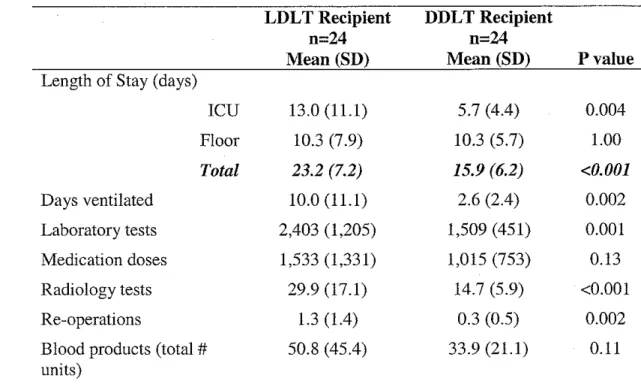
Table 2 shows the differences in 30-day post-operative medical resource utilization between the two groups. LDLT recipients' length of stay was longer in the ICU compared to DDLT recipients, 13.0 vs. 5.7 days, respectively, p=0.004. Total length of stay was longer in the LDLT group at 23.2 days vs. 15.9 days in the DDLT group, respectively, p<O.OOl. The longer length of stay in the LDLT recipients was driven by ICU stay, because length of stay on the floor was 10.2 days in both groups.
Medical Resource Utilization
post-operative period. Re-operations include any time the patient was taken back to the operating room during the 30-day post-operative period, including re-transplantation. The mean number of medication doses (both inpatient and outpatient dispensed at one of our hospital's pharmacies) was higher in the LDLT recipient group, although this did not reach statistical significance even after adjusting for the unequal variance.
Cost
Cost data are shown in Table 3. Total and ICU room charges were
significantly higher in the LDLT recipient group, reflective of this group's longer hospitalization. The LDLT recipient group incurred significantly higher
medication, radiology, and operating room costs; while laboratory, blood bank, and other costs (which includes non-OR procedures, dialysis, and respiratory therapy costs) tended to be higher in the LDLT group, although not statistically significant. While the number of medication doses was higher, but not
Complications
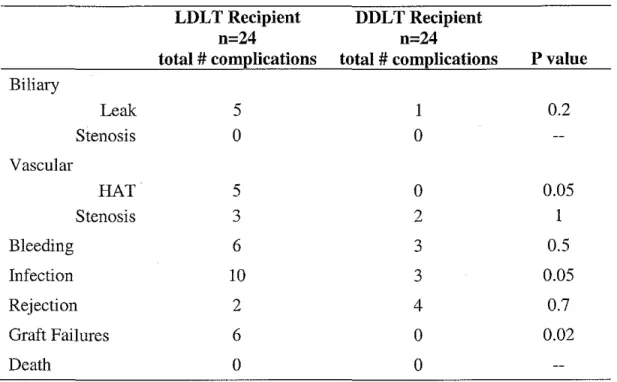
This cost differential between the two groups was largely due to the higher complication rate seen in the LDLT recipient group as shown in Table 4. There were no deaths in either group seen in this 30-day post-operative period.
Biliary Complications
There were more biliary leaks in the LDLT recipient group than in the DDLT recipient group, although this was not statistically different. Three patients in the LDLT recipient group had bile leaks from the cut surface of the liver, two of which resolved with percutaneous drainage and one required surgical
intervention. Two patients had anastomotic leaks, one of which resolved with percutaneous biliary drainage and the other required surgical revision of the anastamosis. The one biliary leak seen in the DDLT recipient group was anastomotic and was managed successfully with endoscopic retrograde
cholangiopancreatography (ERCP) and biliary stenting. No biliary stenoses were seen in this in this 30-day post-operative period.
Vascular Complications
Five patients in the LDLT recipient group suffered hepatic artery thrombosis (HAT), while no patients in the DDLT recipients had HAT. Unfortunately, all 5 occurrences of HAT led to loss of the graft
recipient group. Three patients required evacuation of hematoma from the cut liver surface, while 2 had vena cava bleeding and one had a hepatic artery leak. The 3 patients in the DDLT recipient group with bleeding complications all had hematoma evacuation.
Infections
Rates of infection were also significantly higher in the LDLT recipient group, p=0.05. There were three cases of uncomplicated urinary tract infections, which resolved with antibiotics. One minor wound infection also resolved uneventfully with antibiotics. Another patient developed nosocomial pneumonia and recovered with antibiotics and supportive care. Five patients developed post-operative peritonitis, 2 caused by gram-positive cocci and 3 by gram-negative rods. All were successfully managed with antibiotics. In the DDLT recipient group, one patient developed a minor wound infection and another a transient gram-positive cocci bacteremia, both of which were successfully managed with antibiotics. One patient was diagnosed with cholangitis on liver biopsy and successfully treated with antibiotics.
Rejection
Rejection was the only complication that did not occur at a higher rate for the LDLT recipients. There was no significant difference in rejection between the two groups, p=0.70. Two patients in the LDLT recipient group were diagnosed with acute cellular rejection based on rejection activity indexes (RAI) of 5 and 3 24
DISCUSSION
While LDLT is still a relatively new option for patients with ESLD, several studies have now shown that graft and patient survival rates are acceptable and comparable to DDLT 10-14. Although outcomes are similar with LDLT
compared to DDLT, much less is known about resource utilization after LDLT compared to DDLT. Understanding major areas of resource utilization with LDLT and the differences compared to DDLT may help in improving delivery of care and focus on areas that need improvement.
In this study, the first 24 LDLT recipients performed at our institution were matched to 24 DDLT recipients, including severity of illness based on MELD score at the time of transplant. The two groups were well matched which should eliminate differences in patient characteristics rather than type of
transplant as an explanation for greater resource utilization in the LDLT. After adjusting for severity of illness and time period, 30-day post-transplantation costs and resource utilization were higher in the LDLT recipients compared to the DDLT recipients. Most of the increase in costs in the LDLT recipients was due to increased ICU stay and higher complication rates compared to the DDLT
recipient group.
first 15 cases done within the first 2 years of our LDLT program. Only 2 graft losses have been seen within the past 4 years at our institution, suggesting that this early high complication rate and graft loss may be part of the LDLT learning curve. Since this study represents our early experience with LDLT, our analysis may be biased against LDLT since we have been performing DDLT for a much longer period of time. However, despite this limitation, these data are useful, especially for centers planning an LDLT program.
The increase in total costs in the LDLT group was largely attributed to
L
surveillance or treatment of vascular complications, either hepatic arterythrombosis or venous outflow obstruction. All of the LDLT recipients with hepatic artery thrombosis were re-transplanted, which accounted for most of the $4,400 difference in operating rooms costs between the two groups. The LDLT group had more radiological imaging, including Doppler ultrasound and
abdominal CT scan, which is at least part! y due to our programs heightened awareness of the risk of vascular complication in this group. After 15 LDLT' s the risk of vascular complications decreased, but utilization of radiology did not follow the same pattern.
This study has several limitations. The study time period included only the first 30 days after transplantation. The 30 day post-operative time period was chosen for this study because most complications and intensive medical care and hence costs in liver transplantation usually occurs within the early post-operative time period 26. However, pre-transplant costs related to patient care and transplant
to care of both the recipients and donors after 30 days is not captured. On the pre-transplant side, LDLT may actually be more cost-effective by shortening waiting times and reducing the number of complications while candidates wait for transplantation 27. As liver disease progresses, costly complications related primarily to portal hypertension also increase in both frequency and severity. The cost of transjugular intrahepatic portosystemic shunting may be as high as
$15,000 28. As patients become more debilitated, they often cannot work leading to a significant economic impact- especially since most patients are between the ages of 45 and 65 27 Because these potential pre-transplant cost savings were not captured in this analysis the results are biased against LDLT. In the
peri-transplant time period, LDLT donor evaluation and post-operative care may be only partially offset by DDLT organ acquisition costs. The inclusion of these data would have likely increased the differences already seen in resource utilization and costs between the LDLT and DDLT recipient groups. This study also likely underestimates costs and resource utilization in both groups. Professional fees were not included in this analysis, but would likely have increased the costs similarly in both groups. This is a small study, with only 24 patients in each group. However, even with small numbers, the study found statistically significant differences between the LDLT and DDLT recipient groups with respect to medical resource utilization and costs.
may be a useful way to compare new medical innovations to standard of care. It combines a health services approach and epidemiological methods, both of which are standard in public health. As seen in this study, this methodology is
particularly useful with limited data, e.g. a small sample size over a short time period. This method may be a valuable planning and evaluation tool for institutions considering initiating a new medical treatment program and comparing its costs and resource utilization to standard of care.
In the future, it may be interesting to repeat this cost analysis on the next 24 LDLT's performed at our institution, again controlling for patient severity of illness. Improvements in the technical aspects of the procedure and/or
management of post-operative complications may well lead to decreased costs over time. Also, an analysis comparing pre-transplant medical costs and resource utilization from the time of listing to the time of transplantation between LDLT and DDLT recipients could elucidate potential cost savings in LDLT related to shorter wait times. Little is know about the long-term complications related to LDLT. Future studies may expand the post-operative period of analysis out to many years.
In summary, this study attempts to address post-operative costs while controlling for severity of illness prior to transplantation by matching on MELD score. This insures that the patients in the DDLT and LDLT groups have equal
post-operative complications. Higher complication and graft failure rates in the LDLT recipient group may partly account for these increased costs. The higher costs of LDLT should be taken into consideration when allocating resources for liver transplantation, especially in centers initiating a LDLT program. Continued experience and technical improvements in LDLT may lead to lower resource utilization and costs in the future.
ACKNOWLEDGEMENTS
I would like to thank Mark W. Russo, MD, MPH, Roshan Shrestha, MD, and Mark W. Johnson, MD for their help in this study's design, data analysis, and editing. Also, Larry Mandelkehr, MBA, CPHQ was of tremendous help in
TABLES Table 1. Patient Characteristics.
LDLT Recipient DDLT Recipient
n=24 n=24
Mean (SD) or n(%) Mean (SD) or n(%) Pvalue
Age* 50 (11) 50 (10) 0.86
Male/Female 11 (46% )/13 (54%) 12 (50% )112 (50%) 0.77
Race 0.57
White 22 (92%) 22 (92%)
Black 0 1 (4%)
Hispanic 1 (4%) 1 (4%)
Asian 1 (4%) 0
Etiology of Liver Disease* 0.80
HCV 7 (30%) 6 (25%)
Alcohol 2 (8%) 3 (13%)
HCV I Alcohol 1 (4%) 1 (4%) Cryptogenic/NASH 2 (8%) 3 (13%)
Autoimmune 1 (4%) 2 (8%)
PBC 4 (17%) 0
PSC 2 (8%) 4(17%)
Other 5 (25%) 5 (25%)
MELD at Transplant* 15 (7) 17 (6) 0.07
Charlson Comorbidity Index 4.5 (1.3) 4.3 (1.5) 0.60
Year of Transplant* 0.83
1998-1999 8 (33%) 7 (29%) 2000-2001 12 (50%) 12 (50%) 2002-2003 4 (17%) 5 (21 %)
Median Wait in days (range) 313 (21-1119) 483 (4-2542) 0.15 *Indicates criteria on which the two groups were matched.
Table 2. Medical Resource Utilization.
LDLT Recipient DDLT Recipient
n=24 n=24
Mean (SD) Mean (SD) Pvalue
Length of Stay (days)
ICU 13.0 (11.1) 5.7 (4.4) 0.004 Floor 10.3 (7.9) 10.3 (5.7) 1.00 Total 23.2 (7.2) 15.9 (6.2) <0.001
Days ventilated 10.0 (11.1) 2.6 (2.4) 0.002 Laboratory tests 2,403 (I ,205) 1,509 (451) 0.001 Medication doses 1,533 (1,331) 1,015 (753) 0.13 Radiology tests 29.9 (17.1) 14.7 (5.9) <0.001 Re-operations 1.3 (1.4) 0.3 (0.5) 0.002 Blood products (total# 50.8 (45.4) 33.9 (21.1) 0.11 units)
Table 3. Medical Costs
LDLT Recipient DDLT Recipient
n=24 n=24
Mean (SD)* Mean (SD)* Pvalue
Room costs
ICU $15,504 (12,769) $7,243 (5,548) 0.006 Floor $7,612 (5,766) $7,703 (4,107) 0.95 Total $23,117 (9 ,297) $14,947 (5,905) <0.001 Laboratory $10,022 (7,210) $6,965 (2,923) 0.06 Medications $9,922 (6,849) $5,408 ( 4,993) 0.01 Radiology $3,610 (1,764) $1,644 (872) <0.001 Operating Room $4,968 (6,248) $561 (1,223) 0.001 Blood Products $5,490 (5,997) $3,735 (2,809) 0.20 Other** $4,319 (1,690) $1,711 (708) 0.16
Total $61,488 (33,208) $34,973 (15,680) 0.001
*Means are in US Dollars.
**Other costs include non-operating room procedures, dialysis, and respiratory therapy.
Table 4. Complications.
LDLT Recipient DDLT Recipient
n=24 n=24
total # complications total # complications Pvalue
Biliary
Leak 5 1 0.2
Stenosis 0 0
Vascular
HAT 5 0 0.05
Stenosis 3 2 1
Bleeding 6 3 0.5
Infection 10 3 0.05
Rejection 2 4 0.7
Graft Failures 6 0 0.02
Death 0 0
REFERENCES
1. Starzl TE, Marchi oro TL, Porter KA. Progress in homotransplantations of the liver. Adv Surg 1966;2:295-370.
2. Starzl TE, Demetris AJ, Van Thiel D. Liver Transplantation. N Eng! J Med 1989;321:1014-1022.
3. Starzl TE, Demetris AJ, Van Thiel D. Liver Transplantation. N Eng! J Med 1989;321:1092-1099.
4. Annual report of the of the US scientific registry for organ transplantation and the procurement of and transplantation network- transplant data: 1989-1999. UNOS, Richmond, VA and the Division of Transplantation, Bureau of Health Resources and Services Administration, US Department of Health and Human Services, Rockville, MD, 1999.
5. http://www .unos.org/newsroom/critdata transplants survi ve2.htm. Author unknown. One-year graft and patient survival rates by organ and year of transplant for January 1990 through December 1997, patient survival by organ and year of transplant.
6. Marcos A. Right-lobe living donor liver transplantation. Liver Transpl 2000;6:S59.
7. Imperial J. Natural history of chronic hepatitis Band C. J Gastroenterol Hepatol1999;14(suppi):Sl-S5.
Bureau of Health Resources and Services Administration, US Department of Health and Human Services, Rockville, MD, 2000.
9. Neuberger J. Liver Transplantation. J Hepatol2000;32(1 Suppl):198-207.Malago M, Testa G, Frilling A, Nadalin S, Valentin-Gamazo C, Paul A, eta!. Right living donor liver transplantation: an option for adult patients: single institution experience with 74 patients. Ann Surg 2003;238(6):853-62.
10. Malago M, Testa G, Frilling A, Nadalin S, Valentin-Gamazo C, Paul A, et a!. Right lining donor liver transplantation: an option for adult patients: single institution experience with 74 patients. Ann Surg 2003;238(6):853-62.
11. Ito T, Kiuchi T, Egawa H, Kaihara S, Oike F, Ogura Y, eta!. Surgery-related morbidity in living donors of right-lobe liver grafts: lessons from the first 200 cases. Transplantation 2003;76(1):158-63.
12. Bak T, Wachs M, Trotter J, Everson G, Trouillot T, Kugelmas M, eta!. Adult-to-adult living donor liver transplantation using right-lobe grafts: results and lessons learned from a single center experience. Liver Transpl 2001;7(8):680-6.
14. Todo S, Furukawa H, Jin MB, Shimamura T. Living donor liver
transplantation in adults: outcome in Japan. Liver Transpl 2000;6(6 Suppl 2):S66-72.
15. Trotter JF. Selection of donors and recipients for living donor liver transplant. Liver Transpl2000;6(suppl2):S52-S58.
16. Sagmeister M, Mullhaupt B, Kadry Z, Kullak-Ublick GA, Clavien PA, Renner EL. Cost-effectiveness of cadaveric and living-donor liver transplantation. Transplantation 2002;73(4):616-622.
17. Trotter JF, Mackenzie S, Wachs M, Bak T, Steinberg T, Polsky P, et al. Comprehensive cost comparison of adult-adult right hepatic lobe living-donor liver transplantation with cadaveric transplantation. Transplantation 2003;75(4):473-476.
18. Shetty K, Olthoff KM, Reddy RK, Shaked A. Cost-comparison between cadaveric and living-donor liver transplantation [abstract]. Hepatology 38[S1], 2003, 652A.
19. Taylor MC, Greig PD, Detsky AS, McLeod RS, Abdoh A, Krahn MD. Factors associated with the high cost of liver transplantation in adults. Can J Surg 2002;45:425-434.
20. Brown RS, Ascher NL, Lake JR, Emond JC, Bacchetti P, Randall HB, Roberts JP. The impact of surgical complications after liver
21. Rufat, P, Fourquet F, Conti F, LeGales C, Roussin D, Coste J. Costs and outcomes of liver transplantation in adults: a prospective, 1-year, follow-up study. Transplantation 1999;68:76-83.
22. Markman JF, Markman JW, Markman DA, Bacquerizo A, Singer J, Holt CD, eta!. Preoperative factors associated with outcome and their impact on resource use in 1148 consecutive primary liver transplants.
Transplantation 2001 ;72: 1113-1122.
23. Charlson ME, Pompei P, Ales KL, MacKenzie CR. A new method of
L
classifying prognostic comorbidity in longitudinal studies: Developmentand validation. J Chron Dis 1987; 40(5):373-383.
24. Banff scheme for grading liver allograft rejection: an international consensus document. Hepatology 1997;25:658-663.
25. Marcos A, Ham JH, Fisher RA, Olzinski AT, Posner MP. Single-center analysis of the first 40 adult-to-adult living donor liver transplants using the right lobe. Liver Transpl 2000;6(3):296-301.
26. Best JH, Veenstra DL, Geppert, J. Trends in expenditures for medicare liver transplant recipients. Liver Transpl 2003;7(10):858-862.
27. Russo MW, Brown RS. Financial impact of adult living donation. Liver
-<---Transpl 2003;9(10):S12-S15.
28. Russo MW, Zacks SL, Sandler RS, Brown RS. Cost-effectiveness analysis of trans jugular intrahepatic portosystemic shunt versus