by Debra Weiss
A Master’s paper submitted to the faculty of the School of Information and Library Science of the University of North Carolina at Chapel Hill
in partial fulfillment of the requirements for the degree of Master of Science in
Library Science
Chapel Hill, North Carolina
April, 1999
Approved by:
To Dave
Acknowledgments
I express my deepest gratitude to the North Carolina Networking Initiative for providing the funding which allowed me to work on the I2-DSI project this past year.
A very special thanks goes to my advisor, Bert Dempsey, for providing the opportunity to be part of the I2-DSI team. Dr. Dempsey helped pioneer the I2-DSI project and it is his dedication to it that makes this Masters Paper possible. The work presented here is as much, if not more, a product of his efforts as it is mine. It is impossible to adequately thank him for all his contributions and insights, and for the wonderful experience to work and learn from him.
Debra Weiss. Towards An Efficient, Scalable Replication Mechanism for the I2-DSI Project. April, 1999. 38 pages. Advisor: Bert J. Dempsey
This thesis presents the development of new functionality for the open-source rsync
utility aimed at producing an efficient, scalable solution for multiple-site file
synchronization. The context of our work is the Internet2 Distributed Storage
Infrastructure (I2-DSI) project, which is developing a reliable, scalable, high performance
storage service infrastructure for advanced applications in research and education.
Specifically, the I2-DSI project is working on middleware software to enable the
replication of applications across a set of geographically distributed hosts. This thesis
presents a new mechanism for replicating filesystems, rsync+, which is a modification of
an open-source rsync file synchronization utility. Using rsync+ for file updates, a
flexible, powerful replication mechanism can be developed for publishing source objects
into the I2-DSI replication service, and the approach enables scalable network
distribution through multicast-based solutions. The thesis presents the technical details
behind the rsync+ tool, its use as a replication solution within I2-DSI, and performance
results from a large-scale (multi-gigabyte) WWW mirroring experiment using rsync+
that demonstrate correct operation and efficiency gains with actual data from an active
WWW document archive.
Headings:
Caching and Replication
Multicast Protocols
Contents
Acknowledgments...iii
Abstract...iv
1 Introduction ...6
1.1 Application Scenarios ... 9
2 Rsync+ Motivation ...13
2.1 File Mirroring Tools ...14
2.2 Rsync as a Replication Transport ...16
2.3 Rsync+ as a Replication Transport ...18
3 Rsync and Rsync+ ...21
3.1 Rsync Process Description...21
3.2 Rsync+ Process Description ...24
3.2.1 Implementation Details ...27
3.2.2 Future Work ...29
4 Linux Mirror Experiment...31
4.1 Methodology...31
4.2 Results ...32
Chapter 1
The Internet2 Distributed Storage Infrastructure (I2-DSI) project seeks to develop a
reliable, scalable, high performance storage service infrastructure for advanced
applications in research and education, specifically within the community of 140 U.S.
research universities supporting the Internet2 project. I2-DSI represents a new framework
for integrating storage into the network, but the project focuses on advances that are
readily achievable through innovative use of the storage and networking technology
available today.
The work in this thesis addresses the need for efficient, scalable replication
mechanisms within the context of replicating content and services across hosts in a
wide-area network, e.g., to I2-DSI servers located at Internet2 sites and cooperating
institutions. Here we motivate and overview the I2-DSI project and its goals before
describing our replication approach in following chapters.
Introduction
As Internet connectivity and network bandwidth continue to increase, the potential grows
for large-scale applications involving widely dispersed user communities. In practice,
performance challenges in delivering rich digital media and large data sets are limiting
the feasibility and utility of Internet delivery for many research and education projects.
Simply overprovisioning the network is not economically feasible as wide-area networks
result in delay and packet loss. Traffic statistics from major exchange points, for
example, show high levels of traffic, even on holidays and "off-hours". 1
A long-term solution is the development of quality-of-service networking on an
end-to-end basis. QOS networking refers to network-level technology that will enable service
guarantees, e.g., bounds on packet latency and minimum throughputs, from the network
to be made to individual or aggregate application data flows. Services with statistical
service guarantees, as opposed to deterministic guarantees, are being developed in the
Internet community,2 and an increasing number of network technologies, e.g., ATM
networks, offer some inherent support for QOS service guarantees. Yet, true end-to-end
service guarantees require unification of all intermediate guarantees under one scheme,
which is especially challenging, and even limited forms of QOS networking are not
widely available at this time. Reliance on QOS networking to ensure high-performance
access to Internet-hosted services is not possible for now, and uncertain for the
foreseeable future.
The Internet2 Distributed Storage Infrastructure (I2-DSI) project takes an alternative
approach to improving client-server interactions in networked applications. I2-DSI
focuses on creating a scalable, heterogeneous middleware architecture that is a platform
for replicating services. First, I2-DSI enables the replication of application services by
replicating software servers (e.g., a WWW server) and source objects (e.g., source files)
across a set of dedicated, geographically distributed hosts in the wide-area network.
Then, on the client side, mechanisms are deployed that allow clients to access content
hosted by I2-DSI hosts transparently. That is, without knowledge of the replication
and be directed by network mechanisms to a "good" replica server where "good" means a
server that has the requested content and is as "local" as possible for performance
reasons.
Content in the I2-DSI framework is grouped into content channels. A content
channel is defined to be "a collection of content which can be transparently delivered to
end user communities at a chosen cost/performance point through a flexible policy-based
application of resources."3 The replication framework in I2-DSI provides the flexibility
of determining the resources that will be devoted to improving access to a content
channel. Trivially, the number of replica hosts on which the channel will be replicated is
one such control point. For transparent resolution, content channels will be associated
with Internet domain names so that the ubiquitous distributed database of the Domain
Name Service (DNS) can hold channel information. DNS allows multiple IP addresses to
be associated with a single domain name, e.g., the IP addresses of the replica hosts on
which a channel is replicated. Special DNS resolution software can then dynamically
determine, using network metrics, the IP address of the closest replica host during DNS
name resolution and return that IP address to the client software in the name resolution
interface. 4 Because the DNS resolution interface is unchanged in this scenario, we call
this transparent resolution for the client.
I2-DSI emphasizes localized access because the local network, either an extended
campus local area network (LAN) or even a regional network, will be inherently fast and
reliable. Most LANs today are utilized well below their capacity and generally provide
high-bandwidth, low-latency communication. Moreover, for applications where true QOS
providing QOS networking over a small part of the network is inherently more
manageable and easier to deploy than providing end-to-end QOS across WANs spanning
multiple administrative domains.
I2-DSI also seeks to leverage powerful technology trends in mass storage and
high-speed networks. Storage costs have been dropping by half each year in recent years, and
single systems with terabytes of storage are now in place. At the same time, the raw
transmission speeds of the network have reached gigabits per second in operational
networks with dramatic possibilities for further gains as wave-division multiplexing
becomes a commercial reality. These fundamental trends bode well for content
replication schemes such as that envisioned by I2-DSI.
1.1 Application Scenarios
The target application set for I2-DSI is initially research and education applications since
the project has grown out of the Internet2 project. Directed by the non-profit University
Corporation for Advanced Internet Development (UCAID), the Internet2 project
(http://www.internet2.edu) seeks to accelerate the development of next-generation
Internet technology through a powerful partnership of the academic community with
industry and government. I2-DSI represents one of a higher-layer systems effort within
Internet2 aimed at developing next-generation network services. The envisioned DSI
project will provide the software infrastructure and seminal research to develop the
network-based middleware necessary to support replicated services.
While the replication middleware of I2-DSI does not require the high-bandwidth and
Internet2 context provides both a powerful, state-of-the-art networking environment in
which to develop technical solutions (e.g., we intend to exploit IP multicasting, where
available). The Internet2 community also provides access to innovative researchers and
systems administrators who are willing to work with I2-DSI and who can enable
large-scale experimentation with new ideas. In the application context, Internet2 is focused on
the researchers with next-generation applications, and these application groups are the
ones that I2-DSI is reaching out to as early adopters and collaborators.
In March 1999 at the University of North Carolina, application groups were invited
to explore requirements and possibilities within the I2-DSI framework in a day-long
workshop5. Groups participating covered a range of application types, including:
1. Digital libraries of streaming media and large images such as
• University of Indiana’s Variations that provides access to over 5000
titles of near CD-quality digital audio,
• the California State University Image Consortium that has digitized and
cataloged over 12,000 images to-date for art history education, and
• a medical image database at Vanderbilt University that uses
multiple-resolution imagery and software-based zooming to provide very
high-quality access to a research project using images produced by CT, MR, and
other modalities.
2. Document repositories, like the Internet standards collection at Normos.org and
the Linux Archives at http://metalab.unc.edu/
3. On-line publishing services such as the Columbia EARTHSCAPE project.
• the GIOD project to address the data storage and accesses problems
posed by the next generation of particle collider experiments which will
start at CERN in 2005, and
• the University of North Carolina distributed, virtual laboratory project
that is advancing nanotechnology through development of virtual reality
interfaces to scientific instruments.
As seen in this list of potential I2-DSI applications, the range of application-driven
requirements for effective replication will be quite large. No one replication or resolution
mechanism can serve the needs of all possible content channels, and the I2-DSI
development plan explicitly embraces multiple replication and resolution solutions, as
needed, in coordination with an evolving understanding of the taxonomy of applications
and their common needs.
The work described in this thesis then is one approach to replication. It will serve the
needs of any application with file-based source objects that must be updated from time to
time. Our replication solution also provides an open-source interface that synchronizes
source objects at a master site controlled by the content channel provider with a master
I2-DSI site for the channel. Thus, the channel provider maintains full control over its
source objects and has a completely automated solution for object update. Furthermore,
for synchronization between I2-DSI sites, our solution offers an efficient, scalable
Thesis Structure
The rest of the thesis is organized as follows. Chapter 2 lays out the rsync+ replication
tool we have developed and its envisioned use in I2-DSI. Chapter 3 gives the technical
details of the rsync+ implementation. This chapter is intended to serve as a basis for users
who want to know how the tool works and for application developers or implementors
who want the gory details. Chapter 4 presents a mirroring experiment done using rsync+.
This experiment was designed to validate that our code modifications to rsync work
correctly in operational use and to provide data on the performance of rsync+. Chapter 5
Chapter 2
This chapter describes the rsync+ tool we have developed, a scenario for its use as a
replication mechanism in I2-DSI, and the advantages and limitations of our approach.
Rsync+ is the name we use to denote our modifications to an excellent open-source tool
for file mirroring, rsync.6 In this chapter we motivate these modifications in terms of
developing a scalable, efficient tool for publishing source objects in an I2-DSI content
channel. Publishing here means moving new or modified source objects from a channel
provider's site to the set of I2-DSI replication hosts on which the channel resides.
Our focus in this discussion is on the rsync+ mechanism as a replication transport,
that is, an efficient file update and file transfer protocol for synchronizing a master
filesystem with a set of remote filesystems. The rsync+ mechanism must have a
replication framework built over it to create a complete file replication solution that
addresses replica consistency, atomicity of updates, and other higher-layer issues. We
believe rsync+ provides an efficient, flexible data transport solution to which
higher-layer protocols can be added, as needed, to create replication solutions appropriate for
different classes of applications. As a concrete starting point, our canonical application
for rsync+ is I2-DSI replicable WWW service, that is, replication of WWW-hosted
document archives held in hierarchical filesystems.
For replicating file-oriented channels, one possible approach is to rely on the
replication and concurrency mechanims embedded in a distributed filesystem (DFS), e.g.,
DFS solutions based on the standards of Distributed Computing Environment (DCE) or
are quite powerful and of interest to the I2-DSI project1, but these solutions also have
significant costs with regard to deployment effort, portability, administration, and
configuration overhead. Because these costs limit flexibility and serve as barriers to rapid
adoption, simpler solutions such as weak-consistency replication based on rsync+ have
value in the spectrum of possible replication solutions.
2.1 File Mirroring Tools
Tools for site-to-site file synchronization are widely used among current Internet sites
that replicate files for FTP or HTTP, so-called mirror sites, and our initial approach was
to survey and leverage state-of-the-art mechanisms from these tools. Mirroring tools go
back to early Unix utilities such as rcp and rdist for remote copying and automatic file
updating between distributed Unix file systems. Solutions in use at FTP and HTTP
archives today are generally front-end scripts to FTP such as mirror7 and ftp-mirror.8
They use filesystem commands (e.g., ls -lR) to compare the state of the source and target
filesystems and then build a list of files that must be moved by FTP from the source to
the target. A range of options allow the update process to be tuned to local site needs,
e.g., exclusion of files with certain extensions, use of compression, logging, and so forth.
The wide use of such tools attested to their effectiveness in automating the process of
synchronizing file archives at replicated servers.
1
A recent entry among file synchronization tools is an open-source called rsync.9
Rsync has similar goals and functionality to the tools above. It has many options for
flexible configuration, has been ported to a number of platforms, and is widely used.
Rsync has, however, a distinctive feature that separates it from FTP-based mirroring
tools: it implements a novel file update algorithm that computes checksums over blocks
of information in changed files and transmits over the network only those data blocks
necessary to update the target file. This approach trades off higher processing costs
(checksums over changed files) for reduced network bandwidth. Chapter 3 provides
details on the exact processing performed by rsync during file update and transmission.
A different approach to the problem of synchronizing files is taken in the NetLib
project. Netlib is a very successful, long-running program used in the scientific
computing community to share repositories of freely available mathematical software.10
In this system, a set of distributed servers cooperate to share software repositories. Each
server may have a portion of the aggregate repository for which it controls all updates
(master) and other portions for which it mirrors remote sites (slave). Netlib sites use
background processes to generate an index of each file paired with a checksum over the
file's contents. Updating remote slave filesystems uses checksum comparisons to
determine which files have been changed. Network transport is then accomplished with
an FTP script generated by a Netlib process.
Netlib relies on checksum comparisons, not file modification information, to
determine the list of changed files. By computing checksums in background processes,
file checksums are readily available for this purpose. Besides ensuring detection of subtle
approach, including, for example, (1) flexibility in dealing with access control and
firewalls, (2) avoidance of idiosyncracies and limitations in filesystem utilities related to
older systems, and (3) flexibility in performing compute-intensive comparisons of
compressed files. As emphasized in this last point, the Netlib approach of relying on
information gathered during background or batch computation (e.g., file checksums) is
in contrast to the general-purpose mirroring tools (e.g., ftp-mirror and rsync) where file
comparisons take place while connected to an network session, potentially tying up
network resources for a long time.11
Our replication solution, rsync+, follows from a recognition that the flexibility of the
asynchronous update model used in Netlib could be achieved in combination with the
fine-grained use of checksums in rsync by adding a "batch-mode" operation to the rsync
tool. The next sections illustrate the advantages of rsync+.
2.2 Rsync as a Replication Transport
To motivate our rsync modification, we first consider the use of an unmodified rsync (as
a state-of-the-art Internet file-mirroring tool) for replication of file-oriented channels in
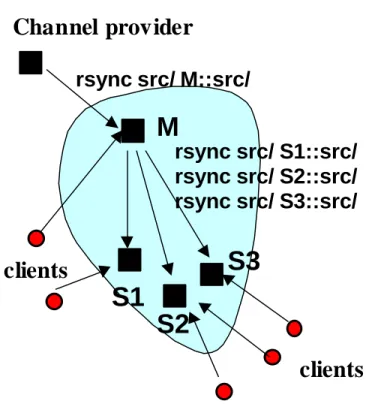
the I2-DSI context. Figure 2.1 shows how rsync in its current form could provide a
channel publishing interface into the I2-DSI core. A channel provider need only set up
rsync and configure it to periodically update the channel. In the figure, new or modified
source objects from the directory src/ are synchronized with the corresponding directory on a master site (M), one of the set of I2-DSI replication hosts (shown as shaded area).
The master site then performs an rsync session with each of the remote I2-DSI hosts on
I2-DSI channel access the replication hosts closest to them using transparent resolution
mechanisms.
Note that, as with the Netlib model, a channel could be an aggregation of separate
file collections, each controlled by a different site. In that scenario, Figure 2.1 would have
multiple "channel provider" sites using rsync to synchronize portions of the channel with
one or more master I2-DSI site(s).
clients
Channel provider
rsync src/ M::src/
M
S1
S2
S3
rsync src/ S1::src/
rsync src/ S2::src/
rsync src/ S3::src/
clients
Figure 2.1: Using Rsync as a Replication Mechanism in I2-DSI
Rsync+ is a response to two factors in the scenario in Figure 2.1 that result in inefficiency
and limit scalability:
• M performs the same processing on the src/ directory for each of the three rsync
includes checking file status information and, if a file has been modified,
computing checksums, and thus it can be compute-intensive for large file trees
and/or large individual file objects. With multiple point-to-point rsync sessions,
the processing load on M increases linearly with the number of remote servers
being updated.
• M transmits identical data streams over the network in each of the three
master-slave rsync sessions (S1, S2, S3).
2.3
Rsync+
as a Replication Transport
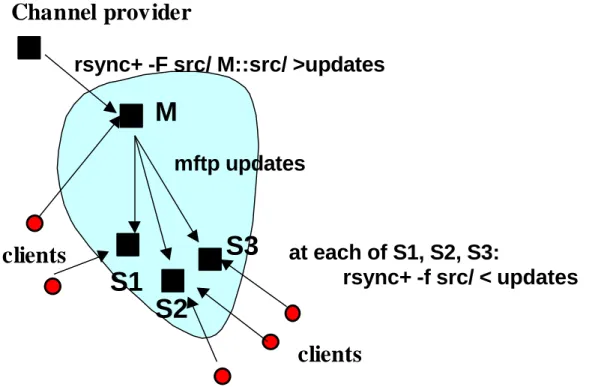
By capturing into a local file the information generated during an rsync file
synchronization session (i.e., file status, checksums, and data blocks), rsync+ enables an
efficient, scalable scenario for multiple-site file synchronization, as shown in Figure 2.2.
clients
Channel provider
rsync+ -F src/ M::src/ >updates
M
S1
S2
S3
at each of S1, S2, S3:
rsync+ -f src/ < updates
clients
mftp updates
During the initial synchronization with the channel provider, the file of update
information (labeled updates in the figure) is captured using the rsync+ option (-F). This
file can then be transmitted using three separate FTP connections or, more powerfully, a
reliable multicast program. The remote servers (S1, S2, and S3) use an option in rsync+
(-f) to update their src/ directories through local processing on the updates file. The solution eliminates redundant processing at M while also allowing, where
operationally feasible, the network transmission to be done with a reliable multicast
protocol. Multicast refers to network transmission in which the data source transmits a
single copy of the data and network elements create data copies as needed to deliver the
transmitted information to a set of receivers. As compared with multiple one-to-one
transmissions, multicasting offers the efficiency gains of using less network bandwidth,
CPU processing, and other computing resources along with the delivery speedups of
transmitting a single copy of the data. These efficiency gains within the DSI model will
grow as the product of the size of the source objects, the frequency with which they are
updated, and the number of DSI servers to which the objects must be delivered. Where
delivery latency is crucial, multicasting may enable scenarios that can not be achieved
with multiple one-to-one connections.
While IP-level multicasting is not available in all portions of the network, many
service providers are committed to it, including the Internet2 community12, and
application-layer tunneling strategies offer similar performance gains in the short term13.
Higher-layer reliable multicast protocols are now available from both research and
commercial sources. Within the I2-DSI project, we will experiment with Starburst
protocol14 and one of the protocols under consideration for standardization in the active
Chapter 3
For I2-DSI, we are leveraging the power and flexibility of rsync, a public-domain mirror
tool, to create a lightweight replication mechanism for content channels. Rsync is widely
used on a variety of platforms and provides an efficient method for remote filesystem
synchronization. In its current form, this synchronization occurs in a single network
session between two sites. Provisioning for the network performance gains made
possible by multicast protocols, we created batch features for rsync and call our new
derivative rsync+. The new batch-mode operation of rsync+ trades off local processing
for efficient use of network bandwidth regardless of the network transport method used,
and offers a scalable solution for multiple-site replication. This chapter provides an
overview of rsync, discusses the batch options we added to create rsync+, and shows how
the new features can be used. Chapter 4 addresses performance aspects of rsync+ in
relation to results obtained in a local mirror experiment with a multi-gigabyte Linux
archive.
3.1 Rsync
rsync is similar to the Unix remote file copy program, rcp, but has a rich set of additional
features which provide considerable execution flexibility. The primary feature is an
internal checksum-search alogrithm with can greatly speedup remote file synchronization
by computing the differences between two files and sending just the differences across
been proven to be reasonably efficient even when the files are quite different.15
Complete documentation describing rsync and its use can be found at
http://samba.anu.edu.au/rsync/.
rsync operates between a master site that maintains the master copy of a shared
archive, and a slave site that stores a replica copy. Like rcp, it requires that source and
destination files be specified as command line arguments to identify the part of the
archive that is to be synchronized, and accepts both local and remote filenames.
Additionally, other command line arguments make it possible to choose various
mirroring options. For example, some of the available options include:
• preserving file permissions and modtimes
• changing checksum blocking size
• recursing into subdirectories
• designating file exclusions
Figure 1 presents a high-level view of how rsync works to synchronize files in
directory mirrorfoo/ at the slave site with files in foo/ at the master. All communication and data exchange between master and slave occur via open network pipes connecting
the two sites. From the command line arguments supplied, a process at the master site
determines which master files are to be copied and builds a list of file information (e.g.
file name, directory name, size, modtime) to send to the slave (Fig. 1, circles 1 and 2).
The slave receives this information and by comparing file sizes and modtimes,
determines local candidates for update. When a potential file change is detected, the
slave splits its local copy into a series of non-overlapping data blocks, calculates a weak
checksums back to the master (Fig. 1, circles 3 and 4).
The master then initiates its own checksum process as it searches for data blocks in
foo/ that have weak and strong checksums that match those received from the slave. A special property of the rolling checksum enables the process to proceed very quickly in a
single pass of a file. When the checksum algorithm shows file discrepancies between the
two sites, the master will send instructions and data block differences so the slave can Master
Slave
rsync foo/ mirrorfoo/
write
read write
read
create file deltas
5
2 master file list
info
6 file deltas foo1/
5
create file list info
1
generate checksums
3
foo/
mirrorfoo/
7
perform updates using deltas
4
slave checksums
reconstruct the master copy locally (Fig. 1, circles 5, 6 and 7). To minimize latency, the
slave process that generates and sends checksums to the master runs independently of the
process that receives file delta information from the master and reconstructs replica
copies. After files are reconstructed at the slave site, mirrorfoo/ and foo/ will be in sync.
3.2 Rsync+
As described in Chapter 2, rsync+ adds a new batch feature to rsync which makes it
possible to decouple the file update process at the slave (Fig. 1, circle 7) and run it locally
at remote sites without consuming network bandwidth. It takes advantage of rsync’s
speedy checksum-search algorithm and the many mirroring options provided, and enables
a mode of synchronization where highly efficient multicast protocols can be used for data
delivery. It is an attractive solution for the content channel model of I2-DSI where
potentially very large data sets will be replicated at multiple servers throughout the
Internet.
Two new command-line options work in tandem to provide the new batch capability
of rsync+. A “write-batch” option, -F, runs at the master site and behaves just like
rsync, with functionality added to capture batch information that remote slaves will
subsequently need to perform local batch updates. This information includes
command-line arguments that designate mirroring options requested, master copy file information,
slave checksums, and the actual file deltas which will be used to reconstruct files at the
slave. It is important to note, as with normal rsync operation, that running rsync+ with
the write-batch option will establish a point-to-point session and synchronize one
between the master and closest slave in the mirror group, network overhead can be
minimized or even eliminated altogether if one slave replica is setup as a local production
backup of the master archive. Once the write-batch option is used to capture batch
information at the master site, the new “read-batch” option of rsync+, -f, can be used at
multiple remote sites to perform batch synchronization.
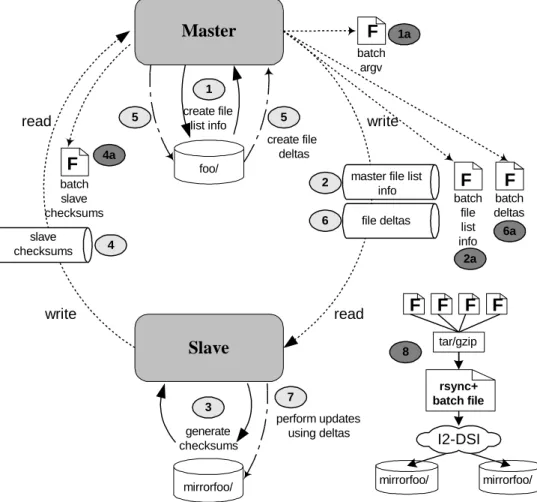
Figure 2 shows rsync+ behavior using the write-batch, –F, option. Darkened circles
Master
Slave
rsync -F foo/ mirrorfoo/
write read write read create file deltas 5
2 master file list
info
6 file deltas foo1/ 5 create file list info 1 generate checksums 3 foo/ mirrorfoo/ 7 perform updates using deltas batch argv batch file list info batch deltas 2a 6a 1a F F F 4a 4 slave checksums batch slave checksums F
F F F
tar/gzip F rsync+ batch file I2-DSI 8 mirrorfoo/ mirrorfoo/
on the diagram (Fig. 2, circles1a, 2a, 4a and 6a) identify the new functionality added to
rsync. At opportune stages in the sychronization process, information described earlier is
written to four batch files:
• a batch argv file with command-line arguments (Fig. 2, circle 1a)
• a file list containing information about master files being synchronized (Fig. 2,
circle 2a)
• a file of checksums computed over slave files being synchronized (Fig. 2, circle
4a),
• a file containing the actual data blocks that remote slaves will use to bring their
mirrors in sync (Fig. 2, circle 6a).
After rsync+ completes, these four files can then be bundled into one compressed rsync+
batch file and shipped off to others in the mirror group (Fig. 2, circle 8).
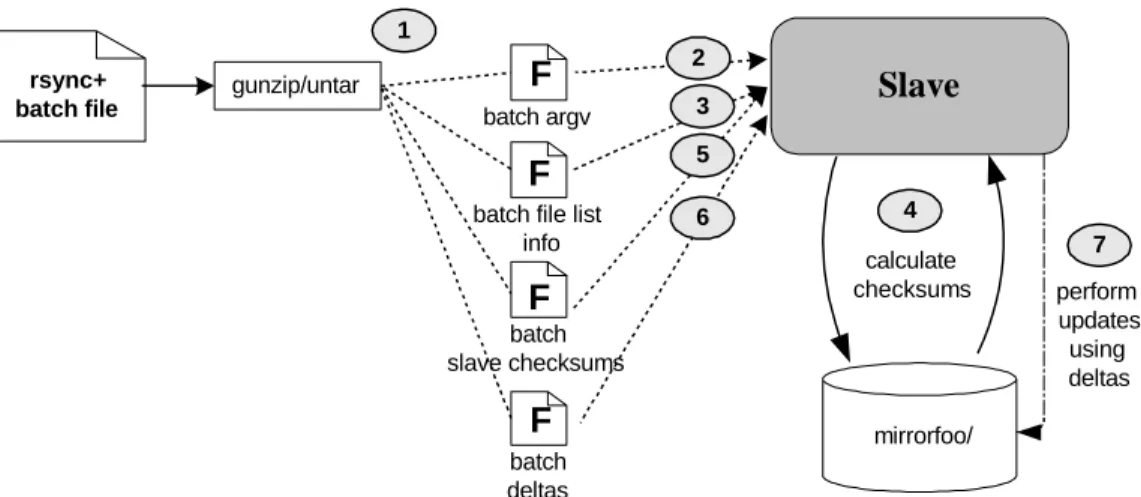
Figure 3 shows rsync+ behavior using the read-batch, –f, option at a remote site. Requisite to the run, the rsync+ batch file received from the master is uncompressed and
unbundled into the batch files created from the write-batch, -F, run (Fig. 3, circle 1). Running locally in read-batch mode rsync+ will read the batch information (Fig. 3,
circles 2, 3, 5 and 6) and use it with locally computed checksums (Fig. 3, circle 4)
to synchronize slave files. By receiving the slave checksums calculated when rsync+
ran in write-batch mode at the master site, a remote site can perform a safety check to
ensure that local files have not become out of sync with replica copies at other slave sites.
Assuming no such discrepancies, rsync+ will proceed to reconstruct the file using the
3.2.1
Implementation Details
System Information
Rsync+ was created from rsync version 2.1.1 for Solaris and run on
high-performance Sun UltraSparc machines using rsh.
Program Code
The main design goal was to disrupt as little of the existing rsync code as possible,
avoiding any changes that would break rsync’s internal data structures. In the final
version, a new program module, batch.c, was created to include all functions related to the new batch processing features, and the following programs were modified: options.c,
main.c, flist.c, compat.c, sender.c, token.c, util.c, and match.c. Approximately 550
lines of code were written in batch.c, and about 200 total new lines of code were added to the other programs. Most of the new program statements added to the other modules
were short if blocks that check for the read-batch and write-batch options, and call
Figure 3.3: rsync+ using -f option
7 Slave calculate checksums 4 1 2 6 5 3 perform updates using deltas gunzip/untar rsync+ batch file batch slave checksums F batch argv F
batch file list info
F
batch deltas
appropriate functions or alter existing program flow. For example, during read-batch
processing (-f option), if read-batch statements recircuit existing rsync code to “snip”
network pipes.
In our implementation of rsync+, we opted to save batch information in four files.
This made it possible to keep much of the current rsync code in place, and to integrate
batch file read/writes at places in the code where pipe I/O occurred. To make it easier to
associate the four files created in any one run, and to enable multipleruns to process sets
of files in the correct chronological order, rsync+ creates the four files with a common
timestamp extension. Along with command-line arguments, the timestamp is also saved
in the argv batch file which rsync+ makes executable (with –F changed to –f) to enable automated read-batch processing at remote sites..
Compiling and Running rsync+
rsync+ is compiled like rsync using the same makefile with the addition of batch.c(o). It is executed like rsync with the addition of the –F or –f option. Since it is mainly
comprised of rsync code, it should port to every platform that supports rsync.
Sample Implementation Scripts
Write-Batch (-F option)
#!/bin/ksh
# Very basic rsync+ -F script with no exception handling
# Run rsync+
rsync -F -r -t -l -H -S --delete /export/home/foo slave:/export/home
# Get the file extension of the argv batch file. Use it to get the # other batch files which go with it. Revise if more than one # set of batch files in current directory
argv_filename=`ls rsync_argvs.*`
file_ext=`basename "${argv_filename}"|awk -F\. '{print $2}'`
# Tar up the batch files with the same file extension, then compress tar -cf rsync_tar.$file_ext *.$file_ext
Read-Batch Script (-f option)
#!/bin/ksh
# Very basic rsync+ -f script with no exception handling
# Unzip the rsync_tar.gz file gzip -d rsync_tar.*.gz
# Get the file extension of the unzipped rsync_tar file. # Revise if more than one tar file in current directory rsync_tar_file=`ls rsync_tar.*`
file_ext=`basename "${rsync_tar_file}"|awk -F\. '{print $2}'`
# Untar the rsync_tar file tar -xf $rsync_tar_file
# Run rsync+ using rsync_argvs file rsync_argvs.$file_ext
3.2.2 Future Work
For our purposes, we tested rsync+ with the following set of rsync options:
-r recurse into subdirectories
-t reserve times
-l preserve soft links
-H preserve hard links
-p preserve permissions
--delete delete files that don’t exist on the sending side
--exclude=PATTERN exclude files matching PATTERN
Further testing needs to be done using other rsync options. Additionally, when making
code changes, we focused on rsync “push” behavior where data is mirrored from a local
master to a remote or local slave. That is, the files created as shown in Figure 3.2 are
investigating for flexibility in use enabling creation of rsync+ output files at the
destination (slave) machines.
rsync+’s full dependence on rsync makes it unfriendly to new rsync versions. If
rsync changes, we will have to add our code to each new version until it can be integrated
into the public rsync source code domain. The latter is something we hope to initiate in
the near future.
Finally, stronger error-handling and reporting mechanisms need to be developed to
Chapter 4
In this chapter, we present performance data from a long-duration data mirroring
experiment utilizing rsync+. The experiment was to create a local (i.e., on the same local
area network) mirror site of 8GB of Linux-related files from a busy WWW archive site,
metalab.unc.edu. The Linux archives at UNC MetaLab were chosen because the file
archive is diverse (e.g., source code, program executables, documentation, html, and
graphics files) and active, receiving 30-50 contributions per day from developers and
users across the open-source Linux community.
The goals of the experiment then were to confirm correct operation of the rsync+
code with a large set of WWW content and also to gather performance data for
preliminary evaluation of rsync+. Here, we describe our methodology, present our
results, and summarize our findings.
4.1
Methodology
The Linux repository at UNC MetaLab is served with other collections from a single
high-performance (4 processors, 1 GB memory) Sun UltraSparc Enterprise 400 machine,
metalab.unc.edu, and is available for download at [f|ht]tp://metalab.unc.edu/pub/Linux.
We mirrored an 8-gigabyte subset of the archive (approximately one-half of total
collection) to a dedicated Sun Sparc workstation co-located on the same campus LAN.
The network path between the two machines includes both 100-Mbit/s and 10-Mbit/s
Seven active subdirectories under the /pub/Linux tree (X11, apps, devel, docs,
games, system and utils) were chosen for the mirror experiment. A script on
iris.unc.edu was set to run twice a day, at 8:30 a.m. and 8:30 p.m., to synchronize each of the local directories with the source directories on metalab. Each script run consisted
of three phases.
(1) Each directory on iris was synchronized with the master on metalab using normal (unmodified) rsync, one rsync run per directory.
(2) Then, locally on iris, we ran rsync+ in write-batch mode (-F option).
(3) Finally, to simulate remote updates, we ran rsync+ again on iris, this time in
read-batch mode (-f option), using a pre-updated version of each directory, that
is, a directory image identical to that on iris before step (1).
4.2 Results
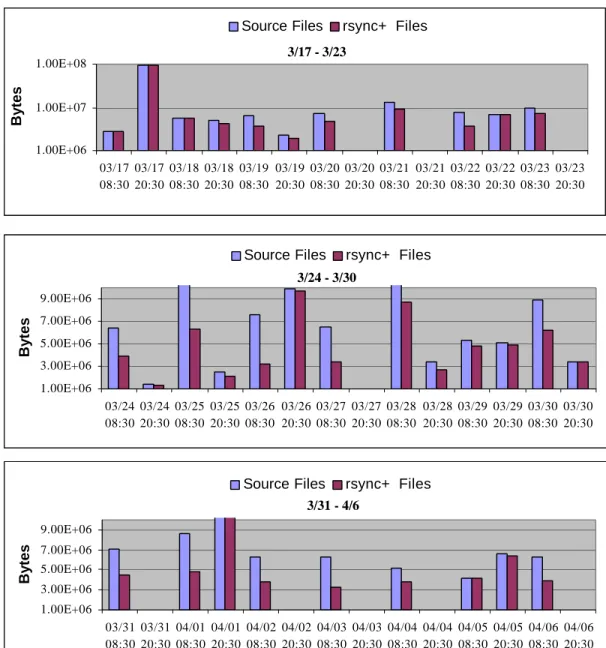
Rsync+ preserves the differential file update capability in rsync. In Figure 4.1, we show
the total number of bytes for all files added or modified in each 12-hour interval for the
seven directories on the metalab site (labeled source files, light bars) and the total data bytes that the rsync+ algorithm will move over the network to perform these updates
(labeled rsync+ files, dark bars). The data shown covers a three-week period from March
17th to April 6th, 1999. Note that the top graph is plotted with a log-scale y-axis whereas
the two lower graphs have a linear y-axis.
As shown in the figure, the differential file update algorithm has a modest effect for
some update periods, those in which updates are largely new files added to the archive. In
additions, the charts show that differential batch updating is quite significant. Over all
updates, the sum of rsync+ files represents 81% of the sum of source files. Also, in
general, the figure indicates great variation in the aggregate size of the source files
changed over any 12-hour period, including periods of no change at all.
3/17 - 3/23
1.00E+06 1.00E+07 1.00E+08 03/17 08:30 03/17 20:30 03/18 08:30 03/18 20:30 03/19 08:30 03/19 20:30 03/20 08:30 03/20 20:30 03/21 08:30 03/21 20:30 03/22 08:30 03/22 20:30 03/23 08:30 03/23 20:30 Bytes
Source Files rsync+ Files
3/24 - 3/30
1.00E+06 3.00E+06 5.00E+06 7.00E+06 9.00E+06 03/24 08:30 03/24 20:30 03/25 08:30 03/25 20:30 03/26 08:30 03/26 20:30 03/27 08:30 03/27 20:30 03/28 08:30 03/28 20:30 03/29 08:30 03/29 20:30 03/30 08:30 03/30 20:30 Bytes
Source Files rsync+ Files
3/31 - 4/6
1.00E+06 3.00E+06 5.00E+06 7.00E+06 9.00E+06 03/31 08:30 03/31 20:30 04/01 08:30 04/01 20:30 04/02 08:30 04/02 20:30 04/03 08:30 04/03 20:30 04/04 08:30 04/04 20:30 04/05 08:30 04/05 20:30 04/06 08:30 04/06 20:30 Bytes
Source Files rsync+ Files
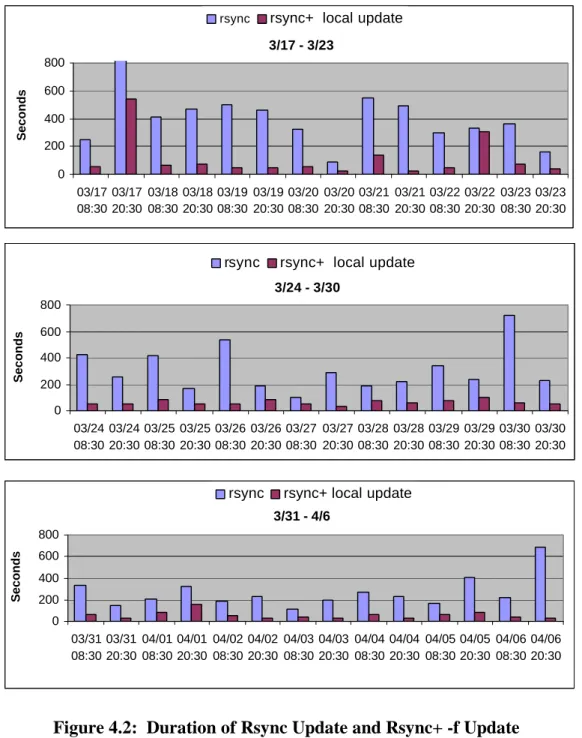
Figure 4.2 shows the real-time duration in seconds for Step 1 (light bars) and Step 3
(dark bars) in each run over the three-week period. The data shows that the network rsync
between metalaband iris varied greatly in duration, with some sessions taking 10
3/17 - 3/23
0 200 400 600 800 03/17 08:30 03/17 20:30 03/18 08:30 03/18 20:30 03/19 08:30 03/19 20:30 03/20 08:30 03/20 20:30 03/21 08:30 03/21 20:30 03/22 08:30 03/22 20:30 03/23 08:30 03/23 20:30 Seconds
rsync rsync+ local update
3/24 - 3/30
0 200 400 600 800 03/24 08:30 03/24 20:30 03/25 08:30 03/25 20:30 03/26 08:30 03/26 20:30 03/27 08:30 03/27 20:30 03/28 08:30 03/28 20:30 03/29 08:30 03/29 20:30 03/30 08:30 03/30 20:30 Seconds
rsync rsync+ local update
3/31 - 4/6
0 200 400 600 800 03/31 08:30 03/31 20:30 04/01 08:30 04/01 20:30 04/02 08:30 04/02 20:30 04/03 08:30 04/03 20:30 04/04 08:30 04/04 20:30 04/05 08:30 04/05 20:30 04/06 08:30 04/06 20:30 Seconds
rsync rsync+ local update
minutes or more. One factor here is the high activity rate on the metalab.unc.edu server,
which serves over 2 million HTTP and one-third of a million FTP hits per day.
By contrast, the same synchronization activity performed with a local batch file on the
dedicated machine iris using rsync+ -f was much faster (dark bars). While further
experimental analysis is required to be conclusive, we speculate that the rsync+ approach
of decoupling network communication and file update operations will result in significant
speed-ups in replication update latency when compared with interactive update during a
Chapter 5
To achieve its vision, the I2-DSI project must develop methods for efficient and scalable
replication of source objects in content channels. As the base of application classes that
I2-DSI must support grows, replication mechanisms will be deployed a range of source
object models (files, database objects, or other object stores). In our work we have begun
development on an efficient replication approach for file-based channels by leveraging
previous development of a powerful open-source tool for file mirroring.
The mirror experiment presented in Chapter 4 validates the correctness of our
rsync+ code base in at least one long-duration test. It also has produced encouraging
performance data on rsync+ ---as an example, local processing time for the batch-mode
options completed quickly (e.g., about 1 minute in most cases) for the local mirror site.
Given the replication scenario envisioned in Figure 2.2, rsync+ replication could offer a
channel provider a form of atomic updates at the remote replicas by blocking access to
the replica contents during the update process. During this "black-out" at the local replica,
requests could simply be redirected to other I2-DSI servers. Given the timing data from
the experimental mirror, we conclude that atomic update could be a supported feature of
the I2-DSI replication service. In contrast, during the local rsync session with the busy
metalab server, rsync sessions took many (e.g., 2-10 in most cases) times longer to complete, and access delays under an unmodified rsync model would be much less
attractive.
Our work will continue in the near term with creating and supporting WWW content
in our local mirroring experiment will be expanded and distributed as a public "Linux
Channel" within I2-DSI. Operational experience with this and other file-oriented content
channels will expand and refine our understanding of the rsync+ transport as the basis for
a replication solution. As more sophisticated models of I2-DSI replicable service emerge
from existing work,17 our view of rsync+ as a replication transport will also evolve. We
believe, however, that rsync+ offers a very general platform for innovation given its
Notes
1
http://www.mfsdatanet.com:80/MAE/east.stats.html
2
Steven Blake, David L. Black, Mark A. Carlson, Elwyn Davies, Zheng Wang, and Walter Weiss, An Architecture for Differentiated Services, RFC 2475, Informational RFC, December 1998.
3
Beck, M. and Moore, T., "The Internet2 Distributed Storage Infrastructure Project: An Architecture for Internet Content Channels", in Computer Networking and ISDN Systems, 1998, 30(22-23): pp. 2141-2148.
4
G. Carpenter, G. Goldszmidt, M. Beck, T. Moore, B. Dempsey, D. Weiss, "Improving the Availability of Internet2 Applications and Services", (submitted).
5
Internet2 DSI Applications Workshop, http://dsi.internet2.edu/apps99.html, UNC-CH, March 1999.
6
Rsync, available at http://samba.anu.edu.au/rsync
7
Felix von Leitner, Mirror 1.0, http://www.oasis.leo.org/perl/scripts/net/infosys/ftp/Mirror.dsc.html.
8
Lee McLoughlin, ftp-mirror, available at ftp://src.doc.ic.ac.uk/packages/mirror.
9
Tridgell, A., and Mackerras, P., The Rsync Algorithm, Technical Report, Australian National University Department of Computer Science, June 1996.
10
Netlib, http://netlib.org/.
11
E. Grosse, Repository Mirroring, ACM TOMS 21:1 (Mar 1995) 89-97.
12
http://www.internet2.edu/html/multicast.html/wg-plans.html
13
J. Donnelley, WWW Media Distribution via Hopwise Reliable Multicast, 3rd International WWW Conference, Darmstadt, Germany, April 1995.
14
Ken Miller, K. Robertson, A. Tweedly, and M. White. StarBurst Multicast File Transfer Protocol (MFTP) Specification, Internet Draft, Work in progress, draft-miller-mftp-spec-03.txt, April 1998.
15
Tridgell, A., and Mackerras, P., “The rsync algorithm”, Technical Report, Australian National University Department of Computer Science, June 18, 1996.
16
See http://dsi.internet2.edu/dsi_map.jpg for testbed status as of April 1999.
17
Portable Content Representation of Internet Content Channels in I2-DSI,