Sarah H Hurd1, Natalia Krupenko1,2
1 Department of Nutrition, University of North
Carolina, Chapel Hill, NC, 2NC Research Campus, Kannapolis, NC
ABSTRACT
Exercise may increase reactive oxygen species (ROS) to levels that overwhelm the body’s natural antioxidant (AOx) protection capacity, resulting in oxidative stress. Supplemental Vitamin C, an antioxidant (AOx), may be an effective treatment for counteracting ROS that result from exercise. We conducted a
systematic review of experimental,
randomized, placebo-controlled trials to examine the effectiveness of Vitamin C supplementation in decreasing exercise-induced ROS in the body. We identified relevant studies through PUBMED searches between years 2000-2015 using keywords “Oxidative Stress”, “Vitamin C,” “Exercise.” Studies were included in the analysis if they investigated oxidative stress biomarkers after a controlled exercise protocol in individuals supplemented with Vitamin C alone or in combination with other AOx versus individuals supplemented with a placebo. Relevant articles were identified by screening the abstracts, titles and full text. We also reviewed references from selected studies to identify additional studies that may have been overlooked in the electronic databases. From a total of 158 articles, we identified 15 experimental studies, which were primarily randomized and double-blind. Among the 15 studies analyzed, 8 found
REVIEW ARTICLE
decreased levels of ROS, 2 found increased levels of ROS, and 5 saw no effect on ROS after supplementation with Vitamin C. There were no significant differences between those who were trained and those who were untrained. Of the studies reporting decreased levels of oxidative stress, most were minimal and used amounts 5-10 times higher than the RDA for
Vitamin C (75-90 mg/day). While
supplementation may be beneficial for endurance athletes or those with a baseline Vitamin C deficiency, there is not a preponderance of evidence to recommend supplementation with Vitamin C to counteract oxidative stress. These studies also suggest that combined supplementation (Vitamin C and Vitamin E) is not effective either. Overall, data suggests that keeping normal Vitamin C levels is a vital protective measure.
Keywords: exercise, Vitamin C, oxidative stress, reactive oxygen species (ROS), Antioxidant, free radical(s)
Abbreviations: AOx – antioxidants, ROS – reactive oxygen species, GPx – glutathione peroxidase, SOD – superoxide dismutase
INTRODUCTION
Oxidative stress in the body
The importance of a healthy, balanced diet is well-acknowledged, especially by regular exercisers who are typically more aware and invested in their health. Yet, countless research questions remain about what has and
hasn’t been proven in regards to counteracting the stress that exercise induces on the body. Dietetic professionals and those in the sports nutrition niche should be aware of the current research on exercise and oxidative stress, as well as dietary and supplementation options with regard to AOxs. As the modern concept of a healthy lifestyle continues to propagate, the interest in creating the ideal pre- and post-workout routine and nutrition pattern will
continue to expand.
The benefits of exercise are highly touted, including lowering blood pressure, improving cardiovascular health, building muscle, boosting endorphins, and helping with weight management and mental stress, to name a few (1). However, there are other less-known effects that exercise triggers in the body, such as the formation of ROS, or free radicals, especially among endurance or trained athletes who are exercising at high intensities. A free radical is a main source of ROS that refers to a molecule or atom with one or more unpaired electrons, causing the molecule to be highly chemically reactive (2). Because they oxidize other molecules and cause oxidative stress, the ROS and free radicals grouped together are known as oxidants. These oxidants can initiate chain reactions and cause damage to proteins, lipids, cell receptors, cell membranes, and even DNA, which can lead to possible mutations (3).
There is a widely debated idea in the literature that supplementing with additional AOx, such as Vitamin C, to counteract oxidants, may help inhibit the oxidation of molecules and attenuate the formation of free radicals. The scientific research is in the midst of transition in studying the effects of AOx supplementation on oxidative stress, redox status and muscle performance. Over the past 20-30 years, our knowledge of the biological implications of exercise-induced oxidative stress has substantially increased (4), and through this review, we seek to analyze some important research findings to be able to
provide general recommendations for the public.
Exercise-induced ROS
biological problems (McGinley). Higher levels of ROS in the body utilize more of the body’s natural defense systems and decreases AOx reserves. This is the basis for the belief that exercise increases the body’s susceptibility to oxidative stress, and AOx are depleted more as ROS production increases (10, 11). When muscles contract at higher rates, ATP production increases to support contraction. It’s estimated that the resting energy expenditure for muscle is about 13 kcal/kg body mass a day, yet duringendurance exercise, there is a 10-20 fold increase in whole body oxygen consumption, and oxygen uptake in the active skeletal muscle increases 100- to 200- fold also. Oxygen use is dependent on the flow of electrons through the electron transport chain, which is coupled to ATP production. This increased flow of electrons through the mitochondria also leads to an increased leakage of electrons, which can initiate free radical production. During metabolism, an estimate of 2-5% of total oxygen in the inner mitochondrial membrane may undergo one electron reduction to produce the free radical superoxide (12).
ROS and cellular response to inflammation
ROS production is an inevitable process occurring in our cells and under normal, resting conditions, the body is equipped to handle it through these systems and enzymes. Growing evidence suggests that physical exercise induces many of these AOx defenses on its own, including Superoxide Dismutase (SOD1, SOD2), and Glutathione Peroxidase (GPx). These natural defenses, in addition to catalase and glutathione, help neutralize or mitigate normal ROS production. The explanation for this theory is the concept of hormesis, a particular dose-response relationship in which a low dose of a substance can be stimulating, while a high dose can be inhibitory (4). However, there are many instances where the defense system doesn’t work as it should, leading to an imbalance between ROS
(pro-oxidants) and the body’s capacity to defend against it (AOxs), a state referred to as
oxidative stress (12).
When the body’s oxygen supply can’t match our energy demands, such as in strenuous exercise, muscle fibers undergo hypoxic states, contributing to a stressed body state (8). The body reacts through various mechanisms intended for protection. Unfortunately, some of these protective mechanisms can also cause inflammatory responses that damage muscle and initiate a chain-reaction of responses ultimately leading to free radical production (2, 7).
In order for the immune system to protect host tissues, there is a rapid invasion of neutrophils and macrophages. These phagocyte cells mitigate to the injury site and undergo a “respiratory burst” where they rapidly release proteins and ROS to protect the host against infection and enable tissue repair. There is research suggesting that neutrophils may be an important source of free radicals contributing to the lipid peroxidation process (7). The increase in oxygen consumption also triggers NADPH Oxidase, a membrane-bound enzyme complex, to convert oxygen (O2) into the superoxide
anion (O2-) to also engulf and kill bacteria (13,
14). O2- can then be converted into hydrogen
peroxide (H2O2)by SOD. H2O2 can be broken
days after exercise (8). O2- and H2O2 are two primary free
radicals produced during these increased oxygen states. These free radicals, though initially produced for protection, can easily react with other molecules to form reactive oxygen and reactive nitrogen species. O2- can be
particularly dangerous because it has a longer half-life than other free radicals, allowing it to diffuse within the cell and target various cellular functions. Some free radicals may last up to 24 hours after injury or exercise, and therefore, researchers contend that muscle tissue is exposed to oxidative stress not only during exercise, but after as well (16, 8).
Systemic response to inflammation
Increased ROS can cause damage in the body when endogenous defenses are not proportional to free radical production, or in other words, the pro-oxidants outweigh the body’s AOxs. ROS can attack biological
macromolecules, especially DNA,
polyunsaturated fatty acids, amino acids and active proteins (5, 3, 9). Several mechanisms act collectively to propagate free radicals, promoting more oxidative reactions to cells, especially those parts in a relatively reduced state, such as cell membranes or nucleic acids (17). When membrane-bound polyunsaturated fatty acids are attacked, they undergo lipid peroxidation, making them more destructive, amplifying their spread in the body and causing subsequent protein damage. Lipid peroxidation can also decrease cell membrane fluidity, causing an inability to maintain an ionic gradient, cellular swelling, and tissue inflammation. All of these effects can modify cellular processes and limit muscle contraction (7,18).
Furthermore, “pro-oxidant” conditions can have a detrimental effect on muscle fatigue and exercise performance. Several authors claim that free radicals are involved in contractile dysfunction and a reduction in the capacity for muscles to generate force, as well
as altering muscle adaptations (4). Oxidative damage to ATPase pumps may impair the development of action potentials necessary for muscle contraction, as the pumps enable potassium to travel back into skeletal muscle cells (8). Damage to ATPase pumps may also reduce the ability of the sarcoplasmic reticulum to take up calcium. Depletion of intracellular calcium can disrupt calcium homeostasis and further potentiate free radical generation and lipid membrane peroxidation. The peroxidation of membranes can lead to the leakage of intracellular enzymes, such as creatine kinase, which can interfere with and reduce muscle contractility (19). Furthermore, myosin chains and other muscle contractile proteins, as well as mitochondrial enzymes such as cytochrome oxidase and/or succinate dehydrogenase, may be susceptible to oxidative damage, and subsequently, experience altered function (8).
Weighing the good and bad of oxidative stress
Despite the ability to cause damage in our bodies, free radicals do have many physiological functions to the point that we don’t want to eliminate them completely. At normal levels in the body, free radicals and oxidants play important roles in controlling gene expression, regulating signaling pathways, and controlling skeletal muscle force (3). Free radicals also stimulate the invasion of phagocytes (macrophages and neutrophils), protect against invading organisms (respiratory burst), and help engulf and absorb bacteria and harmful particles. Following moderate ROS
production, one may see increased
low compared with other tissues, and although exercise training may improve AOx defenses, increased ROS may be a desired or required consequence of exercise. Clinical lab results have shown that a continuous presence of ROS stimuli (at low levels) may signal to up-regulate gene expression and endogenous AOx defense mechanisms (SOD, catalase, GPx), as well as provide favorable effects on training adaptations and optimal muscle cell contraction (8, 20, 21). Other physiological changes that occur following moderate ROS production include increases in mitochondrial growth factors and cell survival proteins (Bcl- 2), and a reduction in muscle atrophy and proteins involved in cell death signaling pathways (22). However, other researchers concede that at continuously high levels, ROS can be destructive and cause muscle damage that may devastate health (8). The evidence of oxidative stress amplification is abundant, linking it to fatigue, muscle damage and reduced immunity, all of which may hinder exercise performance (11). Some even suggest that the pathogenesis of many diseases, such as diabetes, atherosclerosis, cancer, inflammation, or pulmonary diseases may result partly from increased oxidative damage to cells, membranes and tissues (23, 20). Therefore, the question remains whether exercise increases ROS to levels the body is incapable of handing, and if so, can Aox supplementation help counteract the higher ROS levels?
Measures of oxidative stress
While several measures can be used to quantify oxidative stress, research lacks a single, ideal biomarker. This explains, at least partially, the inconsistent and sometimes contradictory results of studies. There are many inherent difficulties in measuring free radical production directly, due to their short half-life and high reactivity. Furthermore, an increase in oxidant production does not necessarily equate to a pro-oxidant condition, which can cloud
interpretations (3).
It is important to have a foundational understanding of how the researchers measure oxidative stress. Powers et al defines the qualities of a reliable biomarker as follows: being chemically unique and detectable, possessing a relatively long half-life, being increased or decreased during periods of oxidative stress, and not being impacted by other cellular process, such as energy metabolism (3). The simple increase in the formation of radicals or other oxidants can act as a biomarker. Other measures that are typically used to evaluate oxidative stress include a decrease in lipid soluble AOxs, a disturbed cellular redox balance, and oxidative damage to components such as lipids, proteins
or DNA (3).
The majority of studies, though, have looked specifically at indirect markers of lipid peroxidation. Serum malondialdehyde (MDA) is one prime biomarker for measuring the intensity of lipid peroxidation, which may be directly related to neutrophil and MPO activity (7). Serum MDA results from reactions with hydroxyl radicals or other free radicals (24). Both acute and regular exercise can increase
serum MDA levels, demonstrating a
relationship between exercise and the hydroxyl attack on lipid membranes (7). However, not all studies have reported increased MDA after exercise. Niess found no significant increases in MDA in trained and untrained groups following exhaustive bouts of exercise (25), while Dufaux also observed no change in plasma MDA after subjects ran for 2.5 hours (26). Nonetheless, inconsistencies may result from the time that serum MDA is measured. Serum MDA may be unaffected immediately after exercise but may increase or decrease up to 90 minutes after exercise and beyond (16). In one randomized, experimental study, it took four days to see a
rise in MDA levels (24).
assay, yet researchers criticize solely relying on them. They have worked better on defined membrane systems in vitro, but have been criticized for use in human studies because there is concern about their specificity and sensitivity, as they also readily react with carbohydrates and prostaglandins in addition to
lipid membranes (27, 12).
Other assays are more related to the increased permeability from damaged cell membranes. Enzymes such as creatine kinase, lactate dehydrogenase and myoglobin can leak out into the blood after lipid peroxidation, and can be measured following exercise (21). These enzymes provide indirect indicators of muscle damage after exercise, yet some researchers advocate they may not represent reliable indicators of exercise-induced muscle damage (28). Similarly, cellular AOxs, such as glutathione, ascorbate and alpha tocopherol, should be decreased in a stressed state because they are being utilized. They can also be used as biomarkers. However, they are not ideal measures and don’t take into account that changes in diet and cellular metabolism can also influence AOx levels in cells (28). Other indirect assays that can be used include a decreased ratio of reduced glutathione (GSH) to oxidized glutathione (GSSG), protein carbonyls, F2-isoprostanes, catalase, and total AOx capacity (TAC). F2-isoprostanes, prostaglandin-like compounds formed from lipid peroxidation, typically rise after exercise and have been named the most reliable biomarker of lipid peroxidation in vivo (29). Protein carbonyls refer to functional groups with a carbon atom double-bonded to an oxygen atom, which are produced when ROS attack amino acids. Carbonynls can reflect protein degradation and may provide references for muscle damage (4, 12). Like F2-isoprostanes, many studies have seen increases in TBARS and protein carbonyls consistently after exercise, but this is not agreed upon across the literature (4, 12, 8, 27). All of this conflicting research emphasizes that there is no
universal biomarker measurement that is agreed upon in the research.
COUNTERACTING OXIDATIVE STRESS Antioxidants and oxidative stress
There is also a strong focus in the literature on substances that may counteract oxidative stress. Many people have heard of AOxs and their potential benefits, but it is not well known that many micronutrients, such as Vitamin E, Vitamin C, selenium, and
carotenoids, have AOx properties.
Micronutrients are needed in small amounts compared to macronutrients. They play essential roles in metabolism, enzyme function, tissue growth, function and maintenance. Like macronutrients, adequate intake ranges are recommended for micronutrients, but excessive amounts do not necessarily lead to better health, and could in fact in be harmful to those who
don’t require them (21).
AOxs are broadly defined as substances that delay or prevent the oxidation of other molecules, or more vaguely, provide protection against free radical production and oxidative stress. AOxs scavenge ROS and convert them into less reactive molecules. They can bind to proteins to prevent them from oxidizing, and can help prevent forms of muscle damage (30). AOxs are usually categorized as endogenous or exogenous. The main endogenous AOxs include SOD, catalase, GPx and glutathione, which are present in the body and under physiological conditions, can handle the normal amounts of ROS we encounter. Exogenous AOxs, on the other hand, are obtained from supplements and the diet, including vitamin E (tocopherols and tocotrienols), vitamin C (ascorbic acid), coenzyme q10 and carotenoids. However, the effect of exogenous AOxs from food sources, such as fruit, vegetables, wine, tea, nuts and seeds, on oxidative stress remains unknown, as the majority of research has focused on supplementation rather than natural
food sources (11).
indicating that AOx supplementation can delay muscle fatigue during submaximal contraction, and can protect the heart and skeletal muscle from strenuous exercise-induced free radical damage (31). Therefore, recreational and professional sport enthusiasts continue to rely on heavy AOx supplementation. More than 50% of all elite endurance athletes, and even 25% of women and 16% of men participating in regular exercise programs, consume vitamin supplements daily (32). Despite these high numbers, there is no clear evidence whether this supplementation is even beneficial for muscle
repair, regeneration and function.
Vitamin’s E and C are the most popular AOxs supplements due to their potential protection against muscle damage (33,22). We have chosen to focus this review on Vitamin C because at physiological concentrations, it is believed to be one of the strongest reductants and radical scavengers (23). Much of this is due to its ability to donate electrons, which prevents other compounds from being oxidized. Due to this property and other benefits, such as aiding in the formation of collagen and crosslinking proteins, Vitamin C has been studied extensively in relation to exercise. However, despite its importance in the body, we lack conclusive evidence for its role as an AOx (24). While it has been proven an effective AOx in vitro, the in vivo results are more inconsistent (23,4). We hope to provide a more detailed explanation of its role through our review.
Vitamin C properties and metabolism
Vitamin C is the major water-soluble AOx found in plasma and tissues. In donating electrons to prevent other compounds from being oxidized, Vitamin C acts by scavenging superoxide, hydroxyl and lipid hydroxperoxide radicals (7). It is available in two forms; ascorbic acid/ascorbate (the reduced form and main form found in the blood) and dehydroascorbic acid (DHA; the oxidized form). The oxidized form is readily converted back to the reduced form through reduced
glutathione, NADPH, or both (34). Ascorbic acid helps detoxify various oxygen radicals and can reduce the superoxide radical to hydrogen peroxide, which can then be converted to water to avoid reactivity and oxidative reactions (14). Vitamin C also provides protection against phagocyte-derived oxidants by reducing adhesion of phagocytes to the endothelium, which weakens the “respiratory burst” and prevents subsequent lipid peroxidation (7). Indirectly, Vitamin C plays a role in recycling and regenerating Vitamin E in membranes during oxidative stress as well, and some evidence suggests that in doing so, it helps prevent against lipid peroxidation (34). Vitamin C supplements have also been shown to alter various human immune responses, likely because the concentration of Vitamin C is high in activated neutrophils and macrophages (6). In scavenging ROS, Vitamin C also offers a protective effect on
neutrophil-mediated cell injury.
men, needed in order to maintain a normal plasma concentration of around 50-70 nmol/L (36,37,32). A deficiency of Vitamin C, called scurvy, can be prevented by as little as 10 mg/day (37). Too much Vitamin C can also be harmful, though, and is associated with diarrhea and disturbances within the gastrointestinal tract.
The control of Vitamin C levels in tissues is maintained by tissue transport, absorption and excretion (23). Absorption is inversely related to dose, so the higher the dose of Vitamin C administered, the less absorption. Unmetabolized ascorbic acid is excreted in urine. This may be one reason why additional supplementation has not worked in some studies. Vitamin C is typically reabsorbed in the proximal kidney tubules by the Vitamin C transporter SVCT1. When the transporter is saturated at maximal velocity (believed to be doses between 60 and 100 mg daily), the absorption threshold is reached and the remaining Vitamin C is believed to be lost in the urine. In amounts greater than 500 mg, the entire absorbed dose is excreted (23).
STUDY SELECTION AND ANALYSIS
In searching the literature, we focused on experimental, randomized, double-blind studies. The majority of studies compared indirect biomarker measures before and after
exercise among groups receiving
supplementation versus groups receiving a placebo in a double-blind fashion.
Studies demonstrating positive effect of Vitamin C supplementation
Among the 15 studies reviewed, 8 found that Vitamin C does play some sort of role in counteracting oxidative stress, though the role varied in each study. Of the 8 studies, 7 found significant results, and one only recommended supplementation if deficient. Thompson et al found benefits in supplementing with Vitamin C in combatting
supplementation may inhibit valuable cellular redox pathways and responses or alter redox
pathways (14).
These results are interesting based on the fact that those in the placebo group were not deficient to begin with. Those in the placebo group were still receiving 162 mg/day of Vitamin C from their diets (which is far above the RDA), while the supplemented group was receiving 278 mg/day through supplements and diet. Therefore, these results may be exaggerated due to the combination of Vitamin C and E, or the magnitude of supplementation in the AOx group was so much larger than that in the placebo group that when comparing the two, the scale of difference seemed more significant.
Watson et al and researchers took a different approach to studying the effects of high and low AOx diets. They tested the same group of 17 subjects (experienced runners) with a high AOx diet for two weeks and then tested the same group with a low AOx diet for two weeks. Participants completed an exercise test after each two-week period. F2-isoprostanes were similar at rest, indicating that in the resting state, both diets proved to be capable of defending against free radical generation. However, F2-isoprostanes increased more after submaximal exercise (38%), exhaustion (45%), and 1 h of recovery (31%) when following the low AOx compared with the high AOx diet. These results suggest that the AOx defenses were not as capable as a higher AOx diet in defending against the increased production of ROS throughout exercise. Total circulating AOx concentrations tended to be lower in those following the low AOx diet, though differences were not significant. Watson concluded that those regularly participating in high-intensity exercise for up to 40 minutes may require higher intakes of AOx to defend against increased oxidative stress (11).
Studies demonstrating positive effect of Vitamin C supplementation in individuals with vitamin deficiency
Several research papers have hypothesized that the beneficial effects of AOx supplementation may apply only to individuals with high baseline levels of oxidative stress and/or low AOx levels. Hence, it is important to consider the initial values of redox biomarkers as focal predictors to the response to exercise (42). Many differences in study results can be attributed to the presence of baseline AOx levels, which if higher, may decrease the likelihood of increased free radicals and reduce
lipid peroxidation (11).
Paschalis et al observed that Vitamin C supplementation decreased oxidative stress (F2-isoprostanes) and marginally improved exercise performance, but only in those with low baseline Vitamin C levels to begin with (42). Exercise performance was measured by VO2 max, the maximum volume of oxygen consumption during exercise (8). The study included two groups of 10 (chosen out of a population of 100 trained individuals), with the lowest and highest Vitamin C values among the group. Results showed that compared to those with higher baseline levels (around 164 mg/day), individuals with lower baseline levels (around 35 mg/day) experienced a lower VO2 max and higher levels of F2-isoprostanes and protein carbonyls. Upon supplementation with Vitamin C, oxidative markers decreased in both groups, but the low baseline group saw a greater magnitude of decrease in F2-isoprostanes (though not significant), suggesting that supplementation was more impactful for those with low baseline levels. Furthermore, only the low Vitamin C group showed signs of improvement in exercise performance after supplementation.
authors acknowledged that 1 month of Vitamin C supplementation was sufficient to almost restore the baseline concentration, redox status, and potentially the exercise performance in the low group (42). This may suggest long term or high amounts of supplementation is not necessary. However, one weakness of this study is that the population of those with the highest and lowest Vitamin C values was drawn from a random sample of 100 males, which may not represent an equal distribution of the normal population.
Studies comparing trained individuals to untrained individuals
There is some debate in the literature regarding the body’s response to differing baseline exercise levels and/or different intensities of exercise and results are very inconsistent. Trained subjects are likely to have a higher natural AOx defense system than untrained subjects, as regular training has been reported to increase the levels of SOD, catalase and GPx (21). Popovic et al sought to provide
answers by comparing identical
supplementation in both trained and untrained athletes, rather than studying just one of the groups. Results showed that free radical production increased after exhaustive running among both untrained and trained individuals, in agreement with previous research. While both groups experienced post-exercise increases in serum MDA levels, the regular training group had higher resting levels, implicating persistent lipid peroxidation (7). Higher resting MDA levels may be related to the highly trained status of subjects, though (21). The trained group also had higher basal Vitamin C levels, suggesting an adapted response to exercise. This is based on the concept that Vitamin C is continuously mobilized from the adrenal glands in response to high cortisol levels and exercise-induced oxidative stress. Therefore, exercise training will induce adaptations that increase Vitamin C
in the blood to be used as an AOx to balance or
increase baseline levels (7,29).
After supplementation, serum MDA significantly decreased in both groups (P<.001), providing evidence that Vitamin C can suppress lipid peroxidation in regular exercisers and sedentary individuals. MPO activity was elevated in the regular training group at baseline. However, this study found that even after supplementation, serum MPO remained unchanged, suggesting Vitamin C had no effect on the neutrophil response to free radical generation, and that it could not block oxidized products derived from NADPH
Oxidase (7).
in response to exercise in both the supplemented and placebo group (p<.05), yet remained elevated in only the placebo group over the next 24 hours, indicating additional supplementation may be necessary to lesson oxidative stress. One finding, though, does infer that prolonged supplementation may be futile. Two hours after supplementation, Vitamin C levels were significantly higher in the supplemented group than placebo group, as expected (p<.05). Throughout exercise, Vitamin C levels steadily increased in the supplemented group, then declined to baseline levels within the next twenty-four hours (40). These results, similar to interpretations from other studies, can infer that plasma Vitamin C levels respond rapidly to supplementation, therefore prolonged supplementation may be unnecessary (16). However, it is difficult to forecast trends from Nakhostin’s study, as it was a one-time bout of exercise that didn’t follow participants over a course of time. Additionally, Colbert et al also found no differences between oxidative stress in the trained and untrained, reporting adults who are AOx users have lower biomarkers, regardless of exercise level (41). Vitamin C did not have any effect on inflammation in any of these studies, suggesting that oxidative damage and the inflammatory response may operate independently from one another (40). Other researchers acknowledge clear benefits from supplementation, but recognize setbacks in future recovery. Close et al, for example, found that supplementation with 1 gram of ascorbic acid increased the plasma ascorbate concentration enough to minimize free radical production before lipid peroxidation (MDA formation) occurs. While there were no increases in MDA immediately after exercise in either group, MDA levels rose days after exercise in only the placebo group, rising from .80 to 1.09 after 72 hours and to 1.13 after 96 hours (p<.05), suggesting that the supplementation attenuated its formation. While Thompson’s group found that ROS was
decreased immediately after exercise among those supplemented, this is the first report of the attenuation of ROS in the days following exercise (24). However, authors concluded that the ROS after muscle-damaging exercise may play a key role in mediating muscle recovery in stimulating hormesis, the adaptive response that promotes endogenous AOx defenses. Therefore, supplementing with AOx may impede these effects of health promotion and therein hinder future performance and the recovery process (24, 39).
Studies demonstrating no effect from Vitamin C supplementation
Studies demonstrating no effect from combined AOx supplementation
Given the variety of conclusions listed above, and perhaps limitations in each of the studies, many researchers are in agreement that the benefits of supplementation are inconsistent, and overall it is ineffective and may be a waste of money. There is also the possibility that when combined when Vitamin E and other AOx, Vitamin C supplementation may be futile, and facilitate interactions between different AOx mechanisms (29). While there is a common conception that “more is better,” the research does not necessarily agree with this conclusion. Several studies focusing on a combination of Vitamin C and Vitamin E supplementation have shown no effect on performance, enhancing adaptability
or attenuating oxidative stress.
Theodorou et al investigated the effect of chronic eccentric (muscle damaging) exercise on redox status and muscle performance, using a combination of Vitamin C and E supplements. Results showed that high doses of AOx could not alter the redox status of blood and skeletal muscle, finding no differences in muscle damage between supplemented and placebo groups. Although acute eccentric exercise resulted in a marked increase in TBARS, protein carbonyls and enzyme leakage from skeletal muscle, altered redox status and impaired muscle function, prior AOx supplementation didn’t attenuate any of these effects in comparison to a placebo (4). Any muscle adaptations occurring from eccentric exercise was similar in both groups. While eccentric exercise is capable of inducing severe muscle damage and oxidative stress, it is possible that using a different type of exercise stimulus, such as running or another form of aerobic exercise, may have shown a different redox response to supplementation. Teixeira et al also concluded that supplementation does not offer protection against exercise-induced lipid peroxidation, and has no effect on delaying muscle fatigue or
inflammation, as the body keeps Vitamin C under tight control. A combined AOx supplement (Vitamin C, Vitamin E, Beta carotene, lutein, zinc, and selenium) was mostly ineffective in blunting increases in TBARS and CK among trained subjects, and had no effect on promoting cell membrane integrity or decreasing permeability (27). Despite receiving 400 mg of Vitamin C, there were only small serum increases in Vitamin C concentrations. This is likely explained by the body keeping plasma levels under tight homeostatic control. One limitation of the study is that authors only measured TBAR levels 15 minutes after exercise, when other research has shown that they can increase hours to days after exercise as
well (4,8,12,27).
myoglobin and CK leakage from skeletal muscles (0=.001) in both the supplemented and placebo groups, prior supplementation with AOx vitamins did not attenuate any effect relative to placebo supplements. This is despite the fact that when considered within the context of participants’ diets, AOx supplementation resulted in an 8-fold increase in Vitamin C content, equaling over 1,000% of the RDA (29). Authors also did not witness a decrease in urine concentrations of F2-isoprostanes in the supplemented groups, as they had predicted. In fact, concentrations were similar in both groups over the first 24 hours of post-exercise recovery, but supplemented groups even saw a tendency for higher concentrations after 48 hours of recovery (p=.04) (29). Though this may have represented a Type I statistical error, it could also demonstrate how timing affects the measurement of certain biomarkers. It is unknown when the concentrations started rising in the supplemented group, or if they peaked at
48 hours.
Studies demonstrating negative effect of Vitamin C supplementation
On the contrary, many studies have not recognized benefits of supplementation on reducing oxidative stress. Some researchers argue that Vitamin C supplementation may exacerbate oxidative stress, decrease training efficiency and prevent cellular adaptations to chronic exercise (23). There is also the prevalent argument that taking additional Vitamin C may jeopardize or limit the body’s
inherent AOx systems (4).
Gomez- Cabrera et al is a highly-cited study, known for its finding that supplementation can suppress normal training adaptations, which can then intensify “not only oxidative damage but also the cells ability to adapt under exercise-derived oxidative stress (20).” In the double-blind study, those not receiving supplements (n=9) saw a 22% increase in VO2 max after the six-week training period, compared to a 10.8% VO2 max increase
in those supplemented with 1 g/day of Vitamin C (n=5). The VO2 max rate increased significantly in both groups, however the
magnitude was much lower in the
supplemented group, suggesting that Vitamin C modulates endurance capacity but not maximal oxygen uptake after training. Gomez also performed a side study on rats, yielding similar results. He concluded that training generally increases major AOx enzymes in skeletal muscle (SOD, GPx), yet the administration of Vitamin C prevents the mRNA expression of
these systems (20).
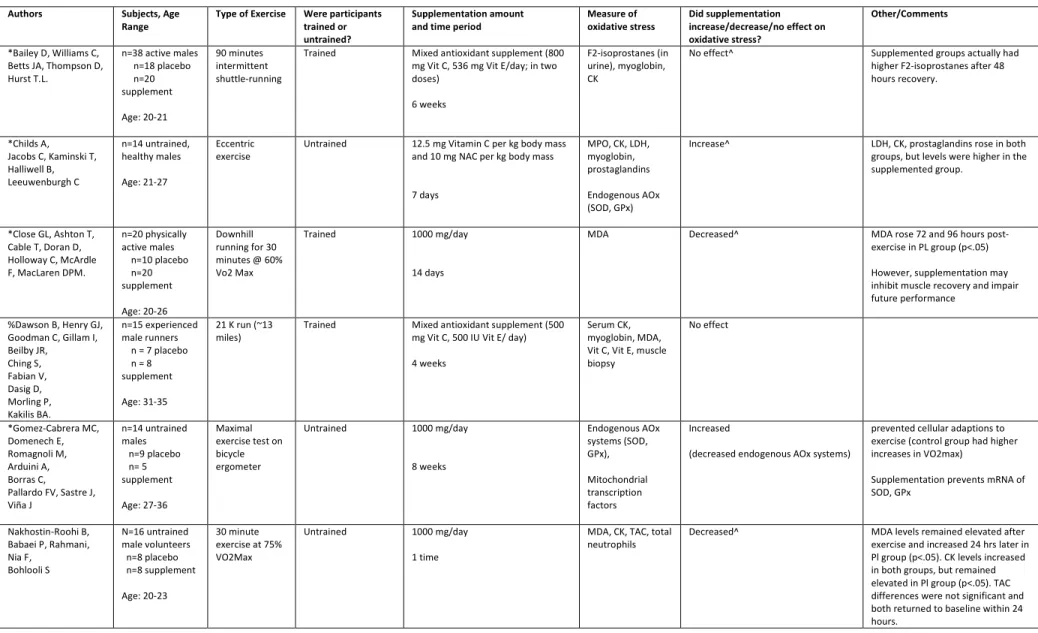
TABLE 1: STUDY ANALYSIS
Authors Subjects, Age Range
Type of Exercise Were participants trained or untrained?
Supplementation amount and time period
Measure of oxidative stress
Did supplementation increase/decrease/no effect on oxidative stress?
Other/Comments
*Bailey D, Williams C, Betts JA, Thompson D, Hurst T.L.
n=38 active males n=18 placebo n=20 supplement Age: 20-21 90 minutes intermittent shuttle-running
Trained Mixed antioxidant supplement (800 mg Vit C, 536 mg Vit E/day; in two doses)
6 weeks
F2-isoprostanes (in urine), myoglobin, CK
No effect^ Supplemented groups actually had higher F2-isoprostanes after 48 hours recovery.
*Childs A, Jacobs C, Kaminski T, Halliwell B, Leeuwenburgh C n=14 untrained, healthy males Age: 21-27 Eccentric exercise
Untrained 12.5 mg Vitamin C per kg body mass and 10 mg NAC per kg body mass
7 days
MPO, CK, LDH, myoglobin, prostaglandins
Endogenous AOx (SOD, GPx)
Increase^ LDH, CK, prostaglandins rose in both groups, but levels were higher in the supplemented group.
*Close GL, Ashton T, Cable T, Doran D, Holloway C, McArdle F, MacLaren DPM.
n=20 physically active males n=10 placebo n=20 supplement Age: 20-26 Downhill running for 30 minutes @ 60% Vo2 Max
Trained 1000 mg/day
14 days
MDA Decreased^ MDA rose 72 and 96 hours
post-exercise in PL group (p<.05)
However, supplementation may inhibit muscle recovery and impair future performance
%Dawson B, Henry GJ, Goodman C, Gillam I, Beilby JR, Ching S, Fabian V, Dasig D, Morling P, Kakilis BA. n=15 experienced male runners n = 7 placebo n = 8 supplement
Age: 31-35
21 K run (~13 miles)
Trained Mixed antioxidant supplement (500 mg Vit C, 500 IU Vit E/ day)
4 weeks
Serum CK, myoglobin, MDA, Vit C, Vit E, muscle biopsy No effect *Gomez-Cabrera MC, Domenech E, Romagnoli M, Arduini A, Borras C, Pallardo FV, Sastre J, Viña J n=14 untrained males n=9 placebo n= 5 supplement Age: 27-36 Maximal exercise test on bicycle ergometer
Untrained 1000 mg/day
8 weeks Endogenous AOx systems (SOD, GPx), Mitochondrial transcription factors Increased
(decreased endogenous AOx systems)
prevented cellular adaptions to exercise (control group had higher increases in VO2max)
Supplementation prevents mRNA of SOD, GPx
Nakhostin-Roohi B, Babaei P, Rahmani, Nia F, Bohlooli S N=16 untrained male volunteers n=8 placebo n=8 supplement Age: 20-23 30 minute exercise at 75% VO2Max
Untrained 1000 mg/day
1 time
MDA, CK, TAC, total neutrophils
*Nieman DC, Henson DA, McAnulty SR, McAnulty L, Swick NS, Utter AC, Vinci DM, Opiela SJ, Morrow JD.
n=28
ultramarathoners , male and female n=13 placebo n=15 supplement
20-70
80 km run Trained 1500 mg/day (500 mg x3)
7 days
Lipid
hydroperoxide, F2-isoprostane
No effect F2-isoprostanes higher in supplemented groups at all times
*Paschalis V, Theodorou A, Kyparos A, Dipla K, Zafeiridis A, Panayiotou G, Vrabas I, Nikolaidis M.
n= 20 males (screened from 100 males; 10 lowest and 10 highest chosen)
Age: 19-25
Incremental cycling test until exhaustion
Trained 165 mg/ day
30 days
F2 iso-prostanes protein carbonyls
Decreased (Only if deficient) Only those who are deficient saw the largest decreases of F2-isoprostanes and increase in exercise performance (VO2 max)
#Popovic LM, Mitic NR, Miric D, Bisevac B, Miric M, Popovic B
n=30 sedentary males (acute training group)
n=30 professional male athletes (regular training group)
Age: 20-27
Bruce treadmill protocol (BTP)
{exhaustive running @ 80% of age predicted max heart rate}
Untrained/Trained 2000 mg/day (500 mg 4x/day) for both groups
2 weeks
MDA serum MPO
Decrease^ After supplementation, serum MDA significantly decreased in both groups (p<.001)
Supplementation did not affect MPO activity
*Ristow M, Zarse K, Oberbach A, K löting N, Birringer M, K iehntopf M, Stumvoll M, Kahn CR, Blüher M.
n=40 (n=20 untrained, n=20 trained,; n=20 supplemented, n=20 placebo); 4 groups of 10
Age: 20-30
20 85-min sessions of exercise on 5 days
Trained Mixed antioxidant supplement (1000 mg/day Vitamin C and 400 IU/day Vit E)
4 weeks
TBARS, muscle biopsy
Decrease^ In absence of AOx, subjects had more than two-fold increase in TBARS after exercise, measured three days later. TBARS did not increase in supplemented group (p=.03)
*Sureda, A, Ferrer MD, Mestre A, Tur JA, Pons A
n=14 male amateur runners
n=7 placebo n = 7 supplement
Age: 20-42
13.1 miles Trained Mixed antioxidant supplement (152 mg/d Vitamin C + 50 mg/d Vitamin E)
4 weeks
Oxidized neutrophils, protein carbonyls, catalase, GPx
Decrease^
*Teixeira VH, Valente HF, Casal SI, Marques AF, Moreira PA
n=20 trained athletes (14 males, 6 females)
n=10 placebo (7M, 3F) n=10 supplement (7M, 3F)
Age: 15-24
1,000-m kayak race
Trained Mixed antioxidant (400 mg VIt C, 272 mg Vitamin E, minimal amts of beta carotene, lutein, selenium, zinc, magnesium) in form of two capsules daily
4 weeks
TBARS, uric acid, CK, SOD, GPx,
No effect Supplementation may hinder recovery
Only did a single blood measure of TBARS 15 minutes after exercise, while it can increase hours and days later.
* Theodorou, AA, Nikolaidis MG, Paschalis V, Koutsias S, Panayiotou G, Fatouros IG, Koutedakis Y, Jamurtas AZ.
n=28 recreationally trained males n=14 placebo n=14 supplementation
Age: 20-27
Eccentric (muscle-damaging) exercise 2 times/week
Trained Mixed antioxidant supplement (1000 mg Vitamin C + 1 tablet 400 IU Vit E/day)
11 weeks
GSH, GSSH, TBARS, protein carbonyls, catalase, CK, Muscle biopsy
No effect No significant differences were observed between the placebo and vitamin groups at any time point
* Thompson D, Williams C, McGregor S, Nicholas C, McArdle F, Jackson M, Powell J
n=16 males, recreational exercisers n=8 placebo n=8 supplemented
Age: 21-27
LIST – Loughborough Intermittent Shuttle Test (90 minutes of walking, running, sprinting)
Trained 400 mg/day (200g 2x/day)
2 weeks
MDA Serum CK, myoglobin
Decreased^ MDA decreased in Supp. Group (P<.05); No difference in serum CK and myoglobin. Supp may reduce inflammation + muscle soreness.
#Watson TA, Callister R, Taylor RD, Sibbritt DW, Macdonald-Wicks LK, Garg ML.
n=17 endurance runners
Age: 18-35
Running protocols; 30 minutes at submaximal speed followed by incremental test to exhaustion
Trained All followed AOx rich diet (139 mg Vit C/day) for two weeks and then AOX deficient diet for two weeks (49 mg/day)
4 weeks total (2 weeks for each diet)
F2-isoprostanes Decreased^ No difference in F2-isoprostanes at rest, but after exercise, they rose significantly higher in restricted AOx group
*Experimental, Randomized Double-blind study
% Experimental, Randomized Single-blind study
# Experimental study
a placebo or combination of Vitamin C and NAC. Both groups experienced increased serum levels of LDH and CK leakage on days 2, 3 and 4 (p=.0001), yet levels tended to be higher in the supplemented group. Furthermore, the supplemented group had higher levels of hydroperoxides and prostaglandins, indicating increased tissue damage and oxidative stress. However, serum SOD and GPx defenses (which normally increase after exercise) were also increased to a greater extent in the supplemented group, indicating that Vitamin C may not be inhibitive of these enzymes, as many studies have suggested (43). It is unknown whether results would have been different if Vitamin C was studied individually, or if a longer endurance cardiovascular exercise, such as running or biking, was performed. Other limitations to the study include a very short study period (7 days) and the dose of supplement was based on kg of body weight. Hence, each person was receiving a different amount of AOx supplement, making generalizations difficult.
Analyzing Result Inconsistencies
Much of the conflicting evidence is due to many variable factors, including study recruitment, methods and biomarker measures, small sample sizes, and individual differences in responses to supplements and exercise. Studies varied from focusing on non-trained individuals, to recreational exercisers, to endurance athletes. No two studies included the
same number of participants, dose
administered, training requirements, training endpoints measured, or oxidative stress biomarkers measured. Most studies used indirect measures of muscle damage to assess oxidative stress, such as plasma CK, LDH,
Myoglobin, MDA, TBARS and
F2-isoprostanes, which have been criticized in the literature as not being as accurate as direct measures and should be carefully interpreted (12).
defense system (6). Furthermore, there is no consensus about the ideal time to supplement. Vitamin C is primarily located in the plasma, rather than stored in active tissue. The rationale for supplementing after exercise is because elevated levels of plasma Vitamin C may offer increased AOx protection if coinciding with increased ROS production at its peak during the inflammatory phase of muscle damage (33). However, the majority of studies have focused on supplementing Vitamin C before exercise or even a combined approach of before and after exercise. This strategy rationale is to increase Vitamin C levels in the plasma, mitochondrial matrix and extracellular fluids to increase bioavailability to the active tissues, enabling Vitamin C to be readily mobilized to counteract the increased ROS during exercise (33). However, a longer lag time between supplementation and the start of exercise may account for lower plasma Vitamin C concentrations. Furthermore, trained subjects may need longer supplementation periods to show an additive effect to their already enhanced AOx defense systems. Data has shown that some degree of chronic ultrastructural muscle damage is normally apparent in well-trained runners, so no impact may be seen if the supplementation period is not
long enough (21).
Similarly, opinions vary about the best time to measure oxidants. Any absence of signs of oxidative stress after exercise does not necessarily imply that oxidative damage did not occur, as the delayed onset of lipid peroxidation after exercise varies (21). Some oxidants, such as TBARS, may not be elevated directly after exercise but may reach their max hours or even days later (8). If biomarkers are not followed long enough after exercise, results may not paint an accurate picture of oxidative stress. Of course, others suggest that to accurately measure any effect of AOx supplementation on reducing free radical induced muscle damage, it should be evaluated over the course of training,
rather than before/after specific exercise bouts, in which most studies focused on (20).
Furthermore, “performing until
exhaustion” is a relative term and may be variable among different populations. Gomez argues that VO2 max is not the ideal measurement of training efficiency, as it is
dependent on cardiovascular system
adaptations. Rather, endurance capacity is directly related to mitochondrial content, and exercise training enhances mitochondrial biogenesis (20). He reasons this with evidence that top marathon runners only exhibit modest measures of VO2 Max since they are so well adapted to the cardiovascular exercise, and therefore, their maximum intensities may not portray their endurance capacity.
Conclusion
It is important to be aware of the cell and tissue damage that can result from physical activity. While research is inconsistent about potential effects of Vitamin C supplementation before/after exercise, it seems evident that like most medical and nutritional recommendations, AOx recommendations should be individually tailored. It is crucial for individuals to maintain adequate levels of serum Vitamin C for a “healthy” redox status and proper cell functioning. Initial values of redox biomarkers are important predictors of how individuals respond to exercise. While supplementation should be considered for those with a baseline deficiency of the vitamin or those competing in high-intensity, endurance bouts, we see no
reason to recommend additional
under tight control, so those who already have normal levels may excrete any surplus. Lastly, people interested in supplementation are likely health-conscious individuals who are already consuming a balanced diet, and will not experience any effect from moderate supplements on training adaptations. Much of the current evidence has proven combined supplementation (Vitamin C with other AOx) to be ineffective. This could be due to metabolic interactions that potentially block the effect of the individual AOx by accompanying AOx. Of the six studies we reviewed with combined supplementation, four showed no effect on oxidative stress biomarkers. We also did not note any significant differences in the results of supplementing trained and untrained individuals. Trained individuals likely have increased levels of endogenous AOx due to the continuous adaptations their bodies make in response to training. They also are likely to have higher resting levels of oxidative stress markers, such as MDA or MPO (21). Therefore, serum MDA levels may not accurately reflect ROS that increase after a specific exercise, and future studies should take this into consideration.
AOx supplementation, specifically with Vitamin C, will remain an important area of research among the physically active community, as there remains a lack of consensus regarding supplementation effectiveness. Given the amount of information we still don’t know, future studies should consider enrolling subjects with low baseline Vitamin C levels to more accurately determine effects from supplementation. Studies should also focus on controlled production of ROS, whether they have specific physiologic functions, and the mechanisms by which they can assist in the recovery process to protect cells from future damage. While the majority of studies have used indirect methods for determining oxidative stress, more studies should emphasize direct, non-invasive
measures of muscle damage for more accurate, translatable results. Perhaps, use of several biomarkers should be required to accurately evaluate the presence of oxidative stress.
The authors’ responsibilities were as follows – Ms. Hurd designed this review, performed the literature search, drafted the initial manuscript (and table), and had primary responsibility for the final content. Dr. Krupenko critically reviewed and revised the manuscript, and Ms. Hurd improved revisions. Neither author declared a conflict of interest. The authors have no potential conflicts of interest, financial or otherwise, to disclose.
REFERENCES
1. Centers for Disease Control and Prevention. Division of Nutrition, Physical Activity, and Obesity. Version current 4 June 2015. Internet: http://www.cdc.gov/physicalactivity/basics/pa-health/index.htm (accessed September 25, 2015).
2. Elkington LJ, Gleeson M, Pyne DB, Callister R, Wood LG. Inflammation and Immune Function: Can AOxs Help the Endurance Athlete? In: Lamprecht M, editor. AOxs in Sport Nutrition. Boca Raton, FL: CRC Press/Taylor & Francis, 2015. Chapter 11.
3. Powers SK, Kavazia A, Jackson MJ. Reactive Oxygen Species: Impact on Skeletal Muscle. Compr Physiol 2011;1(2):941-969.
4. Theodorou, AA, Nikolaidis MG, Paschalis V, Koutsias S, Panayiotou G, Fatouros IG, Koutedakis Y, Jamurtas AZ. No effect of AOx supplementation on muscle performance and blood redox status adaptations to eccentric training. Am J Clin Nutr 2011;93:1373–1383.
5. Mastaloudis A, Leonard SW, Traber MG. Oxidative stress in athletes during extreme endurance exercise. Free Radical Biology Medicine 2001; 31(7):911-22.
7. Popovic LM, Mitic NR, Miric D, Bisevac B, Miric M, Popovic B. Influence of Vitamin C Supplementation on Oxidative Stress and Neutrophil Inflammatory Response in Acute and Regular Exercise. Oxidative Medicine and Cellular Longevity 2015; 2015:1–7.
8. Vollard NB, Shearman JP, Cooper CE. Exercise-induced oxidative stress: myths, realities and
physiological relevance. Sports
Med 2005;35(12):1045-1062.
9. Yavari A, Javadi M, Mirmiran P, Bahadoran, Z. Exercise-Induced Oxidative Stress and Dietary AOxs. Asian J Sports Med 2015;6(1):1-7.
10. Taghiyar M, Darvishi L, Askari G, et al. The Effect of Vitamin C and E Supplementation on Muscle Damage and Oxidative Stress in Female Athletes: A Clinical Trial. International Journal of Preventive Medicine 2013;4(1):S16-S23.
11. Watson TA, Callister R, Taylor RD, Sibbritt DW, Macdonald-Wicks LK, Garg ML. AOx Restriction and Oxidative Stress in Short-Duration Exhaustive Exercise. Med Sci Sports Exercise 2005;37(1):63-71.
12. Urso M, Clarkson P. Oxidative stress, exercise, and AOx supplementation. Toxicology 2003, 189(1-2):41-54.
13. Gaut JP, Belaaouaj A, Byun J, Roberts LJ 2nd,
Maeda N, Frei B, Heinecke JW. Vitamin C fails to protect amino acids and lipids from oxidation during acute inflammation. Free Radical Biology and Medicine 2006;40(9):1494-1501.
14. Sureda, A, Ferrer MD, Mestre A, Tur JA, Pons A. Prevention of neutrophil protein oxidation with vitamins C and E diet supplementation without affecting the adaptive response to exercise. International Journal of Sport Nutrition and Exercise Metabolism 2013;23(1):31–39.
15. Tidball, James G. Inflammatory processes in muscle injury and repair. American Journal of Physiology, Regulatory, Integrative and Comparative Physiology 2005;288(2):R345- 353.
16. Thompson D, Williams C, McGregor S, Nicholas C, McArdle F, Jackson M, Powell J.
Prolonged vitamin c supplementation and recovery from demanding exercise. International Journal of Sport Nutrition and Exercise Metabolism 2001;11:466.481.
17. Shenkin A. Micronutrients in health and disease. Postgraduate Medical Journal 2006;82(971):559-567.
18. Thirumalai T, Therasa S, Elumalai EK, David E. Intense and exhaustive exercise induce oxidative stress in skeletal muscle. Asian Pacific Journal of Tropical Disease 2011;1:63–66.
19. Evans, WJ. Vitamin E, Vitamin C, and exercise. Am J Clin Nutr 2000; 72L647S-52S.
20. Gomez-Cabrera MC, Domenech E, and Viña J. Moderate exercise is an AOx: upregulation of AOx genes by training. Free Radical Biology and Medicine 2008; 44:126-131
21. Dawson B, Henry GJ, Goodman C, Gillam I, Beilby JR, Ching S, Fabian V, Dasig D, Morling P, Kakilis BA. Effect of Vitamin C and E
supplementation on Biochemical and
Ultrastructural Indices of Muscle Damage after a 21 KM Run. Physiology and Biochemistry 2002;23(1):10-15.
22. Braakhuis AJ. Effect of vitamin C supplements on physical performance. Curr Sports Med Rep 2012;11:180–184.
23. Padayatty SJ, Katz A, Wang Y, Eck P, Kwon O, Lee JH, Chen S, Corpe C, Dutta A, Dutta SK, Levine M. Vitamin C as an AOx: Evaluation of its Role in Disease Prevention. J Am Coll Nutr 2003;22(1):18-35.
24. Close GL, Ashton T, Cable T, Doran D, Holloway C, McArdle F, MacLaren DPM. Ascorbic acid supplementation does not attenuate post-exercise muscle soreness following muscle-damaging exercise but may delay the recovery process. The British Journal of Nutrition 2006;95(5):976-81.
26. Dufaux B, Heine O, Kothe A, Prinz U, Rost R. Blood glutathione status following distance running. Int. J Sports Med 1997; 18:89-93.
27. Teixeira VH, Valente HF, Casal SI, Marques AF, Moreira PA. AOxs do not prevent postexercise peroxidation and may delay muscle recovery. Med Sci Sports Exerc 2009:1752–60.
28. Higashida K, Kim SH, Higuchi M, Holloszy JO, Han DH. Normal adaptations to exercise despite protection against oxidative stress. Am J Physiol Endocrinol Metab 2011; 301:E779–E784.
29. Bailey D, Williams C, Betts JA, Thompson D, Hurst T.L. Oxidative stress, inflammation and recovery of muscle function after damaging exercise: effect of 6-week mixed AOx supplementation. European Journal of Applied Physiology 2011;111(6): 925-936.
30. Yavari A, Javadi M, Mirmiran P, Bahadoran, Z. Exercise-Induced Oxidative Stress and Dietary AOxs. Asian J Sports Med 2015; 6(1):1-7.
31. Sen CK. AOxs in exercise nutrition. Sports Med 2001;31:891–908.
32. Yfanti C, Akerstrom T, Nielsen S, Anders R, Nielsen RM, Mortensen OH, Lykkesfeldt J, Rose
AJ, Fischer CP, Pedersen BK. AOx
supplementation does not alter endurance training adaptation. Med Sci Sports Exercise 2010;42:1388– 95.
33. McGinley C, Shafat, A, Donnelly AE. Does AOx vitamin supplementation protect against muscle damage? Sports Med 2009;39:1011–32.
34. Jacob RA, Burri BJ. Oxidative damage and defense. Am J Clin Nutr 1996;63:985S-90S.
35. McCall MR, Frei B. Can AOx vitamins materially reduce oxidative damage in humans? Free Radic Biol Med 1999;26:1034–53.
36. National Institutes of Health. Vitamin C: Fact sheet for health professionals. Version current 5
June 2013. Internet:
https://ods.od.nih.gov/factsheets/VitaminC-HealthProfessional/ (accessed November 20, 2015).
37. Lykkesfeldt J and Poulsen H. Is Vitamin C supplementation beneficial? Lessons learned from randomized controlled trials. British Journal of Nutrition 2010;103:1251-1259.
38. Donato AJ, Uberoi A, Bailey DM, Walter Wray D, Richardson RS. Exercise-induced brachial artery vasodilation: effects of AOxs and exercise training in elderly men. American Journal of Physiology 2010;298(2):H671-H678.
39.Ristow M,Zarse K, Oberbach A, Klöting N, Bir ringer M, Kiehntopf M, Stumvoll
M, Kahn CR, Blüher M. AOxs prevent health-promoting effects of physical exercise in humans. Proc Natl Acad Sci USA 2009;106:8665– 8670
40. Nakhostin-Roohi B, Babaei P, RahmaniNia F, Bohlooli S. Effect of vitamin C supplementation on lipid peroxidation, muscle damage and inflammation after 30min exercise at 75% VO2max. J Sports Med Phys Fitness 2008;48:217– 24.
41. Colbert LH, Visser M, Simonsick EM, Tracy RP, Newman AB, Kritchevsky SB, Pahor M, Taaffe DR, Brach J, Rubin S, et al. Physical activity, exercise, and inflammatory markers in older adults: findings from the Health, Aging and Body Composition Study. J Am Geriatr Soc 2004;52(7):1098–104.
42. Paschalis V, Theodorou A, Kyparos A, Dipla K, Zafeiridis A, Panayiotou G, Vrabas I, Nikolaidis M. Low Vitamin C values are linked with decreased physical performance and increased oxidative stress: reversal by Vitamin C supplementation. European Journal of Nutrition 2014.
43. Childs A, Jacobs C, Kaminski T, Halliwell B, Leeuwenburgh C. Supplementation with vitamin C and N-acetyl-cysteine increases oxidative stress in humans after an acute muscle injury induced by eccentric exercise. Free Radic Biol Med 2001;3 (6): 745-53.