
Browse Title Index
20
0
0
Full text
(2) Norhaslina Hassan, Noor Ismawati Mohd Jaafar, Raja Noriza Raja Ariffin, Asnarulkhadi Abu Samah & Mohd Nazari Jaafar Perceptions on Quality of Life in Malaysia: The Urban-Rural Divide. Change, Social Participation, Public Safety and Social Security. Quality of Life Index in this study which is based on a questionnaire survey on 3,500 respondents was derived using the Customer Satisfaction Index. It revealed a gap between the perceived importance and satisfaction rating for most of the quality of life domains studied. This gap prevailed for both rural and urban respondents. Keywords: regional planning, urbanization & quality of life.. INTRODUCTION Research and discussion on the quality of life (QOL) is pursued in a detailed and elaborate manner since the early 80s (Marcouiller, & English, 2001; Dissart & Deller, 2000). Marans and Stimson (2011) recently summarized major efforts covering the theory, methods and empirical research on quality of life studies. One of the more important aspects of QOL research throughout literature is its definition which generally refers to the degree of well-being felt by the community or individual. Many researchers have expanded their research using multivariable criteria for assessing a good quality place (Norainah A.R., Dasimah O. and Abdul Ghani S., 2012). Szalai (1980) defines quality of life based on the degree of excellence or satisfactory character of life. While covering many, the two basic components of quality of life which underpin many efforts to quantify quality of life are physical and psychological. The physical component covers areas such as health, nutrition, and protection from disease while the psychological component deals with issues such as stress, entertainment and leisure. As a concept the meaning of quality of life (QOL) can infer to the notions of “well-being,” focusing on the individual, to “good society”, to “good place/city” focusing on the location (Dissart & Deller, 2000). According to Zapf (2000), QOL does not only encompass living conditions but also the subjective aspect of living conditions. This necessarily requires that indicators for quality of life besides including the process and provision of, and access to a better environment and better facilities further incorporate the manner of delivery of goods, services, or facilities; and the experience associated with consumption of goods and services (Massam, 2002). Considered from this perspective, QOL has a number of implications for planning, more so in the context of a rapidly urbanizing society such as that of Malaysia’s. Indeed, the main concern of the planners is the promotion of the general welfare or the public interest. The comprehensive nature of quality of life research furthermore corresponds well © 2013 by MIP. 22.
(3) PLANNING MALAYSIA: Journal of the Malaysia Institute of Planners (2013). with the planner’s long-standing concern for comprehensive planning (Myers, 2007). Conscious planning which characterizes the country’s development since independence has placed Malaysia currently to be among Asia’s best. This adds to the considerable degree of consensus regarding the notion that development, defined in terms of economic growth, is positively linked with quality of life as its concomitant effect. In fact, despite the difficulties associated with proving causality in the social sciences, historical evidence suggests that increases in levels of urbanization and development throughout the world have almost always been associated with economic gains (measured in terms of such economic indicators as GNP and GDP). However, it remains to be shown that these economic gains translate into improved human conditions i.e. quality of life. The challenge of the rapid rate of urbanization however continues to remain one of bridging the multidimensional urban-rural gaps. More importantly, have economic gains caused a rift in the quality of lives among the more prosperous compared to the other regions? In Malaysia, urbanization viz development planning was envisaged to help achieve the spatially balanced development target of the NEP, serving as a means to improve the socioeconomic status of the population in general and increase the participation of Bumiputras in particular, in the modern urban sector (2nd Malaysia Plan, 1971). Diffusion of urbanization in Malaysia has contributed to the general improvements of the living environment through the provision of infrastructure and services such as conventional housing, water and electricity supplies, sanitation, sewerage, transport and telecommunications and so forth. Urbanization creates more employment opportunities which are varied, highly specialized and yield higher incomes, promotes modern lifestyles and contributes to a higher socioeconomic standard of living with increased access to higher order facilities and services such as better education, medical services, recreational and the like. The National Urbanization Policy (NUP) and National Physical Plan (NPP) while fully cognizant of the potentially divisive globalization effect on national development, stress the enhancement of overall living qualities for sustainability. This paper seeks to explore the differences between the importance and satisfaction in living qualities between the urban and rural dwellers in 14 quality of life domains with the aim to highlight the role of planning in reducing the perceived gap.. 23. © 2013 by MIP.
(4) Norhaslina Hassan, Noor Ismawati Mohd Jaafar, Raja Noriza Raja Ariffin, Asnarulkhadi Abu Samah & Mohd Nazari Jaafar Perceptions on Quality of Life in Malaysia: The Urban-Rural Divide. URBANIZATION IN MALAYSIA Based on the definition of urban areas by the Department of Statisticsi, Figure 1 shows the urbanization rate in Malaysia since 1911. Urban growth in the country has shown a steady increase with an accelerated rate of increase in the past three decades or so. In 2010, the urbanization rate was 71.0 percent, increasing from 62.0 percent in 2000. Apart from W. P. Kuala Lumpur and W. P. Putrajaya with 100 percent level of urbanization, the other states with a high level of urbanization were Selangor and Pulau Pinang with 91.4 percent and 90.8 percent respectively. Conversely, the states with lower urbanization levels were Kelantan (42.4 percent), Pahang (50.5 percent) and Perlis (51.4 per cent) (Department of Statistics Malaysia, 2012). The marked increase in the urbanization rate started from 1970 onwards, and continues to increase remarkably (Figure 1). The single most important explanation for the phenomenal increase in the urbanization rate since 1970 was the implementation of the New Economic Policy (NEP) which immediately followed the ethnic clash of 1969ii. The two-pronged aim of the policy was to eradicate poverty irrespective of race and to restructure the society so that no identification of ethnic origin with economic functions and geographical locations could be made. Urban strategies which were intertwined with the broader regional policy and programs in Malaysia have led to large scale urbanization especially among the Bumiputras and the Malays. Much of these took place in the newly created towns in the Regional Development Areas (RDAs) called the new towns, further development of existing small towns in the agricultural regions, as well as the establishment of industrial centres within small and medium sized towns in densely populated rural areas (Katiman, 1988). From the mid-1990s onwards, popularly known as the “new period of globalization” (Jomo, 1995), a new trend characterizes urban development in Malaysia. The policy shift emphasizing economic liberalization and modernization in ensuring national success in the new k-economy saw new mega urban projects such as the Multimedia Super Corridor (MSC), the Kuala Lumpur International Airport (KLIA), Kuala Lumpur City Centre (KLCC) and Putrajaya (the new administrative centre) with “hi-tech” physical infrastructures were built as a means of “plugging into”, and “making [of] an information economy and society” (Bunnell, 2002). Based on the pattern of current trends in the globalization of economic activities, urban growth and development are expected to accelerate and concentrate further in the few existing urban conurbations. These are more attractive to international investors since they © 2013 by MIP. 24.
(5) PLANNING MALAYSIA: Journal of the Malaysia Institute of Planners (2013). offer bigger agglomeration economies and returns to investment as well as a higher quality of life. Malaysian Urbanisation 1911 - 2010 80.0 70.0 60.0 50.0 40.0 30.0 20.0 10.0 0.0. 1911 1921 1931 1947 1957 1970 1980 1991 2000 2010 % Urban Population 10.7 14.0 15.1 15.9 26.5 28.7 37.5 54.9 62.0 71.0. Figure 1: Urbanisation Rate in Peninsular Malaysia, 1911-2010 Source: Based on data from Ooi, 1975 and Department of Statistics, 2012. QUALITY OF LIFE REPORTS IN MALAYSIA In response to the growing importance and practicality of quality of life as a measure of progress and harmony in a country, Malaysia has embarked on producing the first Quality of Life Report in 1999. In the Malaysian context, the quality of life is defined as encompassing personal development, healthy lifestyles, access and freedom to acquire knowledge and to enjoy living standards that exceed the basic needs and individual psychology (Malaysian Quality of Life, 2002). These endeavors are in line with the level of social welfare that is set as the national’s goal. A total of 10 indicators was selected that best portray the well-being of the community in the country. These indicators are income and distribution, environment, transport and communications, health, education, housing, environment, family life, social participation and public safety. The sequel to the 1999 report was published in 2002 in order to assess the ongoing changes that are taking place in Malaysia. Several additions have been made in this second report, which includes indicators on culture and leisure. Exclusive indicators focusing on quality of life in urban Malaysia (MUQLI) were also added. The addendum signifies the importance of urban. 25. © 2013 by MIP.
(6) Norhaslina Hassan, Noor Ismawati Mohd Jaafar, Raja Noriza Raja Ariffin, Asnarulkhadi Abu Samah & Mohd Nazari Jaafar Perceptions on Quality of Life in Malaysia: The Urban-Rural Divide. population in Malaysia that represents 71.0 percent of Malaysia's population in 2010 (Department of Statistics Malaysia, 2006). Unlike the first report that utilized the quantitative approach and lacked elaboration of the indicators used, the second report to some extent, attempted to reconcile this by giving further explanation of those indicators. The Malaysian Urban Quality of Life Index (MUQLI) for the period of 1990-2000 is based on data collected from four cities; Ipoh, Johor Bahru, Kuala Lumpur and Kuching that, collectively, accounted for 30 per cent of the country’s total urban population in 2000. The MUQLI is a composite index consisting of indices of income and distribution, working life, transport and communication, health, education, housing, environment, family life, social participation, public safety and culture and leisure. The report also included the findings of a survey carried out in 2000 on 2,304 respondents living in two more cities (Kuantan and Kota Kinabalu), in addition to the four cities above. The survey was carried out to solicit perception as to the urban quality of life in Malaysia and to provide a qualitative assessment of the urban quality of life which complements the quantitative analysis described earlier. All cities studied recorded improvements in the quality of life of their population for the observation period, with Kuala Lumpur registering the highest increase of 9.0 points, followed by Ipoh, Johor Bahru and Kuching. About three-quarters of the people surveyed reported further that they were satisfied with the overall quality of life in Malaysian cities. The majority of the respondents were satisfied with aspects of urban living pertaining to indices for family life, education, infrastructure and amenities, public safety, housing, health, transport and the work place (Economic Planning Unit, 2002).. STUDY METHOD Sampling and survey procedures The primary source of data for this study was a perception survey designed to solicit a broad base perceptions of values that are acceptable and thus used to indicate the quality of living conditions by Malaysian society. The survey method was also used to collect information on satisfaction levels on previously agreed-upon quality of life aspects. Stratified sampling technique was used to determine the acceptable sample size whereby the total population was stratified according to states and districts. Based on this strategy, 100 districts (from the total of 136 districts listed in the Malaysian Population and © 2013 by MIP. 26.
(7) PLANNING MALAYSIA: Journal of the Malaysia Institute of Planners (2013). Housing Census 2000) were sampled. This more than met the 97 districts, the minimum number of districts, required (Krejcie & Morgan, 1970). To ensure sample representativeness, subjects were selected from sex, ethnic, age cohorts and location (urban and rural) categories that reflect the real stratification in Malaysia. Face-to-face interviews were conducted by a trained group of interviewers. The questionnaire survey was administered on 3,500 respondents who were selected from all over Malaysia including Sabah and Sarawak. A total of 3,494 questionnaires were completed and analyzed using SPSS 17.0 (Statistical Package for Social Sciences). All statistical procedures were also performed using the same software. Measurement Quality of Life Index (QOL) in this study was measured by a self-report scale consisting of 30 indicators constructed from a total of 106 items. All items used the five-point Likert scale (1 = not satisfied/good/frequent/important at all to 5 = very satisfied/good/frequent/important). In the interview session, respondents were asked to rate the importance of and satisfaction over a set of indicators of life qualities from the 14 quality of life domains that were identified as a benchmark for determining the quality of life for the Malaysian society. These domains were Population and Family, Participation in Education, Human Resource, Health, Income, Expenditures and Savings, Housing, Environment, Transportation, Culture and Entertainment, National Unity, Communication and Technological Change, Social Participation, Public Safety and Social Security. The 30 indicators were constructed to complement 55 indicators derived from secondary sources according to same 14 domains. These indicators are 108.0 % more than the indicators reported in the Malaysian Quality of Life Index (MQLI) (EPU, 1999) and 194.0% more than the Malaysian Urban Quality of Life Index (MUQLI) (EPU, 2002). Table 1 shows comparative indicators for MQLI, MUQLI in Malaysia and the study indicators. The significant contribution to the existing local knowledge about the quality of life made in this research is the role of National Unity consisting items measuring the society’s readiness and willingness to accept diversity as well as their confidence in local and national institutions’ abilities to safeguard the interests of all fairly.. 27. © 2013 by MIP.
(8) Norhaslina Hassan, Noor Ismawati Mohd Jaafar, Raja Noriza Raja Ariffin, Asnarulkhadi Abu Samah & Mohd Nazari Jaafar Perceptions on Quality of Life in Malaysia: The Urban-Rural Divide. Table 1: Comparative Domains and Indicators for QOL, MQLI and MUQLI in Malaysia DOMAIN. MQLI 1999 & 2002 FAMILY LIFE. MUQLI 2002 FAMILY LIFE. Divorce Household size Crude birth rate Juvenile delinquency. Divorce Household size. EDUCATION. EDUCATION. 1.. QOL 2010 POPULATION AND FAMILY Marriage Divorce Household size Dependency ratio Single household Female-headed household Family happiness PARTICIPATION IN EDUCATION Preschool. Preschool participation rate. 2.. Secondary school. 3.. University students. Secondary school participation rate University participation. Teacher-student ratio secondary school Average class size primary school Average class size secondary school. 4.. Primary school. 5.. Teacher-student ratio primary school Teacher-student ratio secondary school Literacy rate Satisfaction on curriculum & co-curriculum HUMAN RESOURCE Unemployment Workplace accidents Average monthly income Satisfaction and work-life balance Labor force Foreign labor HEALTH Doctor per 10,000 population Hospital beds per 10,000 population Life expectancy at birth (male). 1. 2. 3. 4. 5. 6. 7. DOMAIN. 6. 7. 8. DOMAIN 1. 2. 3. 4. 5. 6. DOMAIN 1. 2. 3. 4. 5. 6. 7. 8. DOMAIN 1. 2. 3. 4. 5. 6. 7.. Life expectancy at birth (female) Infant mortality Epidemic occurance Awareness of epidemic Immunization INCOME, EXPENDITURE & SAVINGS Income per capita Gini coefficient Poverty Household income Importance of income Satisfaction on income gaps Social development. © 2013 by MIP. Teacher-student ratio secondary school Literacy rate. WORK ENVIRONMENT Unemployment Industrial accidents Industrial disputes Work days loss due to industrial actions. WORK ENVIRONMENT Industrial accidents Industrial disputes. HEALTH Doctor-population ratio Life expectancy at birth bagi for male Life expectancy at birth for female Infant mortality. HEALTH Doctor-population ratio Infant mortality. INCOME AND DISTRIBUTION Real income per capita Gini coefficient Poverty. INCOME AND DISTRIBUTION Income per capita Gini coefficient Poverty. 28.
(9) PLANNING MALAYSIA: Journal of the Malaysia Institute of Planners (2013). 8. 9. DOMAIN 1. 2. 3. 4. DOMAIN 1. 2. 3. DOMAIN 1. 2. 3. 4. 5. DOMAIN 1. 2. 3. 4. 5. 6. DOMAIN 1.. 2.. 3.. 4.. 5.. 6.. 7.. expenditures Adequacy of income for life sustainance Satisfaction on savings HOUSING Low cost housing units built Housing affordability Home ownership Houses with electricity supply ENVIRONMENT Clean water supply Clean air Importance of environmental protection TRANSPORT Private transport Roads Satisfaction on public transport. CULTURE & ENTERTAINMENT Cultural, historical & landmark buildings TV programs with local content Cultural importance Television viewers Involvement in activities & past time habits Involvement in cultural activities NATIONAL UNITY Readiness to accept other people’s opinions & willingness to discuss towards arriving at a consensus Readiness to acknowledge & accept other people’s culture, political ideology & religion Tendency & frequency of communication with ethnically-based social institutions Perception of having good relationships with other people at workplace, school, neighborhood and other institutions. Use of national language for communicaation, fluency & the importance of national language for national unity Tendency to associate oneself with similar ethnic group, decendency or original cluster Confidence of (selected) local and national institutions’. HOUSING Average medium-cost house price Low cost housing units Houses with piped water Houses with electricity supply ENVIRONMENT Water quality Air quality Forested area TRANSPORT & COMMUNICATION Private motorcycles & cars Road development index Commercial vehicles Telephone Daily newspaper circulation CULTURE & ENTERTAINMENT Library membership Television viewers Domestic hotels visitors. 29. HOUSING Average rent- income ratio Average house price-income ratio. ENVIRONMENT River quality index Solid waste per capita. TRANSPORT & COMMUNICATION Private motorcycles & cars Public transport Telephone. CULTURE & ENTERTAINMENT Recreational and sports clubs Library membership. © 2013 by MIP.
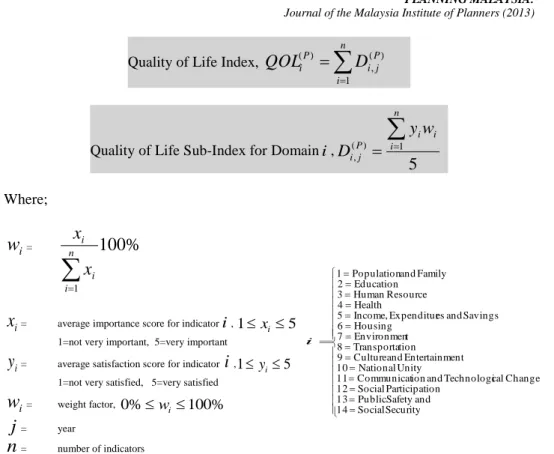
(10) Norhaslina Hassan, Noor Ismawati Mohd Jaafar, Raja Noriza Raja Ariffin, Asnarulkhadi Abu Samah & Mohd Nazari Jaafar Perceptions on Quality of Life in Malaysia: The Urban-Rural Divide. DOMAIN. 1. 2. 3. 4. 5. 6. DOMAIN 1. 2. 3. 4. 5. 6. 7. DOMAIN 1. 2. 3. 4. 5. 6. 7. DOMAIN 1. 2. 3. 4.. abilities to safeguard the interests of all fairly COMMUNICATION & TECHNOLOGICAL CHANGE Fixed phone ownership Daily newspaper circulation Mobile phone ownership Computer ownership Internet access Social communication SOCIAL PARTICIPATION. SOCIAL PARTICIPATION. Involvement in volunteer Involvement organisationsin community activities Registered voters. Registered voters Registered community associations Registered NGOs membership. Direct involvement of members in decision making Voluntary participation in selected organisations Frequency of attendance to community-level meetings. Number of NGOs PUBLIC SAFETY Crime Road accidents Death from road accidents Firefighter & Rescue members RELA membership Fear of crime Juvenile Delinquency SOCIAL SECURITY KWSP contribution Population with insurance Perception on social security protection scheme PERKESO contributors. PUBLIC SAFETY Crime Road accidents. COMMUNITY PARTICIPATION Registered volunteer Registered voters organisations. Rukun Tetangga membership. PUBLIC SAFETY Crime Road accidents. URBAN SERVICES Social services expenditures Expenditures for landscape. ANALYSIS. QOL( P ). i Quality of Life Index in this studywhich is based on primary data collected from field survey was derived using the Customer Satisfaction Index technique. The same technique was used by the Australian University and Deakin University, Australia to construct the Australian Unity Wellbeing Index since 2001. Higher quality of life index values indicate higher living quality as perceived by the society. Similarly, higher values of the sub-index would indicate higher perceived quality of living associated with the relevant domain. The formula for index calculation using this technique is given below.. © 2013 by MIP. 30.
(11) PLANNING MALAYSIA: Journal of the Malaysia Institute of Planners (2013) n. Quality of Life Index,. QOL(i P ) Di(,Pj ) i 1. n. ( P) i, j. Quality of Life Sub-Index for Domain i , D. . y w i. i 1. i. 5. Where;. wi =. xi. x i 1. xi =. 100%. n. i. average importance score for indicator i ,. 1 xi 5. 1=not very important, 5=very important. yi =. average satisfaction score for indicator. i ,1 yi 5. 1=not very satisfied, 5=very satisfied. wi = j= n=. weight factor,. 0% wi 100%. 1 Populationand Family 2 Education 3 Human Resource 4 Health 5 Income, Expenditures and Savings 6 Housing i 7 Environment 8 Transportation 9 Cultureand Entertainment 10 National Unity 11 Communication and Technological Change 12 Social Participation 13 PublicSafety and 14 Social Security. year number of indicators. Paired sample t-tests were conducted to investigate any significant differences between satisfaction level and importance level of the QOL domains among respondents living in rural and urban areas. The gap between satisfaction and importance levels for the domains between rural- and urban-based respondents was tested using the established ANOVA. A total of 42 (3 x 14) hypotheses were tested, three for each domainiii.. FINDINGS Table 2 shows that more than half of the respondents (58%) interviewed lived in the urban areas compared to rural areas (42%). The majority (68.2%) of the respondents aged between 25-54 years old and can be defined as within the productive working age. The larger proportion of the respondents furthermore was of the Malay ethnic origin (55.4) and Muslims (62.5%). Most respondents reported monthly individual income between RM1, 000 – RM4, 000 (56.4%); household size of between 3 - 6 persons (66.3%) and self-owned housing (66.1%). Almost complete coverage of public utilities was also observed in 31. © 2013 by MIP.
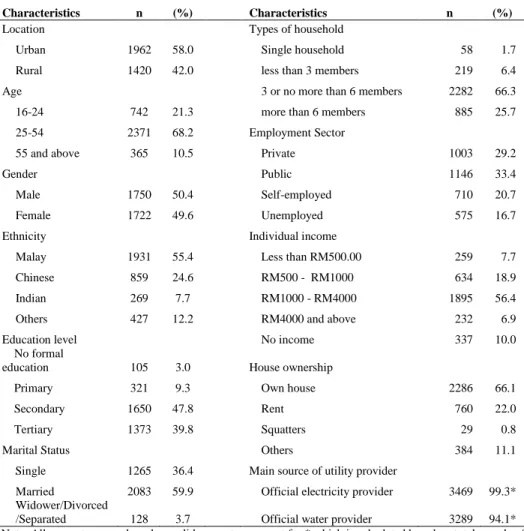
(12) Norhaslina Hassan, Noor Ismawati Mohd Jaafar, Raja Noriza Raja Ariffin, Asnarulkhadi Abu Samah & Mohd Nazari Jaafar Perceptions on Quality of Life in Malaysia: The Urban-Rural Divide. respondents’ housing units. Table 2 summarizes the major characteristics of the sample. Table 2: Sample Characteristics Characteristics Location. n. (%). Characteristics Types of household. Urban. 1962. 58.0. Single household. Rural. 1420. 42.0. less than 3 members. Age 742. 21.3. 25-54. 2371. 68.2. 55 and above. 365. 10.5. Male. 1750. 50.4. Female. 1722. 49.6. Gender. Ethnicity. (%) 58. 1.7. 219. 6.4. 2282. 66.3. 885. 25.7. Private. 1003. 29.2. Public. 3 or no more than 6 members. 16-24. n. more than 6 members Employment Sector. 1146. 33.4. Self-employed. 710. 20.7. Unemployed. 575. 16.7. Individual income. Malay. 1931. 55.4. Less than RM500.00. 259. 7.7. Chinese. 859. 24.6. RM500 - RM1000. 634. 18.9. Indian. 269. 7.7. RM1000 - RM4000. 1895. 56.4. Others. 427. 12.2. RM4000 and above. 232. 6.9. No income. 337. 10.0. 2286. 66.1. 760. 22.0. 29. 0.8. 384. 11.1. Education level No formal education. 105. 3.0. House ownership. Primary. 321. 9.3. Own house. Secondary. 1650. 47.8. Rent. Tertiary. 1373. 39.8. Squatters. 1265. 36.4. Marital Status Single. Others Main source of utility provider. Married 2083 59.9 Official electricity provider 3469 99.3* Widower/Divorced /Separated 128 3.7 Official water provider 3289 94.1* Note: All percentages are based on valid percentage except for * which is calculated based on total sample of 3494.. Figures 2 and 3 show the importance and satisfaction levels by QOL domains among the rural and urban respondents. It can generally be observed that the Malaysian society was rather realistic in that they did not expect perfection in the performance of the QOL measurable domains. However, a few domains were accorded with higher importance score (percentage score exceeding 90%). These domains were Education, Human Resource, Income, © 2013 by MIP. 32.
(13) PLANNING MALAYSIA: Journal of the Malaysia Institute of Planners (2013). Expenditures and Savings, Housing and Social Security. National Unity, Public Safety, Social Participation, Culture and Entertainment, and Communication and Technological Change were by contrast, considered less important in determining living qualities according to the respondents. Figures 2 and 3 also generally depict the underperformance of all domains (excepting Culture and Entertainment) measured against their corresponding importance level as felt by the respondents. The trend prevails for both urban and rural respondents. The significant disparity between satisfaction and importance levels in urban and rural locations is evident from Table 3. All paired sample tests performed were significant at 1% level with the largest observable disparity associated with Income, Expenditures and Savings in all locations. The rural respondents further perceived that there is also much to be done to reduce the wide disparity between satisfaction and importance levels in the Social Participation domain. Smaller disparity in the importance and satisfaction levels was found in the Social Security (for both locations) followed by Human Resource and Environment domains among the urban respondents. Table 3 also reported the importance-satisfaction gap, employing the established ANOVA to test for any significant differences in the gap score between the urban and rural respondents. The importance-satisfaction gap is determined by subtracting the satisfaction score assigned to a domain from its importance score. Table 3 shows rather clearly that there were significant differences in the above-mentioned gap for most domains between rural and urban locations as perceived by the respondents. Variations in the importancesatisfaction gap score between rural and urban respondents were not significant for only Health and Transportation domains. In other words, the perceived importance and satisfaction rating of the two domains were similar for both rural and urban respondents.. 33. © 2013 by MIP.
(14) Norhaslina Hassan, Noor Ismawati Mohd Jaafar, Raja Noriza Raja Ariffin, Asnarulkhadi Abu Samah & Mohd Nazari Jaafar Perceptions on Quality of Life in Malaysia: The Urban-Rural Divide Population and Family, 100% 88% Social Security, 91%. Public Safety, 82%. Social Participation, 87%. Communication and Technological Change, 87%. 90% 80% 70%80% 60% 50% 63% 70% 40% 30% 20% 62% 10% 0%. Human Resource, 92% 78% 78% Health, 88% 79%. 70%. 62%. Income, Expenditure and Savings, 92%. 70%. 78% 69%. 82%. National Unity, 79%. Education, 92%. 79% Housing, 91%. Culture and Entertainment, Environment, 89% 87% Transportation, 89% Importance. Satisfaction. Figure 2: Importance and Satisfaction Levels among Those Living in Urban Areas by QOL Domain Population and Family, 100% 86% Social Security, 91%. Education, 92%. 90% 80% 70%81% 60%. Public Safety, 81%. 69%. Human Resource, 93% 79%. 50% 62% 40%. 79%. 30% Social Participation, 85%. Health, 87%. 20% 56%. 80%. 10% 0%. Communication and Technological Change, 87%. National Unity, 78%. 69%. 60%. Income, Expenditure and Savings, 93% 71%. 78% 68%. 83%. 81% Housing, 92%. Culture and Entertainment, Environment, 89% 87% Transportation, 89% Importance. Satisfaction. Figure 3: Importance and Satisfaction Levels among Those Living in Rural Areas by QOL Domain © 2013 by MIP. 34.
(15) PLANNING MALAYSIA: Journal of the Malaysia Institute of Planners (2013). Table 3: Satisfaction and Importance Levels of Each QOL Domain by Urban and Rural Locations Domain Rural Urban ANOVA F-statistics Satisfact Importa Paire Satisfact Importa Paire ion nce d ion nce d (Mean, (Mean, sampl (Mean, (Mean, sampl n) n) e test n) n) e test (t(ttest, test, df) df) 30.79 38.06 4.1374* 81% 86% 41 80% 88% 62 * Population (1402) (1394) (1399 (1941) (1944) (1945 and Family ) ) 34.84 44.21 3.7515* 79% 92% 31 78% 92% 1 (1317) (1401) (1398 (1828) (1948) (1947 Education ) ) 27.86 18.35 9.8314* 79% 93% 92 78% 92% 2 ** Human (1309) (1403) (1821 (1823) (1950) (1304 Resource ) ) 33.37 40.66 1.6455 80% 87% 95 79% 88% 81 (1405) (1397) (1393 (1952) (1948) (1948 Health ) ) Income, 58.01 50.39 5.0742* Expenditur 69% 93% 32 70% 92% 95 * e and (1362) (1398) (1935 (1886) (1949) (1381 Savings ) ) 35.56 26.05 4.2985* 78% 92% 87 78% 91% 65 * (1407) (1401) (1942 (1940) (1951) (1393 Housing ) ) 29.72 17.34 24.826* 81% 89% 71 79% 89% 08 ** Environme (1410) (1401) (1946 (1946) (1951) (1394 nt ) ) 40.46 35.56 1.1060 68% 89% 87 69% 89% 79 Transportat (1404) (1397) (1929 (1926) (1949) (1388 ion ) ) Culture and 23.4238 83% 87% 82% 87% Entertainm 7.717 13.22 *** (1293) (1397) (1821) (1948) ent 2 28 35. © 2013 by MIP.
(16) Norhaslina Hassan, Noor Ismawati Mohd Jaafar, Raja Noriza Raja Ariffin, Asnarulkhadi Abu Samah & Mohd Nazari Jaafar Perceptions on Quality of Life in Malaysia: The Urban-Rural Divide. National Unity Communic ation and Technologi cal Change Social Participatio n. Public Safety. Social Security. 71% (1386). 78% (1400). 60% (1347). 87% (1398). 56% (1389). 85% (1398). 69% (1412). 81% (1397). 62% (1391). 91% (1399). (1820 ) 35.88 82 (1945 ) 14.71 57 (1938 ) 60.38 66 (1933 ) 34.24 56 (1940 ) 9.914 5 (1941 ). 70% (1936). 79% (1948). 62% (1849). 87% (1946). 62% (1935). 87% (1945). 70% (1946). 82% (1948). 63% (1937). 91% (1947). (1291 ) 23.83 88 (1395 ) 21.56 72 (1390 ) 47.47 61 (1375 ) 32.55 59 (1396 ) 12.17 29 (1385 ). 24.191* **. 50.6382 ***. 5.2262* *. 11.8988 ***. 8.6616* **. Note: * P < 0.01, ** P < 0.05, ***P < 0.001; All paired sample tests have significant values of P < 0.001. PLANNING IMPLICATIONS Myers (2007) advocated the critical use of QOL knowledge by planners since they are inherently concerned with development and the dynamism of change. He used the golden goose metaphor to illustrate the relationship between QOL and development planning – firstly, quality of life encourages economic development; however, the resulting urban growth alters quality of life (potentially killing the golden goose). Secondly, planning can help mitigate the damaging effects of growth, an important complement to its other role in promoting economic development. Indeed, the role of urban planning in Malaysian national development, seen from the above perspective, is indisputable and has in fact, strengthened currently. It was in the Third Malaysia Plan 1976-1980 (Malaysia, 1976) that the strategy for urban and regional development was clearly spelt out for the first time. The fundamental idea was designing the urban hierarchy so as to generate a denser pattern of urban-regional development throughout the country. This urban focus of the regional development strategy, while explicit. © 2013 by MIP. 36.
(17) PLANNING MALAYSIA: Journal of the Malaysia Institute of Planners (2013). and consistent with the objectives of the National Economic Policy (19701990), was carried through to the current National Vision Policy (2001-2010). The 9th and 10th Malaysia Plans (five-year development plans) which embody the length of the policies’ time span, set the strategy for urban development to improved and thereby higher quality of urban services and more livable urban areas. Within the Integrated Resource Planning and Management Framework, development planning in Malaysia integrates spatial planning with other sectoral planning in its implementation incorporating plans and policies already available at the national level. These include the master plans for agriculture, industry, tourism, water management and transport. The National Physical Plans (NPP) in particular, which complements the Five-Year Economic Development Plans starting from the 9th Malaysia Plan embodies the strategy for national spatial development up till 2020 and provides the spatial dimension to the sectoral distribution of national resources (Department of Town and Country Planning Malaysia, 2005). In line with Vision 2020, National Vision Policy and Malaysia’s FiveYear Plans, the role of planning in national development is as follows (Department of Town and Country Planning, 2001): Translating the socioeconomic objectives in spatial and physical forms Translating development policies into physical planning Considering the importance of environmental quality in planning Planning for urban facilities Contributing and managing scientific and technological advancement. Taking into recognition further, the processes impacting national growth and development namely globalization and the emergence of the keconomy, land use/spatial planning in Malaysia currently aims to (1) rationalize national spatial planning for economic efficiency and global competitiveness, (2) promote balanced regional development for national unity (3) optimize utilization of land and natural resources for sustainable development and (4) secure spatial and environmental quality and diversity for a high quality of life. The revised NPP (NPP-2) approved on August 2010, outlined the objective as "to create an efficient, equitable and sustainable national spatial framework to guide the overall development of the country towards achieving a high-income and developed nation status by 2020". Additional policies and measures formulated in NPP-2 include matters regarding climate change, protection of biodiversity, green and new technology, as well as sustainable tourism (Federal Department of Town and Country Planning, Malaysia, 2010). 37. © 2013 by MIP.
(18) Norhaslina Hassan, Noor Ismawati Mohd Jaafar, Raja Noriza Raja Ariffin, Asnarulkhadi Abu Samah & Mohd Nazari Jaafar Perceptions on Quality of Life in Malaysia: The Urban-Rural Divide. The above clearly spells out the increasing importance of urban planning in Malaysia, to support the national agenda. In another planning application, quality of life research such as reported herein provides as a tool for regular monitoring and reporting of place-based and community-based living qualities. The relationships between the characteristics of these places and the perceived QOL of the residents are most certainly important as they underpin many approaches to planning and design to enhance the quality of people’s lives. This is also in line with the livability and sustainability objectives for development within the planning framework in urban Malaysia as indicated over and over, in most planning policies and documents. The subjective indicators employed in this study which attempted to obtain a value for goods, services and amenities from which quality of life is supposed to derive, could be valuable input for planning. Again, this should encompass the whole process of, provision of, delivery of and access to improved living environments. Although QOL indicators may reflect a rich coverage of living aspects, it should be apparent that not all goods, services and amenities which are location specific are under the control of local governments. Some are more effectively provided by higher level governments i.e. state and federal levels. Cleanliness, beautification, localized public nuisances, local level pollution and quality of public services can certainly be acted on by local decision makers. Furthermore, the aggregated individual living qualities in this study, which indicate community consensus, seem to suggest that promoting the social cohesion of communities would improve the quality of life in places. This includes aspects of Social Participation and National Unity, for example, involvement in community activities, perception of having a good relationship with other people at workplace, school, and neighborhood. Clearly, quality of life concept presents an important opportunity for planners to capture the attention of wider stakeholders in development. More important, protecting the quality of life is a goal that citizens’ groups, business leaders share, and hence it affords a potential basis for negotiating consensus over specific planning goals (Myers, 2007). It almost invariably includes political aspiration too.. © 2013 by MIP. 38.
(19) PLANNING MALAYSIA: Journal of the Malaysia Institute of Planners (2013). ACKNOWLEDGEMENT Data reported in this paper is heavily borrowed from the study on Malaysia Social Report (2010)/Laporan Sosial Malaysia (2010) funded by the Malaysian Social Institute/Institut Sosial Malaysia (ISM). The views within however, remain those of the authors’.. REFERENCE Bunnell, T. (2002). Counter-global Cases for Place: Contesting Displacement in Globalizing Kuala Lumpur Metropolitan Area. Urban Studies, 41 (12), 24472467. Cooper, E. (1951). Urbanization in Malaya. Population Studies, 5 (2), 117-131. Economic Planning Unit, Malaysia (2002). Malaysian Quality of Life. Norainah A.R., Dasimah O. and Abdul Ghani S. (2012). Determinant Factors of Neighborhood Quality. Planning Malaysia. Vol. X, 1-16. Noll, Heinz-Herbert; Wolfgang Zapf (1994). Social Indicators Research: Societal Monitoring and Social Reporting in I. Borg, P. Ph. Mohler, Eds. Trends and Perspectives in Empirical Social Research. Berlin/New York: de Gruyter, 116. Jomo, K.S. (1995). Introduction. In K.S. Jomo (ed.) Privatizing Malaysia: Rents, Rhetoric, Realities. Oxford. Westview Press. Lee, B.T. (1977). Malay Urbanization and the Profile of Urban Areas in Peninsular Malaysia. Journal of Southeast Asian Studies. No. 8 (2), 224-234. Lim, David (1973). Economic Growth and Development in West Malaysia: 1947-1970. Kuala Lumpur. Oxford University Press. Malaysia (1970). The New Economic Policy. Kuala Lumpur: Government Printers. Malaysia (1971). 2nd Malaysia Plan, 1971-1975. Kuala Lumpur: Government Printers. Malaysia (1976). 3rd Malaysia Plan, 1976-1980. Kuala Lumpur: Government Printers. Malaysia. 2006, National Vision Policy. Kuala Lumpur: Government Printers. Marans, R. W. & Stimson, R. J. (Eds.) (2011). Investigating Quality of Urban Life: Theory, Method, and Empirical Research. Dordrecht. The Netherlands: Springer Publishing Massam, B.H. (2002). Quality of Life: Public Planning and Private Living. In Progress in Planning, 58, 141 -227. Myers, D. (2007). Building Knowledge about Quality of Life for Urban Planning. In Journal of the American Planning Association, 54 (3), 347-358 Ooi, J. Kamal Salih (1975). Rationalized Growth Centre Strategies in Malaysian Regional Development. In: Chees, S. & Khoo Siew-Mun (eds.) Malaysia Economic Development and Policies. Malaysian Economic Association, Kuala Lumpur. Peninsular Malaysia. Longman Inc., New York. Ooi, J.B. (1975). Urbanization and the Urban Population in Peninsular Malaysia. Journal of Tropical Geography, 40, 40-47.. 39. © 2013 by MIP.
(20) Norhaslina Hassan, Noor Ismawati Mohd Jaafar, Raja Noriza Raja Ariffin, Asnarulkhadi Abu Samah & Mohd Nazari Jaafar Perceptions on Quality of Life in Malaysia: The Urban-Rural Divide. The Federal Department of Town and Country Planning, Malaysia (2005). National Physical Plan. The Federal Department of Town and Country Planning, Malaysia (2006). National Urbanization Policy.. i. According to the Department of Statistics, urban areas in the latest 2000 census were defined to include gazetted areas with their adjoining built-up areas which had a combined population of 10,000 or more. In addition, urban areas should have at least 60% of their population (aged 10 years and over) engaged in non-agricultural activities as well as having modern toilet facilities in their housing units. Urbanization, on the other hand, refers to the proportion of the total population living in its urban areas. ii. For more satisfactory explanations on factors influencing early urbanization in Malaysia, please refer to Lim, 1973; Cooper, 1951; Ooi, 1975). iii. The hypotheses are: Hypothesis 1: paired-sample test There is no significance difference in satisfaction and importance score for domaini among respondents who live in the rural area. There is significance difference in satisfaction and importance score for domaini among respondents who live in the rural area. Hypothesis 2: paired-sample test There is no significance difference in satisfaction and importance score for domaini among respondents who live in the urban area. There is significance difference in satisfaction and importance score for domaini among respondents who live in the urban area. Hypothesis 3: ANOVA There is no significance difference in gap score for domain i among respondents who live in the urban and rural areas. There is significance difference in gap score for domaini among respondents who live in the urban and rural areas.. © 2013 by MIP. 40.
(21)
Figure


+2

Related documents
Th e residents agreed to take out an interest-free loa n of $960 (£600) from DS K to cover the costs of water point construction and connection,.. Community members agreed to
Patterns in Cortical Connectivity for Determining Outcomes in Hand Function after Subcortical Stroke
In stroke patients, a resting-state network of motor execution has been used to investigate the dynamic functional reorganization following motor recovery, which revealed
VISA (Visual Subspace Clustering Analysis) [2] attempts to occlude redundant spaces with efficient representations a nd user feedback (Figure 42). VISA allows subspaces to be
Economic downturns were associated with signi ficant increases in child mortality measures (see online supplementary table M; appendix); this remained the case when restricting
This national approach will ensure a standardisation of education and training of nurses, midwives, health and social care professionals in Basic Cognitive Behavioural Skills
Impact of the parameters on a Gabor’s kernel Linear SVM used for separating two classes of data A schematic view of a classifier creation process for AdaBoost classifier Some
Cate Blanchett as Richard II lifts her leg like a dog against Bolingbroke (Robert Menzies) in the Sydney Theatre Company’s War of the Roses, Part One, by William Shakespeare,
While it is true that most previous research agree that entrepreneurs report more entrepreneurial self-efficacy, more ability to recognize opportunities and less fear of failure
