Christopher Lee
Web archiving is a rapidly growing area of electronic records archiving, with third-party service providers developing comprehensive Web archiving solutions. Currently in the United States, there are two major Web archiving services being used, the Internet Archive’s Archive-It and OCLC’s Web Archives Workbench. These two services are based, respectively on the “technocentric” and “archival” approaches to archiving Web sites, underlying which are specific assumptions about the nature of capturing, managing, and providing access to this type of archival material.
Focusing on how these approaches affect the access and presentation methods supported by Archive-It and the Web Archives Workbench, this paper describes a study conducted at the North Carolina State Archives and Library that tested the effect of the two methods on users’ understanding of contextual information. Study participants’ responses indicate that the “archival” model may provide users with a better understanding of a records context, but that generally users are confident about their ability to understand the records regardless of access methods. Nevertheless, despite these high levels of confidence, participants in this study did not necessarily have a good understanding of the nature of materials captured and archived directly from the Internet. The results of this study also demonstrate that users would like to have contextual information built into document displays, whether in the form of a header containing appropriate metadata or in the documents themselves.
Headings:
Archives/Cataloging Metadata
by
Marilyn E. Rackley
A Master’s paper submitted to the faculty of the School of Information and Library Science of the University of North Carolina at Chapel Hill
in partial fulfillment of the requirements for the degree of Master of Science in
Library Science.
Chapel Hill, North Carolina July 2007
Approved by
C
ONTENTSACKNOWLEDGEMENTS... 3
INTRODUCTION... 3
ARCHIVING ELECTRONIC RECORDS... 6
DESCRIPTION IN AN ELECTRONIC AGE... 8
MACHINE-READABLE DESCRIPTION OF PAPER RECORDS... 10
DESCRIPTION OF ELECTRONIC RECORDS... 13
ARCHIVING WEB SITES... 16
TOOLS FOR WEB ARCHIVING:ARCHIVE-IT AND WEB ARCHIVES WORKBENCH... 19
WEB ARCHIVING WORKFLOW MODELS... 22
ACCESSING WEB ARCHIVES... 24
THEORIES BEHIND WEB ARCHIVING... 29
THEORIES PUT INTO PRACTICE:WAW AND ARCHIVE-IT... 29
CRITIQUES... 30
USER STUDIES IN ARCHIVES... 35
AUSER STUDY IN VIRTUAL ARCHIVES... 41
METHODOLOGY... 42
FINDINGS... 52
DISCUSSION... 59
LIMITATIONS... 62
CONCLUSION ... 66
BIBLIOGRAPHY... 69
APPENDIX A PARTICIPANT INSTRUCTIONS (WEB SITE ARCHIVES) ... 73
APPENDIX B PARTICIPANT INSTRUCTIONS (STATE LIBRARY CATALOG) ... 77
APPENDIX C MARSRECORDS FOR ABCCOMMISSION RECORD SERIES... 80
APPENDIX D STATE LIBRARY CATALOG RECORDS FOR ABCCOMMISSION RECORD SERIES... 81
APPENDIX E NORTH CAROLINA STATE GOVERNMENT ARCHIVES PORTAL AND WAYBACK MACHINE PAGES FOR THE ABCCOMMISSION WEB SITE... 82
APPENDIX G STUDY RECRUITMENT SCRIPT... 87
APPENDIX H CODING OF RESPONSES TO QUESTIONS IN SECTIONS A THROUGH D... 88
APPENDIX I SUMMARY OF REPONSES TO QUESTIONS IN SECTIONS E AND F FOR EACH
DOCUMENT... 90
A
CKNOWLEDGEMENTSI would like to thank the many people at the North Carolina Department of Cultural Resources who helped make this study possible, especially, Chris Black, Kelly Eubank, and Dick Lankford at the State Archives and Eve Neville, Cheryl McKean, and Jennifer Ricker at the State Library; and all the study participants for their generous contributions of their time. I would also like to thank my advisor, Cal Lee, and my friends and family, Paul Pettengill, Catherine Rackley, Honor Rackley, Mary Rackley, Robert Rackley, Harry McKown, and Havivah Schwartz, who helped test the survey and made comments on this paper.
I
NTRODUCTIONTechnological progress has resulted in changes in the nature of information materials created and preserved. It has also changed who has access to these materials and how they access them. Not only do more people have access, different people have access, broadening the audience for archival material. This change in audience is the result not just of technological changes, but societal changes as well (Forde 2005, Menne-Haritz 2001).
Research into the presentation of these resources to future users has been a low priority when the ability to ensure their survival into even the very near future has been doubtful. However, the number of records being created in the future is unlikely to decline, and archives are equally unlikely to receive a significant increase in resources to deal with the records. Moreover researchers now want and expect almost immediate remote access to archival materials in all formats and from all time periods.
Consequently, it is important that archivists not put off discussing these issues indefinitely.
This study looks at two methods of approaching the processing and description of one kind of electronic records: records captured from the Web. It compares how each method affects the ability of researchers to understand the content and context of these records, both in the environment of their creation and the environment of their
services, Archive-It and the Web Archives Workbench, as representative of two distinct approaches to Web archiving, this study looks at their presentation to the end-user of state government records captured from the Web.
The findings described in this paper will be valuable to archivists trying to understand how this new type of record will be processed and presented to users.
Continuing growth in the number of electronic records being created presents a challenge to archivists trying to efficiently process these records, and it is important to evaluate how new processing methods affect the users ability to interpret the records.
Because they will have less control over arrangement and description in their own institutions than they have had in the past, archivists will need user-centered research to convince outside parties of the need for changes in their products. Documentation concerning the use of archived Web sites for research and analysis through tools like the Wayback machine will allow archivists to influence third-party providers in the
development of user interfaces for accessing these historic materials and to help them present their unique perspective on preserving and providing access to records of continuing and evidential value.
about those records and how to make them available to researchers in ways that allow the researchers to evaluate the records properly.
A
RCHIVINGE
LECTRONICR
ECORDSElectronic records present archivists with a new challenge because they cannot simply continue to manage records in the relatively passive way they have for the last several decades, when they could afford to wait for records to come into their institutions. Instead they must now be more actively involved in their preservation, and they must get involved earlier in the records lifecycle. Not so long ago, many archivists would not have considered electronic records as worth preserving because they were only temporary representations of more permanent paper records (Bailey 1989, 180), but archivists must now deal differently with electronic records that will never have paper counterparts, such as Web sites, for instance.
Archivists are beginning to address this challenge and to rethink some aspects of their profession. Thus, it is now generally accepted that to preserve electronic records, archivists will need to intervene much earlier in the records lifecycle than they have traditionally done, and preferably before the lifecycle even begins. They will need to involve themselves in the creation of recordkeeping systems in order to ensure that the records created within these systems will be authentic and reliable in the future
custodial practices, especially when third-parties are involved in the process and
complicated technologies are being developed to address this need for trustworthiness in a new and unfamiliar recordkeeping environment (Hedstrom 1997, 62).
On the other hand, the problem of how archivists can best provide access to electronic records in the archives has not been as thoroughly addressed (Dryden 1995).1 With paper records, archivists generally perform two basic tasks to gain intellectual and physcial control over the records they collect. The first task is to accession the records. Accessioning involves creating a preliminary inventory and documenting basic
information about the donor and the context of the original location of the records and their transfer to the archives. The second task, the more complicated one, is to arrange and describe the records. Arrangement and description involves the creation of a more detailed inventory of the records and the creation of an access aid (or aids), normally a finding aid, which allows the archives to manage and locate the records and allows users to discover and understand the records. It is unclear how these activities will be
performed in the area of electronic records archiving. The growing backlog of
unprocessed paper records, as well as the huge body of unaccessioned digital records that will hopefully find their way into an archival repository at some point, would, it seems, discourage archivists from trying to manage records in the same ways.
As the practices of records creators have changed, so too is it likely that the practices of records users and those who facilitate records use will change. So far, no
1
particular methods for archiving electronic records -- covering records creation through secondary use -- have been developed to take the place of traditional processing methods. However, in the area of Web archiving, there are two specific approaches that have been gaining widespread acceptance as models for archiving that type of electronic record. These approaches to Web archiving will be examined in more detail below.
D
ESCRIPTION IN ANE
LECTRONICA
GEDescription is one of the major archival functions. Usually closely related to arrangement, description “involves developing a summary ‘representation’ or access tool that includes information on the context in which the materials were created, their
physical characteristics, and their informational content” (Roe 2005, 7). Description as an archival function is inseparable from other important functions, such as records management, preservation, and reference (Roe 2005, 8-10). Therefore, archivists must consider the impact of their descriptive choices on all areas of their profession.
Although description has not always had such a prominent role in controlling archives as it does today, Luciana Duranti explains that “[t]he primary purpose of writing about the records has gradually become in Europe (and is beginning to become in North America) that of illuminating provenancial and contextual relationships” (Duranti 1993, 51). In Duranti’s view of description, it does not merely serve to allow for discovery of records; it is essential for understanding those records. This function of description takes on new importance in an age when users may come to the archives with a variety of backgrounds and experience with archival materials. The unique purpose of archival description in contrast to other forms of bibliographic representation requires a unique approach to cataloging:
Archival description focuses on groups of materials rather than discrete items. The need to explain context of creation and use dictates collective description methods, and the voluminous quantities of modern records and manuscripts reaffirm this requirement. It would require countless years of staff-time to item-catalog most modern manuscript collections (Jimerson 2002).
In recent years, the most commonly-discussed form of description within the archival profession has been the finding aid, but there are many other ways to describe archival collections and items, including library catalog records, homegrown databases, repository guides, and national union catalogs. The finding aid is generally considered by archivists to be superior to other descriptive products, though, because of its ability to provide the contextual and provenancial information Duranti describes, in addition to basic control and discoverability.
MACHINE-READABLE DESCRIPTION OF PAPER RECORDS
Thus far, archivists have primarily responded to the increased usage of computers for business and personal matters by making their traditional paper-based finding aids machine readable and available on a networked server so that remote users can access them. As the archivists working to develop the “next generation” finding aid point out, “[d]espite the transition from paper to electronic form, online finding aids retain much of the look and functionality of their paper counterparts and make only minimal use of available technologies, usually for browsing and searching” (Yakel, Shaw and Reynolds 2007). Recent developments in archival access aids have achieved the relative
standardization of the finding aid format and content in order to promote usability and federated searching across finding aids and across repositories. This standardization work has produced Encoded Archival Description (EAD).
EAD is the subject of a great deal of the recent scholarship on archival description and access, including the contents of two whole issues of The American Archivist in 1997 and an issue of the Journal of Internet Cataloging in 2001. An EAD finding aid is not significantly different in structure or content from its paper counterpart, and many encoded finding aids are based on already existing finding aids (Hostetter 2004), although there has been some discussion about improving their labels and organization for EAD implementation (Meissner 1997). The benefit of the encoding is that it improves the ability of the computer to process and present information to users.
research. While “[t]he paper finding aid serves as a mirror…of the arrangement of the archival materials within collections, and insofar as the physical arrangement and intellectual inter-relationships of those materials remain stable, so too does the
arrangement of the finding aid” (Gilliland-Swetland 2001, 230), the encoded finding aid can be manipulated in a variety of ways to enhance the discoverability and the
accessibility of archival materials. Gilliland-Swetland offers suggestions on how to improve discovery and retrieval through EAD finding aids and suggests that perhaps the role of the finding aid for “finding” materials has been (too often) secondary to its role of explaining materials.
Users generally do not recognize and make use of the added benefits of EAD finding aids over other types of finding aids available on the Internet in formats such as Portable Document Format (PDF) (Roth 2001, 231). EAD implementation requires a significant amount of time and resources on the part of the implementing institution. Because of the current state of technologies and practices for using EAD have not developed enough to allow these institutions and their patrons to take full advantage of the benefits of XML-encoded finding aids, EAD has not significantly changed the reference practices of archivists or the access methods of users (Roth 2001).
The introduction of technologies designed to provide better access to archival collections across institutions has further complicated the problem of how to describe them. Christopher Prom describes the results of an experiment in providing access to EAD finding aids through the Open Archives Initiative’s Protocol for Metadata Harvesting (OAI-PMH). He concludes that the stripped-down access aids that can be exposed to harvesters do not adequately convey contextual information to users and fail to describe the hierarchical nature of the underlying records they are supposed to
represent (Prom 2003). One of the most important conclusions archivists can draw from his article is that making archival materials intellectually accessible in the digital era requires rethinking traditional means of representing primary sources in the digital era and not just making these representations machine readable so that they can be sorted and resorted in various ways intended to make them more discoverable.
Unfortunately, the significant amount of attention paid to Encoded Archival Description (EAD) and other machine-readable access aids comes at the expense of a more nuanced examination of the finding aid structure and its content. The focus on the encoded finding aid as an enhanced discovery tool leaves little room for considering its potential as intellectual access aid that plays a contextualizing role vis-à-vis the records being described. For instance, few archivists have considered how the information on the finding aid can be displayed with the records themselves (when they are available
they can work backward to find contextual information, and collection-level description, from which they can work forward to individual items (Sweet and Thomas 2000). With archival access aids and documents available on the Internet, archivists could support both approaches, but they might have to explore less traditional gateways to born digital and born-again digital records.
As for the “next generation” finding aid, it took a group of people working for about a year to create an access aid that took full advantage of the capabilities of XML and Web 2.0, and they were working with primarily pre-existing metadata, including EAD finding aids (Yakel, Shaw and Reynolds, Creating the Next Generation of Archival Finding Aids 2007). While the resulting finding aid may provide an unprecedented level of intellectual access to one particular collection or even group of collections, as in this case with the Polar Bear Expedition collection, this model is clearly not one that every repository could or even would want to follow.
Even with the growing deployment of EAD and other machine-readable access aids, archivists are still unsure that the access aids they are creating are effective in helping users discover and understand archival materials, making it unclear how practical it is to expend resources on creating these descriptive products, unless the process
becomes more automated.
DESCRIPTION OF ELECTRONIC RECORDS
Nor has the increase in the number of electronic records being created and
institutions still centers around the processing of paper records, and when it is
undertaken, the description of electronic records is often administratively separated from description of paper records (Dryden 1995, 103). Consequently, archivists generally have not been able to experiment with how well traditional archival access aids provide access to these records and what other types of access aids might be appropriate to represent collections of them.
Archivists attempting to provide access to electronic records have two major challenges to face: the lack of models for describing and presenting these records and the large quantities of records which they must make accessible.
Some archivists have argued that traditional methods of processing and describing records will not adequately translate into the digital era. They argue that the only way to effectively deal with the massive amount of digital records being created is by designing systems that have archival quality metadata built in (Wallace 1995, Hedstrom 1998, Dryden 1995). They argue that the requirements for long-term preservation and access should not be satisfied after the records have served their primary purpose as the result of additional activity by the archivist, but that satisfying these requirements should be a regular part of the business activity of records creators and managers. A well-designed documentation system could, in fact, provide organization-level metadata, as well as item-level metadata, to facilitate access to individual digital objects, but also adequately represent their context and provenance.
narrative of the finding aid. While their recommendation is an important one, just having large amounts of metadata of any quality will not necessarily be enough to meet the access needs of users. The authors that advocate strongly for the need to include
archival-quality metadata at the time of record creation do not address in detail the issue of how to make these records discoverable and comprehensible for secondary users. For Hedstrom, it seems that archivists will be needed to define requirements for archival-quality metadata, but it will be up to the primary creators and users to fulfill those requirements, freeing up the archivists’ time to focus on context-based description rather than content-based description (Hedstrom 1993), while Wallace seems to think that systems could indeed capture content and context.
Responding to these ideas, Heather MacNeil posits that archivists theorizing about access to electronic records may be privileging content over context in their descriptive practices (MacNeil 1995, 24). The result will be archival description that focuses more on individual records and less on the overall environment in which the records were created and that makes access for secondary usage dependent on the access mechanisms designed to facilitate primary usage. Ultimately, for MacNeil, good
metadata should contribute to effective records management during the active portion of the record lifecycle and support higher-level description once that part of the lifecycle is over.
description? Do they need the broad context provided by fonds and series level
description, or will metadata systems that link content, context, and structure obviate the need for higher level description?” (Duff 1995, 36). To conclude this debate, Duff calls for research that compares the “retrieval performance of the two types of systems” (Duff 1995, 37). However, while discovery is an important aspect of electronic records
accessibility, it is not the only aspect. Research should also compare the performance of the two types of system with respect to intellectual accessibility.
Because individual text-based electronic records are machine-readable, there is the potential to combine item-level description and collection-level description in a way that is manageable for archivists and helpful to users. Archivists will need to determine how they can combine different levels of access efficiently and effectively and will need to consider the nature of the description that will be associated with each level.
A
RCHIVINGW
EBS
ITESpreserve records directly from the Internet, they have the potential to implement retention schedules and appraisal decisions with greater precision and thoroughness than ever before. Organizations with legal requirements to collect and preserve institutional records are already responding to this opportunity and experimenting with harvesting the records and documents they find on the Internet. State archives, records centers, and libraries, for instance, see much potential in Web capture to fulfill a mandate to preserve government publications and other evidence of government activity – a task which has always been difficult when records creators were required to physically transfer records to these departments. In addition, the Web sites themselves are frequently defined as public records subject to records retention laws, making Web archiving an essential part of public records management activity.
Current Web capture applications allow archivists to pro-actively acquire records and documents remotely with very little assistance from records creators and managers.2 Although some institutions have chosen to ask an organization’s permission before harvesting its site, as the Library of Congress and the National Archives of the United Kingdom have, acquiring permission is not necessary for Web sites that are in the public domain (Brown 2006, Grotke and Ruth 2007). In North Carolina’s case, state agency documents and records are not copyrighted, and while it may be necessary to enlist the help of agency Webmasters to ensure successful capture, the Archives and Library may harvest any Web sites produced by state government without going through the process of acquiring permission (Eubank and Martin 2007).
2
In addition to the opportunities Web harvesting presents for archivists trying to collect records in compliance with a legal requirement, remote Web capture allows them to respond quickly to the ephemeral nature of Web documents. The first people to begin archiving Web sites were not, in fact, archivists with a duty to preserve organizational or personal records. They were technologists concerned with the rapid disappearance of large amounts of content on the Internet (Kimpton and Ubois 2006). The idea that Web content is especially at risk of being lost has inspired many of the Web archiving projects to date, including the Web-at-Risk project by the California Digital Library, New York University, and the University of North Texas, and the MINERVA Project at the Library of Congress.3
Nevertheless, even if this information can actually be captured through tools like Web crawlers, the work of preserving it for the future is far from straight forward and will require archivists and libraries to rethink many of their long-established practices. Because many archival institutions do not have the technological support they would need to create and maintain a Web archiving program in-house, they will, at least for the foreseeable future, need to use a third-party service provider to help them capture, preserve, and provide access to selected Web sites.
Currently in the United States, there are two major third-party providers of remote Web capture services. The Online Computer Library Center (OCLC) has created the
3
California Digital Library, “The Web at Risk: Preserving Our Nation’s Cultural Heritage,”
http://www.cdlib.org/inside/projects/preservation/Webatrisk/. Date accessed: June 14, 2007. Library of Congress, “MINERVA Web Archiving & Preservation Project,”
Web Archives Workbench (WAW) for Web harvesting, and the Internet Archive has created Archive-It. 4 Both services offer Web-based applications for creating and managing collections of materials archived remotely from the Web, with the actual crawlers and captured files being maintained by the service providers. Despite these similarities, the WAW and Archive-It services are based on two very different models for Web archiving. Consequently, their features, workflows, and access and discovery methods are markedly dissimilar. These differences have important consequences for all stages of the Web archiving process, from collection development to use by researchers. Although the purpose of this study is compare how well each service provides intellectual access to Web archives, it is important to be familiar with the basic features of WAW and Archive-It, in order to understand the types of access and presentation methods they support.
TOOLS FOR WEB ARCHIVING: ARCHIVE-IT AND WEB ARCHIVES
WORKBENCH
ARCHIVE-IT
The Internet Archive created Archive-It specifically “for institutions that have been mandated to preserve content from the public Web but do not have the IT
infrastructure or technical staff necessary to meet that mandate at the current time.”5 For a fee, partner institutions can use the Archive-It interface to initiate and document crawls of Web sites they deem to be within the scope of their collecting missions. They are also
4
There are a number of open source Web capture tools, including many of the tools used by both the Internet Archive and OCLC, but with few exceptions, most archives and libraries do not have the in-house technical support to configure, manage, and maintain these open source tools.
5
able to attach Dublin Core metadata elements to each Uniform Resource Locator (URL) -- or seed, in Web archiving terminology ---- used as a crawl starting point and to
collections of seeds.
With Archive-It, archives and libraries are able to use the Internet Archive’s technical infrastructure, but maintain some control over the content of their Web archives collections. The Internet Archive maintains its own collection of archived Web sites, donated by Alexa Internet, but this collection tends to be a broad and shallow snapshot of the Web as a whole. It often does not include the lower levels of a site where large amounts of important content are available. Crawls initiated in Archive-It by subscribers travel further into a Web site and attempt to capture every document (as the individual files making up the site are called) in the site. Archive-It crawls are also more focused and generally do not travel outside the domains specified in the seeds. The Internet Archive uses the open-source crawler Heritrix to capture Web sites. It controls the spider settings and maintains the crawler.
It also stores and provides access to the archived Web sites. Mike Burner and Brewster Kahle, at the Internet Archive, created the ARC file format in 1996 to
efficiently store Web files harvested remotely. Archive-It uses this file format to store the files from partner-initiated crawls on the Internet Archive servers. Partners are able to purchase copies of their archived documents, but must install their own access
application locally in order to properly access and display the files from their networks.
WEB ARCHIVES WORKBENCH
publications. The basic functionality of WAW is very similar to that of Archive-It. Like Archive-It, WAW uses the Heritrix Web crawler to remotely harvest files available on the Internet. It also relies on user-specified URLs as the starting point for its crawls and attempts to harvest those entire sites, avoiding links outside of the user-specified
domains.
While Archive-It was developed to capture entire Web sites and to render them exactly as they were on the live Web (or at least as closely as possible), WAW was initially developed to harvest individual publications and documents. Because it uses the Heritrix crawler, WAW can also capture and render entire Web sites, as well as more traditional documents available on the Internet.
WAW has many features to assist librarians and archivists in developing and managing their Web collections, including discovery tools and series-creation functionality.6 Sites harvested in WAW must be manually ingested into a repository before they can become publicly accessible. The archivist has control over which materials are ingested into her repository at the site, directory, or file level. Once the archivist selects the materials to include, they are ingested into OCLC’s digital archive or another compatible repository. In contrast to Web sites captured using Archive-It, which are made available through the Wayback Machine as soon as the crawl is finished, Web sites captured with WAW not only need to be manually ingested, they must be cataloged before they become available to the public.
6
Cataloging these sites with WAW involves creating a Dublin Core metadata record for the site and importing that record into a library catalog based on Machine-Readable Cataloging (MARC) format.7 Users then discover and access the archived Web sites through the library catalog, using keyword or structured searching to search the metadata of the catalog record. It is important to note that very little of this metadata is created automatically during the harvesting, either from the harvesting process or the Web site itself.
WEB ARCHIVING WORKFLOW MODELS
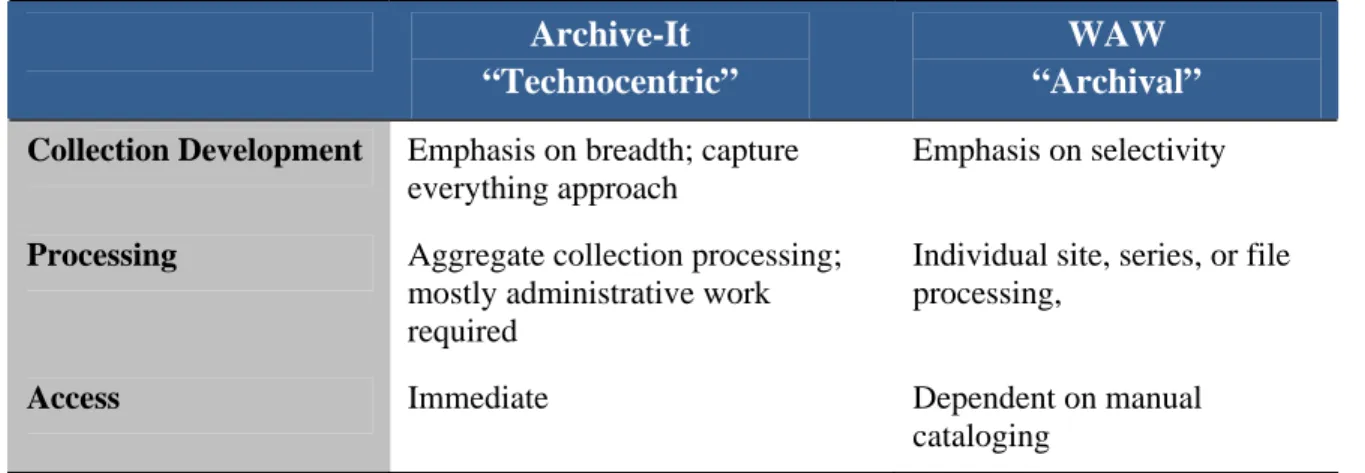
Archive-It and WAW support two very different models for Web archiving workflows and policies. Archive-It’s approach to Web archiving emphasizes automation and the management of aggregates, i.e. collections of sites, over discrete objects, i.e. pages or files. WAW’s approach depends heavily on labor-intensive, manual
management and administration of collections of files. These applications respectively provide examples of the “technocentric” and “archival” approaches to Web archiving described by Richard Pearce-Moses and Joanne Kaczmarek (Pearce-Moses and Kaczmarek 2005).
With Archive-It, the archivist may set up collections of seeds and then set crawls to run automatically as often as necessary. Once the crawls have run, the archived sites are available immediately through the Wayback Machine. The archivist may choose to manually download the reports that summarize the results of an entire crawl, but the
7
successful implementation of Archive-It does not require this step of the process. These reports do not even provide site- or page-specific capture results, only aggregated results. While in reality, managing a Web archiving program does require occasional manual intervention (for instance, to ensure that all seed URLs are still valid and within the scope of the collection), theoretically, an archiving program that uses Archive-It would be largely automated after the initial set-up.
With WAW, more flexibility and more features mean more work for archivists and librarians. Information professionals using WAW have a suite of tools that allow them to discover the documents within Web sites that fit their collecting scope. They also have a number of ways to capture and package this material. They may choose to capture entire sites, specific directories, or specific files. Each item or group of items from a Web site must be manually catalogued and relationships with other items in the collection established. This work takes place prior to ingestion into a digital repository.
Post ingest, the archivist must create catalog records, finding aids, or other access aids to provide public access to the materials. During the ingest process, WAW packages the selected files in an XML wrapper with their associated metadata, but it is up to the Archivist to make the XML encoded metadata available to the user in a manner that is understandable. The OCLC Digital Archives allows the archivist to create MARC Catalog records with relative ease, but these catalog records do not make use of the complex, hierarchical metadata that can be created in WAW.
Archive-It “Technocentric”
WAW “Archival”
Collection Development Emphasis on breadth; capture everything approach
Emphasis on selectivity
Processing Aggregate collection processing;
mostly administrative work required
Individual site, series, or file processing,
Access Immediate Dependent on manual
cataloging
TABLE 1 COMPARISON OF ARCHIVE-IT AND WAW WORKFLOW MODELS
ACCESSING WEB ARCHIVES
With Archive-It, users access the archived Web sites from the Internet Archive servers through the Wayback Machine. The Wayback Machine is an open-source, publicly-accessible online interface developed by the Internet Archive. The Internet Archive uses this interface for its own collection of archived Web sites and for the collections its Archive-It partners create. The main way (and the most effective way) to search for archived versions of a Web site is to enter the URL into the Wayback
Machine. The Wayback Machine then returns a list of dates on which that particular URL was captured and archived (a screenshot of the Wayback Machine page for the Metropolitan Museum of Art is shown in Figure 1). The user may then select the version she is most interested in, and with the click of the mouse, she is able to see how that Web site looked and what content it contained on the date that she selected. With the
though a seed URL may have metadata attached to it through Archive-It, this metadata is not displayed at all in the Wayback Machine.
FIGURE 1 WAYBACK MACHINE PAGE FOR THE METROPOLITAN MUSEUM OF ART
While entering the URL into the Wayback Machine is currently the only way to access materials in the Internet Archives’ general collection, Archive-It does offer a search feature and an overlay for the Wayback Machine in the form of a collection- or institution-specific portal. The ability to create such a portal allows partner institutions to provide a bit more information about their collection and its contents. The portal for the North Carolina State Government Web Site Archives, for instance, is made up of several WebPages describing the collection’s background, providing answers to frequently asked questions, and listing the agencies whose Web sites the institution is capturing
get to the results page for the Wayback Machine. A custom collection portal gives archivists some flexibility in how they present the archived Web sites to users, but the process of creating it requires technical and design expertise and time. These portals are not a feature of the Archive-It product itself. If archivists choose to provide users with the kind of description included in traditional finding aids or other metadata besides Web site capture date, they must add these features outside of the Archive-It and Wayback Machine environment.
The portal also offers a full-text search engine that only searches within a particular collection. However, so far, this search engine does not successfully find relevant results.8 The Internet Archive is working to improve this search functionality, but if a researcher chooses a document found by the search engine, she is taken directly to that document, bypassing any contextualizing information, and even the Wayback Machine interface.
The Wayback Machine was designed specifically to access archived Web sites. As mentioned above, WAW’s access mechanisms are based on traditional access aids. To provide access to materials in the Digital Archive, librarians and archivists can add hyperlinks to records in their OPAC, in-house databases, or finding aids. In this way, they have the ability to provide as much metadata or description as they choose, as their systems allow, and as their users need.
8
There is also a variation on the Wayback Machine, used primarily in Europe, that deserves to be mentioned here. “WERA (Web ARchive Access) is a freely available archive viewer application that gives an Internet Archive Wayback Machine-like access to web archive collections as well as the possibility to do full text search and easy navigation between different versions of a web page.”9 Figure 2 shows the main access page for WERA which allows users to begin their search either with a URL or keywords. Also included is a date range option that allows users to limit their search to a specific year or years. Figure 3 shows a Web page that was accessed through WERA. The banner at the top of the screen shows the version date as well as the original URL of the page and any other search terms used to find it.
9
FIGURE 2 WERA SEARCH PAGE (FROM THE WERA MANUAL)
WERA is not currently being used by any repositories in the United States, but because it does not require archivists to manually describe the captured Web sites and makes more of the metadata automatically captured during the archiving process easily accessible, it presents an attractive alternative to the Wayback Machine. However, since the Wayback Machine is still the more common of the two access tools, even in Europe, this study uses the Wayback Machine as the primary access tool for the “technocentric” approach to Web archiving.
T
HEORIESB
EHINDW
EBA
RCHIVINGWeb archiving is a young practice, and information professionals are still working to develop appropriate tools and methods, especially for preservation and access.
Nevertheless, archivists and technologists have begun to work out systematic approaches to Web archiving built around comprehensive philosophies embracing every step of the process from capture to end-user access. When evaluating Web archiving access methods, it is important to understand these philosophies and how they affect access provision.
THEORIES PUT INTO PRACTICE: WAW AND ARCHIVE-IT
Dictating the (optimal) workflow models and access methods behind WAW and Archive-It are assumptions about the very nature of providing access to Web archives that have important implications for archivists and librarians. Brewster Kahle, Director of the Internet Archive, claims that “the Web is a self-documenting, self-cataloging machine” (Kahle 2002). Therefore, an approach to Web archiving that captures
in order to make the material discoverable and intellectually accessible to users. Kahle’s Internet Archive takes this approach. Its Archive-It service takes a similar approach, but applies it to smaller, institutionally-defined collections of Web sites, rather than the entire Web. The Internet Archive and Archive-It collections are both available through the Wayback Machine with minimal descriptive metadata. However, the idea that the whole Web is self-documenting and self-cataloging in a way that will be understandable to future users has not been tested, and it is unclear whether Kahle’s description would also characterize discrete subsets of the Web taken out of the context of the whole.
Some archivists, on the other hand, argue that the records on the Internet need the kind of contextual explanations traditionally found in archival finding aids and other access aids, like bibliographic records. The Arizona Model for Preservation and Access of Web Documents advocates thinking about electronic records on the Internet in terms of series and describing them at the series level in hierarchically organized finding aids with scope and contents notes giving users background information to introduce them to the records (Pearce-Moses and Kaczmarek 2005).10 This model, an example of a modified “bibliocentric” model for Web archiving, draws on traditional library and archives practices.
CRITIQUES
10
Both positions have merit at a time when librarians, archivists, and other information professionals are trying to fit information from the Internet into previously established categories of information resources. This type of information may fit into the category of publications, which are generally describing and more-or-less self-cataloging (in that the information needed to catalog them is usually found within the publication itself). It may also fit into the category of records, which are generally not considered to be self-describing and often require knowledge that is external to the documents themselves to make them intellectually accessible and to preserve their evidential character.
The debate over the “technocentric” access mechanisms and the “bibliocentric” or “archival” mechanisms is very similar to the debate captured in the exchange between David Wallace, Heather MacNeil, and Wendy Duff in the pages of Archivaria. On the one side are people like Kahle and Wallace who essentially believe that the records are best contextualized by their creators, while on the other are people like Pearce-Moses and MacNeil, who believe that records cannot (or will not) be described by their creators in a manner that will ensure future usability. However it is important to note a difference between the types of records the Wallace discusses and the types Kahle discusses,
(Bailey 1989, 187), but Web sites have an organizational structure that does not necessarily reflect the underlying file directory structure.
In general, traditional cataloging has been the subject of a great deal of criticism in the last few years for failing to keep up with changes in how people discover and assess resources. Critics and users alike identified subject-based access as an area that needed significant improvement. It may even be true that in the 21st century, “[a] complex metadata surrogate describing resources in detail is unneeded when the actual item can be viewed within a few seconds and with little effort on the part of the user” (Coyle and Hillmann 2007).11
Julien Masanès critiques using the traditional cataloguing approach for Web archives because, as he asserts, libraries and archives have only a small role to play in the global effort to edit and provide access to the Web. This effort constructively involves everyone using the Web, and especially those creating new content. Librarians and archivists who attempt to continue in their roles as “information organizers” will only serve “to freeze and preserve their own sample of a larger living culture artifact” (Masanès 2006, 20). In Masanès view, this result is not only undesirable, it is one that cannot be successfully sustained as the amount of material to be cataloged grows exponentially.
Hallgrimsson also argues that cataloging is not appropriate for Web sites archives, although for different reasons. “The experience from the Pandora and the Minerva projects shows that except for a very small Web archive traditional cataloguing is not an
11
option” (Hallgrimsson 2006, 134), and certainly, those who have experience in Web archiving know that selecting, capturing, and cataloging Web sites is time-consuming and expensive (Murray and Phillips 2007). Hallgrimsson also makes the point that the metadata automatically harvested and the metadata automatically added during harvesting will not be enough for effectively providing access in the context of Web archiving. His primary focus is on discovery, and he discusses search engines in depth as a solution to the problems of Web archives accessibility.
A group of researchers developing a specialized browser specifically for viewing Web archives has suggested that “an interface similar to those for the live Web seems the most convenient for Web archives. The interface should support fast and easy
information retrieval and browsing,” with the caveat that “current interfaces to Web archives are still in the development phase and do not necessarily provide such access” (Jatowt, et al. 2006, 136).
Currently, Internet search engines do a poor job of determining relevance based on the date of the materials being indexed (Bar-Ilan 2006), but the temporal coverage of archival materials is extremely important to researchers using them (Duff and Johnson 2003, 87). Allowing users to limit their search results by capture date may offer a decent solution to this problem, but even within a given year, there may be many archived versions of a particular page. A good search engine alone will not be sufficient to provide effective access to Web archives.
Archivists at the Library of Congress advocate a variation of traditional access aids for Web archiving. They suggest using a METS (Metadata Encoding Transmission Standard) package to house descriptive metadata, technical metadata, and administrative metadata. The use of METS will allow for the effective presentation of the complex “tangle of relationships that is an archived Web site” (Guenther and Myrick 2006, 161). However, they do not describe how this metadata will be made available to researchers for discovery and access purposes.
Jatowt et al. present and alternative to the Wayback Machine, in the form of an interesting experimental browser that would allow users to rapidly assess and analyze changes in Web pages over time, but they focus primarily on change rather than on static documents or records. “[Their] approach is based on the belief that browsing of the past Web should be based on change management” (Jatowt, et al. 2006, 138), and their
browser would not necessarily be appropriate for accessing and interpreting static records captured from the Web.
that any presentation of Internet-based records must first and foremost be able to convey both their evidential value and their informational value. Users of these records must be able to understand who created them, when, why, and who is responsible for their safekeeping, in addition to being able to understand the content of the record.
The experiment described below tests the applicability of Kahle’s proposition to a subset of the Web and the applicability of traditional cataloging to Web archiving in general by studying users’ understanding of records on the Internet that have been archived and made accessible through the Wayback Machine and through the State Library’s catalog. The Wayback Machine attempts to contextualize information by preserving its original presentation on the Internet, while archival description attempts to recreate the original context through an archivist-created access aid.
U
SERS
TUDIES INA
RCHIVESIn the archival community, there are frequent calls for studies of archival
materials users. Archivists do not have a full understanding of their users’ needs, making it difficult for them to meet those needs.12 More work needs to be done to determine how researchers of all types find, evaluate, and use primary sources, both digital and analog; and it is becoming increasingly important to study user needs and behavior in the digital age, when many researchers can use archival access aids and archival materials remotely and may never have any direct contact with an archivist. These remote users will be the
12
most difficult to serve and current practices are unlikely to meet the needs of these “invisible researchers” (Hill 2004).
User studies were one of the three broad research areas identified in the Burlington Agenda as essential for “providing intellectual access to electronically published historical documents” (Dow, et al. 2001, 301).13 More specifically, of the eight research issues outlined in the Agenda, half of them involve ensuring that contextual information is effectively presented during resource discovery and use. Knowing how users interact with primary sources online has implications not just for descriptive practices, but it also has implications for collection development. In discussing issues that curators need to address in their collection planning and management, Hur-li Lee includes issues of access in an online environment; “[o]ther questions are of particular relevance in the online environment. How do users use electronic collections? Do they prefer navigating freely in the cyberspace by themselves or starting with a collection as they do in a traditional library?” (Lee 2000, 1112).
The user studies that have been conducted generally explore one of two issues. Either they attempt to determine how people find primary sources relevant to their research14 or they explore how researchers interact with traditional descriptive products, such as the finding aid or the catalog record, with a view toward assessing their
“usability.” With a few notable exceptions, these studies do not examine how (and how
13
The Burlington Agenda was the result of a three-day meeting in 2000 of experts in documentary editing, electronic publishing, computer science, and library and information science to discuss intellectual access to historical documents available electronically. The other two broad research areas identified were publication management studies and studies of access to information.
14
well) people make sense of the records themselves, either based on their interactions with the records or interactions with their bibliographic representations.
For instance, a study of the finding aid usability for the POLARIS Project at the Florida State University Claude Pepper Library generally found that users appreciated having online access to the finding aid, but that with access aids readily available to remote users, they also expect to have access to item-level discovery tools and even to the items themselves (Altman and Nemmers 2001). This study did not investigate the issue of whether the participants were better able to understand the documents if they used the online finding aid rather than the paper finding aid to access them. A study by Wendy Duff and Penka Stoyanova examined the usability of a number of archival display
systems and compared them with an archival display based on specific design guidelines, concluding that users preferred the standards-based display (Duff and Stoyanova 1998). Here again, the focus was on responses to document representations separated from what they were representing.
Even good usability studies are not sufficient to ensure that records are intellectually accessible. Access aids that are easy to use do not necessarily provide researchers with the information they need to evaluate and understand the records. Advocates of user-centered design admit that there are limitations to usability testing. In the words of one author, usability tests “should be used to help create intuitive, usable sites, not to test the need for or usefulness of a new service. It is certainly possible to create an extremely usable site that is not useful” (Lack 2006, 76).
collections do not make effective use of online resources to discover collections (Hamburger 2004; Anderson 2004; Duff, Craig and Cherry 2004; Tibbo 2003), even though archivists are keen to make the majority of their collections discoverable online.15 Finding aids, as one study concludes, are not well understood by researchers, and EAD does not make them any easier to understand (Yakel 2004). EAD finding aids were designed for historians and do not necessarily support the type of searching that genealogists do (Duff and Johnson 2003).
Moreover, the use of online finding aids presents its own problems. An
experiment conducted by Tim Hutchinson demonstrated that full-text searching in finding aids yields greater recall but less precision in result sets than searching than short, more precise collection representations, such as the introductory portions of the finding aid (Hutchinson 1997). While Hutchinson concludes that EAD will facilitate more precise retrieval when it can be used for structured, field-specific searching, his study has important implications for the retrieval of documents themselves, as well as their
descriptions. The results of searching for either documents and/or access aids through an Internet search engine are likely to have the same low precision, high recall
characteristics as the results the experiment with retrieval through full-text finding aids. Increased recall and decreased precision will require archivists to think carefully about how they help remote users decide if a given result is what they are seeking.
15
Many of the user studies that scholars in the archives community have conducted focus on researchers in academic environments, primarily professional historians and students, paying less attention to the non-academic professionals and recreational researchers that make up a large portion of archives’ user population. For example, the Gladys Kriebel Delmas Foundation funded three large-scale studies of historians in the US, UK, and Canada (Anderson 2004; Duff, Craig and Cherry 2004; Tibbo 2003). A recent article purporting to explain the basics of user studies was similarly limited in the scope of its audience (Proffitt 2006).
Historians generally use print or informal sources of information to find primary source materials (Anderson 2004; Duff, Craig and Cherry 2004; Tibbo 2003). One interesting study of another user group, genealogists, by Wendy Duff and Catherine Johnson found that they also generally preferred informal sources of information rather than formal sources, such as finding aids and collection guides (Duff and Johnson 2003, 94-95). It is unclear whether and how these discovery methods apply to Web archives and other electronic records.
The user studies conducted to date in the archival community have been either exploratory in nature or very specifically tied to one particular situation or descriptive product. Three very different studies have delved into the problem of providing access to electronic records in extremely interesting and useful ways. Margaret Hedstrom and others working on the CAMiLEON project at the University of Michigan tested
electronic records preservation from the user’s perspective in an attempt to discover what properties of the original digital objects were important to users. The experiments
the results indicated that contextual information was, indeed, important for using and understanding archived digital objects, the authors also noted that the study participants did not make use of the metadata associated with the textual documents to interpret them (Hedstrom, Lee, et al. 2006, 184, 187).
In a study dealing specifically with access to Web site archives, a group of researchers in Japan developed an interactive browser that would allow researchers to access Web sites archived in multiple repositories and to view the various versions chronologically in a slideshow-like manner (Jatowt, et al. 2006). They designed the browser, the “past Web browser,” specifically to highlight the changes in the site over time, rather than to provide a static record of a site at a particular time.16 The researchers then conducted an experiment in which they had users complete a set of tasks using their browser and using the Wayback Machine. The results suggest that the past Web browser allowed for more efficient and effective completion of the study tasks. However, the tasks in the experiment concentrated on identifying and evaluating changes in a Web page over time and the results may not be indicative of how the two access tools would compare if the tasks evaluating records at a specific point in time.
A study of user understanding of MARC AMC records conducted by Robert Spindler and Richard Pearce-Moses presents findings that, like Prom’s article (Prom 2003), show how difficult it is to recreate the contextual information contained in more complicated archival access aids in the type of access aids found in library catalog
16
(Spindler and Pearce-Moses 1993). Both of these articles show that it is not easy to replicate the kind of contextual information needed to understand and evaluate archival records in a way that is easier to integrate into the larger world of information available in many formats and in many types of repositories and in a form that is actually less time-consuming for archivists to create and manage.
User studies in the 21st century should still address the issue of resource
discovery, but they also need to address aspects of user understanding, as these last three studies do. Moreover, they should include a broader definition of archival users, so that archivists will be effectively serving all types of users, some of whom may be remotely using their collections without their knowledge.
A
U
SERS
TUDY INV
IRTUALA
RCHIVESThis study investigates the issue of users’ understanding of the context of records in Web archives through a scenario-based test, which “involves presenting representative end-users with scenarios, or specific tasks, designed to cover the major functionality of the software system and to simulate expected real-life usage patterns” (Levi and Conrad 2002). It compares users’ experiences of the access methods associated with the
METHODOLOGY
The participants who completed the study were researchers at the North Carolina State Archives and State Library. Although the participants did not provide any personal information as a part of this study, the user population for these two collections
comprises students; academics; professionals, including other state employees; and recreational researchers. Most of the users live in the state of North Carolina, but the Archives and the Library also serve patrons from other states and other countries. Researchers range in age from college students to retirees and generally have a varying degree of experience with computers and primary source materials.17
For the study, each participant was asked to image that she was a researcher working in the year 2150 to follow very specific step-by-step instructions to find two different records, using either the State Library Catalog or the State Government Web Site Archives Portal and the Wayback Machine as the starting point for the search. The participant then completed a questionnaire that required her to explain the content and context of the records and to answer questions about how well she understood and trusted the records and how easy it was to locate contextual information about the records. The final section of the questionnaire asked the participant to reflect on the process of finding the information needed to explain the records’ content and context. Each participant was exposed to only one of the two archival environments and had explicit instructions not to leave that environment for the live Web. All participants examined the same two records,
17
which were minutes of a meeting of the North Carolina Alcoholic Beverage Control Commission and a revenue report from the Commission.
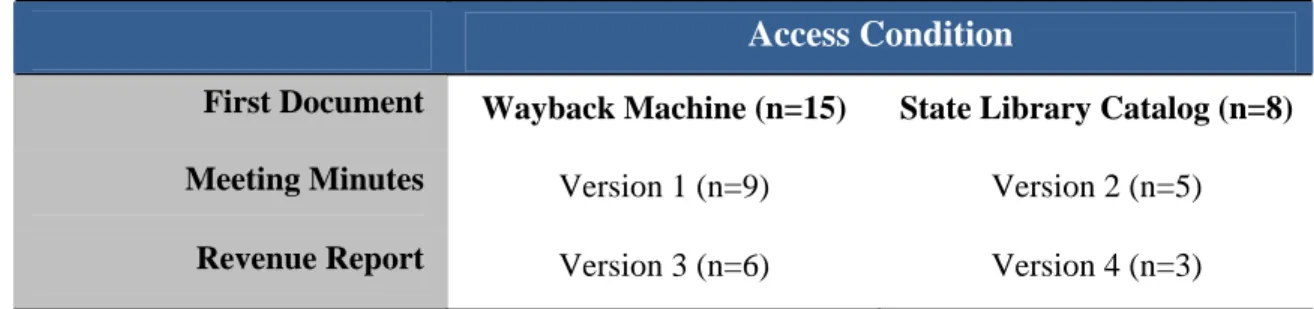
There were four versions of the survey instrument. Two versions gave the participant instructions to use the State Government Web Site Archives to retrieve the records, but the order of retrieval was varied between those two versions. The other two versions directed the volunteer to use the State Library Catalog to retrieve the records, and again the order of retrieval was varied between those two sets. Thus one group of participants used the Web Site Archives to examine first the meeting minutes and then the revenue report, one group of participants used the Web Site Archives to examine first the revenue report and then the meeting minutes, one group used the library catalog to examine first the meeting minutes and then the revenue report, and one group used the library catalog to examine first the revenue report and then the meeting minutes.
Access Condition
First Document Wayback Machine (n=15) State Library Catalog (n=8)
Meeting Minutes Version 1 (n=9) Version 2 (n=5)
Revenue Report Version 3 (n=6) Version 4 (n=3)
TABLE 2 QUESTIONNAIRE VERSIONS
Setting up this study required four main steps: selecting two sample records created by the state of North Carolina available on the Internet, capturing those two records using the Web Archives Workbench and Archive-It and adding the metadata allowed in each tool, developing the participant instructions and questionnaire, and recruiting participants.
The first phase of the study entailed setting up the study environment, including choosing the records, archiving the records with WAW and Archive-It, describing them, and writing the participant instructions and questionnaire. I used the following five criteria to choose the records:
1. The records belong to a series with an existing description in the State Archives’ online catalog MARS;
2. The records have continuing value;
3. The organizational structure of the agency creating the records had not significantly changed since the description was written;
4. The records would not be too familiar to the average researcher;
5. The records are short enough for researchers to read and analyze both within twenty minutes.
I chose records on the basis of whether a description of the corresponding record series already existed in the Archives’ online catalog MARS and whether the records had continuing value. Unfortunately, many state records have not yet been processed and described, limiting the types of records that could be used for this study, because it was not feasible to create new descriptions from scratch in a reasonable time frame. I considered any record that fit into a record series with an existing description in the MARS catalog to have continuing value and therefore, appropriate for this study.
To find the records I browsed the descriptions of State records’ series in MARS. Many of the series with descriptions in the catalog are closed and consequently,
FIGURE 4 ALCOHOLIC BEVERAGE CONTROL COMMISSION MINUTES, DECEMBER 200618
FIGURE 5 ALCOHOLIC BEVERAGE CONTROL REVENUE REPORT19
18
The URL for this document on the live Web is
Once the selection of the records was complete, I manually harvested them from the live Web using WAW on February 6, 2007. I then ingested the two records into the Digital Archive and, with the assistance of a cataloger at the Library, I created MARC catalog records for each item in the State Library Catalog based on the corresponding MARS records (see Appendix C for the existing MARS records for each series and Appendix D for the catalog records created for this study).20 In order to better simulate an actual description of these series including both paper and electronic records, I updated the holdings information and did not include the processing information in the MARS records in the catalog records. To further the illusion, the records in the library catalog also included links to other archived records in the series that were not part of the study. The record for the revenue reports contained links to two years worth of reports, and the record for the minutes included links to three months of minutes.21
The Commission’s entire Web site was also automatically ingested into the North Carolina State Government Web Site Archives on February 2, 2007 using Archive-It, during the regularly-scheduled quarterly crawl run by the State Records Center. Because the Web sites captured during an Archive-It crawl are immediately made available
through the Wayback Machine, no additional work was necessary to make the records for this study publicly accessible.
19
The URL for this document on the live Web is
http://reports.ncabc.state.nc.us/uploads/resources/114c19d793b34380978c7fd82407d6c2.pdf.
20
Although a MARC catalog record is not the exact equivalent of a MARS record, or other similar records in a database of archival access records, WAW primarily supports the creation of MARC records for the materials it harvests. In addition, I was not able to access the MARS database to add records, but I was given permission to add these records to the Library’s catalog.
21
I created instructions for each of the two conditions to direct participants in how to locate the sample records (Appendix A and Appendix B contain one set of instructions for each access condition). Participants using the records as captured by WAW were instructed in how to find the correct catalog records in the North Carolina State Library Catalog and then instructed to click on the links leading to the records in the Digital Archive. Participants using records captured with Archive-It were instructed in how to find the records starting from the North Carolina State Government Web Site Archives portal homepage and going through the Wayback Machine, which required them to navigate through several archived WebPages to reach the records themselves (see Appendix E for screenshots of the navigation steps). Although the two sets of
instructions were very different, they were designed to simulate two probable methods for discovering and retrieving these records. It is inevitable that participants would gain some understanding of the content and context of the records in the process of finding them, so following the instructions was an integral part of the experience of evaluating and analyzing the records and should be seen as part of the overall presentation of the records in the archival environment.
Before seeking the approval of the Institutional Review Board and recruiting any participants, I tested each version of the instructions and questionnaire on either a family member or friend to ensure that the participants would be able to follow the instructions to find the records and that the questions were clearly worded.
COLLECTING THE DATA
For a period of two months, an employee at the State Archives asked everyone
registering to participate in this study, following the script in Appendix G. Employees at the State Library also asked visitors to participate in the study using the same script. In addition, to increase participation rates, I recruited in person at the Archives for two days toward the end of the two-month period. Those visitors who agreed to participate were given a set of instructions and a questionnaire and asked to complete the questionnaire during their visit to the archives. The questionnaire was self-administered, but Library and Archives staff members were available to answer any procedural questions.
Each participant received one of the four versions of the instructions described above in Table 2, but all participants answered the same questions after examining the same two records. Before beginning the study, participants signed the informed consent letter in Appendix F. The signed consent letters were segregated from the completed questionnaires. Participants did not provide any demographic information about themselves, the only personally indentifying information being the signature on the consent letter. The questionnaires themselves contain no personally indentifying data.
Twenty-three researchers completed the questionnaire, including one who returned the questionnaire by mail. Because each participant was given a random set of instructions and some participants did not return their questionnaire, there were fifteen participants who completed the study using the Web Site Archives portal as their initial access point and eight who used the State Library Catalog.
ANALYZING THE DATA
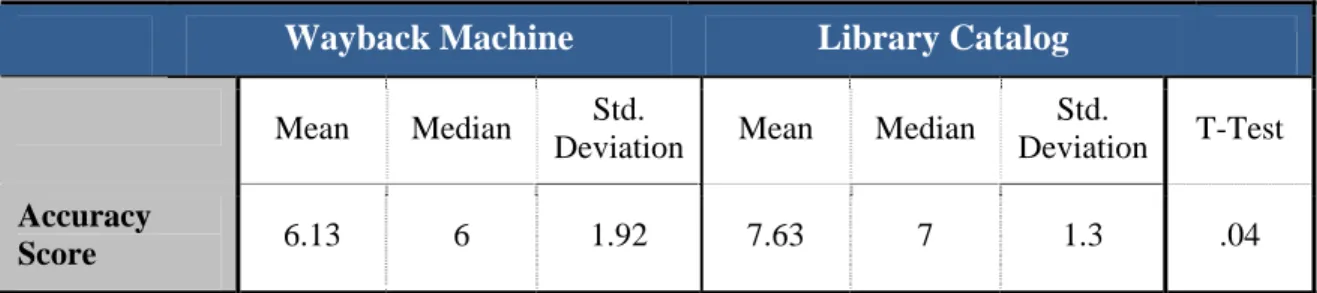
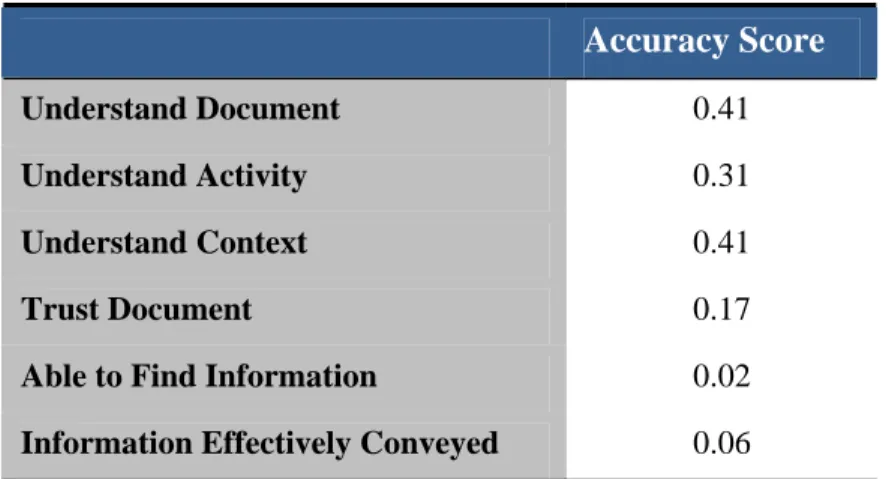
condition to determine how the access method affected their experience in using Web archives. I also looked for similarities to describe researchers’ overall experience using this kind of material.
Section Questions
1. Who created this document?
2. When was this document created?
3. What type of record is this?
Sections A and C
4. Who has preserved this record?
Sections B and D 5. In a sentence or two, explain what event or activity this document describes.
6. I understand the document I have been asked to look at.
7. I understand the activity that the document is representing.
8. I understand the context of the document I have been asked to look at.
9. I trust that this document is what it purports to be.
10. I was able to easily locate the information I needed to answer the questions in Section A of this questionnaire.
Sections E and F
11. The presentation of this document effectively conveyed the information I needed to answer the questions in Section C of this questionnaire.
12. In a sentence or two, describe in your own words whether you found the task of answering the questions in sections A through D easy or difficult, and why.
13. What else would have helped you to answer those questions?
Section G
14. Do you have any other comments on this experience?
TABLE 3 OVERVIEW OF SURVEY QUESTIONS