Sharif University of Technology
Scientia IranicaTransactions B: Mechanical Engineering www.scientiairanica.com
Vibration and buckling analysis of functionally graded
beams using reproducing kernel particle method
R. Saljooghi
a, M.T. Ahmadian
a;b;and G.H. Farrahi
a a. School of Mechanical Engineering, Sharif University of Technology, Tehran, Iran.b. Center of Excellence in Design, Robotics and Automation (CEDRA), Sharif University of Technology, Tehran, Iran. Received 7 October 2012; received in revised form 21 December 2013; accepted 9 March 2014
KEYWORDS Functionally graded beam;
Reproducing kernel particle method; Natural frequencies; Critical buckling loads.
Abstract.This paper presents the vibration and buckling analysis of functionally graded beams with dierent boundary conditions, using the Reproducing Kernel Particle Method (RKPM). Vibration of simple Euler-Bernoulli beams using RKPM is already developed and reported in the literature. So far, the modeling of FGM beams using the theoretical method or the nite element technique has not evolved with accurate results for the power law form of FGM with a large power of \n" value. The accuracy of RKPM results is very good and is not sensitive to the n value. The system of equations of motion is derived using Lagrange's method under the assumption of the Euler-Bernoulli beam theory. Boundary conditions of the beam are taken into account using Lagrange multipliers. It is assumed that material properties of the beam vary continuously in the thickness direction, according to the power-law form. RKPM is implemented to obtain the equation of motion and, consequently, natural frequencies and buckling loads of the FGM beam are evaluated. Results are veried for special cases reported in the literature. Considering the displacement of the neutral axis, buckling loads, with respect to length and material distribution, are evaluated. For special cases of homogenous beams, RKPM matches theoretical evaluation with less than one percent error.
© 2014 Sharif University of Technology. All rights reserved.
1. Introduction
One of the new concepts in material design is the con-cept of Functionally Graded Materials (FGM). These materials are mostly made of ceramic and metallic components, with properties varying from one side to the other, in the form of a particular distribution function. This enables FGM structures to be exible for any desired properties. The exclusive characteristic of functionally graded materials is the continuous and smooth change in properties, which reduces undesirable phenomena, such as stress concentration. Functionally
*. Corresponding author. Tel.: +98 21 66165503
E-mail addresses: [email protected] (R. Saljooghi); [email protected] (M.T. Ahmadian); [email protected] (G.H. Farrahi)
graded materials are used to make gradual changes in the mechanical properties and characteristics of structures [1].
FGMs are of interest for a wide range of applica-tions, such as articial teeth and dental implants, sen-sors, biomedicine, dierent aspects of tissue engineering and aerospace industries [2-8]. The idea of combining two dierent types of material was introduced by Bever and Duwez in 1972 [9]. Over the last decades, many studies have been devoted to understanding the static and dynamic behavior of these materials. Due to the continuous change of properties, analysis of FGMs results in mathematical complications, applying analytical solution to which becomes dicult. Con-sidering the application of beams in most structures, studying the vibration and mechanical performance of FGM beams is of great importance. Chakraborty et
al. [10] developed a new beam nite element for the analysis of functionally graded materials. They used the exact solution of the static part of the governing dierential equations to construct interpolating poly-nomials for the element formulation, and showed the behavioral dierence of functionally graded material beams with pure metal or pure ceramic beams for both exponential and power-law variations of material properties. Xiang and Yang [11] investigated the free and forced vibration of a laminated functionally graded beam of variable thickness under thermally induced initial stresses within the framework of the Timoshenko beam theory. The beam consisted of a homogeneous substrate and two heterogeneous functionally graded layers whose material composition followed a power law distribution in the thickness direction. It was assumed that the beam might be clamped, hinged, or free at its ends. They showed that vibration frequencies, mode shapes and dynamic responses of the beam, were signicantly inuenced by thickness variation, temperature change, slenderness ratio and end support conditions. Aydogdu [12] analyzed the vibration and buckling of simply supported axially FGM beams using the semi-inverse method, assuming the Euler-Bernoulli beam theory. Simsek and Kocaturk [13] investigated free vibration characteristics and dynamic behavior of a functionally graded simply supported beam under a concentrated moving harmonic load. The system of equations of motion was derived using Lagrange's equa-tions under the assumption of the Euler-Bernoulli beam theory, and the constraint conditions of supports were taken into account using Lagrange multipliers. They discussed the eects of dierent material distribution, the velocity of the moving harmonic load and excitation frequency on the dynamic response of the beam. Sina et al. [14] used a new beam theory, dierent from the traditional rst-order shear deformation beam theory, to analyze free vibration of functionally graded beams. The equations of motion were derived using Hamilton's principle and solved using an analytical method. The eects of boundary conditions, volume fraction and shear deformation on natural frequencies and mode shapes were investigated. Simsek [15] investigated vibration of a functionally graded simply-supported beam under a moving mass using dierent beam theories. The material properties of the beam varied continuously in the thickness direction, according to the power law form. The system of equations of motion were derived using Lagrange's equations, while the constraint conditions of supports were taken into ac-count using Lagrange multipliers. The eects of shear deformation, various material distributions, velocity of the moving mass, inertia, Coriolis and the centripetal eects of the moving mass, on the dynamic displace-ments and stresses of the beam were discussed and compared with those of previous literature. Alshorbagy
et al. [16] presented the dynamic characteristics of functionally graded beams with material graduation in axial or transversal directions, based on the power law form. They derived a system of equations of motion using the principle of virtual work and the nite element method to discretize the model. Eects of dierent material distribution, slenderness ratios, and boundary conditions, on the dynamic characteristics of the beam, are discussed.
The purpose of this paper is to evaluate vibration frequencies and buckling loads of functionally graded beams using the RKPM meshless method. The system of equations of motion is derived using Lagrange's method within the framework of the Euler-Bernoulli beam theory. Boundary conditions of supports are taken into account using Lagrange multipliers. It is assumed that the material properties of the beam vary continuously in the thickness direction, according to the power law form.
2. Theory and formulation
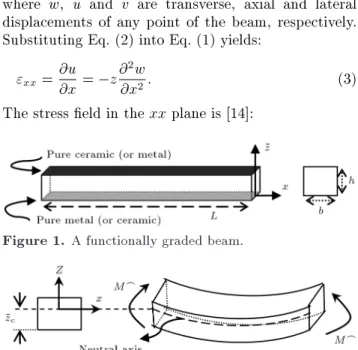
Figure 1 shows an FGM beam with length, L, and thickness, h. A schematic of the beam cross section under bending moment, M_, with the assumption
of the Euler-Bernoulli beam theory, is presented in Figure 2. The normal strain in an arbitrary point in the thickness of the beam is given by [17]:
"xx= @u@x: (1)
The displacement eld of the beam may be written as: w = w; u = z@w@x; v = 0; (2) where w, u and v are transverse, axial and lateral displacements of any point of the beam, respectively. Substituting Eq. (2) into Eq. (1) yields:
"xx= @u@x = z@ 2w
@x2: (3)
The stress eld in the xx plane is [14]:
Figure 1. A functionally graded beam.
xx= E(~z)"xx= E(~z)z@ 2w
@x2; (4)
where E(~z) is the Young modulus of the beam. The potential energy of the beam can be written as [17]:
U =12
L
Z
0
Z
A
"xxxxdAdx; (5)
where A is the cross section of the beam. Substituting Eqs. (3) and (4) into Eq. (5) yields:
U =12
L
Z
0
Z
A
E(~z)z2
@2w
@x2
2
dAdx: (6)
For a homogeneous beam, potential energy is [17]:
U =12
L
Z
0
EI
@2w
@x2
2
dx; (7)
in which, I is the moment of inertia of the beam cross-section. Comparing Eqs. (6) and (7) without loss of generality, an equivalent EI for the FGM beam can be introduced as:
(EI)eq=
Z
Az
2E(~z)dA: (8)
For any arbitrary distribution of materials, the location of the neutral axis may be evaluated as follows [18]:
~zc=
R
AE(~z)~zdA
R
AE(~z)dA
: (9)
Having the position of the neutral axis, according to Figure 1, the equivalent EI for the FGM beam will be:
(EI)eq=
Z h
0 (~z ~zc)
2E(~z)bd~z: (10)
The kinetic energy of the beam for transverse vibration is [17]:
T =1 2
L
Z
0
m
@w @t
2
dx; (11)
in which m is the mass per unit length of the beam and is obtained as below:
m = Z
A(~z)dA =
Z h
0 (~z)bd~z; (12)
where (~z) is the density of the FGM beam.
In Eqs. (4) to (12), material properties of the
FGM beam vary continuously in the thickness direction according to the power law form:
(~z) = b+
~z h
n
(t b);
E(~z) = Eb+
~z h
n
(Et Eb); (13)
where subscripts, t and b, refer to top and bottom. From Eqs. (6) and (11), using Lagrange's theorem, the equation of the transverse vibration of the FGM beam is obtained as below:
(EI)eq@
4w(x; t)
@x4 + m
@2w(x; t)
@t2 = 0: (14)
To solve Eq. (14), w(x; t) is reproduced using RKPM shape functions, and natural frequencies are obtained from the eigenvalue equation.
3. Overview of RKPM
The reproduced function in RKPM is [19]:
uR(x) =Z
a(x; x y)u(y)dy; (15)
in which, is the corrected kernel function dened as: a(x; x y) = C(x; x y)a(x y); (16)
where C is the correction function and a is kernel
function:
C(x; x y) =
n
X
i=0
bi(x)(x y)i= bTH(x y);
HT(x y) =1 x y (x y)2 (x y)n;
a(x y) = 1a
x y
a
: (17)
Dening the moments of kernel function in the follow-ing form:
mk(x) =
Z
(x y) k
a(x y)dy; (18)
the Taylor series expansion of u(y) can be expressed as below:
u(y)=
n
X
a=0
"
( 1)a(x y)a
a! u(a)(x)
n
X
i=0
bi(x)ma+i(x)
# : (19) In order for the reproduced function to be equal to the main function, the following conditions must be
satised:
n
X
i=0
bi(x)mi(x) = 1;
n
X
i=0
bi(x)ma+i(x) = 0; a = 1; 2; ; n: (20)
Eq. (20) can be written in the matrix form: f
M(x)b(x) = H(0); (21) in which matrix fM is:
2 6 6 6 4
m0 m1 mn
m1 m2 mn+1
... ... ... ... mn mn+1 m2n
3 7 7 7
5: (22)
By solving the matrix Eq. (21), unknown coecients, bi(x) and the eventually reproduced function, uR(x)
are obtained.
Applying the trapezoidal rule to Eq. (15) leads to the discretized form of RKPM:
uR(x) =XNP I=1
I(x)u(xI); (23)
where:
I(x) =
" n X
i=1
bi(x)(x xI)i
#
a(x xI)xI;
is the shape function of particle I, u(xI) is the
param-eter associated with particle I, NP is the total number of particles and xI is the specic length of particle I.
xI =
2 6 6 4
x2 x1
2 I = 1 xI+1 xI 1
2 I = 2; ; NP 1 xNP xNP 1
2 I = NP
3 7 7
5 : (24)
4. RKPM for free vibration analysis of FGM beams
Similar to the method used in [20,21], using Lagrange multipliers to impose boundary conditions in the weak form of Eq. (14) at dierent end supports leads to the following equations:
(a) Simply-simply supported: Z l
0
@2w
@x2
@2w
@x2 dx +
m EIeq
Z l
0
@2w
@t2 wdx
+@3w @x3w
l
0
+ @3w @x3w
l
0
= 0: (25)
(b) Clamped-simply supported: Z l
0
@2w
@x2
@2w
@x2 dx +
m EIeq
Z l
0
@2w
@t2 wdx
+ @@x3w3wl
0+
@3w
@x3w
l
0+
@2w
@x2 @w @x 0
+ @@x2w2@w@x
0= 0: (26)
(c) Clamped- free: Z l
0
@2w
@x2
@2w
@x2 dx +
m EIeq
Z l
0
@2w
@t2 wdx
@3w
@x3w
0
@3w
@x3w
0+
@2w
@x2 @w @x 0
+ @@x2w2@w@x
0= 0: (27)
(d) Clamped-clamped: Z l
0
@2w
@x2
@2w
@x2 dx +
m EIeq
Z l
0
@2w
@t2 wdx
+ @@x3w3wl
0+
@3w
@x3w
l
0
@2w
@x2 @w @x l 0
@@x2w2@w@x
l
0= 0: (28)
Applying RKPM discretization to the above weak forms leads to stiness and mass matrices. w and w can be expressed in the form of Eq. (23):
w(x; t) =
NP
X
I=1
I(x)DI(t);
w(x; t) =XNP
I=1
I(x)CI(t); (29)
where DI(t) and CI(t) are degrees of freedom for trial
and test functions and assumed as: DI(t) = dIei!t;
CI(t) = cIei!t: (30)
Finally, the vibration equation of the FGM beam is obtained as an eigenvalue matrix problem:
([K] !2
where !i and i are the natural frequency and mode
shape of the beam.
For example, discretization for a simply-simply supported beam leads to the stiness and mass ma-trices as below:
Mij =
Z l
0
m EIeq i(x)
T
j(x)dx;
Kij =
Z l
0
@2 i(x)T
@x2
@2 j(x)
@x2 dx +
@3 i(x)T
@x3 j(x)
l
0
+ i(x)T@ 3 j(x) @x3 l 0 : (32)
For numeric calculations, integrals of Eq. (32) are discretized using the trapezoidal rule.
5. Buckling of FGM beam
Using (EI)eq, the general equation for transverse
vibrations of an FGM beam under axial compression (Figure 3) can be written in a similar manner to a simple beam [19,20]:
(EI)eq@
4w(x; t)
@x4 + m
@2w(x; t)
@t2 + p
@2w(x; t)
@x2 = 0;
(33) where p is the compressive axial load, which is positive in compression.
It should be noted that load, p, must be applied on the displaced neutral axis, otherwise the buckling analysis of FGM beams would be incorrect.
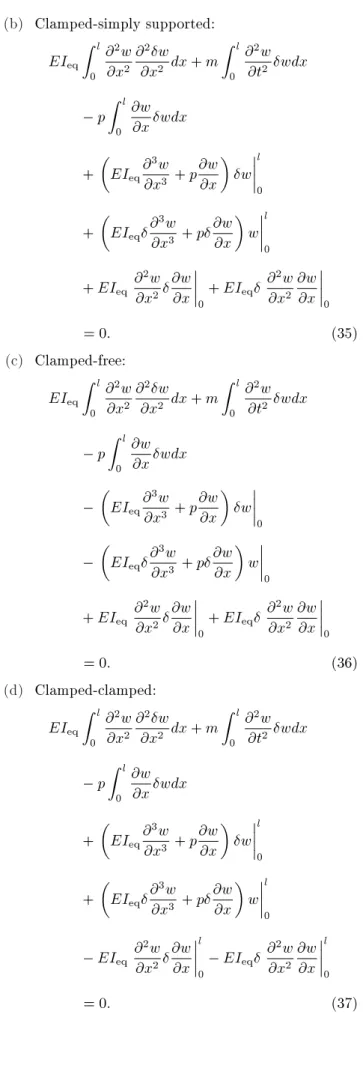
Using Lagrange multipliers to impose boundary conditions on the weak form of Eq. (33) for dierent end supports, under axial compression, leads to the following equations:
(a) Simply-simply supported:
EIeq
Z l
0
@2w
@x2
@2w
@x2 dx + m
Z l
0
@2w
@t2wdx
p Z l 0 @w @xwdx +
EIeq@ 3w
@x3 + p
@w @x w l 0 +
EIeq@ 3w
@x3 + p
@w @x
wl
0= 0: (34)
Figure 3. Beam under axial compression.
(b) Clamped-simply supported: EIeq
Z l
0
@2w
@x2
@2w
@x2 dx + m
Z l
0
@2w
@t2wdx
p Z l 0 @w @xwdx +
EIeq@ 3w
@x3 + p
@w @x w l 0 +
EIeq@ 3w
@x3 + p
@w @x
wl
0
+ EIeq @ 2w @x2 @w @x
0+ EIeq
@2w
@x2 @w @x 0
= 0: (35)
(c) Clamped-free: EIeq
Z l
0
@2w
@x2
@2w
@x2 dx + m
Z l
0
@2w
@t2wdx
p Z l 0 @w @xwdx
EIeq@ 3w
@x3 + p
@w @x w 0 EIeq@
3w
@x3 + p
@w @x
w
0
+ EIeq @ 2w @x2 @w @x
0+ EIeq
@2w
@x2 @w @x 0
= 0: (36)
(d) Clamped-clamped: EIeq
Z l
0
@2w
@x2
@2w
@x2 dx + m
Z l
0
@2w
@t2wdx
p Z l 0 @w @xwdx +
EIeq@ 3w
@x3 + p
@w @x
wl
0
+
EIeq@ 3w
@x3 + p
@w @x w l 0
EIeq @ 2w @x2 @w @x l
0 EIeq
@2w
@x2 @w @x l 0
Considering Eqs. (29)-(31), in a similar manner, sti-ness and mass matrices are obtained. Solving the eigenvalue problem for the buckling of a FGM beam, results in natural frequencies and critical buckling loads.
6. Numerical results
This section is devoted to examples of the free vibration analysis of FGM beams with dierent materials and end supports. The order of the correction polynomial is considered 2 (n in Eq. (17) = 2) and the dilation parameter is considered 3.5 times the specic length of particle I (a = 3:5xI). The number of particles is
assumed to be 100, which are distributed evenly along the beam. This number of particles is selected after performing the convergence test. For the particular problems involved in this paper, 100 particles are enough to give very good results in comparison with theoretical ndings for special cases. As the number of particles goes beyond this number in the actual problem, even though the computational time increases rapidly, no sensible change is achieved. To solve the equations of motion, several MATLAB codes are developed in 1D space and the results are presented in both tabular and graphical forms.
Example 1. Consider an FGM beam made of alu-minum and alumina, as metal and ceramic, respec-tively, with properties varying according to the power-law given by Eq. (13). The bottom surface of the beam is pure alumina, whereas the top surface is pure aluminum. The properties of these materials are given in Table 1. Boundary conditions are assumed to be clamped-free.
Non-dimensional natural frequency maybe de-ned as [18]:
= ! s
12bL4
Ebh2 : (38)
To validate the present formulation for an FGM beam, a comparison is made between the results of RKPM and the analytical method [17] for the clamped-free boundary conditions in Table 2. From Eq. (13), as n ! 1, the beam approaches a homogenous one. For n = 106, non-dimensional natural frequencies
obtained from Eqs. (31) and (38) are compared with the homogenous beam [17]. Results reveal very good
Table 1. Metal and ceramic properties. Properties Unit Aluminum Alumina Elasticity modulus (E) GPa 67 393
Density () kg/m3 2800 3960
agreement, with a maximum dierence of 0.85 percent. To validate the claim that 100 particles are enough to give very good results, the L2-error norm of the rst
four non-dimensional natural frequencies obtained from RKPM, in the case of a homogenous beam, for which exact solutions are available, is presented in Figure 4. It is seen from this gure, as the number of particles goes beyond 100, even though the error decreases slightly, the computational time grows rapidly. Figure 5 shows variations of rst and second non-dimensional natural frequencies versus the power exponent of Eq. (13). It is seen that increasing the power exponent leads to higher frequencies. By increasing the power exponent, properties of the FGM beam approach those of the
Figure 4. L2-error norm of rst four non-dimensional
natural frequencies.
Figure 5. Variation of the rst and second
non-dimensional frequencies with the power-law exponent (n).
Table 2. Non-dimensional natural frequencies for homogenous beam.
Mode number 1 2 3 4
Ref. [17] 3.5160 22.034 61.696 120.903 RKPM with 21 particles 3.5152 22.061 61.973 121.951 RKPM with 51 particles 3.5158 22.033 61.703 120.930 RKPM with 101 particles 3.5159 22.034 61.695 120.901
material at the bottom surface. Since, in this example, the bottom surface is ceramic, the beam gets stier and natural frequencies increase. Table 3 represents rst, second, and third natural frequencies for FGM beams with dierent material distributions. As mentioned before, when the power exponent (n) increases, the beam deviates from pure aluminum to pure alumina, which causes an increase in non-dimensional natural frequencies.
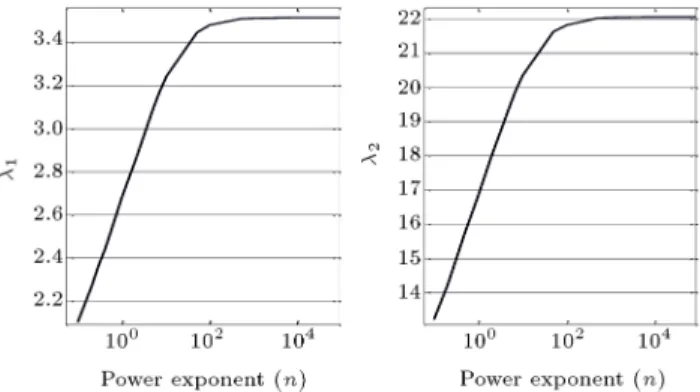
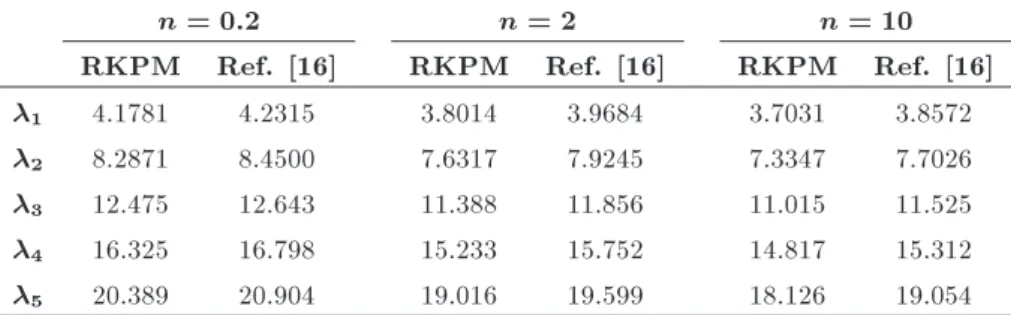
Example 2. Consider an FGM beam made of steel and alumina, as metal and ceramic, with material prop-erties varying continuously in the thickness direction, according to the power law presented by Eq. (13). The bottom surface of the beam is assumed to be pure steel, whereas the top surface is pure alumina. Material properties of steel and alumina are given in Table 4. Considering the formulation used in Ref. [16] for non-dimensional natural frequency, i.e. 2= !p12bL4=Ebh2, using RKPM, non-dimensional
natural frequencies of the simply-simply supported beam are evaluated and represented in Table 5. In this table, the results for non-dimensional natural frequencies of the FGM beam, using the nite element technique [16], are also shown. Comparing the results of RKPM with the ndings of Ref. [16] indicates a very good agreement. Figure 6 shows variations of the rst and second non-dimensional natural frequencies, with respect to the power exponent of Eq. (13). It
Table 3. Non-dimensional natural frequencies of FGM beam.
i n = 0 n = 2 n = 5 n = 10
1 1.785 2.853 3.084 3.24
2 11.031 19.90 19.35 20.33
3 30.99 50.30 54.37 57.11
Table 4. Metal and ceramic properties. Properties Unit Steel Alumina Elasticity modulus (E) GPa 210 393
Density () kg/m3 7800 3960
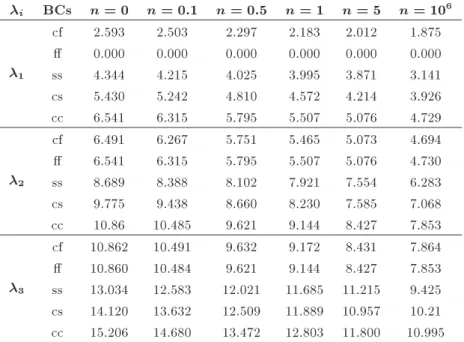
can be seen that, as the power exponent increases, natural frequencies tend to decrease. This is due to a reduction in the beam modulus of elasticity. Figure 7 presents variations of the rst non-dimensional natural frequency of the FGM beam versus the power exponent, at dierent end supports. From this gure, it is clear that clamped-clamped support (cc) leads to the highest frequencies, where the lowest are obtained for clamped-free boundary conditions (cf). The rst three non-dimensional natural frequencies for dierent boundary conditions and power exponents are given in Table 6. It is seen that as the power exponent increases, natural frequencies decrease. This is due to the fact that the structure changes from pure alumina to pure steel.
Figure 6. Variation of the rst and second
non-dimensional frequencies with the power-law exponent (n).
Figure 7. Variation of the rst non-dimensional frequency with the power-law exponent (n) for dierent end supports.
Table 5. The rst ve non-dimensional frequencies for dierent material distribution.
n = 0:2 n = 2 n = 10
RKPM Ref. [16] RKPM Ref. [16] RKPM Ref. [16]
1 4.1781 4.2315 3.8014 3.9684 3.7031 3.8572
2 8.2871 8.4500 7.6317 7.9245 7.3347 7.7026
3 12.475 12.643 11.388 11.856 11.015 11.525
4 16.325 16.798 15.233 15.752 14.817 15.312
Table 6. The rst three non-dimensional frequencies for dierent material distributions and dierent boundary conditions. i BCs n = 0 n = 0:1 n = 0:5 n = 1 n = 5 n = 106
1
cf 2.593 2.503 2.297 2.183 2.012 1.875 0.000 0.000 0.000 0.000 0.000 0.000 ss 4.344 4.215 4.025 3.995 3.871 3.141 cs 5.430 5.242 4.810 4.572 4.214 3.926 cc 6.541 6.315 5.795 5.507 5.076 4.729
2
cf 6.491 6.267 5.751 5.465 5.073 4.694 6.541 6.315 5.795 5.507 5.076 4.730 ss 8.689 8.388 8.102 7.921 7.554 6.283 cs 9.775 9.438 8.660 8.230 7.585 7.068 cc 10.86 10.485 9.621 9.144 8.427 7.853
3
cf 10.862 10.491 9.632 9.172 8.431 7.864 10.860 10.484 9.621 9.144 8.427 7.853 ss 13.034 12.583 12.021 11.685 11.215 9.425 cs 14.120 13.632 12.509 11.889 10.957 10.21 cc 15.206 14.680 13.472 12.803 11.800 10.995 Table 7. Critical buckling loads for a homogeneous simply-simply supported beam.
L = 2 m L = 5 m L = 10 m Analytical Pcr = 2 EIL2
16.1615 MN 2.5858 MN 0.6465 MN
RKPM 16.1754 MN 2.5881 MN 0.6470 MN
7. Example of buckling
This section is devoted to the buckling analysis of an FGM beam under dierent boundary conditions and material distributions. For convenience, the beam of the second example is selected. According to the weak forms of the equation of motion of the beam with dierent boundary conditions (Eqs. (34)-(37)), the higher the compressive load p, the less the elements of stiness matrix, resulting in the reduction of natural frequencies. As p increases, the rst natural frequency tends to zero and buckling takes place. The p value, at which the rst natural frequency becomes zero, is called the critical buckling load [22]. Using RKPM to solve the eigenvalue problem of the FGM beam, buckling loads can be obtained. To validate the present analysis for the buckling of an FGM beam, a comparison is made between results of RKPM and the analytical method [23]. Considering Eq. (13) as n ! 1, the beam approaches a homogenous one, e.g. for n = 106
and critical buckling loads obtained from RKPM are compared with those of the analytical method for a homogenous beam (Table 7). The beam is considered to be made of alumina with simply supported boundary conditions, width of b = 0:2 m, thickness h = 0:1 m, and lengths of 2, 5 and 10 meters. Comparing the results indicates that RKPM can predict the buckling loads with an accuracy of more than 99 percent.
Figure 8. Variation of the rst non-dimensional frequency with the compressive load (p) for dierent material distributions.
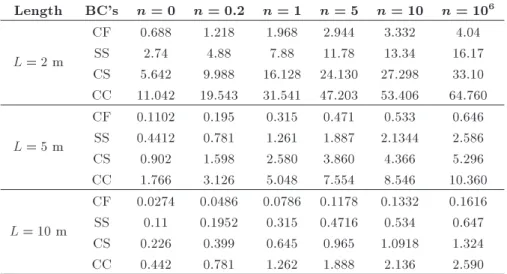
Figure 8 shows variations of the rst non-dimensional natural frequency of a cantilevered FGM beam versus compressive load, for dierent material distributions. From Figure 8, it is seen that, as the power exponent increases, critical buckling load also increases. This is due to higher contribution of a ceramic component in the structure. Table 8 represents critical buckling loads of an FGM beam at dierent beam lengths, material distributions, and boundary conditions, where letters C, F and S stand
Table 8. Critical buckling loads (unit: MN) for FGM beams with dierent material distributions and end supports. Length BC's n = 0 n = 0:2 n = 1 n = 5 n = 10 n = 106
L = 2 m
CF 0.688 1.218 1.968 2.944 3.332 4.04
SS 2.74 4.88 7.88 11.78 13.34 16.17
CS 5.642 9.988 16.128 24.130 27.298 33.10 CC 11.042 19.543 31.541 47.203 53.406 64.760
L = 5 m
CF 0.1102 0.195 0.315 0.471 0.533 0.646 SS 0.4412 0.781 1.261 1.887 2.1344 2.586 CS 0.902 1.598 2.580 3.860 4.366 5.296 CC 1.766 3.126 5.048 7.554 8.546 10.360
L = 10 m
CF 0.0274 0.0486 0.0786 0.1178 0.1332 0.1616 SS 0.11 0.1952 0.315 0.4716 0.534 0.647 CS 0.226 0.399 0.645 0.965 1.0918 1.324 CC 0.442 0.781 1.262 1.888 2.136 2.590
for clamped, simply supported and free boundary conditions.
8. Conclusion
In this paper, free vibration characteristics and buck-ling loads of functionally graded beams are analyzed. A system of equations of motion is derived using Lagrange's equations, under the assumption of the Euler-Bernoulli beam theory. Boundary conditions are taken into account using Lagrange multipliers. It is assumed that the material properties of the beam vary continuously in the thickness direction according to the power-law form. RKPM is applied to solve the eigenvalue equation of FGM beams. Natural frequencies and buckling loads of the FGM beam are evaluated. For the case where n ! 1, results of natural frequencies and buckling loads are in good agreement with analytical ndings. The accuracy of the ndings shows that the RKPM technique is a reliable method for analysis of FGM structures, in which the neutral axis is usually displaced and the density of the components is not homogenous. In this study, the eect of material distribution, compressive load and boundary conditions on the vibration char-acteristics of the beam is discussed. The meshless method of RKPM is shown to be a powerful tool for the vibration analysis and buckling load of beams with non-homogenous material distribution in the thickness direction in which the neutral axis can be displaced drastically.
Nomenclature
A Area of beam cross section a Dilation parameter
b Width of beam cross section
bi(x) Coecients of base functions
bT Transposed vector of coecients of
base function C(x; x y) Correction function
CI(t) Degrees of freedom for test functions
DI(t) Degrees of freedom for trial functions
E(~z) Young's modulus of the beam (EI)eq Equivalent EI
h Height of beam cross section H(x y) Vector of base functions
I Moment of inertia of beam cross section
K Stiness matrix L; l Length of beam
M_ Bending moment of cross section
M Matrix of moments of kernel functions
M Mass matrix
m Mass per unit length of beam mk(x) Moment of kernel function
n Power exponent in Eq. (13), order of correction polynomial in Eq. (17) NP Total number of particles
p Compressive axial load T Kinetic energy of beam U Potential energy of beam u Axial displacement uR(x) Reproduced function
v Lateral displacement w Transverse displacement x Coordinate in axial direction xI Position of Ith particle
z Distance of an arbitrary point from neutral axis of the beam
~z Distance of an arbitrary point from bottom surface of the beam
~zc Position of neutral axis
Variation "xx Normal strain
Non-dimensional natural frequency (~z) Density
xx Normal stress
fig Vector of mode shapes
a Kernel function
a Corrected kernel function
I(x) Shape function of particle I
Domain of integration ! Natural frequency
References
1. Suresh, S. and Mortensen, A., Fundamentals of Func-tionally Graded Materials, Cambridge Publication, London (1998).
2. Zhang, X., Li, W., Hong, C., Han, W. and Han, J. \A novel development of ZrB2/ZrO2 functionally graded ceramics for ultrahigh-temperature application", Int. J. of Scripta Materialia, 59, pp. 1214-1217 (2008).
3. Cetinel, H., Uyulgan, B., Tekmen, C., Ozdemir, I. and Celik, E. \Wear properties of functionally gradient layers on stainless steel substrates for high temperature applications", Int. J. of Surface and Coatings Technol-ogy, 174, pp. 1089-1094 (2003).
4. Gelbstein, Y., Dashevsky, Z., George, Y. and Dariel, M.P. \Development of p-Pb1 xSnxTe functionally graded materials", Int. J. of Physica, 391, pp. 256-265 (2007).
5. Fujihara, K., Gopal, R., Loh, P.L., Ganesh, V.K., Ra-makrisshna, S., Foong, K.W. and Chew, C.L. \Fibrous composite materials in dentistry and orthopaedics: review and applications", Int. J. of Composites Science and Technology, 64, pp. 775-788 (2004).
6. Watari, F., Yokoyama, A., Omori, M., Hirai, T., Kondo, H., Uo, M. and Kawasaki, T. \Biocompat-ibility of materials and development to functionally graded implant for bio-medical application", Int. J. of Composites Science and Technology, 64, pp. 893-908 (2004).
7. Erisken, C., Kaylon, D.M. and Wang, H. \Functionally graded electrospun polycaprolactone and b-tricalcium phosphate nanocomposites for tissue engineering ap-plications", Int. J. of Biomaterials, 29, pp. 4065-4073 (2008).
8. Muller, E., Drasar, C., Schilz, J. and Kaysser, W.A. \Functionally graded materials for sensor and energy applications", Int. J. of Materials Science and Engi-neering, 362, pp. 17-39 (2003).
9. Bever, M.B. and Duwez, P.E. \Gradients in Com-posites Materials", Int. J. of Materials Science and Engineering, 10, pp. 1-8 (1972).
10. Chakraborty, A., Gopalakrishnan, S. and Reddy, J.N. \A new beam nite element for the analysis of func-tionally graded materials", Int. J. of Mech. Sci., 45, pp. 519-539 (2003).
11. Xiang, H.J. and Yang, J. \Free and forced vibration of a laminated FGM Timoshenko beam of variable thick-ness under heat conduction", Int. J. of Composites Part B: Engineering, 39, pp. 292-303 (2008).
12. Aydogdu, M. \Semi-inverse method for vibration and buckling of axially functionally graded beams", Int. J. of Reinforced Plastics and Composites, 27, pp. 683-691 (2008).
13. Simsek, M. and Kocaturk, T. \Free and forced vi-bration of a functionally graded beam subjected to a concentrated moving harmonic load", Int. J. of Composite Structures, 90, pp. 465-473 (2009).
14. Sina, S.A., Navazi, H.M. and Haddadpou, H. \An analytical method for free vibration analysis of func-tionally graded beams", Int. J. of Mater. & Des., 30, pp. 741-747 (2009).
15. Simsek, M. \Vibration analysis of a functionally graded beam under a moving mass by using dierent beam theories", Int. J. of Composite Structures, 92, pp. 904-917 (2010).
16. Alshorbagy, A.E., Eltaher, M.A. and Mahmoud, F.F. \Free vibration characteristics of a functionally graded beam by nite element method", Int. J. of Applied Mathematical Modeling, 35, pp. 412-425 (2011).
17. Rao Singiresu, S., Vibration of Continuous Sys-tems, John Wiley & Sons Inc, New Jersey, Hoboken (2007).
18. Rahaeifard, M., Moeini, S.A., Kahrobaiyan, M.H. and Ahmadian, M.T. \Vibration analysis of a ro-tating FGM cantilever arm", Proceedings of the ASME 2009 International Mechanical Engineering Congress & Exposition, IMECE-11062, Florida, USA (2009).
19. Lui, W.K., Chen, Y., Jun, S., Chen, S., Belytschko, T., Pan, C., Uras, R.A. and Chang, C.T. \Overview and application of the reproducing kernel particle methods", Int. J. of Computational Methods in Engineering, 3, pp. 3-80 (1996).
20. Zhou, J.X., Zhang, H.Y. and Zhang, L. \Reproducing kernel particle method for free and forced vibration analysis", Int. J. of Sound and Vibration, 279, pp. 389-402 (2005).
21. Lu, Y.Y., Belytschko, T. and Gu, L. \A new
implementation of the element free Galerkin method", Int. J. of Comput. Methods Appl. Mech. Engrg., 113, pp. 397-414 (1994).
22. Rao Singiresu, S., Mechanical Vibrations, Pearson Education, Inc., 5th Edition, Chapter 8, pp. 733-734, Prentice Hall, New Jersey, USA (2011).
23. Timoshenko, S. and Young, D.H., Vibration Problems in Engineering, Van Nostrand Company, New York, USA (1955).
Biographies
Reza Saljooghi received his BS degree in Mechanical Engineering, in 2008, from Iran University of Science and Technology, Tehran, Iran, and his MS degree in Mechanical Engineering, Applied Design, at Sharif University of Technology, Tehran, Iran, in 2011. He is now junior lecturer at Hormozgan University, Iran, and his research interests include active vibration control of FGMs and smart structures, hybrid vehicles' dynamics and vibration, active and semi active suspension sys-tems and MEMS/NEMS.
Mohammad Taghi Ahmadian received his BS and MS degrees in Physics, in 1970 and 1972, respectively, from Shiraz University, Shiraz, Iran. He also received
his MS degree, in Mechanical Engineering, in 1980, from the University of Kansas in Lawrence, USA, where he also completed PhD degrees in Physics and Mechan-ical Engineering, in 1980 and 1986, respectively. He is currently Professor in the School of Mechanical En-gineering at Sharif University of Technology, Tehran, Iran, and Head of the Bio-Engineering Center. His research interests include micro and nano mechanics, and bioengineering.
Gholam Hossein Farrahi received his PhD degree in Mechanical Engineering, in 1985, from (ENSAM), Paris, France. He is currently Professor in the School of Mechanical Engineering at Sharif University of Technology, Tehran, Iran. He is also Head of the Applied Design Group and the Materials Life Estima-tion and Improvement Laboratory. His research inter-ests include fatigue, fracture mechanics, shot peening, residual stresses, life improvement methods and failure analysis.