SYSTEMATIC MAP PROTOCOL
What are the impacts of within-field
farmland management practices on the flux
of greenhouse gases from arable cropland
in temperate regions? A systematic map
protocol
Alexandra M. Collins
1*, Neal R. Haddaway
2,3, Biljana Macura
2, James Thomas
4, Nicola Randall
5,
Jessica J. Taylor
6, Steve Cooke
6and Alyssa Gilbert
7Abstract
Background: Reducing greenhouse gas emissions is a vital step in limiting climate change and meeting the goals outlined in the COP 21 Paris Agreement of 2015. Studies have suggested that agriculture accounts for around 11% of total greenhouse gas emissions and the industry has a significant role in meeting international and national climate change reduction objectives. However, there is currently little consensus on the mechanisms that regulate the pro-duction and assimilation of greenhouse gases in arable land and the practical factors that affect the process. Practical advice for farmers is often overly general, and models based on the amount of nitrogen fertiliser applied, for example, are used despite a lack of knowledge of how local conditions affect the process, such as the importance of humus content and soil types. Here, we propose a systematic map of the evidence relating to the impact on greenhouse gas flux from the agricultural management of arable land in temperate regions.
Methods: Using established methods for systematic mapping in environmental sciences we will search for, collate and catalogue research studies relating to the impacts of farming in temperate systems on greenhouse gas emissions. We will search 6 bibliographic databases using a tested search string, and will hand search a web-based search engine and a list of organisational web sites. Furthermore, evidence will be sought from key stakeholders. Search results will then be screened for relevance at title, abstract and full text levels according to a predefined set of eligibility criteria. Consistency checking will be employed to ensure the criteria are being applied accurately and consistently. Relevant studies will then be subjected to coding and meta-data extraction, which will be used to populate a systematic map database describing each relevant study’s settings, methods and measured outcomes. The mapping process will help to identify knowledge gaps (subjects lacking in evidence warranting further primary research) and knowledge clus-ters (subjects with sufficient studies to allow a useful full systematic review), and will highlight best and suboptimal research methods.
Keywords: Methane, nitrous oxide, Climate change, Global warming, Climate, Carbon, COP, Climate targets, Farming, Sustainable farming
© The Author(s) 2019. This article is distributed under the terms of the Creative Commons Attribution 4.0 International License (http://creat iveco mmons .org/licen ses/by/4.0/), which permits unrestricted use, distribution, and reproduction in any medium, provided you give appropriate credit to the original author(s) and the source, provide a link to the Creative Commons license, and indicate if changes were made. The Creative Commons Public Domain Dedication waiver (http://creativecommons.org/ publicdomain/zero/1.0/) applies to the data made available in this article, unless otherwise stated.
Open Access
*Correspondence: [email protected]
Background
Reducing greenhouse gas emissions is a vital step in attempting to reduce climate change and meet the goals outlined in the Paris Agreement resulting from the COP21 in 2015 (http://unfcc c.int/paris _agree ment/ items /9485.php). Studies have suggested that agricul-ture accounts for around 11% of total greenhouse gas emissions [1] and the industry has a significant role in meeting international and national climate change reduction objectives (e.g. England and Wales’s National Union of Farmers’ goal of reaching net zero greenhouse gas emissions across the agriculture sector by 2040 [2] and targets set for the agricultural sector in The Scot-tish Government’s Climate Change Plan [3]).
The atmospheric flux of greenhouse gases, includ-ing the production of carbon dioxide (CO2), methane
(CH4) and nitrous oxide (N2O), is governed by the
activity and turnover of microbial communities in the soil [4, 5], which is strongly regulated to changes in soil physical conditions, organic matter status and nutri-ent availability resulting from agricultural manage-ment [6, 7]. For example the prevailing driver of N2O
production, which has a global warming potential 298 times larger than CO2 over a 100 year period [8], is the
conversion of nitrogen applied as fertilisers to nitrate through processes such as nitrification and denitrifica-tion [5] and into the atmosphere as the greenhouse gas N2O. CH4 can only be produced under anaerobic
con-ditions by bacteria (methanogens) but is also consumed by other bacterial groups (methanotrophs) when oxy-gen is available, acting as a sink for the CH4 produced
in the soil [9]. Production of CH4 in agricultural fields
is usually connected to high soil organic carbon lev-els, and organic soils that are sometimes water-logged are considered as the main sources of CH4 from
agri-cultural soils [10]. Soil management by farmers there-fore plays a central role in defining the conditions for the soil bacteria and thus the production of greenhouse gases from soils.
Despite this, there is currently little consensus on the conditions and mechanisms that regulate the produc-tion and assimilaproduc-tion of greenhouse gases in arable land and the practical factors that affect the process. There is a broad diversity of land management options avail-able to farmers (e.g. intensive tillage using mouldboard plough versus direct drilling or conservation tillage) and the impacts of these different options on greenhouse gas emissions is not well known. Practical advice for farmers is therefore often overly general, and models based on the amount of nitrogen fertiliser applied, for example, are used despite a lack of knowledge of how local conditions affect the process, such as the importance of drainage, humus content and soil types.
Here, we propose a systematic map of the evidence relating to the impact of agricultural management of arable land in temperate regions on greenhouse gas flux, including both mineral and organic soils.
Stakeholder engagement
The topic of this systematic map was identified as a pri-ority by academics and discussed with stakeholders including; the UK’s Department of Environment Food and Rural Affairs (Defra), Environment Agency, Natural Resources Wales, The Scottish Government, The Welsh Government, Centre for Hydrology and Ecology (CEH), The Technical Support Unit of Working Group III of the Intergovernmental Panel on Climate Change (IPCC), he National Farmers Union (NFU), World Wildlife Fund (WWF) and the UK’s Natural Environment Research Council (NERC) who are also funding the work under their Environmental Evidence for the Future programme.
Stakeholders have provided input to this protocol by helping to review and refine the map’s question. Stake-holders will be asked to identify potentially relevant lit-erature, which will then be subject to the full screening process outlined below. Stakeholders will also be asked to comment on the coding strategy so that the information that is of most relevance to them is included in the map.
Objective of the map
The effects of agricultural management on greenhouse gases have previously been reviewed [11], but as yet there is no consensus as to how context (i.e. climate, fertiliser type and quantity, soil drainage, soil texture, and organic matter content) affects greenhouse gas fluxes. There is therefore a need for a systematic map the impact of arable farming practices on greenhouse gas emissions to examine the influence of these sources of heterogeneity across soil types and farming systems..
This systematic map will aim to catalogue and describe the evidence relating to the impacts of agricultural man-agement activities on greenhouse gas fluxes. Wherever possible, evidence relating to the impact of other vari-ables on greenhouse gas fluxes will be catalogued within studies, such as climate, fertiliser type and quantity, soil drainage, soil texture, and organic matter content. This review will allow the identification of knowledge gaps and knowledge clusters to be identified that can be researched further with novel primary research and full systematic reviews, respectively.
The primary question for this systematic map is as follows:
regions?
These questions can be broken down into the following key elements:
Population: Arable farmland in temperate regions.
Intervention: All within-field farmland management practices applied to arable cropland.
Comparator: Without management, with different management, before management, with different intensities of management.
Outcome: Fluxes of greenhouse gases (methane, nitrous oxide, carbon dioxide).
Study type: Replicated observational and manipula-tive studies.
Methods
The review will follow the Collaboration for Environ-mental Evidence Guidelines and Standards for Evidence Synthesis in Environmental Management [12] and it con-forms to ROSES reporting standards [13] (see Additional file 1).
Searching for articles
Searching for articles will involve attempts to source both traditional academic literature and grey literature.
Seven bibliographic databases will be searched to find academic literature, including: AGRIS Agricultural database (FAO), Directory of Open Access Journals, PubMed, Scopus, EThOS, ProQuest Dissertations and Theses Global, and Web of Science Core Collections. These databases will be searched using the following Eng-lish language Boolean search string (presented in Web of Science format):
TS = ((arable OR agricult* OR farm* OR crop* OR
cultivat* OR field*) AND (plough* OR plow* OR till* OR “direct drill*” OR fertili* OR biosolid* OR “bio solid” OR organic OR manur* OR sewage OR com-post* OR amendment* OR biochar* OR digestate* OR “crop residue*” OR “crop straw*” OR mulch* OR “crop rotat*” OR “break crop*” OR “grass ley” OR “clover ley” OR legume* OR “bioenergy crop*” OR “cover crop*” OR “grass clover” OR “cropping system*” OR “crop system” OR “winter crop*” OR “spring crop*” OR “summer fallow*” OR “catch crop*” OR intercrop* OR conservation) AND (CH4 OR methane OR CO2 OR “carbon dioxide” OR N2O OR “nitrous oxide” OR GHG* OR “greenhouse gas*” OR “green-house gas*”) AND (flux* OR dynamic* OR emission* OR exchang* OR balanc*))
Searches will be performed using the subscriptions of Carleton University and conducted in English. Non-Eng-lish articles search results will be recorded, (see “Article screening and study eligibility criteria” section).
The search string proposed has been built based on experience from a systematic review evaluating the effects of agricultural management on greenhouse gas emissions in lowland peatland systems [11] and a system-atic map investigating the effects of agricultural manage-ment on soil organic carbon [14]. Due to overlaps in the intervention and outcome elements of these question experience on the most appropriate search terms was shared by authors who spanned the different reviews, i.e. the outcomes terms optimised during the development of Haddaway et al. [11] were used.
The search string will be tested for sensitivity by com-paring a benchmark list of 25 articles known (see Addi-tional file 2) to be relevant to the review team and the advisory group. Where articles are not identified in two test databases (Web of Science and Scopus) the reasons for missed items will be examined and the search string adapted accordingly. Any adaptation that may be neces-sary will be clearly recorded in the final systematic map report.
Attempts to identify grey literature will include searches of Google Scholar which has been demon-strated to be effective in identifying traditional academic and grey literature together [15]. Two simplified search strings consisting of arable or agriculture, and outcome words related to greenhouse gases will be used, and the resulting references will be sorted by relevance. The first 250 results from each search string will be exported into Excel and duplicates will be removed. Each reference will be examined and screened for appropriateness. Cus-tomized search strings used in search engines will be recorded in an appendix. All resulting relevant articles will be included in the article database.
Additionally, the websites of key organisations will be searched for relevant studies by using built-in search facilities and by searching the sites ‘by hand’ (i.e. focus-ing on any ‘Publications’ pages and examinfocus-ing site maps where available). These websites will include:
• British Society for Soil Science. • Centre for Ecology and Hydrology.
• Department of Agriculture, Environment and Rural Affairs, Northern Ireland.
• European Environment Agency.
• Environment Protection Agency Ireland. • European Commission Joint Research Centre. • Gov.UK.
• Natural Resources Wales. • Project Drawdown. • Rothamsted Repository.
• Scottish Environment Protection Agency. • Scottish Government.
• SNIFFER.
Finally, a public call for relevant studies and sources of studies that may not be readily identified will be made via the expert advisors’ and stakeholders’ networks and social media (e.g. Twitter and Research Gate).
After the search results have been collated, duplicates will be removed using a combination of reference agement software (EndNote) and systematic review man-agement software (EPPI-Reviewer 4) [16]. The review will be managed within EPPI-Reviewer 4.
Article screening and study eligibility criteria Screening process
The final set of deduplicated search results will then be subjected to screening in a two-stage approach, assessing title and abstracts and finally full text documents; includ-ing only those articles that are eligible in the subsequent stage. At each stage the number of excluded results will be documented, and the reasons for excluding articles at abstract and full text will also be recorded in an addi-tional file published alongside the final map report.
Before screening is performed in full, eligibility will be assessed at each stage by two reviewers on a random subset of 10% of articles, and the level of agreement (con-sistency) will be tested by calculating a Kappa statistic [17]. All disagreements will be discussed in detail and inclusion criteria definitions improved where necessary. Where the level of agreement results in a Kappa statistic below 0.6 the consistency checking will be repeated until a ‘moderate’ agreement is achieved.
In order to retrieve full text documents the review team will have access to the libraries and subscriptions of the organisations participating in the review team and advi-sory group. Where articles cannot be sourced due to a lack of subscription, inter-library loans will be requested and/or authors will be contacted directly with requests for digital offprints. Unobtainable articles will be listed in an appendix to the final review report.
Reviewers who have authored articles considered in this review will not pass decisions regarding screening or study validity assessment of their own work.
Eligibility criteria
At each stage, eligibility will be assessed according to the subject scope and methods in each primary research arti-cle. For the purposes of clarity, we break this down into the following eligibility criteria:
Eligible subject(s): Arable farmland in temper-ate climtemper-ates defined as fully humid and summer dry, i.e., Cfa, Cfb, Cfc, Csa, Csb, Cs in Köppen–Geiger classifica-tion [17]. Peatlands will be included only when being used for agricultural pur-poses. Crops that are primar-ily found in tropical regions (e.g., rice, sugarcane, bananas) will be excluded as these were considered as not relevant to the stakeholders. Grasslands, pastures and forests, will be excluded.
Eligible intervention(s): Any farmland management practice applied to the crop or the soil, and that could be applied to entire fields. This would include, for exam-ple: fertilisation; addition of amendments (e.g. lime); dif-ferent crop rotations; soil till-age. Practices such as buffer strips that are not feasible as whole-field interventions are excluded. Comparisons of dif-ferent starting soil types/tents (e.g. phosphorus con-centration, moisture content) will be excluded if no actual intervention is present in the study. Land use change stud-ies will be excluded, i.e. where land is changed from arable to another type of use e.g. from arable to urban development. Eligible comparator(s): Different levels of a
Eligible outcomes: Fluxes of greenhouse gases (CO2, CH4, N2O).
Eligible study designs: Any observational or manip-ulative experimental study. Modelling studies, green-house or laboratory studies and ex situ experiments will not be included.
Eligible languages: Attempts to include arti-cles in a range of languages in addition to English will be made. These are likely to include French, Danish, Ger-man, Norwegian and Swed-ish. Articles judged as eligible but in other languages will be listed in an additional file published alongside the final review report.
Study validity assessment
Formal study validity assessment will not be conducted as part of this SM in line with standard guidance for sys-tematic maps [18]. Rather, we will record a selection of meta-data and coding variables that affect study valid-ity (e.g. sample size). No critical appraisal of these data will be undertaken, but sufficient information will be extracted to allow full critical appraisal in any subsequent systematic review(s) conducted on the map outputs. This information will include:
• Study design type. • Length of study.
• Replication and randomisation details. • Clarity and detail of methods.
Data coding strategy
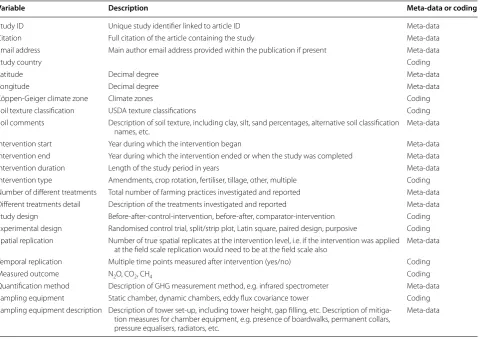
Following full text screening, a database of all relevant studies will be produced, which will describe the articles from which the studies are taken along with information about the study setting, experimental design, and meas-urement methods used (see Table 1 for the proposed
Table 1 Proposed coding and meta-data extraction schema
Variable Description Meta-data or coding
Study ID Unique study identifier linked to article ID Meta-data Citation Full citation of the article containing the study Meta-data Email address Main author email address provided within the publication if present Meta-data
Study country Coding
Latitude Decimal degree Meta-data
Longitude Decimal degree Meta-data
Köppen-Geiger climate zone Climate zones Coding Soil texture classification USDA texture classifications Coding Soil comments Description of soil texture, including clay, silt, sand percentages, alternative soil classification
names, etc. Meta-data
Intervention start Year during which the intervention began Meta-data Intervention end Year during which the intervention ended or when the study was completed Meta-data Intervention duration Length of the study period in years Meta-data Intervention type Amendments, crop rotation, fertiliser, tillage, other, multiple Coding Number of different treatments Total number of farming practices investigated and reported Meta-data Different treatments detail Description of the treatments investigated and reported Meta-data Study design Before-after-control-intervention, before-after, comparator-intervention Coding Experimental design Randomised control trial, split/strip plot, Latin square, paired design, purposive Coding Spatial replication Number of true spatial replicates at the intervention level, i.e. if the intervention was applied
at the field scale replication would need to be at the field scale also Meta-data Temporal replication Multiple time points measured after intervention (yes/no) Coding Measured outcome N2O, CO2, CH4 Coding
Quantification method Description of GHG measurement method, e.g. infrared spectrometer Meta-data Sampling equipment Static chamber, dynamic chambers, eddy flux covariance tower Coding Sampling equipment description Description of tower set-up, including tower height, gap filling, etc. Description of
mitiga-tion measures for chamber equipment, e.g. presence of boardwalks, permanent collars, pressure equalisers, radiators, etc.
coding strategy). Information regarding possible sources of heterogeneity will be extracted (in the form of meta-data and coding) from across the eligible articles. Such variables will include: climate zone; fertiliser type; fer-tiliser quantity; presence of soil drainage; soil texture classification; soil physical characteristics; crop type; above-ground biomass; concurrent land management; land management history; and organic matter content.
Study mapping and presentation
A final SM report will be submitted to the Open Access journal Environmental Evidence. The report will describe the evidence base using text, figures and tables, summarising the quantity of evidence found within major categories and major management prac-tice groups (e.g. organic versus conventional), fertiliser regimes (e.g. organic, mineral, other amendments), and soil texture classifications. A narrative synthesis in the final review report will combine this with additional details documenting all activities involved in the crea-tion of the map in appendices to the report. The report will conclude with a section on the implications of the findings for research and policy.
Knowledge gap and cluster identification strategy
A series of heat maps (cross tabulations of key descrip-tors, e.g. interventions and outcomes, interventions and populations/settings) will be produced. These will be compared with one another and the differences between groupings to systematically identify knowl-edge clusters (subtopics that are well-represented by research studies) and knowledge gaps (subtopics that are comparatively under-represented by research stud-ies). This will be performed by visual inspection by a methodology expert of the review team (i.e. not a sub-ject expert to avoid preconception bias). Additionally, we will aim to present the results using the EviAtlas tool [19], which will allow studies to be presented via location of the study and make use of dropdown filters so that studies relating to different soil types, interven-tions and GHG emissions can be easily identified.
Supplementary information
Supplementary information accompanies this paper at https ://doi. org/10.1186/s1375 0-019-0182-2.
Additional file 1. ROSES form for systematic map protocols.
Additional file 2. A List of benchmark articles.
Acknowledgements
This protocol has been developed from a Mistra EviEM systematic mapping project (http://eviem .se/en/proje cts/soil-organ ic-carbo n-stock s/) and we
thank the review team involved in that project for their excellent basis from which we were able to work.
Authors’ contributions
NRH produced a first draft of this manuscript, heavily revised by AMC, edited, and commented on by all authors. All authors read and approved the final manuscript.
Funding
This work is funded by the UK Natural Environment Research Council (Grant Reference NE/S015949/1)
Availability of data and materials
Not applicable.
Ethics approval and consent to participate
Not applicable.
Consent for publication
Not applicable.
Competing interests
The authors declare that they have no competing interests.
Author details
1 Centre for Environmental Policy, Imperial College London, 109 Weeks Build-ing, 16-18 Prince’s Gardens, South Kensington, London SW7 1NE, UK. 2 Stock-holm Environment Institute, Linnégatan 87D, StockStock-holm, Sweden. 3 Africa Centre for Evidence, University of Johannesburg, Johannesburg, South Africa. 4 EPPI-Centre, Social Science Research Unit, UCL Institute of Education, Uni-versity College London, 18 Woburn Square, London WC1H 0NR, UK. 5 Centre for Evidence Based Agriculture, Harper Adams University, Newport TF10 8NB, Shropshire, UK. 6 Canadian Centre for Evidence-Based Conservation and Envi-ronmental Management, Carleton University, 1125 Colonel By Drive, Ottawa, ON K1S 5B6, Canada. 7 Grantham Institute-Climate Change and the Environ-ment, Imperial College London, Exhibition Road, London SW7 2AZ, UK.
Received: 5 August 2019 Accepted: 18 November 2019
References
1. Tubiello FN, Salvatore M, Ferrara AF, House J, Federici S, Rossi S, et al. The contribution of agriculture, forestry and other land use activities to global warming, 1990–2012. Glob Change Biol. 2015;21(7):2655–60.
2. National Union of Farmers (NFU). (2019). Achieving net zero Farming’s 2040 goal. https ://www.nfuon line.com/nfu-onlin e/busin ess/regul ation / achie ving-net-zero-farmi ngs-2040-goal/. Accessed 17 Sept 2019. 3. The Scottish Government. 2018. Climate change plan The Third Report
on Proposals and Policies 2018–2032.
4. Ronn R, Griffiths BS, Ekelund F, Christensen S. Spatial distribution and suc-cessional pattern of microbial activity and micro-faunal populations on decomposing barley roots. J Appl Ecol. 1996;33:662–72.
5. Christensen S, Bjørnlund L, Vestergård M. Decomposer biomass in the rhizosphere to assess rhizodeposition. Oikos. 2007;116(1):65–74. 6. Christensen S, Degórska A, Priemé A. Combined assessment of methane
oxidation and nitrification: an indicator of air-borne soil pollution? Biol Fertil Soils. 2001;34(5):325–33.
7. Bardgett R. The biology of soil: a community and ecosystem approach. Oxford: Oxford University Press; 2005.
8. Myhre G, Shindell D, Bréon F-M, Collins W, Fuglestvedt J, Huang J, Koch D, Lamarque J-F, Lee D, Nakajima BMT, Robock A, Stephens G. Anthropo-genic and natural radiative forcing. In: Stocker SKA, Qin D, Plattner G-K, Tignor M, Boschung PMMJ, Nauels A, Xia Y, editors. Climate change 2013: The physical science basis. Contribution of working group I to the fifth assessment report of the intergovernmental panel on climate change. Cambridge and New York: Cambridge University Press; 2013.
•fast, convenient online submission •
thorough peer review by experienced researchers in your field • rapid publication on acceptance
• support for research data, including large and complex data types •
gold Open Access which fosters wider collaboration and increased citations maximum visibility for your research: over 100M website views per year •
At BMC, research is always in progress.
Learn more biomedcentral.com/submissions
Ready to submit your research? Choose BMC and benefit from: 10. Kasimir Klemedtsson Å, Weslien P, Klemedtsson L. Methane and
nitrous oxide fluxes from a farmed Swedish Histosol. Eur J Soil Sci. 2009;60(3):321–31.
11. Haddaway NR, Burden A, Evans CD, Healey JR, Jones DL, Dalrymple SE, et al. Evaluating effects of land management on greenhouse gas fluxes and carbon balances in boreo-temperate lowland peatland systems. Environ Evid. 2014;3(1):1.
12. Collaboration for Environmental Evidence. Guidelines and standards for evidence synthesis in environmental management. Version 5.0. In: Pullin A, Frampton G, Livoreil B, Petrokofsky G, editors. 2018. http://www.envir onmen talev idenc e.org/infor matio n-for-autho rs. Accessed 03 Jan 2019. 13. Haddaway NR, Macura B, Whaley P, and Pullin AS. 2017. ROSES for
System-atic Map Protocols. Version 1.0. https ://doi.org/10.6084/m9.figsh are.58972 84.
14. Haddaway NR, Hedlund K, Jackson LE, Kätterer T, Lugato E, Thomsen IK, Jørgensen HB, Söderström B. What are the effects of agricultural manage-ment on soil organic carbon in boreo-temperate systems? Environ Evid. 2015;4(1):23. https ://doi.org/10.1186/s1375 0-015-0049-0.
15. Haddaway NR, Collins AM, Coughlin D, Kirk S. The role of Google Scholar in evidence reviews and its applicability to grey literature searching. PLoS ONE. 2015;10(9):e0138237.
16. Thomas J, Brunton J, Graziosi S. EPPI-Reviewer 4.0: software for research synthesis EPPI-Centre Software. London: Social Science Research Unit. Institute of education, University of London; 2010.
17. Cohen J. Weighted kappa: nominal scale agreement provision for scaled disagreement or partial credit. Psychol Bull. 1968;70(4):213.
18. Kottek M, Grieser J, Beck C, Rudolf B, Rubel F. World map of the Köppen– Geiger climate classification updated. Meteorol Z. 2006;15(3):259–63. 19. Haddaway NR, Feierman A, Grainger MJ, Gray CT, Tanriver-Ayder E,
Dhaubanjar S, Westgate MJ. EviAtlas: a tool for visualising evidence synthesis databases. Environ Evid. 2019;8(1):22. https ://doi.org/10.1186/ s1375 0-019-0167-1.
Publisher’s Note