A dissertation submitted to the faculty at the University of North Carolina at Chapel
Hill in partial fulfillment of the requirements for the degree of Doctor of Public
Health in the Department of Health Policy and Management in the Gillings School of
Global Public Health.
Chapel Hill
2014
Approved by:
Suzanne Hobbs
Sandra Greene
Bryan Weiner
John E. Paul
Marcia Herman-Giddens
OPPORTUNITIES AND BARRIERS IN THE CONTROL AND PREVENTION OF LYME
DISEASE: IMPLICATIONS FOR PRACTICE
ii
ABSTRACTPhilip W. Downs: OPPORTUNIITES AND BARRIERS IN THE CONTROL AND PREVENTION OF LYME DISEASE:
IMPLICATIONS FOR PRACTICE
(Under the direction of Suzanne Hobbs)
Lyme disease is currently the most infectious disease in North America with 300,000 people estimated to be diagnosed with this tick-borne infection per year. While various tick control and Lyme disease prevention practices are documented in the literature review, and comprehensively reflected in an integrated pest management (IPM) strategy, translational studies suggest that very few practices are implemented on a routine basis to influence disease transmission. Public and private sector stakeholders are increasingly playing an important role in tick control and educating populations about personal protective measures.
To understand the influence of the public and private sector on the frequency and coverage of Lyme disease control and prevention practices in Maryland during 2009-2014, interviews were conducted with key informants from the federal, state, and non-profit sector. In addition, public and private sector stakeholders from counties with a high incidence of Lyme disease (greater than 50 cases per 100,000 during 2008-2012) participated in an online survey to describe their role in tick control and Lyme disease activities. Results of these interviews provided context to understanding current control and prevention efforts, including the role of the state and county in the implementation of IPM.
Results showed significant contributions by the public and private sector in
iii
strategies and to create a more comprehensive and inclusive structure for managing IPM, an adaptive resource management (ARM) strategy is recommended.
iv
v
ACKNOWLEDGEMENTS
This work would not have been possible without the encouragement and support of family, friends, colleagues, and classmates. Special gratitude goes to my wife Jillian and daughters Ava and Louise who were constant companions and supporters throughout this process. In experiencing Lyme disease myself, and watching several family members suffer as well, I am constantly reminded that more needs to be done to prevent this debilitating disease.
The guidance provided to me by my key informants was invaluable. Their personal contribution in the control and prevention of Lyme disease and dedication in serving the needs of communities remains an inspiration to me. I’m equally indebted to the various public and private stakeholders who participated in the study and offered their perspectives on tick control and Lyme disease prevention, even when they felt their organizations played a limited role.
I sincerely thank each of my committee members for their time and suggestions in formulating an approach to this study. I am especially honored to have Dr. Suzanne Hobbs as my dissertation committee chair; when my ideas were broadening in scope and becoming overwhelming, you always provided the needed prospective in how to break the problem down into manageable parts.
vi
TABLE OF CONTENTS
LIST OF TABLES ...x
LIST OF FIGURES ... xi
LIST OF ACRONYMS ... xii
CHAPTER 1: INTRODUCTION ... 1
Statement of the Issue ... 1
Background ... 5
Lyme disease in North America. ... 5
Transmission of Lyme disease ... 5
Lyme disease surveillance and reporting ... 7
The role of federal and state health agencies ... 11
Tick-control and Lyme disease prevention ... 12
Lyme disease in Maryland ... 17
Importance and Rational ... 18
CHAPTER 2: LITERATURE REVIEW ... 20
Search Terms and Criteria ... 20
Process for reviewing articles ... 21
Literature Review Findings ... 21
vii
Personal protection measures ... 22
Prophylactic treatment ... 23
Area-wide acaricides ... 24
Host-targeted approaches ... 25
Landscape and Vegetation management ... 26
Wildlife management ... 27
Host vaccination ... 27
Host treatment ... 28
Discussion ... 28
Gaps in Knowledge ... 30
CHAPTER 3: METHODS ... 31
Conceptual Framework ... 31
Study design ... 32
Study Population ... 34
Data Collection and Management ... 36
Key Informant Interviews ... 36
Public/Private Sector Surveys ... 37
Data Analysis... 38
Limitations ... 39
CHAPTER 4: FINDINGS ... 41
Key Informant Interviews ... 41
viii
Tick control and Lyme disease prevention strategies ... 43
Coordination of tick control and Lyme disease prevention ... 49
Key public and private stakeholders ... 51
Public Private Sector Survey ... 52
Which public and private organizations implemented tick-control and Lyme disease prevention practices? ... 52
Which control and prevention strategies were most often used and which were underutilized? ... 56
What were the geographic and temporal coverage of tick-control and Lyme disease prevention practices by county? ... 61
CHAPTER 5: DISCUSION AND CONCLUSIONS ... 68
How did the public and private sector influence the frequency and coverage of Lyme disease control and prevention practices in Maryland during 2009-2014? ... 68
The role of the public and private sector ... 68
Tick control and Lyme disease prevention activities ... 71
CHAPTER 6: PLAN FOR CHANGE ... 74
Leadership Implications ... 75
Emerging strategies for IPM ... 76
Recommendation 1: Formation of county level Tick Borne Disease Committees (TBDC) as sponsors of IPM change initiatives. ... 77
Recommendation 2: Facilitation of stakeholder engagement and communication plan workshops. ... 78
Recommendation 3: Adoption of a behavior change communication (BCC) framework into personal protective measures for TBDs ... 80
ix
Immediate Action Steps ... 84
Appendix A - Summary of Major Field-Based Tick-Control Activities conducted between 2004-2012 (Feb) ... 86
Appendix B: Key Informant Interview Guide ... 91
Appendix C: Public/Private Sector Survey ... 93
x
LIST OF TABLES
Table 1: Lyme disease case classification for surveillance ... 9 Table 2: Summary of tick control and Lyme disease prevention methods ... 16 Table 3: PubMEd and BIOSIS Previews ... 20 Table 4: Incidence of Lyme disease by year in counties reporting on
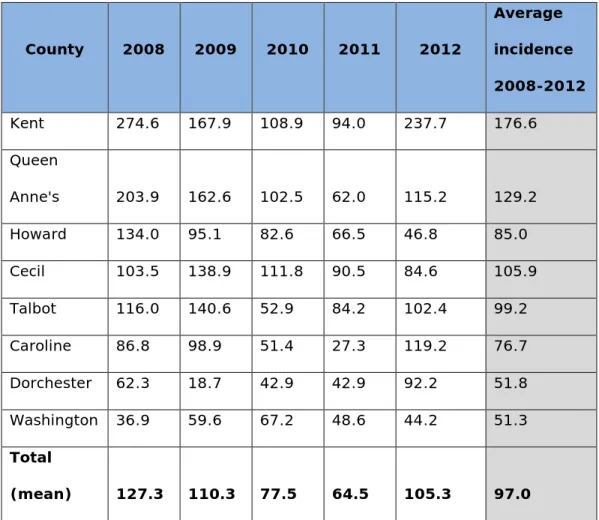
average >50 cases per 100,000 between 2008 and 2012 ... 35 Table 5: Demographic distribution of targeted counties by race, language
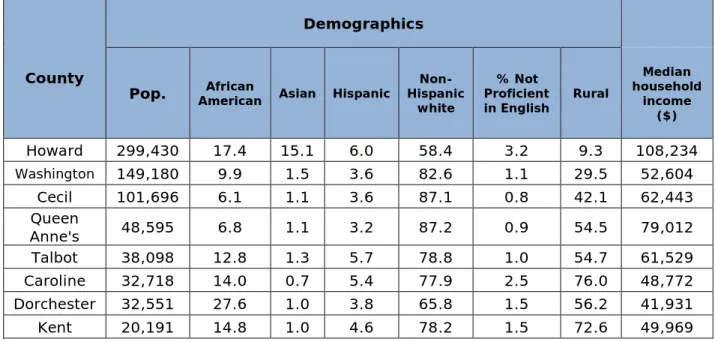
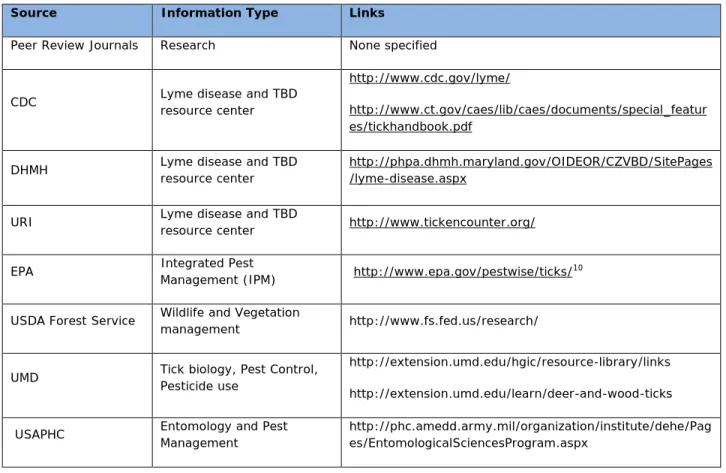
proficiency, rural status, and median income. ... 36 Table 6: Preferred sources on Lyme disease control and prevention ... 43 Table 7: Sources of information that encourage participation in Lyme disease
control and prevention activities among public and private stakeholders ... 53 Table 8: Lyme disease control and prevention practices implemented by public
and private stakeholders in eight counties of Maryland from 2009-2015 ... 56 Table 9: Targeted venues for dissemination of messaging and implementation
xi
LIST OF FIGURES
Figure 1: Tick Life Cycle ... 6 Figure 2: Average incidence of Lyme disease per 100,000 according to surveillance
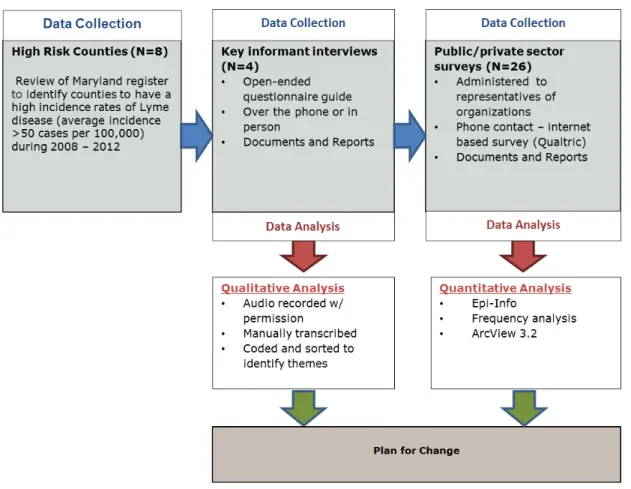
reports in Maryland, 2008-2012 ... 17 Figure 3: Tick-borne disease decision support system (TBDDSS) framework ... 31 Figure 4: Study concept ... 33 Figure 5: Distribution of Lyme disease control and prevention activities
supported by public and private stakeholders in 8 counties of
Maryland, 2009-2014 ... 62 Figure 6: Number of public and private stakeholders providing educational
outreach on Lyme disease prevention, 2009-2013 ... 63 Figure 7: Number of public and private stakeholders providing educational
outreach for Lyme disease prevention by month ... 63 Figure 8: Confirmed Lyme disease cases by age and sex--United States,
xii
LIST OF ACRONYMS ARM Adaptive Resource Management
CDC Centers for Disease Control and Prevention
CSTE Council of State and Territorial Epidemiologists
CZVD Center for Zoonotic and Vector-borne Diseases
DHMH Department of Health and Mental Hygiene
EM Erythema migrans
IDEHA Infectious Disease and Environmental Health Administration
IDSA Infectious Disease Society of America
IPM Integrated Pest Management
NEATCP Northeast Area-wide Tick Control Project
NNDSS National Notifiable Disease Surveillance System
OspA Outer surface protein A
STARI Southern Tick-Associated Rash Illness
TBD Tick-borne disease
TBD-IPM-WG Tick-borne disease integrated pest management workgroup
TBDDSS Tick-borne disease decision support system
UMD University of Maryland
xiii
USAPHC Entomological Science Program at the US Army Public Health Command
1
CHAPTER 1: INTRODUCTION
Statement of the Issue
The influence of the public and private sector on tick control and tick-borne disease (TBD) prevention practices is not well understood. Although an increasing number of evidence-based practices for the control and prevention of Lyme disease are publicly available, there is a paucity of information on the actual frequency and spatiotemporal coverage of interventions among endemic communities. Indeed, the lack of evidence from translational research suggests that very few TBD control and prevention practices are being successfully applied (R. J. Eisen, Piesman, Zielinski-Gutierrez, & Eisen, 2012; Piesman & Eisen, 2008). TBD and tick control, which are relatively new problems for federal and state governments, are typically framed as an individual problem instead of a community-wide issue. Consequently, in high risk, high prevalent areas for Lyme disease, a sudden or gradual decrease in cases, even after community-based control and prevention practices are implemented, is met with skepticism – uncertain of whether a reduction is related to
changes in ecology, case reporting, surveillance practices, or the impact of control and prevention practices.
In North America, Borrelia burgdorferi is the causative agent for Lyme disease, or Lyme borreliosis; a gram negative, spirochetal bacteria spread through the bite of an
2
analyzing medical claims over a 6 year period, CDC estimates that 300,000 people are diagnosed with Lyme disease each year (Kuehn, 2013). Lyme disease is now the most commonly reported vector-borne disease in North America, with 94% of all cases reporting from 12 States in 2011 including (from highest to lowest): Connecticut, Delaware, Maine, Maryland, Massachusetts, Minnesota, New Jersey, New Hampshire, New York, Pennsylvania, Virginia, and Wisconsin.
Lyme disease is a multisystem illness characterized by clinical presentations that most often involves the skin, joints, nervous system, and heart. Initial symptoms are frequently described as flu-like, including a general lack of energy, headache and stiff neck, fever and chills, muscle and joint pain, and swollen lymph nodes (Fell, 2000). Currently, no definitive diagnostic test is available for Lyme disease; therefore the absence or lack of laboratory confirmation should not exclude a suspected individual from treatment, although in some medical practices a lack of laboratory evidence excludes individuals from antibiotic treatment. If not detected and treated early enough, infection may further affect the skin, joints, nervous system, and heart within weeks to months after initial infection. Heart, nervous system, and joint symptoms may be the first signs of Lyme disease in people who do not develop minor cutaneous erythema migrans (EM), or other symptoms of early infection. As an outward sign of infection, EM is typically described as a central clearing lesion, or bulls-eye rash, but can present itself in many different forms including
disseminated lesions, blue-red lesions, blistering lesions, and uniformly red lesions. Not all infected persons will present with EM, and presentation of the EM may go undetected by infected individuals.
3
many patients, who often endure an extended period of illness and multiple doctor visits before receiving appropriate treatment. A majority of Lyme disease patients have reported visiting an emergency room at least once as a result of Lyme disease (L. Johnson, Aylward, & Stricker, 2011). Hospital and emergency room services, as well as a loss of productivity, constitute a large component of costs associated with late Lyme disease (Zhang et al., 2006). The average costs incurred by patients for a typical case of Lyme disease is estimated to be between $161 to $205 in direct medical treatment costs, if diagnosed in the early stages. More serious sequelae, due to early and late disseminated disease, can result in complications that cost from $1,804 to $5,444 per patient in direct medical costs during the first year (Meltzer, Dennis, & Orloski, 1999; Fix, Strickland, & Grant, 1998).
Although the overall number of reported Lyme disease cases has increased since 1991 when reporting first began, several endemic states, including Maryland, have reported a decrease in cases between 2008 and 2011. This reduction in reported cases of Lyme disease is still not well understood – a change in case definition in January 2008 certainly confounds interpretation - but the collective impact of control and prevention practices in high prevalent areas is a possible factor as well. Inconsistencies created through passive surveillance systems remain a major hurdle in interpreting disease trends as not every case of Lyme disease is reported by a medical provider to the county health department.
Underreporting is more likely to occur in highly endemic areas depending on the legal mandate and surveillance practices of the state or local health department (Centers for Disease Control and Prevention, January 11, 2013). Lyme disease was underreported by 10 to 12 fold between 1992 and 1993 (Coyle et al., 1996) and recent studies by CDC suggest the total number of people diagnosed with Lyme disease is roughly 10 times higher than the yearly reported number (Kuehn, 2013).
4
2013). Seasonal fluctuations and prolonged abnormal weather patterns in various parts of the United States prior, during, and after 2008 may have influenced the transmission efficiency of B. burgdorferi among tick and host species resulting in changes in the number of reported cases of Lyme disease. Other studies have shown that the presence of certain bacteria produce antifreeze glycoprotein inside ticks increasing the cold tolerance and survival of I. scapularis during the winter (Neelakanta, Sultana, Fish, Anderson, & Fikrig, 2010) presumably resulting in a higher density of ticks over time.
The complex dynamic between B. burgdorferi, environment, host and vector species, and disease outcome warrants a greater understanding of the available public and private stakeholders that could be expanded or modified to improve the effectiveness and efficiency of Lyme disease control. An exploratory internet web search on ‘Lyme disease’ produces an extensive list of public and private sector organizations associated with Lyme disease
prevention. However, the actual frequency and spatiotemporal coverage of specific tick-control and Lyme disease prevention practices in high risk areas is not well documented, compromising the ability of local authorities to understand the potential role of the public and private sector.
5
BackgroundLyme disease in North America.
In 1776, Yale University researchers described a clustering of undiagnosed illness, suspected to be some kind of juvenile rheumatoid arthritis, in and around three towns in Connecticut, including the towns Lyme and Old Lyme. The condition was called “Lyme disease arthritis” (Steere et al. 1977). Presence of an EM rash among some of the patients led to the recognition that cases in the United States were of the same tick-borne condition known in Europe. Prior to 1976, B. burgdorferi sensu lato infections were known as tick-borne meningopolyneuritis, Garin-Bujadoux syndrome, Bannwarth syndrome, Afzelius' disease, Montauk Knee or sheep tick fever (Bolognia, Jorizzo, & Rapini, 2007). The introduction of B. burgdorferi to the United States is uncertain, however examination of preserved museum specimens has found Borrelia DNA in an infected mouse from Cape Cod circa 1894 (Drymon, 2008). Recent studies suggest that Lyme disease has been present in North America for thousands of years and has followed the migration of early settlers from the Northeast to the Midwest in the early 19th century (Hoen, et al., 2009). The Borrelia
burgdorferi spirochete is named in honor of Willy Burgdorfer who is credited with identifying
spirochetes from patients with Lyme disease as identical to spirochetes isolated in ticks (Burgdorfer, Barbour, Hayes, Benach, Grunwaldt, & Davis, 1982).
Transmission of Lyme disease
Transmission of B. burgdorferi closely follows the 2-year life cycle of the black-legged tick, I. scapularis and I. pacificus, the primary enzootic vector and bridging vector to
6
incidence of Lyme disease, particularly in high-prevalent areas (Pepin et al., 2012). The black-legged tick is a three host tick; each feeding stage (larva, nymph and adult) requires one vertebrate blood meal for its development. When the tick attaches to a suitable host, it inserts its mouthparts and begins to suck the host's blood. The tick's saliva travels into the wound to keep the blood from clotting and carries infectious material into the wound. Host species like the white-footed mouse (Peromyscus leucopus), are effective reservoirs for B.
burgdorferi compared to white-tailed deer (Odocoileus virginianus); a higher proportion of
ticks become infected after taking a bloodmeal from an infected mouse verses an infected deer. On the other hand, white-tailed deer are important hosts for sustaining black-legged tick populations and therefore influence the intensity of disease transmission by supporting the amplification of host seeking ticks feeding on white-footed mice and other reservoir species (Mather, Wilson, Moore, Ribeiro, & Spielman, 1989). Ticks that are attached to a suitable host for more than 24-36 hours are more likely to transmit infection to that host (Alao & Decker, 2012) .
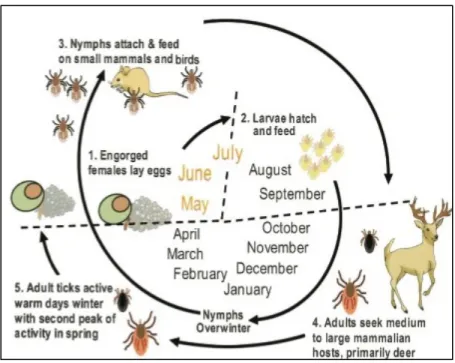
Figure 1: Tick Life Cycle
7
The life cycle of a black-legged tick, depicted in Figure 1, starts from a single batch of eggs deposited in the leaf litter in early spring by a previously blood fed female tick. When eggs hatch in early to mid-summer, six-legged larvae emerge and seek a suitable host, such as the white-footed mouse or other small mammals or lizards (Anderson & Magnarelli, 1980).
After taking a bloodmeal over a 3-5 day period, larvae drop to the leaf litter or host den to digest the blood, stimulating the molting process to become eight legged nymphs before overwintering. In early spring of the second year of life, nymphs will take a second bloodmeal, usually from another small mammalian, avian, or human host before molting again. The engorged nymph drops to the leaf litter again to continue its development into an adult. In late to early fall of the same year the adult ticks begin to quest for a third host, typically larger mammals like the white-tailed deer. Adults will feed on a suitable host for 5-7 days – during which time mating also occurs. Engorged adult ticks will find protection in the leaf litter before emerging in early spring to ovideposit eggs, but can remain active through the winter on days when the ground and ambient temperatures are above freezing. Incidence of new cases of Lyme disease in the Northeast and Midwest are greatest during the months of May through July when nymphs are most abundant and difficult to detect by human hosts (Piesman, 1989).
Lyme disease surveillance and reporting
8
States but are not notifiable, including Southern Associated Rash Illness (STARI), Tick-Borne Relapsing Fever, and Colorado Tick Fever (Centers for Disease Control and
Prevention, 2012). In addition to transmitting Lyme disease, I. scapularis and I. pacificus are known tick vectors for Anaplasmosis, Babesiosis, and Powassan Encephalitis.
The Council of State and Territorial Epidemiologists (CSTE) has provided a
surveillance case definition of Lyme disease since 1995, with subsequent modifications in the definition in 1996, 2008, and 2011. The surveillance case definition developed for national reporting of Lyme disease, however, is not intended for clinical diagnosis. Clinical diagnosis is based on signs and symptoms and a history of possible exposure to infected blacklegged tick. Differences between surveillance and clinical diagnosis continue to generate debate among physicians and infectious disease experts on how individual cases should be classified and treated. Surveillance criteria are intended to be far stricter than what would be required for treatment; however surveillance systems that are unable to detect or report on cases that meet the stricter criteria underestimate risk and undermine control and prevention. The 2011 case guideline for surveillance recognizes three
9
Table 1: Lyme disease case classification for surveillance
Classification Definition
Confirmed a) A physician diagnosed case of EM1 with a known exposure (contact with potential tick habitats in a county in which Lyme disease is endemic less than or equal to 30 days before onset of EM). A history of tick bite is not required; or
b) A physician diagnosed case of EM with laboratory evidence2 of infection if there is no known exposure (a positive culture for B.
burgdorferi, a positive two-tier test, a single-tier IgG immunoblot
seropositivity, or a positive colony stimulating factor (CSF) antibody by Enzyme Immunoassay or Immunoflurescence Assay); or
c) A physician diagnosed case of EM with at least one late manifestation3 (musculoskeletal, nervous, or cardiovascular) with laboratory
evidence of infection.
1 CDC recommends for the purposes of surveillance, EM is defined as a skin lesion that typically begins as a red
macule or papule and expands over a period of days to weeks to form a large round lesion, often with partial central clearing. A single primary lesion must reach greater than or equal to 5 cm in size across its largest diameter. Secondary lesions may occur. Clinical diagnosis for treatment may include a far more varied presentation of dermatitis.
2 CDC recommends for the purposes of surveillance, the definition of a qualified laboratory essay is one of the
following: 1) Positive Culture for B.burgdorferi; 2) two-tier testing interpreted using established criteria, where: a) Positive IgM is sufficient only when ≤ 30 days from symptom onset, b) Positive IgG is sufficient at any point during illness; 3) Single-tier IgG immunoblot seropositivity using established criteria; or 4) CSF antibody positive for B.burgdorferi by Enyme Immunoassay or Immunoflurescence Assay, when the titer is higher than it was in serum.
3 CDC recommends for the purposes of surveillance, late manifestations include any of the following when an
alternate explanation is not found: 1) Recurrent, brief attacks (weeks or months) of objective joint swelling in one or a few joints, sometimes followed by chronic arthritis in one or a few joints; 2) Any of the following, alone or in combination: lymphocytic meningitis; cranial neuritis, particularly facial palsy (may be bilateral);
radiculoneuropathy; or, rarely, encephalomyelitis confirmed by demonstration of higher antibody production against B. burgdorferi in cerebrospinal fluid than in serum; 3) Acute onset of high-grade (2nd-degree or 3rd-degree)
10
Classification Definition
Probable Any other case of physician-diagnosed Lyme disease that has laboratory evidence of infection
Suspected a) A physician diagnosed case of EM where there is no known exposure and no laboratory evidence of infection; or
b) A physician diagnosed case of EM with laboratory evidence of infection but no clinical information available (e.g. a laboratory report).
Source: CSTE Position Statement Number: 10-ID-06. Lyme disease (Borrelia burgdorferi)
Lyme disease is categorized as early localized infection, early disseminated infection, or late persistent infection. Early cutaneous manifestations may involve an expanding annular lesion around the original tick bite, called erythema migrans, and is usually
sufficient for diagnosis and treatment, however the rash only appears in an estimated 50% -70% of patients (Alao & Decker, 2012). Because misdiagnosis is common at early stages of the disease, many patients endure an extended period of illness before receiving
appropriate treatment. Additional co-infections that can be transmitted by I. scapularis and
I. pacificus often complicate diagnosis.
11
The role of federal and state health agenciesAlthough the CDC is one of the lead agencies on the prevention of Lyme disease and other TBDs in the United States, state and county health departments often bear the
responsibility for the implementation and coordination of disease control and prevention activities. Ultimately, the immediate decisions on control and prevention of TBDs are made at the family or individual level (Piesman & Eisen, 2008), but are also manifested through collective action by public and private sector stakeholders.
CDC's Lyme disease prevention and control program provides science-based
education, research, and service, through partners within the National Institutes of Health and other federal agencies, state and local health departments, and other non-federal organizations. CDC supports national surveillance, epidemiologic response, field and laboratory research, consultation, and educational activities. CDC also funds collaborative studies on community-based prevention methods, improved diagnosis and understanding of pathogenesis, tick ecology, and development and testing of new tools and methods for tick control (Mead, 2004). A primary goal emphasized by CDC is to work with Lyme disease endemic communities to develop an Integrated Pest Management (IPM) approach, which includes a wide assortment of practical tick control strategies. IPM employs environmental management, biological and chemical control of ticks, and enhanced personal protection through tick avoidance and other measures to prevent Lyme disease (Mead, 2004). The goal of an IPM approach is “to reduce human illness and associated economic costs while minimizing potential environmental impacts” (Beard & Strickman, 2014).
The Public health system in Maryland is supported by the Department of Health and Mental Hygiene (DHMH) and 24 local health departments, including 23 counties and
12
concerns, many of which are covered under the Prevention and Health Promotion Administration and the Infectious Disease and Environmental Health Administration (IDEHA). These administrative units provide public health services through partnerships with local health departments and public and private sector stakeholders including the prevention and control of infectious diseases, investigation of disease outbreaks, and protection from food related and environmental health hazards.
Within the Maryland Public Health Service Division, the Center for Zoonotic and Vector-borne Diseases (CZVD) monitors, investigates, and reports on diseases that can be transmitted between animals and humans, including Lyme disease, rabies, West Nile Virus, and avian influenza. The Center provides education and training to local health department personnel and general information to the public about zoonotic diseases. Educational materials and resources highlight research, educational initiatives, and special projects involving ticks, mosquitoes, and other disease-carrying vectors. In Maryland, mosquito control is operated by the Maryland Department of Agriculture, which also participates in tick identification4.
Tick-control and Lyme disease prevention
Most references to ‘Lyme disease prevention’ focus on personal preventative measures - behavior change strategies that limit contact with tick species - as a primary intervention to reduce transmission of B. burgdorferi . Lyme disease prevention is also used in reference to vaccine development, prophylactic treatment, and the proper removal of attached ticks in less than 24 - 36 hours, as proactive measures to reduce the probability of infection after being bitten by an infected tick. Tick-control strategies, on the other hand, may incorporate components of Lyme disease prevention, but are specifically related to activities aimed at reducing the infectivity or density of tick vectors in a given area. The primary objective of tick control for Lyme disease is to actively reduce the quantity, range,
13
and infectivity rate of I. scapularis and I. pacificus, as well as the infection rate in host species.
One of the most widely cited resources by federal and state agencies on the control and prevention of TBDs from the 2004 Tick Management Handbook developed by Kirby C.
Stafford II from the Connecticut Agricultural Experiment Station (K. C. Stafford, 2004). The Handbook, funded by the CDC and The Connecticut Agricultural Experiment Station,
provides details on personal protection, integrated tick management, area-wide chemical control of ticks, and organic land care practices. Many of the recommended personal prevention activities are summarized on the CDC website: www.cdc.gov/lyme. The CDC website and the 2004 Tick Management Handbook encourage people to reduce exposure to ticks and to be extra vigilant during warmer months (April-September) when ticks are more active by considering the following activities:
1. Limit exposure to ticks:
a. Avoid wooded and bushy areas with high grass and leaf litter. b. Walk in the center of trails.
2. Adopt Personal protective measures:
a. Use repellents that contain 20 to 30% DEET (N, N-diethyl-m-toluamide) on exposed skin and clothing for protection.
14
c. For pet owners, apply an appropriate tick repellent to prevent bites5 or an acaricide (Fipronil, Pyrethroids, Amitraz) to kill ticks on contact or when they take a blood meal.
d. Conduct a full-body tick check using a hand-held or full-length mirror to view all parts of your body upon return from tick-infested areas. Parents should check their children for ticks under the arms, in and around the ears, inside the belly button, behind the knees, between the legs, around the waist, and especially in their hair. Tick bites on dogs and outdoor pets may be harder to detect and should be checked for ticks daily. Examine outdoor gear; ticks can ride into the home on clothing, pets, and day packs.
e. Bathe or shower as soon as possible after coming indoors (preferably within two hours) to wash off and more easily find ticks.
f. Remove ticks right away – use a removal device or a plain set of fine-tipped tweezers. Pull upward with steady, even pressure. Don't twist or jerk the tick which may cause the mouth-parts to break off and remain in the skin. If this happens, remove the mouth-parts with tweezers. If unable to remove the mouth easily with clean tweezers, leave it alone and let the skin heal. After removing the tick, thoroughly clean the bite area and hands with rubbing alcohol, an iodine scrub, or soap and water.
g. Dispose of a live tick by submersing it in alcohol, placing it in a sealed bag/container, wrapping it tightly in tape, or flushing it down the toilet6. Never crush a tick with your fingers.
5 CDC suggests that a disadvantage of using a repellent on pets is that while it may prevent bite wounds and
possible infections, it also will not reduce the number of ticks in the environment (doesn’t kill the tick). Therefore the use of arcaricides on dogs to reduce the number of ticks could be considered a tick control strategy.
6 Maryland Department of Agriculture’s tick identification program relies on passive submission of specimens.
15
h. Tumble clothes in a dryer on high heat for an hour to kill remaining ticks. i. Reduce tick habitat from yard by making your yard less attractive to ticks.
i. Clear tall grasses and brush around homes and at the edge of lawns. ii. Place a 3-ft wide barrier of wood chips or gravel between lawns and
wooded areas and around patios and play equipment to restrict tick migration into recreational areas.
iii. Mow the lawn frequently and keep leaves raked.
iv. Stack wood neatly and in a dry area (discourages rodents that ticks feed on).
v. Keep playground equipment, decks, and patios away from yard edges and trees and place them in a sunny location, if possible.
vi. Remove any old furniture, mattresses, or trash from the yard that may give ticks a place to hide.
3. Apply area-wide acaricides around residential property:
a. Apply a single springtime application of an acaracide (tick pesticide), such as bifenthin, to reduce the number of ticks in your yard. Consider using a
professional pesticide company7 and check with local health officials about the best time to apply acaricide in your area. Identify rules and regulations related to pesticide application on residential properties (Environmental Protection Agency and your state determine the availability of pesticides).
more likely to develop symptoms before results of the tick test are available. A negative test may lead to false assurances if the person is bitten by more than one disease carrying tick. The overall recommendation to dispose of ticks however does not suggest that standardized tick monitoring and testing is not warranted if part of larger risk-mapping activities.
7 The distinction between private homeowners and professional pest companies in applying an acaricide is
16
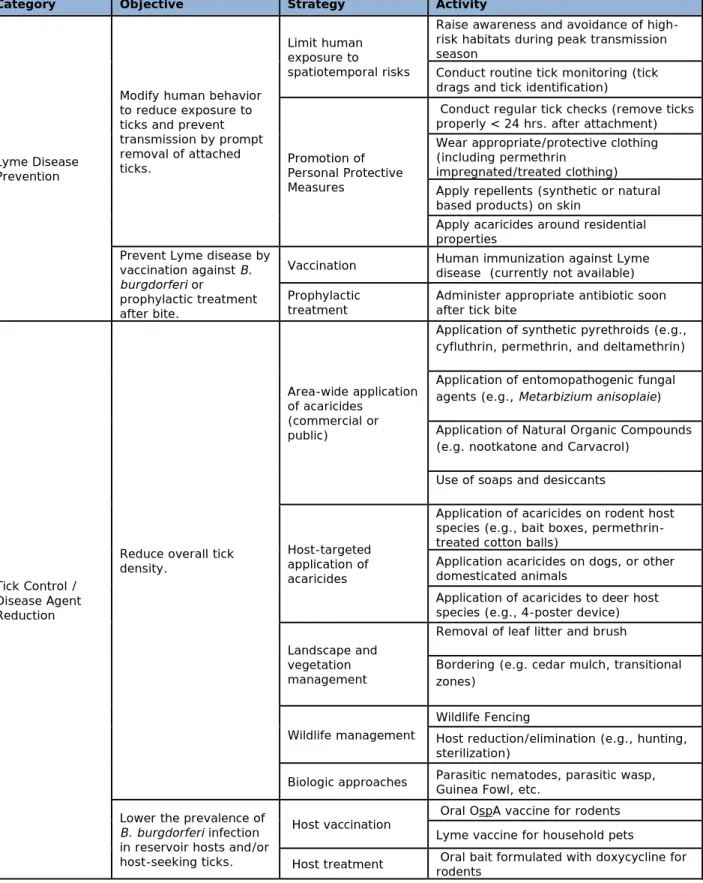
Table 2: Summary of tick control and Lyme disease prevention methods
Category Objective Strategy Activity
Lyme Disease Prevention
Modify human behavior to reduce exposure to ticks and prevent transmission by prompt removal of attached ticks.
Limit human exposure to
spatiotemporal risks
Raise awareness and avoidance of high-risk habitats during peak transmission season
Conduct routine tick monitoring (tick drags and tick identification)
Promotion of Personal Protective Measures
Conduct regular tick checks (remove ticks properly < 24 hrs. after attachment) Wear appropriate/protective clothing (including permethrin
impregnated/treated clothing) Apply repellents (synthetic or natural based products) on skin
Apply acaricides around residential properties
Prevent Lyme disease by vaccination against B.
burgdorferi or
prophylactic treatment after bite.
Vaccination Human immunization against Lyme disease (currently not available)
Prophylactic
treatment Administer appropriate antibiotic soon after tick bite
Tick Control / Disease Agent Reduction
Reduce overall tick density.
Area-wide application of acaricides
(commercial or public)
Application of synthetic pyrethroids (e.g., cyfluthrin, permethrin, and deltamethrin)
Application of entomopathogenic fungal agents (e.g., Metarbizium anisoplaie)
Application of Natural Organic Compounds (e.g. nootkatone and Carvacrol)
Use of soaps and desiccants
Host-targeted application of acaricides
Application of acaricides on rodent host species (e.g., bait boxes, permethrin-treated cotton balls)
Application acaricides on dogs, or other domesticated animals
Application of acaricides to deer host species (e.g., 4-poster device)
Landscape and vegetation management
Removal of leaf litter and brush
Bordering (e.g. cedar mulch, transitional zones)
Wildlife management
Wildlife Fencing
Host reduction/elimination (e.g., hunting, sterilization)
Biologic approaches Parasitic nematodes, parasitic wasp, Guinea Fowl, etc.
Lower the prevalence of
B. burgdorferi infection
in reservoir hosts and/or host-seeking ticks.
Host vaccination Oral OspA vaccine for rodents Lyme vaccine for household pets
17
Tick control and Lyme disease prevention strategies have been more recently summarized in peer-review journals (Clark & Hu, 2008; R. J. Eisen, Piesman, Zielinski-Gutierrez, & Eisen, 2012; Piesman & Eisen, 2008; T. L. Schulze et al., 2006). Table 2 categorizes the major control and prevention strategies and activities described in the peer-review literature and CDC websites.
Lyme disease in Maryland
Figure 2: Average incidence of Lyme disease per 100,000 according to surveillance reports in Maryland, 2008-2012
Data source: http://phpa.dhmh.maryland.gov/SitePages/disease-conditions-count-rates.aspx
18
increase in the number of cases reported from 706 cases to 1,650 cases between 2011 and 2012. Among Maryland’s 23 counties, eight counties reported an average incidence of Lyme disease more than 50 cases per 100,000 from 2008 to 2012, including: Kent, Caroline, Queen Anne’s, Cecil, Talbot, Howard, Dorchester, and Washington (Figure 2).
Importance and Rational
Evidence suggests that tick species are expanding in geographical range and density in the United States with the potential of carrying B. burgdorferi and other infections to previous non-endemic areas (Centers for Disease Control and Prevention, May 13, 2011). Given the challenges in the diagnosis and treatment of Lyme disease and the absence of a reliable human vaccine, a comprehensive and practical approach is needed to measure the frequency and spatiotemporal coverage of practices and to evaluate the role of the public and private sector in Lyme disease control and prevention efforts.
Tick density and infection rates can vary dramatically from county to county within a state (Centers for Disease Control and Prevention, June 15, 2007), and change over time as epidemiologic patterns shift within the complex host-tick-environment relationship. Disease modeling has identified certain geographic distribution patterns influenced by place of residence, density of infected nymphs, vegetation distribution, and population density that are predictive of high risk areas for human infection with B. burgdorferi (Diuk-Wasser et al., 2012; R. J. Eisen, Lane, Fritz, & Eisen, 2006; Frank, Fix, Pena, & Strickland, 2002; Glass et al., 1995; LoGiudice, Ostfeld, Schmidt, & Keesing, 2003; Nicholson & Mather, 1996; Ostfeld et al., 2001). Consequently, tick-control and Lyme disease prevention practices are often not uniformly implemented across a state.
19
20
CHAPTER 2: LITERATURE REVIEW
Since the publication of the Connecticut Agricultural Experiment Station’s Tick Management Handbook (2004), the peer-reviewed literature published between February 2004 and February 2012 has provided a range of tick control and Lyme disease prevention activities implemented in the United States.
Search Terms and Criteria
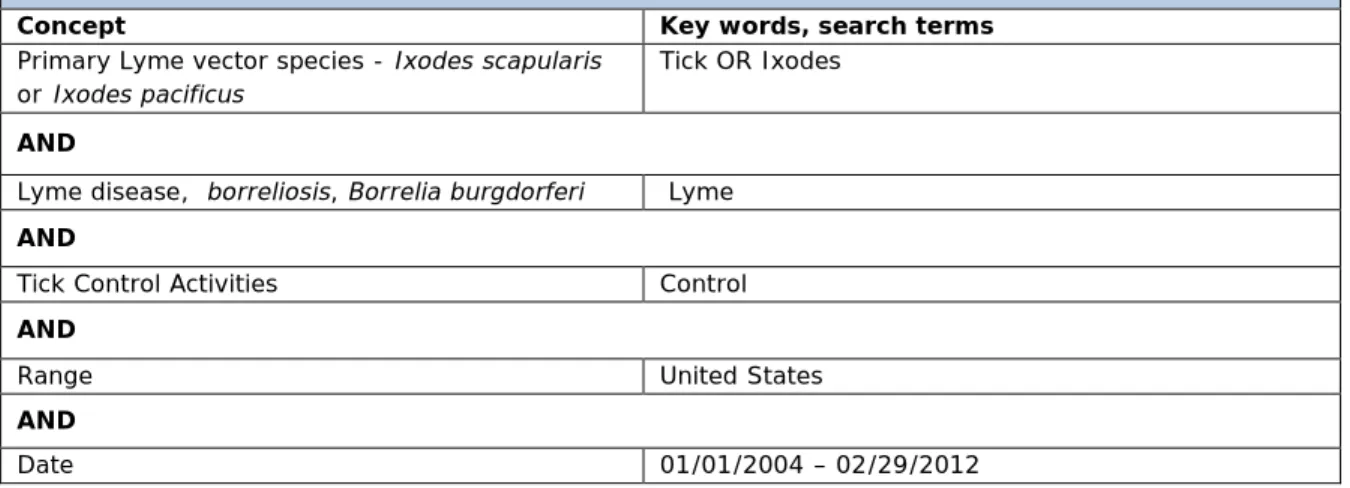
A systematic search of key words was performed using PubMed and BIOSIS Previews (Table 3). Although PubMed comprises over 21 million citations for biomedical literature from MEDLINE, tick control methods are often multi-disciplinary and captured in journals not included in PubMed searches. BIOSIS Previews therefore served as an additional source of journals within the biological sciences.
Table 3: PubMEd and BIOSIS Previews
ALL Searches limited to English, Publication date of 01/01/2004 – 2/29/2012 and INCLUDED:
Concept Key words, search terms
Primary Lyme vector species - Ixodes scapularis or Ixodes pacificus
Tick OR Ixodes
AND
Lyme disease, borreliosis, Borrelia burgdorferi Lyme AND
Tick Control Activities Control
AND
Range United States
AND
Date 01/01/2004 – 02/29/2012
21
and/or aimed at reducing the quantity, range, or infectivity of ticks. When available, efficacy of activities were recorded and analyzed. Articles that presented results of a meta-analysis, or summarized previous work already captured within the literature search, were considered duplicative and not included. Vector control activities that met the following criteria were included in the final analysis:
1. Activity was primarily field-based (outside of a laboratory setting).
2. Intended purpose of activity was to reduce the quantity of ticks, range of ticks and/or infectivity rate of ticks;
3. Vectors targeted by activity inclusive of I. scapularis and/or I. pacificus ticks as a strategy to reduce risk of Lyme disease transmission;
4. Abstract provided implementation basis and geographical area targeted.
Process for reviewing articles
All identified articles were recorded on a summary sheet, including pertinent information on control and prevention activities, study design, targeted vector, targeted diseases, targeted geographic area, implementation basis, and general findings. Abstracts were previewed and evaluated based on inclusion criteria; articles and reports not meeting all specified criteria were excluded.
Literature Review Findings
The duration of which control and prevention activities were implemented and studied ranged from 5 months to 7 years. Studies that involved the United States
22
Depending on the specific control tool, the applied frequency of control strategies over the course of a year varied from a single application to weekly, biweekly, or monthly
application, with some interventions indiscriminately being applied over the duration of the study period. In general, geographical areas targeted by activities were highly focalized within a State and were not applied uniformly across all high-risk areas for Lyme disease.
Human exposure to spatiotemporal risk patterns
A single study considered the dissemination of primary prevention information to passengers on ferryboats going from Hyannis, MA to Nantucket Island, MA, during three consecutive summers in order to encourage people to avoid high-risk tick habitats (Daltroy et al., 2007). The study found that there were lower rates of tick borne infection among participants receiving education compared with control participants, especially visitors who stayed on Nantucket Island for more than 2 weeks. Overall, passengers who were informed about the risk of TBDs on the island were significantly more likely to take precautions (use repellent, protective clothing, limit time in tick areas) and check themselves for ticks.
Personal protection measures
Four studies looked at the impact of adopting one or more personal protection
measures to prevent tick bites, or to reduce the likelihood of transmission after being bitten, by removing the attached tick within 24 hours, including: conducting regular tick checks, wearing protective clothing, wearing permethrin impregnated clothing, and applying repellents on clothes or skin (Connally et al., 2009; Daltroy et al., 2007; Vaughn & Meshnick, 2011; Vazquez et al., 2008). Performing regular tick checks (i.e., inspecting body parts for ticks), specifically after an individual was outdoors in a woodsy area, reduced the risk of Lyme disease as did wearing protective clothing (Connally et al., 2009; Daltroy et al., 2007). The authors note that during spring and early summer, when larvae and
23
to their size. In a study conducted by Vaughn and Meshnick clothing was impregnated with permethrin, which does not repel ticks but kills them upon contact. People who wore the impregnated clothing reduced the incidence of tick bites compared with controls (Vaughn & Meshnick, 2011). The use of repellents on clothes or skin was investigated in 2 studies (Daltroy et al., 2007; Vazquez et al., 2008). These studies concluded that there was a greater adoption of personal protection behaviors, including the use of repellents, in people without Lyme disease, suggesting that these behaviors are protective against Lyme disease.
Prophylactic treatment
A single 200-mg dose of doxycycline given within 72 hours after an I. scapularis tick bite was recommended for patients based on a study conducted prior to 2004 (Nadelman et al., 2001). The study suggests that a single 200 mg dose of doxycycline prevented the development of cutaneous EM. As a follow-up to this study Elizabeth Maloney conducted a review of the antibiotic prophylaxis recommendation for Lyme disease and the evidence supporting it. Her conclusion is based on limited evidence but suggested that physicians may want to consider alternative recommendations to improve efficacy of antibiotic
prophylaxis in preventing clinical signs of Lyme disease, including the administering of 100-mg dose of doxycycline twice daily for 10 to 20 days (Maloney, 2011). Current
recommendations from the Infectious Diseases Society of America (IDSA) are that a single dose of doxycycline should only be prescribed if all of the following exists:
the attached tick can be reliably identified as an adult or nymphal I. scapularis tick that is estimated to have been attached for ⩾36 h on the basis of the degree of engorgement of the tick with blood or of certainty about the time of exposure to the tick; (b) prophylaxis can be started within 72 h of the time that the tick was
removed; (c) ecologic information indicates that the local rate of infection of these ticks with B. burgdorferi is ⩾20%; and (d) doxycycline treatment is not
contraindicated (Wormser et al., 2006).
24
antibiotics only block seroconversion to B. burgdoreferi antibodies without eliminating infection (Volkman, 2007) .
Area-wide acaricides
Three studies documented the use of bio-chemical acaricides applied with sprayers over large areas. Bio-chemical acaricides are often categorized separately from
synthetically derived pesticides. The bio-chemicals used in the studies included applications of plant-derived acaricides, including nootkatone, carvacrol, Beauveria bassiana, and
Metarhizium anisopliae (Metschnikoff) Sorokin strain F52 for the control of I. scapularis
nymphs (Dolan et al., 2009; Jordan, Dolan, Piesman, & Schulze, 2011; K. C. Stafford 3rd & Allan, 2010). All three studies showed significant reductions in nymphal tick abundance as applied by trained spray operators to large wooded areas.
Two additional studies explored area-wide spraying of chemical acaricides on domestic properties as part of a larger evaluation of Lyme disease prevention behaviors (Connally et al., 2009; Vazquez et al., 2008). Both case-control studies showed that spraying acaricides routinely on one’s property did not differ significantly for case-patients and matched controls; i.e. the application of commercial available acaricides by individual families did not significantly protect individuals against Lyme disease. The two studies suggest that even with longer lasting commercially available chemicals, domestic application of acaricides by individual households does not significantly protect against Lyme disease. The lack of a protective effect however may not be related to the chemicals themselves, but issues with application of chemicals: when, where, and how chemical acaricides are applied.
Prior to 2004, several studies showed that area-wide spraying of acaricides to control tick populations resulted in significant reductions (Curran, Fish, & Piesman, 1993; Patrican & Allan, 1995; T. L. Schulze, Taylor, Vasvary, Simmons, & Jordan, 1992). Area-wide
25
public concern over adverse environmental effects, toxicity, and impact on non-targeted organisms (Golaine, 2011). Because of this concern, emphasis on plant derived acaricides, or bio-chemicals, as well as integrated control strategies are being more widely promoted.
Host-targeted approaches
Concerns over the broad use of pesticides has driven support for host-targeted application of acaricides, such as the large scale multi-year USDA supported Northeast Area-wide Tick Control Project (NEATCP), a five year large-scale cooperative demonstration project of the USDA—ARS patented 4-Poster tick control technology, which was promoted as an efficacious, economical, safe, and environment-friendly alternative to area-wide spraying of acaricide to control tick species (Pound et al., 2009). The majority of tick control activities identified by the literature review involved the use of a passive device or material to topically apply insecticide to targeted host species. Of the eight articles that described this approach, six of the studies were supported directly or influenced by NEATCP. Research locations were independently set up in five states (Connecticut, Maryland, New Jersey, New York, and Rhode Island) to study the extent that tick-vector control could be achieved (Pound et al., 2009). By the sixth treatment year, the NEATCP effectively reduced the relative density of I. scapularis nymphs by 71% on an average size treatment site (5.14 km²), corresponding to a 71% lower relative entomologic risk index for acquiring Lyme disease (Brei et al., 2009). An additional follow-on period was conducted on Gibson Island, Maryland, using a similar device but supported by a private cooperation and showed that host-seeking nymphs remained at consistently low levels on the island in spite of 40% fewer 4-Posters and an increase in deer density during the follow-on period (Carroll, Pound, Miller, & Kramer, 2009).
The 7th study involving topical application of insecticides to host species investigated the application of rodent-targeted acaricide (fipronil) through bait boxes to control immature
26
were effective as an acaricide delivery method for reducing nymphal and larval tick infestations on white-footed mice. Abundance of questing I. scapularis adults on treated properties was also reduced compared with untreated sites (Dolan et al., 2004).
The last study focused on the use of M. anisopliae-treated nesting material
(entomopathogenic fungus) placed in artificial nestboxes to control larval and nymphal I.
scapularis ticks (Hornbostel, Ostfeld, & Benjamin, 2005). Entomopathogenic fungi is a
biocide and considered separately from synthetic based chemical insecticides. The delivery mechanism to host species can be the same as with more commonly used area-wide
acaricides, however, in this study the acaricide was passively applied to rodent species. The study found that treated nesting material did not effectively control I. scapularis over a relatively large spatial area but exhibited modest control in smaller, treatment-localized areas.
Landscape and Vegetation management
27
Wildlife managementThree studies included the culling of white tail deer as a control strategy; however only the complete removal of deer from the study area (Monhegan Island, ME) showed a significant decrease in the number of questing ticks (Rand, Lubelczyk, Holman, Lacombe, & Smith, 2004). Deer hunting in the other two studies did not show a clear decrease in the incidence of Lyme disease compared with control sites (Garnett, Connally, Stafford, & Cartter, 2011; Jordan, Schulze, & Jahn, 2007) . The Monhegan Island study showed a significant decline in the number of questing adults, but only 3 years later and only after observing a sharp increase in questing adult ticks during the last year deer were removed from the island. If the final evaluation of the Monhegan Island study was only based on data collected on the last year deer were removed, then the results may have shown no significant difference. To be able to critique the findings of studies that look at deer management, an established population threshold for deer is needed; i.e., the level that deer populations would need to be reduced and sustained in order to decrease tick populations to a level that no longer poses a significant risk to exposed populations.
Host vaccination
A separate study examined the use of a recombinant antigen, outer surface protein A (OspA), to immunize wild white-footed mice. This study found that the OspA vaccination significantly reduced the prevalence of B. burgdorferi in nymphal blacklegged ticks (Tsao et al., 2004). Although the experimental immunization of wild white-footed mice with
recombinant antigen of OSpA significantly reduced the prevalence of B. burgdorferi in
nymphal blacklegged ticks, the immunization of mice required researchers to trap and inject each mouse with the vaccine - a very inefficient distribution mechanism. Additional
28
(Bhattacharya et al., 2011). This seems very promising for future field-based approaches but still untested.
Host treatment
In one field-based experiment, doxycycline hyclate rodent bait was used to prophylactically treat and protect small-mammal reservoirs from infection (Dolan et al., 2011). The use of the doxycycline hyclate impregnated bait resulted in a significant reduction in infectivity of small mammals and a significant reduction in infection rate of questing nymphal ticks.
Discussion
Excluding meta-analyses and laboratory studies, ten major field-based tick control and Lyme disease prevention activities were described in the literature - this includes limiting human exposure to spatiotemporal risk patterns, adoption of personal protection measures, prophylactic treatment, area-wide application of acaricides, host-targeted application of acaricides, landscape management, vegetation management, wildlife
management, host vaccination, and host treatment. Studies involving the use of a human vaccine or biologic control approaches were not identified. The Lyme vaccine developed for use in humans (LYMErix ™) in 1998 was voluntarily removed from the market in 2002 and is not currently available (Poland, 2011); a vaccine however still represents a real and potential tool for prevention.
29
the 22 articles cited (appendix A), the major indicators used to evaluate the potential impact on Lyme disease prevalence included:
• Decrease in incidence of tick bites;
• Decrease in prevalence of host-seeking black legged ticks; • Decrease in prevalence of black-legged ticks on targeted hosts;
• Decrease in infection rate of black-legged ticks infected with B. burgdorferi; • Increased mortality of host-fed blacklegged ticks;
• Decrease in incidence of EM rash;
• Reduced risk in developing Lyme disease; • Decrease in tick-borne illnesses;
The evidence from the literature review suggests that the density of I. scapularis and I.
pacificus tick species, the prevalence of B. burgdorferi infection in reservoir hosts and/or
host-seeking ticks, and the incidence of Lyme disease can actively be reduced through available control and prevention strategies. Moreover, several studies identified
opportunities to scale-up control and prevention activities beyond the study area, even though the variables that influence the sustainability of Lyme disease control and prevention program have not been sufficiently studied.
Results of these studies still need to be carefully considered given a variety of
30
symbiotic and collateral impact of a toolbox approach that is of interest in developing a comprehensive state and county TBDDSS and disrupting transmission of B. burgdorferi.
Gaps in Knowledge
The performed literature review does not capture all possible field-based control and prevention strategies implemented during 2004-2012. For example, there is no mention of commercial landscaping and pest control businesses or other non-research based platforms despite the fact that such interventions were most likely occurring during this period. Most of the studies also did not factor a sufficient amount of time to accurately assess the impact on prevalence rates given the two year life cycle of black-legged ticks and the complex patterns between host species and the environment. The activities that were captured, however, demonstrate that reduction of Lyme disease incidence is possible, but requires more than just individual actions. Sustaining long-term area-wide control and prevention activities requires greater public and private involvement and support.
31
CHAPTER 3: METHODS
Conceptual Framework
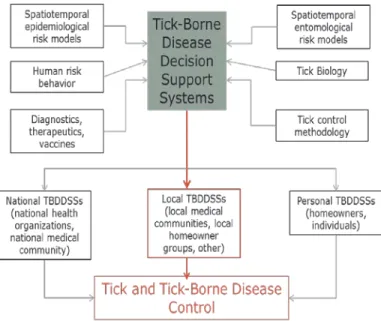
The TBDDSS described by Piesman and Eisen identifies “key points of attack” for tick and TBD control (Figure 3) (Piesman & Eisen, 2008) . According to this framework,
decisions on tick and TBD control are influenced at the national (national health organizations, national medical community), local (local medical communities, local homeowner groups) and individual (homeowners) levels through six major components: spatiotemporal epidemiological and spatiotemporal entomological risk models; exploitation of tick biology; accessibility of diagnostics, therapeutics, and vaccines; understanding of human risk behavior; and availability of tick control methodology. Each component has the potential to influence which strategic approaches to Lyme disease control and prevention are implemented at the national, local, and individual level.
Figure 3: Tick-borne disease decision support system (TBDDSS) framework
32
Although not specified in the local TBDDSS proposed by Piesman and Eisen, a wider range of public and private sector organizations other than local medical communities and homeowner groups are capable of making informed decisions about the implementation of Lyme disease control and prevention. An understanding of the variability of practices among high prevalent areas for Lyme disease and the factors that influence the inputs and outputs of a local TBDDSS. Clarifying this dynamic will assist in the formation of more effective implementation models for tick-control and Lyme disease prevention and encourage a wider range of public and private sector initiatives.
Study design
This study applied a retrospective, mixed-methods investigative approach to identify tick control and Lyme disease prevention activities implemented by public and private stakeholders in high Lyme disease prevalent counties of Maryland during 2009-2014. The study was not intended to establish causation between any one intervention, or combination of interventions, and disease outcome. The nuances between the public and private sector are often debated. For the purposes of this study, public sector stakeholders are entities that provide public services by and for the government and its citizens. Private sector organizations are run by private individuals or groups, and are not controlled by the state. In this sense a public non-profit organization may receive the majority of its funding from the general public, while a private non-profit organization receives most of its funds from only a few private sources, such as through donations from a single family or corporation. Medical providers, including primary health physicians, were not included as part of the study.
33
profit sector were asked to provide their perceptions on tick control and Lyme disease prevention practices and to identify key public and private sector stakeholders. Based on the results of the key informant interviews, additional surveys were administered to
appropriate representatives of public and private sector organizations that provide services within the eight selected counties and who may have a potential role in Lyme disease control and prevention activities. Information gathered from the interviews and surveys was used to describe the overall control and prevention strategies implemented in highly endemic counties, the frequency and coverage of these activities, estimated costs, and the overall motivation of participants to implement Lyme disease control and prevention
strategies. Participants were asked to provide any documents for review that would provide details on specific tick-control or Lyme disease prevention activities occurring within their county (Figure 4).
34
Study PopulationEight counties in Maryland that reported an average incidence greater than 50 confirmed cases of Lyme disease per 100,000 during 2008-2012 were selected for this study, including Kent, Caroline, Queen Anne’s, Cecil, Talbot, Howard, Dorchester, and
Washington. Incidence rates were based on the average annual number of confirmed Lyme disease cases reported per 100,0008. A confirmed case is defined by the DHMS as an
individual presenting an EM with potential exposure in a Lyme disease endemic county less than 30 days before illness reporting. While this definition is not suitable for treatment or to capture actual prevalence in counties, it is appropriate as a surveillance definition to identify high-risk counties. Public and private stakeholders identified as providing services in the eight selected counties during key informant interviews were invited to participate in an online survey about tick control and Lyme disease prevention practices. Identified
participants were encouraged to complete the survey even if they felt their organization was not contributing towards tick control or Lyme disease prevention.
The eight counties included in the study all reported reductions in incidence of Lyme disease from a 2008 to 2011, with the exception of Washington County which reported an increase in incidence from 36.9 in 2008 to 48.6 in 2011. Between 2011 and 2012 incidence rates increased in the majority of counties except Howard, Cecil, and Washington (Table 4). As previously discussed, changes in ecology, case reporting, surveillance, or control and prevention practices may affect a change in incidence but it remains uncertain to which degree. Regardless of the change in reported cases, the risk of B. burgdorferi transmission to humans in these 8 counties would be considered unchanged in the absence of any documented prevention or control strategy and without further entomological evidence to show a reduction in the level of circulating pathogen among Ixodes spp. and host species.
8 CZVBD of Maryland provides public access to an online database of select notifiable diseases, including reported
35
Table 4: Incidence of Lyme disease by year in counties reporting on average >50 cases per 100,000 between 2008 and 2012
County 2008 2009 2010 2011 2012
Average incidence 2008-2012
Kent 274.6 167.9 108.9 94.0 237.7 176.6
Queen
Anne's 203.9 162.6 102.5 62.0 115.2 129.2
Howard 134.0 95.1 82.6 66.5 46.8 85.0
Cecil 103.5 138.9 111.8 90.5 84.6 105.9
Talbot 116.0 140.6 52.9 84.2 102.4 99.2 Caroline 86.8 98.9 51.4 27.3 119.2 76.7 Dorchester 62.3 18.7 42.9 42.9 92.2 51.8 Washington 36.9 59.6 67.2 48.6 44.2 51.3 Total
(mean) 127.3 110.3 77.5 64.5 105.3 97.0
Source: http://phpa.dhmh.maryland.gov/SitePages/disease-conditions-count-rates.aspx
36
Table 5: Demographic distribution of targeted counties by race, language proficiency, rural status, and median income.
County
Demographics
Pop. American Asian Hispanic African Hispanic Non-white
% Not Proficient
in English Rural
Median household
income ($)
Howard 299,430 17.4 15.1 6.0 58.4 3.2 9.3 108,234
Washington 149,180 9.9 1.5 3.6 82.6 1.1 29.5 52,604
Cecil 101,696 6.1 1.1 3.6 87.1 0.8 42.1 62,443
Queen
Anne's 48,595 6.8 1.1 3.2 87.2 0.9 54.5 79,012
Talbot 38,098 12.8 1.3 5.7 78.8 1.0 54.7 61,529
Caroline 32,718 14.0 0.7 5.4 77.9 2.5 76.0 48,772 Dorchester 32,551 27.6 1.0 3.8 65.8 1.5 56.2 41,931
Kent 20,191 14.8 1.0 4.6 78.2 1.5 72.6 49,969
Source: 2014 County Health Ranking
Data Collection and Management
Key Informant Interviews
To identify public and private entities that have a role in Lyme disease control and prevention and to define the critical components emerging in the coordination and
37
Verbal consent was obtained from all four key informants to participate in the
interviews. Two respondents declined permission to record and transcribe audio recordings. ‘Audio memo’ was used to collect digital recordings of interviews from consenting
participants before being manually transcribed, coded and sorted in Excel; recordings were transferred to a secure computer within a day of being recorded. Non-recorded interviews (consent was not provide for recording) were also coded and sorted in Excel, but based on detailed field-notes from the primary investigator. All data from the key informant
interviews and public/private sector surveys were transferred into Excel and stored on a non-networked, password protected computer. Shared documents pertaining to the control and prevention of Lyme disease within the county were downloaded for further review and used in the analysis to support key findings. All digital files were deleted within one month after transcription. All electronic datasets and hardcopy data collected from the online survey were de-identified. A copy of the questionnaire guide is provided in Appendix B.
Public/Private Sector Surveys