THE RELATIONSHIP BETWEEN OPTIMISM AND MARKERS OF PSYCHOLOGICAL HEALTH IN COLLEGIATE ATHLETES
Lindsay McCarn Smith
A thesis submitted to the faculty at the University of North Carolina at Chapel Hill in partial fulfillment of the requirements for the degree of Masters of Arts in the Department of Exercise and Sport Science (Athletic Training) in the College of Arts & Sciences.
Chapel Hill 2015
Approved by:
Jason P. Mihalik
J.D. DeFreese
Kristen L. Kucera
© 2015
ABSTRACT
Lindsay McCarn Smith: The Relationship between Optimism and Markers of Psychological Health in Collegiate Athletes
(Under the direction of Jason Mihalik)
There is a current need to examine collegiate athletes’ psychological health. Our study examined
the relationship between optimism and psychological health and explored how imagery affects
optimism. Division I collegiate varsity and club athletes completed an internet-based
questionnaire (including the LOT, SWLS, I-PANAS-SF, and ABQ) as a measurement of
psychological health. The experimental group completed an imagery intervention in efforts of
altering optimism. Correlational analyses identified associations among optimism and the
psychological health outcomes at time one. The repeated measure ANOVA’s identified a
significant change in optimism in all participants throughout the study but identified no
significant change in affect, burnout, and psychological well-being. The study indicated
optimism may change. The study did not show clinical implications for using imagery to
improve optimism in student-athletes; however it did not indicate any negative effects of
providing information about positivity and incorporating imagery into a student-athletes daily
TABLE OF CONTENTS
LIST OF FIGURES ... vii
LIST OF TABLES ... viii
LIST OF ABBREVIATIONS ... ix
CHAPTER 1 ... 1
INTRODUCTION ... 1
Research Questions ... 8
CHAPTER 2 ... 10
Optimism ... 10
PSYCHOLOGICAL HEALTH FACTORS ... 16
Psychological Well-Being ... 16
Affect ... 18
Athlete Burnout ... 21
IMAGERY ... 24
JOURNAL ENTRIES ... 27
QUALTRICS ... 29
CURRENT RESEARCH ... 30
CHAPTER 3 ... 32
Recruitment ... 32
Inclusion ... 34
Exclusion ... 34
Instrumentation ... 34
Modified Motivational Imagery Ability Measure Scale (MIAMS) ... 40
Journal entries ... 42
Pilot testing ... 43
Procedures ... 44
Background information ... 44
First testing session ... 45
Compliance/adherence ... 50
Statistical Analysis ... 51
Power analysis ... 52
Challenges ... 53
Clinical Journals ... 53
CHAPTER 4 ... 54
MANUSCRIPT ... 54
INTRODUCTION ... 54
METHODS ... 60
Research Design ... 60
Participants ... 61
Procedures ... 63
Background information ... 63
First testing session ... 64
Instrumentation ... 68
Modified Motivational Imagery Ability Measure Scale (MIAMS) ... 71
Journal entries ... 72
Statistical Analysis ... 73
Results ... 74
Discussion ... 80
APPENDIX A: PATIENT HISTORY QUESTIONNAIRE ... 90
APPENDIX B: INTERNATIONAL POSITIVE AFFECT AND NEGATIVE AFFECT SCHEDULE-SHORT FORM ... 92
APPENDIX C: LIFE ORIENTATION TEST (LOT) ... 93
APPENDIX D: SATISFACTION WITH LIFE SCALE (SWLS) ... 94
APPENDIX E: MOTIVATIONAL IMAGERY ABILITY MEASURE FOR SPORT ... 95
APPENDIX F: EXPERIMENTAL GROUP END OF STUDY QUESTIONNAIRE ... 99
APPENDIX G: CONTROL GROUP END OF STUDY QUESTIONNAIRE ... 100
APPENDIX H: ATHLETE BURNOUT QUESTIONNAIRE ... 101
APPENDIX I: JOURNAL ENTRY FOR EXPERIMENTAL GROUP ... 102
APPENDIX J: CONTROL GROUP JOURNAL ENTRY ... 103
APPENDIX K: SCRIPTS FOR STUDY ... 104
LIST OF FIGURES
LIST OF TABLES
Table 1. Attrition of Participants throughout the study. ... 33
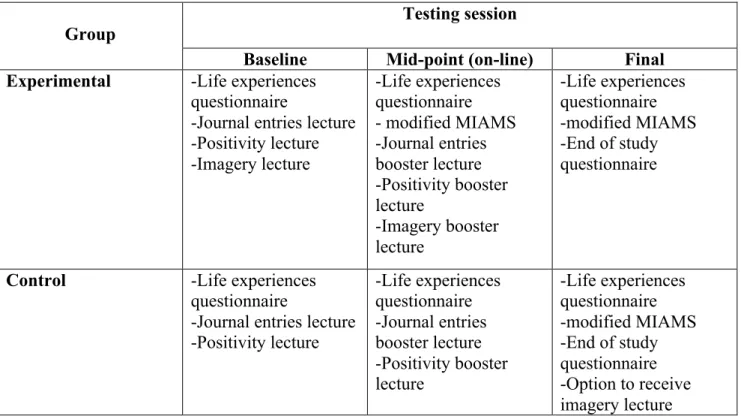
Table 2. Study assessment timeline. ... 50
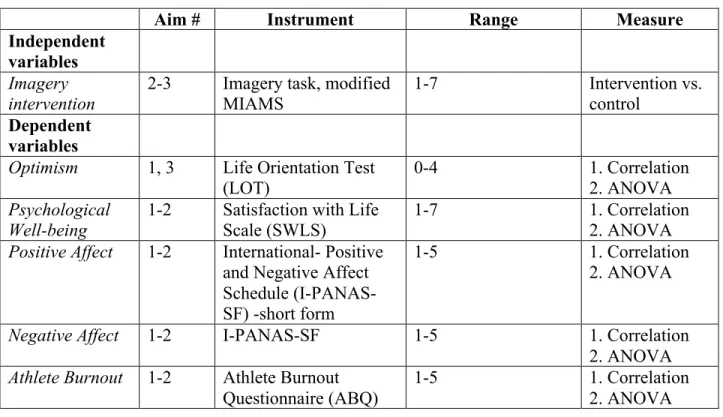
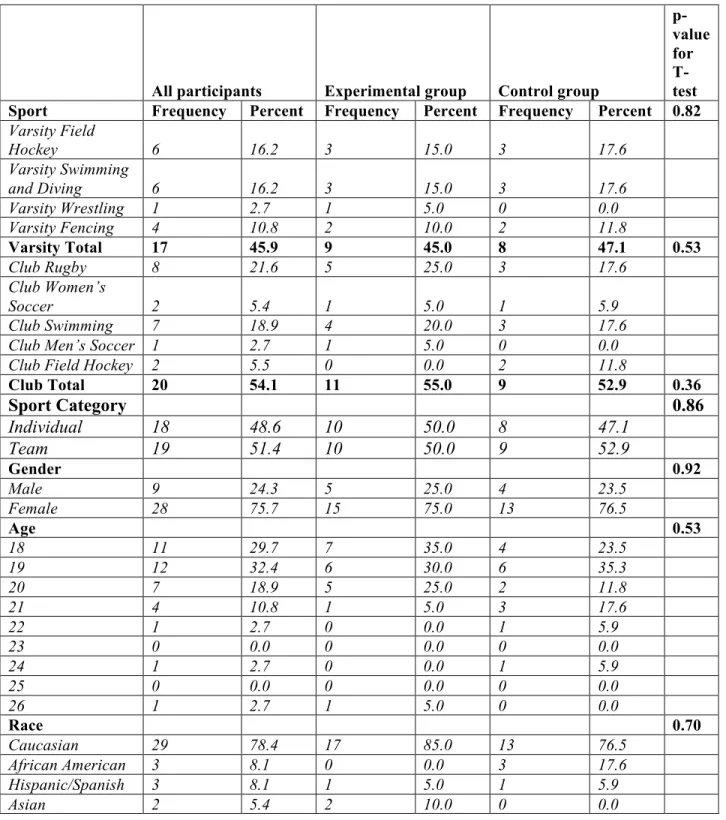
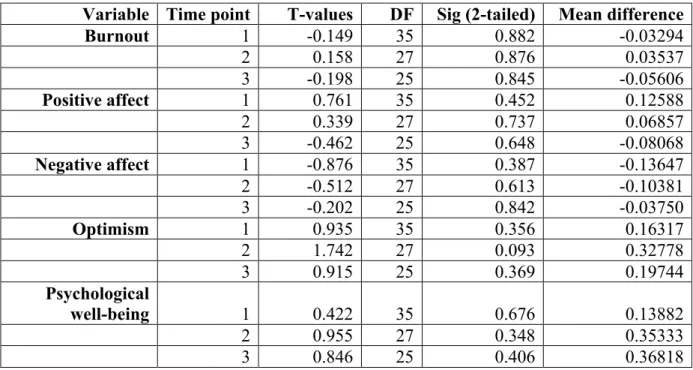
Table 3. Table of variable analysis. ... 52 Table 4. Participants Demographics following first testing session. ... 62 Table 5. Study assessment outline. ... 67 Table 6. Correlations for entire study sample (N=37) appear in the table
above. *p<0.05 ... 74 Table 7. Correlations for experimental group sample (N=20) appear in the
table above. *p<0.05 ... 75 Table 8. Correlations for control group sample (N=17) appear in the table
above. *p<0.05 ... 75 Table 9. Five independent t-tests for study variables at each of the three time points. ... 76 Table 10. Means and Standard Deviations of Variables at each time point
(Experimental= E; Control= C) ... 76 Table 11. Repeated Measures ANOVA by time points (all groups combined;
N=27). *P<0.05 indicates significance. ... 77 Table 12. Repeated measures ANOVA by time point*group (Control= 12;
Experimental; 15). ... 78 Table 13. Pairwise comparison for LOT measurement across the three testing
LIST OF ABBREVIATIONS
ABQ Athlete Burnout Questionnaire
ANOVA Analysis of Variance
I-PANAS-SF International Positive Affect and Negative Affect Schedule Short Form
LOT Life Orientation Test
MIAMS Motivational Imagery Ability Measure Scale
NCAA National Collegiate Athletic Association
SWB Subjective Well-Being
CHAPTER 1
INTRODUCTION
In 2011-2012, according to the National Collegiate Athletic Association, there were more
than 450,000 student-athletes participating in collegiate sports (Neal, Diamond, Goldman,
Klossner, Morse, Pajak, Putukian, Quandt, Sullivan, Wallack, & Welzant, 2013).
Student-athletes’ must attend to both their physical and psychological health while participating in sports.
A multitude of instances exist when a medical professional must consider the physical
capabilities of athletes; for instance, during injury rehabilitation. However, the psychological
aspect of a student-athlete’s maintenance and treatment should also be considered. Athletic
injuries may lead to psychological disturbances, likely resulting from increased psychological
stress (Neal et al., 2013). According to Neal et al. these psychological disturbances may include
changes in eating/sleeping habits, alcohol use, loss of emotion, mood swings, irritability,
negative self-talk, excessive worry, fatigue, and overuse injuries (Neal et al., 2013).
Student-athletes’ may also experience these psychological disturbances during life transitions, such as
beginning or finishing college. Another potential impetus for psychological disturbances is
traumatic life events with unclear personal outcomes (Carver, Scheier, & Segerstrom, 2010).
For example, a student-athlete might experience psychological changes when a teammate suffers
from an accidental death. These psychological disturbances have potential to contribute to
One personality trait which may be affected by psychological changes in an individual is
optimism. Optimism is the expectation of good circumstances occurring in the future (Eichner,
Kwon, & Marcus, 2014). Optimism can be classified as a state or trait attitude. State optimism
changes in relation to the current circumstance or situation (Kluemper, Little, & De Groot, 2009)
while trait optimism refers to stable changes generally occurring with optimism (Kluemper et al.,
2009). Past researchers have indicated there is a relationship between optimism, physical health
(Carver et al., 2010; Lipowski, 2012), mental health (Carver et al., 2010), and overall well-being
(Blackwell, Rius-Ottenheim, Schulte-van Maaren, Carlier, Middelkoop, Zitman, Spinhoven,
Holmes, & Giltay, 2013; Carver et al., 2010; Conversano, Rotondo, Lensi, Della Vista, Arpone,
& Reda, 2010; Lipowski, 2012). Evidence supporting potential individual changes in
dispositional optimism has been inconclusive due to the trait and state distinction (Blackwell et
al., 2013; Carver et al., 2010; Meevissen, Peters, & Alberts, 2011b). For example, Carver et al.
concluded optimism is a relatively stable personality trait that may be manipulated using an
intervention, but due to the innate stability of trait optimism, the changes evoked by the
intervention may not be significant or clinically relevant. However, past research has used
imagery interventions to demonstrate how optimism may change over the course of a study in
non-athletic populations (Blackwell et al., 2013; Meevissen et al., 2011b).
Other research studies have demonstrated optimism may be manipulated with imagery by
visualizing future events (Blackwell et al., 2013; Meevissen et al., 2011b). A study completed
by Blackwell et al. examined how imagining positive and negative events affected optimism
levels, in addition to the vividness of the imagery, in Dutch participants ranging from ages 18-65.
They found the vividness of the imagery and what the individual imagines to affect changes in
higher optimism levels; whereas when an individual vividly imagines negative events they
possess lower optimism levels (Blackwell et al., 2013). Another study completed by Meevissen
et al. studied how using “best possible self” imagery would alter an individual’s optimism levels.
The Dutch participants, ranging from ages 18-43, imagined their best possible future self and
then reflected about it in a journal log (Meevissen et al., 2011b). The researchers found the
individuals of the study to experience increases in optimism over the course of the study by using
the “best possible self” imagery (Meevissen et al., 2011b). Therefore, these studies indicate
vividly imagining positive future events or circumstances could lead to increases in optimism
levels in the average population. However, the researchers did not examine an athletic
population and how their optimism levels may be affected by imagery. As a result, it is
necessary to study whether imagery may produce significant changes in optimism in a
student-athlete population.
As clinicians and researchers it is important to recognize that athletes have both physical
and psychological needs; therefore, it would be beneficial to identify of how psychological
factors, such as optimism, may be related to physical health. In a meta-analysis of optimism and
physical health, Rasmussen et al. found optimistic people to report having less pain related
symptoms, and better overall physical function (Rasmussen, Scheier, & Greenhouse, 2009).
Importantly, past studies have focused on the general population; therefore it would be beneficial
to examine athletes’ optimism to identify if their optimism level differs from the general public
because of the different demands placed on them. For instance, Division I athlete’s typically
have a greater amount of physical demands, in addition to the cognitive challenges, placed on
them when compared to the general public. They have the cognitive demands associated with
stressors. As a result of these multi-faceted demands faced by student-athletes, their day-to-day
atmosphere differs than that of the general public.
While many research studies have focused on the physical health of athletes, this study
will address key markers of the athlete psychological health and specifically examine: 1) how
they are associated with optimism and 2) whether they may be influenced by imagery-based
optimism training. Psychological health is measured through a variety of psychosocial markers
including affect, characterized as either positive or negative. Affect is the extent a person
experiences engagement with the environment resulting in a variety of mood states, whether it is
pleasant or unpleasant (Crawford & Henry, 2004; Watson, Clark, & Tellegen, 1988), and can
therefore be classified as either positive or negative. Positive affect is associated with positive
emotions such as pride, love, and happiness (Lazarus, 1991, 1993), whereas negative affect is
linked to maladaptive psychological responses such as depression and anxiety (Crawford &
Henry, 2004). In an athletic population, positive and negative affect levels can alter how an
individual perceives and physically adapts to a sport. For instance, an individual with elevated
positive affect may have increased motivation to work harder at practice in an effort to improve
performance compared to someone with low positive affect levels. An athlete with high negative
affect may have increased feelings of anxiety causing them to move their focus from competing
well to worrying about not being successful compared to those with low negative affect (Wilson,
J.S., & Pritchard, 2002). In addition, a study completed by DeFreese and Smith has shown
significant a positive correlation between trait negative affect and burnout (DeFreese & Smith,
2014). In addition, they identified significant negative correlations between negative affect and
trait optimism and psychological well-being (DeFreese & Smith, 2014). Thus, research indicates
Another psychological health outcome of optimism and psychological health is athlete
burnout which Raedeke defined as a cognitive affective syndrome encompassing several
symptoms including: emotional and physical exhaustion; reduced sense of accomplishment; and
sport devaluation (Raedeke, 1997). Student-athletes experience several different types of
psychological variables including situational demands, cognitive appraisal, physiological
demands, and coping/task behavior (Gould, Udry, Tuffey, & Loehr, 1996). Gould et al.
suggested low social support, chronic stress, injuries, anxiety, tension, psychological withdrawal,
and lower school performance are some components that may contribute to burnout in athletes
(Gould et al., 1996). Thus, athlete burnout may negatively contribute to several factors in a
student-athlete’s life, including athletic performances, academic engagements, and psychological
health outcomes (Gould, 2002). Identifying an intervention addressing psychological health
outcomes, such as athlete burnout, psychological well-being, affect, and optimism, will provide
additional insight for how a student-athlete’s psychological health may be altered.
Past research studies have shown mental imagery as a useful tool for increasing optimism
levels (Meevissen et al., 2011b) and psychological well-being (Blackwell et al., 2013). Imagery
is a mental process that includes generating positive thoughts, controlling those thoughts, and
vividly imagining positive future events (Blackwell et al., 2013; Meevissen et al., 2011b).
Research studies have used imagery to focus on future events and the perception of those events.
For instance, Meevissen et al completed a study that required the participants to imagine their
“best possible self” to increase levels of optimism (Meevissen et al., 2011b). In this study,
participants were asked to write down all aspects their future best possible self should encompass
(personal domain, relational domain, and professional domain) (Meevissen et al., 2011b). They
weeks, which resulted in a significant increase in optimism. Blackwell et al. completed another
study examining the relationship between optimism and imagery relationship and examined how
the vividness of imagining positive and negative events related to an individual’s optimism
levels (Blackwell et al., 2013). They concluded effectiveness in vividly creating images could
lead to higher levels of optimism (Blackwell et al., 2013). They found higher vividness of
positive events to relate to higher optimism scores and higher vividness of negative events to
associate with lower optimism scores (Blackwell et al., 2013). This study identifies the
importance of focusing on positive events when completing an imagery task in order to
positively affect an individual’s optimism levels. However, both of these studies did not assess
the effects of imagery on dispositional optimism and/or psychological health outcomes in athlete
populations.
Imagery has been used specifically in athletic populations for performance and
motivational purposes throughout practice and competition (Blair, Hall, & Leyshon, 2007;
Munroe-Chandler, Hall, Fishburne, & Strachan, 2007). In these studies, athletes have found
imagery to be beneficial by helping them effectively mentally re-create competitive situations
and appropriate corresponding responses (Blair et al., 2007; Munroe-Chandler et al., 2007).
However, these research studies have not focused on the benefits of imagery relative to athlete
psychological health outcomes (i.e. psychological well-being, positive affect, negative affect,
athlete burnout) or optimism. Therefore, it would be clinically beneficial to study collegiate
athlete optimism and the effects of imagery to identify potential clinical psychological treatments
for this population.
In the 2013 position statement “Inter-Association Recommendations for Developing a
Level: An Executive Summary of a Consensus Statement,” the National Athletic Trainers’
Association emphasized the current need and importance of examining and intervening to
promote the psychological health of collegiate athletes (Neal et al., 2013). One component of
psychological health that would be beneficial to examine empirically is trait optimism.
Specifically, it may be possible to manipulate trait optimism by using an intervention. An
intervention targeting trait optimism would be beneficial for increasing a student-athlete’s
positive outcomes of psychological health. An intervention is a method of action used to cause a
change in an individual, such as a psychological trait like optimism. In order to ensure the
effectiveness of the intervention, studies should focus on a healthy population prior to injured
collegiate athletes. By observing healthy athletes, the researchers will grasp an understanding of
athlete’s ability to complete an imagery task successfully. As we learn more about an athlete’s
ability to complete imagery and how it affects athlete’s psychological health outcomes and
optimism, we may identify a need for further application of an imagery intervention to examine
how it relates to injury and rehabilitation.
Our current study allowed us to evaluate athlete behavioral responses to an
imagery-based psychological intervention and the efficacy of using this intervention in a clinical setting,
which to our knowledge has not been studied previously. The primary purpose of this study was
to examine the relationships between optimism and markers of athlete psychological health
(including psychological well-being, positive affect, negative affect, and athlete burnout). Our
secondary purpose was to explore if and to what degree collegiate athlete optimism can be
manipulated with a motivational imagery intervention. The final purpose was to identify how
motivational imagery intervention. Our participants consisted of Division I varsity and club
sport student-athletes.
Research Questions
RQ1: How is collegiate athlete baseline trait optimism associated with positive affect, negative
affect, athlete burnout, and psychological well-being?
Hypothesis 1: Collegiate athlete baseline trait optimism was hypothesized to positively correlate
with psychological well-being and positive affect and negatively correlated with negative affect
and burnout.
RQ2: Does a nine week motivational imagery intervention increase healthy collegiate athlete’s
trait optimism scores from baseline as compared to controls?
Hypothesis 2: Healthy collegiate athletes who receive the motivational imagery intervention will
exhibit increases in trait optimism from baseline compared to controls.
RQ3: How does a nine week motivational imagery intervention affect psychological well-being,
positive affect, negative affect, and athlete burnout in healthy collegiate athletes?
Hypothesis 3A: Athletes exposed to the motivational imagery intervention will exhibit higher
levels in psychological well-being as compared to controls.
Hypothesis 3B: Athletes exposed to the motivational imagery intervention will exhibit higher
Hypothesis 3C: Athletes exposed to the motivational imagery intervention will exhibit no change
(i.e. lack of an increase) in negative affect as compared to controls.
Hypothesis 3D: Athletes exposed to the motivational imagery intervention will exhibit no change
CHAPTER 2
LITERATURE REVIEW
Optimism
This research study examined the relationships among athlete perceptions of optimism,
psychological well-being, positive affect, negative affect, and burnout. In a literature review
completed by Carver et al., optimism was defined as a personality trait that reflects the extent an
individual has favorable expectancies of their future (Carver et al., 2010). In this review, the
authors suggested optimism is a relatively stable trait, but may be subject to change during times
of life transition, breaks from prior experiences, and when the outcome is uncertain, such (i.e.
personal response to traumatic events like a death in the family) (Carver et al., 2010). Kluemper
and DeGroot suggested optimism can be classified as a trait or a state depending on the
circumstance (Kluemper et al., 2009). Trait optimism is related to general outcomes (e.g. long term health) and represents more individual differences in the level of optimism (Kluemper et al.,
2009). State optimism may be changed due to situational or contextual factors and has been
shown to relate more to occupational outcomes, which may be due to the variation of leadership
styles of employers (Kluemper et al., 2009). Student-athletes are subjected to a variety of
transition periods throughout their collegiate career (i.e. beginning college, in-season,
post-season, academic semesters), therefore it would be beneficial to observe how their trait optimism
changes that may occur with a psychological imagery intervention in a collegiate student-athlete
population.
In addition to the examining optimism based on classification (trait vs. state), optimism
research has largely been informed by two theories. The explanatory style theory (Buchanan & Seligman, 1995) and self-regulatory theory (Carver & Scheier, 1981) were each developed to portray a better conceptual understanding of optimism. The explanatory style theory suggests an
individual rationalizes the causes of both negative and positive events to explain why these
events occurred (Buchanan & Seligman, 1995). This theory categorizes optimistic people as
those who associate bad events to external, unstable reasons and good events to personal, internal
reasons (Kluemper et al., 2009). This implies optimistic individuals will take credit for the
positive events that occur in their life. The explanatory theory helps identify how people may
rationalize events occurring in their life as well as their subsequent reactions to them (Buchanan & Seligman, 1995). For example, an optimistic person may rationalize a car accident as an
incident out of their control, but recognize that passing their exam occurred from studying.
Therefore, the explanatory theory focuses on the explanation or rational for events.
Alternatively, the Self-Regulatory Nature Theory focuses on human behavior in relation
to goals (Carver & Scheier, 1981). This theory suggests that when a person realizes there is a
conflict between their personal goal and the current situation; the person will re-assess the
situation (Carver & Scheier, 1981). Moreover, when a person encounters a situation with a particular goal, then he/she will determine if the present goal is worth the mental effort required
to attain that goal (Kluemper et al., 2009). This theory relates more to a person’s overall goals
and how goals adapt as the individual changes. For instance, a track athlete may have a goal to
perform better physically and mentally. In relation to optimism, the self-regulatory nature theory
suggests when people, such as student-athletes, attain their goals; they will experience high
levels of optimism.
Both theories attempt to explain how a person’s psychological perspective may affect
their overall optimism. The explanatory theory emphasizes how the student-athlete rationalizes
why the event occurred (i.e. poor performance at a meet), whereas the self-regulatory theory
suggests why the student-athlete may change their overall goals in certain circumstances (i.e.
perform well enough to go to an advanced round of competition such as Regionals). In addition,
the explanatory theory and self-regulatory theory provide additional methods for explaining an
athlete’s level of optimism. These theories provide insight on how components of an athlete’s
psychology, including optimism, may change situational optimism responses and vice versa. If a
student-athlete can positively rationalize through certain events occurring, whether they are good
or bad, then it may lead to changes in optimism. Also, if a student-athlete is able to achieve the
goals they set for themselves, then they may feel more positive emotions, such as optimism, due
to their ability to complete the task successfully.
Research has indicated there are several positive benefits to optimism associated with
individual outcomes of psychological well-being and one’s ability to effectively cope with
stressors. Optimism has been shown to increase the overall well-being of an individual
(Aspinwall & Taylor, 1992; Meevissen et al., 2011b). In addition, optimism has been associated
with certain coping skills. Studies have shown optimists typically have engagement coping
skills, problem focused coping, and proactive coping (Gustafsson & Skoog, 2012; Meevissen et
al., 2011b; Schou, Ekeberg, & Ruland, 2005). Engagement coping focuses on dealing directly
Problem focused coping is aimed to alter the stressor itself to decrease the amount of distress
occurring (Lazarus & Folkman, 1984). Proactive coping is defined as actively trying to prevent an event from occurring (Aspinwall & Taylor, 1997). These coping skills directly target the
stressor and should help the individual adaptively adjust to the situation presented to them. If an
individual may more effectively adapt to the stressors placed on them through coping
mechanisms then they may have better outcomes of psychological health and optimism.
Optimism levels may vary amongst different populations, including the general public
and student-athletes. A couple of studies examined how optimism levels differ between athletes
and non-athletes. Lipowski conducted a research study suggesting athletes possess higher levels
of optimism than non-athletes (Lipowski, 2012). Lipowski compared athletes (competing in
team and individual sports) and non-athletes, between the ages of 16-30, to evaluate variations in
optimism levels (Lipowski, 2012). Lipowski concluded athletes, both female and male,
displayed a higher degree of optimism when compared to non-athletes (Lipowski, 2012).
Another study conducted by Venne et. al examined the differences in optimism between
non-athletes and athletes, in addition to the individuals level of competition for the athletes (first
verses final season) and academic year (first year verses final year). Venne et al. studied athletes
of various Division I athletic sports including: women’s basketball, women’s volleyball, men’s
tennis, baseball, football, softball, hockey, cheerleading, swimming, and water polo. The
non-athletes in this study were not currently participating in athletics, had not participated in athletics
in high school, and were psychology students. Venne et al. found athletes and non-athletes in
their final year of school to exhibit higher levels of optimism as compared to first year athletes
and non-athletes (Venne, Laguna, Walk, & Ravizza, 2011). In addition, they found significant
year athletes possessed higher optimism levels (Venne et al., 2011). Therefore, an athlete’s
optimism level may vary depending on their collegiate experience with their sport. This is a
valuable element when studying collegiate athletes of all years because they may experience
different levels of optimism at the beginning of the study. If a final year athlete participates in a
study focusing on improving or changing optimism, they may not experience significant changes
in optimism since they may already possess high levels of optimism. Whereas, a first year
athlete may experience significant changes in optimism through the use of an intervention since
they begin with lower optimism levels as compared to a final year athlete.
Optimism has also been examined as it may be associated with athlete psychological
responses to injury. A study completed by Madrigal and Gill examined how Division I
collegiate female athletes respond psychologically as a result to an injury (Madrigal & Gill, 2014). This study examined several psychological factors including mental toughness, optimism,
and stressors. They completed case studies on four female collegiate athletes who played soccer
or softball. The results of the study indicated variations in the psychological reactions of the
female athletes. Some of the athletes experienced decreases in optimism levels initially following
injury and during the beginning of rehabilitation, however they returned to normal by the time
they were cleared to play (Madrigal & Gill, 2014). In addition, the study indicated the athletes felt additional stressors from the coaches and feelings that they were letting the team down while
they were injured. The support of teammates, friends, coaches, and athletic trainers helped one
athlete better cope with her injury and understand it better. Therefore, additional support from
the athletic trainers and identifying ways to incorporate psychological treatment for athletes,
variety of athlete populations, including those athletes currently ongoing rehabilitation from an
injury.
Research shows individuals with higher positivity and life optimism have the potential to
have less reported and presented physical symptoms of illness and injury (Scheier & Carver,
1985). As a student-athlete, injury and illness prevention are pertinent due to the increased
physical and psychological pressures they experience daily with their sport and daily activities
(i.e. academics). A study performed by Hanssen et al. examining how the utilization of a “best
possible self” imagery strategy may affect pain. This study found subjects to report less pain
symptoms with cold immersion as compared to control participants (Hanssen, Peters, Vlaeyen,
Meevissen, & Vancleef, 2013). Also, research has shown optimism is negatively correlated to
burnout, which are both factors salient to athlete psychological health and well-being
(Gustafsson & Skoog, 2012). Due to the length of seasons and demands of collegiate athlete’s
sport it is vital that athletes do not become consumed with stress and burnout because they will
not be able to perform as well in their sport.
Compared to optimists, pessimists, a distinct but negatively related psychological
outcome, perceive stress differently. Pessimism is the expectation of experiencing negative
future outcomes (Gustafsson & Skoog, 2012). Pessimists tend to use more avoidance coping,
whereas optimists tend to have more active coping (Aspinwall & Taylor, 1992). When actively coping with a situation the individual will recognize the situation and cope accordingly.
However, when a person uses avoidance coping, he/she will avoid the conflicting situation.
Therefore, the coping style determines if a person reacts positively or negatively to a stressful
In an athletic population, coping could affect how the athletes perform in competition
settings. Pessimists and optimists tend to have different interpretations of stress such that
optimists tend to experience less negative emotions and view life more positively (Carver et al.,
2010). For example, during competition a pessimist may have greater performance anxiety
compared to an optimist.
Track and field collegiate athletes optimism in relation to competition anxiety was
investigated by Wilson (Wilson et al., 2002). Their group examined how anxiety affects a
pessimist’s ability to compete athletically. In this study, optimistic individuals possessed lower
predicted and actual precompetition anxiety when compared to pessimists (Wilson et al., 2002).
Thus, optimistic athletes’ have lower levels of anxiety prior to competition compared to
pessimists, which could affect their overall well-being. Therefore, this study emphasizes the
importance of treating an athlete’s psychological health in addition to their physical health
because it can not only affect his/her overall well-being, but may also have positive implications
for his/her individual performance.
PSYCHOLOGICAL HEALTH FACTORS
Psychological Well-Being
Diener suggested subjective well-being (SWB) consists of three major components: life
satisfaction, negative experiences, and positive experiences (Diener, 1984). Several studies have found alterations in a person’s SWB may lead to changes in the person’s psychological and
physical health (Diener & Chan, 2011; Lyubomirsky, King, & E., 2005). Furthermore, these
studies suggest people with higher SWB have better health and increased longevity with higher
physiological effects and negative feelings can have undesirable physiological effects, such as
increases in stress (Diener, 2013).
Research also examines social support as a factor impacting well-being (Brannan,
Biswas-Diener, Mohr, Mortazavi, & Stein, 2013; DeFreese & Smith, 2013; DeFreese & Smith,
2014). Some studies have concluded social support may increase optimal psychological
well-being resulting in positive academic outcomes (Brannan et al., 2013; Diener, 1984). Brannan et
al. focused on how friends and family are main sources of social support. However, collegiate
athletes may also receive social support from their teammates and coaches. Another study
completed by DeFreese and Smith identified how social support and negative social interactions
related to psychological well-being in Division I and NAIA collegiate athletes. They found
social support to positively relate to well-being, whereas negative social interactions negatively
correlated to well-being (DeFreese & Smith, 2014). Thus, suggesting positive interactions with
others will result in increases in psychological well-being.
Amorose et al. completed a research study discussing psychological well-being in
relation to self-esteem and burnout (Amorose, Anderson-Butcher, & Cooper, 2009). In this
study, ninety-three adolescent volleyball players were tested to see if perceived competence,
autonomy, and relatedness over a competitive season were predictive of changes in athletes
well-being, self-esteem, and burnout levels in sport (Amorose et al., 2009). Self-esteem “reflects ones
affect toward an overall evaluation of worth or value as a person (Amorose et al., 2009).” In
addition, Amorose et al. studied how need satisfaction in sports were linked to specific markers
of well-being, such as competence and autonomy (Amorose et al., 2009). They found changes in
perceptions of competence and autonomy over the course of a volleyball season were positively
of competence, autonomy, and relatedness, which are the need for a sense of belonging, over the
course of the season negatively related to changes in athlete’s burnout. Therefore, these
components of well-being are related to both self-esteem and burnout in student-athletes.
Ford et al. also completed a study that further emphasized the relationship between global
self-esteem and psychological well-being (Ford, Eklund, & Gordon, 2000). They investigated
how stress may influence an athlete’s risk of developing or suffering from an injury (Ford et al.,
2000). The study identified how a psychological or physical stress could lead to an injury, which
could affect a student-athlete’s overall well-being. Ford et al. concluded higher-stress results in
more injuries than lower stress (Ford et al., 2000). This study suggests if athletes’ decrease their
stress levels and keep them to a minimum, they could prevent further injuries from occurring.
Therefore, positive psychological well-being could result in decreases in psychological stress and
further help prevent injuries from occurring in student-athletes, which would have positive
effects physical and psychologically for the individual.
Affect
Affect is another marker of psychological health. Crawford and Henry have shown affect
can be classified as either positive or negative (Crawford & Henry, 2004). They further suggest positive affect relates to a pleasurable emotion and negative affect relates to an unpleasant
emotion (Crawford & Henry, 2004). In addition, they concluded affect is also associated with
how a person engages with their environment resulting in a variety of mood states (Crawford &
Positive affect has been linked to positive emotions. Research has shown several terms
may be used to describe positive affect, including: enthusiasm, alertness, attentive, interested,
excited, inspired, proud, determined, strong, hope and active (Crawford & Henry, 2004;
Gustafsson, Skoog, Podlog, & C., 2013) . Gustafsson et al. specifically researches the links
between hope and positive affect (Gustafsson et al., 2013). Student’s with high hope perform
better academically, and experience increases well-being and positive affect (Gustafsson et al., 2013).
Such research has important implications for collegiate athletes since they are obligated
to perform well academically and athletically. According to the NCAA, in order to maintain
eligibility a Division I athlete must complete at least forty percent of their coursework for their
degree by the end of their second year, sixty percent by the end of their third year, and eighty
percent by the end of their fourth year (NCAA). In addition, Division I athletes must obtain at least six credit hours each term and meet the GPA requirement established by the school (NCAA). If student-athletes are unable to maintain appropriate academic levels, they are not
able to participate athletically, which could negatively affect their psychological health.
Negative affect has been related to negative emotions. Crawford and Henry listed the
following terms to describe negative affect: distressed, angry, fearful, guilty, and jittery
(Crawford & Henry, 2004). These terms are related to sadness and anger, which would be
disadvantageous for the athlete. Negative affect has also been associated with individual
perceptions of psychological stress (Gustafsson et al., 2013; Nicholls, Backhouse, Polman, & J.,
2009). An athlete, who is no longer allowed to practice and compete due to insufficient grades,
would most likely experience an increase in negativity. Consequently, the athlete could have
From a research vantage, Gustafsson et al. found athlete endorsement of perceived stress
and negative affect were positively correlated with all three athlete burnout dimensions,
including sport devaluation, reduced sense of accomplishment, and emotional and physical
exhaustion (Gustafsson et al., 2013). In addition, a study completed by DeFreese and Smith found negative affect to be associated to athlete burnout in Division I and NAIA collegiate
athletes (DeFreese & Smith, 2014). Another study completed by Lemyre et al. examined affect and burnout over the course of the season in NCAA Division I swim athletes. They found
negative affect to positively related to all three burnout dimensions at the end of the swim
season (Lemyre, Treasure, & Roberts, 2006). In addition, they studied if negative affect and
positive affect may predict athlete burnout. They identified negative affect may be a predictive
factor for athlete burnout, however positive affect was not a significant predictive factor. Thus,
research suggests if an athlete exhibits signs of negative affect, they may have an increased risk
of experiencing burnout symptoms.
Affect may alter optimism different ways depending on whether it is positive or negative
affect. Positive affect is related to positive emotions and engagement with environment, whereas
negative affect is related to negative emotions and disengagement with the environment
(Crawford & Henry, 2004). Studies have indicated the negative markers of psychological health
to positively correlate (i.e. negative affect and athlete burnout) (DeFreese & Smith, 2014;
Lemyre et al., 2006) and negatively correlate with positive markers of psychological health (i.e.
psychological well-being, optimism, and positive affect) (DeFreese & Smith, 2014). Whereas,
studies have shown the positive markers of psychological health to positively correlate (i.e.
been shown to relate to positive emotions, like positive affect, and favorable expectancies of the
future.
Athlete Burnout
Another factor that may affect an athlete’s psychological health and performance in sport
is burnout (Raedeke & Smith, 2004). Athletic burnout consists of: “emotional and physical
exhaustion from physiological and psychological demands of competing; reduced sense of
personal accomplishment in sports abilities and achievements; and negative detached attitudes
towards sport and their involvement in it (Chunxiao, Wang, Pyun, & Kee, 2013; Raedeke, 1997;
Raedeke & Smith, 2004).”
Athlete burnout may cause psychological disturbances resulting from the increased
athletic demands or challenges (Chunxiao et al., 2013; Raedeke & Smith, 2004). In addition,
athletes who have experienced a lack of improvement, success, and/or talent in their sports may
have increased risk of developing burnout (Raedeke & Smith, 2001a), possibly due to the lack of personal accomplishment. As a result, when the athlete experiences these negative experiences
in sport he/she may stop participating in the sport (Raedeke & Smith, 2004), but not all
discontinue participating in their sport.
Another study conducted by Chen et al. researched the relationship between athlete’s
optimism and burnout (Chen, Kee, & Tsai, 2008). This study examined volleyball athlete’s optimism and burnout over the course of four months. Chen et al. found a negative correlation
between optimism and burnout, in addition to emotional exhaustion and reduced sense of
athlete with more optimism may possess less emotional exhaustion and interpret their sports
experience more positively (Chen et al., 2008).
Cresswell and Eklund studied professional rugby player burnout levels relative to
motivation (Cresswell, S. L. & Eklund, R. C., 2005). This study demonstrated a correlation between burnout and motivation levels in athletes. Amotivation, which is the lack of motivation,
has been positively associated with burnout (Cresswell, S. L. & Eklund, R. C., 2005). Therefore,
in athletes, lower intrinsic motivation is associated with higher burnout rates, specifically with
sense of accomplishment and sport devaluation (Cresswell, S. L. & Eklund, R. C., 2005). In
addition, their follow up study examined rugby players at a top amateur level confirming their
previous results (Cresswell, S. L. & Eklund, R.C., 2005). Thus, motivation has been shown to be
an important factor that is negatively associated with athlete burnout.
Other factors shown to be correlated to burnout are social support, coping behaviors and
perceived stress (DeFreese & Smith, 2013; Gustafsson & Skoog, 2012; Raedeke & Smith, 2004).
Social support has been associated with two components of burnout, sense of accomplishment
and sport devaluation. Social support has been identified as the presence of other athletes who
an individual may rely on and know care for him/her (Raedeke & Smith, 2004). DeFreese and
Smith found social support from teammates to be negatively associated with a reduced sense of
accomplishment and devaluation (DeFreese & Smith, 2013).
In addition, athlete stress has been found to be positively associated with athlete burnout.
Psychological stress is when an environmental event exceeds a person’s ability to adapt to the
situation and may result in psychological and biological changes (Cohen, Kessler, &
associated with higher self-report burnout levels (Gustafsson, Kenttä, & Hassmén, 2011). Stress
can lead to psychological and physical changes, such as anxiety and increased blood pressure
(Gustafsson et al., 2011), which may also contribute to emotional and physical exhaustion, which
is one of the key facets of burnout.
Researchers have tested two hypotheses to indicate the relationship between social
support, coping behaviors, stress, and burnout. One hypothesis suggests social support and
coping behaviors negatively and directly influence stressed induced burnout (Raedeke & Smith,
2004). Another hypothesis suggests social support and coping behaviors act as moderators
between stress and burnout-related perceptions (Raedeke & Smith, 2004). This study
demonstrated stress to act as a more of a direct mediator for burnout, as compared to a moderator
(Raedeke & Smith, 2004). In other words, positive, consistent social support and personal
coping behaviors help decrease stress and prevent burnout from occurring.
Gustafsson et. al discusses the development of an integrated model to represent and gain
an understanding about burnout. In this model, Gustafsson et al. suggests a model representing
burnout consists of several factors that lead to development of athlete burnout and lead to its
occurrence, such as excessive training, school demands, negative performance, lack of control,
diminishing motivation, mood disturbance, lack of coping skills, goal orientation, and trait
anxiety (Gustafsson et al., 2011). This model suggests there are several elements effecting
overall well-being of an individual when suffering from burnout. Gustafsson et al. describes
negative consequences that may occur with burnout, such as mood changes, decreased
motivation, and psychological withdrawal (Gustafsson, Kenttä, & Johansson, 2008). As a result,
psychological well-being. Therefore, based on past literature and this current model, we chose to
look at burnout in relation to optimism and other psychological health outcomes.
IMAGERY
Imagery is the act of cognitively visualizing an object, situation or sensation as though it
were actually occurring in reality (Driediger, Hall, & Callow, 2006). Past studies have suggested
effective imagery use may incorporate five senses: vision, audition, olfaction, gustation (taste),
and kinesthetic (Vines, 1988). Driediger and Callow indicated the use of imagery evokes the physical characteristics of an absent object, event, or activity that has been perceived in the past
or may take place in the future (Driediger et al., 2006).
Imagery has been used for a variety of reasons and in an assortment of populations.
Research studies have used imagery to identify psychological and performance changes in
non-athletic and (Blackwell et al., 2013; Meevissen et al., 2011b) non-athletic populations (Blair et al.,
2007; Driediger et al., 2006; Munroe-Chandler, Hall, & Fishburne, 2008; Munroe-Chandler et
al., 2007). Meevissen et al. asked non-athletic participants to imagine their “best possible self
(Meevissen et al., 2011b).” For two weeks, the participants completed a five minute “best
possible self” imagery intervention daily followed by a journal entry (Meevissen et al., 2011b).
The researchers concluded imagery is beneficial for increasing levels of optimism in non-athletic
populations using the Life Orientation Test (LOT) (Meevissen et al., 2011b).
In addition, the vividness of imagery has been used to increase optimism levels in
non-athletic populations (Blackwell et al., 2013). This study used the Life Orientation Test-Revised
(LOT-R) to identify optimism levels, the Prospective Imagery Test to identify vividness of
(Blackwell et al., 2013). As a result, higher results on the Prospective Imagery Test resulted in
higher scores on the LOT, suggesting a positive link between optimism and vividness of imagery
use (Blackwell et al., 2013).
Imagery has also been shown to positively influence injury rehabilitation, performance
levels, self-confidence and self-efficacy in athletic populations. Paivio developed a theory of
cognitive and motivational purposes for imagery that has been supported by several studies (Driediger et al., 2006; Gregg, Hall, & McGowan, 2011; Munroe-Chandler et al., 2008; Paivio,
1985). Specifically, Paivio stated athletes use imagery for five mains reasons: cognitive specific, cognitive general, motivational specific, motivational general arousal, and motivational general
mastery (Paivio, 1985). Cognitive specific imagery refers to mental rehearsal of specific skills.
Cognitive general imagery addresses the rehearsal of various strategies and plans pertaining to
sport. With motivational specific imagery, the individual imagines goals associated with sport
participation. Motivational general arousal imagery addresses how imagery relates to arousal,
stress, and anxiety of performing. Motivational general mastery imagery refers to constructing
images related to being confident and mentally tough.
Munroe-Chandler et al. found motivational general mastery imagery to be positively
related to self-confidence and self-efficacy in youth soccer players (Munroe-Chandler et al.,
2008). In addition, motivational general mastery imagery use in recreational athletes explained a
greater amount of variance in self-confidence than in competitive athletes (Munroe-Chandler et
al., 2008). Overall, research indicates imagery has been beneficial for both varsity and
recreational athletes. However, future research should examine how motivational general
arousal and motivational general mastery imagery interventions alter collegiate athletes’
and self-efficacy in the general population. By identifying if an imagery intervention is
beneficial, research will gain a better understanding of how to promote positive outcomes
athletes psychological health and well-being. In addition to imagery providing psychological
benefits for student-athletes, research has demonstrated athletes to have positive performance
outcomes resulting from imagery.
Research has examined how athletes use visual (internal and external) and kinaesthetic
imagery for sports performance during training, competition, and sport injury rehabilitation
(Blair et al., 2007; Driediger et al., 2006; Munroe-Chandler et al., 2007). Training and athletic
competition address how imagery has been used to focus on sports performance from a practice
and competitive point of view. Training is when an athlete practices and tries to improve their
sports specific skills. An athletic competition is an event in which an athlete competes against
another individual or team. In addition, imagery may also enhance sports performance from a
health related and recovery aspect with sports injury rehabilitation and injury prevention. Sport
injury rehabilitation occurs when an athlete completes a rehabilitation plan focusing on injury
prevention or rehabilitation of an injury focusing on range of motion, strength, and
neuromuscular control. Injury prevention emphasizes correcting biomechanical abnormalities
and managing current physical health. Wiese-Bijornstal found imagery was beneficial to athletes
during injury recovery due to improved rehabilitation adherence and efficacy (Wiese-Bjornstal,
2010). Also, research studies have investigated what athletes visualize during each imagery
session and the timing of these sessions (Blair et al., 2007; Driediger et al., 2006;
Munroe-Chandler et al., 2007). Munroe-Munroe-Chandler et al. found athletes use imagery to imagine themselves
succeeding in an event prior to a competition setting (Munroe-Chandler et al., 2007). Beyond,
2007). This study extended over a six week soccer training period and found the participants
regarded the imagery intervention as helpful and indicated that they would use it in the future
(Blair et al., 2007). To date, empirical studies of imagery have largely focused on sport
performance enhancement for athletes. To extend the knowledge on imagery use in sport, our
study focused on improving athletes’ general psychological health and optimism levels, an area
in need of future research.
There are several benefits for using imagery as a psychological health intervention.
Imagery is a low-cost intervention because it does not require expensive materials or tools.
Imagery does not require a large amount of effort. In addition, the individual is only required to
imagine a certain emotion or visualize an event for a short period. Imagery is a low-risk
intervention and the individuals aren’t required to have any laboratory devices attached to them
during the intervention. Also, imagery interventions require minimal time to learn and
implement appropriately. However, imagery interventions require multiple sessions to result in
changes in psychological health, therefore, individuals should complete the task daily for short
periods of time to develop changes (Van Raalte & Brewer, 2014).
JOURNAL ENTRIES
Journaling has been used to illustrate what people experience during imagery sessions.
Gregg and McGowan found imagery may cause people to experience positive changes in
vividness, visualization, kinesthetic and emotional responses, and ease in conjuring the image
(Gregg et al., 2011). Due to the variations that may occur with imagery, we asked participants
entries to identify their ability to complete the imagery task effectively. Therefore, we were able
to explore the variability that may occur between the participants’ imagery ability.
Journaling has been found to be useful when using an imagery intervention and trying to
boost adherence to the study (Blair et al., 2007; Gregg et al., 2011; Meevissen et al., 2011b; Shambrook & Bull, 1996). Specifically, Blair et al. used journaling to identify how often subjects
were completing the prescribed imagery task. Their study showed that subjects chose to use
imagery outside of the required training sessions suggesting the participants found the
intervention helpful. In addition, a study completed by Shambrook and Bull used journal entries
to encourage their participants to complete the imagery tasks and adhere to the study. Building
on previous study findings: it is important in the current work that participants keep a journal to
identify 1) what they imagine and 2) any potential emotional differences the participants
recognize following imagery use. Such information is important as a means to recognize the
benefits of the imagery intervention by the participants.
Daily imagery journals have been used to record frequency of imagery tasks and identify
changes in emotions or mood over time (Blair et al., 2007; Meevissen et al., 2011b; Shambrook
& Bull, 1996). Meevissen et al. had participants write in their journal for twenty minutes after
the first imagery session when imagining their “best possible self” to ensure they were correctly
performing the imagery (Meevissen et al., 2011b). During this journaling session, participants
reflected on their emotions about their best possible self. Blair and Leyshon completed an
imagery intervention study with novice and skilled soccer players (Blair et al., 2007). They also
found the imagery journal beneficial to ensure completion of the imagery task and gather
Lastly, research has shown keeping an imagery journal promotes adherence to the
imagery intervention and assists assessing in intervention’s effectiveness (Shambrook & Bull,
1996). In our study, the experimental group was required to complete a nine week motivational
imagery intervention. The journal entries were used to assess interventions compliance in the
experimental group. In addition, the purpose of the journal entries was to help participants in the
experimental group reflect on what they imagined, how their imagery progressed, and any
psychological changes that occurred. The journal entries were used only to assess psychological
changes in the control group.
QUALTRICS
Qualtrics.com is a survey engine that was used by the researchers to send the participants
the questionnaires (demographic information, Life Orientation Test, Satisfaction with Life Scale,
International-Positive and Negative Affect Schedule-Short Form, Athlete Burnout Questionnaire,
modified Motivational Imagery Ability Measure Scale, and end of study questionnaires) and
journal entries. Qualtrics.com allows researchers to upload surveys, polls, and panels for
participants to complete (Qualtrics.com). On Qualtrics.com, the researchers may indicate when
the surveys and questionnaires may be launched and accessed by the participants. In addition,
the researchers may address how long the participants have to complete the questionnaires and if
they may close the survey and finish it later. In order to complete the questionnaires and
surveys, researchers have to email the participants a link via Qualtrics.com. Once completing
the survey or questionnaire, the participants may submit their responses and will no longer have
Qualtrics.com is a beneficial survey engine because it allows participants in the study to
complete questionnaires online, complete journal entries on their own time, eliminates the need
for paper, and can automatically score questionnaires (Qualtrics.com). When setting up the surveys or questionnaires, the researchers may indicate the point value of each question. By
using this feature, Qualtrics.com will automatically grade the questionnaire based on the
responses provided, thereby, eliminating the possibility of calculation errors by the researchers.
The data is then downloaded for analysis, again, eliminating clerical errors in transferring
handwritten scores to electronic format (Qualtrics.com). Lastly, since Qualtrics.com is online,
participants can complete their journal entries on their own time and at a convenient location
with internet access.
CURRENT RESEARCH
Current research lacks information indicating a relationship between optimism and
psychological well-being, positive affect, negative affect, and burnout in healthy collegiate
athletes. In addition, past studies have not examined how these markers of psychological health
may change in collegiate athletes with the use of an imagery intervention. Researchers have
used various imagery interventions to alter an athlete’s sport performance, but have not
determined if imagery may affect their psychological health. More specifically, no studies have
assessed if motivational general arousal imagery affects athlete dispositional optimism as well as
overall health and well-being.
To address these important research gaps, the current study examined the relationship
between markers of psychological health, specifically optimism, psychological well-being,
optimism and markers of psychological health were changed following completion of a daily
motivational general arousal imagery intervention. This study provided further insight on how
CHAPTER 3
METHODOLOGY
A block randomization design was utilized to complete this study. Utilization of this
design allowed the researchers to assign the participants into groups based on their sports team.
Participants were randomly assigned to control and experimental groups within each sport and
team. The four questionnaires utilized to measure the markers of psychological health were the
Lift Orientation Test (LOT), Satisfaction with Life Scale (SWLS), International Positive Affect
and Negative Affect Schedule Short Form (I-PANAS-SF), and Athlete Burnout Questionnaire
(ABQ). Participants were told they were completing a study on health and well-being. Once
randomly assigned to a group, participants were given a brief description of the study. The
specific procedures of the study are outlined below. Briefly, we examined how the
psychological health outcomes correlated and the effects of an imagery intervention on
perceptions of optimism and psychological health outcomes in collegiate student-athletes.
Recruitment
To recruit participants for this study, the researchers contacted the coaches and received
permission to attend a team meeting at the beginning of the fall 2014 semester. During the team
meeting, the researchers announced they were completing a nine week study on life experiences
in varsity and club sport collegiate athletes. Participants were informed the study is completely
point if they no longer felt comfortable participating. Participants were required to come to
testing sessions two times throughout the semester (weeks one and nine) and complete one
one-hour on-line testing session at the mid-point of the study. In addition, they were informed they
would have to complete a short computer-based journal entry about their current psychological
health three times a week for nine weeks. Athletes were also told they must meet the following
criteria to meet the eligibility requirements for our study: 1) full time students at UNC Chapel
Hill and 2) not currently rehabilitating for a time loss injury at the onset of the study.
Participants were asked to provide their email, name, and sport and indicate if they would like to
be contacted by the researchers to participate in the study. In addition, participants signed a
consent form if they were interested in participating in the study.
Participants
Thirty-six Division I varsity and club sport athletes (28 female, 9 male) between the ages
of 18-26 years old (22±4) participated in this study. The researchers recruited from a pool of
approximately 350 student-athletes from 13 teams (6 NCAA varsity team, 7 club teams). One
hundred and five student-athletes completed the consent form and indicated interest in
participating in the study during recruitment. Of those interested in participating, sixty-five
potential participants completed the patient history questionnaire. However, only thirty-seven
participants attended the first testing session. One participant asked to be removed from the
study following the first testing session and there was an attrition of nine people with the
remainder of the study, thus resulting in 27 total participants.
Table 1. Attrition of Participants throughout the study.
Stage of Study Total Participants
Consent 105
Patient history questionnaire 65
Time point 1 37
Time point 2 29
Time point 3 27
Inclusion
Participants were included if they were full time students at UNC Chapel Hill, English
speaking, and healthy Division I varsity and club collegiate student-athletes. We chose to
include both individual and team sports and female and male sports to broaden the
generalizability of our study.
Exclusion
Participants were excluded if they did not meet the inclusion criteria or were currently
being rehabilitated for a time loss injury at the onset of the study.
Instrumentation
Life Orientation Test (LOT)
The Life Orientation Test (LOT) reflects how much an individual expects favorable
future outcomes (Scheier & Carver, 1985). The LOT is used to measure optimism (Carver et
al., 2010; Rasmussen et al., 2009) and has been used in a variety of populations including
Division I football players (Albinson & Petrie, 2003), Dutch participants ranging in ages 18-65
(Blackwell et al., 2013; Meevissen, Peters, & Alberts, 2011a), Australian athletes ranging in
al., 2000), high school athletes between the ages of 16-19 in individual (cross country skiing,
golf, tennis, track and field) and team sports (ice-hockey, basketball, handball, soccer, and
volleyball) (Gustafsson & Skoog, 2012), and undergraduate college students (Smith, Pope, &
Rhodewalt, 1989). The SWLS consists of four positive, four negative, and four filler items that
are rated on five point Likert scale. The participants rated each item based on a 5-point scale
ranging from 0 (strongly disagree) to 4 (strongly agree) (Scheier & Carver, 1985).
The total score is calculated by averaging the items of the LOT together. When scoring
the LOT, items 3, 8, 9, and 12 are reverse coded (Scheier & Carver, 1985) prior to averaging the
total score. Once items 3, 8, 9, and 12 are reverse scores, the average of the twelve items was
calculated to identify the overall LOT score. The total score indicates an individual’s level of
optimism with higher scores denoting higher levels of optimism.
The LOT has been shown to have test-retest reliability with undergraduate college
students, with a test-retest correlation of 0.79 (Scheier & Carver, 1985). Scheier and Carver
found the LOT to have internal consistency in a college student population (Scheier & Carver,
1985). The LOT has also been shown to have convergent and discriminant validity in a college
student population (Scheier & Carver, 1985). In addition, the LOT has been shown to be
effective in measuring optimism in previous collegiate athlete samples (Albinson & Petrie, 2003; DeFreese & Smith, 2014; Ford et al., 2000; Gustafsson & Skoog, 2012). Specifically, DeFreese
and Smith found internal consistency reliability of the LOT for measuring optimism in collegiate
Satisfaction With Life Scale (SWLS)
The Satisfaction With Life Scale (SWLS) is a 5 item measure assessing participants
overall evaluation of life satisfaction (see appendix D) (Diener, Emmons, Larsen, & Griffin, 1985). The SWLS uses a 7-point Likert scale (1= strongly disagree, 7= strongly agree).
Well-being scores of the SWLS were calculated by averaging the scores of all five items. Higher
scores of the SWLS indicated greater overall life satisfaction (Diener, 2006; Frank & Yawen,
2013) and lower scores indicate lower levels of life satisfaction (Diener, 2006).
The SWLS possesses test-retest reliability of 0.50 to 0.83 (with a two week to four year
interval) (Kamil, Ferdi, Ahmet, & K.T., 2012). The SWLS has been shown to exhibit construct
validity, convergent validity, and discriminant validity in college students (Chia-Huei, Lung, &
Ying-Mei, 2009; Diener et al., 1985; Pavot & Diener, 1993). In addition, DeFreese and Smith
found the SWLS to have significant internal consistency reliability for measuring life satisfaction
in a collegiate athlete sample (Cronbach’s alpha= 0.88-0.92) (DeFreese & Smith, 2014). The test has been shown to have longitudinal (two-month period) invariance in college university
students as well (Chia-Huei et al., 2009). Our study consisted of collegiate student-athletes;
therefore, we felt it best to use the SWLS to measure life satisfaction.
International Positive and Negative Affect Schedule- Short Form (I-PANAS-SF)
The PANAS short form was developed by Kercher using an elderly population (Kercher,
1992). Kercher’s short form adaptation of the PANAS included 5 positive affect items (excited,
enthusiastic, alert, inspired, determined) and 5 negative affect items (distressed, upset, scared,
nervous, and afraid). Following Kercher’s development of the short form PANAS, Mackinnon